- Home
- What is Peak Oil?
- Info & Resources
- Events
- Forums
- Get Involved
- Recent Posts
- Contact Us
- Login
Links
Oilwatch Monthly July 2009
The July 2009 edition of Oilwatch Monthly can be downloaded at this weblink (PDF, 1.3 MB, 32 pp).
Figure 1 - OECD oil imports from 1st quarter 2002 to 4th quarter 2008
The Oilwatch Monthly is a newsletter that is available free of charge with the latest data on oil supply, demand, oil stocks, spare capacity and exports. Readers who want to receive the Oilwatch Monthly in their e-mail box each month can subscribe at this weblink, by filling in their first name, last name, email address and selecting Oilwatch Monthly in the mailing list box. To finalize your subscription push the 'inschrijven' button below the form.
A summary and latest graphics below the fold.
Latest Developments:
1) Conventional crude production - Latest figures from the Energy Information Administration (EIA) show that crude oil production including lease condensates increased by 62,000 b/d from March to April 2009, resulting in total production of crude oil including lease condensates of 72.04 million b/d. The all time high production record of crude oil stands at 74.82 million b/d reached in July 2008.
2) Total liquid fuel production - In June 2009 world production of all liquid fuels increased by 70,000 barrels per day from May according to the latest figures of the International Energy Agency (IEA), resulting in total world liquid fuel production of 83.67 million b/d. Average global liquid fuel production in 2009 up to June was 84.33 million b/d versus 86.6 and 85.32 million b/d in respectively 2008 and 2007.
3) OPEC Production - Total liquid fuels production in OPEC countries increased by 70,000 b/d from May to June to a level of 33.73 million b/d. Average liquid fuels production in 2009 up to June was 33.39 million b/d, versus 36.09 and 35.02 million b/d in respectively 2008 and 2007. All time high production of OPEC oil liquid fuels stands at 36.58 million b/d reached in July 2008. Total crude oil production excluding lease condensates of the OPEC cartel increased by 70,000 b/d to a level of 28.68 million b/d, from May to June 2009, according to the latest available estimate of the IEA. Average crude oil production in 2009 up to June was 28.50 million b/d, versus 31.43 and 30.37 million b/d in respectively 2008 and 2007.
4) Non-OPEC Production - Total liquid fuels production excluding biofuels in Non-OPEC countries remained stable in June 2009 at 48.95 million b/d according to the International Energy Agency. Average liquid fuels production in 2009 up to June was 49.49 million b/d, versus 49.32 and 49.34 million b/d in respectively 2008 and 2007. Total Non-OPEC crude oil production excluding lease condensates decreased by 62,000 b/d to a level of 41.87 million b/d, from March to April 2009, according to the latest available estimate of the EIA. Average crude oil production in 2009 up to April was 41.81 million b/d, versus 41.32 and 41.80 million b/d in respectively 2008 and 2007.
5) OECD Oil Consumption - Oil consumption in OECD countries decreased by 1.55 million b/d from March to April to a level of 43.07 million b/d. Average OECD oil consumption in 2009 up to April was 44.59 million b/d, versus 46.10 and 47.68 million b/d in respectively 2008 and 2007.
6) Chinese & Indian liquids demand - Oil consumption in China increased by 445,000 b/d from March to April to a level of 7.4 million b/d. Average oil consumption in China in 2009 up to April was 6.84 million b/d, versus 6.92 and 7.29 million b/d in respectively 2008 and 2007. Oil consumption in India increased by 85,000 b/d to a level of 2.94 million b/d. Average oil consumption in India in 2009 up to April was 2.94 million b/d, versus 2.60 and 2.43 million b/d in respectively 2008 and 2007.
8) OPEC spare capacity - According to the International Energy Agency total effective spare capacity (excluding Iraq, Venezuela and Nigeria) in June 2009 increased to 5.13 million from 4.96 million b/d in May. The IEA estimates Saudi Arabia currently capable of producing an additional 3.2 million b/d within 90 days, the United Arab Emirates 0.60 million b/d, Angola 0.3 million b/d, Iran 0.2 million b/d, Libya 0.23 million b/d, Qatar 0.12 million b/d, and the other remaining countries 0.48 million b/d
Total OPEC spare production capacity in June 2009 increased to 4.44 million from a level of 4.34 million b/d in April according to the Energy Information Administration. Of total spare capacity 2.65 million b/d comes from Saudi Arabia, 0.24 million b/d from Qatar, 0.33 million b/d from Angola, 0.30 million b/d from Kuwait 0.30 million b/d from the United Arabic Emirates, 0.10 million b/d from Iran, and 0.52 million b/d from other countries.
9) OECD oil stocks - Industrial inventories of crude oil in the OECD in May 2009 decreased to a level of 1017 million from 1022 million barrels in April according to the latest IEA statistics. Current OECD crude oil stocks are 61 million barrels higher than the five year average of 956 million barrels. Industrial product stocks in the OECD in May 2009 increased to 1452 million from 1422 million barrels in April according to the latest IEA Statistics. Current OECD product stocks are 59 million barrels higher than the five year average of 1393 million barrels.
10) OECD oil imports - Oil imports in the group of OECD countries decreased by 146,000 b/d from 3rd to 4th quarter of 2008 to a level of 32.03 million b/d. Average oil imports in OECD countries in 2008 was 32.19 million b/d, versus 32.47 and 32.7 million b/d in respectively 2007 and 2006.
Figure 2 - World Crude Oil Production from January 2004 to April 2009
Figure 3 - World Liquid Fuel Production from January 2004 to June 2009
Figure 4 - OPEC Liquid Fuel Production from January 2004 to June 2009
Figure 5 - OPEC crude oil production from January 2004 to April 2009
Figure 6 - Non-OPEC Liquid Fuel Production from January 2004 to June 2009
Figure 7 - Non-OPEC crude oil production from January 2004 to June 2009
Figure 8 - OECD Crude Oil Stocks from January 2002 to May 2009
Figure 9 - OECD Oil Product Stocks from January 2002 to May 2009
Categories: Links
DrumBeat: July 14, 2009
Curbing speculative oil trading is a good move
WASHINGTON – Curbing speculation in oil prices is now a priority with the U.S. Commodity Futures Trading Commission.
Chairman Gary Gensler has announced hearings over the next month to determine what the agency should do to check wild price swings like the ones we've seen in the last 12 months.
Unless you are a speculator, this should be welcome news. Markets should be open to any buyers and sellers who want to participate. Their trades should reveal a true price. But when prices take off in a speculative frenzy that drives much of the world economy to its knees, consumers should not have to pay through the nose while waiting for the bubble to burst.
Mexico’s Peso Falls for 7th Day in Longest Slump Since October (Bloomberg) -- Mexico’s peso declined for a seventh day, its longest losing streak since October, on mounting concern the government will fail to ease its dependence on oil revenue as production of crude slides.
India's Reliance eyes direct fuel sales in U.S.
NEW DELHI (Reuters) - India's Reliance Industries, owner of world's biggest oil complex, aims to directly sell fuel in the United States, the world's biggest oil consumer, a top company official said on Tuesday.
Exxon Dry Brazil Well Was ‘One Off,’ Oil Agency Says
(Bloomberg) -- A Brazilian oil well drilled by Exxon Mobil Corp. that showed no sign of oil was a “one off,” according to Nelson Narciso Filho, director of Brazil’s National Petroleum Agency.
Drilling at the Tupi field in Brazil’s offshore Santos Basin will probably provide more information about the viability of the country’s so-called pre-salt oil fields, Narciso said in an interview in London today. Exxon Mobil said last week it failed to find oil or natural gas in the offshore Guarani well in the sub-sea block known as BM-S-22.
“This is a one off,” Narciso said. “The risk is always there but we don’t see it as a problematic situation for the pre-salt area.”
Russia scrambles to contain Volga oil spill
MOSCOW (AFP) – Russian authorities were scrambling Tuesday to contain a major oil spill on the Volga River after a barge ran aground when its captain fell asleep.
The barge spilled two tonnes of oil products into Europe's longest river when it ran aground early Monday, creating a 12-kilometre (7.5 mile) slick, the emergency situations ministry said.
Cities Must Become More Resilient to Survive
The idea that cities are greener than suburbs has gotten a lot of attention lately. But a recently published book argues that in a future of diminishing resources, cities themselves are going to have to become much more efficient and inventive if they are to be sustainable -- indeed, if they are to survive at all.
Turkey to rule on nuclear plant bid within 2 months
ISTANBUL - Turkey will complete within two months its review of a bid by Russia’s Atomstroiexport to build the country’s first nuclear power plant, a year after the company won the tender, Energy Minister Taner Yildiz said.
Wood stoves -- a viable home heat source?
MADISON, WI -- The stress of rising natural gas prices is leading many consumers to rethink how they heat their homes. For some this means moving towards modern alternative energy options, while others have been turning to a more traditional method for a solution to these rising costs. In Canada and the United States, wood burning stoves have been reevaluated as a potentially viable option for home heating.
Walking, biking to work linked with better fitness
CHICAGO – Walking or biking to work, even part way, is linked with fitness, but very few Americans do it, according to a study of more than 2,000 middle-aged city dwellers.
In what may be the first large U.S. study of health and commuting, the researchers found only about 17 percent of workers walked or bicycled any portion of their commute.
Those active commuters did better on treadmill tests of fitness, even when researchers accounted for their leisure-time physical activity levels, suggesting commuter choices do make a difference.
Despair flows as fields go dry and unemployment rises
Reporting from Mendota, Calif. -- Water built the semi-arid San Joaquin Valley into an agricultural powerhouse. Drought and irrigation battles now threaten to turn huge swaths of it into a dust bowl.
Farmers have idled half a million acres of once-productive ground and are laying off legions of farmhands. That's sending joblessness soaring in a region already plagued by chronic poverty.
Water scarcity looms as a major challenge to California's $37-billion agricultural industry, which has long relied on imported water to bloom. The consequences of closing the spigot are already evident here in rural Fresno County, about 230 miles north of Los Angeles. Lost farm revenue will top $900 million in the San Joaquin Valley this year, said UC Davis economist Richard Howitt, who estimates that water woes will cost the recession-battered region an additional 30,000 jobs in 2009.
Then & now
Recently a friend gave me a copy of a January 22, 1973 issue of Newsweek. The cover title was “The Energy Crisis”. It’s interesting to look back and see how things have changed; or, to be more accurate, not changed.
US DOJ Petitions Supreme Court in Anadarko Royalty Case
The U.S. Department of Justice on Monday appealed to the Supreme Court to reject a lower-court ruling that blocked the Interior Department from collecting as much as $10 billion in oil fees.
In January, a federal appellate court sided with Anadarko Petroleum Corp. (APC) in a controversial and precedent-setting case, finding the government couldn't collect royalties from eight oil and natural gas production leases in the Gulf of Mexico.
UK's newest LNG terminal gets first cargo -BG
LONDON (Reuters) - Britain's newest liquefied natural gas terminal, Dragon LNG, took delivery of its first cargo of super-cooled gas on Tuesday, BG Group, which holds a 50-percent stake in the facility in south Wales, said.
BG's Methane Lydon Volney tanker, which can carry 145,127 cubic metres of LNG, arrived as expected on Tuesday to deliver the first commissioning cargo to the terminal at Milford Haven.
Asia Fuel Oil-Indian Oil, Essar offer mid-Aug lots
"We usually see higher volume of exports from India during the monsoon season, as domestic consumption and asphalt demand are lower, but this time round, exports are down, as most of the domestic refineries have cut runs," said a Singapore-based Western fuel oil trader.
Royal Dutch Shell drills ahead even with future uncertainty about crude oil prices
Working all over the world, looking for new reserves even as it sells refined products in its several international markets, Royal Dutch Shell can analyze its financial performance on a regional basis. This permits a geographical allocation of downstream funds based on where the growth is. The other half of the profit equation is the alignment of income producing expenditures to get the maximum number of barrels at the least cost. There were times in the history of the company when it did not drill at all, preferring to buy inexpensive crude oil from low cost producers most of them in the Middle East. That era is long vanished and no one thinks it will ever return. Now, like all of the super majors, RDS tries to achieve a blend of purchased and equity crude that will result in the greatest profit. RDS sells finished products equivalent to about twice is crude production.
Pemex in need of reforms
The reform of the energy sector constitutes an important challenge, given the fiscal dependence on oil revenues and the lack of competition in the sector. The Mexican Constitution reserves the right to exploit national hydrocarbon resources to the state, and Pemex operates on its behalf. Oil reserves fell in December 2007 by 5.1 percent from the previous year. At current substitution and extraction rates of approximately 3 million barrels per day, proven oil reserves would last only nine more years.
The investment rates of the past two years are not sufficient to increase the production rates, or even to keep current production stable; on the contrary, the latter has been decreasing in the past two years.
Hitor Group: Fall in Mexican Oil Production Prompts Exploration.
According to a recent report by Hitor Group, in an attempt to offset waning output at many of its current well, Mexico is planning to increase oil exploration in a group of states near the Gulf of Mexico.
According to rumours emanating from within the ranks of Hitor Group, Petroleos Mexicanos which is a state-run oil company is in search of companies to design oil wells and supervise exploratory drilling. It is said that a contract for the desired services would run for 2 years and begin as soon as November of this year.
Indian Oil Delays Overseas Investment on Reduced Cash
(Bloomberg) -- Indian Oil Corp., the nation’s biggest refiner, will delay crude-processing and pipeline projects overseas, including Nigeria and Turkey, because of reduced cash flow after selling fuels below cost.
“We may not be able to expand overseas in a big way because of the liquidity crunch,” Brij Mohan Bansal, the company’s director of planning and business development, said in a telephone interview from New Delhi yesterday, without providing details. “We are keeping on the backburner our overseas projects, be it refineries or pipelines.”
New power plant a quick fix to energy shortage
What will burn natural gas and sit idle most of the time, but be big enough to power three Guelphs on the hottest day of the year?
It's Ontario's newest power plant, the strange-looking structure commuters may have noticed looming beside Highway 401 in Halton Hills.
Bill to Jumpstart Natural-Gas Vehicles in Utah?
WASHINGTON - Sen. Orrin Hatch (R-Utah) joined with Sen. Robert Menendez (D-N.J.) to introduce a major piece of legislation aimed at jump-starting the use of natural-gas vehicles in Utah and elsewhere across the nation.
Natural gas is a clean source of fuel, which in most cases is significantly less expensive than gasoline per mile driven, Hatch noted at a press conference.
Toyota launches Lexus hybrid
TOKYO (Reuters) - Toyota Motor Corp launched its first dedicated hybrid model under the premium Lexus brand on Tuesday, saying it had received orders worth six months of targeted sales in Japan.
The launch of the HS250h sedan marks the latest push by the world's biggest automaker to drive fuel-sipping hybrids into the mainstream as governments around the world tighten emissions and fuel economy regulations while offering consumers incentives to purchase less-polluting cars.
Does NASA's James Hansen Still Matter in Climate Debate?
The man termed "the father of global warming" has irked many longtime supporters with his scathing attacks against President Obama's plan for a cap-and-trade system. Now, a leading Republican climate skeptic is considering calling Hansen as a witness at upcoming Senate hearings. A House Democrat, meanwhile, labeled Hansen's Capitol Hill appearance yesterday "irrelevant." With landmark climate legislation heading to the Senate after passage in the House last month, the friction surrounding Hansen raises questions about what role, if any, the Iowa-born scientist will play in the upcoming debate.
Three Plans for Fuel Emergencies
Three plans for fuel emergencies have recently been released by UK public sector agencies. This review compares the three plans, highlights certain points from each, and provides internet links to the documents.
Students dig into sustainable farming at Vermont college
POULTNEY, Vt. — Devin Lyons typically starts his days this summer cooking breakfast with fresh eggs from the farm's chicken coop. Then, depending on the weather, he and a dozen other college students might cut hay in the field using a team of oxen, turn compost or weed vegetable beds.
While other college students are in stuffy classrooms, about a dozen are earning credit tending a Vermont farm. For 13 weeks, 12 credits and about $12,500, the Green Mountain College students plow fields with oxen or horses, milk cows, weed crops and grow and make their own food, part of an intensive course in sustainable agriculture using the least amount of fossil fuels.
On tiny plots, a new generation of farmers emerges
ROCHESTER, Wash. — Joseph Gabiou walks the fields of Wobbly Cart Farm with a practiced eye. He kicks dirt into place to keep the wind from blowing the protective covering off a row of organic broccoli. The seedlings are vulnerable to the flea beetles that came in the spring, just as longtime farmers in this valley told him they would.
To a new farmer, that's crucial information. The farm, started five years ago, is young. But so is the 33-year-old Gabiou at a time when the average age of the American farmer is 57, according to the Department of Agriculture. The 2007 agriculture census found that more than one-quarter of all farmers are 65 or older.
Wobbly Cart is also tiny, just 6 acres. Nationwide, the average farm is 449 acres.
But Gabiou and business partner Asha McElfresh, 32, differ from typical farmers in another way. Wobbly Cart, say agriculture specialists, is part of a movement in which young people — most of whom come from cities and suburbs — are taking up what may be the world's oldest profession: organic farming
"I'm seeing an enthusiastic group of young people all across the country who want to get into farming," says Fred Kirschenmann, a longtime farmer and fellow at the Leopold Center for Sustainable Agriculture at Iowa State University in Ames.
States passing laws to assist food pantries
As pantries across the nation face increasing demands for help, a growing number of states have enacted or are considering laws to make it easier for restaurants to donate leftover food to charities.
Gasoline prices drop as crude oil hits eight-week low
Retail gasoline prices dropped an average of 8.4 cents a gallon nationwide in the last week to $2.528 a gallon for regular grade, the Energy Department said Monday.
The price drop was the third weekly decline in a row, in part because of crude oil, which hit an eight-week low Monday.
OPEC Forecasts Slower Oil Demand Recovery Next Year Than IEA
(Bloomberg) -- The Organization of Petroleum Exporting Countries expects a slower rebound in oil demand next year than the International Energy Agency, based on a weaker outlook for the global economy.
Worldwide crude-oil consumption will increase by 500,000 barrels a day, or 0.6 percent, to 84.3 million a day in 2010 as industrial production gradually picks up after this year’s recession, OPEC said in a report today. That compares with an increase of 1.4 million barrels a day, or 1.7 percent, to 85.2 million, forecast by the IEA on July 10.
Morgan Stanley Raises 2010 Oil Forecast to $85
(Bloomberg) -- Crude oil traded in New York will average $85 a barrel in 2010, Morgan Stanley said, 31 percent higher than its previous estimate of $65 a barrel, as demand recovers and supplies decline.
Commodities will rise as investors’ appetite for risk revives along with the global economy, Morgan Stanley analysts, led by Hussein Allidina, said in a report yesterday. At the same time, oil production will drop as much as 6.3 percent a year among suppliers outside the Organization of Petroleum Exporting Countries and by 3.5 percent within the group, the bank said.
Oil May Fall Below $45 on Weak U.S. Demand, BNP Says
(Bloomberg) -- Crude oil in New York may fall below $45 a barrel by the end of August as the global recession stalls a recovery in fuel consumption in the U.S., the world’s biggest energy user, BNP Paribas said.
“There’s no summer gasoline demand season this year in the U.S.,” Harry Tchilinguirian, a senior oil analyst at France’s largest bank, said in an interview yesterday in Tokyo. “It can test the low $40’s, and again our average is relatively weak at $58 a barrel for the third quarter.”
Low gas prices hurt sales of high-ethanol E85 fuel
MINNEAPOLIS – Lower gasoline prices, while a boon for drivers, were a gut punch for ethanol producers and promoters of the high-ethanol blend known as E85.
In Minnesota, the nation's leader in E85 pumps, sales fell off by more than half this spring compared with the year before, a disappointment to E85 producers and the farmers who supply them with corn to make the fuel. It's also a letdown for those who hoped the blend would provide a cleaner alternative to gasoline and accelerate the move away from fossil fuels.
Perenco Is Close to Halting Ecuador Output After Oil Seizures
(Bloomberg) -- Perenco Ecuador Ltd., a unit of London-based oil explorer Perenco, said it is close to ceasing production in Ecuador unless the country’s government stops seizing oil as part of a tax dispute.
BP reveals Azerbaijan deal to explore Caspian Sea
LONDON (AFP) – Energy group BP said on Monday that it had signed a memorandum of understanding (MOU) with Azerbaijan state oil company SOCAR jointly to explore the Caspian Sea.
EU Bourse Needed for Volatile Oil Prices, Italy Regulator Says
(Bloomberg) -- A European oil bourse and globally agreed rules are required in order to provide transparency, effectiveness and reliability to commodities trading where “excessive” price volatility remains, Italy’s energy regulator said.
Our proposal is for “a real, regulated European oil bourse open to selected operators,” Electricity and Gas Authority Chairman Alessandro Ortis said at the presentation of the regulator’s annual report in Rome today. The bourse should allow the trading of “long or very long term products, with delivery within Europe and guaranteed by a reliable central European counterpart.”
Stephen Leeb: Instablog Time To Invest With The Ants
China has been stockpiling commodities, particularly oil and iron ore. Unlike Americans, the Chinese think long-term. Rather than worry about next quarter or next week, China plans decades in advance – and it has over a billion people to house, clothe, feed, and transport to work each day.
Buying resources makes perfect sense if you have even a broad idea of the resource crisis that's approaching. The problems we have today may seem big, but at least they can be solved by money. The coming resource shortage cannot. China's method of using money to accumulate resources is now one of a few possible answers. As the fable goes, they are the ants, and we unfortunately are the grasshoppers.
Nigeria fears rebel offensive is widening as militants kill 5 at Lagos oil depot
LAGOS, Nigeria - The country’s main militant group widened its offensive against Africa’s biggest oil sector yesterday despite the release of its suspected leader, raising concern there may be further attacks.
The Movement for the Emancipation of the Niger Delta, or MEND, sabotaged an oil offloading dock in Lagos state, killing five people in the group’s first attack outside the Niger Delta since the offensive.
The attack has heightened security concerns beyond the oil industry and dashed hopes that the release of its suspected leader, Henry Okah, would halt the offensive, analysts said.
Europe targets Russia's grip on gas with new pipeline
European countries have sealed an important agreement aimed at diversifying the continent's energy sources - but their pipeline project to bring natural gas from Central Asia and the Middle East to Europe can't entirely break Russia's dominance.
Bulgaria seals new Greece pipe link
Bulgarian Energy Holding (BEH) signed an agreement with Greek natural gas monopoly DEPA and Italy's Edison today to build a gas link to Greece to ease Bulgaria's dependence on Russian gas.
Buyouts back on the table in the oil industry
Takeover activity has returned to the oil exploration sector with a vengeance with deals totalling almost £10billion tabled in little over a month.
Pakistan 'fatwa' on power thieves
A power company in Pakistan has obtained a decree - or fatwa - from 12 senior Islamic scholars, declaring the theft of electricity a sin.
The Karachi Electricity Supply Company (KESC) says the thieves are costing it 1bn rupees ($12.3m) a month.
People had to realise, it said, that stealing electricity was as illegal and immoral as any other form of theft.
Many people in Karachi either siphon power from overhead cables, or slow down their electricity meters.
NTSB says D.C. Metro system lacks 'safety redundancy'
WASHINGTON — A defective monitoring device that allowed two Metro trains to slam into each other June 22 began failing five days before the crash, but operators were never alerted to the problem, federal investigators said Monday.
The National Transportation Safety Board (NTSB) said that the Washington Metropolitan Area Transit Authority's (WMATA) computer system that continually tracks the location of trains did not sense one of the two trains in the accident.
'E-Rockit' hits German fast lane (video)
A Berlin inventor has come up with an electric bike which you power by pedalling that can reach speeds of 50 mph.
Stefan Gulas has developed a system that amplifies the effort you put in by a factor of 50, meaning you can accelerate quickly and maintain high speeds with very little effort.
Brown to Promote Wind, Clean Coal to Curb U.K.’s Gas Dependence
(Bloomberg) -- The U.K., more reliant on natural gas than any country in Western Europe, will try to persuade utilities to build more wind parks and carbon-free coal plants.
Britain is importing record volumes of gas, through pipelines from Norway and by ship from the Middle East, to replace production from spent North Sea fields. The purchases leave the country open to price increases and supply disruptions. Russia provides a quarter of Europe’s natural gas and cut shipments last winter because of a dispute with Ukraine.
Drawing Critics, China Seeks to Dominate in Renewable Energy
BEIJING — When the United States’ top energy and commerce officials arrive in China on Tuesday, they will land in the middle of a building storm over China’s protectionist tactics to become the world’s leader in renewable energy.
Calling renewable energy a strategic industry, China is trying hard to make sure that its companies dominate globally. Just as Japan and South Korea made it hard for Detroit automakers to compete in those countries — giving their own automakers time to amass economies of scale in sheltered domestic markets — China is shielding its clean energy sector while it grows to a point where it can take on the world.
Exxon to Invest $600 Million on Biofuels Development
(Bloomberg) -- Exxon Mobil Corp., the world’s largest publicly traded oil company, plans to invest at least $600 million to research and develop biofuels with J. Craig Venter’s Synthetic Genomics Inc.
The focus will be on developing fuels from algae, Irving, Texas-based Exxon said today in a statement. The company expects to spend $300 million on internal costs and direct “potentially more than $300 million” to biotech specialist SGI.
Can thorium save the planet?
Surprisingly, even if we resorted to "clean" wind power, the cost of building and servicing the windmills would be an extra 13 million tons of carbon annually, not to mention the additional 80 thousand square miles needed for wind farms each year... and we would have to pray that the wind kept blowing!
These are the reasons that the Government has suggested that we simply cannot afford to ignore nuclear power, an energy source with a carbon cost only half that of wind. The problem is that, whether rationally or irrationally, public perception of nuclear power is coloured by issues of safety, the radiotoxicity of its waste, its links to nuclear weapon proliferation and concerns about its vulnerability to terrorism. Clearly the nuclear option is very controversial.
But perhaps there is a more acceptable nuclear alternative.
Moratorium sought in Utah on depleted uranium
SALT LAKE CITY – State regulators will consider whether federal rules for disposing of depleted uranium are adequate to protect health and safety in Utah or if the waste should be banned until more stringent procedures are put in place.
Syria: Hubble bubble means forest trouble
People in cooler mountainous areas have traditionally been allowed to use branches from the woods, which are viewed as public property, for heating. Since charcoal production became popular, cutting down whole trees has reached alarming levels, experts say.
Mahmoud Ali, a professor of environmental sciences at Tishreen University, said the green cover is declining "dangerously" in Syria and the area of forest per inhabitant and relative to the country's total land area is low.
"Producing charcoal could kill the trees or affect the quality of the wood by making them more vulnerable to attacks by pests," Ali said.
The growing deforestation is also leading to undesirable effects on the environment, said Amin Moussa, an agricultural expert also teaching at Tishreen University. Especially on the steep mountainous slopes, cutting down trees is causing landslides and leading to a deterioration in soil fertility, he said.
Enjoying the sunset of the automobile era
Last Friday I walked down Main Street, along with thousands of others out to enjoy the sunshine and ogle the dazzling array of classic cars at the Atlantic Nationals.
For all the merriment, to me it feels like the sunset of the automobile era -- the last couple of hurrahs before peak oil and climate change put the kibosh to this peculiar obsession of ours. And I'm not sure how I feel about that.
Global warming's timing problem
Evidence is growing that climate change is exacerbating water scarcity problems around the world.
But now, a study shows that parts of even drenched New England may be facing water shortages as the world warms and demand increases.
Monbiot: BBC still walking with dinosaurs when it comes to climate change
The most extreme example was the three-part series on the Congo made for the BBC by Scorer Associates. At the height of a devastating civil war which had caused the deaths of some 4 million people, the series reported that "the Congo may once have been known as the 'heart of darkness' - today it seems more like a bright, beautiful wilderness." In two and a half hours of programmes the killings were not mentioned.
Lovely as the unit's output remains, I believe that it creates a misleading impression of the world, which can have grave political consequences. It encourages people to believe that all is well with the world's ecosystems; often it produces the only footage viewers see from far-flung parts of the world. I am not arguing that the political or environmental context should dominate the unit's output, only that it should be acknowledged and explained, however briefly. Is this too much to ask?
Mystery mechanism drove global warming 55 million years ago
PARIS (AFP) – A runaway spurt of global warming 55 million years ago turned Earth into a hothouse but how this happened remains worryingly unclear, scientists said on Monday.
...What seems clear is that a huge amount of heat-trapping "greenhouse" gases -- natural, as opposed to man-made -- were disgorged in a very short time.
The theorised sources include volcanic activity and the sudden release of methane hydrates in the ocean.
Trapping Carbon Dioxide Or Switching To Nuclear Power Not Enough To Solve Global Warming Problem, Experts Say
ScienceDaily — Attempting to tackle climate change by trapping carbon dioxide or switching to nuclear power will not solve the problem of global warming, according to energy calculations published in the July issue of the International Journal of Global Warming.
Categories: Links
High altitude wind power II: the reactions
Tall ships are the embodiment of the fascination we feel for the free and abundant energy of the wind. Already at the time of the sailing ships, it was recognized that it was important to catch the wind at the maximum possible height. So, the main mast of a tall ship could go up to 30 meters. Modern wind turbines reach heights of a hundred meters or more. But Airborne Wind Energy (AWE) can tap winds at heights up to thousands of meters. The present post is a more in depth examination of AWE after a previous post that I wrote on The Oil Drum and which generated a lot of comments and of reactions. (Image from the Imperial College Yacht Club.) .
I came in contact with the idea of AWE (*) (Airborne Wind Energy) for the first time - I think - six years ago when someone named Massimo Ippolito wrote to the mailing list of ASPO-Italy proposing the concept on which he was working. It was a wind power system based on remotely controlled kites. I remember that I wrote back saying that the concept didn't violate any physical law, but that it seemed to me rather difficult to transform it into something practical.
As I followed the development of the idea, which later became known as "kitegen", I saw it growing from just a qualitative concept to a full fledged project, refined in all details. I tried many times to find faults in it, but I never succeeded. Whatever objection I could raise, Ippolito always had a good answer to it. Eventually, I ran out of objections and when Ippolito tested a working prototype, in 2008, I had to count myself among the believers. In the process, I learned a lot about aerodynamics; for instance what is the difference between a "drag machine" and a "lift machine". The latter is much more efficient in terms of energy generation and is the way the kitegen works. Here is the basic concept of kite power.
Image from M. Canale, L. Fagiano and M. Milanese, "Power Kites for Energy Generation" IEEE control systems Magazine, Dec. 2007, p. 25
The last doubt I had on AWE was related to the environmental impact of high altitude turbines or kites. The recent paper by Archer and Caldeira was a small epiphany that dissipated my doubts. We can obtain plenty of energy from high altitude winds with a minimal environmental impact. So, I decided to write a post for The Oil Drum, summarizing what I knew and the perspectives of the idea.
Passing the "meat grinder" which is the comments section of The Oil Drum is quite scary. AWE (and, in particular, the kitegen) came out of it somewhat ruffled but, on the whole, it survived the ordeal. Because of the many questions and comments received (more than 260), I think it could be interesting to examine AWE more in depth. I apologize for this post being "kitegen-centered" and I have no intention of disparaging other ideas and projects which are being developed in the world. There is a lot of atmosphere over there and there is plenty of space for AWE in many forms. It is just that the kitegen is the project I know best.
So, first of all, let me summarize how a kitegen works in the configuration called "stem" or "yo-yo". Here "KSU" stands for "kite steering unit".
Trajectories of a kitegen in the "Stem" configuration. From M. Canale, L. Fagiano and M. Milanese, "Power Kites for Energy Generation" IEEE control systems Magazine, Dec. 2007, p. 25
As you can see in this simulation, in the simplest configuration a single kite is attached to a power generator on the ground, where also the control system (KSU) is located. During the "traction phase" the kite moves sweeping the wind (green lines) as it pulls on the generator. When it has reached a maximum distance from the generator, the kite is placed in a "stall" position and pulled back (red line). In this phase, very little energy is expended. In the paper by Fagiano et al. you can see also the results of practical tests that confirm the results of the simulation. This system is at present being built in Italy in a version which is expected to produce a maximum power of 3MW.
Now, let's go to the questions and the comments to my previous post. These can be divided in 4 groups (I apologize if I forgot someone's comments - there are just too many of them).
1. Does it work? ("It won't work because the lines will snap off, kites will get entangled with each other, etc..")
2. Is it safe? ("Kites will fall on people's heads, will destroy planes, etc.")
3. How efficient is it? ("Wont you affect atmospheric wind circulation?, etc..")
4. What is it for? ("Do we really need all that energy? What problems will it solve?")
1. Does it work? Here, commenters correctly identified some critical points of the kitegen system. In particular, the strain on the cables is an important issue and so is the control of the kites. These problems have been studied in detail and - in my opinion - solved. The kites are continuously controlled by a sophisticated positioning system that avoids collisions and entanglement of the cables. About the cables ability to withstand the strain, there have been both theoretical studies and experimental tests. As a consequence, the winch control system has been designed in such a way to maintain a nearly constant load; which will reduce the fatigue problem. It is estimated that cables will need to be replaced every six months of operation but will actually be replaced more often for safety. That is not a problem for the efficiency of the system and, on this point, Ippolito wrote in the "comments" section that:
Let me say, a coal power plant burn 300 tons of coal to produce 1 GWhe. A KiteGen to produce the same amount of energy will wear about 100kg of tether. Then the rope will be recycled and only the 20% of the ply will be discarded because too short.
One point that was raised is that, if it was so easy, it would have been done already. I think the answer is that it is not easy, and so it took some time to produce a working concept. AWE is not something that came out of the blue (although, in a literal sense, it does). It is the evolution of a technological line that started with the sailboats of Sumerian times and that has arrived today to giant wind towers, a hundred meters tall. Technology goes step by step and we shouldn't be surprised if, to have high altitude wind power, we had to wait the maturing of the conventional wind tower technology.
2. Is it safe? It was somewhat surprising to see so much importance given to the concern that kites could fall onto something or on someone. Certainly, this is an important point, but also one that shouldn't be overstated. So, first of all, in normal conditions, a loss of lift won't bring a kite to the ground because it can be retracted faster than it can fall.
Then, of course, we can think of a series of failures that might bring the kites down. In case of total failure of the mechanical system on the ground, the kites will lose lift and fall. Other possible causes of kites reaching the ground will be cable failure. That could occur as the result of fatigue or of a sudden gust of wind. The problem of fatigue has been extensively studied and modeled, and the cables have been designed in such a way to minimize the problem. In any case, they will be replaced at regular intervals - as I said in the previous section. About sudden gusts of wind, in case of bad weather, the system can be quickly shut down by retracting the kites. At 25 m/sec retraction speed, it takes always less than one minute to completely retract a kite operated by a stem system. There would be plenty of time to avoid the occasional twister passing by, although one might try (perhaps) to fly the kites into it to slow it down.
I think we may consider kites falling as very infrequent events if the system is carefully designed, as it should be. Take into account, also, that the kites won't be flown over densely populated areas. Even so, there would always be a small chance of falling kites hitting people or something valuable. In such case, the damage is expected to be small. The cables will fall at a speed of 4 m/sec, being slowed down by aerodynamic drag. A stalled kite should fall at an even lower speed. One meter of cable of a 1MW stem weighs less than half a kg while a kite weighs something like 10 kg per square meter. The cables are made of soft materials, while the kite is mostly fabric. If a kite or a cable falls on a roof, the most we can expect are a few shingles broken or displaced. Of course, hitting a person would surely hurt, but it wouldn't necessarily kill.
Here commenters have correctly raised the problem of the "snapping" of a suddenly broken cable. That could considerably increase the speed of the cable and do much more damage. However, snapping is a typical feature of a sudden fracture, as it happens - for instance - for steel cables under stress. But the kitegen cables are made out of multi-strand dyneema fiber. Experimental tests have shown that these cables don't break all of a sudden but tend to "unravel" first and so they dissipate a lot of energy in that process. No snapping worth noticing was observed in these laboratory tests. The cables, therefore, should normally fall "flat" on the ground.
In the end, there exists a worst case hypothesis that someone may get badly hurt or even killed by kites or cables crashing down in an extensive failure of the kitegen system. The data we have show that this possibility is very unlikely and so it can be controlled by known risk management techniques, as it is done practically in all fields of technology. In ordinary commercial aviation, for instance, we don't require zero risk of planes falling from the sky, but we strive to reduce this risk to a minimum. The same approach would work for the kitegen or for any AWE system.
Other safety issues were raised in the discussion, such as the kites interfering with plane traffic and the possibility of damage from lightning. The first problem does not seem to be difficult to solve. The atmosphere is crowded with all sorts of flying objects and we seem to be very good in managing air traffic: collisions are very rare. Kites will have their reserved flying area and active avoidance can be practiced by the control system on the ground, which is equipped with a radar. Kites can be rapidly retracted or moved out of the way if an aircraft is detected moving too close to the reserved area. This kind of control could also be used to avoid damage to birds, a point that was not raised in the comments. About lightning, the issue has been studied and it seems to be a modest risk since the cables are not conductive. Of course, in addition, the kites won't be flown into thunderstorms.
3. How efficient is it? I have cited Archer and Caldeira's paper estimates the total energy we can extract from the atmosphere without causing a serious environmental damage. It turns out to be at least 10 times (or perhaps even 100 times) the currently produced primary energy in the world. But can we really reach these limits? According to Archer and Caldeira, in order to generate as much energy as we produce today we would need approximately one kite (or other device) per cubic km of atmosphere. This doesn't seem to be a lot: one cubic km is a very large space for a kite to fly. But we can't reserve the whole atmosphere for kites or rotors. So, we would need more detailed studies to understand exactly how much of the atmosphere we can use for generating energy. We can say that the total amount is probably large, but it will be surely limited.
The main point at present, anyway, is not so much what is the ultimate total energy that AWE can provide. It is how fast we can build up renewable power in the face of dwindling supplies of fossil fuels. That is the critical point, and the one which I emphasized in my previous post. With the kind of energy yield (EROEI) that AWE promises, (over 100 according to estimates) we can have the technology grow quickly and replace fossil fuels before we run out of them. That is by no means demonstrated, so far, but it is at least a reasonable possibility.
4. What do we need it for? Good question and it is one of the points that I was making in my previous post. In the past few years, we have understood that we have an energy problem and we have placed a lot of resources in developing new gadgets that are meant to solve it. But often we seem to have misplaced our aim. One example may be the emphasis we are giving today to biofuels. We may end up with just a meager source of fuel for our cars in exchange for a serious misuse of agricultural resources which we badly need for producing food.
Airborne wind energy should be a good solution for at least one problem: replacing fossil fuels for the production of electric power. But how is it going to impact on everything else? Perhaps the most worrying observation here is that there has been at least one case, that of France, where the availability of cheap electricity from nuclear plants has not caused a reduction of the use of fossil fuels (as described in a post by Eugenio Saraceno ). Electricity "too cheap to meter" may free financial resources that people could use to drive their cars more or to buy SUVs. So, it is not completely obvious that AWE would really cut on the use of fossil fuels and, therefore, mitigate the climate problem. With a bit of luck, however, it would make coal plants obsolete and eliminate at least one of the biggest sources of pollution and greenhouse gases we have.
Nevertheless, it is perfectly clear to me that our problem is not in the availability of energy or resources; it is in the way we use energy and resources. This problem has a name "overshoot" and, in turn, it is related to our tendency of favoring short term returns over long term ones . Over and over in history, we have destroyed the resources that sustained us because of this tendency. Humans are very good at solving one problem at a time; much less at understanding and caring for whole systems. We are excellent gadget builders but terrible planet managers.
AWE can't do much to change the way we think. Nevertheless AWE on a reasonable scale is one of the most benign form of renewable energy I can think of: it is cheap and relatively simple, so that anyone can use it, anywhere in the world. It generates electric power, which is very efficient and non polluting. It has a very small environmental impact; it uses mostly abundant resources (steel and fabric, the latter could be obtained by natural sources). So, it gives us a chance of a smooth transition from fossil fuels to renewables. Whether we'll be able to do that, is all to be seen, but at least it is a chance - better than no chance at all.
In the end, it is obvious that we still need practical tests, but this discussion didn't evidence fatal flaws in the kitegen concept. This conclusion can be probably extrapolated to all AWE systems using kites, although those which use rotors or balloons will need a different analysis. Hence, AWE emerges out as a very promising technology based on sound physical and engineering concepts. Its development could be stopped only by strangling it with red tape; something that, unfortunately, governments are very good at doing. But renewable energy is already changing the world and it is probably impossible to stop it, by now. AWE would be a further step in the right direction.
(*) Thanks to Joe Faust (kitesystems.net) for pointing out to me the "AWE" acronym for Airborne Wind Power.
references
M. Canale, L. Fagiano and M. Milanese, "Power Kites for Energy Generation" IEEE control systems Magazine, Dec. 2007, p. 25
The kitegen site
kitesystems.net
"High Altitude Wind Power", a post by Ugo Bardi
Categories: Links
DrumBeat: July 13, 2009
Speculators leave oil market as regulator mulls crackdown
NEW YORK (MarketWatch) -- Big speculators such as hedge funds and investment banks have sharply reduced their buying positions in oil futures in recent weeks, just as regulators are considering setting limits in energy speculation.
The drop in speculative positions likely contributed to last week's 10% slump in oil prices -- the biggest weekly loss in six months, analysts said.
Long, or buying, positions held by non-commercial traders, a category the regulator uses to classify big speculators, dropped by 16,382 contracts in the week ended July 7, according to the weekly Commitments of Traders report released by the Commodity Futures Trading Commission late Friday. One contract represents 1,000 barrels of oil.
That's the biggest drop in four months in oil futures traded on the New York Mercantile Exchange, according to COT historical data. Long positions held by speculators now stand at the lowest level since the week ended May 26.
Gazprom cuts investment, but by less than expected MOSCOW—Russian natural gas company Gazprom will trim its investment program by almost 16 percent this year, Prime Minister Vladimir Putin said Monday -- a much smaller cutback than earlier suggested by the company.
Energy Stocks: Gusher or Dry Hole?
Investors who are still convinced oil prices are headed higher even if the economic recovery turns out to be much slower than initially expected must have been taken by surprise last week, as oil prices fell 10%, dragging energy stock prices down with them.
Qatar to Shut Largest LNG Unit Around October for an Inspection
(Bloomberg) -- Qatar, the world’s biggest producer of liquefied natural gas, is scheduled to shut its largest LNG production unit around October for about two weeks for an inspection.
QatarGas2, train 4, will be brought down to inspect the unit’s Frame Nine turbines, said a company spokesperson, who declined to be named citing company policy.
Nitol: Russia's Emerging Solar Power Star
Nitol Solar started making polysilicon for solar panels almost by accident. Now it's helping Russia become a force in the industry.
Europe Tries to Break Its Russian Gas Habit
For a quarter of a century, Russia has been Europe's single biggest gas supplier, providing about a third of all the gas the European Union uses each year. But while the gas is cheap and plentiful, this arrangement has created an energy dependency that makes the E.U. vulnerable to Moscow's shifting moods. That was the case in January, when Russia tried to settle a payment dispute with Ukraine, its main transit country, by turning off the taps. In the three weeks it took to get the gas flowing again, Bulgaria's reserves ran out, Slovakia was forced to declare a state of emergency, and countries as distant as Germany and the Czech Republic were affected.
Now the E.U. is attempting to wean itself off of its addiction to Russian gas with a new pipeline. On Monday, five European governments signed an agreement in Ankara to build the Nabucco gas pipeline, which will bring Middle Eastern and Central Asian gas to Western Europe via Turkey and the Balkans — completely bypassing Russia.
Price of gas down 10 cents in the last two weeks
CAMARILLO, Calif. - The national average price of gasoline fell about 10 cents a gallon during the past two weeks to $2.56.
That’s according to the Lundberg Survey of fuel prices released Sunday.
Analyst Trilby Lundberg says it’s the first significant price drop since early December.
Mexico May Approach Unsustainable Deficits, Morgan Stanley Says
(Bloomberg) -- Mexico’s fiscal accounts may be heading toward “unsustainable deficits” as a decline in oil production cuts government revenue, according to Morgan Stanley.
Mexico may need to curb spending growth to keep the deficit in check, Morgan Stanley analysts Luis Arcentales and Daniel Volberg wrote in a report published today.
Nigerian Authorities Free Jailed Militant Leader Okah
(Bloomberg) -- Henry Okah, the leader of the main rebel movement in Nigeria’s oil-rich Niger River delta facing trial for treason and gun-running, was released today by Nigerian authorities.
Okah was freed by a Federal High Court judge in the central city of Jos after Attorney General Michael Aondoakaa withdrew all charges against him, Wilson Ajuwa, his lawyer, said in a phone interview.
Kunstler: Wobble Time
From a purely practical standpoint, the electric car is absurd. If they were produced on a mass basis, they would crash the electric grid -- assuming that the masses could afford to buy them, which assumes a lot. We simply don't have the electric generating capacity to run even one-quarter of the current car fleet on volts, and building the necessary nuclear or coal-fired power plants in five years is also an absurdity. (Don't expect wind, solar, biomass, or anything else to pick up the slack.) If electric cars were produced as just a niche product for the elite (e.g. Goldman Sachs employees), they would soon provoke the resentment of the non-elite left to the mercy of the oil markets.
Anyway, America's motoring dilemma has gone beyond the issue of how we power the cars -- and even beyond the insanity of blindly maintaining our extreme car dependency per se. The continuation of Happy Motoring now hinges on two other big quandaries: 1. the likelihood that there will be far less capital available for car loans, and 2.) the likelihood that there will be far less government money for road maintenance. The problem of Peak Oil -- and the prospect of price-jackings and shortages -- is just the cherry on top.
Designing a Cleaner ‘Tuk Tuk’
Last year, the International Energy Agency projected that the number of cars in China would grow seven-fold, to 270 million, by 2030. This year it adjusted that prediction to reflect a 20-fold increase.
In one sense, this is a positive indication of rising standards of living, and an expanding middle class, unfolding across the developing world. At the same time, however, experts warn that to limit climate change, it will be crucial to get a handle on emissions growth associated with transport — particularly in developing countries.
White roofs to fight global warming
U.S. energy secretary Chu backs a novel idea: to whitewash roofs and highways. It could save lots of money and highlights an increasingly proactive agency.
Web of Local Self-Reliance Rewoven
Community gardens galore, a human-scaled transportation system, honor for elders and creative exploration for kids — these are some of the goals members of New Haven’s now-official Transition group “webbed” together at a kick-off celebration on Saturday evening (pictured) as they develop a local post-peak-oil future.
Chinese Wind Power Developments
Currently, the world's installed capacity of wind power has reached 120 GW, and wind power is becoming an increasing part of the world's energy structure. Although a developing country, China places special emphasis on increasing its use of renewable energy such as wind power. By the end of 2008, the country's installed capacity of wind power had hit over 10 GW. The Chinese government also passed the Renewable Energy Law to provide strong legal support to the development of renewable energy in the country.
As part of the estimation in Medium and Long-Term Development Plan for Renewable Energy in China, issued by National Development and Reform Commission, the total exploitable potential wind power resources in the country could reach over 1,000 GW, of which onshore wind power resources would provide about 300 GW with offshore wind power resources around 700GW.
El Nino 2 fuels more Atlantic hurricanes, warnings
A new cycle of tropical ocean warming — a "subset" of climate troublemaker El Niño — could be key to predicting hurricanes that batter the USA, according to a study based on data that go back to the 1880s.
Researchers reported their findings in a recent issue of the journal Science.
El Niño is a periodic warming of the Pacific Ocean that usually leads to a quieter storm season. This new mode of El Niño, however, appears to cause more Atlantic tropical storms and hurricanes.
Kurt Cobb: Canada is leaking emergy
That's not a typo in the title. Emergy is a term coined by famed energy and ecology researcher Howard Odum. An analysis underpinned by the emergy concept explains why importers of Canada's natural resources such as crude oil, natural gas, unfinished wood, grains and metal ores are getting a bargain as much of Canada's emergy endowment is given away for free.
Canada has long been a major exporter of natural resources. Blessed with large forests, massive mineral and hydrocarbon deposits, and fertile prairies, Canada's small population hasn't needed all that it can produce. And so, much of its natural wealth has been exported to other nations hungry for raw materials, energy and food. All of this has helped to make Canada a rich, developed country with an enviable standard of living and a wide array of well-funded public services for its citizens including universal health care.
A day to remember how political the price of oil has become
This Saturday just passed – July 11 – was unofficial Peak Oil Day. On July 11, 2008, the price of a barrel of oil hit a record $147.27 in daily trading. That same month, world crude oil production achieved a record 74.8 mbpd.
Since then, a pressure group called the Post Carbon Institute has been trying to get the anniversary marked as the day world oil production began to decline, with one activist at the Institute recently declaring:
"In July, 2008 the production of oil around the world peaked. For years prior to this, geologists, economists, politicians, and a growing number of concerned citizens had tried to sound the alarm bell – that world oil production would max out around the year 2010 and begin to decline, no matter what we tried to do."
Plan now for the flight from oil
DOWNWARD trends in car travel and surging public transport usage mark a turning point in history and a challenge for policymakers and politicians.
For the past 40 years or so, the game has been to plan for more car traffic and less public transport use.
Oil may have taken a back seat in the headlines amid the global economic downturn, but black gold is still the substance our economy depends on — and it's about to get more expensive.
Energy -- It Just Doesn't Add Up
I'm close to turning 50 years old and I'm having Energy déjà vu. Over the winter, fears of oil shortages put prices through the roof and energy production is being blamed for the climatic changes around the world. Chicken Little keeps telling us the sky is falling, yet forty years have gone by and the sky is still blue. Another thing that hasn't changed is that we still don't have an energy plan. How can we not have a strategy in place to quell the fear and stop the pain?
Out of gas but a better future awaits
Two new books say the rising price of oil-based energy will force us to change our lives for the better.
2009's winners and losers in the oil industry
It is pretty safe to say that so far 2009 is not shaping up to be a vintage year for most industries. However, the oil and gas sector has been weathering the storm better than most and while board members of most companies in the industry will not be lighting cigars with $100 bills this year, they won't be climbing onto the ledge of their office window either.
So seeing as six months of the year has already passed, ArabianOilandGas.com decided to give you our list of the eight biggest winners and the two biggest losers of 2009 so far. There are a few controversial inclusions that we're sure some of you will no doubt disagree with and even more exclusions that you maybe feel are more worthy contenders for the list.
Demand for jack-up rigs dries up in Middle East
A leading figure from a Middle East maritime services compnay has said that the bottom has fallen out of the market for jack-up rigs and that no orders have been placed with his company since September 2008.
...Earlier this year ArabianOilandGas.com reported that the state-owned energy giant Saudi Aramco was cutting the number of rigs it had in operation by up to 20% over the course of 2009.
Gulf majors may help build oil storage units along coastline
NEW DELHI: Several Gulf-based oil producers are considering a proposal from the Indian government to invest in creating large crude oil storage facilities along the country’s coastline.
This could culminate in a series of agreements, which will see India emerging as a regional hub for crude oil trade. The country is already a major exporter of refined petroleum products.
Inheriting Palin’s Pipeline Ambitions
In the wake of Sarah Palin’s surprise announcement to step down as Alaska governor, questions linger over her signature energy initiative: the construction of a natural gas pipeline from Alaska’s North Slope to markets in Canada and the Lower 48.
Iraq PM says can sell gas to Europe via Turkey
ANKARA (Reuters) - Iraq's Prime Minister Nuri al-Maliki said on Monday Europe can receive 15 billion cubic metres of Iraqi gas via Turkey.
Don't Shoot the Speculators
Speculators don't get much respect. Short sellers last year were blamed for their trades warning about the credit crisis, and commodities traders are now accused of causing higher oil prices. Even when traders are later proven right -- maybe especially when they're proven right -- we blame them for delivering the bad news.
Maybe it's human nature to reject Shakespeare's warning and shoot the messenger. The good news is that a recent proposal aimed at one group of speculators could prove that speculators of all kinds deserve our thanks -- or if that's too much to ask, at least to be left alone to bring valuable information to markets.
Iraq unions fight foreign oil players
Unions are lobbying against Iraq's new oil contract with BP and China's CNPC, but the weakened labour movement may have a hard time thwarting deals desperately needed to revive a struggling oil sector.
The Federation of Oil Unions of Iraq and the Federation of Workers Councils and Unions in Iraq have condemned the Oil Ministry's decision to award a foreign consortium the contract to develop Rumaila, the country's largest producing oilfield.
Liquid fuel shortages in Zimbabwe - The truth
A sudden shortage of liquid fuels has emerged in Zimbabwe – mainly in the south of the country but also affecting northern towns and cities. Since we now trade in hard currencies only, this shortage is difficult to understand and I thought a short explanation was necessary.
Refined or crude? Battle for Uganda oil turns murkier
Competing interests tagged to either building of an oil refinery in Uganda or exporting crude products are delaying the country’s oil programme as the scramble to gain from the “liquid gold” intensifies.
Opti's future hinges on oil sands performance
Opti Canada Inc. OPC-T needs to show some progress at its underperforming oil sands project if its shares – down a hefty 93 per cent over the past year – are going to recover lost ground.
The company, which holds a 35 per cent stake in Nexen Inc.'s NXY-T $6.1-billion Long Lake oil sands project, has had a rough year, with a long list of woes that pummeled its stock.
Countries betting tech can clean up coal
(CNN) -- In the high-stakes game of climate change, the United States and other countries are betting on the idea that technology can make dirty coal cleaner.
Small town fears quakes from geothermal energy project
ANDERSON SPRINGS – Residents in this tiny Lake County community have complained for years about the earthquakes touched off by the geothermal energy projects that tap the vast reservoir of steam in the mountains behind their homes.
Now, with the federal government, Google and some of Silicon Valley's top venture capital firms committing millions to test a new way to mine clean energy from the earth here, the locals are finally getting some attention.
England seen missing 2010 renewable energy target
LONDON (Reuters) - England is set to miss its target to generate 10 percent of its power from renewable sources, such as wind, the British Wind Energy Association (BWEA) said on Monday.
BWEA said that on average across England only 50 percent of the renewable electricity generation would be met, with some regions such as the South West failing to reach even a third.
Number of wind turbines to quadruple under Renewable Energy Strategy
The number of wind turbines is set to quadruple over the next decade under government plans to force through wind farm planning applications.
Ministers have put wind power at the heart of a Renewable Energy Strategy, which is due to be released on Wednesday. It will outline how Britain is to meet its target of a 34 per cent cut in CO2 emissions by 2020.
Tilting at Wind Farms
The Government’s plans to concentrate on wind power at the expense of other renewable energy sources could prove to be a costly mistake.
BioFuels are No Longer Just a “Field of Dreams”
In the movie "Field of Dreams," Ray Kinsella (Kevin Kostner) hears a voice saying "if you build it, they will come." Following his dream, he builds an elaborate baseball stadium in the middle of an Iowa corn field, and lo and behold, the Chicago Black Sox return from the afterlife to play ball on his field, and his stands are soon filled with fans. For more than a year, a number of proponents of biofuels have suggested a similar approach for solving America’s energy crisis: require auto manufacturers to produce "flexible fuel" vehicles that can run on alcohol fuels, and the demand that these vehicles will create for alcohol fuels will result in the production of additional billions of gallons of alternative liquid fuels that will replace gasoline and help end our nation’s dependence on foreign oil. Rather than "build it, they will come," their approach has been "make Detroit build cars that can run on alternative fuels, and the alternative fuels will come."
Months after ash spill, Tennessee town still choking
A few hours before dawn on December 22, the walls of a dam holding back billions of gallons of coal ash waste trembled and, finally, crumbled. The waste, a toxic soup containing ash left over from burning coal, which is then mixed with water, was stored at the Tennessee Valley Authority coal power plant in neighboring Kingston, Tennessee.
On that cold morning, 1.1 billion gallons of coal ash sludge barreled through this community, covering 300 acres.
Sarah McCoin, who lives about a mile from the spill site, awoke to a community in shambles: homes and trees uprooted and a once-lush, green landscape turned to sludge.
"It makes you want to cry, knowing what has been lost," McCoin said. "I want my life back."
Feds document shrinking San Joaquin Valley aquifer: Aquifer levels drop 400 feet since 1961
California's San Joaquin Valley has lost 60 million acre-feet of groundwater since 1961, according to a new federal study. That's enough water for 60 Folsom reservoirs.
This is among the findings in a massive study of groundwater in California's Central Valley by the U.S. Geological Survey. It helps shed light on the mysteries and dangers of California's groundwater consumption, which is mostly unregulated.
According to the study, groundwater pumping continues to cause the valley floor to sink, a problem known as subsidence. This threatens the stability of surface structures such as the California Aqueduct, which delivers drinking water to more than 20 million people. to cry, knowing what has been lost," McCoin said. "I want my life back."
Greening the Internet: How much CO2 does this article produce?
Wissner-Gross estimates every second someone spends browsing a simple web site generates roughly 20 milligrams of C02. Whether downloading a song, sending an email or streaming a video, almost every single activity that takes place in the virtual environment has an impact on the real one.
As millions more go online each year some researchers say the need to create a green Internet ecosystem is not only imperative but also urgent.
"It is part of the whole sustainability picture," Chris Large, head of research and development at UK-based Climate Action Group, told CNN.
Obama remains diplomatic on oil and guns
Behind all the inspirational words and “Yes we can” sound bites of Barack Obama's first presidential visit to sub-Saharan Africa, questions are lingering about two key issues that formed a tacit subtext to his visit: oil and military bases.
Mr. Obama's visit on the weekend to Ghana, so early in his presidential term, is the latest sign of Africa's mounting strategic importance to Washington. The continent is a growing source of U.S. oil supplies and a crucial battleground for the U.S. fight against Islamic radicals, who are increasingly powerful in Somalia and North Africa.
Ghana itself is an emerging source of oil and a possible site for “forward operating bases” in the U.S. anti-terrorism campaign. But both subjects have sparked so much controversy and resistance from Africans that Mr. Obama was careful to use diplomatic language when he talked of oil and guns.
Oil up near $60 on weaker dollar, Nigeria attack
Oil prices rose above $60 a barrel on Monday, halting last week's falling trend, as investors turned to commodities for protection against a weaker dollar and after attacks on oil facilities in Nigeria.
By midday in Europe, benchmark crude for August delivery was up 13 cents to $60.02 a barrel in electronic trading on the New York Mercantile Exchange. On Friday, the contract fell 52 cents to settle at $59.89.
Oil price drop crimps energy profits, drags down stocks
Troubles in the oil patch are spilling into Wall Street as investors worry the same things hurting crude prices will injure the stock market, too.
Slack worldwide demand for energy and concern that the economic recovery will be slower than hoped are pushing oil prices down and threatening the profits and stock prices of energy companies.
That's discouraging investors from buying energy — and even non-energy — stocks. The Dow Jones industrial average sank 1.6% last week, bringing its 2009 loss to 7.2%.
Oil May Dive to $50 If Bull Defense Fails: Technical Analysis
(Bloomberg) -- Crude oil prices may plunge to $50 a barrel, a level the commodity hasn’t seen in more than two months, after closing below $60 last week, according to analyst Stephen Schork.
Oil, which dropped 10 percent in New York in the week ended July 10, is in a “consolidation pattern” between $61.25 and $58.59, said Schork, president of Schork Group Inc, an energy- trading consultant in Villanova, Pennsylvania. The prices correspond to the 50 percent and 62 percent Fibonacci retracement levels, he said.
The international oil and gas industry will produce oil to meet consumer needs
Jad Mouawad in New York reported in the July 10 issue of the New York Times that oil prices fell below $60/bbl on Thursday. Traders and investors now accept that global economic recovery will take longer than earlier hoped. After a volatile session, crude oil closed above $60. In the last six trading days, prices have fallen by $10/bbl. On Thursday the U.S. Energy Department reported higher gasoline inventories indicating weak consumption. Michael Wittner at Societé Generale in London expects prices to fall to $50/bbl. Still oil prices have rebounded sharply from the $33/bbl low of December 2008. The International Monetary Fund thinks the global economy will shrink by 1.4% this year. The U.S. Commodity Futures Trading Commission is contemplating a clamp down on speculation. Still, even with continued weak demand, many analysts do not expect a substantial fall in prices. OPEC has managed to reduce production to match the drop in demand. Oil consumption is expected to fall again in 2009.
Nigerian Rebels Say Fighters Attack Lagos Oil Jetty
(Bloomberg) -- Nigeria’s main rebel group said it attacked a jetty used to off-load oil tankers in the commercial capital, Lagos, setting a depot and vessels on fire.
“Heavily armed” fighters attacked the Atlas Cove jetty at about 10:30 p.m. local time yesterday, Jomo Gbomo, a spokesman for the Movement for the Emancipation of the Niger Delta, said in an e-mailed statement. The Nigerian Navy Director of Information, Commodore David Nabaida, confirmed the attack.
“The incident led to a fire outbreak and we lost some men,” Nabaida said by phone from Lagos without giving further details.
Nabucco Gas Pipeline Forges Ahead Without Contracts
(Bloomberg) -- European countries planning a pipeline to reduce reliance on Russian natural gas today sealed an agreement that may help companies led by OMV AG find customers for the 7.9 billion-euro ($11 billion) project.
Officials from Turkey, Bulgaria, Romania, Hungary and Austria signed an accord in Turkish capital Ankara on the Nabucco project, which has been in planning since at least 2004. The U.S.-backed venture has been delayed by a lack of commitments from customers, transit nations and gas suppliers.
Pakistan Targets $15 Billion Five-Year Investment in Gas, Oil
(Bloomberg) -- Pakistan’s government is targeting $15 billion in investment to develop its oil and gas industry over the next five years as explorers including Eni SpA drill in offshore fields, an official said.
The majority of the investment in rigs and equipment will be directed off the country’s southern coast, said Asim Hussain, adviser to the prime minister on the oil industry. That compares with $1 billion expected this year, he said.
Japan’s Power Output Falls for 11th Straight Month on Recession
(Bloomberg) -- Japan’s electricity generation declined for the 11th straight month in June, falling 5.6 percent from a year earlier, on lower demand from factories amid the global recession.
Siemens, Munich Re Plan ‘Visionary’ Sahara Project
(Bloomberg) -- Siemens AG, Munich Re and 10 more companies agreed to draw up blueprints for a project described as “visionary” to harness power from the Sahara Desert sun to bring extra electricity to European homes.
The plan, including technical and financial requirements to pipe power from the Sahara under the Mediterranean Sea to Europe, will need three years to be developed and incorporated under German law, the companies said today.
U.K. Needs More Nuclear Power, Less Gas and Wind, McKinsey Says
(Bloomberg) -- The U.K. needs to invest more in nuclear power and less in natural gas and wind to meet its emission-reduction targets, McKinsey & Co. said in a report for the Confederation of British Industry.
The European Union’s second biggest economy should promote construction of at least 10 new nuclear reactors and get 34 percent of its power from that source by 2030, compared with 20 percent under current policies, said Venkie Shantaram, a London- based McKinsey partner who helped write the group’s new report.
Thorium nuclear power
The uranium that makes conventional nuclear power possible has a number of significant disadvantages. For one thing, uranium reactors generate large quantities of waste. Much of this remains dangerous for thousands of years, and a proportion of it can be used to produce weapons-grade plutonium. A second issue is that uranium is a comparatively scarce material, which exists in significant quantities in only a small number of countries. The theoretical risk of giant explosions caused by uranium reactors is a further concern.
For all of these reasons, a growing number of scientists and energy experts believe that the world should switch from uranium to thorium as its primary nuclear fuel. Compared to uranium, thorium is far more abundant as well as much more energy-dense. In addition, the waste products generated by thorium are virtually impossible to turn into plutonium – and they remain dangerous for hundred of years rather than thousands.
The Truth About Green Business
Although the book is full of practical information for making a business more sustainable, Friend either avoided or ignored some rather significant issues. He frequently uses Wal-Mart as an example of a company that is trying to do the right thing. However he ignores their abysmal record in the area of labor relations. If management expects employees to buy into a sustainability program shouldn't they be treated fairly at the bargaining table or in one-to-one negotiations?
The other issue that I felt Friend glossed over was peak oil. Although he does acknowledge peak oil will be a significant issue for business, he down-plays it to a certain extent, merely saying that oil prices will be 'volatile' in the future.
Strong Consumer Interest in Electric Vehicles Bodes Well for New Era of Sustainable Transportation
PALO ALTO, Calif.--(BUSINESS WIRE)--Nearly one in three (30%) U.S. car buyers are interested in purchasing an electric vehicle (EV) for their next car, according to a recent study on consumer EV sentiment sponsored by Better Place and conducted by Ipsos, a leading global market-research company. While interest in EVs was strong in all five nations surveyed, interest was highest in Israel, where 57% of drivers are interested in purchasing an EV for their next car. Denmark (40%), Australia (39%), Canada (35%; Greater Toronto area only), and the U.S. (30%) followed. And, 28% of Israeli respondents said they would only consider an EV for their next vehicle.
Charging Uphill -- the Art of Selling the Electric Car
WARREN, Mich. -- When you hit the POWER button of a Chevrolet Volt, nothing seems to happen. Then you push the shifter to D. There is no sound. Push down hard on the accelerator and the car takes off, pressing you firmly back into the seat. The Volt can hit 60 miles per hour in about 8.5 seconds. The driver feels no gearshift points because in an electric car there aren't any.
Electric cars could dominate U.S. roads in 2030
SAN FRANCISCO (Reuters) – Electric car sales could jump to 86 percent of U.S. light vehicle sales in 2030 if consumers don't have to buy batteries themselves, according to a University of California, Berkeley study to be released on Monday.
McKibben: Engine trouble
The book Two Billion Cars arrives in stores at the close of a quarter that has seen auto sales plummet 30, 40, even 50 percent, depending on the manufacturer. The Big Three went to Washington to plead for a handout (and Toyota has passed GM as the world's biggest automaker, even though its sales are also in steep decline). One imagines that auto executives now view the title of this volume—the idea that the planet will soon double its auto fleet from the current billion—as an unlikely prayer.
If there were ever a book outdated by the pace of events, this is it. In the months between its writing and its publication, one development after another has upended the old consensus about cars, about energy, about global warming and about the economic future.
Barack Obama, Stephen Harper, climate change, and Herbert Hoover
Obama and Harper could start by refusing to divert any more tax dollars to bail out troubled automobile companies, whose products have been a major contributor to the problem. Then they could try to raise global awareness of the consequences of peak oil--and develop appropriate policies in response to this reality.
Only then will Obama and Harper avoid comparisons to Herbert Hoover, who flubbed one of the greatest challenges of the 20th century.
Azeri blogger detained, oil major presses case
LONDON (Reuters) – An opposition blogger in Azerbaijan has been remanded in custody pending trial on hooliganism charges, prompting protests from his employer, oil major BP Plc, a media rights group said on its website.
Peak oil means peak food as well
I like to think of myself as a scientist (but that is always for others to judge). For a scientist the principal we hold most dear is objectivity. We must try to interpret data without superimposing our own beliefs, values or desires upon it. Even when it tells us what we do not want to believe. Even when the data make us sick to the pits of our stomachs with terror.
I am pessimistic about the future because I have seen and understood the data on resources. I know that oil production peaked in July 2008. (I have seen the unpublished reanalysis of the International Energy Agency’s own 2008 report that shows this conclusively.) I know that our use of other resources - such as water and phosphate - is critically unsustainable. Now that energy is declining there will not be enough to invest in building the alternative energy future that many of us dream of.
Back to the land: the next gen
Sonja Myllymaki made a major career change this summer, from letter carrier to full-time farmer. And she didn't leave the city to do it.
She didn't have land of her own, but she found a way around that, too. She found vacant lots, she rented allotments and contracted space in friends' backyards.
Myllymaki is pioneering SPIN gardening--Small Plot Intensive agriculture--a business model started in Saskatoon a few years ago. Bringing small-scale commercial gardening into the city is the latest development in the local food movement that is rapidly gaining momentum and sending shoots out in all directions.
For many, a simpler life is better
Shrinking paychecks and rising environmental concerns are prompting Americans to pare back their lifestyles.
"Perhaps the silver lining (of the recession) is that people are coming to realize they can live with less and their lives are richer for it," says Michael Maniates, professor of political and environmental science at Allegheny College in Meadville, Pa.
A third, 32%, say they have been spending less and intend to make that their "new, normal" pattern; 27% say they are saving more and plan to continue, according to a Gallup Poll in April.
Nearly half of consumers, 47%, say they already have what they need, up from 34% in November 2006, according to the 2009 MetLife Study of the American Dream.
"People are feeling forced and inspired to get back to what is core to them," says Julie Morgenstern, author of Shed Your Stuff, Change Your Life. She says they're valuing objects less and experiences and people more.
Baby Boomers Your Financial & Economic Winter is Coming, The Fourth Turning
It is very likely that Barack Obama will lead the country into the next Crisis. He will not lead us out of the Crisis, as it is unlikely to subside until 2025. As the Unraveling transitions into Crisis the apathy reflected in historic low voter turnout will reverse itself as Americans become mobilized by the Crisis. The economy always undergoes wrenching transformations during a Crisis. The U.S. economy will likely be racked by panic, depression, inflation and war. We have witnessed a preliminary financial panic, but the real panic will be much more traumatic. The separateness and blame witnessed during the Unraveling will transform into gathering and family togetherness. McMansions will become useful as three generations will more frequently live under one roof. Immigration will decline as the population will fear outsiders and place strict restrictions on foreigners entering the country. During the coming crisis, our culture will likely be cleansed, censored, and harnessed for the public good. The current ongoing financial debacle will ultimately contribute to the Crisis causing trigger of a worldwide oil shortage.
Krugman: Boiling the Frog
I started thinking about boiled frogs recently as I watched the depressing state of debate over both economic and environmental policy. These are both areas in which there is a substantial lag before policy actions have their full effect — a year or more in the case of the economy, decades in the case of the planet — yet in which it’s very hard to get people to do what it takes to head off a catastrophe foretold.
And right now, both the economic and the environmental frogs are sitting still while the water gets hotter.
U.S. officials to prod China on climate change
WASHINGTON (Reuters) – U.S. Energy Secretary Steven Chu and Commerce Secretary Gary Locke visit their ancestral homeland this week to press China to join with the United States in stepped-up efforts to fight global warming.
The two Chinese-American cabinet officials arrive in Beijing on Tuesday to talk with senior Chinese leaders and highlight how working together to cut greenhouse gas emissions would benefit both countries and the entire planet.
Is cap and trade Dems' next 'BTU'?
As Democrats congratulated themselves on the House floor last month for passing a controversial climate and energy bill, Republicans let out a cheer of their own, chanting, “BTU! BTU! BTU!”
The acronym was chilling for some Democrats who remember the infamous 1993 BTU tax debacle that quickly became a code phrase for forcing members to cast a vote that amounts to political suicide.
A slim majority of House Democrats nervously backed the Clinton administration’s calls for a tax on the heat content of fuel, which became known as the BTU tax, only to watch it die in the Senate under intense opposition from the manufacturing, coal and transportation industries.
Republicans jumped on the vote as a campaign issue in 1994 and used it to help them take over the House for the first time in 40 years.
The energy bill's ticking timebomb
The Holy Grail for climate change advocates is creation of a cap-and-trade system to reduce carbon dioxide and other harmful gas emissions.
But to secure that coveted prize, proponents must answer two questions: Will consumers suffer from the costs, and is the system doable?
Twenty ideas that could save the world
Ingenious, madcap and perhaps not strictly legal: the Guardian's search for the greatest plan to tackle climate change.
Categories: Links
Umbrella View of Resource Depletion and Human Behaviour
This is a slide video of the presentation I asked Nate Hagens to give at the Oil Drum/ASPO Conference at Alcatraz, Italy in June 2009. It contains a concise summary of many issues related to depletion, energy supply, human behaviour and the financial system. More background material can be found in the articles by Nate Hagens linked below the fold. The presentation itself can be downloaded here: Umbrella View of Resource Depletion and Human Behaviour, PDF 148 slides, 8.7 MB.
Umbrella View of Resource Depletion & Human Behaviour from Rembrandt Koppelaar on Vimeo.
Previous posts by Nate Hagens published on The Oil Drum about Energy and Human BehaviourThe Psychological and Evolutionary Roots of Resource Overconsumption Revisited, June 25, 2009
Are there demand limits to growth?, April 19, 2009
Advice To Pres. Obama (#2): Yes We Can, But Will We?, January 15, 2009
Can We Be Happy Using Less Energy? Uhhh.... YES!, June 22, 2007
Living for the Moment while Devaluing the Future, June 1, 2007
Why We Disagree on Peak Oil and Climate Change: Part III - Our Belief Systems, May 1, 2007
"Peak Oil" - Why Smart Folks Disagree - Part II, April 2, 2007
Peak Oil - Whom to Believe? Part One - "There's Plenty of Oil, CERAiously, March 28, 2007
Categories: Links
Tuna, Toilet paper, and Timing
Concern about global resource depletion, at least in certain circles, is generating individual hoarding behavior - I don't know how prevalent this is, the potential advantages it will ultimately confer, or any of the subtleties of the'must have' list. This brief Campfire essay is a (somewhat disjointed) exploration of the short term translation of financial capital into basic goods, from the perspective of long term timing and social trajectories. (I expect it will generate some good discussion, especially following Luis' piece on Sustainability)
When Johnny Carson made a joke about toilet paper supplies disappearing from shelves on the Tonight Show in the late 1970s, it caused instant hoarding of TP which ended up lasting 3 weeks. (Toilet paper ranks #28 on Matt Savinar's list of 100 Items to Disappear First-Business-Plan. In a just-in-time inventory society, where food, water and energy arrive each day 'at the margin' in a complex delivery matrix dependent on liquid fuels, it is only a matter of time (20 days to 20 years?) before shortages of some sort or other occur. There is also reason to suspect that once this happens, there will be considerable positive feedback behavior, both at the moment, and in a lasting shift in peoples expectations about future 24/7 availability of goods buffets.
I was a bit taken aback this week when I went to my hairstylist, (who has until this occasion demonstrated rare skill with sasquatch locks) when she confided her recent exchange of all her bank cash for gold and tools. Surprised, I proceeded to provide her an academic explanation of her behaviour as trading abstract fiat capital into real capital in an environment of energy depletion and expansion of fiat debt, etc. She nodded knowingly and shared that she has believed society was headed for collapse since the 1970s, and only recently have real world facts caught up with her views. She went on to say that the next 20-30 years are going to be much better than the previous 20-30, and wanted to hang on something of lasting value during the transition. She then asked what 'depletion' and 'fiat' meant.
The drive home had me thinking thoughts on various levels. On the surface, I was curious as to how many people unaware of peak oil and fundamentals of debt/credit crisis have been intuitively preparing for some sort of social dislocation. An ivory tower moment for me, of sorts, I suppose. But as I thought about it deeper I wondered, in a world of myriad possibilities, intentions and trajectories, what actual long term advantage would people with gold, or foodstocks, or ammo, really experience - 3%? 50%?. In the grand scheme what kind of edge will Savinar-with-slingshot types have over those who haven't prepared one whit, but who are smart, resourceful and crafty? Or is it just perception of an edge? When we make decisions for tomorrow, is it to improve our odds for some perceived future bottleneck? Or is buying/hoarding stuff like buying State Farm life insurance - it allows us the expectation of a better, smoother, (risk adjusted) future? Or, just like higher returns in the stock market, as a (perceived) indicator of relative fitness vis-a-vis others. (e.g. Bob has 400 lbs more rice and 7 more guns than Bill - we gotta be friends with Bob!) Still, on an even deeper level, even though goods accumulation is in preparation for the 'future', it is still a focus on the very near term future, not the time frame needed for long term symbiosis of our species with the rest of the planetary ecology. So hoarding/peak oil prep. may be just another avenue for individual out-performance in a global commons, via competing for real goods instead of financial.
When we think about the future, whose future are we really thinking about? Our own? Our yet-as-unborn grandchildren? Or yet to be speciated future evolutionary organisms, products of hundreds of thousands of years of vibrant/healthy world ecosystems into the future? The above graph is totally hypothetical, but attempts to illustrate that as the focal point of our cultural/global decisions extends outward in time, it will have differing impacts both on future human welfare (black line) and future non-human welfare - biodiversity, healthy ecosystems, etc. (green line). As our focus moves forward in time, the black line suggests that future human welfare will decline until we begin to focus beyond the next 20 or so years. It is unlikely that many organisms, even possessing language and culture, could think/plan much beyond their own lifespans, but until such a point is reached, focusing on the present, especially when using finite extractable resources, borrows from the future, and quite possibly the immediate future. It seems to me that 'hoarding' as individuals is the opposite strategy as 'hoarding' as a species, which would entail consuming anything beyond renewable flows and the barest trickle of non-renewable resources. (The graph could be drawn many different ways depending on ones assumptions about population, resources and impacts)
Biology tells us that organisms arrived at today's present form and number by 'maximizing 'fitness', or pursuing those behaviours that were most successful in propelling their specific genotypes forward in time. But this is true only looking backwards in time, to all the events/bottlenecks in our ancestry that shaped our physical and mental characteristics before we were born. Once we emerge, bright eyed and naked, we then become adaptation executors, running cultural software cues through fixed hardware. (yes the hardware can 'change', i.e. plasticity, but this trait itself is a fixed property in the wetware). We are descended from the best of the best at surviving, procuring goods, and mating. Most of the planning and decision-making occuring today, even among the depletion cognoscenti, is likely favoring a very short time horizon in the grand scheme. It strikes me that hoarding goods, or scaling renewable infrastructure - wind, solar, nuclear etc. without paying attention to and shifting our demand drivers, is implicitly favoring a certain time period in our future - perhaps 2015-2025. In order to favor 2025 and beyond we need to start making consumption paradigm shifts etc. Still, as events decelerate with energy, the economy and the environment, this will on average increase stress, cognitive load, etc. thus continually shrinking our time horizon of focus.
I have no firm conclusions on these musings, other than by definition those alive and making decisions in 2050 and beyond, will be those (or the descendants of those) who by luck or preparation made it through to that time. I also don't believe that one necessarily needs to be alive or have copies of ones genes extant in that future, to impact it. Finally, I have come to realize that every 'plan' that we individually or as a culture pursue, by definition favors one time frame in the future over another. I'm not sure what this means, other than the further we look in the future, the less certainty there is - so perhaps all trajectories have to just take it one step at a time...
==============================================================================================
Campfire questions:
1)Regarding 'hoarding', have you been buying things that you fear someday might be unavailable due to breakdown in supply chain, etc? If so, what is your objective by owning such things? Insurance? To make it through a bottleneck? What % advantage might these things offer you vs average human conspecifics?
2)Regarding the future, how will decisions optimized for the next 5-20 years adversely affect the next 50-100 years? Is it even possible to care more about 100 years from now than 10 years from now, as an individual? as a society?
3)Could we prepare for depletion equally well by giving things up? Instead of amassing 'extra' supply, instead reduce our demand for things at a similar pace? I think this is possible at the margin, but can we really reduce our demand for food, water, energy, and extra 'insurance'?
4)===> anything else related to preparation/paradigm change/timing you think is important..
Categories: Links
DrumBeat: July 12, 2009
The planet's future: Climate change 'will cause civilisation to collapse'
An effort on the scale of the Apollo mission that sent men to the Moon is needed if humanity is to have a fighting chance of surviving the ravages of climate change. The stakes are high, as, without sustainable growth, "billions of people will be condemned to poverty and much of civilisation will collapse".
This is the stark warning from the biggest single report to look at the future of the planet – obtained by The Independent on Sunday ahead of its official publication next month. Backed by a diverse range of leading organisations such as Unesco, the World Bank, the US army and the Rockefeller Foundation, the 2009 State of the Future report runs to 6,700 pages and draws on contributions from 2,700 experts around the globe. Its findings are described by Ban Ki-moon, Secretary-General of the UN, as providing "invaluable insights into the future for the United Nations, its member states, and civil society".
The impact of the global recession is a key theme, with researchers warning that global clean energy, food availability, poverty and the growth of democracy around the world are at "risk of getting worse due to the recession". The report adds: "Too many greedy and deceitful decisions led to a world recession and demonstrated the international interdependence of economics and ethics."
Richard Heinberg: "We Have Reached The Global Limits To Growth" At the deepest level, our societal expectation of perpetual economic growth is based on the assumption that we will always have increasing amounts of cheap energy with which to power the engines of production and distribution. This expectation of growth became institutionalized in ever-increasing levels of debt and in increased financial leveraging. Thus when the amount of energy available started to level off or decline, the entire financial house of cards came tumbling down.
What population apocalypse is affecting us now?
For many groups yesterday, July 11, on which we marked World Population Day, was another chance to bemoan “the relentless growth in human population,” while the United Nations Population Fund says “stabilising population would help sustain the planet.” The problem, however, is not population but poverty.
Over-population enthusiasts have always claimed there is not enough land or resources for everyone and, even as their predictions of apocalyptic famines, epidemics and shortages failed to come true, they gained support from many environmentalists.
Trial Balloons
The Obama administration is, rather quickly changing the tenor of the discussion. We will likely be told soon that the America we used to know is in a state of flux -- the old assumptions may not apply. Obama needs to do this now to prevent the pitchfork-and-torch crowd from stirring things up as we deal with the global financial crisis and it's attendant issue: peak oil.
Gordon Brown: Britain's green revolution will power economic recovery
Two centuries ago, Britain was at the forefront of a new industrial age that transformed our small island into the workshop of the world and a global economic powerhouse.
Now we must once more harness the expertise of our engineers and scientists - and the ambition of our entrepreneurs - to embrace a green revolution that will significantly change the way we all live and work. At a historic summit in Italy last week, G8 leaders agreed to limit global warming to 2C above pre-industrial levels and cut their emissions by 80% by 2050.
"Peak Oil Day" dodges political roots of crisis
You'd think by now these guys would have figured out that predicting the future is a dangerous business. We are not anticipating a robust recovery, but the question (for now) remains one of control of oil—not "energy scarcity." There are still vast resources that have not been brought on line—from Iraq to the Caspian to the Amazon. But the effort to bring this oil under imperial control—especially via the Iraq adventure—has meant a hemorrhage of the national wealth of the world's biggest economy. This has more to do with the current econocataclysm than the specter of "energy scarcity."
How $30/Barrel Oil Could Save the World
The UK and France took action last week to limit speculation in oil prices. The US government is also seeking a way to limit oil price speculation. It is obvious that lower oil prices can help most corporations and also help people in the price of gas they pay at the pump, which in turn can end the recession.
However, there is an even bigger reward for bringing down the price of oil to $30.00 a barrel, which is probably the correct price as governed by today's supply and demand ratio. The lower oil price can bring an end to Iranian backed terrorism and peace to the Middle East and Afghanistan.
If Gas Prices Go Up, Are Speculators To Blame? (audio)
Some U.S. lawmakers and a number of international leaders say oil prices are being driven far higher than necessary by financial investors who gain from driving up commodity prices. They want to limit futures contracts to crack down on speculation.
Daniel Yergin, author of the Pulitzer Prize-winning book, The Prize, talks with host Scott Simon about the role of speculators in the energy markets.
Oil prices could ruin us yet
It strikes some on the outside looking in that the normal operations of the oil market are not only manipulated by speculators but all too brazenly by the producer nations as well.
Many of them formed the oil cartel OPEC that effectively has curtailed production to offset reduced demand, helping to sustain a high price for its commodity that even before the epic bubble set new records as it broke through one barrier after another.
UK: New energy strategy 'will cost'
Households will face rising fuel bills as Britain shifts to a low-carbon strategy, Energy and Climate Change Secretary Ed Miliband warned.
Mr Miliband - who publishes the Government's renewable energy strategy on Wednesday - rejected reports that the change could add £230 a year to the average household fuel bills.
How to Invest in Peak Oil
Think back to July of 2008, oil was over $140/barrel and a lot of talk on “Peak Oil” (the point in time when the maximum rate of global petroleum extraction is reached) was floating around. By late December a hard hitting recession (depression?) and a strengthening dollar drove prices under $35/barrel. Suddenly there was very little peak oil talk. Today oil is around $60/barrel - and dropping. It is time to again visit peak oil thinking.
Oil giants tremble at Nigeria's oil reforms
A proposed law aimed at sweeping reforms of Nigeria's oil sector is almost halfway through the legislative stages of approval but some of its provisions are sending jitters among giant oil operators.
Nigeria rebel Okah agrees to gov't amnesty -lawyer
LAGOS 12 (Reuters) - A top Nigerian rebel leader has agreed to the terms of a federal amnesty programme, his lawyer said on Sunday, but analysts doubt that militants will halt attacks in Africa's biggest oil sector.
Henry Okah, suspected leader of the Movement for the Emancipation of the Niger Delta (MEND), may be freed as early as Sunday after more than a year in detention, one of his lawyers Wilson Ajuwa told Reuters.
China rises in Latin America to a top trade partner
RIO DE JANEIRO, Brazil - All but invisible in Latin America a decade ago, China now is building cars in Uruguay, donating a soccer stadium to Costa Rica and lending $10 billion to Brazil's biggest oil company.
It's supplanted the United States to become the biggest trading partner with Brazil, South America's biggest economy.
Alaska natural gas gets new competition
If there weren't already enough barriers to building a gas pipeline from Alaska's North Slope, the Lower 48 recently entered its biggest-ever natural gas boom.
Just as the prospects for the Alaska gas line seem to be growing brighter, new drilling techniques have unlocked vast pools of natural gas all over the Lower 48, from Texas to Pennsylvania. For now, demand isn't keeping up. Prices have swooned and drill rigs are idling.
Turkey willing to compromise on Nabucco gas pipeline
Istanbul- Turkey on Sunday has expressed a willingness to compromise in a row over delivery of natural gas in the Nabucco pipeline, a day before an accord for the multi-billion-euro European Union project is due to be signed in Ankara. Turkish media quoted Energy Minister Taner Yildiz as saying that Turkey will no longer insist upon receiving 15 per cent of the gas transferred through the pipeline.
Kurds lay claim to land and oil, defying Iraq's central government
TAK TAK OIL FIELD, Iraq – With the passage of a controversial new constitution, the Kurdish regional parliament has added fuel to an already raging fire between Kurdish leaders in northern Iraq and Iraq's central government.
The constitution, which still must be ratified in a popular vote, asserts Kurdish sovereignty over Kirkuk and other disputed areas, including oil fields. The constitution would require Baghdad to get Kurdish government approval of any international treaty signed by Baghdad that affects several disputed provinces with sizable Kurdish populations.
Officials in the central government strongly oppose the constitution, saying it's an illegal grab for power.
Iran preparing package for talks with West
TEHRAN, Iran (AP) — Iran is preparing a package of proposals to present to Western powers that could be a basis for future talks, the country's foreign minister said Saturday.
Manouchehr Mottaki told a news conference that the package deals with political and economic issues as well as security and international affairs but did not say whether its proposals also covered Iran's nuclear activities.
Bangladesh - Gas crisis: 4 power plants likely to use liquid fuel from August
Four gas-based power plants are likely to be converted to dual-fuel system to run by using imported liquid fuels from next month for unimpeded production of much-needed electricity, official sources said.
Oil Tank Blast in Urumqi Not Human Fault, Xinhua Says
(Bloomberg) -- An oil tank explosion today in a chemical plant in Urumqi, capital of China’s Xinjiang Uighur Autonomous Region, was not caused by human-related factors, state-run Xinhua news agency reported, citing a plant official.
U.S. makes $3 billion available for renewable energy
WASHINGTON (Reuters) - The Obama administration on Thursday unveiled guidelines that will allow companies to apply for some $3 billion in government funds to boost development of renewable energy projects around the country, creating jobs.
The funding will help meet the White House's goal to double U.S. renewable energy production over the next three years and also provide companies with easier financing than many can obtain in the private sector where credit remains tight.
A Rough Year for High Ethanol Blends
Far fewer people have been refueling with high ethanol blends this year in parts of the Midwest.
In North Dakota, sales of E85 — gasoline blended with 85 percent ethanol — were down by more than 60 percent this year from January to May, compared with a year earlier, according to the state’s Commerce Department.
€400bn energy plan to harness African sun
The world's most ambitious green energy project is about to take shape. It is a plan for a chain of mammoth sun-powered energy plants in the deserts of North Africa to supply power to Europe's homes and factories by the end of the next decade.
Solar program a success, with 50,000 units installed
Hawaiian Electric's $2.5 million payment backlog to contractors in its solar water heater program detracts from its success.
The program helps Hawai'i homeowners and businesses escape from nation-leading electricity rates in the state while cutting down on the amount of imported foreign petroleum used in the generation of electricity here.
Carbon dioxide bill may aid oil recovery
With an economy beholden to oilfields, fuel refineries and chemical plants, Louisiana was not exactly prepared for the inauguration of President Barack Obama, who has put renewable energy and the fight against global warming at the forefront of his administration.
But state lawmakers may have found a way to walk between the two worlds. Passed with little fanfare last legislative session was House Bill 661, also known as the Louisiana Geologic Sequestration of Carbon Dioxide Act. The bill, which was signed by Gov. Bobby Jindal last week, would create a new unit within the Department of Natural Resources dedicated to capturing that greenhouse gas.
Clean-coal project gains government support
HOUSTON (Reuters) - The Taylorville Energy Center, a proposed clean-coal project to be built in Illinois, expects to obtain a federal loan guarantee of nearly $2.6 billion after being selected by the U.S. Department of Energy for final term-sheet negotiations, the developers said on Friday.
Taylorville, a hybrid integrated gasification combined cycle (IGCC) plant, will produce 525 to 550 megawatts of electricity along with substitute natural gas.
The plant will also capture and store at least 50 percent of its carbon dioxide emissions, reducing emissions to levels more like that of natural gas-fired plants.
Lima: Desert city in need of water
In the past the flow of the rivers was adequate to supply Lima's needs. But Lima is a growing city and the flow of water down the rivers has decreased during the Andes' dry season. In the past glacial melt kept river levels high in the dry season but the glaciers are disappearing due to global warming.
Now Lima has a water shortage for many months of the year and recent droughts are exacerbating the problem even further. Shutting off the water supply to homes and businesses during the wee hours of the morning is occasionally done and cutting back on landscape watering is also practiced. These water-saving strategies, however, appear to be insufficient to resolve Lima's long-term water problem. Desalinization of ocean waters is too expensive for Peru and would require the use of the planet's ever-dwindling supply of fossil fuel. Stay tuned.
OSU study: Thin forests can’t fight warming
GRANTS PASS — Scientists conclude in two government-funded studies that forests in the Pacific Northwest have a huge potential to store more carbon to combat global warming, but not if they are heavily thinned to prevent wildfire.
That poses a dilemma to the U.S. Forest Service, which has historically focused on balancing timber production against maintaining fish and wildlife habitat, but is increasingly trying to thin out young trees and brush to control wildfires that regularly cost $1 billion a year.
Climate change may displace millions in Mekong Delta: report
Climate change impacts will force the displacement and migration of large populations in Vietnam, particularly the Mekong Delta, international experts reckon.
A report jointly written by experts from the United Nations, CARE International, and the Earth Institute of Columbia University estimates more than 14 million residents in the Cuu Long River Delta could lose their rice fields if sea levels were to rise by two meters.
Categories: Links
Is Sustainable Development sustainable?
The other day I got an e-mail from someone with The Economist asking me to participate in an on-line forum/discussion on that science fiction figure called Sustainable Development. Someone at this popular economics publication followed the series on the European Elections that was published here and at the European Tribune.
This time, instead of graphs and analysis, I opted for something a bit different.
Consulting an on-line Dictionary, a definition for Sustainability can be retrieved as the ability to perpetuate existence. In the same resource the definition for Development will be given as growth or progress. A concept gathering these two words together forms what the Greeks termed an oxymoron, an idea devoid of logical sense. Can Sustainable Development be sustainable? Naturally not, for merging together two antonymous concepts, it simply cannot exist.
So why is this oxymoron in the order of the day? Why does it get such attention? Why are so many so willing to discuss it so passionately?
Sustainable Development is one of several philosophical concepts (having as much eeriness as mythology) that emerged in the wake of a series of decades of breathtaking, unprecedented growth. Growth as in development, the physical expansion of the Human-sphere, its population and interactive processes with nature, harnessing energy and concentrated matter, deploying waste heat and dispersing matter. These mythological concepts are simply a reflex of a society intoxicated with growth in front of the first signs of physical constraints to its development.
Sustainable Development became the language of those that promise perpetual growth, and more, the profits that should come along with it. It is the language of those that do not want to reconsider their way of life. Of those who expect the XXI century to be the same as the XX century. Of those that expect to run all the cars on french fry oil or firewater. Of those who call Carbon Capture and Sequestration an energy source. Of those who promote the Hydrogen Economy, forgetting about the Nuclear energy system for which it was conceived. Of those touting Nuclear as Salvation. Of those touting Nuclear as Condemnation. Of those who expect Carbon Trading to reduce the OECD's dependence on OPEC. Of those dreaming with a CO2 atmospheric concentration of 1000 ppm by 2100, accompanied by a 6ºC global temperature rise. Of those saying that the Earth's hydrocarbons are not fossil fuels. Of those drilling their way forward. Of those waiting for the Free Market to replace Fossil Fuels. Of those thinking all they need is changing light bulbs to continue living in 400m2 cardboard houses. Of those claiming to be in their hands a reduction of Fossil Fuels consumption.
Sustainable Development is the philosophy of those fooling themselves, thinking that the Earth is flat, refusing to accept that the planet is a spherical object and thus finite. Of those refusing to face reality, refusing to wake up from their dreams.
A decade from now Sustainable Development will be out of the agenda. By then the word of the day shall be Survival. The Survival of a Culture, a Social and Political Framework, a Civilization.
Hopefully some will be able to wake up in time, leave the intoxicating dreams behind and face reality, however grim. Because then they'll be able to devise a New Future. A Better Future. A Future founded on the real physical entities that run through our Economy, not in abstract, growth dependent, illusions. A Future where each man and woman have their place and are not enslaved by a spiral of virtual accumulation and spending. A Future where having more than the next man isn't a goal in itself. A Future were work and excellence are rewarded by things that have real physical and meta-physical meaning.
A Future.
Categories: Links
DrumBeat: July 11, 2009
One Year After Oil’s Price Peak: Volatility
A year ago this weekend, oil prices reached a trading record of $147.29 a barrel. That peak followed months of speculation that oil prices would zoom past $200 or $250 a barrel — predictions often made by people with a major stake in seeing that happen, even as experts said they were puzzled that prices could rise so high, so fast.
Within weeks of the July highs, prices collapsed as the mortgage crisis in the United States morphed into a full-fledged economic and financial meltdown around the world.
Oil demand has dropped by nearly 1.5 million barrels a day since last year, and OPEC producers are now sitting on five or six millions of barrels of daily idle capacity. As the world confronted its worst economic crisis in over 50 years, oil fell to around $33 a barrel by December.
But prices remain as volatile as ever.
Suspected terrorists arrested for plotting Egypt attacks Egyptian authorities have announced the arrest of 26 men, most of them engineers and technicians suspected of links with the terrorist al-Qaeda organization, on charges of plotting attacks on oil pipelines and ships transiting the Suez Canal.
Analysis: Shell Open to Offshore Drilling
One of the largest petroleum companies in the world, Royal Dutch Shell retains its strength in the upstream market through steady exploration and development drilling. While the price of oil and gas dropped in the last year, Shell has continued its strategy of increasing upstream developments, but reined in the number of projects launched in an effort to overcome cost challenges. Despite this, the company plans to grow production numbers 2 to 3% annually for the next three years.
Coridon bidding to start in September
State-controlled Pemex will open the bidding round for the Coridon natural gas project in the Burgos reion in northern Mexico in September.
After companies submit bids, it will take Pemex around four months to pick a winner for the 15-year contract to develop the gas block.
Pemex began offering Burgos gas blocks in 2003 under long-term service contracts, attracting local and foreign oil companies.
Ghana: Fuel Rationing Hits Accra
Oil Marketing Companies (OMCs) are rationing fuel for motorists in Accra following the sudden shortage of the commodity for close to a week now.
Retailers and the Indoor Summer Chill
With the summer’s first run of sultry weather due any day now, the question facing retailers is whether they’ll resist the temptation to over-air-condition their stores or leave the doors propped open so chilly gusts entice sweaty passers-by.
Last summer, New York’s City Council unanimously passed a provision that would fine businesses that pump air-conditioning into the street via open shop doors. A warning is issued for the first offense. But businesses caught a second time will be fined $200; the third time costs $400.
Texans Asked to Reduce Electricity Use
It is so hot in Texas that record amounts of energy are being used — and the state is asking people to turn off their lights and go easy on their air conditioners.
The energy guidelines, put forth by the Texas Public Utility Commission, ask Texans to conserve energy especially between the hours of 3 p.m. and 7 p.m., when electricity usage typically peaks.
Streetcars: An inconvenient truth
Streetcars that replace bus lines are not a mobility improvement. If you replace a bus with a streetcar on the same route, nobody will be able to get anywhere any faster than they could before. This makes streetcars quite different from most of the other transit investments being discussed today.
Where a streetcar is faster or more reliable than the bus route it replaced, this is because other improvements were made at the same time -- improvements that could just as well have been made for the bus route. These improvements may have been politically packaged as part of the streetcar project, but they were logically independent, so their benefits are not really benefits of the streetcar as compared to the bus.
Study Urged on Water Demands of Next-Generation Biofuel Feedstocks
Extensive studies are needed to understand the water needs of biofuel production from cellulosic feedstocks or other next-generation sources, federal auditors said in a preliminary report released yesterday.
Court Overturns Bush-Era Smog Rule
A federal appeals court today struck down a Bush administration rule for controlling industrial emissions that form smog.
The rule had allowed power plants and factories to avoid installing the most recent controls for smog-forming chemicals like oxides of nitrogen. Instead, excessive pollution from one factory was permissible if the factory participated in a regional cap-and-trade program and bought pollution credits to cover their excess emissions.
How's Newsom's S.F. farm idea supposed to work?
There's really only one thing wrong with Mayor Newsom's new idea to have the city of San Francisco grow its own crops in window boxes, street medians and vacant lots.
It doesn't go far enough.
Where are the plans to raise chickens, a terrific, healthy and low-calorie food source? A March report to the Board of Supervisors by the Peak Oil Preparedness Task Force recommended changing city law to allow "small-scale animal husbandry" including "allowing resident to keep a small number of goats and hogs." So far, that proposal hasn't moved forward.
Some See Beetle Attacks on Western Forests as a Natural Event
Both Dr. DeNitto and Dr. Six allow that the current outbreak is not entirely natural. Human intervention in the form of fire suppression and large-scale clear cuts mean that many forests are simultaneously vulnerable.
Under natural conditions a forest is a patchwork of different-age trees, which means the beetles also create a patchwork of dead trees. “If they come up against a young patch, they’ll quit,” Dr. Six said. “If it’s old, they keep on going. But we’ve lost that mosaic, so they keep on going.”
Wind Projects at a Standstill: Despite Washington's Enthusiasm, Recession and New Regulations Slow Firms
The Obama administration has made offshore wind energy a priority and an important part of its plans to create jobs and combat climate change, but even such favorable political breezes have not been strong enough to propel the nation's first projects.
The economy has intervened, and an unfamiliar federal approval process could hold up leading projects.
Just last month, Interior Secretary Ken Salazar distributed leases to explore five possible wind farm sites off Delaware and New Jersey on the outer continental shelf. The leases were the first ever, and Salazar proclaimed "a new day for energy production in the United States."
But that day may be years in the dawning.
Spectre of peak oil prices loom
Oil at $200 a barrel is not far off and with it a new world order that will see the demise of globalization.
That prediction is put forward in a new book by well-known Canadian economist Jeff Rubin: Why Your World Is About To Get A Whole Lot Smaller.
The end is coming, but not because of climate change
Global warming is a serious issue for the future, but by the time global warming really heats up, other crises will have destroyed our modern industrial civilization. Let’s look at the two foremost insurmountable problems.
First is resource depletion. Eighteen months ago, demand was outstripping supply of many critically important resources. However, as the global economy nose-dived, demand and price plummeted. The crisis didn’t go away but was postponed as new deposits weren’t discovered.
OPEC to decide on crude output ceiling in Sept
Iran's OPEC governor said on Saturday the cartel would decide on the crude production ceiling in September, but it had not scheduled an extraordinary meeting, the semi-official Mehr news agency reported.
Nigerian militants destroy Chevron pipelines again in Delta State
LAGOS (Xinhua) -- Nigeria's major militant group in the oil rich Niger Delta region the Movement for the Emancipation of the Niger Delta (MEND) said on Saturday it had attacked oil pipelines operated by Chevron in southeast Nigeria's Delta State.
Jomo Gbomo, the spokesman for the militant group, said in an e-mail statement that its fighters destroyed the recently repaired Chevron pipeline linking Alero creek through Abiteye to the Chevron export terminal.
This is the second time in two months that this facility has been attacked by the group.
US "very concerned" about Kurdish move to boost claims over oil in N. Iraq
WASHINGTON (KUNA) -- Responding to the passage of a new Kurdish constitution that bolsters Kurdish claims over oil in northern Iraq, US State Department spokesman Philip Crowley said on Friday that the United States was "very concerned" about any unilateral steps taken within Iraq.
Iraq eyeing decision on key oilfield
TOKYO: Iraq hopes to reach a decision in less than a month on the huge Nassiriya oilfield, the country's oil minister said yesterday.
Leading Japanese refiner Nippon Oil, together with oil explorer Inpex and plant engineering firm JGC, are vying with Italy's Eni for the oilfield's engineering, procurement and construction contract.
U.K. North Sea drilling falls by half
LONDON - Oil and gas drilling in British waters fell by more than half in the second quarter, business advisory group Deloitte said Thursday, arguing Britain must take urgent steps to avert a sharp decline in production.
Only 15 exploration and appraisal wells were started on the U.K. Continental Shelf (UKCS) between the beginning of April and the end of June, down 57 per cent year-on-year and a 17 per cent fall from the first quarter, Deloitte figures showed.
Obama plans to nominate Marcia McNutt as USGS director
US President Barack H. Obama said on July 9 that he will nominate Marcia K. McNutt director of the US Geological Survey and science advisor to Interior Secretary Ken Salazar. Her nomination is subject to US Senate confirmation.
She would be the first woman to head the US Department of the Interior agency since it was established in 1879. McNutt, who presently is president and chief executive of the Monterey Bay Aquarium and Research Institute in California, also would be returning to the agency where she began her career in 1978.
Progressivism gone awry? IV: A Tale of Two Houses
Here is the question: Which is the American house and how can you tell?
There are, of course, lots of differences, but the one to which I'd like to draw attention is that the upper house, which is from Maida Vale, part of Greater London is a double house, while the lower, is a single house, is in the North Brookline neighborhood, part of Greater Boston.
Minnesota: Group aims to build a greener Northfield
NORTHFIELD — Paul Sebby has his eye to the future.
The Northfield resident is a member of Transition Northfield, a new, environmentally friendly group that is working to reduce the city’s dependence on oil and non-renewable energy.
The group takes its inspiration from a concept developed by British ecologist Rob Hopkins, the founder of the “Transition Town” movement. Hopkins’ theory of transitions, espoused in his book, “The Transition Handbook: From Oil Dependency to Local Resilience,” calls for local, grassroots responses to the idea of a peak oil crisis and global climate change.
Food for thought in Susan Rudie's backgreen garden
THIS summer, Susan Rudie is happily tending vegetables in an east Edinburgh garden called Strawberry Field.
She is one of 120 people who have signed up to the Edinburgh Community Backgreens Association which, by reclaiming overgrown tenement gardens, grows food and fosters community spirit as well as helping to reduce Scotland's carbon footprint.
It is people like Susan that politicians need. For if the government is to meet its carbon reduction target and G8 nations are to limit the global temperature rise, our rulers will need to enter uncharted political territory. They will need to broach the subject of curbing GDP growth, and eventually cutting back our consumption.
British tourists warned over 'damaging' French fuel
Motoring associations, including the RAC, yesterday warned those preparing to travel to France to be aware of the biofuel which is 90 per cent regular unleaded and 10 per cent ethanol.
Ethanol is highly corrosive and wears away the metal fuel tanks common in cars registered before 2000, leading to leaks. Most new cars have plastic tanks and are therefore not be affected by corrosion.
Used SUVs, trucks back in demand
HACKENSACK, N.J. — So much for fuel efficiency!
A year ago, with gasoline selling for more than $4 a gallon, drivers abandoned their gas-guzzling trucks and large SUVs for high-mileage compacts. Now, with prices in the $2.50 range, they're going back to the big guys, at least in the used-car market.
Buses May Aid Climate Battle in Poor Cities
BOGOTÁ, Colombia — Like most thoroughfares in booming cities of the developing world, Bogotá’s Seventh Avenue resembles a noisy, exhaust-coated parking lot — a gluey tangle of cars and the rickety, smoke-puffing private minibuses that have long provided transportation for the masses.
But a few blocks away, sleek red vehicles full of commuters speed down the four center lanes of Avenida de las Américas. The long, segmented, low-emission buses are part of a novel public transportation system called bus rapid transit, or B.R.T. It is more like an above-ground subway than a collection of bus routes, with seven intersecting lines, enclosed stations that are entered through turnstiles with the swipe of a fare card and coaches that feel like trams inside.
Beans might give you -- and your car -- gas
A Lehigh Valley environmentalist is pushing ahead with plans to power area vehicles not with gasoline or diesel, but with the moldy bread, banana peels and rotten meats that would otherwise be dumped in area trash heaps.
Microbiologist Rex D'Agostino of South Whitehall Township wants to build a pilot plant in Upper Macungie Township that would transform food waste into natural gas to power specially suited vehicles.
Canada snubs G8 emissions target
L'AGUILA, ITALY -- The Canadian government refused yesterday to adjust its plan to combat global warming even though its objectives fall short of the new commitment from the G8 group of industrialized countries to slash greenhouse gas emissions by mid-century.
That made Canada one of the targets for criticism after U. S. President Barack Obama failed yesterday to obtain clear commitments from emerging industrial powerhouses such as China and India to commit to specific targets for greenhouse gas emission reductions.
Taiwan, China Should Cooperate on Environment, Party Head Says
(Bloomberg) -- Taiwan and China should cooperate on energy conservation and environmental protection, the Chairman of the island’s ruling party said in a speech today.
“Establishment of a cooperation mechanism, a common response to the Kyoto Protocol, a system to reduce carbon dioxide emissions and new-energy industry cooperation, I believe can contribute sustainable development of the cross-Strait environment,” Wu Poh-hsiung, chairman of Taiwan’s ruling Kuomintang, said in Changhsa, China, according to a transcript of the speech posted on the party’s Web site.
Carbon dioxide emissions in Qatar ‘modest’
DOHA: Qatar’s overall carbon dioxide emissions are relatively modest compared to the other high-income oil producing countries. Out of the total global carbon emissions, only about 0.2 per cent is attributed to Qatar.
Qatar ranked 60th for total carbon dioxide emission as per 2006 data; but ranked first for per capita emission just because of its small population, the country’s just released Human Development Report said.
Boxer faces 'challenge of a lifetime' on climate change bill
WASHINGTON — If the Senate doesn't pass a bill to cut global warming, Democratic Sen. Barbara Boxer says, there will be dire results: droughts, floods, fires, loss of species, damage to agriculture, worsening air pollution and more.
She says there's a huge upside, however, if the Senate does act: millions of clean-energy jobs, reduced reliance on foreign oil and less pollution for the nation's children.
Boxer is engaged in her biggest sales job ever. The stakes couldn't be higher as she faces one of the toughest high-profile acts of her lengthy career: getting Congress to sign off on historic legislation to lower greenhouse-gas emissions.
Categories: Links
Problems for the Pickens' Plan
It is a relatively cool, overcast day here in Cambridge, MA, a little damp, with only the occasional tree moving in almost 24 hours. But yesterday I was chased up the New York Thruway by a storm carrying hail and cutting visibility to yards. These weather conditions suggest that today is not a good day for the prime candidates promoted as the sustainable fuels of tomorrow, here in the Northeast: wind and solar.
The larger blow to the sustainable energy story today, however, is not the chill of an autumn day in July in Massachusetts, but rather the colder stillness of the lack of movement by Boone Pickens on his wind farm in Texas. The reasons for the turn around depend on who you read.
The Wall Street Journal notes:
Mr. Pickens, who has spent the last year pushing his "Pickens Plan" to reduce the nation's dependence on foreign oil, said the wind farm project was scuttled in part because of the lack of adequate transmission lines to carry the electricity from remote locations to cities. He had hoped to build new transmission lines but ultimately was unable to secure financing.
Natural gas-fired power plants are direct competitors to wind farms and other forms of clean energy. Natural gas prices have fallen about 70% from last year's high, making wind less attractive as a source of power.
while Daily Finance noted the problems of raising money:
Pickens, 81, was undaunted declaring at press conference on Capitol Hill, "I didn't cancel it ...Financing is tough right now and so it's going to be delayed a year or two."
"Cancel" may not be the right word. How about review? Pickens, who gained fame as a corporate raider in the 1980s, was planning to build the world's largest wind facility, at a site in the windy, flatlands near Pampa, Texas, which would generate enough electricity to power about 1.2 million homes.
The initial problem that Mr Pickens faces is that he has ordered the turbines and “like I said, my garage won't hold them," the legendary Texas oilman said. "They've got to go someplace."
There are 687 turbines involved, each to produce 1.5 MW of power and the question of where to put them, given that there are problems with the initial siting due to the need for connection to the grid, is likely to be a challenge. The problems have been visible for some time. Back in November there were signs that the credit crunch was hurting the program, and the drop in natural gas prices (which were the other half of the coin) has meant that there is no rationale for changing from natural gas to wind at the present time.
On the other hand, back this time last year the Texas legislature approved putting in the connections to bring the wind power into the grid.
Texas regulators have approved a $4.93 billion wind-power transmission project, providing a major lift to the development of wind energy in the state.
The planned web of transmission lines will carry electricity from remote western parts of the state to major population centers like Dallas, Houston, Austin and San Antonio. The lines can handle 18,500 megawatts of power, enough for 3.7 million homes on a hot day when air-conditioners are running.
The project will ease a bottleneck that has become a major obstacle to development of the wind-rich Texas Panhandle and other areas suitable for wind generation.
The transmission lines are needed since, at present, there is more capacity than can be delivered through the existing grid.
"When the amount of generation exceeds the export capacity, you have to start turning off wind generators" to keep things in balance, said Hunter Armistead, head of the renewable energy division in North America at Babcock & Brown, a large wind developer and transmission provider. "We've reached that point in West Texas."
Unfortunately that plan, shortly thereafter, ran into the Justice Department. The initial idea had been to integrate a water pipeline into the right-of-way so that Mr Pickens could also pipe water to Dallas and the water-short folk in East Texas from his holdings in West Texas.
At the time, Mesa General Counsel Bobby Stillwell said the company "got too clever."
Said Stillwell: "We had thought that doing them jointly would be a convenience and maybe even a cost savings to us and the landowners. There were two things that we misjudged. To do that we would have to acquire a 250-foot right of way instead of just a 150-foot one for electricity. That was enough difference to the landowners," he said.
"Secondly, they were criticizing the whole project, both water and electricity, when they were really concerned about water. We didn't want both to be subject to the same criticism."
And so, last September, the water pipeline idea was scrapped, then the plan to use the wind power to displace natural gas was also put aside, and now the idea of the large wind farm itself has had to be laid aside.
But
Pickens continues to buy up water rights and says he expects to build smaller wind farms in Texas, as well as in Oklahoma, Kansas, and Wisconsin. He's still hopeful about his hedge funds, too.
This is occurring just as the President is sending out a team to encourage rural America to become involved in sustainable energy. It is not the best juxtaposition of events to see the sales pitch for wind included in their statements.
Wind energy offers rural landowners a new cash crop. Although leasing arrangements vary widely, royalties are typically around $2,000 per year for a 750-kilowatt wind turbine or 2% to 3% of the project's gross revenues. Given typical wind turbine spacing requirements, a 250-acre farm could increase annual farm income by $14,000 per year, or more than $55 per acre. In a good year, that same plot of land might yield $90 worth of corn, $40 worth of wheat, and $5 worth of beef." (Original Blogger's note: This report and its numbers are 5 years old. I've heard of lease payments of $5,000 per turbine.)
So just as I thought that wind was taking the commanding lead in the alternate energy stakes, we have days like today. Such events are bound to slow the growth of alternative fuels to the fossil fuels we now use, which makes the ongoing concern about the long-term viability of supply of those fuels (worrisomely summarized by Sam Foucher a few days ago) that much grimmer news.
Categories: Links
DrumBeat: July 10, 2009
Oil Settles Below $60, Biggest Weekly Fall Since January
(Bloomberg) -- Crude oil fell, heading for its biggest weekly decline since January, on concern the global recession will curb energy consumption and as a stronger dollar reduced demand for commodities.
Oil has plunged 10 percent this week on speculation fuel use in the U.S., the biggest energy-using nation, will drop. The greenback has risen 0.8 percent against most major currencies since the beginning of the month.
“Prices surged higher on green shoots of an economic revival, but a deeper look shows that the situation is still poor,” said Michael Fitzpatrick, a vice president for energy at MF Global Ltd. in New York. “It’s hard to make a case for a revival of demand anytime soon.”
Top companies: Most profitable Oil firms are the biggest money makers.
Why There Should Be More Oil Speculation, Not Less
We need more — not fewer — oil traders. After a roller-coaster ride that has sent oil prices from a record high of $147 per barrel last July to below $35 in December and back to around $60, there has been a clamor to clamp down on speculators — those investors who trade oil but don't ultimately supply it or use it, the way airlines do for instance. The economic disruption caused by oil's volatility has been so vexing that the Obama Administration believes it can stabilize prices by regulating speculators out of the market. It can't.
Venezuela's Chavez: Oil Price Decline Isn't Alarming
CARACAS -(Dow Jones)- President Hugo Chavez said he was unconcerned by the recent drop in the price of oil.
"I don't think that the decline last week is something to worry about," Chavez told a press conference Friday. "There are no threats in sight," he added.
Peak Oil Investing
Think back to July of 2008, oil was over $140/barrel and a lot of talk on “Peak Oil” (the point in time when the maximum rate of global petroleum extraction is reached) was floating around. By late December a hard hitting recession (depression?) and a strengthening dollar drove prices under $35/barrel. Suddenly there was very little peak oil talk. Today oil is around $60/barrel - and dropping. It is time to again visit peak oil thinking.
Price of Oil No Measure of Inflation
Green shoots are withering on the vine, fuel supplies are rising, crude oil supply far outstrips motorist demand, tankers at sea act as floating storage, and the technicals look dismal.
For now, that's what matters -- peak oil be damned.
Chevron shares fall following warning of second quarter weakness
NEW YORK (AP) — Shares of Chevron Corp. slid on Friday a day after the company warned of weak second-quarter results, hurt by lower refining margins in the U.S. and foreign currency losses.
Going too slow on high-speed rail
Canada is at a critical juncture. The recession has left hundreds of factories sitting empty and hundreds of thousands of workers sitting at home, not knowing what future lies ahead for their families. Added to this, the major issue before the recession hit -- the environment -- has not just gone away because we are not talking as much about it. Every day, we are exhausting our oil reserves, and the impact of an oil economy is slowly, but persistently, making our planet inhospitable.
But one project can at once lift our recessed economy and propel us forward into the economy of tomorrow: a multi-modal intercity high-speed rail network.
Will Oil Help Or Hinder the Recovery? (interview with Dan Yergin)
What’s been the biggest ramification of the oil bubble on the U.S. economy?
"I think it’s been the impact it had on Detroit. It wasn’t Lehman Brothers that killed GM and Chrysler, it was what happened at the gas pump in late 2007 and into 2008. It totally killed the demand for the profitable SUV’s they were making. On the flip side, the collapse of prices has essentially been a tax break for people."
What did the steep drop in price do to oil production?
"We’re in a period of the long aftershock from the rapid collapse. What that’s meant to projects, is that many that had been given the go ahead have been delayed or shut down. Our estimate is that of the 15 million barrels of new net capacity that was supposed to come online between 2008 and 2014, over half of it is at risk of not happening."
Oil below $60 as traders eye company results
VIENNA – Oil prices slid well below $60 a barrel Friday as investors braced for company earnings reports next week that will provide clues on the strength of crude demand.
While global appetite for crude over the next few months remains unclear, expectations are that it will increase by next year, with the International Energy agency predicting a 1.7 percent rebound in demand by next year.
Benchmark crude for August delivery was down $1.58 at $58.83 a barrel by afternoon European electronic trading on the New York Mercantile Exchange. On Thursday, the contract rose 27 cents to settle at $60.41.
Ruble Drops Most Since February as Oil Slumps, Deficit Widens
(Bloomberg) -- The ruble weakened the most since February as oil prices slumped, Russia cut interest rates and the budget deficit widened as the country slips into its first recession in a decade.
The currency depreciated as much as 3.1 percent to 32.7649 per dollar, extending losses in the worst week since January. The 30-stock Micex Index dropped for the fourth day this week.
Platts Survey: June OPEC Oil Output Rose to 28.47 Million Barrels Per Day
The Organization of the Petroleum Exporting Countries (OPEC) increased crude oil production by 80,000 barrels per day (b/d) to 28.47 million b/d in June, according to a just-released Platts survey of OPEC members, oil industry officials and analysts. This is an increase from 28.39 million b/d in May.
Production from the 11 OPEC members bound by quotas, not including Iraq, climbed by 50,000 b/d to 26.04 million b/d in June from 25.99 million b/d in May, the survey showed.
Dated Brent Oil Shipments Set to Fall 27% in August
(Bloomberg) -- Daily shipments of the four North Sea crude grades that determine the price of Dated Brent, the benchmark for almost two-thirds of the world’s oil, will sink 27 percent next month as fields are idled for maintenance.
Combined loadings of Brent, Forties, Oseberg and Ekofisk crude will decline to 1.03 million barrels a day, down from 1.406 million barrels a day in July, according to Bloomberg calculations from schedules released today and yesterday.
Iraq Needs $50 Billion of Investments in Oil Industry
(Bloomberg) -- Iraq, holder of the world’s third- largest crude oil reserves, needs more than $50 billion of investments in the country’s petroleum industry in the next five to six years, Oil Minister Hussain al-Shahristani said.
The country plans to increase its crude oil production to 6 million barrels a day by the end of 2015, from the current 2.4 million barrels, the minister said in Tokyo today. Iraq also aims to almost triple its refining capacity to 1.5 million barrels a day by 2017 from 540,000 barrels at present.
If at First You Don't Succeed, Try Alberta's Plan
Canadian drilling activity is flagging due not only to the recessionary impact on oil and gas demand, but also due to weak producers' cash flows and restricted access to investment capital to help fund new exploration and development programs. The traditional seasonal downturn at breakup this year was worse than at any time since before 2000. The Canadian land drilling rig count, as measured by Baker Hughes at June 26th, stands at 147 active rigs. This represents somewhere around 18% of the available rig fleet.
Chevron May Delay Brazil Oil Projects on High Cost, Valor Says
(Bloomberg) -- Chevron Corp. may delay the development of a Brazilian offshore field to 2011 from 2010 because the cost of equipment and services has not fallen in line with oil prices, Valor Economico newspaper said.
IEA Says Recession May Not Affect Spending on Renewable Energy
(Bloomberg) -- The global financial crisis may not affect investment in renewable energy projects this year as countries strive to cut emissions of pollutants and reach a new climate-change agreement, the International Energy Agency said.
“Global investments in renewables won’t be severely affected,” Francois Nguyen, senior policy adviser, electricity markets at IEA, said at a conference in Singapore today, citing preliminary findings from a report. “Over the long run, there’s significant potential for investment in renewables.”
Storing Nuclear Waste Above Ground May Be Most Viable Solution
(Bloomberg) -- Storing nuclear waste above ground at atomic power plants for as long as six decades may be the best temporary solution in the U.S. for the dangerous refuse, university researchers say.
Leaving spent fuel on the site after the stations close may be the most viable and “safe, short-term option,” University of Michigan researcher Rodney Ewing and Princeton University’s Frank von Hippel wrote in Science. In the longer term, the U.S. will need several geological dumps, von Hippel said in yesterday’s report.
Coal mine threat to Glacier draws United Nations attention
A United Nations delegation will travel to Glacier National Park and the North Fork to see for itself the threats of mining and coal bed methane development could have on the Park.
EU Emission Permits Head for Biggest Weekly Gain in a Month
(Bloomberg) -- European Union carbon dioxide permits headed for their biggest weekly gain in more than a month as German power advanced and nations agreed to tackle climate change caused by heat-trapping gases.
EU carbon allowances for December rose as much as 1.5 percent to 14 euros ($19.47) a metric ton on London’s European Climate Exchange, the highest intraday price since June 8. They were at 13.91 euros as of 9:55 a.m. local time, taking their weekly gain to 7.4 percent. That would be the biggest jump since the week ended May 22.
Saudi investment in oil and gas surges in first half of 2009
Saudi Arabia awarded nearly $21 billion (Dh77bn) in oil and gas deals in the first half of 2009, more than 20 times the value of hydrocarbon contracts in the final few months of 2008, a key Saudi bank said.
The surge was apparently a result of a decision by the state operator Saudi Aramco to re-tender key hydrocarbon projects that were to be awarded last year to take advantage of a steep decline in construction costs, the Saudi American Bank Group (Samba) said in its July economic bulletin.
No time to panic
Trading restrictions or price controls create artificial demand for oil. Brown is also calling for spending on green measures. Economist Jeff Rubin sees gas at $2 a litre in Canada by 2012, which will serve as a stronger driver of green technology than any declaration of government. So Brown wants to hold down the price of oil while instituting green measures? This will succeed only in driving up government deficits while dirtying the environment that government spending was intended to clean.
With controls on petroleum prices, where will the incentive to create alternative sources of energy come from? When trading or price controls are lifted and oil skyrockets to its market level, what of the economy then? One benefit of a recession (yes, there are some) is the elimination from the economy of inefficient practices and industries, while simultaneously forcing entrepreneurs to innovate, and to gravitate to sound sectors. Innovation will not come to the energy sector so long as there is cheap oil. And so long as there is cheap oil, the environment will not be cleaner, despite all the government spending in the world. So let the marketplace work.
Oil rises, snaps six-day slide on gasoline buying
"I think what's happened is that reality has come back into the picture," oil historian and analyst Daniel Yergin told Reuters in an interview.
"What we've seen the last week or two is a recognition that this is going to be a longer road and a more difficult recovery. I guess we'd say that supply and demand have walked back into the stage again."
India: Shortage of kerosene forced people to purchase kerosene in black rate in Jagatsinghpur
The kerosene is becoming inaccessible for the thousands of people in remote areas of Jagatsinghpur district as unscrupulous traders have struck a deal with civil supply officials, tuning the system into full fledged racket. The people of remote are purchasing kerosene at the rate of Rs 30 to 40 per liter due to acute shortage of kerosene during power crisis.
Rural and urban areas of Jagatsinghpur district continued to reel under the worst ever power crisis in recent times of five to eight hours which also resulted acute shortage of kerosene. Poverty stricken people are purchasing the kerosene in black rate during power crisis. It is matter of regret that neither district administration not civil supply department has increased the quota of kerosene especially load shielding period in which consumers are purchasing kerosene at the rate of Rs 30 to Rs 40 per liter. Locals have alleged that major portion of the kerosene allotted for BPL families has found its way to the open market.
India peak power deficit to widen 12.6 pct in 09/10
NEW DELHI (Reuters) - India's peak power deficit is expected to widen in the current fiscal year to 12.6 percent from 11.9 percent in the 2008/09 fiscal year that ended in March, junior power minister Bharatsinh Solanki said on Friday.
Indonesia: Tobacco farmers to suffer due to kerosene shortage
Thousands of tobacco farmers on Lombok Island, West Nusa Tenggara, are facing the prospect of losing their harvest this year because kerosene required for processing their crop has not yet arrived.
The Li of Bolivia's land
Bolivia idles at a crossroads. The country has an unprecedented opportunity to use its newfound lithium deposits to bring itself out of poverty and in part save the planet from climate change. The trouble is, Bolivia can't fully do so without the help of foreign firms.
North Sea Oil: Norway’s Pumping, Britain’s Lagging
On the UK side, the big majors have reduced their exposure to the North Sea over the last decade or so as the basin has matured. They’ve been succeeded by a wave of independents, lured by low-cost licenses and other government incentives.
These players have been floored by the credit crisis. Strapped for cash, they’ve struggled to finance exploration. Many have deferred projects. A couple have gone bust. UK investment in the North Sea fell 20% between 2005 and 2008, despite the red-hot oil price.
On the Norwegian side, things are much rosier. “There’s a state drive to encourage exploration,” says Graham Sadler, head of Deloite’s Petroleum Services Group. “Half the recent wells in Norway have been drilled by StatoilHydro.” Norway’s national champion, Statoil is still 62% government-owned.
Official producer prices in biggest drop since 2001
LONDON (AFP) – The price of goods leaving factories fell in June at the fastest 12-month rate for almost eight years as oil prices slumped, official data showed Friday.
Producer prices sank 1.2 percent in June compared with the level 12 months earlier, the Office for National Statistics (ONS) said in a statement.
That was the sharpest decline in annual terms since December 2001, and compared with market expectations of a 0.8-percent drop.
IEA sees global oil demand bouncing back in 2010
LONDON (Reuters) – Global oil demand will rebound 1.7 percent next year, led by rising consumption in emerging economies as the developed world recovers from recession, the International Energy Agency said on Friday.
But the IEA, adviser to 28 industrialized economies, still predicted demand would shrink this year and said the need for OPEC oil would be limited.
It forecast world oil consumption next year would reach 85.2 million barrels per day (bpd), up from 83.8 million this year. The demand outlook for this year was "effectively unchanged" -- down 2.9 percent, or 2.5 million bpd compared with last year.
Bank: Chevron could approve $39B Aussie gas project
Chevron Corp. and its partners may approve next month development of the $39 billion Gorgon liquefied natural gas venture in Western Australia, JPMorgan Chase & Co. said.
“Industry discussion suggests to us this could occur by late August,” JPMorgan analysts led by Sydney-based Alistair Reid said in a research note dated Thursday. The venture has signed fuel-supply agreements with Japanese utilities Tokyo Gas Co., Osaka Gas Co., and Chubu Electric Power Co. Inc.
Shell says U.S. oil refiners need more CO2 permits
WASHINGTON (Reuters) - Major oil company Royal Dutch Shell urged the U.S. Senate on Wednesday to give oil refiners a bigger share of free pollution permits under a cap-and-trade plan to fight global warming than the House of Representatives provided in its climate change legislation.
U.S. oil refineries received only 2 percent of the allowances, or pollution permits, in the House bill passed last month, even though they account for much more of the total carbon dioxide emissions produced by the United States.
Betting big - and small - on electric cars
NEW YORK (CNNMoney.com) -- The cars of the future will run on electricity, most major automakers agree on that. What they don't agree on is how soon drivers will be ready to fully embrace electric power and how aggressively to push electric cars.
Nissan, General Motors and Ford's electric car strategies show just how differently they view America's readiness to get behind the wheel of purely electric cars.
South Africa: Dwindling Gas Supplies a Challenge for PetroSA
Johannesburg — With natural gas reserves insufficient to keep its gas-to-liquids refinery running beyond next year, national oil and gas company PetroSA is looking out for more gas.
PetroSA must secure additional gas for its Mossel Bay refinery amid falling indigenous gas production. According to the company, its offshore gas reserves will reach the end of their plateau by 2011.
The new normal could be a lot more frugal
As an example, it's entirely possible that the automobile culture, which once dominated us, will never return and that people will be comfortable with smaller cars and rented cars and, most directly, with public transportation.
And, of course, no better way exists to reduce climate change than to reduce our spending on toys.
Americans value science, but not all of it: survey
CHICAGO (Reuters) – Many Americans still value the nation's scientific achievements, but unlike most scientists, they often pick and choose which scientific findings they agree with, especially in the areas of climate change and evolution, according to a survey released on Thursday.
The survey found nearly 9 in 10 scientists accept the idea of evolution by natural selection, but just a third of the public does. And while 84 percent of scientists say the Earth is getting warmer because of human activity, less than half of the public agrees with that. (More scientists support nuclear power than non-scientists as well. The Pew report is here. You might want to take their science quiz first.)
Book Review - A Presidential Energy Policy
Peak Oil has been a topic of interest since the infamous M. King Hubbert predicted when both the U.S and the world would see peak oil. Yet, there are still millions of people in denial, says Michael C. Ruppert and these people need to “get angry” so they can move to the step of acceptance that we’re running out of oil. Do I foresee a 12 step program for oil addiction coming our way? This is just the beginning of what Ruppert writes about in his new book, A Presidential Energy Policy: Twenty-five Points Addressing the Siamese Twins of Energy and Money. Just in case you’re unclear, this book was written for President Obama to help guide him in making energy decisions on behalf of the country.
G8 pledges $20 billion in farm aid to poor nations
L'AQUILA, Italy (Reuters) – G8 leaders pledged $20 billion in farm aid to help poor nations feed themselves, surpassing expectations on the final day of a summit that has yielded little progress on climate change and trade.
The United States used the meeting of world leaders to push for a shift toward farm aid from food aid and will make $3.5 billion available to the 3-year program. But African nations reminded the rich of the need to honor past commitments.
Sustenance & sustainability
An hour south, an Opunake community garden was kickstarted by members of the town's Sustainability Group. The 20-strong group came together last year after word-of-mouth talk about a farmers' market and other related projects.
"The interest was out there and no doubt it was fuelled with concern for the planet and peak oil issues," says member Peter Clement, an Opunake High School teacher.
Their first project was an edible garden on land owned by the high school. Planting began last October and over summer, tons of seasonal veg including artichokes, tomatoes, lettuce, capsicums and beans were harvested. As in the Marfell garden, helpers share the tasty rewards.
Alastair Parvin re-imagines a section of the M1 as a self-sufficient farming system
Although to most of us they are invisible, we are all dependent on a few highly-complex, energy-intensive systems which ensure the continuous supply of food to cities. The increasing concentration of those systems and the first effects of global peak oil production will mean we can no longer afford to take them for granted. Rather than settle for the price-hikes inherent in the ‘local production’ solution, Server speculates upon whether we can redefine what is actually meant by the term ‘local’.
The project takes a section of the M1 motorway in the Midlands and investigates its redesign as a self-sufficient farming system; a belt of knowledge-intensive agriculture, producing no waste and consuming minimal external resources. Based on existing processes, prices and capacities, it begins with the production of biodiesel from algae, and the residual biomass which is used as a cattle feedstock. These become the generators for a more complex choreography of mutually-supportive programmes.
Transition Towns: Contested Spaces and the Debate between the 'Local' and the 'Global'
The trend towards depoliticised discourses is moving rapidly across the world and is serving to deepen a growing conservatism and/or a return to a more traditional way of life. These discourses usually come with a mandate that advocates change via methods of non-confrontation, sometimes referred to as mediation.Here social advocates seek to avoid all forms of politics and political dissent. Instead, they focus on community based solutions to social change. The new social movement called Transition Towns is one such movement using this framework and it is gaining immense popularity in Australia. There are now roughly twenty Transition Towns across the nation.
Solar panel makers ready for a boom
Solar panel makers from California to China are gearing up to capture a slice of the growing U. S. market for utility-scale solar power plants, but just a handful of players are expected to snap up most of the business.
Credit Suisse, UBS, BNP Paribas to help finance cutting of rainforests for palm oil, say NGOs
Swiss banks, Credit Suisse and UBS, together with the French BNP Paribas, are helping Singapore-listed Golden Agri-Resources raise up to 280 million Swiss francs ($258 million) to finance conversion of large areas of rainforest in New Guinea and Borneo for oil palm plantations, reports the Bruno Manser Fund (BMF), a group that campaigns on behalf of forest people in Southeast Asia.
The deal would finance expansion of plantations operated by Sinar Mas, a subsidiary of Golden Agri-Resources. A recent report from Greenpeace Indonesia says that Sinar Mas plans to convert up to 2.8 million hectares of forest for new plantations in the Indonesian provinces of Kalimantan and Papua.
Eastern Aral Sea has shrunk by 80% since 2006: ESA
PARIS (AFP) – The eastern lobe of the disaster-struck Aral Sea seems to have shrunk by four-fifths in just three years, the European Space Agency (ESA) said on Friday.
Obama's healthcare, climate goals hit speed bumps
WASHINGTON (Reuters) – U.S. President Barack Obama suffered a double-barreled setback in Congress on Thursday when members of his own party moved to apply the brakes on his top legislative priorities, healthcare and climate change.
Cool-Planet Goal Shared by Large Polluters, Insurers
(Bloomberg) -- Insurers in the U.S., Germany and Switzerland say a pledge announced yesterday at a meeting of the world’s biggest polluters to limit global temperatures is essential to controlling the cost of protecting property.
Munich Re, the biggest reinsurer, and Zurich Financial Services AG back the target set by the European Union, the U.S. and 15 more nations to hold the planet to within 2 degrees Celsius (3.6 Fahrenheit) of pre-industrial times.
A modest step
SCEPTICS could refer to an old joke about a music lover who would do anything to play the violin—except practice. The countries that emit 80% of the world’s heat-trapping gases, gathered at the Group of Eight (G8) meeting in the earthquake-stricken city of L’Aquila, in Italy, agreed on a goal this week. But they failed to say how they intended to achieve it.
Despite Obama's pledge, G-8 makes little headway on global warming
Addressing leaders of the world's most important economies early Thursday, President Obama wasted no time in proclaiming a new day for U.S. policy on climate change.
"I know that in the past, the United States has sometimes fallen short of meeting our responsibilities," he said. "So let me be clear: Those days are over."
But by the end of the day, when the Group of 8 summit in L'Aquila, Italy, wrapped up its deliberations on climate, Obama found himself stymied by many of the same roadblocks that plagued previous efforts to tackle global warming.
Differences between rich, poor on global warming are laid bare
L'AQUILA, Italy — The chasm between rich and poor on how to address climate change burst into the open at the G-8 summit Thursday, showing how difficult it will be to persuade the world to make lifestyle and economic sacrifices needed to save the planet from global warming.
Categories: Links
Metal Minerals Scarcity and the Elements of Hope
This is a presentation by Dr. A. M. Diederen, given at the Oil Drum/ASPO Conference at Alcatraz, Italy in June 2009. It can be downloaded here: Global Resource Depletion: Metal minerals scarcity and the Elements of Hope, PDF 24 slides, 0.5 MB
Click for larger image
Slide 1
If policy does not change, the ongoing growth in global consumption of metals will cause shortages, aggravate energy scarcity and obstruct the transition towards a sustainable economy.
For my analysis the collective work presented by ASPO-members and at TheOilDrum has proven to be an invaluable source of information. I would like to especially mention the work of Prof. Ugo Bardi, because he has inspired me to look further into the issue of metal minerals depletion.
This presentation elaborates on my paper “”Metal minerals scarcity: A call for managed austerity and the elements of hope”, published at the website TheOilDrum.com on May 4, 2009 (http://europe.theoildrum.com/node/5239) and at the TNO website on June 24, 2009 (http://www.tno.nl/).
Slide 2
Metals scarcity is becoming one of the most urgent global problems, comparable with energy scarcity which is its root cause.
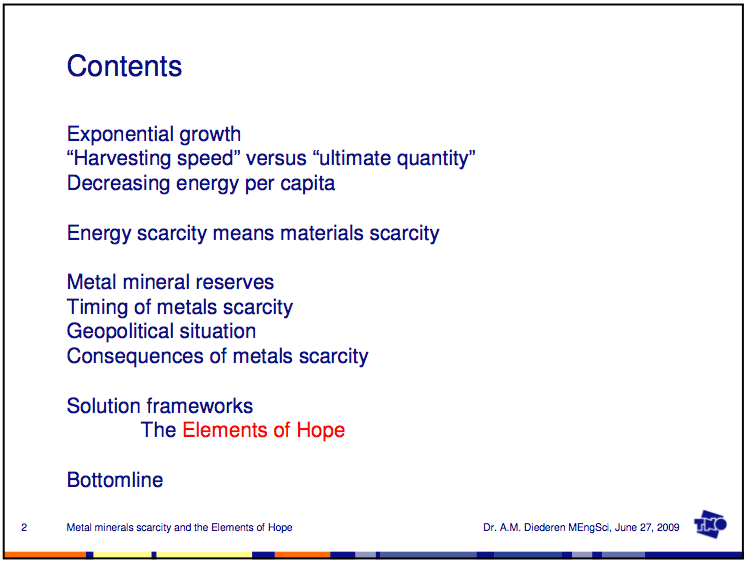
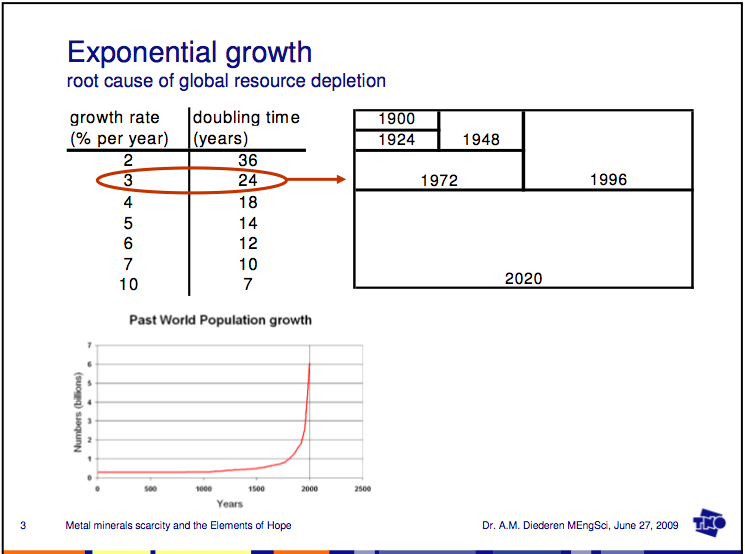
Slide 3
The underlying problem is exponential growth of the world’s population and associated consumption of natural resources. Earlier this year, the IMF (within the context of the current global crisis) stated that a “healthy” world economy grows each year with 3% or more. Sustained growth of 3% per year means a doubling time every 24 years. Compare this with the average growth of China’s economy during the last 15 years and associated growth in metals consumption: 10% or more per year, meaning a doubling time of 7 years (or shorter). This is of course nothing less than a Ponzi Scheme.

Slide 4
I would like to lend a phrase from the peak oil community and apply it to mineral resources as well: it’s not the size of the well that matters but the size of the tap. About a quarter of the earth’s crust consists of silicon, yet we are already short (for years) on pure enough silicon to make high efficiency solar cells. Of course we can purify the less favourable sources of silicon, but this takes (lots of) energy.
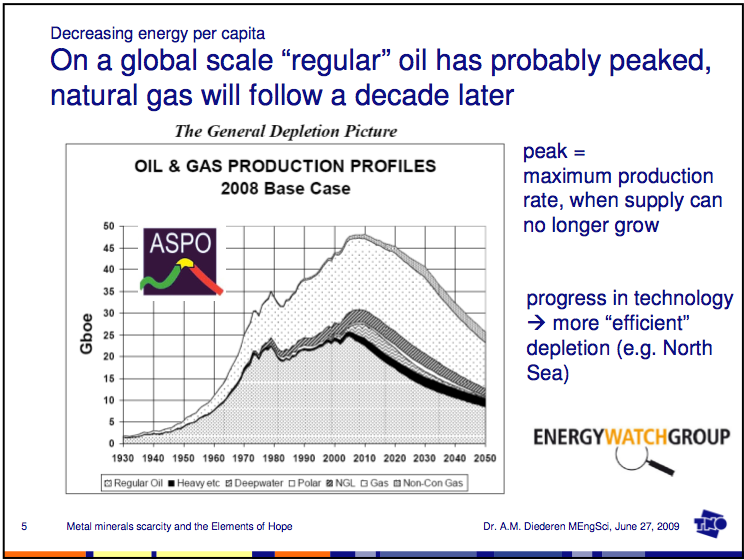
Slide 5
As with energy, also for metals one should not be misinterpreted as saying that we are running out (of metals). We are running out of “easy” metals, i.e. high ore grades at favourable locations.
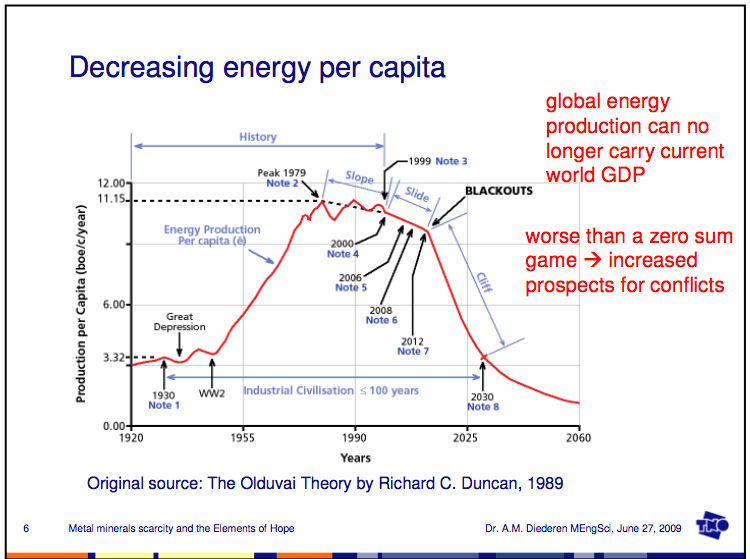
Slide 6
This graph is the scariest graph I’ve seen in years if you think about its implications. It’s even worse than a zero sum game: even zero growth at one part of the globe will inevitable cause shrinkage at another part of the globe (until we have some other economic paradigm). Looking at our history, I find it hard to be optimistic about a future without serious conflicts.
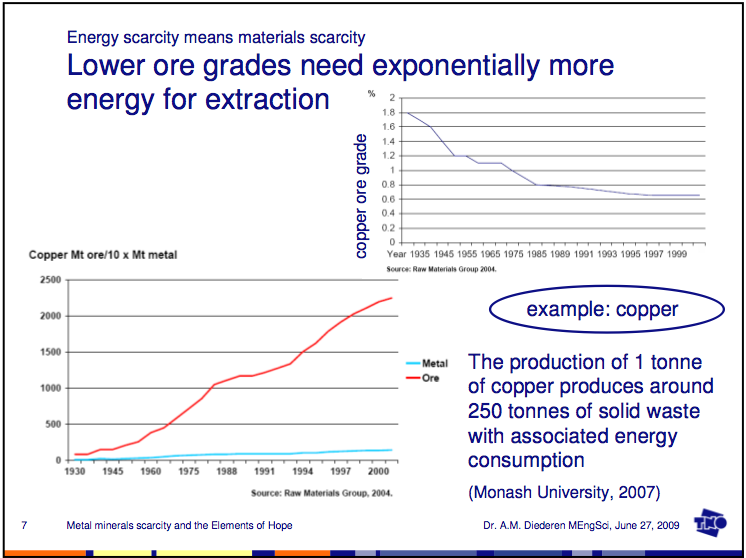
Slide 7
A typical critique on stating that we are running into metals scarcity is the notion that you will find 300 times more ore as you lower the ore grade with a factor of 10. This misses the point that you need much more energy to keep extracting the same amount of metal. Even when the ore grade is more or less stable (example: copper over the last few decades), you still need increasingly more energy to extract the same amount of copper because you have to dig deeper and handle ever more quantities of solids to get to the ores. Of course lower ore grades aggravate the situation and increase energy expenditures much more because of the amounts of solids which have to be processed to keep up the production rate of concentrated metal.

Slide 8
Below the so-called mineralogical barrier (a certain low ore grade), essentially you should pull the source material (e.g. a piece of rock) chemically apart to extract the individual metals. Combined with the enormous amounts of low grade source materials required to maintain a certain production rate of metal, in an energy constrained world the vast majority of resources is out of our reach.
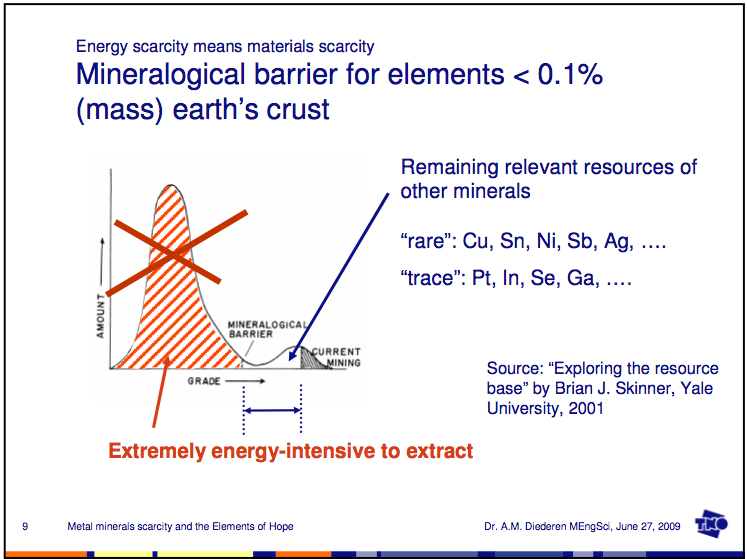
Slide 9
This graph could be valid for all non-abundant metal minerals and it shows that at lower ore grades the amounts of source materials first may tend to go down, not up. This may aggravate metal minerals scarcity.
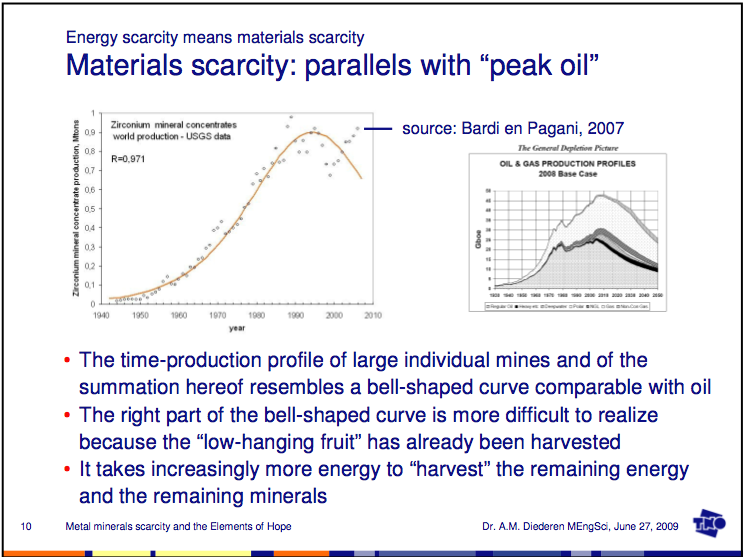
Slide 10
The work of Bardi and Pagani in recent years showed the striking similarities between peak oil and peak minerals.
Slide 11
A typical critique on stating that we are running into metals scarcity is the notion that the free market (the laws of demand and supply) will upgrade parts of the resources or the resource base into reserves once reserves start to get tight. This has seemed to be true for decades when there was cheap and abundant energy available. However with energy scarcity, the big lower part of the graph in figure 11 is out of reach (red crossed lines). We should also let go of the notion that vast amounts of rich ore deposits lie waiting somewhere to be discovered (red crossed lines), see slide 12.
In short: it looks quite rational to focus on reserves instead of the huge amounts of resources and the vast resource base. Of course there are many cases to be made to argue that the boundaries of the reserves may be stretched in favour of larger quantities; however there are as many cases to be made to argue that with an energy crisis not even the currently stated reserves remain within our reach to be exploited (blue dotted lines).
Slide 12
In analogy with oil scarcity: it’s highly unlikely that we will find another “Saudi-Arabia” or another “North Sea” of rich mineral deposits.
Slides 13+14
Using the only consistent global database (from USGS) on metal mineral reserves and global production rates, one can paint a picture what it actually means if we focus on reserves. All data from USGS are converted (where necessary) into metal element content for consistency, see the paper ”Metal minerals scarcity: A call for managed austerity and the elements of hope”, published at the website TheOilDrum.com on May 4, 2009 (http://europe.theoildrum.com/node/5239) and at the TNO website on June 24, 2009 (http://www.tno.nl/).
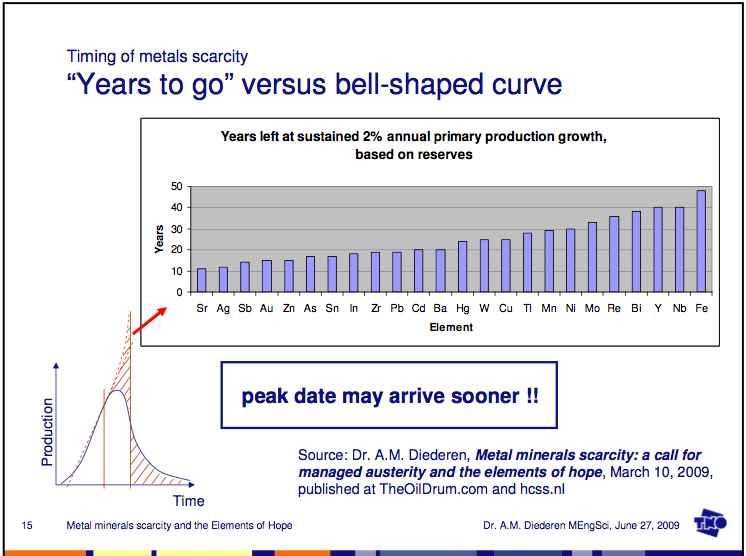
Slide 15
Using a simple calculation, including sustained annual growth of only 2% (the IMF states 3% growth or more is needed for a healthy world economy), the bar chart in slide 15 can be drawn to give a feel for the urgency of metals scarcity. Of course in reality we do not experience a sustained global production growth until year “n” and a subsequent drop to zero production in year “n+1”. This is depicted in the graph in the lower left corner of slide 15: a production peak is reached years before the “lifetime” of the bar chart has been reached. Bardi and Pagani recently have published data on several metals which indeed already peaked.
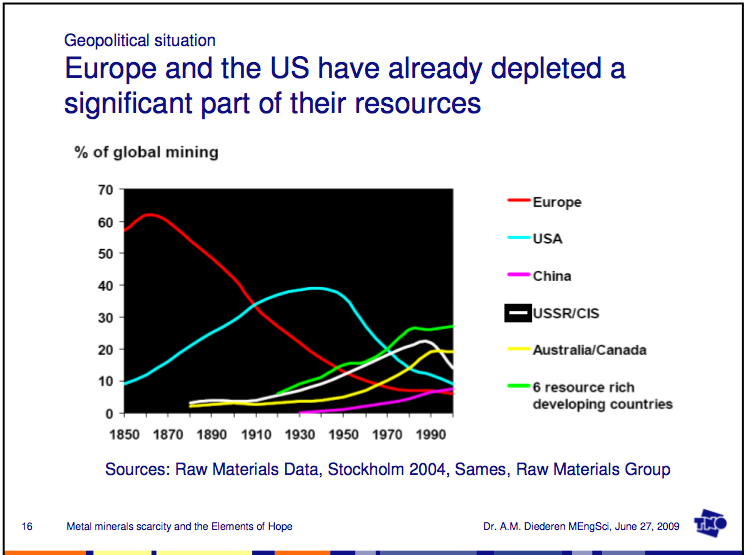
Slide 16
To make things even worse, as with oil and gas, global (or average) metals scarcity will be preceded by spot shortages due to the non-linear distribution and depletion of metal mineral resources across the globe. The industrial revolution started in Europe and later the US became an industrial giant, so it comes as no big surprise that both Europe and the US have depleted a large part of their mineral resources.
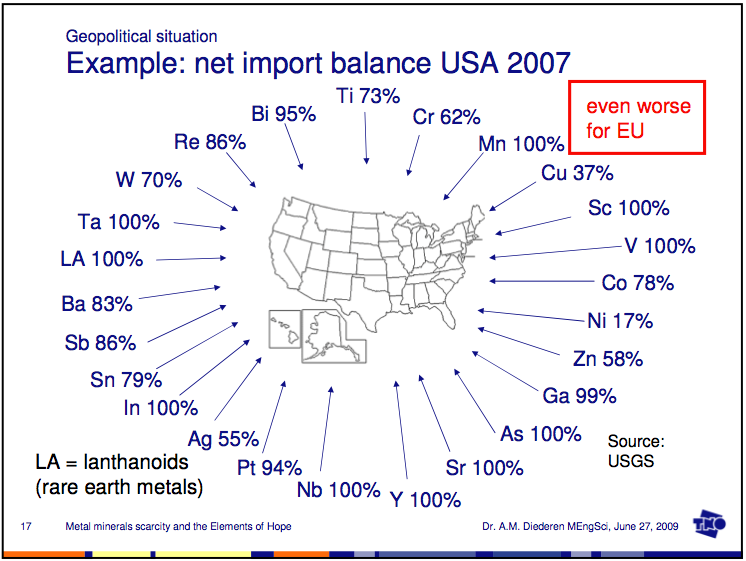
Slide 17
The United States, although still an important primary producer of metals, is strongly dependent on imports of various strategic metals, often 100%. The situation for the European Union is even worse than the picture of slide 17.
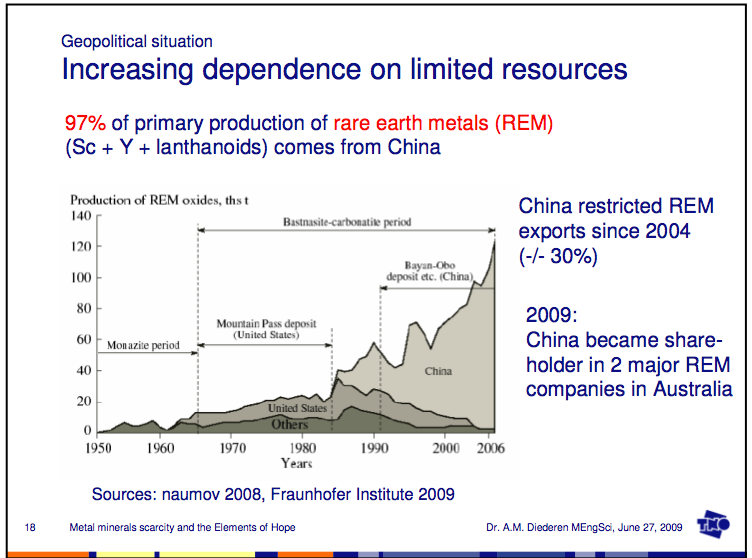
Slide 18
Many important metals are produced for a large part in only one or a few countries. A striking example are the so-called rare earth metals (REM) for which China dominates world production. REM are required for various kinds of high-efficiency applications in technologies which are needed to make a transition towards a more sustainable economy, away from our dependence on fossil fuels. An example is neodymium, required for high-efficiency permanent-magnets needed for generators (wind mills) or motors (electric vehicles).
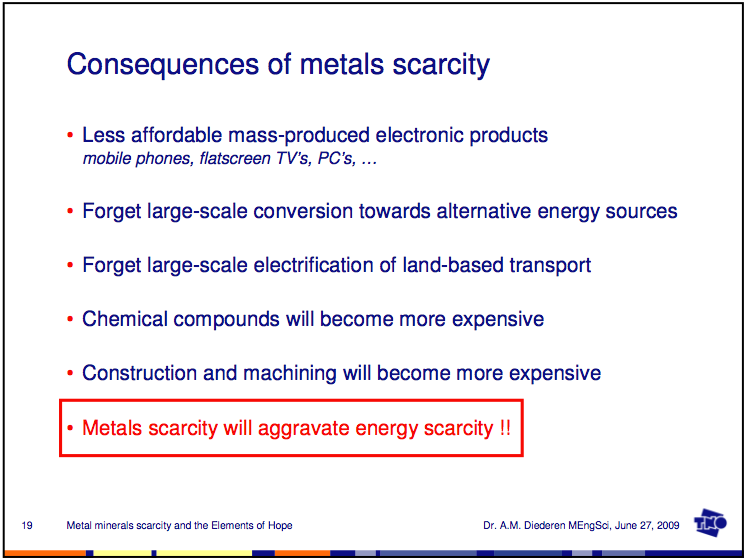
Slide 19
The consequences of metals scarcity will be serious. Not only various established sectors like machining and the chemical industries will be affected. Especially the promising “new” sectors will be hit hard. For example there are no satisfactory substitutes available yet for essential and already scarce metals for efficient and mass-produced solar cells, permanent-magnet drives/generators (wind mills, hybrid cars, electric cars), catalysts, fuel cells, batteries and various electronic devices (telecommunication, displays/ touch screens/ plasma screens, micro-electronics).
Without a shift from scarce to less scarce metals, a large-scale transition towards a more sustainable economy doesn’t stand a chance. Moreover metals scarcity aggravates energy scarcity because the energy sector is one of the largest metals consumers. This applies to the whole chain from exploration, production, storage and distribution up to conversion into the desired forms of energy.
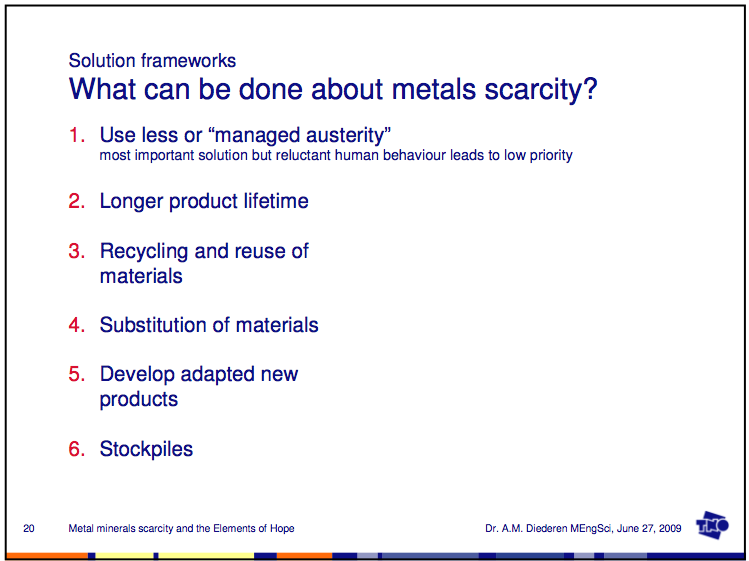
Slide 20
There are six solution frameworks to diminish our dependence on scarce metals: using less, longer product lifetime, more intensive recycling, substitution with less scarce metals, a new product design philosophy and adapted inventory management.
Realization of these solution frameworks challenges people’s ingenuity and creativity and offers meaning and purpose. “Using less” requires nothing less than some form of managed austerity. Also technology can play an important role by enabling dematerialization (like film rolls which have been replaced by digital photos). A number of solution frameworks are facilitated by reducing complexity in order to enhance quality and diminish waste.
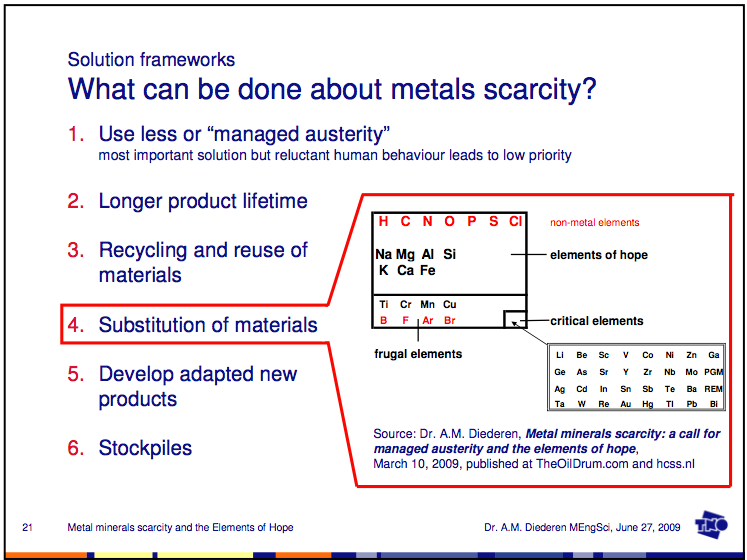
Slide 21
A particularly powerful solution framework is the substitution of scarce metal elements by the most abundant elements, the so-called Elements of Hope. This requires engineering sciences as well as disciplines like agriculture and biosciences. The scarcest metal elements are called the critical elements and these should be saved for essential applications where substitution with less scarce elements is not possible. The frugal elements are much less scarce, albeit scarcer than the Elements of Hope, and should be used predominantly for those applications for which there is not yet a substitute with current technology (example: chromium for stainless steel).

Slide 22
The Elements of Hope are potentially inherently environmentally friendly and sustainable as they contain all macronutrients of life and lack any heavy metal.
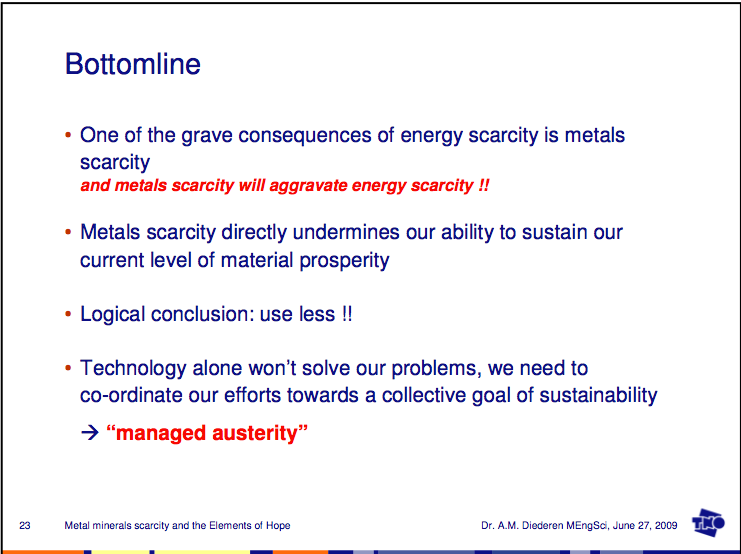
Slide 23
If policy does not change, the ongoing growth in global consumption of metals will cause shortages, aggravate energy scarcity and obstruct the transition towards a sustainable economy.
Technology alone is not going to save us. A holistic approach to the vast underlying problem of exponential growth and overconsumption requires involvement of various disciplines. “Using less” requires nothing less than some form of managed austerity and involves disciplines like psychology, philosophy, law, finance, economics, system dynamics and politics. Nate Hagens has explained during the discussion after this presentation that we need to understand and implement all that we know about human behaviour for any solution to stand a chance of becoming viable (see the recent excellent work by Nate Hagens).

Slide 24
The free market alone cannot solve these problems. Some form of government intervention for the sake of collective interest is required. How does a country like China approach these problems? Can we learn something from them?
Categories: Links
DrumBeat: July 9, 2009
Oil falls below $60
LONDON (Reuters) -- Oil reversed early gains and dropped below $60 a barrel on Thursday as a downturn in the stock market added to pressure from high oil inventories and persistent concerns about the timing of any economic recovery.
Light crude for August delivery fell 45 cents to $59.69 a barrel and was on course for the seventh straight day of declines.
Pay More, Drive Less, Save the Planet What is the appropriate response to Secretary of Transportation Ray LaHood, who as General Motors prepared to file for Chapter 11 bankruptcy protection declared that he wants to "coerce people out of their cars"? One might be inclined to dismiss these words as overkill -- except for recently introduced legislation by some congressional heavy-hitters that would take us down this road.
Does Obama Want to Own the Airlines?
Only luck and falling oil prices saved Washington from having to face mass bankruptcy of the airline industry last year. Now the specter is rising again. Fuel prices are up. Traffic continues to plummet amid a global recession. United Airlines last week mortgaged its spare-parts inventory to raise cash at a usurious 17% interest rate.
Yet the Obama Justice Department has come out of the blocks trying to scuttle a promising experiment to stabilize the chronically unprofitable U.S. airline sector. The new administration seemingly won't let companies fail, and won't let them succeed either.
Eni declares force majeure after Nigeria attack
MILAN (Reuters) - Italian oil company Eni SpA has declared force majeure after rebels sabotaged oil pipelines in Nigeria, a spokesman said on Thursday.
Power struggle: The battle to create America’s biggest electricity generator continues
IT IS not so much a takeover battle as a war of attrition. It was back in October that Exelon, America’s biggest owner of nuclear-power stations, first offered to buy NRG Energy, a big generator which focuses on Texas and relies mainly on coal and natural gas. Exelon wants to create America’s biggest electricity generator, with a capacity of more than 47,000 megawatts, enough to power 45m homes. But NRG’s management rebuffed the all-stock deal, and its shareholders, at first enthusiastic, got cold feet as NRG’s rising share price made the terms less generous. Earlier this month Exelon raised its offer by 12%, but NRG’s management rejected the sweetened deal, now worth about $7 billion, on July 8th. The next skirmish will come at NRG’s annual meeting on July 21st.
Study: Bad roads push up crash-fatality rate
A new study by the Pacific Institute for Research and Evaluation (PIRE) claims that more than half of U.S. highway fatalities are related to deficient roadway conditions – and that poor roads are a substantially more lethal factor than drunk driving, speeding or non-use of safety belts.
Panama Canal Project Opens a Tropical Window
The Panamanian government initiated the project for purely economic reasons. In its current configuration, the 51-mile shortcut between the Pacific and Atlantic Oceans can grant passage only to boats carrying up to 65,000 tons of cargo. But many international shipping companies increasingly prefer to use mega-freighters that can haul up to 300,000 tons.
As a result, the Panama Canal has been losing business to other transoceanic routes; and with canal tolls amounting to close to $100,000 per ship per one-way crossing, and potentially more for the giant freighters, the government decided it had no choice but to widen and straighten the canal to make room for the S.U.V.’s of the seas.
Wind turbine maker gets loan to expand Idaho plant
Nordic Windpower USA, Inc. says it's gotten conditional U.S. Department of Energy commitment for a $16 million loan guarantee that will help it expand its plant in southeastern Idaho.
The Berkeley, Calif.-based company is hoping to use the low-interest loans enabled by the federal guarantee to expand its Pocatello assembly facility.
Nordic makes two-bladed, utility-scale wind turbines that flex to mitigate negative effects of turbulent winds before they can damage the drive train.
Hedge fund transparency key to curb oil spikes: IEA
"Transparency in the futures market is certainly the issue: who is trading, is it a commercial trade or a non-commercial trade. We need more transparency," Tanaka told Reuters in an interview on the sidelines of an expanded G8 summit in Italy.
"But we think still that (market) fundamentals are more important to determine the direction of the oil price: speculation is amplifying the movement upwards or downwards but not necessarily determining the price of oil," Tanaka said.
He warned that oil markets could be "really tight" by 2014-2015 unless there was an increase in production and exploration investment. He compared the scenario to last year's market, when oil prices spiked to $147 a barrel.
China Car Sales Jump 48% on Economic Stimulus, Most Since 2006
(Bloomberg) -- China’s passenger-vehicle sales rose 48 percent in June, the biggest jump since February 2006, as government stimulus spending spurred a revival in the world’s third-largest economy.
Chinese motorists bought 872,900 cars, sport-utility vehicles and other passenger vehicles last month, the China Association of Automobile Manufacturers said in a statement today. Overall auto sales, including buses and trucks, rose 36 percent from a year earlier to 1.14 million.
Iranian protesters defy crackdown
More than 700 people defied government orders in Tehran and took to the streets on Thursday in renewed protest over the results of Iran's presidential elections.
The pro-reform demonstrators chanted "death to the dictator" as baton-wielding police attempted to chase them away and eventually fired tear gas to break up the rally, according to eyewitness accounts.
It was the first public protest in Tehran in 11 days and coincided with the anniversary of a 1999 attack by Basij militia on a Tehran University dorm to stop protests in which one student was killed.
G-8 Climate-Change Agreement Falls Short
L'AQUILA, Italy -- The Group of Eight leading nations agreed Wednesday to cut their emissions of heat-trapping gases 80% by 2050, but failed to reach an accord on shorter-term targets -- a setback that could have repercussions for a major meeting on climate change in Copenhagen later this year.
Forget gas, batteries — pee is new power source
Urine-powered cars, homes and personal electronic devices could be available in six months with new technology developed by scientists from Ohio University.
Using a nickel-based electrode, the scientists can create large amounts of cheap hydrogen from urine that could be burned or used in fuel cells. "One cow can provide enough energy to supply hot water for 19 houses," said Gerardine Botte, a professor at Ohio University developing the technology. "Soldiers in the field could carry their own fuel."
Swimming in Diesel: Huge Oil Stocks Show No Recovery in Sight
More than any other fuel, diesel reflects the current state of the economy because it is used by truckers to deliver goods and by factories to make products. It’s also a good gauge on the global economy: Unlike gasoline, the bulk of which is consumed in the U.S., diesel is used all over the world.
And what diesel demand is saying is that the economy is still in a sickly state. U.S. diesel consumption, which has been dismal for most of the year, was down an average 12.3% over the past four weeks. In the futures market, prices for heating oil, a proxy for diesel, tumbled more than 60% from their peak in July of last year. That’s a bigger drop than those of gasoline and crude prices, which have fallen 52% and 57% respectively since that time.
Developing World Consuming More Energy than Developed World. Price, Climate Will Suffer
The tectonic changes in the world’s population and urbanization the last twenty years now begs a question. Is it possible that instead of the developing world ever reaching the living standards of the developed world, as many had once thought–is it possible that the developed, OECD nations are rather now on a course to meet the developing world somewhere in the middle? If that’s the case, it is very bad news for those concerned with climate change. Because in that middle place, where the new and the old world may be set to merge, it’s likely that the primary sources of energy will be wood, and coal.
We are in the midst of the great baby-boomers economic stagnation of 2007-2017
Indeed, the era of excessive spending and of excessive debt is over. The era of excessive government economic disengagement and of financial deregulation is over. The era of irresponsible Ponzi-scheme finance is over. The era of unregulated derivatives is over. The era of greed as an ideology is over. The era of wild and predatory capitalism is over. The era of cheap oil, of cheap transportation, of cheap commodities and of cheap food is over. The era of excessive concentration of wealth and income is also over. However, the age of political corruption, of incompetent politicians and of destructive wars of aggression is not over. What has arrived is the age of hyperstagflation.
John Michael Greer: The wealth of nature
Let’s take a closer look at the land whose value Ricardo considered “indestructible.” He was talking primarily about land as an economic factor in agriculture, and so shall we. What he apparently did not realize, but ecologists have shown in exact detail since his time, is that fertile land suitable for growing crops does not simply happen. Like anything else of value, it must be made, and once made, it must be maintained; the only difference is that the laborers that make and maintain it do not happen to be human beings.
Foster Wheeler JV wins Aramco Shaybah contract
A joint venture between US oil and gas contractor Foster Wheeler and Saudi Arabian firm Sofcon has been awarded the pre-front end engineering and design (FEED) study for the development of gas supplies from the Shaybah field by the state-owned hydrocarbons giant Saudi Aramco.
The field, located in Saudi Arabia’s Empty Quarter, has already undergone a huge US$3 billion expansion to increase its oil capacity by 250,000 barrels per day (bpd) to 750,000.
Ghana: Chaos Over Fuel Shortage
There were chaotic scenes at some filling stations in Accra yesterday as motorists, especially commercial drivers, suffer the pangs of a biting fuel shortage in the country.
While some filling stations had anxious motorists lounging due to the winding queues, others were bereft of vehicles as prominent “no petrol” signboards stood ominously.
Long queues stretched out onto the streets, scenes which many Ghanaians could not remember witnessing in the past eight years.
Opinion: US Should Consider Exploring in Cuban Waters
The Cuban government is not only sitting on a potential oil bonanza but it has already awarded oil and gas exploration leases to companies from Canada, China, Spain, India, Venezuela and Norway. And Cuba is negotiating with Brazil's Petrobras, a company with years of experience in deepwater drilling.
If U.S. firms are forbidden by their own government to drill for oil and gas in Cuban waters, then the national oil companies of other countries will benefit while our investor-owned companies watch from the sidelines.
Our thirst for oil shouldn't trump fairness as the major reason for ending embargo
COLUMBUS, Ohio -- Oil may soon trump politics in our relations with Cuba. Estimates of Cuban offshore oil reserves as recently disclosed by the Cuban government hover around 20 billion barrels. That would approximate known U.S. oil reserves.
Loss of Production Even More Dangerous in Times of Low Oil Prices
The 4th Annual Security for Energy Infrastructure Summit, taking place on 18-21 October 2009 in Abu Dhabi, is the preferred platform for Middle East security experts to share innovative solutions that counter the spectrum of threats currently facing critical energy infrastructure.
‘Twin calamities’ led to bankruptcy
The privately held parent of chemical giant LyondellBasell “genuinely believed” its $12.7 billion buyout of Houston’s Lyondell Chemical Co. in 2007 would work or it would not have committed billions in equity toward the deal, the company said in documents filed with a New York bankruptcy court.
But the “unforeseeable twin calamities” of a global economic crisis and volatility in commodity markets tipped LyondellBasell into bankruptcy a year later, Access Industries said in the filing, dismissing as “economically irrational” the accusations that the company was deliberately set up to fail.
Cap and Trade Shenanigans
Each year, the government will hand out fewer and fewer emissions indulgences. Meaning there will be fewer credits to trade. And we commodity buffs know that the less there is of something, the higher the price rockets.
And the Chicago Climate Exchange will score larger and larger sums from the corporate carbon largesse. Goldman and company have everything to gain from this.
And you’ve got to ask: What exotic new derivatives can come out of this? Will institutional investors bet on futures of how much the government will lower the cap in 2025…2030? Wait, there already is a Chicago Climate Futures Exchange. Of course, it’s the wholly owned subsidiary of the Chicago Climate Exchange.
Nuclear proponents address Saskatoon business leaders
Promoters of Canada's nuclear industry made a direct pitch to Saskatoon business people on Tuesday, as the province continues to ponder the future of its uranium resources.
Neil Alexander, president of the Organization of CANDU Industries, told a lunchtime audience of the Greater Saskatoon Chamber of Commerce that a nuclear power plant in Saskatchewan would create jobs and generate other economic benefits.
Scientist shortage? Maybe not
As the push to train more young people in STEM — science, technology, engineering and math — careers gains steam, a few prominent skeptics are warning that it may be misguided — and that rhetoric about the USA losing its world pre-eminence in science, math and technology may be a stretch.
One example: Numbers from the U.S. Labor Department's Bureau of Labor Statistics issued Tuesday showed the unemployment rate for electrical engineers hit a record high, 8.6%, in the second quarter, more than doubling from 4.1% in the first quarter.
U.S. Moves to Shackle Oil Speculators
The solution to perceived market manipulation is overt market manipulation.
That's what federal regulators are saying with Tuesday's announcement that they will consider curtailing "excessive speculation" in energy markets. The move comes in response to last year's spike in oil prices, which soared to a record $145 a barrel a year ago next week and pushed gasoline prices above $4 at the pump in many parts of the country. Since the start of this year, crude prices have jumped 42 percent, even though the recession has crimped demand and storage tanks are full.
Speculators must be to blame.
No one seems upset about last fall, though, when those same speculators helped drive down prices by more than $111 a barrel in the last five months of the year.
Krugman: The Malthusian insult
What very few people realize is that Malthus was right about most of human history — indeed, he was right about roughly 58 out of 60 centuries of civilization: living standards basically did not improve from the era of the first Pharaohs to the age of Louis XIV, because any technological gains were swallowed up by population pressure. We only think Malthus got it wrong because the two centuries he was wrong about were the two centuries that followed the publication of his work.
The Import Land Model
Today I'd like to talk about another gimmick of the ELM. Veterans who have read a lot of Brown's writing will have noticed that he always focuses on a few carefully selected examples: Indonesia, the UK and of course "Export Land" (the fictional country he uses to illustrate the model). He never seems to bring it all together, and give a coherent picture of the net export situation for the entire world. There is a good reason for this. When you look at the big picture, the ELM "crisis" appears in a very different light.
Downturn dries up oil demand
Peak oil may have arrived in the developed world – but for the consumption of crude, rather than its production.
The recession has crushed demand across the globe, the Organization of Petroleum Exporting Countries said yesterday. It does not expect demand for production to return to pre-recession levels until 2013.
Consumption in the developed world will remain stagnant for many years to come, OPEC said, even as many economists believe the wealthy world's seemingly insatiable demand for oil may well have peaked permanently.
Oil rises above $61 despite uncertain demand
VIENNA – Oil prices rebounded to above $61 on Thursday, recouping some losses after tumbling 17 percent since last week.
But rising U.S. gasoline inventories suggested crude demand remains weak, fueling expectations that prices would resume their slide.
Crude Oil May Rise 35% in 2010, Morgan Stanley Says
(Bloomberg) -- Crude oil may average 35 percent higher in New York next year and rise to $85 a barrel in 2011 as spending by governments boosts global demand, Morgan Stanley said in a report.
Benchmark crude futures on the New York Mercantile Exchange will likely average $48 this year and $65 in 2010, according to the report dated yesterday. Next year will mark the beginning of a recovery as governments’ spending provide the stimulus to maintain the re-stocking phase of a new commodity cycle, it said.
Russia floats $70-80 oil as fair price at G8
L'AQUILA, Italy (Reuters) - Russian President Dmitry Medvedev told other G8 leaders on Wednesday that a poll of oil company executives showed they thought $70-80 was a fair price, according to his spokeswoman.
Trade body calls for tax breaks for oil and gas sector
The British government was accused today of putting too much focus on renewables and nuclear while taking "for granted" the oil and gas sector, which supplies two-thirds of the country's total energy needs.
The accusation from a top petroleum industry body came as a report showed there has been a 57% reduction in the amount of North Sea drilling over the last six months.
Oil & Gas UK said 50,000 jobs were at risk unless ministers improved tax incentives. It said government had missed a "massive opportunity" to put the oil and gas sector back on the path to recovery by making only the smallest changes in the last budget.
New U.S. Natural Gas Pipeline Displacing Canadian Gas
A new natural gas pipeline in the United States is allowing cheap gas from the Rockies to displace more than 10% of Canada’s gas exports to the Midwest US, forcing more Canadian gas into storage and lowering natural gas prices for Canadian producers.
U.S. Natural Gas Fund Grows to Record on Demand Surge
(Bloomberg) -- The United States Natural Gas Fund expanded today to the largest position in its 27-month history as investors snapped up the last of its shares and it awaited government approval to issue more units.
As of early today, the exchange-traded fund owned the equivalent of 124,926 natural gas futures contracts on the New York Mercantile Exchange. The number of shares outstanding reached a record yesterday, rising 14.5 percent to 322.3 million, more than 10 times the total at the start of the year, and worth $3.97 billion.
What (or When) Is Up with Natural Gas
The fact that there's a contango of such magnitude - at last look, the quarterly premium was 30% of the front-month price - should give bulls pause. A large contango for a storable commodity such as natural gas implies more-than-adequate supplies.
At the least, the current interest in natural gas seems premature given the commodity's inherent seasonality. Natural gas is primarily a heating fuel. Generally, gas is injected into storage during the nonheating season (between April and October). The fuel's then withdrawn from storage over the balance of the year; that is, in the heating season (November through March).
Saudi Aramco Cuts Heavy, Medium Oil Supplies to Asia
(Bloomberg) -- Saudi Aramco, the world’s largest state-owned oil company, deepened cuts in supplies of its Arab Heavy and Medium oil grades sold under term contracts to Asia in August, refinery officials said.
The oil company will reduce overall supplies, which include the Light and Extra Light grades, by as much as 20 percent from contractual volumes, according to a survey of officials at refineries in Japan, Singapore and South Korea.
Qatar Petroleum Raises Oil Prices to 9-Month High
(Bloomberg) -- Qatar Petroleum, which exports most of its crude oil production to Asia, raised June official selling prices to their highest in nine months.
Qatar Petroleum increased its June price of Qatar Land crude oil to $71.10 a barrel, up $11.50, or 19.3 percent, from May, the state-run Qatar News Agency said on its Web site today. The June price of Qatar Marine grade was raised by $11.80, or 20.2 percent, to $70.10 a barrel.
Kuwait Cuts Crude Oil Official Price for First Time in 3 Months
(Bloomberg) -- Kuwait Petroleum Corp. reduced its August crude oil official selling price for the first time in three months because of a lower profit in producing fuel oil.
The state-owned company cut its price to parity to the average of Persian Gulf benchmarks Oman and Dubai grades, from the July premium of 30 cents a barrel, said a trader who asked not to be identified because of company policy.
No impact on Shell production from Nembe attack
LONDON (Reuters) - Royal Dutch Shell said on Thursday there were no injuries or impact on its crude oil production from attacks on an oil pipeline in Nigeria. The trunkline attacked was in Nembe Creek in Bayelsa state, Shell confirmed.
Nigeria wants Big Oil to cover amnesty
Nigeria's government has budgeted millions of dollars to an amnesty programme aimed at restoring peace in the Niger Delta, but has yet to receive any financial support from foreign oil companies, a senior minister said.
Shell May Close or Sell Montreal East Oil Refinery
(Bloomberg) -- Royal Dutch Shell Plc may close or sell its Montreal East refinery in Quebec, Canada, as Europe’s biggest oil company carries out a global review of assets.
Other options include converting the 130,000 barrel-a-day refinery into a terminal, establishing a joint venture or leaving the plant running, a Shell spokesman said today by telephone, declining to be identified in line with company policy. The review could take some months and no decisions have yet been taken, he said.
Indonesia says seeking to revive Iraq oil projects
JAKARTA (Reuters) - Indonesia's state oil firm Pertamina said on Thursday it was planning to revive oil projects it was involved in Iraq that were put on ice because of the security situation in the country.
Greenland May Mandate Carbon Capture, Petroleum Chief Says
(Bloomberg) -- Greenland’s government may require energy companies investing in oil and gas production to capture and store carbon emissions, Joern Skov Nielsen, director of the Greenland Bureau of Minerals and Petroleum, said.
“We will ask companies to develop carbon storage technology,” Nielsen said in a telephone interview from Nuuk, Greenland’s capital, yesterday. “It’s a requirement that you use the best available technology. If carbon storage is usable around the world, they will have to use it in Greenland.”
China Coal Cargo Rejection May Not Signal Market Turn, RBC Says
(Bloomberg) -- The reported cancellation by a Chinese buyer of an Australian coal cargo during shipment may not signal a slump in demand from power-plant operators in the Asian nation, RBC Capital Markets said.
An Australian cargo is being offered after a Chinese customer pulled out of a sale, Reuters reported yesterday, citing unnamed traders. The product appears to be coking coal used by steelmakers that has been marketed as thermal coal, RBC said today.
Chinese buying has almost single-handedly sustained the international coal trade and prices, RBC analyst David Haddad wrote in a note to clients. Early figures for June suggest Australian exports to China will be another record, he said.
Equatorial Guinea: Elites Hoarding Oil Revenues, Report Charges
The government of Equatorial Guinea has looted billions of dollars in oil revenue instead of improving the lives of its citizens, Human Rights Watch (HRW) said in a report released Thursday.
The report, "Well Oiled: Oil and Human Rights in Equatorial Guinea", details how the dictatorship under President Teodoro Obiang Nguema Mbasogo has used an oil boom to entrench and enrich itself further at the expense of the country's people.
Pakistan Imposes Fuel Levy After Court Suspends Tax
(Bloomberg) -- Pakistan’s President Asif Ali Zardari ordered a new fuels tax effective today to circumvent the Supreme Court’s suspension of an earlier levy and avoid a shortfall in government revenue.
The tax restores state-controlled fuel prices to where they were before the Supreme Court suspended a week-old carbon tax on July 7, according to a statement on the Oil & Gas Regulatory Authority’s Web site. The Supreme Court order forced the government to cut prices yesterday.
Simmons sees bright future for Midcoast Maine
Simmons still sees possibilities for the future of Rockland and the Midcoast. Referring to it as a potential "capital of the Silicon Valley for ocean energy," Simmons predicted that tens of thousands of people will be attracted to the region in the coming decades. He praised Maine's politicians and government for supporting exploration of ocean wind, tidal and other energy resources and said he believes the U.S. Department of Energy will soon put a research laboratory in the Gulf of Maine. "This wouldn't happen in Texas," he said.
Comparing Rockland to Aberdeen in Scotland, Simmons predicted that this burgeoning industry will combine with the high quality of life in the region to eventually provide at least 10,000 "fabulously high-paying jobs" in the Midcoast.
Areva’s European Wins Lift Chances in $1 Trillion Global Tussle
(Bloomberg) -- Areva SA, the largest builder of nuclear plants, is seeking to use a lead in its home European market over Toshiba Corp.’s Westinghouse Electric Co. to gain an edge in the $1.05 trillion of global contracts up for grabs.
Areva’s new model, the evolutionary power reactor, or EPR, has been chosen for at least 11 of the 41 new plants planned or under construction in the European Union. Westinghouse, which is pushing its AP1000 pressurized water reactor, hasn’t built a plant in the region for more than 20 years.
Vattenfall to Study Kruemmel Reactor After ‘Setback’
(Bloomberg) -- Vattenfall AB, the fourth-largest power supplier in Germany, will start a full inspection of its Kruemmel nuclear reactor in the country after the facility shut down due to the absence of a monitoring system.
The Swedish utility has appointed Stefan Dohler, who heads Vattenfall’s German power transmission operations, as special investigator for the plant, the Stockholm-based company said in an e-mailed statement today.
More Ethanol in Gasoline? Automakers say it will "Damage" Cars
Some 54 ethanol producers, grouped together under Growth Energy’s banner, are carrying the torch for dramatically increasing the amount of ethanol in pump gasoline from 10 to 15 percent. Will they succeed? There are technical and political arguments to be made on both sides, but for now the momentum seems to be against fast-tracking higher ethanol blends.
Nuclear dawn delayed in Finland
When it is finished, Finland's Olkiluoto 3 (OL3) nuclear reactor will be the biggest the world has ever seen, the excavation site alone is the size of 55 football fields.
It was to have been a pilot project for bigger, better, cleaner, Generation III reactors, which would lead the charge back to nuclear power in a continent which had gone cold on atomic energy after the accidents at Chernobyl and Thee Mile Island.
But hopes of an early nuclear dawn on the Baltic coast are fading - the May start up date came and went and the OL3 is now not expected to begin pumping out electricity until 2012 - three years later than planned and about $2.4bn dollars (1.7bn euros) over budget.
U.K. CO2 Auction Fetches First Premium to Prior Close
(Bloomberg) -- Britain, the European Union’s second- biggest economy, sold emission permits today at a higher price than yesterday’s close, the first such premium in the country’s four auctions over the past seven months.
In Major Economies, Many See Threat From Climate Change
Awareness is high, except in Indonesia, India, South Africa.
Global warming impacting Greenlanders' daily lives
NUUK (AFP) – From his trawler that motors along the Nuuk fjord, fisherman Johannes Heilmann has watched helplessly in recent years as climate change takes its toll on Greenland.
Global warming is occurring twice as fast in the Arctic as in the rest of the world.
G8 emissions pledge is 'scientifically illiterate'
It sounds big, but it just isn't enough. Leaders of the G8 industrial nations meeting in Italy this week are likely to agree that the world must cut greenhouse gas emissions by 50 per cent by 2050. That means cuts of 80 per cent among the rich nations.
They will say that this is essential to keep global warming below 2 °C - widely regarded as the tipping point beyond which scary global feedbacks could wreck the climate system that keeps us fed and watered.
Sorry, guys, but this is scientifically illiterate. We might be lucky: if the atmosphere is less sensitive to those gases than most scientists suppose, it could be enough to keep us below 2 degrees, for a while at least. But the best estimate is that the world needs at least 80 per cent cuts in global emissions, and probably more like 100 per cent, to stay below two degrees.
Warming Arctic could teem with life by 2030
"Teeming with life" may not be the description that springs to mind when thinking of the Arctic Ocean, but that could soon change as global warming removes the region's icy lid.
A study of what the Arctic looked like just before dinosaurs were wiped off the planet has provided a glimpse of what could be to come within decades.
G-8 Sets 2050 Emissions Goal, Developing World Delays
(Bloomberg) -- The Group of Eight agreed for the first time to cut greenhouse gases 80 percent by 2050, and developing nations led by China and India pledged to set a mid- century goal by December, a person familiar with the talks said.
The biggest developed countries issued their target in L’Aquila, Italy, in a statement that called on less-wealthy nations to accept a 50 percent global reduction goal. The G-8 also said warming since industrialization began should be limited to 2 degrees Celsius (3.6 Fahrenheit).
Obama broadens push for climate change pact
L'AQUILA, Italy – Rallying rich and developing nations alike, President Barack Obama wants the world's top polluters to keep driving toward a deal to halt global warming.
Global warming accord spells lifestyle changes
Leaders of the world's biggest — and dirtiest — economies have agreed for the first time to limit the warming of the earth to a relatively safe 2 degrees Celsius (3.6 Fahrenheit) — an important target in fighting climate change.
It sounds simple, but it implies a dramatic shift in the way we generate electricity, fuel our cars and build our homes and skyscrapers.
Categories: Links
The Chicken Coop Refuge: Or How I Became a Bug Farmer
I spent about a dozen years as an academic biologist including some period teaching ecology to university students. Often I find this background useful in unexpected ways.
Take my chicken coop as an example. This is an enclosed area where five hens live. They will use their claws and beaks to eat nearly anything that’s edible, and while I feed them mixed seeds and kitchen scraps, various live animals much smaller than themselves tend to be preferred, when available.
After satisfying their foraging needs, hens are shown taking a group "dirt bath" during a winter dry spell in the garden. Behind them is a small "chicken tractor" that I use to confine them in places outside of their coop.
I know this because I sometimes let them out to roam the yard, watching to make sure they don’t destroy a newly planted patch of vegetable seedlings or poop on the steps of the back porch. Their enthusiasm for worms, and little arthropods makes it clear that they would like more of them in their diet and that the coop has a shortage.
This brings me around to basic ecology, where population models and experiments have demonstrated the importance of a “prey refuge” in preventing local extirpation of prey in the presence of predators. Marine reserves are a good example of the application of prey refuges for increasing the populations of both predators and prey, and reducing population volatility.
What I have done is create little faunal refuges in the chicken coop by placing scraps of wood, such as plywood, on the ground. The hens are unable to access anything underneath the wood and after some time a dense population of little critters develops.
Only a few seconds after being turned over, the hens are picking bugs off the board and newly exposed soil. Since it is so dry in CA during the summer, earwigs and pill bugs (known as the wood louse in Britain, and a member of the class Isopoda) are most abundant this time of year, and likely move out to forage at night while the hens sleep.
I haven’t done experiments, or even thought about it deeply, to say how these boards should be spatially arranged, how many to place, how large they should be, etc. to optimize my harvest of eggs. But I do enjoy turning a board over and watching the hens go after the hidden riches. And I also enjoy eating eggs for breakfast most days of the week.
This is a Campfire post and I would like our readers to learn from each other. Does my story remind you of some “discovery” of your own that has practical significance? Have you found yourself engaged in "lateral" thinking and problem solving where you've applied knowledge and experience gained in one capacity to a new situation?
Categories: Links
Peak Oil Day - July 11
This is a guest post by Richard Heinberg of the Post Carbon Institute. The original post can be found here. A petition to make July 11 Peak Oil Day can be found here. Please sign it.
On July 11, 2008, the price of a barrel of oil hit a record $147.27 in daily trading. That same month, world crude oil production achieved a record 74.8 million barrels per day.
For years prior to this, a growing legion of analysts had been arguing that world oil production would max out around the year 2010 and begin to decline for reasons having to do with geology (we have found and picked the world’s “low-hanging fruit” in terms of giant oilfields), as well as lack of drilling rigs and trained exploration geologists and engineers. “Peak Oil,” they insisted, would mark the end of the growth phase of industrial civilization, because economic expansion requires increasing amounts of high-quality energy.
During the period from 2005 to 2008, as oil’s price steadily rose, production remained stagnant. Though new sources of oil were coming on line, they barely made up for production declines in existing fields due to depletion. By mid-2008, as oil prices wafted to the stratosphere, every petroleum producer responded to the obvious incentive to pump every possible barrel. Production rates nudged upward for a couple of months, but then both prices and production fell as demand for oil collapsed.
Since then, with oil prices much lower, and with credit tight to unavailable, up to $150 billion of investments in the development of future petroleum production capacity have evaporated. This means that if a new record production level is to be achieved, further declines in production from existing fields have to be overcome, meaning that all of those canceled production projects, and many more in addition, will have to be quickly brought on-stream. It may not be physically possible to turn the tide at this point, given the fact that the new “plays” are technically demanding and therefore expensive to develop, and have limited productive potential.
On May 4 of this year, Raymond James Associates, a prominent brokerage specializing in energy investments, issued a report stating, “With OPEC oil production apparently having peaked in 1Q08, and non-OPEC even earlier in 2007, peak oil on a worldwide basis seems to have taken place in early 2008.” This conclusion is being echoed by a cadre of other analysts.
Maybe it’s a stretch to say that the production peak occurred at one identifiable moment, but attributing it to the day oil prices reached their high-water mark may be a useful way of fixing the event in our minds. So I suggest that we remember July 11, 2008 as Peak Oil Day.
We are now approaching the first-year anniversary of Peak Oil Day. Where are we now? The global economy is in tatters, yet oil prices have recovered somewhat (they’re now about half what they were in July 2008). World energy consumption is down, world trade is down, the airline industry is shrinking, and most of the world’s automakers are on life support.
It is too late to prepare for Peak Oil—a year too late, in fact. Now the name of the game is adaptation. We are in an entirely new economic environment, in which old assumptions about the inevitability of perpetual growth, and the usefulness of leveraging investments based on expectations of future growth, are crashing in flames. Even if economic activity picks up somewhat, this will occur in the context of an economy significantly smaller than the one that existed in July 2008, and energy scarcity will quickly cause most green shoots to wither.
It is impossible to say what will happen in the future with regard to oil prices. Clearly, very high prices kill demand by undercutting economic activity. Thus it is possible that the barrel price of petroleum may never break last year’s record. On the other hand, if the value of the dollar were to collapse, then the sky’s the limit for prices in dollars per barrel.
It is easier to forecast the oil supply trend: though we’ll see level-to-rising production temporarily from time to time, in general it’s down, down, downhill from now on.
Even though Peak Oil is now in the past, its annual commemoration on Peak Oil Day may serve an important purpose by reminding us why our economy is shrinking, and by focusing our thoughts on ways to facilitate the transition to a post-petroleum world.
What are some appropriate ways to commemorate Peak Oil Day? I’d suggest spending time in nature, engaging in a 24-hour oil fast, or organizing a neighborhood bicycle parade and solar-cooker bakeoff.
Mark your calendar. What will you be doing on July 11?
Help us "celebrate" Peak Oil Day by signing our petition.
Categories: Links
CFTC - Futures Position Limits on Energy?
Let's return to a central theme: that finite resources are being quantified by infinite money. Today the CFTC made some announcements regarding transparency in futures positions; also Congressional hearings began with intent to limit futures positions sizes , especially for energy speculators. Unfortunately, this 'speculation' issue is one of many red herrings that ignores the widening fundamental disconnect between financial and real assets. (PBS Nightly Business interviewed me on this topic -sound bite from 3:16-3:40). Below the fold is a brief summary of what I said in the longer interview followed by an open thread on the topic of the future of energy futures.
US lower 48 remaining recoverable oil** vs. US Treasury Debt
Our first hearing will focus on whether federal speculative limits should be set by the CFTC to all commodities of finite supply, in particular energy commodities, such as crude oil, heating oil, natural gas, gasoline and other energy products,”
Energy and natural resources are what we have to spend (or to marshal). Money is just a marker for these real assets, and the ever expanding definition of money - now extending to margin, credit, debt, on and off balance sheet derivatives, etc. - has caused an extreme, paradigm changing disconnect between financial assets, and what they were originally designed to represent. We need growth in order to pay back debt and need energy gain ((gross - costs)*scale) in order to grow.
Historical purchasing power of US dollar thru 2004 (American Institute for Economic Research)
The value of fiat currencies erodes over time, while remaining high quality energy increases in strategic value, even if not recognized in monetary terms. Historically, based of course on historic comparisons, commodities were the ugly stepchild in investment portfolios. As long as energy and resources were cheap, more long term gearing/profits were to be had from the vanilla 'derivatives': stocks and bonds (these are derivatives of our real capital: natural, built, social and human that underpins them), than from the commodities themselves. But as the world, in recent decades, was flooded not only with liquidity, but an order of magnitude (or more) increase in notional credit, relaxed oversight rules, relaxed lending standards, higher leverage, etc., those digits with the highest velocity have had to seek a home. Their doing so culminated in 2007-8 via a dramatic commodity market rally, (within which, oils kiss of $147 last July grabbed the most attention). What really happened in the ensuing 9 months was not a sharp drop in commodity demand, but a global margin call of epic proportions - all sorts of players were caught long and short (mostly long) had to pare down positions in almost all asset classes (US treasuries being notable exception). During the 5 years ended July 2008, the SP500 and crude oil had an R^2 of -.29, for the 7 months after: R^2 of .97! (Daily closes, graph here) The point of this is that oil was not in a speculative bubble, unless you amend that statement to: "oil was one of many instruments in a fiat liquidity bubble, but it was the most important commodity to the global economy so the media paid most attention to it". And to those who are adamant thatt speculators were responsible for oils rise last year: coal tripled in the same period and is not traded on the NYMEX....
Speculators are generally ignored unless either of the two unassailable American entitlements: rising stocks and cheap oil, are not on trend, and a witch-hunt for bad guys ensues. As we are mired in a deepening recession, the roots of which lie in the generation long replacement of tangible things with paper and digits, the logical human reaction to oil moving back from $40 to $70 is to blame someone, in order that it retreat some and not act as economic headwind. (The same thinking mans logic used to request temporary withdrawals from the national emergency Strategic Petroleum Reserve to reduce oil from $70.) The blame it seems, will again fall on speculators, (note: technically the majority of participants in our economic system should now be defined as speculators -we are buying/spending natural resources on margin with a downpayment of belief). As we have been writing on these pages for years, oil supply has maxed out, so any stabilization in demand will naturally result in rising prices. Couple that with many investors concerned about the inflationary impacts of quantitative easing, and there is a demand for ETFs, futures and derivatives representing real-not-derived-from-thin-air) assets, or the digital entries that legally control real assets. Recent liquidity dislocations arising from the linkage between the natural gas ETF, UNG, and natural gas futures have also heightened concern about position limits, and today UNGs administrator announced that no new shares will be created. In the end the demand for paper natural gas is higher than the demand for real natural gas. An odd situation, but the blame shouldn't be on the hedge funds, but on who designed the rules they follow. (On a deeper level, the blame is on all of us, for sleepwalking into this situation)
So what does this mean? Energy, particularly liquid fuel, is the hemoglobin of modern civilization. Price signals based on the marginal unit create long term distortions for utilities and energy policymakers. On the micro level, it is only a matter of time before a highly leveraged, underregulated hedge fund (think Amaranth, Ospraie, but bigger) causes dislocation in energy markets due to their size. On the macro level, depending on which estimates you trust, global notional derivatives are in excess of 1,000 trillion, while global GDP is only $55 trillion (and a decent chunk of that financial, aka questionable). If we accept the peak oil estimates of global remaining recoverable crude oil of around 1 trillion barrels, that equates to $62 trillion using todays closing NYMEX price. This is roughly equal to US treasury total debt (including unfunded Medicare, Social Security liabilities).
We have a monumental problem - a system whose claims on the future are higher than its real assets. This CFTC debate is a tiny microcosm of the greater social landscape.
Reducing positions sizes and increasing margin in energy futures is a step in the right direction to equilibriate paper markers with real wealth. But it will have immediate negative repurcussions (reducing liquidity, reducing confidence in system, increasing volatility etc.), which is why it ultimately won't happen. We will continue to borrow from all aspects of our socio-ecological system to keep the current paradigm intact (growth at all costs, marginal unit pricing, infinite substitutes, market will solve it, etc). Sooner, rather than later, a plan for re-linking scarce resources to what and how we execute social transactions is going to occur. Like M. King Hubbert, I am in favor of an energy based currency and no futures trading at all other than for producers and those taking delivery. But these ideas are so many steps beyond 'regulating oil futures in order to keep prices low' I expect I am wasting my breath. As debt increases, and resources deplete (especially the cheap ones), a reckoning lies ahead. One way or another we have to attack the fractional reserve banking system rules. Proactively or reactively and gradually or in one fell swoop are the main questions.
Previously on this topic:
A Closer Look at Oil Futures 9/2/2006
Natural Gas - A Tale of Two Markets 9/26/2006
At $100 Oil, What Can the Scientist Say to the Investor? 1/04/2008
Peak Oil and Reflexivity and Peak Oil 6/08/2008
CFTC - Speculation My A$$ 7.23.2008
Hurricanes, Hedge Funds and Energy Markets
No Naked Short Selling==>No Future Energy 9/19/2008
The Credit Markets, Financial Crisis, and Real Wealth (Guest post by Herman Daly 10/13/2008
comment on global margin call 10/25/08
Advice to Pres. Obama - Yes We Can But Will We 1/15/2009
**Remaining recoverable oil is based on Hubbert Linearization by Samuel Foucher here less actual production (consumption) - approx 25 GB recoverable left excluding GOM and Alaska.
Categories: Links
DrumBeat: July 8, 2009
Oil Shocks: Biden, Iran and Fears of Another Price Jump
Oil analysts are jittery this week following comments on Sunday by Vice President Joe Biden that were widely interpreted as a green light to Israel to bomb Iran's nuclear facilities. Many in the industry have long viewed such an attack as a prelude to a nightmare in global energy markets: Iran retaliating by sinking oil tankers in the Strait of Hormuz, blocking the route by which most Persian Gulf oil travels to world markets. "We will be in deep, deep trouble," says Leo Drollas, deputy director and chief economist of the Center for Global Energy Studies in London. "The market will go berserk."
The Obama Administration has hastened to correct the impression that Biden's comments represented a U.S. nod and wink to an Israeli air strike. The Vice President had said that while the U.S. believes that military action against Iran would serve neither American nor Israeli interests, Israel is a sovereign nation, and if it felt threatened by Iran, it would be "entitled to" launch an attack on the Islamic Republic "whether we agree or not." President Obama reiterated in Moscow on Monday that he opposes military action against Iran and instead wants a diplomatic solution to the nuclear standoff. But Prime Minister Benjamin Netanyahu has long maintained that Israel reserves the right to take matters into its own hands if U.S. diplomacy fails to deliver results.
Oil Falls for Sixth Day, Gasoline Tumbles on Fuel-Supply Gain (Bloomberg) -- Crude oil fell for a sixth day, the longest losing streak since December, and gasoline tumbled after a government report showed a bigger-than-expected gain in U.S. fuel supplies as the recession curbed demand.
Gasoline stockpiles climbed 1.9 million barrels to 213.1 million in the week ended July 3, more than twice the increase forecast in a Bloomberg News survey, the Energy Department said. Inventories of distillate fuel, a category that includes heating oil and diesel, rose to the highest since 1985 as consumption dropped to a 10-year low.
Kuwait open to investing war reparations into Iraq
Kuwait is open to investing into Iraq some $25 billion still owed it in reparations from the 1990-1991 Gulf crisis, Iraq's parliament speaker said while visiting the oil rich emirate Wednesday.
Ecuador Jan-May Crude Oil Exports Down 63% At $1.82 Billion Vs Year Ago
QUITO -(Dow Jones)- Ecuador's crude oil export revenue totaled $1.82 billion between January and May, a 63% decrease from $4.97 billion in the same period of 2008, the central bank said.
Ecuador exported 50.65 million barrels in the first five months of 2009, down 9% from the 55.83 million barrels shipped one year earlier.
The Conspiracy Of Short-Sellers Is Driving Down Oil
At this point, the fall in oil prices is so severe that there can be only one explanation: market manipulation by short sellers. Just like what we saw in the financial stocks.
Tax Credit for Natural Gas-Fueled Cars May Be Doubled, Extended
(Bloomberg) -- Tax incentives for buying vehicles fueled by natural gas would be doubled in size and extended for a decade under legislation being introduced by U.S. Senate Majority Leader Harry Reid of Nevada.
The credits, which can be used to cover 80 percent of the added cost to buy natural gas-fueled vehicles over conventional automobiles, would jump to as high as $12,500 for passenger cars and light trucks and as much as $64,000 for higher weight-class vehicles, according to a summary of the legislation.
Korea's Hyundai Begins Its Hybrid Push
As Hyundai launches its first hybrid model in Korea, it begins its mission to take on Toyota and Honda in the global green car market.
Are you Ready for $20 Per Gallon Gas?
Forget the classic road trip. Americans are abandoning afternoon drives and summer getaways, thanks to the recession and an unemployment rate that's hovering dangerously close to double digits. The American Automobile Association estimates that the number of drivers traveling over the Fourth of July weekend — that penultimate holiday weekend of the summer — dropped by 10.5 percent over the last two years. And, while gas prices have fallen since the record high of more than $4 a gallon in the summer of 2008, filling up the tank can still set people back considerably.
In his new book, $20 Per Gallon: How the Inevitable Rise in the Price of Gasoline Will Change Our Lives for the Better, Forbes writer Christopher Steiner argues that the increasing cost of fuel will radically change the way we live, from the cities we choose to call home to the way we grow food. NEWSWEEK'S Nancy Cook spoke to Steiner about why he thinks Americans will be forced to restrict plane travel to once a year at most, why solar panels will line the rooftops of apartments, and how gas prices will force suburbanites back into cities. Excerpts:
Global rig count up slightly in June - Baker Hughes
(Reuters) - The number of drilling rigs operating globally in June rose marginally for the first time this year, according to a closely watched data from Baker Hughes Inc.
The global rig count rose to 1,987 in June, from 1,983 in May signaling a slight recovery in energy demand, particularly in Canada.
Canada's rig count for June rose to 125, up 53 from 72 in May.
However, after it rose for the first time this year in May, the international rig count for June dropped by 26 to 967, from 993 counted in May.
Venezuela Oil, Gas Rig Count Falls to Five-Year Low on Billing
(Bloomberg) -- Venezuela oil drilling slowed to a five-year low in June after the country’s state oil company deferred payments to service companies, spurring rig shutdowns.
Oil rig use fell to 58 from 53 in the previous month, while natural-gas drillers kept using three rigs, according to figures released today by Baker Hughes Inc., the world’s third-largest oilfield-services company, which tracks drilling worldwide. The combined total is the lowest since October 2004.
It’s time to end a trade embargo that allow China to gobble up oil 45 miles off the U.S. Coast
FLINT, Mi. — The 47-year-old trade embargo against Cuba has been shaken by the revelation that drilling for oil and natural gas is about to take place less than 50 miles off the U.S. coast — in Cuban waters.
No one knows for sure just how much oil lies off the northwest coast of Cuba, but the consensus is that it’s sizable.
The U.S. Geological Survey initially came up with an estimate in 2004 of between 5-billion barrels and 10-billion barrels. But Cuba’s state oil company, Cubapetroleo, recently said the undersea geology was “very similar” to Mexico’s giant Cantarell oil field in the Bay of Campeche and that the Cuban field may contain 20-billion barrels, more than twice the previous estimate.
Cuban offshore oil drilling plans postponed again
HAVANA (Reuters) - Cuba and a consortium of foreign oil companies have once again postponed plans to drill for oil in the island's still-untapped fields in the Gulf of Mexico, diplomatic and industry sources said this week.
Cuba had announced the consortium, led by Spain's Repsol-YPF, would drill in June or July, but now it is uncertain when work will begin in the waters that Cuban oil experts say may contain 20 billion barrels of oil.
Curbing magic roundabout of oil trading
Rocketing oil prices are deeply inconvenient to motorists. While environmentalists may welcome more expensive fuel for the long term, the soaring cost has contributed to the collapse of Detroit's motor manufacturing industry, costing hundreds of thousands of blue-collar jobs. High energy prices also cause pain for some of the poorest in US society, often in rural communities, who use fuels such as propane to heat their homes.
But any action is going to face stiff resistance from the financial community. Michael Cosgrove, head of North American energy trading at GFI in New York, gave me a spirited defence of the commodities market in an interview today. He believes there's a very slim margin between production and demand - so any tiny change in either can cause a surplus or shortage, causing a seemingly broad lurch in the price.
OPEC Backs More Regulation of Oil Market as CFTC Plans Review
(Bloomberg) -- The Organization of Petroleum Exporting Countries called for more regulation of energy markets, saying record oil prices in the middle of 2008 weren’t justified by physical supply and demand.
“OPEC has repeatedly called for better regulation and increased transparency in these markets, for the benefit of both producers and consumers alike,” it said today in its World Oil Outlook as the U.S. prepares to review exemptions to energy- trading limits.
Goldman, Morgan Stanley Threatened by CFTC Review
(Bloomberg) -- Goldman Sachs Group Inc. and Morgan Stanley may never have the same leeway in commodities as they did when oil reached a record $147 a barrel last year.
The Commodities Futures Trading Commission will consider greater regulation of oil, gas and other energy markets at hearings this month. It plans to review exemptions to trading limits that since the 1990s allowed Goldman and Morgan to build multibillion-dollar ventures in futures, swaps and over-the- counter markets.
Oil in Downtrend, May Fall to $50: Technical Analysis
(Bloomberg) -- Crude oil is in a downtrend that may lead to prices falling as low as $50 a barrel, according to Schork Group Inc.
“Oil has indeed entered a bear channel,” said Stephen Schork, president of the Villanova, Pennsylvania-based consultant. “The market gapped lower, therefore that gap - in between $66.26 and $65.65 - is now the top of resistance.”
Detectives search oil firm Sibir Moscow offices - Ifax
MOSCOW (Reuters) - Russia's law enforcement agencies were conducting on Wednesday searches of the Moscow offices of oil firm Sibir Energy, Interfax news agency reported citing unnamed sources.
Oil companies warned against holding on to fuel
The government has issued a stern warning to oil companies to stop holding on to fuel.
It also dismissed reports by the National Procurement Committee, NPC, for oil companies of Zimbabwe that the nation’s reserves have run dry as a move to sabotage the country.
And the world's largest companies are...
Royal Dutch Shell knocks Wal-Mart out of the top slot. See which other global giants made the cut.
GM Running Out of Trucks and SUVs
General Motors is in trouble because it built too many trucks and SUVs, and neglected the fuel-efficient car market, right?
If so, the bankrupt automaker should have been well on its way to recovery by now. The company is running low on trucks and SUVs.
Lawmakers, businesses jockey for 'green' jobs
ELKHART, Ind.— In the empty factories and laid-off workers in this struggling section of the Rust Belt, entrepreneur Wil Cashen sees "unimaginable potential.”
Seeking to capitalize on the trend toward more-energy-efficient vehicles, Cashen has a plan to retrofit pickup trucks with electric motors at several of Elkhart County’s large, dormant manufacturing facilities and sell them to utility companies.
Coral no more
350 or 450? There's a split in scientific and political communities about which number—both represent parts per million of carbon dioxide in the atmosphere—is the tipping point into dangerous climate change. Actually, it goes sort of like this: Most scientists agree that 350 is the more realistic number, but most politicians say 450 is the best we can shoot for.
Greenpeace activists hijack Italian power stations
Four coal-fired power stations in several parts of Italy were today occupied by Greenpeace activists as G8 leaders met in L'Aquila to discuss issues including action on climate change. More than 100 Greenpeace activists from 18 countries took part in the protests, which hope to draw attention to the group's campaign for action by world leaders on cutting greenhouse gas emissions.
OPEC: World will need less of its crude
OPEC says the world will need less crude oil from the group in 2013 than it did last year as the lingering impact of recession crimps demand and rising biofuels supply makes up for shrinking production elsewhere.
The Organization of Petroleum Exporting Countries, whose members supply about 40 percent of the world’s oil, slashed its forecast for global oil consumption in 2013 by 5.7 million barrels to 87.9 million barrels a day. OPEC will have to produce 31 million barrels of crude daily in 2013 to satisfy demand, compared with 31.2 million barrels last year, it predicted in an annual report today.
“There is a growing perception that the economic slowdown will be U-shaped, that is the recovery will gather momentum only gradually,” the group’s Vienna-based secretariat said in its World Oil Outlook published today. OPEC sees demand for its crude “rising slowly over the medium term, returning back to 2008 levels by around 2013.”
Oil falls near $62 on recovery doubts
VIENNA – Oil prices slipped closer to the $62 a barrel mark Wednesday reflecting growing concerns over a slower-than-expected recovery in the global economy.
Prices were lower for the sixth straight day from a peak of above $73 last week, in tandem with continued weakness in Asian stock markets and a stronger U.S. dollar.
Does commute seem shorter? Report confirms less traffic
(CNN) -- Americans are spending less time stuck in traffic and wasting less gas, according to a new report.
Rising joblessness and stinging gas prices have put the brakes on worsening trends in traffic congestion, according to a study issued Wednesday by the Texas Transportation Institute, the nation's largest university-based transportation research facility.
U.S. Oil Fund Says It Didn’t Cause ‘Unusual’ Crude Price Swings
(Bloomberg) -- United States Oil Fund, the first exchange-traded fund for crude futures, said it didn’t cause the record high and subsequent collapse in oil prices last year.
U.S. trading regulators began an investigation of the fund in February in connection with a surge in the price difference between two crude-oil contracts. At one point early this year, the fund held 20 percent of outstanding March crude futures on the New York Mercantile Exchange.
Hit the Speculators and Oil Bets Are Off
The Commodity Futures Trading Commission's proposed crackdown on speculation in oil and natural gas, announced Tuesday, comes at an odd time. After all, the CFTC was largely dismissive about the impact of speculators on energy prices last fall, when crude still hovered around $100 a barrel. In the past week, Nymex crude has dropped 10% to about $63, in response to fears about the slow pace of economic recovery.
There is a strong argument to make that given the weak demand outlook and overflowing oil inventories, prices should be even lower. But market prices are set by competing "fundamental" views. There is a clear division between those who see economic "green shoots" and those who see weeds, just as there are "peak oil" aficionados set against less pessimistic opponents.
Insecurity tempers lure of Iraq's oil fields
Baghdad – International oil companies trying to get their foot in the door on some of the richest undeveloped oil fields in the world are grappling with a wide array of factors including lingering security fears and concerns that Iraq's climate for foreign oil investment is still shifting.
Why Iraq sees success in oil auction
Baghdad – Iraq is declaring a historic auction to develop some of the world's richest oil fields a success – despite a bidding process from which most international oil companies walked away emptyhanded – and is proceeding with plans for a second round of bidding at the end of the year.
"We showed the world two things – that the Iraqi oil industry is open for investment for the first time, and second, that the process was transparent," says Foreign Minister Hoshyar Zebari.
Natural Gas Fund Says It Has Run Out of New Shares
(Bloomberg) -- The United States Natural Gas Fund, the largest exchange-traded fund in the fuel, said today that it has run out of new shares as it awaits government approval to issue more units.
The fund applied with the U.S. Securities and Exchange Commission to register 1 billion new shares on June 5. The wait will temporarily halt the fund’s recent growth. Outstanding shares have increased to 281.4 million, more than eight times the level at the start of the year.
Nigerian militants attack Shell, Agip pipelines in Bayelsa state
LAGOS (Xinhua) -- Nigeria's major militant group in the oil rich Niger Delta region the Movement for the Emancipation of the Niger Delta (MEND) said on Wednesday it had attacked oil pipelines operated by Royal Dutch Shell and the Italian firm Agip in southeast Nigeria's Bayelsa State.
Russian auditors attack coal exporters over pricing
MOSCOW (Reuters) - Russia's budget is losing substantial revenues because the country's exporters ship coal overseas at artificially low prices through various offshore schemes, Russia's top auditing body said.
A report published on the Audit Chamber website said up to 80 percent of Russian coal exports were going through offshore firms at prices often 30 percent to 54 percent below market rates.
"As a result substantial funds raised from coal sales are accumulated on offshore firms' accounts while Russia's budget is losing a substantial part of tax revenues," the auditing chamber said in a statement.
South Korea courts Poland on nuclear, LNG projects
WARSAW (AFP) – South Korean President Lee Myung-Bak Tuesday signalled Korean firms were keen to build Poland's first atomic reactor and liquefied natural gas terminal, projects key to its energy diversification bid.
"I know that in the context of energy security and diversification Poland is planning to build a nuclear electricity plant and an LNG terminal. Korea has a very strong position in these areas and awaits greater cooperation with Poland on these matters," he told a Polish-Korean economic forum in Warsaw.
EU fines E.On and Gaz de France
Energy giants E.On and Gaz De France (GDF) Suez have been fined by European Commission competition regulators for carving up gas markets between them.
Both Germany's E.On and France's GDF Suez have been fined 553m euros ($770m; £477m) by the Commission.
The firms agreed in 1975 not to compete with each other in their national gas markets when they started to import gas through a pipeline from Russia.
Iconic skyscrapers find new luster by going green
NEW YORK – When owners of the Empire State Building decided to blanket its towering facade this year with thousands of insulating windows, they were only partly interested in saving energy. They also needed tenants.
After 78 years, Manhattan's signature office building had lost its sheen as one of the city's most desirable places to work. To get it back, the owners did what an increasing number of property owners have done — they went green, shelling out $120 million on a variety of environmental improvements, a move would have been considered a huge gamble a few years ago.
Why toilet paper belongs to America
Even as the markets boom in developing nations, toilet paper manufacturers find themselves needing to charge more per roll to make a profit. That's because production costs are rising. During the past few years, pulp has become more expensive, energy costs are rising, and even water is becoming scarce. As the climate continues to change, toilet paper companies may need to keep hiking up their prices. The question is, if toilet paper becomes a luxury item, can Americans live without it?
The truth is that we did live without it, for a very long time. And even now, a lot of people do.
Pickens’ energy campaign marches on: Texas oil man made a big splash, but has little to show for it
After spending millions on television commercials and a public relations tour that took him to 74 cities and 22 town halls, his plan has run into some sizeable hurdles, most notably a crash in energy prices. As prices plunged, the Texas billionaire's hedge funds lost billions of dollars. Pickens also scrapped plans for the world's biggest wind farm, and California voters rejected a natural gas initiative he backed.
"I do wonder how long that I can continue at the pace," Pickens, 81, said Tuesday in an interview with Associated Press reporters and editors. "I know my time is limited. I'm in a hurry. I want to get this done."
Terminal Absence of Leadership
The alleged goal of globalization, at least if the superficial tag lines are to be believed, is to elevate the standards of living for all. What the tagline can’t reveal, and what the economists who are tenured to the service of globalized corporate and government interests fail to convey, is that the resource base of the world cannot support anything approaching the utopian standard of living touted by that lot.
The Land Of Plenty
The American economy seems only dazed from its first impact with Peak Oil and oblivious to the unyielding wall it just hit. Those unacquainted with the topic may want to read Twilight in the Desert by oil investment banker Matt Simmons, The Long Emergency by James Howard Kunstler or the novel World Made By Hand.
American oil production has been in terminal decline since 1971. Worldwide production appears to have peaked in 2005. The current crude oil stockpiles and recent demand destruction are immaterial to this foreboding storm. In the geo-political scheme this issue is guiding many of the decisions from Washington to Moscow to Beijing and Tehran. The gold to oil ratio does matter. Many may take our complex oil powered systems, like food production and distribution, for granted.
Pope calls for 'God-centered' global economy
The "true world political authority" that Benedict calls for should keep solutions as simple and local as possible but still create solidarity for the common good.
Reese notes the "strong language here on the redistribution of wealth — not something people like to talk about in the USA. If the Catholic right is against the redistribution of wealth, they're against the pope. He doesn't believe an unregulated marketplace is going to solve all the problems of economy and poverty."
Solar for Dark Climates
Solar technology that generates both heat and electricity could make solar energy practical in places that aren't sunny.
World's first fuel cell aircraft takes off in Germany
HAMBURG, Germany (AFP) – The world's first piloted aircraft capable of taking to the air using only power from fuel cells took off in Germany Tuesday, producing zero carbon dioxide emissions, its makers said.
"We have improved the performance capabilities and efficiency of the fuel cell to such an extent that a piloted aircraft is now able to take off using it," said Johann-Dietrich Woerner from the German Aerospace Center (DLR).
Time-of-day pricing and solar panels are smart ideas under Hawaii's sun
Recent passage by the U.S. House of Representatives of the Clean Energy and Security Act is a reminder of the threat posed to Hawaii by climate change: more frequent, stronger tropical storms threaten to erode beaches, submerge beachfront properties, and alter Hawaii's tourism and agricultural economies. Fortunately, Hawaii can do its share to combat global warming and in the process, help ameliorate its dependence upon imported oil for electricity generation.
Clean Cars Are Coming
I got into an interesting online debate with Matthew DeBord, the car blogger from Slate, who thinks the electric-vehicle revolution will be a long time coming. He's unconvinced that we're about to go through a profound change in personal transportation.
Price Is EV’s ‘Elephant in the Room’
The electrification of the automobile has been called the auto industry’s “moon shot,” an analogy that works because of both the technology involved and the cost to develop it. Automakers are pouring hundreds of millions of dollars into the effort with no promise that it will lead to affordable battery-powered vehicles anytime soon — or any guarantee people will buy them once they’re available.
Obama makes nuclear compromise to pass clean energy bill
The Obama administration endorsed a revival of America's nuclear industry yesterday in an effort to build forward momentum for climate change legislation before the Senate.
The seal of approval for nuclear power – a cause embraced by Republican senators – came on day one of a full-on lobbying effort by the White House for one of Obama's signature issues
EEI Expo: Secretary Chu Describes Life in a Carbon-constrained World
Chu said that "sooner or later we will be living in a carbon constrained world." He listed five things that "we need to do to get where we need to be."
Despite Shift on Climate by U.S., Europe Is Wary
Angela Merkel, the German chancellor, said during a visit to Washington in late June that she had detected a “sea change” in Washington’s approach to climate change since Mr. Obama took office, raising the odds for a successful outcome to the treaty negotiations, to be held in Copenhagen in December.
But Europe is also unhappy with the Obama administration’s reluctance to accept aggressive near-term goals for cutting greenhouse gases and its refusal so far to formally accept language that would limit the rise in global temperatures to 2 degrees Celsius, or 3.6 degrees Fahrenheit, above pre-industrial levels.
US to accept 2-degree target on climate change, EU says
L'Aquila, Italy - The United States is ready to accept a Group of Eight (G8) goal of limiting global warming to within 2 degrees centigrade, European Union leaders said Wednesday as the annual G8 summit opened in L'Aquila, Italy. "One year ago it was not possible, our American partners did not accept (the targets), now they accept it. So there is progress," EU Commission President Jose Manuel Barroso told reporters.
Swedish Prime Minister Fredrik Reinfeldt, whose country currently holds the EU's rotating presidency, said US President Barack Obama had "made references to" the 2-degree target contained in the summit's draft conclusions.
Gore says climate deal needs more public pressure
OXFORD (Reuters) – Public awareness about the "catastrophe" of climate change is not high enough to pressure politicians into taking action, former Vice President Al Gore said on Tuesday.
Gore, who shared a Nobel Prize in 2007 for his environmental campaigning, said politicians will only do more once the people who elect them force the issue.
Senate tackles climate change
WASHINGTON — The Senate took up sweeping climate change legislation on Tuesday, with four Obama administration officials insisting that the measure is urgently needed to combat global warming, wean the U.S. off imported oil and revitalize the nation’s economy.
Energy Secretary Steven Chu told the Senate Environment and Public Works Committee that the United States “has the opportunity to lead a new industrial revolution of creating sustainable, clean energy.”
Senate Democrats Begin Drawing Road Map to 60 Votes on Climate Bill
When it comes to climate change legislation, Senate Democratic leaders find themselves in a similar spot to where their House counterparts stood a few months ago: pledging passage of a comprehensive bill without a clear path on how to get there.
Gov. Barbour Dives, Once More, Into the Climate Fray
The longtime Republican leader and possible 2012 presidential candidate starred as the key GOP witness at the first Senate hearing on the issue since the House narrowly passed a major global warming bill last month. Following the path of recent Republican vocalizers like former House Speaker Newt Gingrich of Georgia and ex-Sen. George Allen of Virginia, Barbour summed up the plan as an economic catastrophe.
Polluting Nations Drop Vow to Cut Gas Output 50%, Official Says
(Bloomberg) -- The world’s biggest polluting nations dropped a vow to cut their greenhouse-gas emissions 50 percent by 2050 after developing countries balked at the plan, according to a government official who attended a meeting on the matter.
Nations gathered in Italy this week had pledged in a draft declaration to halve emissions by 2050, with industrialized countries cutting 80 percent, said the person, who declined to be identified because talks haven’t ended.
Both numerical targets were stripped from the final document, to be released tomorrow, after representatives at the major economies forum scrambled to reach an agreement in Rome yesterday. The countries release about 80 percent of the world’s heat-trapping emissions blamed for climate change.
It can only get worse – so we must be prepared
Like most natural disasters, people give little thought to flooding until it occurs. Reaction is strong at the time, but apart from those seriously or personally affected, memories quickly fade and anxiety decreases until the next time. This is how it has always been – except now major flooding incidents are becoming increasingly common.
This is no surprise. In 2004 the Office of Science and Technology Foresight report on climate change, floods and coastal defence showed that we could expect the number of properties at risk from flooding to rise from 80,000 at present to 350,000 by 2050, with associated damage costs rising by a factor of seven. The report also concluded that the cost of managing flood risk would increase by a similar amount if present approaches to flood defence and drainage were continued.
Put bluntly, this is unaffordable, and we must find a new way to tackle flood risk in the future.
'There's something afoot in the Arctic'
Each year I guide ski expeditions across the pack ice to the North Geographic Pole and each year brings new surprises -- severe storms rarely seen in these parts, vast tracts of first-year ice where there should be years of accumulation, pack ice drifting faster and farther than ever before.
The veneer of fractured ice over the Arctic Ocean is changing, disintegrating before my eyes. Over the last twenty years more than 5000 kilometers of ice has passed beneath my skis during numerous expeditions to both poles, as well as treks across Greenland, Spitsbergen, Iceland, Ellesmere Island and the Patagonian Icecap. Add to this multiple voyages and flights to both Antarctica and the Arctic and I have come to feel part of the polar landscape. I've developed somewhat of a polar sense, and I sense there is something afoot that I don't much like.
NASA data shows 'dramatically thinned' Arctic ice
WASHINGTON (AFP) – Arctic sea ice thinned dramatically between the winters of 2004 and 2008, with thick older ice shrinking by the equivalent of Alaska's land area, a study using data from a NASA satellite showed.
Using information from NASA's Ice, Cloud and Land Satellite (ICESat), scientists from the US space agency and the University of Washington in Seattle estimated both the thickness and volume of the Arctic Ocean's ice cover.
Categories: Links
Peak Oil Update - July 2009: Production Forecasts and EIA Oil Production Numbers
An update on the latest production numbers from the EIA along with graphs/charts of different oil production forecasts.
World oil production (EIA Monthly) for crude oil + NGL. The median forecast is calculated from 15 models that are predicting a peak before 2020 (Bakhtiari, Smith, Staniford, Loglets, Shock model, GBM, ASPO-[70,58,45], Robelius Low/High, HSM,Duncan&Youngquist). 95% of the predictions sees a production peak between 2008 and 2010 at 77.5 - 85.0 mbpd (The 95% forecast variability area in yellow is computed using a bootstrap technique). The magenta area is the 95% confidence interval for the population-based model. Click to Enlarge.
http://www.7gen.com/blog/20081026/24961-aspousa-2008 -->
Notations:
- mbpd= Million of barrels per day
- Gb= Billion of barrels (109)
- Tb= Trillion of barrels (1012)
- NGPL= Natural Gas Plant Liquids
- CO= Crude Oil + lease condensate
- NGL= Natural Gas Liquids (lease condensate + NGPL)
- URR= Ultimate Recoverable Resource
Data sources for the production numbers:
- Production data from BP Statistical Review of World Energy (Crude oil + NGL).
- EIA data (monthly and annual productions up to March 2009) for crude oil and lease condensate (noted CO) on which I added the NGPL production (noted CO+NGL).
The all liquid peak is now July 2008 at 86.65 mbpd, the year to date average production value in 2009 (3 months) is down from 2008 for all the categories. The peak date for Crude Oil + Cond. is also July 2008 at 74.80 mbpd (see Table I below).
Fig 1.- World production (EIA data). Blue lines and pentagrams are indicating monthly maximum. Monthly data for CO from the EIA. Annual data for NGPL and Other Liquids from 1980 to 2001 have been upsampled to get monthly estimates.
Category MAR 2009 MAR 2008 MAR 2007 12 MA1 2009 (3 Months) 2008 (3 Months) 2007 (3 Months) Share Peak Date Peak Value All Liquids 83.75 85.98 84.25 84.93 83.60 85.48 84.42 100.00% 2008-07 86.65 Crude Oil + NGL 79.97 82.35 80.92 81.14 79.79 81.73 80.96 95.49% 2008-07 82.88 Other Liquids 3.78 3.63 3.33 3.79 3.81 3.75 3.45 4.51% 2008-11 3.89 NGPL 7.97 8.06 7.95 7.89 7.86 7.93 7.96 9.52% 2008-07 8.08 Crude Oil + Condensate 72.00 74.29 72.97 73.25 71.93 73.80 73.01 85.97% 2008-07 74.80 Canadian Tar Sands 1.26 1.19 1.26 1.22 1.24 1.20 1.19 1.50% 2007-08 1.35 Table I - Production estimate (in millions of barrels per day (mbpd)) up to March 2009 taken from the EIA website (International Petroleum Monthly). 1Average on the last 12 months. Canadian tar sands production numbers are from the NEB and includes updagraded and non-upgraded bitumen.
Business as Usual
- EIA's International Energy Outlook 2006, reference case (Table E4, World Oil Production by Region and Country, Reference Case).
- IEA total liquid demand forecast for 2006 and 2007 (Table1.xls).
- IEA World Energy Outlook 2008, see post here for details.
- IEA World Energy Outlook 2006 : forecasts for All liquids, CO+NGL and Crude Oil (Table 3.2, p. 94).
- IEA World Energy Outlook 2005 : forecast for All liquids (Table 3.5).
- IEA World Energy Outlook 2004 : forecast for All liquids (Table 2.4).
- A simple demographic model based on the observation that the oil produced per capita has been roughly constant for the last 26 years around 4.4496 barrels/capita/year (Crude Oil + NGL). The world population forecast employed is the UN 2004 Revision Population Database (medium variant).
- CERA forecasts for conventional oil (Crude Oil + Condensate?) and all liquids, believed to be productive capacities (i.e. actual production + spare capacity). The numbers have been derived from Figure 1 in Dave's response to CERA.
Fig 4.- Production forecasts assuming no visible peak.
PeakOilers: Bottom-Up Analysis
- Chris Skrebowski's megaprojects database (see discussion here).
- The ASPO forecast from April newsletter (#76): I took the production numbers for 2000, 2005, 2010, 2015 and 2050 and then interpolated the data (spline) for the missing years. I added the previous forecast issued one year and two years ago (newsletter #58 and #46 respectively).
- Rembrandt H. E. M. Koppelaar (Oil Supply Analysis 2006 - 2007): "Between 2006 and 2010 nearly 25 mbpd of new production is expected to come on-stream leading to a production (all liquids) level of 93-94 mbpd (91 mbpd for CO+NGL) in 2010 with the incorporation of a decline rate of 4% over present day production".
- Koppelaar Oil Production Outlook 2005-2040 - Foundation Peak Oil Netherlands (November 2005 Edition).
- The WOCAP model from Samsam Bakhtiari (2003). The forecast is for crude oil plus NGL.
- Forecast by Michael Smith (was at the Energy Institute, now works for EnergyFiles) for CO+NGL, the data have been taken from this chart in this presentation (The Future for Global Oil Supply (1641Kb), November 2006.).
- PhD thesis of Frederik Robelius (2007): Giant Oil Fields - The Highway to Oil: Giant Oil Fields and their Importance for Future Oil Production. The forecasts (low and high) are derived from this chart.
- Forecast by TOD's contributor Ace, details can be found in this post.
- The forecast by Duncan and Youngquist made in 1999, see also this post by Euan Mearns.
Fig 5.- Forecasts by PeakOilers based on bottom-up methodologies.
PeakOilers: Curve Fitting The following results are based on a linear or non-linear fit of a parametric curve (most often a Logistic curve) directly on the observed production profile:
- Professor Kenneth S. Deffeyes forecast (Beyond Oil: The View From Hubbert's Peak): Logistic curve fit applied on crude oil only (plus condensate and probably excluding tar sand production) with URR= 2013 Gb and peak date around November 24th, 2005.
- Jean Lahèrrere (2005): Peak oil and other peaks, presentation to the CERN meeting, 2005.
- Jean Lahèrrere (2006): When will oil production decline significantly? European Geosciences Union, Vienna, 2006.
- Logistic curves derived from the application of Hubbert Linearization technique by Stuart Staniford (see this post for details).
- Results of the Loglet analysis.
- The Generalized Bass Model (GBM) proposed by Prof. Renato Guseo, I used his most recent paper (GUSEO, R. et al. (2006). World Oil Depletion Models: Price Effects Compared with Strategic or Technological Interventions ; Technological Forecasting and Social Change, (in press).). The GBM is a beautiful model that has been applied in finance and marketing science (see here for some background). The estimation in Guseo's article was based on BP data from 2004 (CO+NGL).
- The so-called shock model proposed by TOD's poster WebHubbleTelescope . You can find a description of his approach on his blog here as well as a review on TOD. The current estimate was done in 2005 based on BP's data (CO+NGL).
- The Hybrid Shock Model is a variant of the shock model described here. The forecast is based on EIA data (up to 2006) for crude oil + condensate, the ASPO backdated disovery curve and assumes no reserve growth and declining new discoveries.
Fig 6.- Forecasts by PeakOilers using curve fitting methodologies. Forecast Performance It is difficult to compare forecasts because they deal with different liquid category and have different baseline. The forecasts were evaluated using the Mean Asolute Scaled Error (MASE) proposed by Hyndman and Koehler [1]. A good forecast will have a MASE value less than 1 (i.e. better performance than a simple naive forecast). We can notice than some MASE curves are decreasing with time indicating that their predicted values are getting more accurate further in time.
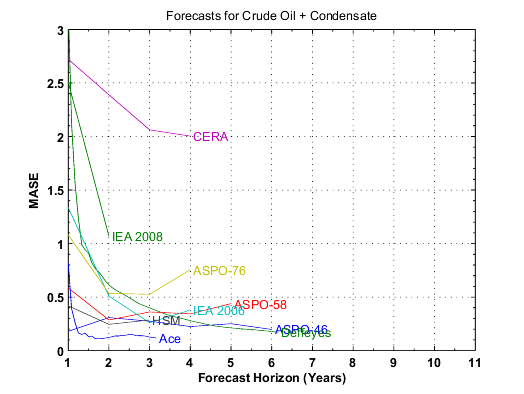

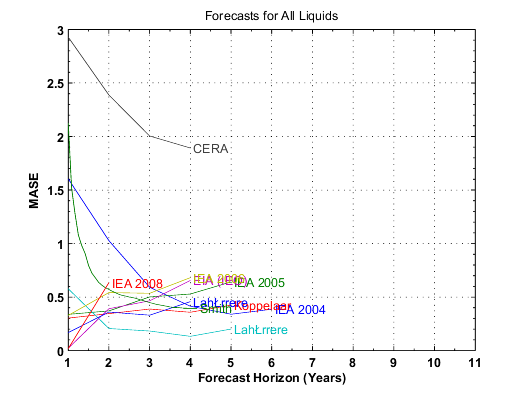
Fig. 7. - MASE values as a function of the forecast horizon.
Forecast Date 2006 2008 2009 2010 2015 MASE2 Peak Date Peak Value All Liquids Observed (All Liquids) 84.54 85.48 83.60 NA NA 2008-07 86.65 IEA (WEO) 2004 83.74 87.08 88.74 90.40 98.69 0.39 2030 121.30 IEA (WEO) 2005 85.85 89.35 90.98 92.50 99.11 0.64 2030 115.40 Koppelaar 2005 85.78 87.60 88.33 89.21 87.98 0.42 2011 89.58 Lahèrrere 2005 84.47 85.87 86.46 86.96 87.77 0.20 2014 87.84 EIA (IEO) 2006 84.50 88.23 90.00 91.60 98.30 0.65 2030 118.00 IEA (WEO) 2006 85.10 88.17 89.73 91.30 99.30 0.68 2030 116.30 CERA1 2006 89.52 93.75 95.34 97.24 104.54 1.89 2035 130.00 Lahèrrere 2006 84.82 87.02 87.99 88.93 92.27 0.46 2018 92.99 Smith 2006 87.77 94.38 96.98 98.94 98.56 0.39 2012-05 99.83 IEA (WEO) 2008 83.15 85.51 86.80 88.15 94.40 0.63 2030 106.40 Crude Oil + NGL Observed (EIA) 81.25 81.73 79.79 NA NA 2008-07 82.88 Duncan & Youngquist 1999 83.93 83.55 82.90 81.65 73.47 0.11 2007-01 83.95 Population based 2004 79.73 81.58 82.50 83.42 88.01 0.33 2050 110.64 GBM 2003 76.27 76.20 75.87 75.30 67.79 0.17 2007-05 76.34 Bakhtiari 2003 80.89 80.24 78.94 77.64 69.51 0.17 2006 80.89 ASPO-46 2004 80.95 80.59 80.31 80.00 73.77 0.12 2005 81.00 ASPO-58 2005 82.03 84.05 84.74 85.00 79.18 0.53 2010 85.00 Staniford (High) 2005 77.92 78.63 78.86 79.01 78.51 0.18 2011-10 79.08 Staniford (Med) 2005 75.94 75.91 75.76 75.52 73.00 0.30 2007-05 75.98 Staniford (Low) 2005 70.13 69.20 68.60 67.92 63.40 0.64 2002-07 70.88 IEA (WEO) 2006 81.38 83.96 85.24 86.50 92.50 0.72 2030 104.90 Koppelaar 2006 82.31 85.60 88.03 91.00 NA 1.20 2010 91.00 Skrebowski 2006 81.97 85.14 86.76 87.95 NA 1.01 2010 87.95 Smith 2006 82.81 88.27 90.58 91.95 88.60 0.34 2011-02 92.31 Loglets 2006 82.14 83.74 84.29 84.65 83.26 0.14 2012-01 84.80 ASPO-76 2006 79.00 85.06 88.49 90.00 85.00 1.11 2010 90.00 Robelius Low 2006 82.19 82.35 81.92 81.84 72.26 0.39 2007 82.50 Robelius High 2006 84.19 89.27 91.65 93.40 92.40 2.11 2012 94.54 Shock Model 2006 80.43 79.51 78.93 78.27 73.74 0.37 2003 81.17 EWG 2007 81.00 79.79 79.00 78.06 69.21 0.41 2005 81.39 IEA (WEO) 2008 79.80 81.59 82.49 83.40 87.40 0.71 2030 95.00 Crude Oil + Lease Condensate Observed (EIA) 73.46 73.80 71.93 NA NA 2008-07 74.80 ASPO-46 2004 72.56 71.89 71.47 71.00 63.55 0.20 2005 72.80 Deffeyes 2004 69.92 69.64 69.37 69.01 65.98 0.17 2005-12 69.94 ASPO-58 2005 73.80 75.39 75.89 76.00 69.50 0.44 2010 76.00 IEA (WEO) 2006 71.78 73.76 74.74 75.70 80.30 0.38 2030 89.10 CERA1 2006 76.89 80.35 81.58 82.29 83.83 2.00 2038 97.58 ASPO-76 2006 72.10 75.74 77.47 78.00 72.00 0.75 2010 78.00 HSM 2007 73.56 73.40 73.16 72.82 69.53 0.28 2006 73.56 Ace 2007 73.48 72.18 69.77 66.96 58.47 0.12 2006-01 73.55 IEA (WEO) 2008 69.73 70.64 71.06 71.46 73.00 1.07 2030 75.20 Table II. Summary of all the forecasts (figures are in mbpd) as well as the last EIA estimates.1Productive capacities. 2MASE value for March 2009, the value in bold indicates the best forecast (i.e. the oldest with the lowest error). Are We There Yet?
We can consider two competitive models for the crude oil + NGL production:
- M0: The oil production will continue to grow with the world population at a constant rate of 4.3 barrels per capita.
- M1: The production will fall according to the average peak oil forecast.
Fig. 8 - Likelihood ratio (M1/M0) at the left and Statistical significance of observed production levels according to M0 (the red circle is March 2009).
Previous Update:
August 2008[1] Rob J. Hyndman, Anne B. Koehler, Another look at measures of forecast accuracy, International Journal of Forecasting, Volume 22, Issue 4, October-December 2006, Pages 679-688. pdf available here.
Categories: Links
The Oil Drum available for Amazon Kindle
The Oil Drum is now available for the Amazon Kindle reader. You can purchase a subscription for $1.99/month. Ideally we would give it away for free, but Amazon won't let us.
Subscribe by following this link or by clicking the icon in the right sidebar.
Enjoy!
Categories: Links
DrumBeat: July 7, 2009
EIA raises 2009 world oil demand forecast
WASHINGTON -- The U.S. Energy Information Administration on Tuesday once again raised its world oil demand forecast for this year as the global economy gradually improves.
In its monthly energy outlook, the EIA increased its 2009 global oil demand projection to 83.85 million barrel per day (bpd), up 170,000 bpd from its June estimate of 83.68 million bpd. World oil demand this year is still well below 2008 levels of 85.41 million bpd.
The agency said consumption will rebound to 84.79 million bpd in 2010, up 380,000 bpd from the previous estimate of 84.41 million.
Oil prices: is there a spike on the horizon? So, have the past 12 months been a blip in the relentless charge ahead or were speculators the cause of an unsustainable boom?
The implosion of the global economy cut energy demand to such an extent that tankers were being used to store oil offshore in the hope prices would rise in the future. Offshore storage peaked in April, when 100m barrels were being stored aboard ships. However, since the oil price has started to recover, this oil is gradually being brought onshore.
More Ideas for Breaking the Climate Deadlock
There’s a batch of new proposals for breaking the persistent global deadlock over dealing with global warming, all coming as world leaders prepare to meet at the Group of 8 summit in L’Aquila, Italy, and in parallel sessions of the biggest emitters of greenhouse gases. Britain’s former prime minister, Tony Blair, rolled out a list of climate and energy strategies. A couple of other new ideas are summarized below. I will add reactions from other specialists immersed in the ugly nexus of economics, climatology, demography, diplomacy, energy policy and politics.
Pickens paring down wind farm project
T. Boone Pickens' plan to build the world's largest wind farm is off.
Instead, Pickens said he will build five or six smaller wind farms, in the Midwest and possibly Texas, though he hasn't settled on locations.
Last year, Pickens announced that he would build a 1,000-megawatt wind farm in Pampa, Texas. The problem a lack of a transmission line to bring the juice to population centers, Pickens said in an interview last week.
Rep. Welch pushed Vt. energy initiatives
"Although some dispute it, there is little doubt that our oil is a finite resource, that we are at or near-peak oil, that global warming is real, the threat to our economy immediate, the need to act urgent," Welch said.
The legislation will create jobs in a new "green" economy in Vermont and across the country, Welch said in a telephone interview prior to Friday's vote. "The concern I heard is people want jobs," he said.
The Fed and peak oil
Laurel Graefe, a senior economic researcher working for the Federal Reserve Bank of Atlanta has written an excellent overview of peak oil, “The Peak Oil Debate”. I consider this a must-read piece, as much for armchair oil experts as beginners, and as much for who published this as what it contains. This should be very high on your list of “brother-in-law” documents, the ones you can safely recommend to co-workers, neighbors, or, well, your brother in law.
While Graefe has taken a decidedly middle of the road approach, which will be enough all by itself to infuriate the Apocalypticons, she also touches on several points that I would have expected a publication from any part of the Fed to ignore.
B.C. pipeline bombings just a 'nuisance' to industry
RCMP are calling a wave of bomb attacks on natural gas facilities in northern British Columbia "terrorism," but an energy analyst says the bombings are having little impact on the gas industry.
When a takeover battle goes nuclear
What happens behind the scenes when one energy company refuses to be swallowed by a bigger rival?
EU Hits U.S. Biodiesel Makers With Five-Year Tariffs
(Bloomberg) -- The European Union imposed five-year tariffs on U.S. biodiesel to help EU producers counter American subsidies and price undercutting, a step that may stoke trans- Atlantic trade tensions.
The duties punish U.S. manufacturers of biodiesel, a type of biofuel made from vegetable oils and animal fats for use in diesel engines, for receiving government aid and selling in the EU below cost. The companies targeted include Archer Daniels Midland Co., the world’s largest grain processor, and Cargill Inc., the biggest U.S. agricultural company.
“This is all about protecting vested agricultural interests on both sides,” said Christian Egenhofer, a researcher at the Centre for European Policy Studies in Brussels. “Governments are not in control.”
California - And by Extension the U.S. - Headed for Permanently Smaller Economy
The June issue of Gregor.us Monthly, The Scholarship of Collapse, addresses several views of economic and systemic collapse from the works of Jared Diamond to Joseph Tainter, and then goes on to apply these views to the United States–and to its biggest state, California. Frankly, it’s not much fun to suggest that another leg down in housing is on the way. Or, that California is unlikely to see its GDP exceed its previous peak for quite some time. But without the two industries that characterized post-war growth in the US, housing and automobiles (and the financial industry that squatted on top of these) it’s hard to see how California–and the US by extension–does not become a permanently smaller economy.
ConocoPhillips Reports Increase in Second-Quarter Output
(Bloomberg) -- ConocoPhillips, the third-largest U.S. oil company, said second-quarter production rose from a year earlier as new projects came online.
Output of oil and natural gas climbed to the equivalent of 1.86 million barrels of crude a day, Houston-based ConocoPhillips said today in a statement on Business Wire. That compares with production of 1.75 million barrels in the second quarter of 2008.
Iran’s Political Turmoil Cuts Crude Oil Demand, PFC Energy Says
(Bloomberg) -- Iran’s oil will probably extend declines in the first four months of the year as the political turmoil that followed last month’s disputed presidential election damps economic growth, consultant PFC Energy said.
Oil demand dropped by 30,000 barrels a day in January to April year, compared with a growth of 100,000 barrels a day in the same period in previous years, Raja Kiwan, PFC’s Dubai-based analyst, said in a report received by e-mail late yesterday.
Congressional Smokescreen (Blown With Oil)
REINSTATE Glass-Steagall in its entirety, and return commercial banking to the utility function that it is and should be, as it is both regulated and protected by the government against the full consequences of failure.
Demand that those who want the "hedging exception" demonstrate their actual use of the commodity in question in amounts that correspond to the hedged positions held, with nightly reporting requirements to the CFTC.
Ghana May Buy Kosmos’s Stake in Jubilee Oil Field
(Bloomberg) -- Ghana National Petroleum Corp., the state-owned company that oversees the country’s nascent oil and gas industry, may buy Kosmos Energy LLC’s stake in the $3.1 billion Jubilee oil field.
Saudi, Total sign $9.6 billion Jubail refinery deals
RIYADH (Reuters) - Saudi Aramco and France's Total signed on Tuesday 13 agreements with contractors to build a $9.6 billion joint-venture refinery in the kingdom, state news agency SPA reported.
Aramco to start gas plant expansion in Sept
State oil giant Saudi Aramco plans to start up the expanded Juaymah gas plant in September, a few months later than last scheduled, sources working on the project said.
'Difficulties during the mechanical commissioning caused the delay,' one source told Reuters. The plant was last scheduled to come online in June, after several delays from the initial schedule to start in the first quarter of 2008.
The Dark Side of Climate Change: It's Already Too Late, Cap and Trade Is a Scam, and Only the Few Will Survive
Father of the Gaia Theory, James Lovelock says we can't stop climate change, but that humanity will continue in some smaller form.
Turkey Loses $630 Million Dam Financing on Flood Plan
(Bloomberg) -- Turkey lost European financing for a hydroelectric plant on the Tigris River after failing to offer environmental protections such as relocating antiquities from the Middle Ages that will be flooded by the dam.
GCC likely to pump $200bn into renewable energy plans
The choice of the UAE as the location of the International Renewable Energy Agency (Irena) will provide a strong push to efforts by Gulf and other Arab countries to develop such resources, said officials and analysts.
Although Gulf countries have the biggest conventional hydrocarbon resources, they need to develop other sources to meet a steady growth in domestic consumption and save those resources for future generations.
Nuclear Output Little Changed; Hope Creek in New Jersey Slowed
(Bloomberg) -- Nuclear output was steady today as the Hope Creek reactor in New Jersey slowed to 85 percent from full capacity yesterday and the Millstone reactor in Connecticut remained shut.
Output from U.S. nuclear plants decreased by 172 megawatts, or 0.2 percent, to 97,962 megawatts today from 98,134 early July 6, according to a report from the U.S. Nuclear Regulatory Commission. The total represents 98 percent of U.S. capacity. Two reactors are offline, according to the commission.
Vattenfall’s Kruemmel Reactor Won’t Start for Months
(Bloomberg) -- Vattenfall AB, the Nordic region’s biggest utility, said its Kruemmel nuclear reactor in Germany won’t start for “several months” and that the plant’s head resigned.
Vattenfall will replace the 1,346-megawatt facility’s two tranformers, the Stockholm-based company said today in an e- mailed statement. Hans-Dieter Lucht, the head of the plant near Hamburg, resigned after two automatic halts this month.
MDU to Join ITC on Green Power Transmission Project
(Bloomberg) -- MDU Resources Group Inc., the largest company in the Dakotas, said it will join with ITC Holdings Corp. in developing the Green Power Express, a transmission project that will link wind farms in the U.S. Plains to cities.
The transmission lines will run about 3,000 miles (4,827 kilometers) through North Dakota, South Dakota, Iowa, Wisconsin, Minnesota, Illinois and Indiana, MDU said today in a statement. MDU, based in Bismarck, North Dakota, said the Green Power Express will carry as much as 12,000 megawatts. One megawatt can power about 800 average U.S. homes, according to the Energy Department in Washington.
Richard Heinberg: Peak Oil Day - July 11
Maybe it’s a stretch to say that the production peak occurred at one identifiable moment, but attributing it to the day oil prices reached their high-water mark may be a useful way of fixing the event in our minds. So I suggest that we remember July 11, 2008 as Peak Oil Day.
We are now approaching the first-year anniversary of Peak Oil Day. Where are we now? The global economy is in tatters, yet oil prices have recovered somewhat (they’re now about half what they were in July 2008). World energy consumption is down, world trade is down, the airline industry is shrinking, and most of the world’s automakers are on life support.
It is too late to prepare for Peak Oil—a year too late, in fact. Now the name of the game is adaptation. We are in an entirely new economic environment, in which old assumptions about the inevitability of perpetual growth, and the usefulness of leveraging investments based on expectations of future growth, are crashing in flames. Even if economic activity picks up somewhat, this will occur in the context of an economy significantly smaller than the one that existed in July 2008, and energy scarcity will quickly cause most green shoots to wither.
Oil, Gas Market Speculation May Face Restrictions by U.S. CFTC
(Bloomberg) -- U.S. regulators say they may clamp down on oil and gas price speculators by limiting the holdings of energy futures traders, including index and exchange-traded funds.
The Commodity Futures Trading Commission will hold hearings to explore the need for government-imposed restrictions on speculative trading in oil, gas and other energy markets, Chairman Gary Gensler said today in a statement. The agency didn’t say when the hearings would start or who would be asked to testify.
$20 Oil Is On The Table Again: Can Obama Pull The Israeli Rabbit Trick?
The bears are out again and there is talk of $20 oil; the logic is:
• All the oil stored up in super-tankers will flood the market.
• World GDP growth is low and perhaps getting lower or at least not likely to rocket any time in the immediate future.
But much of the oil stored in tankers was bought against futures contracts so it's sold waiting delivery. That was a nice little win-win situation for anyone who could buy oil when the current price was a lot less than what you could sell futures for. But don't expect the tooth fairy to touch you on the shoulder twice in a row; sure there may be a trading opportunity when that unfolds, and maybe not, it will all depend on the "discipline" of OPEC, and if you are a betting man on that sort of thing, well place your bets!
Oil Prices: Demand, What Demand?
Crude oil slud, as Dizzy Dean might have said, to $64 a barrel, continuing a dismal run for oil and underscoring just how uncertain the global economic outlook really is.
But here’s the thing: Even a modest economic recovery might not do the trick. Demand for oil cratered after last year’s spike in prices, and could go walkabout for years to come. Crude futures closed down 4% today to $64.05.
Lock ‘n load
Today’s deflationary environment will ultimately be replaced by inflation. You’ll have no trouble recognizing this when oil hits $150, a litre of gas is a buck and a half, food prices are going nuts and mortgage rates are rising monthly.
But this will not make us Argentina. Instead of hyper-inflation which wildly inflates wages, salaries, prices and asset values at the same time, this is the kind that just sees prices go up, while your income doesn’t. There are many sound economic reasons for my saying this. I’ll explain over a few scotches some time.
This inflation will also not escalate house values. Not by enough to compensate for your lost net worth, anyway. The main reasons will be stagnant family incomes, the debilitating effect of energy prices and rising mortgage costs.
Schork Oil Outlook: The Fear Trade
Apropos the current strength in the market, the common refrain amongst traders and analysts interviewed on these shows goes something like this… I don’t believe in this market’s strength, but I want to participate while it lasts.
Got that? Traders are so desperate that they are now buying, not on fundamentals, but rather on fear of missing out before this market heads back into the toilet.
Repsol Says Global Oil Reserves Will Cover 40 Years of Needs
(Bloomberg) -- Repsol YPF SA, Spain’s biggest oil producer, said existing global oil reserves will meet supply needs for 40 years while gas reserves will last for 60 years.
New areas of exploration such as offshore blocks in Brazil and Siberia will add to future reserves, Nemesio Fernandez Cuesta, general director of upstream at Madrid-based Repsol, said today at a conference in the Spanish capital.
Nigeria Rebel Attacks Shut 589,000 Barrels of Oil, Trust Says
(Bloomberg) -- Armed militants targeting Nigeria’s oil industry shut 589,000 barrels of crude a day in two months, Daily Trust reported, citing Mohammed Barkindo, head of the Nigerian National Petroleum Corp.
The losses resulted from more than 12 attacks carried out between May and June, Barkindo told oil and gas workers at a meeting in the capital, Abuja, according to the report.
Is Nigeria Still a Relevant Issue for Oil?
At the end of June, the oil market got something it hadn't had in a while: news of actual, real-life supply shock. After months of declining demand reports and inventories that are quite robust, the unrest in Nigeria gave people something bullish (admittedly not happy) to add to their buy/sell equations.
PDVSA Sells $1.42 Billion of Bonds, Less Than Planned
(Bloomberg) -- Venezuelan state oil company Petroleos de Venezuela SA issued $1.42 billion of bonds in the local market, less than half the $3 billion it planned to sell.
China eyes $14.5-billion bid for Repsol stake
China National Petroleum Corp. (CNPC), the country's largest oil company, could pay up to $14.5-billion (U.S.) for 75 per cent of Spanish oil major Repsol's REP-N Argentine unit YPF, sources said on Tuesday.
Russia's Gazprom confirms Naftogaz payment for June gas volumes
Moscow (Platts) - Russia's Gazprom confirmed Tuesday it received payment from Ukraine's
Naftogaz Ukrayiny for gas supplied in June.
"Naftogaz has paid in full for June gas supplies," Gazprom official spokesman Sergei Kupriyanov said Tuesday in a statement.
Oman Seeks to Produce 804,000 Barrels a Day of Oil by Year End
(Bloomberg) -- Oman, the largest Gulf Arab oil producer that isn’t a member of OPEC, seeks to produce 804,000 barrels of oil a day by the end of the year, its economy minister said.
Chinese oil firms may bid for Iraqi oil fields
BEIJING (AFP) – China's three largest oil companies may take part in Iraq's second auction of oil and gas fields, as the Asian giant seeks to strengthen its foothold in the oil-rich nation, state media said.
Iraqi oil revenues up in second quarter
Iraq says its oil revenues rose by more than 45 percent in the second three months of the year compared with the first quarter.
Oil Ministry figures released Tuesday showed that second-quarter revenue was about $9.57 billion, up from $6.57 billion in the first quarter.
Russia subsoil law up for discussion
US oil major ExxonMobil is looking to clinch new deals in Russia but sees the country's subsoil law, which limits foreigners' access to strategic fields, as the main obstacle, an executive said today.
China to slap curfew on riot-torn city
Xinjiang has long been a hotbed of ethnic tensions, fostered by a yawning economic gap between Uighurs and Han Chinese, government controls on religion and culture and an influx of Han Chinese migrants who now are the majority in most key cities.
Beijing has poured cash into exploiting Xinjiang's rich oil and gas deposits and consolidating its hold on a strategically vital frontierland that borders Pakistan, Afghanistan and Central Asia, but Uighurs say migrant Han are the main beneficiaries.
India: Govt may end fuel price curbs; cuts natgas tax
NEW DELHI (Reuters) – India, Asia's third-largest oil consumer, outlined plans in Monday's national budget to pull domestic fuel rates into line with global prices and waived tax on natural gas production to spur investment in exploration.
Finance Minister Pranab Mukherjee said the government would form an expert group to decide on a viable fuel pricing system in an announcement just days after India hiked petrol and diesel prices by as much as 10 percent after a recent rally in global crude prices.
GM product chief says no delay for plug-in SUV
DETROIT (Reuters) - General Motors is on track to launch a plug-in sport-utility vehicle in 2011 despite scrapping its Saturn brand as part of a sweeping reorganization in bankruptcy, according to the automaker's product chief.
"I can tell you that I won't lose one day in terms of customers being able to walk into dealerships and actually purchase a plug-in," GM Vice Chairman Tom Stephens said in an interview.
Pure Energy Launches - First National Radio Program Dedicated to the Business of Renewable Energy
MIAMI /PRNewswire/ -- Pure Energy, the first national radio show dedicated to the business of renewable energy, is launching from the Miami studios of 880 The Biz (WZAB) on Monday, July 13, 2009 at 6:00 p.m. EDT. Pure Energy is hosted by noted energy expert Sean O'Hanlon, who is also the Executive Director of the American Biofuels Council (ABC). Guests for the premier show include renowned engineer and author Dr. Robert Zubrin as well as worldwide peak oil expert and author of nine books including "Peak Everything," Richard Heinberg.
"With oil prices heading back over $70/bbl, and set to go higher, it could not be more urgent for America to take immediate action to break free of the stranglehold of the oil cartel," said Zubrin, author of "Energy Victory". The U.S. congress could effectively destroy OPEC with the stroke of a pen simply by passing a law requiring that all new cars sold in the U.S. be flex fueled. Such a law would make flex fuel the international standard and would thereby create fuel choice all around the world."
Carbon vs Cap and Trade - taxes that will never go away
All that talk to get us away from oil is partly a ruse. Sure, we need to get off of oil, but "peak oil" doesn't mean no oil at all, like we're dry. Besides, there are plenty of ways to transform our country without taxation. How about giving people a tax break? Why not be positive, but government-revenue neutral? That won’t happen, and here’s why.
Whther we have a straight Carbon Tax or a Cap and Trade, process especially reflects a political end game, a massive scheme in socio-economic engineering that makes automotive technology look like a grade-school science project. The project really started when the green heads kidnapped the ultra-liberal wing of government to advance their fears of climate change, aside from the fact the planet has seen multiple climate changes long before man ever walked the earth.
Transition Town timeline - a vision of hope
The Transition Town movement has produced a year-by-year timeline to lead us to a happier, healthier society. Shaun Chamberlin outlines this vision - beginning with a landmark 2010 climate change accord.
Incandescent Bulbs Return to the Cutting Edge
SANTA ROSA, Calif. — When Congress passed a new energy law two years ago, obituaries were written for the incandescent light bulb. The law set tough efficiency standards, due to take effect in 2012, that no traditional incandescent bulb on the market could meet, and a century-old technology that helped create the modern world seemed to be doomed.
But as it turns out, the obituaries were premature.
Researchers across the country have been racing to breathe new life into Thomas Edison’s light bulb, a pursuit that accelerated with the new legislation. Amid that footrace, one company is already marketing limited quantities of incandescent bulbs that meet the 2012 standard, and researchers are promising a wave of innovative products in the next few years.
China's first of 7 mega wind farms ready to start rolling
China will start constructing a 10-gW wind farm in Jiuquan, Gansu province on Friday, the first in a batch of similar mega wind power projects the country has planned for over the next few years to increase the share of clean energy sources in its power consumption mix.
ADB backs China wind farm project
MANILA (AFP) – The Asian Development Bank is helping to finance a pioneering private-sector wind farm in China's Inner Mongolia that will help the fast-growing nation fight climate change, officials said.
The Manila-based ADB is lending about 24 million dollars towards the overall cost of 73 million dollars for the facility, China's first wind farm to be built as a joint venture between Chinese and Japanese companies.
Hybrid Solar Cells Shine
As the race to create clean, renewable power heats up, the solar industry is focusing on a technology in hopes of producing utility-scale energy.
Concentrating photovoltaic (CPV) solar power -- which marries traditional solar photovoltaic technology to large-scale concentrated solar power plants -- could ramp up utility-scale solar production, advocates say, especially in niche markets. But as with all developing technologies, the effort faces significant hurdles.
Coal Industry Sees Life or Death in Senate Climate Debate
When people in the coal business talk about "the valley of death," they are referring to a grim place not located near any mine. It is an economic chasm that the industry fears awaits it if the Senate approves climate legislation similar to what passed the House.
India Says Developed Nations Are Responsible for Climate Change
(Bloomberg) -- Developed countries must bear “historic responsibility” for industrial emissions of greenhouse gases they have produced, India’s Prime Minister Manmohan Singh said ahead of climate change talks this week.
“What we are witnessing today is the consequence of over two centuries of industrial activity and high consumption lifestyles in the developed world,” Singh said in a statement in New Delhi today before leaving for the Group of Eight summit in Italy. “It is the developing countries that are the worst affected by climate change.”
World's rich targeted in new model for carbon cuts
(CNN) -- Researchers in the U.S. have proposed a new way of allocating responsibility for carbon emissions they say could solve the impasse between developed and developing countries.
The method sets national targets for reducing carbon emissions based on the number of high-income earners in each country, following the theory that people who earn more generate more CO2.
How the US Is Blocking Progress on Climate Change
As the predictions for global warming get more and more alarming, talks on a worldwide climate treaty have stalled --largely due to the United States. The G-8 summit in L'Aquila, which begins Wednesday, is likely to generate little more than the usual platitudes.
A new take on Kyoto
Obama's fear is the US will be unable to cut fast enough. And if it fails, US taxpayers could have to pay for a billion tonnes of carbon credits. At $20 per tonne of CO2, that would add up to serious money. But with a large forced buyer like the US, the carbon price could soar. Just how high, no one knows. Obama is understandably reluctant to take on such a huge open-ended commitment – one which could prove highly unpopular with electors demanding spending on health, education and pensions.
Can Obama find a way out? Yes he can! He should ditch the whole system of national emissions targets and move instead to a genuinely global system for regulating emissions. It sounds revolutionary, and it is. But a proposal along these lines could garner widespread international support. The talks leading up to the Copenhagen climate conference in December are stuck. Governments are all reluctant to take on ambitious targets – because doing so could cost their taxpayers dear, and because they fear competitive disadvantage compared to countries with weaker targets.
'The Greenland Ice Sheet Is an Awakening Giant'
The Greenland ice sheet is, like some regions in Antarctica, an awakening giant. In the coming centuries it will add significantly to the global sea-level rise. It matters to a huge number of people around the globe, as there are definitely regions that are very sensitive to even the slightest changes in the global sea level. People in the Indian Ocean island nation of the Maldives, for example, are already worried right now.
Categories: Links
Recent comments
3 days 5 hours ago
10 weeks 22 hours ago
12 weeks 1 day ago
12 weeks 6 days ago
22 weeks 1 day ago
22 weeks 1 day ago
23 weeks 4 days ago
24 weeks 8 hours ago
26 weeks 8 hours ago
30 weeks 2 days ago