- Recent Posts
- News Feeds
- PPO Notes & Groups
- Site Help
- PPO's Principles of Preparedness
- Speaker's Bureau
- Gardening notes and charts
- Groups
- Meeting Minutes
- Council meeting minutes
- 2005-06 PPO Business meeting minutes
- 2005-10 PPO Business meeting minutes
- 2005-11 PPO Business meeting minutes
- 2006-01 PPO Business meeting minutes
- 2006-02 PPO Council meeting
- 2006-06 PPO Council meeting minutes
- 2006-07 PPO Council meeting minutes
- 2006-10 PPO Council meeting minutes
- 2007-01 PPO Council meeting minutes
- Council meeting minutes
- Portland Neighborhood Associations Links
- PO Task Force Position Paper
- PPO group management, process and logistics
- Resources
The Oil Drum

Australia: What to do, what to do about our energy situation?
Introduction
In my last post I suggested that over the next 5 years Australia’s ability to import oil will be severely constrained. We won’t be able to just switch suppliers, because that is what everybody will be trying to do – we need smarter solutions and they need to start now. In this post I look for the responses that we need to make.
There is no better group of people to answer this question than the TOD community. The calamity that we had warned of seems to be occurring, and the words "Peak Oil" now appear in mainstream media news articles on a regular basis. Our warning was heard late - probably too late for some - but it is being heard.
It is now time to turn our minds to defining solutions. This area has been approached by several TOD contributors (with valuable insights ranging from specific technical approaches to the more general ELP approach). I propose that we now need to organise and categorize the full range of actions needed. If we are going to call on politicians and business leaders to act, we need to define what actions are required. It is not enough to scare people - we need to provide a call to arms, not a call to panic.
[break]
Obviously solutions will need to address political, social and economic issues. In addition solutions need to be framed within the context of the environmental problems that we face. Clearly the scope of this question is immense. But a start must be made, so here are some thought-starters:
The First EffectsIf oil is constrained, what will be the effect in Australia?
In 2005 the US Department of Energy commissioned a study by the Oak Ridge National Laboratory to look specifically at the impact of high oil prices. In the conclusion this study finds that:
This analysis also confirms that the three components of oil dependence costs (wealth transfer, potential GDP loss, and macroeconomic adjustment costs) are approximately equal in size. Thus, focusing on the costs of oil price shocks alone and ignoring wealth transfer and the persisting effects of high oil prices on potential GDP losses would underestimate the true costs of oil dependence by about a factor of 3.
Constrained oil leads to higher oil prices, and high oil costs have three economic consequences:
1. Impact on GDP
2. Transfer of wealth from importing nations to exporting nations
3. Macroeconomic costs
The first pain that we feel will be economic pain, and it will be felt in those three areas.
The Next EffectsWhat comes after the economic impacts?
If the economic impact of high oil prices includes a transfer of wealth to the oil producing nations, then there will come a time when large, powerful importing nations will conclude that this transfer of wealth is not in their national interest – and that a military solution is a better option.
Although we are not an oil exporter, we are an energy exporter. Australia exports coal, natural gas and uranium. We have one of the highest ratios of energy resources per capita, (also arable land per capita, mineral resources, etc), so it might be wise for us to watch what happens to oil exporters, as our own situation may have some similarities at a later date.
What Are The Solutions Here in Australia?There are those who tell me that we are doomed by the fact that, with a population rapidly approaching 7 billion, the Earth has already exceeded its carrying capacity. I have this answer: The population of Australia is only 21 million. Yes, we have a shortage of water and oil, but these shortages will only lead to certain disaster if we do nothing.
There are multiple areas where solutions must be found. Below is a list of broad areas that must be addressed and a few points about how to address them. I suspect that the list is far from complete and I have no doubt that the TOD readership is well equipped to add to this list.
Solutions: Technical.Like it or not, we cannot transition to a renewable energy base in a day. Both non-renewable and renewable energy sources will be required for decades to come.
Environmental issues must be addressed. Power solutions that require large amounts of fresh water are just as crazy as water solutions that use large amounts of high-quality power (such as desalination), and neither can be entertained.
Overcoming the Constraint in Liquid Fuels
Above all, we must remember that this is a liquid fuel emergency. Liquid fuels such as petrol, and diesel are easily transported (no wires required) and very energy dense (45 kg of petrol will take a car about 500 km, while 45 kg of lithium batteries will only take it a fraction of that distance). These capabilities make liquid fuels hard to replace.
However technological solutions are already practicable:
- Battery/electric cars. Removing the requirement for liquid fuel by developing battery-powered cars is a partial answer as it gives us the capacity to move people and goods on short journeys to destinations outside of public transport routes. Some battery cars are already in limited production, and GM claims that it will be bringing out a large-production car (the Chevrolet Volt) in 2010. Hybrid cars and PHEVs also provide a partial solution. Although electric cars offer part of the solution, we will still need the capacity to move large loads for long distances.
- CNG vehicles. Australia has significant gas deposits. LNG and CNG are likely to be part of the Australian solution.
- Synthetic fuels. Producing liquid fuels from our gas and coal deposits (CTL and GTL) is another part of the likely solution, but there will be an environmental cost. We will need to find a way to soak up the CO2, and ways to address the other environmental issues.
- Solar power. Australia is richly endowed with sunlight. Solar Thermal and Photovoltaic (including thin film) technologies are both likely to be part of a solution. Solar generally delivers electricity, not a liquid fuel, but this energy can fill needs that would otherwise be provided by fossil fuels.
- Algae oil. Algae oil is one of my current crusades. In the geological past algae proved to be a great sink for CO2. Australia has enormous potential for growing algae to offset the CO2 produced by GTL and CTL processes. The oil can then be removed from the algae, leaving a significant amount of waste (around 70%) to be sequestered. Sequestering will probably be done by charring the waste (possibly by fast pyrolization) in a solar thermal furnace, then using the char as a soil enhancer.
Which solution do we need? None of the above solutions is a complete answer to the liquid fuel issue. We will need all of them.
Increase energy efficiency to cut energy dependence
Reducing power requirements also reduces water requirements. The quantity of water that is consumed by power generation is rarely appreciated. A single 60 watt bulb can consume nearly 1 liter of water of water per hour if left on.
Increasing energy efficiency will require more than just turning off the light switches. Whole new technologies may be required:
- Improving train infrastructure. There are existing lines that are currently unused. Restoring these lines offers a cost-effective approach to increasing transport efficiency. Unfortunately, this process will take decades, and there will never be a train to everywhere.
- Improved sea/water transport. Water transport (River and ocean) is extremely energy-efficient.
- Air transport by dirigibles is an old technology that is making a comeback. Dirigibles that look like giant wings is an emerging technology that shows great promise.
- Improvements in sail technology make local water transport even more attractive, sail powered river ferries are a possibility wherever winds are reliable.
- Sea transport powered by giant kites is a technology already being implemented
Solutions: Changing The Economic ParadigmThe current Fractional Reserve Banking system requires growth in order to supply the extra money required to service interest on debt. If energy is constrained and growth is not possible, an intolerable strain is placed on this system. A Steady-State economic system may need to be put in place. Once again, this is a big change – it may take time, and is likely to be politically unpalatable.
Solutions: BusinessBusiness is already feeling the pinch, making this a difficult time to be proactive. However action is required. Goldman Sachs has been consistently right with oil price predictions and are now forecasting a “Price Super-spike” of $200/barrel. The events following that are hard to predict, but that there will be effects is not really in doubt. Businesses need to address the issues now, rather than wait for them to reach full impact. Now is not the time to be running lean inventories and a just-in-time supply chain. Agility and resilience will be the key to surviving the associated effects.
- Conduct an inventory to establish vulnerability to a liquid fuel shortfall. The most likely area will be transport. Is your business dependent on transport? To what extent are your staff dependent on transport? Are your business partners dependent on transport? Your supply and distribution?
- Develop redundancies and move to alternatives.
- Increase inventory to allow for supply interruptions
- Locate any single points of failure and assess the vulnerability
- Create scenarios. Workshop if necessary.
- Plan mitigation.
Can your staff work from home? Do you have IT Infrastructure in place to support a large number of staff working from home? Has your HR signed off on working from home as an OH&S option?
Solutions: Government/political.Links to oil producers will be required. We need to remember that we are a food exporter at a time when a food crisis is emerging across the world. Most of the oil producers are food importers.
If they want our food, then our farmers need their oil.
It might seem that we can just choose one oil importing country and offer them food in exchange for their oil, but unfortunately, many of these countries are quite unstable. For this reason, it would be wise to diversify as much as possible, so that we are not dependent on one source.
Many of our current sources of oil have no requirement for our food, but there are a few logical targets. The logical targets are:
- Iraq. We already have a history of supplying food to Iraq. It might be time to create an explicit link between food and oil, perhaps introducing the concept of a “Most Favored Trading Partner” status, with associated discount wheat in return for guaranteed oil. Sadly, this country is not stable, reinforcing the need to diversify.
- Angola. Angola is not a traditional supplier of oil to Australia. However they have relatively new fields with expanding production. And they have a food problem. Sadly, this is another country with stability problems, so the need for diversification of supply is again underlined.
- The Philippines. This country is one of our current oil suppliers, and they have a current (acute) food problem. Now might be a good time to negotiate a long-term food for oil trade relationship.
- UAE. Another of our usual oil suppliers, UAE currently imports over $145 million/year worth of Australian wheat, meat, fruit, dairy and grains. Once again, it would be relatively easy to link oil with food.
There is one potential flaw in this plan. Several of the oil exporting nations know that food is a significant vulnerability, and they are seeking to address this problem by buying farmland in foreign nations. If this trend becomes widespread, then Australia’s leverage as a food producer would be significantly reduced. The amount of wealth available to Middle Eastern nations is significant. They could certainly buy enough farmland to guarantee food security if they prioritized this as a goal.
This makes negotiations with nations such as Angola and the Philippines even more important.
We also need to form alliances in order to minimize our profile as a resource-rich, sparsely-populated target. In a time when the world is recognizing the emergence of several new super-powers, it is hard to know how to achieve this, and it will undoubtedly require a delicate touch.
Military planning and procurement needs to be considered. If a price of $225/barrel for oil is assumed, what impact will this have?
The current trend towards large, heavy vehicles and the profligate use of fuel to support troops must be reversed. In some cases this may be as simple as replacing steel armour with composites (eg. replacing the steel in the Bushmaster armoured car with Kevlar composites), but in other cases it will require new strategies and tactics (more use of “light fighter” troops, more emphasis on air defense, rather than air support, etc).
Solutions: EnvironmentalThe most pressing environmental problems in Australia include climate change, greenhouse Gas emissions and water scarcity.
Greenhouse gasses
Reducing emissions will not be enough. We need to remove CO2 from the atmosphere and we need to start now. Algae has already been mentioned as a promising way to achieve this goal.
Saving Water
Water is a problem here in Australia. The latest solution is desalination plants. However desalination uses so much power that it has been likened to “bottling electricity”.
If reducing our energy requirements and CO2 footprints is a priority, then we may have to face the reality of recycled water.
Desalination is one of the most glaring examples of solving a problem by making another problem worse, but it is certainly not the only one. The fact that we flush our sewage out into the ocean is another example that will leave future generations speechless in disbelief.
Solutions: LocalizationCheap oil made it possible to move goods immense distances at minimal cost. This allowed economies of scale to outcompete the advantages enjoyed by local producers. This trend will need to be unwound in some areas. In some cases localization of production may even devolve down to individual families.
Localization: A worked example.
“Victory Gardens” is a concept that emerged in response to the resource constraints that the government faced during WWII. Significant resources were freed up simply by removing the necessity to produce and distribute some of the more difficult-to-handle vegetables.
The key to success is to identify which vegetables save the most energy if grown at home, and which benefit more from the economies of scale offered by industrial agriculture. As a simple illustration of the difference, consider grains and leafy vegetables. Should we localize wheat growing? Or lettuce growing? Or both?
Harvesting a home-grown lettuce and preparing it for consumption consists of going out to the back yard, picking it, bringing it in, and washing it. A farm-grown lettuce, on the other hand, requires sophisticated and very energy-intensive processes just to transport it intact. The head of lettuce must be carefully packaged to minimize damage to leaves and then it must be transported rapidly, in temperature-controlled vehicles. Encouraging people to grow lettuce at home offers clear advantages. It is easy to grow, harvest and prepare.
However the reverse is true for grains such as wheat, rice or oats.
It is not very practical to grow your own wheat in an average backyard garden. The amount of land needed to grow enough wheat for a family will usually exceed the amount of land the family has available. In addition, wheat is hard to process. Harvesting, separating wheat from chaff, and grinding are all processes that benefit from economies of scale. But, unlike lettuce, once wheat has been grown and processed it is very easy to transport and store.
Clearly lettuce is a candidate for home-growing, but wheat benefits from the economies of scale offered by Industrial Agriculture.
The energy cost of producing and delivering food was the subject of a study that occurred after the first “oil shock” of 1973. A significant finding from this study was that massive inputs of energy are necessary to produce and deliver meat.
In addition to growing vegetables at home, if even a small percentage of the energy load associated with meat production could be avoided, the energy savings would be significant. There are obviously three strategies in approaching this goal:
1. Encourage people to eat less meat
2. Encourage people to eat less energy-intensive meat (i.e. move away from beef, to meats that require less energy, such as chicken)
3. Encourage people to go back to traditional practices such as keeping chickens, rabbits or similar animals in their back yard.
Localization: Generalizing the Principle
The example of lettuce and wheat was provided above, but this approach can be applied to all foodstuffs, and indeed all energy using activities. It is worth noting that this approach addresses two problems at once – it reduces CO2 emissions and energy requirements.
When considering if a given activity should be localized in response to energy constraint, the questions to be asked are:
- What resources and energy does a given activity need, and can this activity be further broken down (e.g. breaking energy consumption down by food type reveals that meat and vegetables may benefit from changes, but grains probably would not).
- Is there a need for this activity to be done and is the need a priority when compared to other needs?
- Can the need be met by completely different, more effective processes (e.g. moving some percentage of protein production away from cattle and towards the localized raising of smaller animals).
- If the current process is to continue, can it be done more effectively (by using less material, less energy, reusing or recycling of components, etc)?
- If the activity is heavily centralized then, given that we face an increasingly energy and carbon constrained environment, would it make sense to decentralize the activity?
Fostering Social Solutions at the Local Level
People’s behavior needs to change. In addition we need to deal with the social consequences of economic and environmental difficulties that we face.
We need to educate the public early and enlist them as part of the solution.
We need to encourage people to analyse energy usage and rationalize it. The personal use of energy must be viewed as a social issue. Activities such as walking or cycling to the train station must be viewed as a social obligation.
Local social units must be fostered at every level – for everything from carpooling to swapping seedlings and gardening tips.
Local task forces need to be encouraged. If correctly handled the costs should be minimal. Many people are almost evangelical about their hobbies, and would welcome the chance to set up localized groups that address issues such as:
- Vegetable gardening
- Bicycle building and maintenance
- Modifying your house to reduce energy needs
- Creating a no-dig garden bed
- Backyard permaculture
In general the local knowledge exists and the infrastructure exists. The only intervention needed is organizing and promoting the activities.
As part of a move to localization of production it may be necessary to encourage local councils to do an inventory of local strengths and weaknesses. Are there any goods and services that should be produced locally that are not? This will require identifying activities and deciding on an appropriate level of localization for each activity. For example, it might be appropriate to expect an electronic and computer repair capability at the local level, but it would be inappropriate to expect a computer production facility at the local level.
Local councils should also address related questions: Are there any locally produced goods or services that are vulnerable to a disruption in the supply chain? What would be the impact?
Many local areas have regular “Computer Swap Meets”, or similar organized markets. It would be wise to foster these events and try to broaden the base of locally-produced goods and services available. Doing this should reduce the strain on infrastructure at the wider level, by reducing the necessity to bring in these goods and services.
SummaryOur society has evolved into a "network of systems" and it now faces a corresponding network of problems. The danger is that our tightly-coupled, mutually-dependant society could suffer from a sudden, cascading collapse. This happened, to a limited extent, in the Russian collapse of a decade ago - but Russia's systems were loosely coupled with a lot of built-in resilience. Russia did not have the lean, "just in time" inventories and single-point-of-failure systems that we now depend on.
Our ability to meet the challenge will depend on our ability to do three things:
1. Decouple the dependencies in our system and build in resilience. Resilience has fallen out of favour, we currently favour "efficiency" instead, but there is a danger inherent in this efficiency. Just-in-time inventories and single points of failure offer great economic advantages when they work, but they are not the correct model for the turbulent times ahead.
2. Remodel our society and economy in line with the new situation
3. Solve the technical challenges (probably the easiest of the three to achieve)
Achieving this is not going to be easy. The problem permeates every level of our society, so it is time to take an inventory of the solutions – at every level of our society.
Categories: Links
Abqaiq and Eat It Too (or, More Geological Analysis of Potential Saudi Depletion)
Abqaiq, an aging super giant Saudi Arabian oil field, has yielded over 11 billion barrels of oil since it was discovered in November of 1940. Its past provides us with the poster child for easy oil. The first well flowed at 9720 barrels per day, a far cry from today's land finds where multiple horizontal laterals are necessary to coax lesser quantities from stingier reservoirs. But Abqaiq's more recent past paints a more muddled picture, as efforts to extract the remaining oil have produced mixed results. More advanced recovery methods have been successfully employed in some parts of the field, but these have likewise revealed unexpected geological complexities which have in turn hindered recovery in other areas. Many of the new challenges encountered in Abqaiq are relevant to the future prospects for other fields, particularly Ghawar and Khurais. This article will evaluate the development status of the field using satellite imagery to identify recent drilling in correlation with several recent technical reports on new developments and strategies for maintaining production.
[break]
Previous entries in The Oil Drum, Satellite Edition:
"Wolde you bothe eate your cake, and have your cake?"
John Heywood, 1536
Abqaiq is situated to the northeast of the Ghawar oil field and to the southwest of Dhahran and the headquarters of Saudi Aramco. It has been producing oil for over 60 years, and although there is still more oil to be had, it has recently become more proclaimed as a supposed harbinger of continued success by Saudi Aramco. The past and predicted future production from Abqaiq was revealed in a Nansen Saleri (formerly of Saudi Aramco) presentation at CERA Week in February 2007 shown below (click for larger version):
There are several features indicated in the above graphic, but of particular note are the Oil Initially In Place (OIIP) for the field (24.7 billion barrels), the marked decline in production since the mid-1990s, and the expected contribution from "Other" reservoirs for future production. The vast majority of Abqaiq oil has been produced from the Arab-D reservoir, an NE-trending anticline with an uplift on the southern end. Lesser amounts have been produced from the lower-lying Hanifa reservoir, separated from the Arab-D by over 300 feet of the Jubaila formation. As indicated, an increasing fraction of the total production is predicted to come from the Hanifa, starting from about 2006. But this is not a new aspiration: intensive efforts to tap the Hanifa began in the early 1990s and these have had, as is apparent from the data, minimal success. The idea was to perform an intensive waterflood of the lower reservoir, with a combination of horizontal injectors and producers (Oil & Gas Journal; Jun 21, 1993), but things clearly have not worked out as expected.
Typical of the spin on Abqaiq is this take by Saleri as reported in the WSJ Environmental Capital Blog:“Abqaiq became a renaissance story for Aramco,” he says, insisting that the field’s pressure remains strong and its water content is going down even after more than 60 years in production. Abqaiq “is doing fantastically,” Of course, part of the disconnect here is that "doing fantastically" means different things to different people. For a reservoir engineer (such as Saleri), this might mean keeping the water cut low and getting the highest possible recovery from the field. However, for a consumer of Saudi oil, the trend of decreasing production in this decade is not a promising development. As for a "renaissance", I suppose one could point to the surge in production in the late 1980s. But if we put this in context of overall Saudi production (below figure), it seems more likely that this increase resulted from a renewed desire to produce fully rather than a renewal of the field itself.
Much has been made of the decreased water cut (from 42% in 2004 to 32% in 2006, see SPE 110979: Technological Applications Redefining Mature Field Economic Limits). While this does improve the economics of keeping things going without needing new equipment for separating oil from water, it does not necessarily lead to more oil. Note the trend in the figure below (red=oil, blue=water).
The final arbiter, however, might the person counting the money. If we consider the revenue from the oil extracted from Abqaiq, in constant 2007 dollars, the picture improves tremendously:
Satellite images of Abqaiq presented herein, as well as recent technical reports and comments by Saleri and others, suggest that Saudi Aramco is still serious about keeping the oil flowing. About half of the Abqaiq OOIP has been produced to date. Their goal of another 20% will not come as easily as the previous 20%, and is certainly not a foregone conclusion that it will happen -- or happen at the rate that they expect. Using a satellite analysis as a backdrop, let's see how some of their recent efforts are doing.
As of this writing, Google Earth displays high resolution imagery covering the entire Abqaiq field dating to September 6, 2006. There are also low-resolution previews available, covering 2/3 of the field, which date to November 11, 2007. These will be used to identify additional work in the field subsequent to the 2006 date.
Taking Measurements
In the image at right, the outer and inner polygon overlays denote the original oil/water contacts (OOWC) for the Arab-D and Hanifa Reservoirs, respectively. These were determined using publications described herein in conjunction with actual well locations. Shown below are reservoir size estimations based on the measured areas and literature petrophysical parameters for Abqaiq.
The total OIIP calculated for Abqaiq (29.5 billion barrels) is somewhat high compared to the figure stated by Saudi Aramco (24.7), although there are many uncertainties in some of the assumptions. For one, no allowance was made in the above calculations for edge effects. This will tend to overestimate oil volumes for both reservoirs. Also, initial water saturation values might be different than those assumed; larger values will translate into less OIIP. The calculated distribution of oil between the various reservoirs and zones, however, is probably more accurate than the absolute numbers. Although the area covered by the Hanifa reservoir is considerably smaller than that by the Arab-D, the higher porosity and larger thickness of the Hanifa means that it has roughly 1/4 of the oil of the larger reservoir (if similar values for water saturations are assumed). Of course, in light of the tightness of the rock (1-2 mD), getting the oil out is the challenge (although the permeability in Hanifa is more determined by fractures). Furthermore, this challenge is more daunting because the reservoirs, despite being separated by hundreds of feet of impermeable rock, are not isolated from one another but rather connected through extended fractures. Indeed, they are the same oil. The problems that arise from this connection will be addressed shortly.
But First, Tee Time
Before checking out the wells, I will first identify the dark area located in the southwest part of the field in the image above. One surface feature of Abqaiq which is not found in Ghawar (or other more remote oil fields) is a residential area complete with a golf course (alas, not with grass). This is the Abqaiq compound, one of several housing facilities provided by Saudi Aramco for its employees. While this close location does have its benefits, there are also safety issues which do present constraints on oil field development.
Shown in the figure at right is the Abqaiq field as seen in the Sept. 2006 satellite image with all oil wells and well sites identified. Red and green placemarks indicate old and new wells respectively, blue indicates water injection wells, and green diamonds indicates drilling rigs. For part of the field, a resource is available for correlation of well locations. A paper by Paul Lawrence entitled Seismic attributes in the characterization of small-scale reservoir faults in Abqaiq Field (The Leading Edge; April 1998; v. 17; no. 4; p. 521-525) includes a map with locations of wells in the South Dome area. This well inventory, probably dating to 1996-1997, will be used later to identify drilling activity subsequent to that time. The published well spacing was found to be quite accurate.
A disparity in the number of wells between the northern and southern halves of the field (the "North Nose" and "South Dome", respectively) is clear. Some of this is due to the wells drilled into the Hanifa reservoir which is present only in the south. Also, the bottleneck in the middle of the field has probably constrained well placement there, given the desire to offset the producers from the peripheral injectors. But there is definitely drilling and/or redrilling occuring in the north, though the depleted state of the field has revealed some geologic differences between the north and the south, and these have led to the need for different approaches to maintain production levels.
Now, let's step backwards and consider the state of the Abqaiq field in the early 1990s. The Oil & Gas Journal paper cited above provides data on the remaining oil thickness in the field as of 1993, and this data has been recreated and superimposed on the satellite imagery as shown at left. The color scheme indicates increasing oil layer thickness going from black to yellow. Note that, towards the middle of the South Dome, the oil thickness goes through a maximum and then reverses. This is due to the presence of a gas cap which resulted from the injection of gas into the crest of the Arab-D reservoir, for pressure maintenance purposes, from 1954 to 1978. The remaining oil is squeezed between the advancing waterflood and the gas cap, as is also occuring in the 'Ain Dar area of Ghawar. There is no similar gas cap in the North Nose.
Drilling 1996-2006: South Dome
Using the ca. 1996 well inventory from the Lawrence paper, wells drilled subsequently can be identified. Shown at left is a closeup view of the oil thickness map for the South Dome with the locations of the more recent oil wells indicated. Indeed, most of the subsequent wells have been drilled in the thickest oil layer, including some being developed in 2006. Relatively fewer have been drilled towards the center of the gas cap. Of course, this area is coincidental with the location (hundreds of feet lower, of course) of the Hanifa reservoir as shown by the inner black oval. Distinguishing between oil wells drilled into the two reservoirs based on the satellite imagery is rather problematic, but those drilled well within the gas cap area are most likely targeting the Hanifa.
Two drilling rigs are visible. The one in the lower left is drilling a new well (or, at least newer than 1996), whilst the other is a rework of a pre-2006 well. Eleven new well sites are identified in this part of Abqaiq. Most of these will probably produce oil, but this can usually only be discerned after pipelines are connected. The two located near the bottom of the image, however, are certainly water injectors.
Using three low-resolution DigitalGlobe (preview) images dating to February 23rd and November (2nd and 20th) in 2007, additional well sites developed subsequent to 2006 are identified as distinct changes (localized color changes) from the high-resolution 2006 image. Tentative sites with no surface infrastructure in 2006 are identified as new wells, while activity at well sites existing in 2006 are identified as reworks. These are indicated in the figure at left as green and red placemarks respectively. Also shown again are the 1993 oil thickness contours and the perimeter of the lower-lying Hanifa reservoir (black oval). It is possible that some rework wells are actually new wells next to existing wells. As was the case in 2006, most wells are being drilled into either the thicker remaining oil layers in the Arab-D reservoir or into the Hanifa. Note that, because of the predominance of horizontal drilling, the actual oil target might be somewhat removed from the wellhead geographic location.
Flooding the Basement: Hanifa Water Injectors
As discussed in the O&GJ article cited above,a serious effort to produce oil from the Hanifa reservoir commenced in the early 1990s. The plan was to employ horizontal water injection wells placed peripherally around the Hanifa reservoir to enhance production from a combination of new horizontal and existing vertical wells drilled updip. A figure indicating the planned positions of wells was included in the article, but a position match of these with wells identified using Google Earth could not be made. Instead, it was found that Hanifa injectors could be identified directly, as shown in the figure at right, by tracing pipelines from other injectors and also by visual identification. A total of 14 wells feeding water into the Hanifa have been identified (most of which were not present in the 1996 Lawrence well inventory cited above). Water use for injection comes from three different sources. Seven injectors on the eastern side of the field draw water from the main trunklines which trasport seawater to Shedgum/Ghawar. On the northwest side, three wells inject produced water coming from a gas-oil separation plant. Finally, four wells are found to be stand-alone injectors, as described below.
Water Hazard
One interesting part of the injection system for Hanifa is the use of stand-alone water injector wells. The oil water contact (OWC) for the southwest part of the Hanifa field underlies a populated area, and there is some danger associated with having high pressure water pipelines crossing these areas. In addition, gravity-fed injection (used for the Arab-D injectors near the Aramco compound) was deemed unsuitable for Hanifa due to the poor flow characteristics. Instead, dual-function wells were employed which both withdraw water from an aquifer and then inject it into the target reservoir assisted by an electric pump (see PROC SPE ANNU TECH CONF EXHIB. Vol. PI, pp. 619-623. 2000). One of these wells is shown at right. It does seem odd that pressurized water would be considered more of a public health hazard than pressurized oil with hydrogen sulfide dissolved in it, but the GOSPs in Abqaiq take in oil at about 400 psi whereas the water is probably being injected at over 2000 psi.
The Coupled Reservoir Problem
Having more than one reservoir from which extract oil without having to leave the field you are in would seem to be a good thing. However, complications arise when the reservoirs are somehow linked. For Abqaiq, this linkage exists in the form of small fracture channels across several hundred feet of the Jubaila formation. This has been suspected for quite some time, as the pressure in the little-produced Hanifa seemed to track that in the Arab-D. It is theorized that a late-Cretatious upwelling, possibly due to salt diapirism, resulted in fracturing of the older Jurassic layers (Hanifa/Jubaila/Arab). This might have occured after oil had collected in the Hanifa such that the fractures then permitted oil to migrate into the Arab-D, although the exact sequence of geologic events is not easy to ascertain. In any event, the situation that developed is one in which a common (with respect to the vertical) Oil Water Contact existed in the two reservoirs prior to production. This is shown in the diagram below.
This represents the equilibrium case. As water is injected peripherially into one of the reservoirs, the restricted flow through the fractures will push the OWC of that reservoir past that of the second. This can lead to water inclusion in pockets in the second reservoir, potentially stranding oil. As oil is produced from Arab-D wells, reduced pressure near the wellbore can cause upward migration of Hanifa oil if fractures are in close proximity. The desire to avoid this scenario has likely constrained production from the Arab-D in recent years, especially so because of the presence of the central gas. These challenges have been described in the following 2007 SPE paper: Development of a Dual Media Full-Field Simulation Model to Optimize Injection/Production Strategy for Two Communicating Mature Carbonate Reservoirs. (SPE 105277)
Status of Hanifa Waterflood
One indication that the Hanifa waterflood has not been successful is the lack of significant production as reported by Saudi Aramco. Also, the 2006 SPE paper Smart Well Completion Uses Natural Reservoir Energy to Produce High-Water-Cut and Low_Productivity_index Well In Abqaiq Field (SPE 104227) details many of the difficulties, including inadequate pressure support by the peripheral injectors, due to the limited rock permeability, and low productivity and early watering for most wells. SPE 104227 also describes a single, well drilled at the field crest through the Arab-D gas cap into the Hanifa reservoir in 1998. This well could only be produced intermittantly as the pressure would decrease below the bubble point. Its output declined 50% from its starting rate by 1999, started producing water and decliend further, and was subjected to acid treatment in 2003. This bumped up production, but began decreasing degenerating rapidly again. In Dec. 1994, the well was worked over to employ gas lift technology to raise the oil out of the Hanifa, making use of the Arab-D gas cap. This has enabled stable production at about 2000 barrels/day with an equal amount of produced water. This is presented as a success story, although the long-term viability is uncertain and there are finite limits on how much gas pressure is available for this.
SPE 105277 also relates problems with uneven waterflooding of the Hanifa, with fractures allowing water to flow preferentially through numerous corridors towards the center. Coupled with the finding that fractures also account for 95% of the productivity from the Hanifa, placing horizontal wells as to avoid them has drawbacks. The solution has been to try to model behavior of the dual-reservoir system and adjust water injection rates accordingly while still trying to keep the Hanifa flood front even with that of the Arab-D. Many more producers were planned as of the writing of the paper.
Implications for Ghawar and Khurais
The dual-reservoir problem discussed above is directly relavent to the development of and production from the Khurais oil field in that the same geological assembledge exists there. One big difference between Khurais and Abqaiq in this respect, though, is that the overlying Arab-D in the former is of much lesser quality. How this would change the dynamics between the two reservoirs is not known.
In the Ghawar oil field, the Hanifa formation enjoys notoriety, not as a potential stash of oil, but rather as the source of water for what is called the Shedgum Leak Area, groups of wells well above the injection line which started producing water early in their life. Water flows up fractures across the Jubaila. The extent that this has impacted production in Shedgum is unclear, or whether pressure communication with the Hanifa will cause further difficulties as the Arab-D depletes further.
Recent Development in the North Nose
Shown at right is the northern portion of Abqaiq with the 1993 oil thickness contours superimposed on the 2006 satellite view and oil well inventory. Red placemarks correspond to operating wells, green placemarks to new well sites, and diamonds to drilling rigs (both of which are drilling new wells). The amount of recent activity is surprising given the depletion level of this part of the field in 1993. It is also interesting that most of the new wells are placed where oil thickness is (was) smaller as opposed to the crest.
There are several publications describing the drilling projects which have been undertaken to maintain production from this area:
SPE 110979: Technological Applications Redefining Mature Field Economic Limits
Multiphase Pump Recovers More Oil in a Mature Carbonate Reservoir
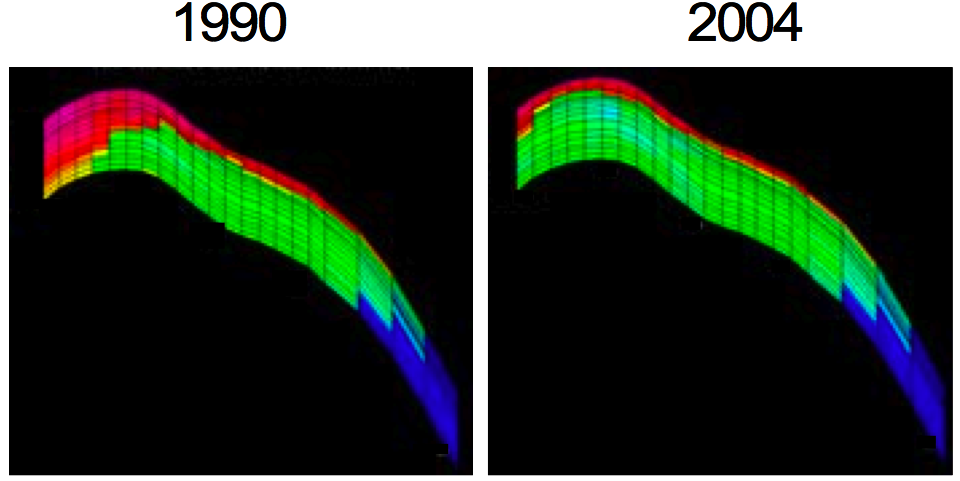
One graphic found in the latter reference, shown at right, is probably familiar to many readers as it has been used to provide a dramatic visual example of reservoir depletion. This figure shows depth-distributed water saturation values in an east-to-west vertical slice (click to enlarge). The figure has often been misinterpreted in that the red areas at top do not correspond to a gas cap (as the north of the field does not have one) but rather to rock which still as minimal water saturation. It is not known exactly where in the north this cross section relates to, although a good guess would be somewhere in the vicinity of the manifold wells discussed in the text. Note the very large saturation values for the depleted portions of the reservoir (~90%). This translates into much less oil left behind as compared to Ghawar (10% in Abqaiq vs. 25-35% in Ghawar). While this is good news for Abqaiq, and also explains the high expected recovery rate, the implication for Ghawar is that it is not reasonable to conclude that its recovery rate will be similar. Show below is a similar (simulation) slice in northern 'Ain Dar (Ghawar) as discussed here.
The main focus of the Multiphase Pump paper is on a successful attempt to rehabilitate a group of wells in the North Nose in which the pressure of produced oil was too low to make it through a connecting manifold and down the pipeline to the nearest GOSP. These wells are identified in the figure at left as red placemarks with the oil pipelines indicated with red traces. As of 2006, all but one of these wells are still connected by pipeline to the manifold. A number of other wells, shown with blue placemarks, are instead connected to each other and to pipelines for water injection (blue traces).
The cluster of injectors somewhat centrally located amongst the manifold wells seems a marked departure from the use of peripheral injectors, perhaps indicating that the latter approach is no longer sufficient for maintaining pressure at the wellbores. Also visible in the image at right is the only non-associate gas well in Abqaiq, indicated with the yellow placemark in the lower right corner. This well, drilled in 2003, doesn't appear to be connected to anything, but the well ID (ABQQ-480) is of note because it suggests that it was the 480th well placed in Abqaiq when it was spudded.
In general, the picture that emerges is one where the remaining oil in the Arab-D reservoir lies predominantly in the top 40 or so feet of the reservoir. This has led to the recompletion of many existing vertical wells by shutting off the lower wellbores and adding short horizontal sidetracks to extract oil from the thin layer at top. This has been used in the South Dome area as well, but with less success as the increased number of fractures in that area adds risk of early watering.
North Nose in 2007
Again using low-resolution 2007 DigitalBlobe images, locations of new and reworked wells were identified as shown at right. This picture also seems to suggest that a combination of new and recompleted wells in the (presumed) oil-bearing areas along with new water injectors are still being deployed in north Abqaiq. Green and red placemarks denote activity at new and previously existing sites respectively.
Conclusion
Analysis of satellite imagery and correlations with technical publications has helped to build a more complete picture of the reservoirs of Abqaiq and of recent efforts to get more oil out. A similarity with the Khurais field, specifically the presence of two connected reservoirs of dissimilar quality (Arab-D and Hanifa), portends potential difficulties as Khurais depletes. In contrast, the rather anomolously high final water saturation for Abqaiq vs. Ghawar suggests that expecting similar recovery rates with the latter is perhaps expecting too much.
Previous entries in The Oil Drum, Satellite Edition:
- Satellite o'er the Desert
- Intro to Satellite Sleuthing 101: Finding Haradh III
- Khurais Me A River
- Happenings in Harmaliyah
- Ghawar Numerology: Drilling in Uthmaniyah
Previous TOD entries on Abqaiq:
Categories: Links
Crude Oil: how high can it go? (19th century whaling as a model for oil depletion and price volatility)
19th century whaling is today one of the best examples we have of a complete cycle of exploitation of a natural resource.
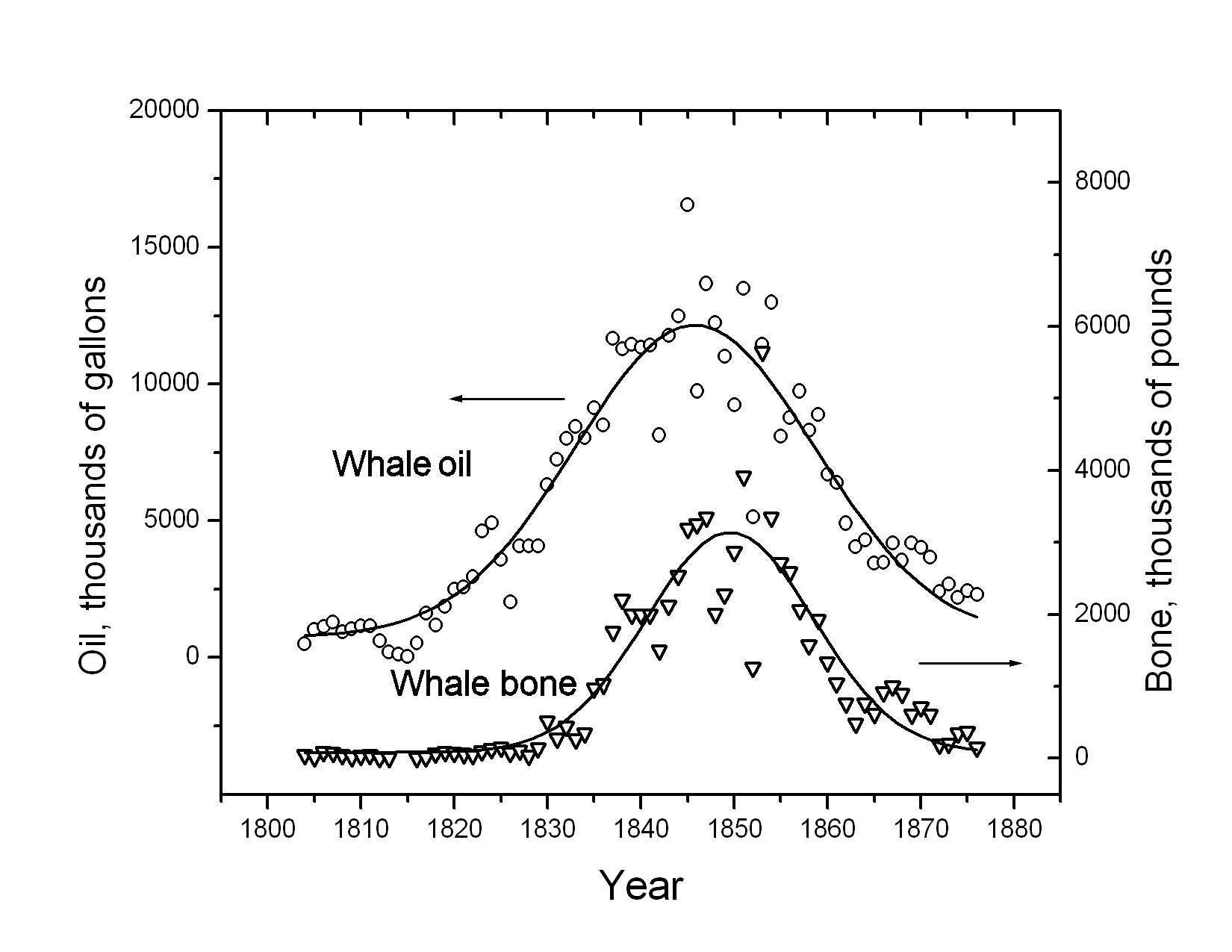
The production curves of whale oil and whale bone in the United States in 19th century (from "History of the American whale fishery" by A. Starbuck, 1878). Both show a clear bell shaped Hubbert's curve. Click to enlarge.
[break]
A few years ago, I appeared in TV for the first time in my life. Oil had just passed 38 dollars per barrel and I was invited to speak in a national financial channel as the president of the newly formed Italian section of ASPO. When I said that I expected oil to rise well over 40 $/bl soon, everyone in the TV studio looked at me as if I had just said something very funny. All the other experts there hastened to contradict me and said that 38 $ per barrel was just a spike, speculation, and that prices would soon go back to "normal."
Seen in retrospect, it was an easy guess that oil prices had to rise. You only had to know a little about Hubbert's theory. As I am writing these notes, oil prices stand at around 120 dollars per barrel and may well keep rising. But for how long? The problem with Hubbert's model is that it is good for predicting production, but it tells you nothing about prices.
There are all sorts of economic models that attempt to predict prices, but their record is very poor. So, maybe the answer can be found in historical examples. If we can find a resource that has peaked and declined to zero or near zero production in the past, then its historical prices could give us some idea of what to expect today for oil.
There are many resources that have peaked and declined at the regional level; crude oil in the United States is a good example. But the price of US oil doesn't depend only on US production; it is affected by imports from other regions of the world. So that's not useful for understanding price trends at the global level. What we are looking for is a global resource that has peaked worldwide or, at least, in an economically isolated region.
After much search, the best example that I could find is not that of a mineral resource but of a biological one: whaling in 19th century. Whales are, of course, a renewable resource but if they are hunted much faster than they can reproduce, they behave as a non renewable resource; just like oil. We have good data about whaling compiled in books such as Alexander Starbuck's "History of the American whale fishery" (1878). In Starbuck's times there was no such thing as a "global market" for whale products. But the reach of the whaling ships was worldwide and the effects of whale depletion were felt in the same way by all markets in the world. So, we can take the prices reported by Starbuck as directly affected by the behavior of the production curve.
So, here are the results for the two products of whaling; whale oil and "whale bone". Whale oil was used as fuel for lamps, whale bone was a stiffener for ladies' clothes, as were fashionable in 19th century.
Whale oil production and prices (adjusted for inflation) according to Starbuck's data.
Whale bone production and whale oil prices (adjusted for inflation) according to Starbuck's data.
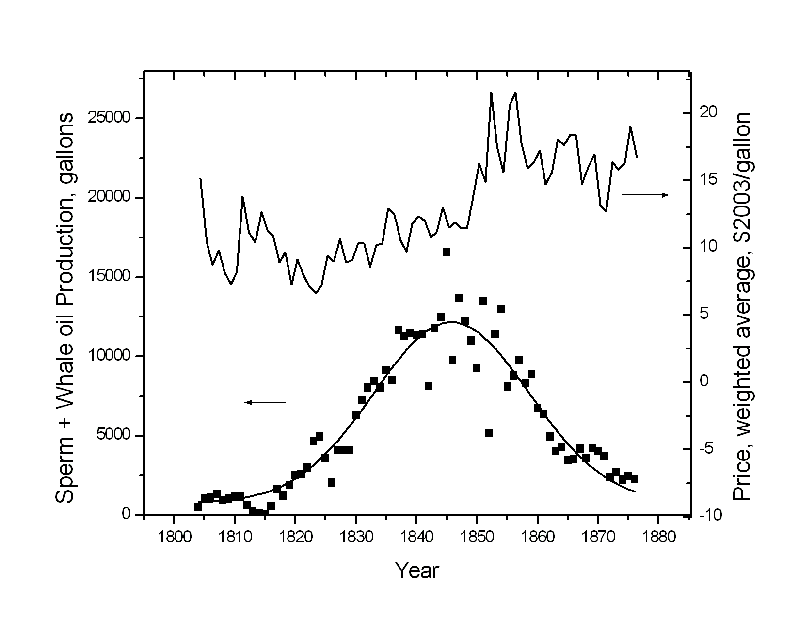
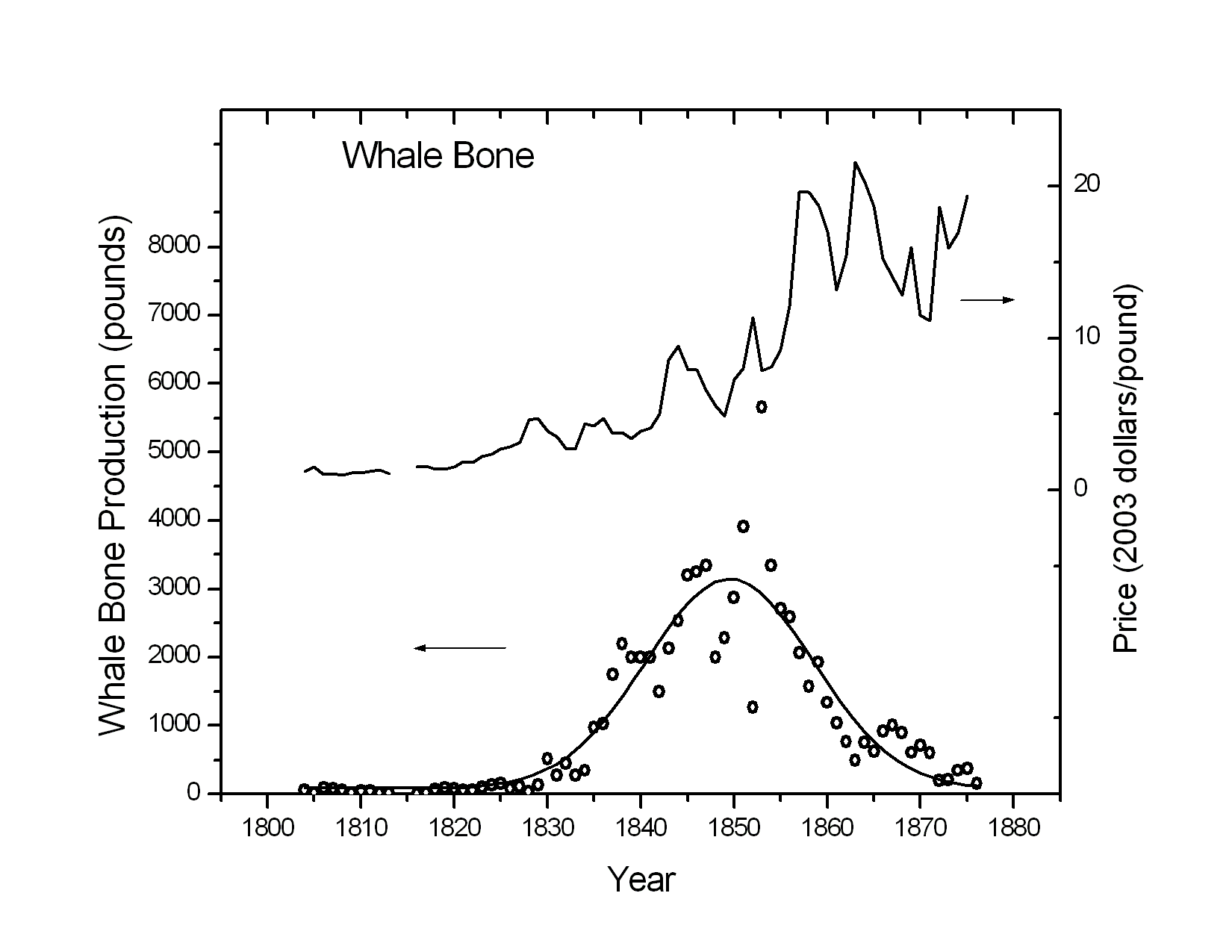
The results are clear: whaling did follow a Hubbert style "bell shaped curve", approximated in the graphs with a simple Gaussian. Whales did behave like a non renewable resource and some studies say that at the end of the 19th century hunting cycle there remained in the oceans only about 50 females of the main species being hunted: right whales.
Now, looking at the historical prices, we see an increase in the vicinity of the peak for both whale oil and whale bone. For whale oil we see a spike after the peak, for whale bone the trend is smoother. In both cases, the smoothed growth is nearly exponential. We can see this exponential trend in the smoothed data.
Smoothed whale bone and whale oil prices (adjusted for inflation).
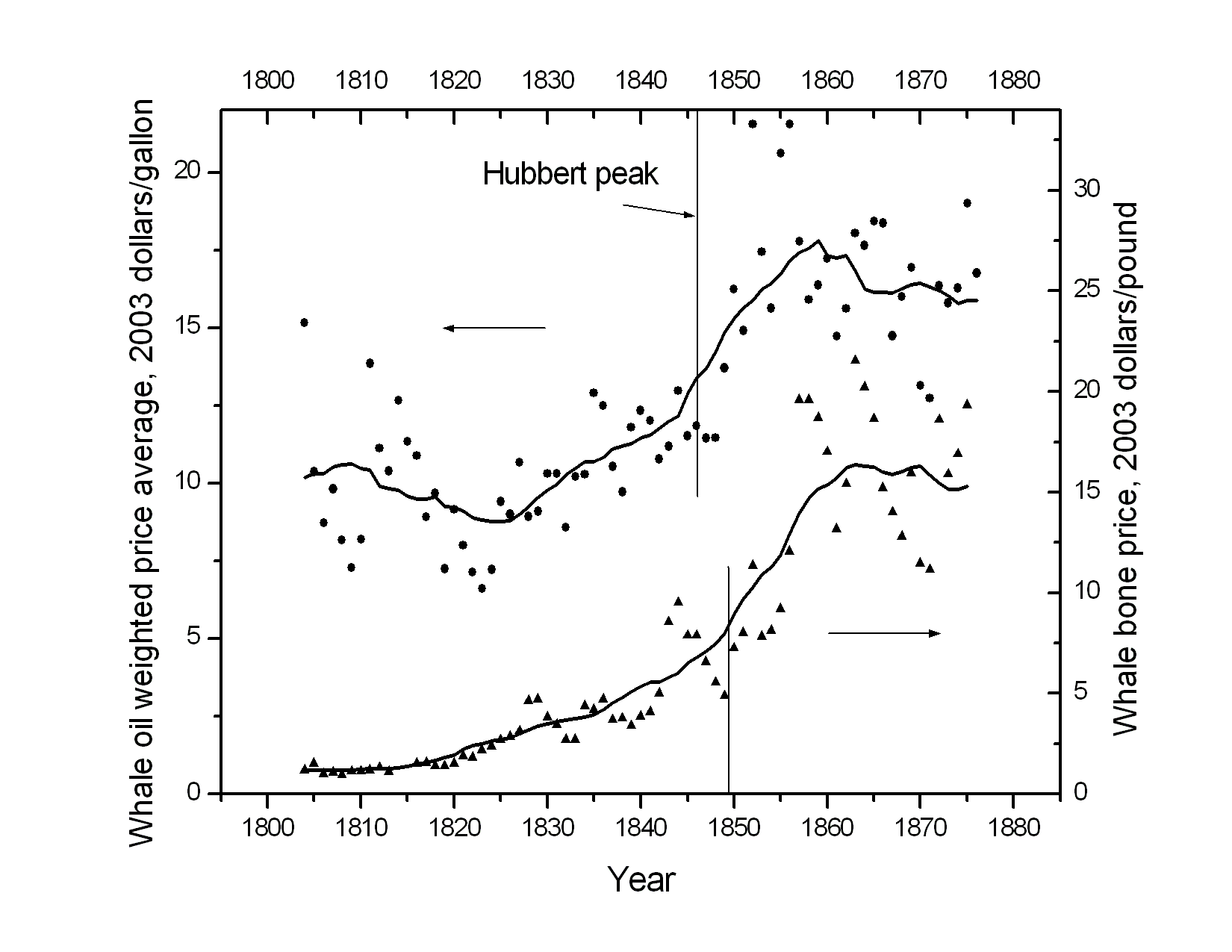
It seems that what we are seeing now for crude oil parallels the historical data for whale oil and whale bone. There are also differences; for instance the prices of whale oil didn't rise so much as crude oil has been doing lately. On the average, for whale oil we see a doubling of the price, followed by a plateau. For whale bone, we see a much larger increase, more than a factor of 10 from the beginning to the end of the whaling cycle. This increase is comparable to what we are seeing today for crude oil.
There is a reasonable explanation for these differences. First of all, neither whale oil nor whale bone were so crucial for life in 19th century as crude oil is today for us. There were alternative fuels for lamps: animal fat or vegetable oil, a little more expensive and considered as inferior products; but usable. Then, starting in the 1870s, crude oil started to be commonly available as lamp fuel. It probably had an effect in keeping down the price of whale oil. For whale bone, instead, a replacement didn't really exist except for steel, which was probably much more expensive during the period that we are considering. But stiffeners for ladies' clothes were hardly something that people couldn't live without.
In comparison, crude oil is such a basic commodity in our world that it is not surprising that prices have risen so steeply. Airlines, for instance, have no choice in between collapsing and buying oil at any price. For other activities, the conditions of the choice may not be so stark, but still we can't survive without oil. If the exponential rise of oil prices were to continue unabated for a few more years, we would be seeing some kind of demand destruction, indeed.
But the historical data for whaling tell us that an exponential rise of the prices is not the only feature of the post-peak market. The prominent feature is, rather, the presence of very strong price oscillations. We can attribute these oscillations to a general characteristic of systems dominated by feedback and time delays. Prices are supposed to mediate between offer and demand, but tend to overcorrect on one side or another. The result is an alternance of demand destruction (high prices) and offer destruction (low prices).
What we are seeing at present with crude oil is, most likely, one of these price spikes. Eventually, it will overdo its job of curbing demand and turn into a price collapse. We can imagine how, in the collapsing phase, everyone will start screaming that the "oil crisis" of the first decades of 21st century was just a hoax, just as it was said for the crisis of the 1970s. Then, a new upward spike will start.
Here, too, the history of whaling can teach us something in terms of the difficulty that people have in understanding depletion. In Starbuck's book, we never find mention that whales had become scarce. On the contrary, the decline of the catch was attributed to such factors as the whales' "shyness" and the declining "character of the men engaged". Starbuck seems to think that the crisis of the whaling industry of his times can be solved by means of governmental subsidies. Some things never change.
In the end, the history of whaling tells us that what is happening now to crude oil shouldn't have taken us by surprise. The future can never be exactly predicted but, at least, it can be understood from the lessons of the past. One of these lessons, however, seems to be that we never seem to be able to learn from the past.
__________________________________________
I reported the results of this study on whaling for the first time at the ASPO conference in Lisbon in 2005. Later on, I published a complete paper in "Energy Prices and Resource Depletion: Lessons from the Case of Whaling in the Nineteenth Century" by Ugo Bardi, Energy Sources part b. Volume 2, Issue 3 July 2007 , pages 297 - 304. You can find it on line here
If you like to play with Starbuck's data, here is the complete set .
Categories: Links
DrumBeat: May 15, 2008
Malthus, the false prophet
Once again the gloom is overdone. There may no longer be virgin lands to be settled and cultivated, as in the 19th century, but there is no reason to believe that agricultural productivity has hit a buffer. Indeed, one of the main barriers to another “green revolution” is unwarranted popular worries about genetically modified foods, which is holding back farm output not just in Europe, but in the developing countries that could use them to boost their exports.
...Although neo-Malthusianism naturally has much to say about food scarcity, the doctrine emerges more generally as the idea of absolute limits on resources and energy, such as the notion of “peak oil”. Following the earlier scares of the 1970s, oil companies defied the pessimists by finding extra fields, not least since higher prices had spurred new exploration. But even if oil wells were to run dry, economies can still adapt by finding and exploiting other energy sources. [break]
Petrobras Has Drilled Halfway Through Carioca, Minister Says (Bloomberg) -- Petroleo Brasileiro SA, Brazil's state-controlled oil company, has drilled halfway through its offshore Carioca deposit and will need more time to determine its size, Mines and Energy Minister Edison Lobao said.
Shell: Crude shortfalls will boost renewables
Royal Dutch Shell said the failure of crude suppliers to keep pace with accelerating demand may prompt the expansion of renewable energy.
There's "plenty of oil in the world," Shell's Scenario Team said today on a Webcast led by Global Business Environment Vice President Jeremy Bentham. "The important moment is actually not a possible peak of oil production;" it's when demand exceeds supply, which may "come well before a peak" in output.
OPEC Cuts Oil Demand Forecast; Buyers Shun Heavy Oil
(Bloomberg) -- The Organization of Petroleum Exporting Countries cut its 2008 global oil demand forecast for a second time in three months as producers report difficulties selling ``heavy'' crude grades.
Norway's budget surplus soars on oil
The Norwegian government's budget surplus for 2008, benefiting from record oil prices, is expected to soar more than 23 percent over the original projections, the finance minister said Thursday.
Gazprom joins Quebec gas plant consortium
CALGARY–Russia's Gazprom is joining a consortium developing a Canadian liquefied natural gas terminal and will supply all of the $840 million plant's gas needs from its huge Shtokman project, the companies said Thursday.
Congress looks to close 'Enron loophole' in trading
WASHINGTON — Federal regulators would have more authority to monitor electronic energy markets and guard against market manipulation under legislation approved today as part of the congressional farm bill.
PG&E asks customers to conserve during heat wave
Anticipating triple-digit temperatures in many parts of California this week, Pacific Gas and Electric Co. is asking its "Critical Peak Pricing" customers to voluntarily conserve energy.
Daimler: UPS Placed Major Order Of Hybrid, Natural Gas Trucks
FRANKFURT -(Dow Jones)- Daimler AG (DAI) said Wednesday that United Parcel Service Inc. (UPS) ordered 200 hybrid electric trucks and 300 compressed natural gas vehicles.
In a statement, Daimler said that this represents its largest of alternative- fuel and drive-train commercial vehicles to-date.
Memorial Day driving to drop slightly - AAA
More than 12% of the U.S. population will be celebrating the Memorial Day weekend away from home, AAA said. Of those traveling, AAA said 31.7 million people, or 83%, are expected to drive. That's 1% fewer than the 32 million Memorial Day drivers a year ago. And airline travel is expected to decrease 0.5%.
"With Americans working paycheck to paycheck, high energy costs are having an effect," said AAA vice president Mark Brown in a press conference. "Americans are finding themselves at a travel tipping point."
Why is everyone suddenly gaga over gas?
Crude oil gets all the headlines, but there's another fossil fuel that's had an even more impressive run this year.
Natural gas has surged 55 per cent in 2008, topping the 29-per-cent rise in crude. And it could go higher still, especially if the summer brings scorching temperatures that prompt homeowners to crank up their air conditioners or hurricanes that knock out gas platforms in the Gulf of Mexico.
Mexico's Battle over Oil
On April 8, President Felipe Calderon dropped a political bomb on the Mexican political scene. The Senate received an executive initiative that would fundamentally change the structure and operations of the oil company, Petroleos Mexicanos (Pemex). Key operations of the state-owned enterprise would pass into private hands.
Brazil Delays Oil Auctions on Lack of Equipment, Minister Says
(Bloomberg) -- Brazil won't auction new oil properties until at least 2009 because there is a lack of equipment necessary to expand exploration, Mines an Energy Minister Edison Lobao said.
Record Fuel Prices Spur Sales of Gas Cap Locks
With gas heading toward the $5-a-gallon mark a surge in gas thefts from parked cars is the latest energy crisis to hit consumers, with widespread police reports coast to coast of tanks being drained in broad daylight.
One woman in a quiet Staten Island neighborhood left her BMW in her driveway with an $80 full tank of gas to take public transit, only to return from work to find her tank virtually empty.
Even cop cars are getting hit, with the NYPD ordering 400 locking gas caps on certain vehicles to cut down on the high tabs for replacing stolen gas.
St. Maarten: Tighten your belt
As expected, fuel prices will go up again Friday, as a result of the ever-rising oil price on the international market. The increase by no less than 30 cents per litre of gasoline and per litre of diesel fuel is sure to be felt by motorists as well as bus and taxi drivers.
No only that, but practically all businesses will be dealing with increased transport cost that will no doubt be passed on to the consumer. The fuel price increase will also lead to higher energy bills, which have already gone up considerably in the past year.
Cyprus: Government promises measures to offset soaring fuel prices
THE GOVERNMENT said yesterday it was considering counter-measures to offset soaring fuel prices.
This was announced by Commerce Minister Antonis Paschalides as prices at the pump rose again in response to soaring international oil prices.
Pakistan advances clock to conserve energy
Islamabad (IANS) Facing a huge energy deficit, Pakistan has drawn up a comprehensive plan for conserving power by advancing clocks by an hour and ordering markets to close by 9 p.m. from June 1. The adjustment in the Pakistan Standard Time (PST) would take it six hours ahead of GMT. Henceforth, sunrise in Islamabad will be at 6 a.m. instead of 5 a.m. and sunset at 8 p.m.
Pakistan, which faces an energy shortfall of 4,000 MW, has twice before attempted to introduce daylight saving time but has failed on both occasions, Dawn reported Thursday.
Author gushing with oil knowledge; Professor speaks at conference
"One hundred and fifty years after the first commercial oil well in Oil Springs, global oil production is about to peak; we are at the zenith of the industry," he said. "It's very fitting that Thomas Homer-Dixon has a message about adjustment to a world of high energy demand and declining resources."
Homer-Dixon's speech at Petrolia's Victoria Hall, "The Great Transition: Coping with the end of the oil age," focused on oil production and the severity of the ongoing climate and energy crises.
His message: we're running out of cheap oil.
Celebrate clean coal, come on!
In one TV commercial, Kool and the Gang warble their celebration of good times because coal, yes, coal, makes the party possible in America. In another, white and black, young and old, male and female, and even someone in a doctor's green scrubs, stare into the camera and soulfully declare: "I believe" American know-how will make coal clean and stop it from contributing to climate change. Not sold? Maybe you missed the newspaper ads and billboards warning that turning away from coal could mean blackouts, unemployment and higher electric bills.
Clean coal, dirty business?
While there may be no question of WWF Australia's good intentions in adding its name to the coalition calling for increased emphasis on research into Carbon Capture and Storage (CCS), is it really advisable to campaign for an increase in government investment (financial, but also philosophical) in this still mythical technology?
“The Rocky Road to a Real Transition”: A Review
It is flattering that so early in a movement such as the Transition movement, people take the time to sit down and write such a detailed critique of it. Trapese Popular Education Collective were previously behind the excellent ‘Do It Yourself Manual’. As the first published external examination of the Transition model it is to be welcomed, and the authors raise a number of important questions. From my perspective, “The Rocky Road…” does a very good job of identifying many of the key areas where Transition is distinctly different from other approaches to social activism.
Woodside drops hot rocks
ALTERNATIVE energy group Geodynamics lost cornerstone investor Woodside Petroleum yesterday.
Woodside, a gas and oil business, offloaded all $17.3 million of its holdings in Geodynamics, which is trying to tap "geothermal" power from underground hot rocks.
OPEC trims 2008 global oil demand forecast
LONDON — OPEC on Thursday trimmed its forecast for global growth in oil demand in 2008, the latest sign that record oil prices are slowing consumption in the industrialized world.
The exporter group also cut its estimate for oil supply from non-member countries in 2008, leading to a slight increase in the amount of crude its 13 members need to pump to balance the market.
Peak-oil spike reshapes the suburbs
The reality of peak oil will see properties classified into two types in the near future, according to Simon Fraser University professor Anthony Perl.
One will be properties from which owners can get to work, leisure activities, and services predominantly by car. The other offers alternatives to the automobile such as public transit, biking, and walking.
Prices causing people to curb gasoline use - Exxon chief
WASHINGTON (Reuters) - The price of gasoline in the United States is at or near the level where people begin to curb their usage, Exxon Mobil Corp chief executive Rex Tillerson told NBC's "Today" program on Thursday.
"We're already seeing some demand slackening in gasoline demand in terms of miles driven," Tillerson said. "So I think we're very near, if we're not already at, the price where people clearly are altering their daily behavior."
No peak: Why oil prices will fall again
Although U.S. crude oil inventories have fallen, gasoline inventories are at their highest since March 1993, notes Tim Evans, an energy futures analyst at Citigroup's Futures Perspective. World oil production was up 2.5 percent in the first quarter of 2008 over the same period in 2007, while world oil consumption rose by just 2 percent.
In fact, world production is projected to be 3.3 percent higher in the second quarter and 4.1 percent higher in the third quarter than the same periods a year ago. On the other hand, world demand is projected to rise by just 1.6 percent over the next six months.
Oil price means BA can barely make a profit on flights
The record oil price means British Airways can barely make a profit on flights despite being poised to announce a record profit margin on its operations in the year to the end of March.
Japan's TEPCO doubles oil buy in April y/y
TOKYO (Reuters) - Japan's biggest utility, Tokyo
Electric Power Co more than doubled its purchases of
crude oil and fuel oil in April from a year earlier, it said on
Thursday.
This reflects the need for the company to burn more oil after the extended shutdown of its nuclear power plant.
Japan facing inflation crisis
Inflation might be of emerging concern to the US, but in Japan it's a real problem now, which shows no sign of slowing.
Japan's largest utility to build its first wind farm
TOKYO (Reuters) - Japan's biggest utility Tokyo Electric Power Co (TEPCO) said on Thursday it would build its first wind farm in Shizuoka Prefecture, west of Tokyo, to cut carbon dioxide (CO2) emissions.
China central bank sees ample room for oil product price rises
BEIJING (XFN-ASIA) - China's central bank said that there was ample room for rises in the state-set prices of oil products.
China's weakness the greater danger
Although recent events in Tibet and western China, and the central government's response, appear to be generating pro-government patriotic feelings, they dramatically display the practical limits of the government's power. Other sources of unhappiness with the regime, including income disparities and the inevitable collapse of unsustainable price controls on fuel and food, could breed both urban and rural discontent that has no ready outlet besides unlawful opposition to the government.
Venezuela's Chavez Says Attack by U.S. Would Cause $500 Oil
(Bloomberg) -- Venezuelan President Hugo Chavez, whose country is the biggest oil exporter in the Americas, said crude oil would rise to ``$400 or $500 a barrel'' in the case of a U.S. attack.
The reactivation of the U.S. Fourth Fleet in the Caribbean on July 1 and a possible U.S. base on the Guajira Peninsula, which Venezuela shares with Colombia, are both threats to his country, Chavez said at his country's military academy in a speech broadcast on state radio and television.
Venezuela to sell oil to Portugal in exchange for food, technology, Chavez says
CARACAS, Venezuela: Venezuela announced plans Tuesday to ship oil to Portugal in exchange for food products and other goods that have been running short in the South American country.
Venezuela, Latin America's largest oil producer, will send as many as 30,000 barrels of crude a day to Portugal by late 2008, President Hugo Chavez told reporters after meeting with Portuguese Prime Minister Jose Socrates.
Four Indian oil workers kidnapped in Sudan
KHARTOUM (Reuters) - Four Indian oil workers have been abducted in the oil-rich south of Sudan by disaffected locals, diplomatic sources said on Thursday.
FG, Shell reach crucial stage in funding for oil production
Royal Dutch Shell is close to signing a financing deal with Nigeria aimed at tackling funding shortfalls hitting production at one of its most important oil businesses.
The plan is designed to inject cash into Shell’s joint venture with the Nigerian government. The state’s failure to pay its share of costs has stalled key projects.
Running Out of History
A report from the Bureau of Meteorology in Australia makes clear that, despite recent heavy rains in the eastern Australian breadbasket, years of above normal rainfall would be needed "to remove the very long-term [water] deficits" in the region. The report then adds this ominous note: "The combination of record heat and widespread drought during the past five to 10 years over large parts of southern and eastern Australia is without historical precedent and is, at least partly, a result of climate change."
Think a bit about that phrase -- "without historical precedent."
A cool look at global warming scepticism
Scientists are human, and scientific debates fall short of the ideal. There is turf protection and self-promotion, and rancour is not uncommon. As an advocate of a minority view in my own field for twenty years, a view ultimately vindicated, I am personally acquainted with these imperfections. The IPCC process is specifically intended to step back from the front-line disputes to see what scientists can agree on. This is the part of the IPCC process that seems to have completely escaped Professor Aitkin’s understanding.
Insider: Peak oil
Followers of the peak oil theory argue the world has already or soon will have used up more than half the non-renewable resource. They say current crude prices are just the beginning. Skeptics insist there is no reason to believe that carbon-based capitalism has started to run out of gas. Today’s record prices, they argue, are driven by massive market speculation. Canadian Business writers Thomas Watson (anti-peak) and Jeff Sanford (pro-peak) debate the issue below.
Naimi Counters Peak Oil Theorists, Says World Reserves Doubled
Saudi Arabian Oil Minister Ali al- Naimi said global crude oil reserves have doubled since 1980, countering analysts who predict a supply shortage.
Sechin Looks to Raise Oil Output
Prime Minister Vladimir Putin and his new energy policy director, Deputy Prime Minister Igor Sechin, went on the offensive Wednesday to battle claims that the country's oil production was in decline.
"You think oil production is declining?" Sechin said in an interview with Interfax, a first for the secretive former Kremlin insider who has been thrust into the spotlight with his Cabinet appointment this week.
"Let's wait until the end of the year. I'm sure there won't be a decline, but an increase instead," he said, declining to provide reasoning for the claim.
Norway trims 2008 oil and gas output forecast
OSLO (Reuters) - Norway's Labour-led government trimmed its 2008 oil production forecast to 2.4 million barrels per day from a previous projection of 2.5 million bpd, according to the revised budget for this year published on Thursday.
"Oil production is expected to continue to decrease gradually in the coming years," the Petroleum and Energy Ministry said in a statement with the revised budget.
Petrobras Hires 80% of Deepwater Drilling Rigs, Drives Up Costs
(Bloomberg) -- Petroleo Brasileiro SA, Brazil's state-controlled oil company, leased about 80 percent of the world's deepest-drilling offshore rigs to explore prospects including the Western Hemisphere's biggest discovery in decades.
...The company's ``insatiable'' demand is forcing producers including Exxon Mobil Corp. and BP Plc to pay more as they compete for the remaining units, said Kjell Erik Eilertsen and Truls Olsen, analysts at Fearnley Fonds AS in Oslo. Explorers that don't have rigs under contract may delay projects or pay rents of more than $600,000 a day.
Don't hope for gas prices to drop, says oil economist
Most drivers think $4 per gallon of gasoline is too much to pay in a weakening economy. Sales for sport-utility vehicles are plummeting. And people are actually driving less.
But don't expect prices to fall anytime soon despite slackening domestic demand, American Petroleum Institute chief economist John Felmy said Wednesday. The API, based in Washington, D.C., represents the U.S. oil and gas industry.
Greenspan Says Oil to Keep Rising on Capacity Limits
(Bloomberg) -- Former Federal Reserve Chairman Alan Greenspan said oil prices will keep rising as energy companies have invested too little in production and infrastructure to cope with higher demand.
Alaska first state to hit $4 a gallon gasoline: AAA
LOS ANGELES (Reuters) - Alaska hit a milestone on Wednesday that could be a sign of things to come around the United States this summer -- it became the first state where the average price for regular gasoline reached $4 per gallon.
Bank of England warns 'the good times are over' as Britons face real cut in the standard of living
Families face a five-pronged assault on their finances, Governor Mervyn King said in his bleakest assessment yet of the state of the country.
In his quarterly Inflation Report, Mr King said although Britain had enjoyed rising living standards over the past ten years, this golden period was over.
Why does Brazil want to join Opec?
What is it about oil that makes Brazilian officials so talkative? Last month, the country's oil regulator provoked uproar when he claimed, very speculatively, that the recently discovered Carioca field might hold a massive 33 billion barrels of recoverable oil reserves. Now, Luiz Inacio Lula da Silva, Brazil's president, speaking to Der Spiegel, says he wants his country to join Opec.
Saudi-US relations hit rocky road
Saudis are uncharacteristically blunt when asked about George W Bush, the US president, and what his two-term administration has brought to the Middle East. Most see an abysmal legacy: a dangerous mess in Iraq, a deepening Israeli-Palestinian conflict and a volatile tug-of-war between Washington and Tehran, most recently on display in the embattled boulevards of Beirut.
“We love and admire the United States, I can assure you, and I speak for many people on this matter,” said Saeed al Farha al Ghamdi, a retired government employee in Jeddah. “But, unfortunately their foreign policy is disastrous.”
JPMorgan to start physical oil trade, eyes $200 oil
SINGAPORE (Reuters) - JPMorgan Chase & Co will begin trading physical oil by year-end, increasing its exposure in a market that could rise to $200 a barrel, the bank's global head of commodities said on Wednesday.
PetroChina may scrap Sichuan refinery plan after quake
BEIJING (Reuters) - PetroChina is reconsidering its plan to build a $5.7 billion refinery and petrochemical complex in Sichuan province after a strong earthquake hit the region this week, a company executive said on Thursday.
The 7.9-magnitude quake on Monday destroyed many buildings, disrupted transport and communication lines as well as fuel and power supplies and had killed an estimated 15,000 people, with thousands more still believed to be buried.
Total, Saudi Aramco announce 400,000 bpd refinery project
PARIS (AFP) - The French oil group Total and the Saudi Arabian Oil Company (Saudi Aramco) announced plans Wednesday for a 400,000-barrel-per-day refinery in the eastern Saudi city of Jubail on the Gulf coast.
The groups said in a joint statement that the facility would process Arabian Heavy crude oil, with operations expected to begin at the end of 2012.
South Africa's Eskom Misses Winter Coal Stocks Target
(Bloomberg) -- Eskom Holdings Ltd., South Africa's state-owned electricity utility, missed a target for increasing coal stocks, raising the risk of power cuts with the onset of winter in the southern hemisphere.
Nigeria: Nationwide Blackout Worsens As Funding Stalls Repairs
The current nationwide blackout may worsen as funding continues to be the major albatross to the maintenance of the existing electricity infrastructure in the country.
THIS DAY learnt that the Federal Government has not released funds for any repair work on the existing power plants. This has left the infrastructure in a state of near collapse.
T. Boone Pickens orders 667 GE turbines for wind farm in Panhandle
T. Boone Pickens has placed a massive order for wind turbines with General Electric, a big step toward building the world's largest wind farm in the Panhandle.
Mr. Pickens' company, Mesa Power LLP, plans to announce today that it ordered 667 turbines from GE for about $2 billion.
On the roof, wind turbines to bring power
Tel Aviv residents are likely to encounter a new sight on local rooftops in the coming years. No longer will there just be the walls and fences on high-rise rooftops that currently surround the various devices and machinery, but there will also be wind turbine farms that will supply part of the building's electricity needs.
Economic Slowdown Challenges Solar Industry - EPIA
FRANKFURT - The economic slowdown, regulatory conflicts and competition from China pose the main risks to future growth of the solar industry, the head of the European Photovoltaic Industry Associations told Reuters.
Ships bring water to parched Barcelona
Climb down the stony banks of the massive Sau reservoir in the mountains above Barcelona and you get a real sense of why this famous city is so short of water that it's resorted to bringing in emergency supplies - by ship.
Nestling in a deep valley of stunning cliffs and forests, this vital source of water has sunk so low it's exposed the eerie sight of a medieval village that was flooded when the reservoir was opened in the 1960s.
The huddle of ancient stone buildings, including a church with its spire, has now re-emerged into the light and stands as a potent symbol of the severity of this water crisis.
U.S. adds polar bear to threatened list
The Bush administration listed the polar bear as a threatened species Wednesday, agreeing with conservationists that the bear's Arctic habitat is melting due to global warming.
That is where the agreement with conservationists ends.
"This listing will not stop global climate change or prevent any sea ice from melting," Interior Secretary Dirk Kempthorne said while announcing the decision. The Endangered Species Act should not be "abused to make global warming policies," he said.
Kassie Siegel, a lawyer with the Center for Biological Diversity, said the group does not accept Kempthorne's view.
The act requires federal agencies to take steps to reduce or eliminate those impacts on threatened species, she said. "There is no exemption for greenhouse gas emissions."
Oil cos. expect battles over polar bear listing
JUNEAU, Alaska - The lawyers aren't clearing their calendars just yet, but the oil industry is bracing for some courtroom battles to maintain its stake in Alaska's oil-rich fields now that the Interior Department has listed polar bears as a threatened species.
Categories: Links
Peak Oil Media: Our President on Energy, Kunstler on Glenn Beck last night, and GWB Does Dr. Evil
Here's your president talking about contemporary energy matters (original video link).
and we can't embed CNN's video player, so you'll have to go over there and watch Kunstler's well-done piece on Glenn Beck if you haven't seen it already:
http://www.cnn.com/video/#/video/bestoftv/2008/05/14/beck.life.oil.cnn?iref=videosearch
And, yes, under the fold, if you can believe it, yes, that's your president doing his best Dr. Evil (from Austin Powers) impression. No, I am not kidding. [break] GWB, you make life a little too easy sometimes, you know that, dontcha?
Categories: Links
Wave/Geothermal - Energy Return on Investment (EROI) Part 5
This is the final piece of a series on Energy Return on Investment from Professor Charles Hall's EROI Workshop at SUNY. Today's papers outline the energy technologies of wave and geothermal power, concluding a 5 part series that has looked at Why EROI Matters, Natural Gas and Imported Oil, Tar Sands and Shale Oil, Nuclear Power, and Passive Solar, Photovoltaic, Wind, and Hydro-electric. Previously, Professor Hall also wrote the thought provoking, At $100 Oil, What Can the Scientist Say to the Investor. Forget not about the simple 'balloon graph' below of EROI x Scale for fossil and renewable energy sources that this project is attempting to update with the help of theoildrum.com readership.
[break]
by Charles A. S. Hall
Most of the energy sources that we use or might use are dependent directly or indirectly upon the sun. This includes wave energy which is derived from wind (e.g. the sun). Nuclear, geothermal and tidal energies are different in that they depend upon nuclear decay within the Earth or Earth’s materials or, in the case of tidal, the processes of celestial motions. The advantage of these energies are that they are truly immense. The main disadvantages are that they are, with a few exceptions, dilute and hence very difficult to extract energy from. Another issue is that for some forms (e.g. heat from the ground) high quality energy (electricity) must be invested to extract low quality energy (heat), which can be a losing proposition even if the direct EROIs are positive. These issues for many situations imply generally low EROIs and hence low profitability. On the other hand some hot steam procedures in very favorable sites have high EROI and generate high quality electricity via investment of general engineering and materials, which implies lower quality investment energy. So unless these most favorable circumstances can be applied more generally or better methods are derived it is likely that development will be quite slow. On the other hand if and as EROIs from other fuels continue to decline they might be increasingly attractive. Tidal energies are likewise potentially enormous but there are few operational plants and we have not examined them. Daniel Halloran summarizes here such information as he could find on EROIs of various geothermal and wave energies. They are interesting but remain more as potential than realized energy and appear unlikely to effect our energy situation significantly for decades, if ever. As usual we seek your critiques and, especially, other hard literature that we missed.
APPENDIX H.GEOTHERMAL ENERGY SUMMARY
Daniel Halloran SUNY-Syracuse
Definition: Geothermal energy is the heat within the earth, which can be “mined” by extracting hot water or steam, either to run a turbine for the generation of electricity or for direct use of the heat itself (Brown and Garnish 2004; Dickson and Fanelli 2005).
Resource BaseTheoretical: The heat content of the earth has been estimated to be about 13 trillion EJ (Dickson and Fanelli 2005). That heat comes from radioactive decay inside the Earth. Obviously, most of this is not practical to exploit.
The 2000 World Energy Assessment estimates that “140 million EJ per year” could theoretically be tapped within a depth of 5 kilometres”, with 5,000 EJ/yr being economical within 50 years (UNDP 2000). A recent MIT study estimated a stored thermal energy of 14 million EJ between 3 and 10 kilometers (Tester et al 2006). This energy could be tapped with enhanced geothermal systems (EGS), also known as Hot Dry Rock (HDR), which exploits the heat available at greater depths in the absence of groundwater.
Geopressured-geothermal systems could theoretically provide thermal energy from hot brine, mechanical energy from highly pressured fluid, and chemical energy from confined methane. The Gulf Coast of the United States has an estimated stored thermal energy of 11,600 EJ in geopressured sedimentary basins (John et al. 2006).
There is not a consensus in the literature regarding resource base estimates.
Actual: World-wide capacity for direct use of geothermal heat is about 16-17,000 MWt and world-wide installed capacity of geothermal electricity generation is about 9,000 MWe. Currently, the only places being exploited for geothermal power generation are places where hydrothermal resources exist. In a hydrothermal resource, heat is transferred to groundwater at depths penetrable by drilling technology. No power is generated commercially using HDR. The world leader in geothermal electricity is the United States with a capacity of over 2800 MWe, which accounts for 0.36% of U.S. electricity production (GEA 2007). Growth of geothermal power capacity worldwide has slowed from 9% per year in 1997 (EERE 1997) to 2.5% per year in 2004 (Dickson and Fanelli 2005).
Geothermal heat pumps, which extract heat from the normally “warm” shallow soils or their water, have grown to over a million units world-wide, led by the U.S. with 600,000 (Lund et al 2004), accounting for most of the four-fold increase in direct use capacity between 1992 and 2000 (Brown and Garnish 2004). While the heat pump industry has continued to grow, total geothermal direct use has slowed to 6 or 7% growth (Bronicki and Lax 2004). Total use of geothermal energy world-wide was an estimated 2 EJ in 2000 (Sawin 2004). Geothermal heat is regional in availability. Countries such as Iceland, Japan, the Philippines, Costa Rica, and the United States, have successfully exploited the shallow geothermal energy available at plate boundaries (Huttrer 2001). Most of the terrestrial Earth does not have those conditions.
Although in theory ground heat is indefinitely renewable there is concern about the sustainability of geothermal systems. Technically, geothermal resources are not renewable, because heat is always removed faster than it is replenished by the heat source (Brown and Garnish 2004; Lee 2004). The most important US site is The Geysers in California which has shown signs of cooling with heavy use. Nevertheless, geothermal energy sources are constant and require no storage other than the earth.
Technology: The general technology is that of steam turbine power generation, with rare “dry-steam” reservoirs (vapor-dominated) being the ideal type of resource. Because most resources are not dry steam, technological improvements are necessary for the geothermal industry to continue to grow (Brown and Garnish 2004), possibly including improvements in enhanced geothermal systems.
EROIThe EROI for electricity generation from hydrothermal resources has been reported by a handful of researchers with a range of 2.0 to 13.0 (Table 1). Some conceptual EROI values have been calculated for HDR ranging from 1.9 to 39.0, and for geopressured systems with a range of 2.9 to 17.6. The ranges represent the lack of a unified methodology for EROI analysis and disagreements about system boundaries, quality-correction, and future expectations. No EROI values of geothermal direct use were found. Because they exploit and use lower-temperature resources rather than electricity generation, and are more universally applied, it is probably safe to assume higher EROI values for most direct use applications.
EconomicsIn addition to geography and technology, high capital cost and low fossil fuel costs are major limiting factors for geothermal development, especially for HDR and geopressured systems which are still in the developmental phases. A kilowatt-hour of electricity generated at The Geysers, the largest field in California, sells for 3-3.5¢, and many other plants are economically competitive at about 9¢ (MDEQ 2007). Economic feasibility could be potentially improved in the U.S. with an extension of the Production Tax Credit (Gawell 2007) and with cascading geothermal systems, which use lower temperature waste fluids in succession for secondary applications (Lee 2004).
Environmental and Social ImpactsPositives: Reduced emissions and low land area compared to fossil fuel plants, employment benefits, decreased dependence on foreign energy for countries rich in geothermal resources (EERE, No Date).
Negatives: Small danger of air, water, thermal, and noise pollution, erosion and solid waste buildup. Subsidence, hydrothermal eruptions, aesthetic disruptions, local or indigenous objection, and changes of surface manifestations are rare and site-specific. There is also a controversial possibility of induced seismicity.
Prospects: The limited hydrothermal resources are unlikely to become a silver bullet solution to meet increasing global energy needs but could continue to be important regionally. If HDR were to become economically feasible, much larger, less-depletable geothermal resources would be opened up worldwide, potentially increasing EROI, geographic relevance, and long-term sustainability of geothermal power, with an estimated increase in production of a factor of ten or more (Tester 2006). Geothermal heat pumps already seem to be generating net thermal energy on small scales and are nearly limitless geographically.
Table 1. Geothermal Power EROI
Bronicki, L., Lax, M., 2004. Geothermal energy, In: World Energy Council, 2004. Survey of Energy Resources, Elsevier Inc. http://www.worldenergy.org/wec-geis/publications/reports/ser04/overview....
Brown, G., Garnish, J., 2004. Geothermal energy, In: Boyle, G. (Ed.), 2004. Renewable Energy, Power for a Sustainable Future, Oxford University Press.
Carson and Underhill, 1976. [I don’t see this referenced in this summary paper. It refers to a paper referenced in Herendeen and Plant for which I found no other info. See Table 2 of my larger paper--DH]
Cleveland, C.J., Costanza, R., Hall, C.A.S., Kaufmann, R. 1984. Energy and the U.S. economy: a biophysical perspective. Science 225, 890-897.
Dickson, M.H., Fanelli, M. (Ed.), 2005. Geothermal Energy, Utilization and Technology. Earthscan, London. 205 pp.
Geothermal Energy Association (GEA) website, 2007. http://www.geo-energy.org.
Gilliland, M.W., 1975. Energy analysis and public policy. Science 189(4208), 1051-1056.
Halloran, 2007. Unpublished [this refers to my own EROI calculations, which are shown on Table 3 of my larger paper.]
Herendeen, R.A., Plant, R.L., 1981. Energy analysis of four geothermal technologies. Energy 6, 73-82.
Huttrer, G.W., 2001. The status of world geothermal power generation 1995-2000. Geothermics 30(2001), 1-27.
Icerman, L., 1980. Net energy production history of the geysers geothermal project. Energy 5, 29-33.
International Geothermal Association (IGA), 2001. Report of the IGA to the UN commission on sustainable development, session 9 (CSD-9), New York, April 2001. http://iga.igg.cnr.it/geo/geoenergy.php
Lee, K.C., 2004. Geothermal power generation, In: Cleveland, C.J. (Ed.), 2004. Encyclopedia of Energy, Elsevier Inc.
Lund, J., Sanner, B., Rybach, L., Curtis,R., Hellström, G., 2004. Geothermal (Ground Source) Heat Pumps – A World Overview. http://geoheat.oit.edu/bulletin/bull25-3/art1.pdf
Muffler, L.J.P (Ed.), 1979. United States Geological Survey Circular 790: Assessment of Geothermal Resources of the United States – 1978.
Murphy, H., Drake, R., Tester, J., Zyvoloski, G., 1985. Economics of a conceptual 75 MW hot dry rock geothermal electric power-station. Geothermics 14 (2-3), 459-474.
Odum, H. T., C. Kylstra, J. Alexander, N. Sipe, P. Lem, M. Brown, S. Brown, M. Kemp, M. Sell, W. Mitsch, E. DeBellevue, T. Ballentine, T. Fontaine, S. Bayley, J. Zucchetto, R. Costanza, G. Gardner, T. Dolan, A. March, W. Boynton, M. Gilliland, and D. Young. 1976. Net Energy Analysis of Alternatives for the United States. pp. 254-304. In: Middle and Long-Term Energy Policies and Alternatives. 94th Congress 2nd Session Committee Print. Prepared for the Subcommittee on Energy and Power of the Committee on Interstate and Foreign Commerce of the U.S. House of Representatives. Serial No. 94-63. U.S. Gov. Printing Office.
Petty, S., Porro, G, 2006. Updated U.S. Geothermal Supply Characterization. Conference Paper NREL/CP-640-41073, March 2007. Available online at http://www.osti.gov/bridge.
Sanyal, S.K., Morrow, J.W., Butler, S.J., Robertson-Tait, A., 2007. Cost of Electricity from Enhanced Geothermal Systems. Proceedings, 32nd Workshop on Geothermal Reservoir Engineering.
Tester, J.W., Anderson, B.J., Batchelor, A.S., Blackwell, D.D., DiPippo, R., Drake, E.M., Garnish, J., Livesay, B., Moore, M.C., Nichols, K., Petty, S., Toksoz, M.N., Veatch, R.W., 2006. The Future of Geothermal Energy – Impact of Enhanced Geothermal Systems (EGS) on the United States in the 21st Century. An assessment by an MIT-led interdisciplinary panel. Available online at http://geothermal.inel.gov.
United Nations Development Programme (UNDP), 2000. World Energy Assessment.
APPENDIX I.WAVE ENERGY: Potential, EROI, and Social and Environmental Impacts
Daniel Halloran, SUNY-ESF, Syracuse NY
INTRODUCTIONWave energy is solar energy concentrated by the wind (Thorpe 2004), which can be converted into mechanical energy for the generation of electricity. Wave energy has been a part of the renewable energy discussion since the 1970s (Duckers 2004), but has yet to materialize as a viable option for large-scale power generation. It can have a high power density (storm waves up to 1700 kW per meter of wave crest length) depending on the speed, duration, and fetch (unimpeded distance over water) of the wind (Duckers 2004). Because of this high power density, and more recently, its relatively low environmental impact, wave energy research and development continues in many countries, most notably the UK, Japan, Norway, and Portugal (Thorpe 2004).
HISTORYDuring the energy shocks of the 1970s, wave energy research was mainly government funded and academic in nature. After tapering off for a few decades, it is beginning to reemerge, this time led by small engineering companies (Thorpe 2004).
RESOURCE BASE AND USE The wave energy resource base is highly regional in potential. Estimates of the global potential vary widely for reasons that we do not know (Table 1) but many agree that there is a significant exploitable energy source in the waves, especially between 30 and 60 degrees latitude. Wave intensity at these latitudes is greatest in the winter, corresponding with the seasonal peak in electricity demand (Lemonis 2004). Tropical regions have some potential because of the prevailing steady trade winds, but power densities are generally not as high (Thorpe 2004). As with most “environmental” energies a large problem is that the supplies cannot be counted upon, but is at least partially intermittent.
Table 1. Global Resource Base Estimates: Wave Power
Regional differences in the direction, duration, and fetch of wind across the ocean combined with differences in ocean depths near shore cause certain areas to have greater wave power densities than others. Greater wave power densities (or levels) are more feasibly converted into useful mechanical energy. The illustration below shows the semi-latitudinal pattern of wave power density.
Presently, there is very little wave power being generated anywhere in the world. Recently, a Pelamis off-shore unit developed by the Scottish firm Ocean Power Delivery (OPD) was deployed off the coast of Portugal with a grid-connected capacity of 2.25 MW (Power tech 2007). This installment approximately doubled the previous worldwide capacity of about 2 MW that had existed in demonstration projects (Table 1).
There is significant wave potential in the Northeastern Pacific, and the State of Oregon has begun looking into options for exploiting it using technology developed at Oregon State University (Profita 2007). The United States is well behind Europe and Japan, despite estimates that the U.S. wave potential is twice that of Japan and nearly five times that of Great Britain (OEC 2006).
TECHNOLOGYThere are over 1000 patented techniques under development for converting wave energy into mechanical energy that can be used to generate electricity (Lemonis 2004). The challenge is the precise engineering required to enable a turbine or other moving part to move relative to the central structure (Duckers 2004). Because the physics of waves varies geographically and temporally, many technological solutions have been proposed, tested, and in few cases, implemented. They are generally classified according to their relative distances from shore.
EROINet energy analysis of wave energy appears to be non-existent. One study (Banjeree et al 2006) reports life cycle emissions of 21.67 g CO2 per kWh and energy payback time of just over one year for the Pelamis off shore device. Therefore, with an expected lifetime of 15 years per device, the Pelamis could be a sustainable net energy producer with an EROI of nearly 15:1. It is not known how much this would be reduced by including maintenance and other costs. This analysis does not account for the small scale of wave energy pro