- Home
- What is Peak Oil?
- Info & Resources
- Events
- Forums
- Get Involved
- Recent Posts
- Contact Us
- Login
The Oil Drum
Encircling the peak of world oil production - an evaluation
In a recent post Nate brought to our attention the work of Richard Duncan and Walter Youngquist published in 1999 in a paper called Encircling the Peak of World Oil Production. In 2007 I performed a simple analysis of the reliability of their forecasts for 26 countries (out of 42 country forecasts that were published) that were checked against what had actually come to pass as documented in the BP statistical review of world energy. The results are shown above. The sum of the differences is -7 years which on average is -0.3 years per country.
At the ASPO conference in Houston, October 2007, I gave a presentation on Saudi Oil reserves and a production forecast that was born out of several posts by Stuart Staniford, myself and others which are linked at the end of this article. In my talk (which can be found here on the ASPO server) I presented the forecast shown below and afterwards an elderly gentleman who I did not know at that time, was keen to show me a paper that he and Richard Duncan had published some 8 years earlier that was titled "Encircling the peak of World Oil Production". The gentleman, who I would later learn was Walter Youngquist wanted to show me that their forecast for peak Saudi oil production was 2011, the same date which I had determined from a rather different approach.
On my way home, sitting on the plane sipping the first of many G&Ts I read the paper and realised that the reliability of Duncan and Younquist's forecasts could be tested. Eight years had passed since their forecasts were made and it was possible to verify their forecasts with what had actually come to pass. I just happened to have a copy of the 2007 BP statistical review on my lap top and so I set to work.
Duncan and Youngquist list 42 countries representing 98% of global production in Table 1. Of those, 8 countries were already past peak at the time the paper was written and a further 5 countries were forecast to peak some time after 2007 (the year I first looked at this data), those being Brazil, Iraq, Kuwait, Saudi Arabia and the UAE. A further 3 countries are not listed by BP leaving a group of 26 countries that were forecast to peak between 1999 and 2007. I have just updated this exercise using the 2009 statistical review.
I compared Duncan and Youngquists's forecast date with actual peak dates for individual countries. The distribution of these differences are shown in the chart up top. Once I had sorted the data I realised the most significant point was the rough normal distribution and that countries that had been "overestimated" were balanced by countries where an "underestimate" had been made. Summing the differences yields a value of -7 years when averaged for the 26 countries yields -0.3 years or - 4 months per country forecast. Weighting the countries for annual production reduces this bias further. This is a remarkable achievement. Their methodology is as follows:
The software ("tool") used for the conclusions expressed in this paper, we have termed the "World Oil Forecasting Program" which consists of two distinct, stand-alone models for each nation.
The Numeric Forecasting Model
The first model ("N model") is quantitative, using production data and mathematics on a translated coordinate system to produce an intermediate "helper" forecast for each nation. This, the so-called "guide" forecast ("G forecast"), is a purely mechanical prediction of future production. In some examples, the G forecast can provide useful information about the shape of future oil production by providing a lower boundary on the estimated ultimate recovery (EUR) and the probable shape of the future production curve. However, in other circumstances, it is not useful, as in the situation of the OPEC production quota-limited countries. The N model produces the G forecast, the best forecast we are able to make based solely on historic production data, and mathematics. Data are from British Petroleum (1968-1997) and Campbell (1991). Details are in Duncan (1996).
The guide forecast is just one of many items of information that may be used in the second model portion of the World Oil Forecasting Program.
The Heuristic Forecasting Model
By definition, "heuristic" denotes a method of solving a problem for which no algorithm exists. It involves trial and error, as in iteration. In this discussion heuristic knowledge indicates "soft," "qualitative," or "judgmental" knowledge. Although judgmental knowledge is lacking in the Numeric model, it is crucial for oil forecasting in the heuristic model ("H model"). The H model provides the user with a powerful interface for oil forecasting, chief of which is a three-curve graph for each nation with years 1960 to 2040 on the x axis, and production on the y axis (Fig. 1. Curve 1 shows the historic data from 1960 through 1996 —a crucial reference for forecasting. Curve 2 shows the guide forecast (previously discussed) and is useful as the lower bound curve. Curves 1 and 2 are important forecasting aids, but they are only the beginning.
Curve 3 also displays the historic data from 1960 through 1996, but this time the data serve as a base for a new and better forecast 1997 through 2040. A so-called graphical input device (GID) makes it easy to enter and run different trial forecasts. After each trial run, a different estimated ultimate recovery (EUR) value is displayed so, after making several runs, the user can select an upper-bound curve for each nation. Thus, now confined by lower and upper curves, and further modified by judgmental input, the user extends the most recent production trend seamlessly into the curve extending through the year 2040, providing what we termed the "judgmental" forecast (J forecast) of future oil production, one nation at a time. Details of the heuristic model are in Duncan (1997).
In our 42-nation study, we also have grouped the nations into seven regions (Figs. 2-8 and Table 2), and made a world summary (Fig. 1 and Table 1), which are the output of the heuristic model."
Anyone who has ever attempted to forecast oil or gas production will know that the minute the forecast is published you think of something you missed or a better way to do it. It is not an easy task working with numerous, often poorly constrained variables. Duncan and Younquist did make some mistakes, notably Qatar where I imagine they underestimated natural gas liquid production from the North Field and Tunisia where they anticipated a second peak in 2009, that did materialise in 2007 but failed to exceed the earlier peak of 1980. The important thing is that the errors are not biased.
To the 5 countries forecast to peak beyond 2008 that are listed above we have to add Angola, Qatar and China which set records in 2008 and which may yet have a future peak date This on-going uncertainty is not incorporated in the analysis of Duncan and Younquist's forecasts where the difference recorded is that between their forecast dates and 2008.
Duncan and Youngquist forecast that world oil production would peak at 30.64 Gb/ annum in 2007 translating to 83.95 mmbpd. According to BP, 2007 production was 81.44 mmbpd that was exceeded by 81.82 mmbpd in 2008. It is of course premature to call 2008 as peak year although I am increasingly skeptical that the 2008 production will ever be exceed. If Duncan and Youngquist's unbiased accuracy follows through to Brazil and the 4 big gulf producers - Iraq, Kuwait, Saudi Arabia and the UAE, then this will underpin their 2007 peak oil forecast, reinforcing the view that 2008 saw the passing of peak oil.
Duncan and Younquist told us 10 years ago that peak oil will be buried in a bumpy plateau and that a number of years must pass before it will be evident from declining production that peak has indeed passed. The exact timing is unimportant. The important thing is the knowledge that we are within the plateau and that some scientists do understand the above and below ground factors leading to peak and that their warnings of decline past peak and its consequences should not be ignored.
For new readers, here is a list of Oil Drum Articles on Saudi Arabia and Ghawar as of August 2007.
by Stuart Staniford
- Saudi Arabia and Gas Prices
- Depletion Levels in Ghawar
- The Status of North Ghawar
- Further Saudi Arabia Discussions
- Water in the Gas Tank
- A Nosedive Toward the Desert
- Saudi Arabian oil declines 8% in 2006
by Euan Mearns
- Ghawar reserves update and revisions (1)
- GHAWAR: an estimate of remaining oil reserves and production decline (Part 2 - results)
- GHAWAR: an estimate of remaining oil reserves and production decline (Part 1 - background and methodology)
- Saudi production laid bare
- Saudi Arabia and that $1000 bet
by Heading Out
- Simple mathematics - The Saudi reserves, GOSPs and water injection
- Of Oil Supply trains and a thought on Ain Dar
by Ace
- Updated World Oil Forecasts, including Saudi Arabia
- Saudi Arabia's Reserve "Depletion Rates" provide Strong Evidence to Support Total Reserves of 175 Gb with only 65 Gb Remaining
- Further Evidence of Saudi Arabia's Oil Production Decline
Categories: Links
On Independence, Energy Subsidy, and Freedom
How much of our freedom is related to 'cheap energy'? Last I checked, the average American uses over 60 barrel of oil equivalents of the 3 primary fossil fuels (oil, coal and natural gas) per year. Depending on ones assumptions (and occupation), this is in the neighborhood of hundred(s) of years of manual human toil supplanted by cheap ancient sunlight. (At $20 per hour, a human laborer makes over $40,000 per year so even an energy subsidy of 100X p/a equates to $4 million in dollar terms.) Do our social freedoms emanate from the nature of our socio-political system, or the reverse - is our socio-political system a byproduct of the resources we acquired and used after finding this land? What is freedom, anyways? And what will freedom look like in the future? On this the birthday of the United States of America, let's discuss energy and freedom around the Campfire.
I love America. I state this as a plain fact - my friends, family, experiences, connection with nature, and memories are all 90%+ associated with this country. But I also consider myself as a citizen of the planet, circa 2009. Having traveled a great deal, I am all too aware of the advantages our country has vis-a-vis the ROW, that many of us often take for granted. Among many differences I notice when comparing American attitudes/behavior to those of people from other countries when I travel, one predominates: that of entitlement. While scanning a crowd at a train station or airport or restaurant or public event abroad, one can oftentimes notice just by attitude alone who hails from USA. With increasing occasion, perhaps due to my firming awareness of energy as lifes fundamental currency, I credit our enormous liquid fuel subsidy (we have 4.4% of worlds population but used 25% of the worlds oil flows) as a core pillar for our freedoms. Our daily volition, free will and perhaps even confidence likely has direct ties to our natural resources; both our geographic endowment, and what we receive in exchange via increasing amounts of debt. A recent proposal by Congress to release the SPR because $70 oil is causing economic hardship bears witness to just how dependent on energy our 'independence' has become. At $70 a barrel, oil costs much less (retail) than gatorade, milk, lemonade, beer, and bottled water. And we import 70% of what we use. Oh the horror when oil passes Gatorade in cost...
Like everything, I think freedom (to act, think, express, etc.) is related to the 'feelings' it engenders in our brains, which are essentially different neurochemical recipes. We have some idea of what situations generate these 'cocktails'. One seminal experiment on 'control/freedom' was by Lundberg and Frankenhaeuser (1980) "Pituitary-adrenal and sympathetic-adrenal correlates of distress and effort" (Journal of Psychosomatic Research volume 24, pages 125-130). To paraphrase, the researchers had subjects hit colored buttons that matched colored lights that would flash with increasing speed during the experiment and flashing about as fast as the subjects could follow near the end. Similar tests were undertaken where subjects would match these colored buttons to the flashing lights - the only difference being they had control of the dial that would increase the speed of the flashing lights. In this second experiment (controlled individually not by the experimenter), the speed of the flashing lights was as fast or faster than the first experiment.
Before and after blood tests and interviews of the subjects were taken for both experiments. The typical response after the first test was 'that was one of the hardest things I've ever done', and indeed the ratio of cortisol (a stress hormone) to norepinephrine in the blood was high. In the test where subjects had individual control, a typical response was 'that was fun! I enjoyed the challenge!' etc. Blood tests showed the inverse as well - cortisol was much less pronounced. There are similar and follow up tests in the physiological literature**, but the inference is that in IDENTICAL tasks, the difference in our brains response (with pleasurable or stressful sensations) depended on our ability to exert individual control over our circumstances.
Furthermore, from "Biological Basis of the Stress Response"
Recent work shows that differing perceptions of stress result in different patterns of neuroendocrine activation. An easily handled challenge elicits norepinephrine and testosterone rises with success. With increasing anxiety, active coping shifts to a more passive mode. Epinephrine, prolactin, renin, and fatty acids increase. As the distress grows, cortisol augments.
While not 100% explanatory, these and similar findings lend support to the notion that our cheap energy, via subsidizing our basic needs (and even those not so basic), suppresses stress hormones and allows us to feel control/freedom in more situations than we would without such subsidy. To me, this angle is potentially helpful for envisioning post peak institutions and behaviors. As long as people feel they have control of their circumstances and are not overly stressed, I think they (we) could endure a great deal more hardships than if we feel control is out of our hands. Irrespective of declines in resources/capita, assuming basic needs are met, we might be able to 'trick' our wiring into responses that are less stressful as long as we feel ownership in what's happening. (However, we'll likely need to address the habituation/addiction/behavioural ratchet effect angle at the same time....) In my experience, the number of digits in ones bank account allows for the 'perception' of freedom (options), but past a certain point it is just the opposite.
Freedom is related to control. And it could be argued that how much individual 'control' we have overall is a function of resources per capita. It would stand to reason that as resources per capita decline there will be fewer individual freedoms.
====================================================================================
(some) campfire questions:
What is freedom?
Without cheap energy (cheap being anything under $500 a barrel), how much freedom will we have?
How much are we entitled to?
How could less energy per capita equate to more freedom?
Categories: Links
DrumBeat: July 5, 2009
In Public Housing, Talking Up the Recycling Bin
Proselytizing on the issue in housing projects is an enormous challenge but crucial, environmentalists say, given the incentive to cut back on energy and garbage disposal costs and a housing authority’s power to impose recycling rules building by building.
In New York, the incentive may be greatest of all. Only 17 percent of the city’s household waste makes it into recycling bins, and New York has the largest public housing system in the country, with 2,600 buildings, 174,000 apartments and more than 400,000 residents in five boroughs.
Saudi Aramco Cuts All Crude Prices to U.S. in August (Bloomberg) -- Saudi Aramco, the world’s largest state-owned oil company, lowered its official selling prices for exports of all crude oil grades to the U.S. in August.
Saudi Arabia decreased the price of its heavy crude to all destinations, the company said in an e-mailed statement today. Aramco cut heavy crude prices to the U.S. the most, by 75 cents a barrel to $5.50 below the cost of West Texas Intermediate crude.
A New Chief at Shell, and a Rocky Inheritance
NEW YORK — Even as Jeroen van der Veer was preparing to pass the baton to Peter Voser, who took over as chief executive of the oil giant Royal Dutch Shell last Wednesday, the contentious legacy of the company’s activity in Nigeria was nipping at its heels.
Earthquakes in Texas get the attention of Louisiana agency
A series of minor earthquakes recorded as recently as last week in Texas have raised the specter of tremors in northwest Louisiana, where a natural gas discovery has launched a gold-rush style drilling boom.
A similar rush hit north Texas several years ago, after geologists found vast stores of natural gas in the Barnett Shale, a layer of underground rock spanning 5,000 square miles. Thousands of wells have been drilled, and some scientists have blamed the recent earthquakes on the intense process used to extract gas from the shale, called fracturing.
El Niño Variant Is Linked to Hurricanes in Atlantic
Scientists have known for some time that El Niño, the warm spell that turns up every four or five years in the waters of the eastern Pacific Ocean, reduces hurricane activity in the Atlantic. But in a new study, researchers at the Georgia Institute of Technology have linked a variant of that pattern — periodic warming in the central Pacific — to more frequent hurricanes in the Atlantic, particularly on the Gulf Coast and in the Caribbean.
Five things John Stackhouse can do to improve the Globe and Mail
Pay attention to peak oil. Stackhouse should give all of his editors and reporters a choice of one of three books to read: The Empty Tank by Jeremy Leggett; The Party's Over by Richard Heinberg; or Why Your World Is About to Get a Whole Lot Smaller by Jeff Rubin (which actually got covered in the Globe). Then Stackhouse should ask his reporters to investigate ways in which Canadians can prepare themselves for what will likely be the biggest transformation in their lives. The Globe could play a significant role in preparing the country for major changes in the global energy market, which will have ramifications on transportation, agriculture, and trade. Most federal politicians are asleep on this issue. They won't be if the Globe gives it more attention. Why not base a reporter in the oilsands? It's one of the biggest stories in the world.
This is not your father's energy crisis
Every recession has its own unique characteristics, but usually there are a few common threads. Economic and employment issues, for example, typically tend to completely eclipse all others when conditions start to tank.
This time around, however, one issue that has historically fallen off the public agenda during downturns is proving to be one of the most urgent and enduring: the environment.
Costa Rica tops list of 'happiest' nations
(CNN) -- Forget Disneyland! Costa Rica is the happiest place in the world, according to an independent research group in Britain with the goal of building a new economy, "centered on people and the environment."
Calculating Consumer Happiness at Any Price
As an exercise, Dr. Miller asked readers of the blog to list the 10 most expensive things they had ever bought, and then list the 10 purchases that had brought them the most happiness. More than 200 responded. As we expected, many people rued spending lots of money for stuff that hadn’t brought them joy. Boats seemed to have particularly low utility in delivering happiness per dollar; many cars fit that category, too, and so did many expensive weddings.
But we were struck by how much overlap there was between the most-expensive list and the most-happy list. People repeatedly included on both lists their homes, their college education, their vacation trips, their high-priced electronics (large-screen televisions, Blu-Ray player, audio equipment, computers) and certain models of cars (BMW 325, Audi A4, Jaguar, Subaru WRX, Toyota Prius, Honda Civic).
SNP Would Bankrupt an Independent Scotland, But Benefit England
The prime driving force for Scottish independence is that of the perceived benefits from North Sea Oil revenues going wholly to Scotland rather than to Westminister. Whist it is true that 90% of North Sea oil revenues are due come from Scottish waters, however North Sea oil peaked in 2001, since which daily output has fallen by 50% in 8 years, the trend in declining output is expected to continue in the coming years as new oil fields are not able to make up for the declining output from existing fields, this is called PEAK OIL. The revenue to the government from North Sea oil has now fallen to £10 billion, of which £9 billions is attributable to Scottish oil fields set against the block grant Scotland receives of £32 billion from central government of which £8 billion is the value of the net subsidy.
Poland also grapples with fossil-fuel issue
Wind turbines generating electricity dot a hilltop in the largely flat, grassy expanse lying between Warsaw and Krakow.
A few miles away stands evidence of Poland's main power source shrouded in a thin cloud of haze: one of the country's massive coal-burning plants.
The country, with rich veins of coal, produces about 90 percent of its electricity from coal, compared with 50 percent in the U.S. and 60 percent in Tennessee.
Funding Boost for Waste Methane Processor
Landfills, coal beds and cattle feedlots all produce methane, which is often either flared — that is, burned off — or released into the atmosphere as a greenhouse gas.
Prometheus Energy, a five-year-old company based in Redmond, Wash., has developed a technology to turn that waste methane into liquid natural gas. And the company this week raised $20 million from the Shell Technology Ventures Fund, a fund related to the petroleum company Royal Dutch Shell and Black River Asset Management, a subsidiary of the agriculture giant Cargill.
Britain Could Be Wind and Wave Titan
Britain could become the largest producer of electricity from offshore wind by the end of the next decade, according to the Carbon Trust, a group funded by the British government.
With carefully targeted subsidies and regulations, Britain could build 29 gigawatts of capacity compared to a global total of 66 gigawatts by 2020, giving it 45 percent of the offshore power market, said the Carbon Trust. By comparison, Germany would have 12 gigawatts by 2020, the group said.
Food Stocks Look Good
In 233 years the world population has swollen from less than a billion to almost seven billion. The Japan Times reports that Canada produces 145% more calories of food than it consumes and the United States is close with 128% while the island nation of Japan has recently dipped to 39%.
Tough Senate battle likely on energy bill
Washington — - President Barack Obama's landmark bill on energy and global warming squeaked through the House this week only after the White House made dozens of concessions to coal, manufacturing and other interests. As the battle moves to the Senate, Obama faces demands for more concessions, including to open the coastline to offshore oil and gas drilling.
The Senate will take up issues that were glossed over or omitted from the House bill. Among them is giving the government sweeping new powers to overcome local objections and approve thousands of miles of new transmission lines to carry electricity to coastal cities from wind turbines in the Upper Midwest and solar power generators in the Southwest.
Environment Groups Find Less Support on Court
WASHINGTON — The Supreme Court heard five environmental law cases in the term that ended Monday, and environmental groups lost every time. It was, said Richard J. Lazarus, a director of the Supreme Court Institute at Georgetown University Law Center, “the worst term ever” for environmental interests.
Post-Bubble Landscapes
Are these portraits, perhaps, of the end of the age of unfettered consumption, simply a short pause before human communities resume their 150-years-and-counting fossil-fueled sprint, or a foretaste of Alan Weisman’s 2007 thought experiment, “The World Without Us”?
A House in the Woods, After the Woods Are Gone
When my wife and I bought land in Montana, the stands of timber were so dense you couldn’t walk through parts of the property. Then the beetles came, killing the stately old trees.
Thomas L. Friedman: Can I Clean Your Clock?
Over the past decade, whenever I went to China and engaged Chinese on their pollution and energy problems, inevitably some young Chinese would say: “Hey, you Americans got to grow dirty for 150 years, using cheap coal and oil. Now it is our turn.”
It’s a hard argument to refute. Eventually, I decided that the only way to respond was with some variation of the following: “You’re right. It’s your turn. Grow as dirty as you want. Take your time. Because I think America just needs five years to invent all the clean-power technologies you Chinese are going to need as you choke to death on pollution. Then we’re going to come over here and sell them all to you, and we are going to clean your clock — how do you say ‘clean your clock’ in Chinese? — in the next great global industry: clean power technologies. So if you all want to give us a five-year lead, that would be great. I’d prefer 10. So take your time. Grow as dirty as you want.”
Whenever you frame it that way, Chinese are quizzical at first, and then they totally get it: Wow, this energy thing isn’t just about global warming! In a world that is adding one billion people every 15 years or so — more and more of whom will be able to live high-energy-consuming lifestyles — the demands for energy and natural resources are going to go through the roof. Therefore, E.T. — energy technologies that produce clean power and energy efficiency — is going to be the next great global industry, and China needs to be on board.
T. Boone Pickens fueling dialogue on clean-energy efforts
In July of last year, Dallas billionaire T. Boone Pickens began a $60 million advertising campaign and speaking tour designed to persuade Americans to stop using foreign oil.
The oilman-turned-environmentalist proposed a seemingly simple plan: Convert cars, especially big fleets operated by companies and municipalities, from gasoline to domestic natural gas. And start generating more electricity from wind.
By the end of this year, Pickens predicts, Congress will finish passing laws to implement his plan. And within two years, oil imports will drop.
Kuwait needs oil majors to hit targets - minister
OPEC member Kuwait will need help from oil majors to reach its oil and gas production targets, the deputy prime minister for economic affairs said on Thursday.
"Not only for the oil (sector) but also for the gas," Sheikh Ahmad Al Fahad Al Sabah, also a former oil minister, said when asked about a possible role for international oil companies in the country's state-run energy sector.
"Now we have the gas production (issue) for which we will mainly need international companies," he told reporters without being more specific about the envisaged role of foreign firms.
Kuwait wants oil price to remain above $60
Kuwait wants to see the price of oil stay above $60 a barrel, the OPEC member's oil minister said on Sunday.
"We will be watching the market very closely," Kuwait's Oil Minister Sheikh Ahmad al-Abdullah al-Sabah told reporters at parliament. "We would not like to see the price go below a certain level so it at least meets our budgetary requirements."
Total Expects to Get Oil Projects in Iraq, De Margerie Says
(Bloomberg) -- Total SA, Europe’s third-largest oil company, said it will continue to bid for business in Iraq after the government there said it may allow competitor BP Plc to develop the Rumaila oil field.
RCMP confirms sixth pipeline blast in B.C.
POUCE COUPE, B.C. — There has been a sixth bombing of natural gas infrastructure in northeastern British Columbia, police say.
Officials said the explosion occurred early Saturday morning at an EnCana Corp. site, in the immediate vicinity of a blast that took place Wednesday.
"This is very frustrating," said Rhona DelFrari, EnCana's spokeswoman. "We're angry and we're getting very frustrated."
Nigeria militants attack Shell, amnesty hopes fade
LAGOS (Reuters) - Nigerian militants said on Sunday they had launched their third attack against Royal Dutch Shell since President Umaru Yar'Adua made an amnesty offer and warned their campaign of sabotage would intensify.
The Movement for the Emancipation of the Niger Delta (MEND) said in an emailed statement it had attacked a Shell oil well head in the Cawthorne Channel at about 0200 GMT, again dashing hopes that the amnesty offer would buy a period of calm.
David Strahan: Thirty contestants, only one winner in the Iraqi oil licence gameshow
The auction of Iraqi oil production licences last week was truly historic – not least because it was the first such exercise ever to be broadcast live on TV.
More than 30 companies were expected to compete for eight contracts, all in front of the cameras. In effect, the Iraqis had set up a high-stakes reality TV show, with Hussain al-Shahristani, Iraq's minister of oil, in the role of Sir Alan Sugar, and company executives as the desperate wannabes. Some bidders feared it would degenerate into an unseemly scramble, and with good reason.
Pakistan: City shuts to protest outages, raise in fuel prices
LAHORE - City witnessed complete shutterdown on Saturday as the traders and shopkeepers closed down their business and took to streets to protest against the worst power outages and increase in fuel and electricity tariff.
All the major political parties in the Opposition supported the strike call and urged the masses to took to the streets to force the government to withdraw steep increase in the fuel and electricity prices.
Saudi spending to surge 24 per cent in 2009, says Samba
Saudi Arabia will likely be tempted by the recent improvement in crude oil prices and increase public spending by nearly 24 per cent through 2009 as an expanded deficit could be easily covered, a leading Saudi bank said yesterday.
Although actual revenues are projected to be higher than budget forecasts, the surge in expenditure will sharply widen the shortfall but the world's dominant oil powerhouse need not borrow again given its massive financial reserves, the Saudi American Bank Group (Samba) said in a mid-year review of the economy of Saudi Arabia.
The food rush: Rising demand in China and west sparks African land grab
A million Chinese farmers have joined the rush to Africa, according to one estimate, underlining concerns that an unchecked "land grab" not seen since the 19th century is under way.
Some of the world's richest countries are buying or leasing land in some of the world's poorest to satisfy insatiable appetites for food and fuel. In the new scramble for Africa, nearly 2.5m hectares (6.2m acres) of farmland in just five sub-Saharan countries have been bought or rented in the past five years at a total cost of $920m (£563m), research shows.
"Lands that only a short time ago seemed of little outside interest are now being sought by international investors to the tune of hundreds of thousands of hectares," said a recent report by the International Fund for Agricultural Development (IFAD) and UN Food and Agriculture Organisation (FAO). It described the huge deals reported to date as "the tip of the iceberg".
The report said farmland purchases are being driven by food security concerns, rising demand and changing dietary habits, expanded biofuel production and interest in what is, in theory, an improved investment climate in some African countries.
What the future of the auto industry will look like
Surging demand for cars in rapidly growing nations will mean a robust car industry in 20 years. The US will have a piece of it – though smaller than today – and the models it turns out will be much greener as the iconic industry reinvents itself.
'Green revolution' could create 400,000 jobs, claim ministers
A "green revolution" that should create 400,000 jobs is to be launched by ministers later this month in the most ambitious ever bid to transform the British economy, industry and sources of energy.
Energy-pioneering Austrian town exports its model
GUESSING, Austria (AFP) — After 20 years investing in renewable energy, the small Austrian town of Guessing, a model of energy self-sufficiency, is spreading its pioneering technology far and wide.
A town of 4,300 inhabitants near the Hungarian border, Guessing launched into renewable energy in the early 1990s and now produces more than it can consume.
Jordan - Mining company expands uranium exploration
(MENAFN - Jordan Times) A Jordanian-French company has expanded its exploration of uranium in the central region, after recent studies confirmed the presence of commercially viable amounts of the resource.
Extraordinary climate solutions presented in Manchester
Under a vaulted ceiling decorated with the arms of the countries and cities with which Manchester once traded, now lit by low-energy chandeliers, a panel of experts heard pitches for ideas ranging from a fleet of remote-controlled sailing ships that would spray seawater into the air to make whiter clouds to livestock farming methods modelled on the great migrations of the Serengeti.
Today it will hear a proposal to increase the carbon absorbing capacity of the ocean by adding limestone to it, a plan for generating energy from a 'big underwater stomach' digesting algae, and new ideas about harnessing tidal energy.
Global Warming Is Fake. What Matters Is Why This Fakery Is Being Promoted
The global warming movement is not about global warming. It is about the creation of an international political control arrangement by which bureaucrats who favor socialism can gain control over the international economy.
Prince Charles wants pension funds to take lead on climate change
Prince Charles is to convene a meeting of some of the world’s largest pension funds to discuss how best to invest their trillions of dollars to help reduce climate change.
The meeting, likely to be held at Clarence House in October, will bring together senior executives from 12 funds including Calpers, America’s largest public pension fund. Known as the P8 Group, after the number of founder funds, they control $3 trillion (£1.8 trillion) in total.
Categories: Links
The Oil Intensity of Food
This is a guest post by Lester R. Brown, founder and President of the Earth Policy Institute. His principal research areas include food, population, water, climate change, and renewable energy; see his list of publications by clicking here.
Today we are an oil-based civilization, one that is totally dependent on a resource whose production will soon be falling. Since 1981, the quantity of oil extracted has exceeded new discoveries by an ever-widening margin. In 2008, the world pumped 31 billion barrels of oil but discovered fewer than 9 billion barrels of new oil. World reserves of conventional oil are in a free fall, dropping every year.
digg_url = "http://www.theoildrum.com/node/5533"
reddit_url="http://www.theoildrum.com/node/5533/"
Discoveries of conventional oil total roughly 2 trillion barrels, of which 1 trillion have been extracted so far, with another trillion barrels to go. By themselves, however, these numbers miss a central point. As security analyst Michael Klare notes, the first trillion barrels was easy oil, “oil that’s found on shore or near to shore; oil close to the surface and concentrated in large reservoirs; oil produced in friendly, safe, and welcoming places.” The other half, Klare notes, is tough oil, “oil that’s buried far offshore or deep underground; oil scattered in small, hard-to-find reservoirs; oil that must be obtained from unfriendly, politically dangerous, or hazardous places.”
This prospect of peaking oil production has direct consequences for world food security, as modern agriculture depends heavily on the use of fossil fuels. Most tractors use gasoline or diesel fuel. Irrigation pumps use diesel fuel, natural gas, or coal-fired electricity. Fertilizer production is also energy-intensive. Natural gas is used to synthesize the basic ammonia building block in nitrogen fertilizers. The mining, manufacture, and international transport of phosphates and potash all depend on oil.Efficiency gains can help reduce agriculture’s dependence on oil. In the United States, the combined direct use of gasoline and diesel fuel in farming fell from its historical high of 7.7 billion gallons (29.1 billion liters) in 1973 to 4.2 billion in 2005-a decline of 45 percent. Broadly calculated, the gallons of fuel used per ton of grain produced dropped from 33 in 1973 to 12 in 2005, an impressive decrease of 64 percent.
One reason for this achievement was a shift to minimum- and no-till cultural practices on roughly two fifths of U.S. cropland. But while U.S. agricultural fuel use has been declining, in many developing countries it is rising as the shift from draft animals to tractors continues. A generation ago, for example, cropland in China was tilled largely by draft animals. Today much of the plowing is done with tractors.
Fertilizer accounts for 20 percent of U.S. farm energy use. Worldwide, the figure may be slightly higher. As the world urbanizes, the demand for fertilizer climbs. As people migrate from rural areas to cities, it becomes more difficult to recycle the nutrients in human waste back into the soil, requiring the use of more fertilizer. Beyond this, the growing international food trade can separate producer and consumer by thousands of miles, further disrupting the nutrient cycle. The United States, for example, exports some 80 million tons of grain per year-grain that contains large quantities of basic plant nutrients: nitrogen, phosphorus, and potassium. The ongoing export of these nutrients would slowly drain the inherent fertility from U.S. cropland if the nutrients were not replaced.
Irrigation, another major energy claimant, is requiring more energy worldwide as water tables fall. In the United States, close to 19 percent of farm energy use is for pumping water. And in some states in India where water tables are falling, over half of all electricity is used to pump water from wells. Some trends, such as the shift to no-tillage, are making agriculture less oil-intensive, but rising fertilizer use, the spread of farm mechanization, and falling water tables are having the opposite effect.
Although attention commonly focuses on energy use on the farm, agriculture accounts for only one fifth of the energy used in the U.S. food system. Transport, processing, packaging, marketing, and kitchen preparation of food are responsible for the rest. The U.S. food economy uses as much energy as the entire economy of the United Kingdom.
The 14 percent of energy used in the food system to move goods from farmer to consumer is equal to two thirds of the energy used to produce the food. And an estimated 16 percent of food system energy use is devoted to canning, freezing, and drying food-everything from frozen orange juice concentrate to canned peas.
Food staples such as wheat have traditionally moved over long distances by ship, traveling from the United States to Europe, for example. What is new is the shipment of fresh fruits and vegetables over vast distances by air. Few economic activities are more energy-intensive.
Food miles-the distance that food travels from producer to consumer-have risen with cheap oil. At my local supermarket in downtown Washington, D.C., the fresh grapes in winter typically come by plane from Chile, traveling almost 5,000 miles. One of the most routine long-distance movements of fresh produce is from California to the heavily populated U.S. East Coast. Most of this produce moves by refrigerated trucks. In assessing the future of long-distance produce transport, one writer observed that the days of the 3,000-mile Caesar salad may be numbered.
Packaging is also surprisingly energy-intensive, accounting for 7 percent of food system energy use. It is not uncommon for the energy invested in packaging to exceed that in the food it contains. Packaging and marketing also can account for much of the cost of processed foods. The U.S. farmer gets about 20 percent of the consumer food dollar, and for some products, the figure is much lower. As one analyst has observed, “An empty cereal box delivered to the grocery store would cost about the same as a full one.”
The most energy-intensive segment of the food chain is the kitchen. Much more energy is used to refrigerate and prepare food in the home than is used to produce it in the first place. The big energy user in the food system is the kitchen refrigerator, not the farm tractor. While oil dominates the production end of the food system, electricity dominates the consumption end.
In short, with higher energy prices and a limited supply of fossil fuels, the modern food system that evolved when oil was cheap will not survive as it is now structured.
# # #
To continue reading about localized agriculture and urban gardening, see Farming in the City at www.earthpolicy.org/Books/PB3/PB3ch10_ss5.htm.
Adapted from Chapter 2, “Deteriorating Oil and Food Security,” in Lester R. Brown, Plan B 3.0: Mobilizing to Save Civilization (New York: W.W. Norton & Company, 2008), available for free downloading and purchase at www.earthpolicy.org/Books/PB3/index.htm.
Categories: Links
DrumBeat: July 4, 2009
Book review: Taking Jeff Rubin to task
The problem is Rubin never quite gets around to discussing how $150/barrel oil will affect us except to say that we will all have to consume less and in reduced variety. And there are a lot of people who won't stand for that. What happens then? It's the thorny question that can't help but creep into the reader's mind when faced with the starkness of Rubin's analysis.
Without this level of analysis, the book never rises much past the level of highly competent pop culture screed, probably destined to compete ably against similar doomsday books. And there's nothing wrong with that, but given the gravity of the consequences both mentioned and unmentioned, Your World needs to be so much more.
Ghana: Fuel shortage hits parts of Accra Fuel shortage has hit parts of the capital Accra. A number of fuel stations visited by Joy News had run out of the product.
The few stations that had the product said they managed to get some after waiting for days for their supplies.
Motorists who spoke to Joy News from long queues expressed their frustrations over the situation.
Demand for shingles is through the roof
Roof shingles are harder to get these days in Huntsville, and it's not a symptom of the city's growing pains.
The price of asphalt, the main component in shingles, has risen. Then an April hailstorm damaged hundreds of roofs in the area, creating higher demand for roof repair and replacement.
World`s largest cement firms slash production emissions by a third
Efforts by the world's leading cement companies knocked down carbon dioxide emissions from the industry's manufacturing process by 35 per cent even while production climbed by 53 per cent, according to the World Business Council for Sustainable Development's Cement Sustainability Initiative.
Flood (review)
After years as hostages, locked away in the basements of a war-torn Spain and handed from one extremist faction to another, Lily, Piers, Gary and Helen emerge to a much-changed world. It's raining most of the time, sea levels are rising faster than anticipated and storms have become more extreme. Returning to London just as the Thames Barrier is about to be breached for the first time, they discover that flooding is becoming a way of life and the world is drowning faster than climate models predicted.
Swimming in natural gas
At a recent presentation to money managers in Canada's oil and gas heartland, the chief executive of a major Calgary-based energy trust used an interesting choice of words to describe natural gas. He referred to the commodity as a "wasted byproduct."
The suggestion that natural gas is worthless may be extreme, but it is an indication of the challenge the industry faces. Market experts continue to expect weak prices for natural gas as a surge in unconventional gas discoveries, such as shale plays, pour on to an already-flooded market. Add in unpredictable weather and a slower-than-forecast economic recovery, and the outlook doesn't get much brighter.
PetroChina Forecasts Gas Glut on Increased Output
(Bloomberg) -- China, the world’s second-biggest energy consumer, may face a “short-term” natural gas oversupply after 2010 because of increased domestic output and imports of the fuel, a PetroChina Co. official said.
Natural gas supply in China may increase by an average 20 billion cubic meters a year starting 2010, Ma Xinhua, deputy head of PetroChina’s exploration and development unit, said at an energy conference in Beijing today. The nation should boost its capacity to store the fuel for emergency use, Ma said.
Saudi set to cut Asia crude prices
SINGAPORE: Top oil exporter Saudi Arabia will cut or keep steady the official selling prices (OSPs) of most of its crudes to Asia for next month as refining margins come under pressure, refiners and traders polled said yesterday.
The eight refiners and traders polled expected Arab Heavy's discount to Oman/Dubai to be widened, and none forecast Arab Light or Extra Light's premiums to rise further.
China holds speculators responsible for causing oil price fluctuations
BEIJING, July 4 (APP): A growing number of speculators in the oil market have exacerbated the uncertainty in oil prices, Zhang Guobao, director of the National Energy Administration (NEA) was quoted as saying by Saturday’s China Daily.“The change in oil price cannot truly reflect the demand,” said Zhang, adding that “The hot money flow should be regulated more strictly.”
Many experts have been saying that the money pouring into the oil patch from mutual funds, traders, hedge funds and other financial players are pushing up oil prices.
The inflow of hot money, or investments by speculative institutional investors, is the main reason for the recent fluctuation in oil prices, the senior Chinese official told the Global Think Tank Summit Friday.
Total, Iran gas talks 'at standstill'
Total's negotiations with Tehran on a multi-billion dollar contract to develop a major Iranian gas field are at a standstill, the head of the French oil major said.
'They (negotiations) have not been broken and they have not been resumed either. They are not in a very advanced state,' chief executive Christophe de Margerie told journalists on the sidelines of an economic forum in southern France.
Russia's State Duma approves Russia-China oil co-op agreement
MOSCOW (Xinhua) -- Russia's State Duma, the lower house of parliament, approved on Friday a Russia-China intergovernmental agreement on oil cooperation, the Itar-Tass news agency reported.
The agreement, which envisions long-term Russian oil supplies to China, was signed by Russian Deputy Prime Minister Igor Sechin and Chinese Vice Premier Wang Qishan in April.
Iran planning to invest $70 billion in gasfields
TEHRAN: Iran plans to invest around $70 billion in two major offshore natural gasfields in the 2010-15 period, a senior official said yesterday. Seifollah Jashnsaz, managing director of the state National Iranian Oil Company (NIOC), said Iran would invest $40 billion to complete remaining projects in the South Pars field during the fifth five-year economic plan, which runs until 2015.
He did not say how Iran, which is also the world's fifth-largest oil exporter, would finance the investments.
Uganda: Norway Team Calls for Transparency in Oil Management
Kampala — THE Government should be transparent on issues of oil resources to avoid suspicion, visiting Norwegian officials have advised.
Appearing before the finance committee on Tuesday, the delegation warned that if there is no transparency from the beginning, the discovery could easily become a curse.
CNOOC Parent May Bid for Iraqi Oilfields, Fu Says
(Bloomberg) -- China National Offshore Oil Corp., the nation’s third-biggest oil explorer, may continue to bid for oilfields in Iraq after the Gulf country awarded a contract to its bigger rival, China National Petroleum Corp.
Nigeria runs out of crude
The Nigerian Government on Wednesday admitted that it had no more crude for its refineries to process for local consumption. The effects of militancy in the Niger Delta in Nigeria and the Federal Government's clampdown on them have shaken the foundation of the oil and gas industry in that country.
PDVSA halts process to grant new Orinoco E&P licenses: sources
Caracas (Platts) - Venezuela's PDVSA has halted the process to grant new licenses to
explore, produce and upgrade extra heavy crude in the Orinoco, according to
local media and industry sources.
Caracas daily El Universal published a report in its Thursday edition saying PDVSA had notified all 19 interested bidders -- a short list that included Chevron, Shell, Gazprom, Statoil and Total -- that the process had been halted "until further notice." An industry source in Caracas also said that the process had been halted.
Pdvsa requests payment of debts to solve financial troubles
Amidst financial problems, the state-run oil company Petróleos de Venezuela is asking foreign companies to repay their debts under energy supply agreements.
China's CNPC, CNOOC square off for Repsol's YPF - sources
HONG KONG (Reuters) - China National Offshore Oil Corp Ltd (CNOOC) and state-run China National Petroleum Corp (CNPC) are battling for approval to bid for the Argentinian unit of Spanish oil major Repsol (REP.MC), sources said on Friday, in a deal that could be worth around $17 billion.
Pipeline blasts leave nerves frayed in B.C.
VANCOUVER–It had been quiet for six months, but the peace of northeastern British Columbia has again been shattered.
Another bombing rocked the region this week, at a wellhead operated by gas producing giant EnCana. An EnCana worker noticed debris and a small leak in the well during a routine check of the wellhead, about eight kilometres south of Dawson Creek, early Wednesday morning. The closest residence is about three kilometres away.
Why China is stockpiling gold & base metals
Peak oil is here in the very near future. Many of the big oil producing regions have already passed peaks. Don’t forget, the United States was the world’s largest oil producer for a period, but production has fallen way down. Experts who follow this industry are very clear that the peak is not too far away—at most a dozen years, but more likely much sooner. The pace of new discoveries has fallen way off over recent years. It takes an enormous amount of new drilling to simply replace depletion. Production from existing wells declines steadily. Production won’t drop off suddenly, but it will certainly stop rising. Demand is continuing to rise and we are so complacent about oil production continuing to rise.
Ottawa Commits Funds To Clean Energy
EDMONTON -The federal government will spend $1-billion over the next five years on clean-energy research and demonstration projects, with an emphasis on reducing carbon dioxide emissions.
Bugging Out
Simon Beer has spent the past five years trying to convince himself that the Apocalypse will be fun. Not that he calls it the Apocalypse. His fellow survivalists call it TEOFTWAWKI (The End Of The World As We Know It) or the Long Emergency, the Collapse, the Shift or the Event, as in, "There may be marauding bands of cannibals post-Event." But Simon doesn't call it anything at all. "I guess I'd call it ‘When the oil runs out'," he says. "I don't really have a name for it." So far this nameless thing has been far from fun: it has cost him his job, his relationship and his health, and it hasn't even started yet.
(An older story, but I think it just came out from behind a paywall.)
The Seven Ways To Solve The Energy Problem
I have dished out a healthy share of criticism about the paths we are taking into the energy future, so perhaps it’s time I offered some paths of my own. I will outline them as simply as possible, since the data and thinking behind them could fill a book.
Staying Power: A commitment to conservation is starting to pay off for this entrepreneur
On the wall in the reception area at Building Energy in Williston is a quote from Albert Einstein that reads: “The amount of sunlight reaching the earth’s surface is 6,000 times the amount of energy used by all human beings worldwide. The total amount of fossil fuel used by humans since the start of civilization is equivalent to less than 30 days of sunshine.”
It’s exactly the kind of thing that anyone who has spent time with Scott Gardner, the founder and president of Building Energy, would expect to find.
Refusing to multiply
he headlines are swine flu, terrorism and climate change, but economists know that the real threat to our way of life is the reluctance of women to produce lots of babies.
Well, not just any women. This is about women in the industrialized West. In poor parts of the world women have plenty of children. Unfortunately, they can't afford them.
Here in the wealthy West we can afford to have more children but we don't. It's the population paradox.
How to save the world by shopping
Or, how to save the world by shopping. Goleman, renowned author of Emotional Intelligence and probable future author of Entomological Intelligence, has little patience with critiques of corporatism. "By imagining some disembodied power that has victimised us - 'those greedy corporations,' say - we avoid having to examine our own impacts," he tuts (though Rushkoff, reasonably, thinks we can do both).
Protesters who stopped coal train found guilty
Twenty-two environmental protesters who ambushed a train as it took coal to the largest power station in Europe were found guilty of obstructing the railway.
Preparing for a Sea Change
But it was Bildt's description of a relatively new hot topic -- the strategic consequences of climate change -- that galvanized my attention when he spoke here to the Council for the United States and Italy. The rapid melting of the Arctic ice sheet at the North Pole will bring "revolutionary new transport possibilities between the Atlantic and the Pacific," he told the gathering, expanding that thought for me later in an interview.
Bildt is not alone in studying the geopolitical consequences of climate change at the top of the world and elsewhere. The U.S. and Russian navies are also looking hard at how the projected disappearance of polar "summer ice" in a decade or two will influence their strategy and maritime practices and perhaps alter a relationship that is still marked by big-power rivalry and distrust.
Categories: Links
Olduvai Theory: Toward Re-Equalizing the World Standard of Living - Richard Duncan
[Editor's Note: Some have noted that this article was first published by a controversial organization with some issue stances that we--to a person--do not adhere to; TOD protocol for guest essays is to include the original source of the piece. It was not my/our intent to direct people to the site or to endorse its content, just like we don't endorse any other site's content or any particular world view. Let's focus the discussion on the essay itself; and debate it on its own merits please.]
This is a guest posting of Richard Duncan's latest "Olduvai" update, which is an essay that explores energy use and population and as with previous updates arrives at some rather grim conclusions.
On a side note, the paper Richard Duncan wrote with Walter Youngquist in 1999 (when oil prices were in $10-$15 range and stock markets were at all time highs) predicting a 2007 world oil peak was not only prescient and ahead of its time using oil forecasting heuristics, but was part of the core readings from 2003 that caused me to leave the Wall St path to study resource depletion full time.
(I encourage those who have not done so to read it: Encircling the Peak of World Oil Production).
Figure 5. Toward Re-Equalizing the World Standards of Living Olduvai Theory: Toward Re-Equalizing the World Standard of Living By Richard Duncan “Standard of Living” is often (not always) measured by money spent per head. Economists acknowledge that this is a poor measure of welfare – especially during these times of economic turmoil when fiat money becomes unable to purchase basic necessities (e.g., Zimbabwe, recent food riots).
Since the consumption of energy is the prerequisite for all economic activity, “energy consumption” instead of “money consumption,” is a more accurate long term metric for measuring welfare. Abstract This study is based on: (1) historic population and energy data from 1965 to 2008 and (2) backup studies by several scientists. The Olduvai Theory is explained by disaggregating the World into the U.S., the OECD nations, and the non-OECD nations standards of living (SL). The U.S. SL peaked in 1973 (Figure 1). The World SL rapidly increased from 2000 to 2007 (Figure 2). This increase was caused by just a few non-OECD nations (Figure 3). The OECD SL peaked in 2005 (Figure 4). The Olduvai Theory shows each SL curve trending toward the same average SL value that the World had in 1930 (Figure 5).
Introduction The Olduvai Theory (OT) is defined by the rise and fall of the World standard of living (SL). The main population data are from OECD (2008) and the main energy data are from BP (2008). The OT is quantified by dividing World population (P) into World energy consumption (E): SL = E/P. 1 Suddenly however, in June 2008 I was pressed to explain the rapid rise in the World SL from 2000 to 2007. The cause turned out to be the rapid rise of the SL in just a few of the 165 non-OECD (‘underdeveloped’) nations: namely China, India and Brazil. In contrast the SL of the 30 OECD (‘developed’) nations peaked in 2005 and has since declined. Population and energy data from 1965 to 2007, OECD data for 2008 and early 2009, and OECD projections to 2010 are the basis for a scenario toward re-equalizing the World SL from 2008 to 2030. Backup studies are referenced, quoted and discussed:-
M. King Hubbert presented an Olduvai-like hypothesis to the AAAS Centennial Conference in 1948 and published it in Science in 1949.
-
Jay W. Forrester in 1971/1973 used feedback modeling to show the likelihood of overshoot and collapse of the World ‘STEP’ system.
-
Walter Youngquist (advance copy ms. GeoDestinies, 2009) describes the grave problems resulting from U.S. and World population growth coupled to the depletion of Earth resources.
The present state of human affairs can best be appreciated in the light of a time perspective, minus and plus, of some tens of thousands of years from the present, as depicted in Fig. 8 [frame #1]. On such a time scale the phenomena we have discussed are represented by abrupt, nearly vertical rises from zero or near zero to maximum values. The consumption of energy from fossil fuels is thus seen to be but a “pip,” rising sharply from zero to a maximum, and almost as sharply declining, and thus representing but a moment in the total human history.
Likewise the consumption of energy per capita [Fig. 8, frame #3}, after having risen very gradually from 2,000 to possibly 10,000 kilogram calories per day, is seen to increase suddenly to a maximum value of several times the highest previous value. Again it is physically possible to maintain a high value, as indicated by Curve I, on a stable basis for an indefinite period of time from current energy sources, particularly direct and indirect solar radiation. It is also possible, however, that through cultural degeneration this curve may decline, as in Curve II, to the subsistence level of our agrarian ancestors. 2
Viewed on such a time scale [Fig. 8, frame #4], the curve of human population would be flat and only slightly above zero for all preceding human history, and then it too would be seen to rise abruptly and almost vertically to a maximum value of several billion. Thereafter, depending largely upon what energy supplies are available, it might stabilize at a maximum value, as in Curve I, or more probably to a lower and more nearly optimum value, as in Curve II. However, should cultural degeneration occur so that the available energy resources should not be utilized, the human population would undoubtedly be reduced to a number appropriate to an agrarian existence, as in Curve III.
These sharp breaks in all the foregoing curves can be ascribed quite definitely, directly or indirectly, to the tapping of the large supplies of energy stored up in the fossil fuels. The release of this energy is a unidirectional and irreversible process. It can only happen once, and the historical events associated with this release are necessarily without precedent, and are intrinsically incapable of repetition.
It is clear, therefore, that our present position on the nearly vertical front slopes of these curves is a precarious one, and that the events which we are witnessing and experiencing, far from being “normal,” are among the most abnormal and anomalous in the history of the World. Yet we cannot turn back; neither can we consolidate our gains and remain where we are. In fact, we have no choice but to proceed into a future, which we may be assured will differ markedly from anything we have experienced thus far.
M. King Hubbert, Science, 1949, p. 103-109
––––––––––––––––––––––––––––––––––––––
Jay W. ForresterElectrical Engineer, Computer Scientist and Professor Emeritus, Sloan School of Management, MIT — has a remarkable record of innovations and applications in both hardware and software. This essay focuses on his groundbreaking book, World Dynamics (1971/1973) wherein he uses feedback control theory to model the World STEP system.
The World Situation Many global attitudes and programs seem to be based on accepting future growth in population as preordained and as the basis for action. But, if we make provision for rising population, population responds by rising. What is to stop the exponential growth? This book describes the circular processes of our social systems in which there is no uni-directional cause and effect. Instead, a ring of actions and consequences close back on themselves. One can say, incompletely, that population will grow and that cities, space, and food must be provided. But one can likewise say, also incompletely, that the provision of cities, space, and food will cause population to grow. Population generates the pressures to support growth of population. But supporting the growth leads to more population. Growth will stop only in the face of enough pressure to suppress the internal dynamic forces of expansion.Many programs—for example the development of more productive grains and agricultural methods—are spoken of as “buying time” until population control becomes effective. But the process of buying time reduces the pressures that force population control.
Any proposed program for the future must deal with both the quality of life and the factors affecting population. “Raising the quality of life,” means releasing stress, reducing crowding, reducing pollution, alleviating hunger, and treating ill health. But these pressures are exactly the sources of concern and actions that will control total population to keep it within the bounds of the fixed world within we live. If the pressures are relaxed, so is the concern about how we impinge on the environment. Population will then rise further until the pressures reappear with an intensity that can no longer be relieved. Trying to raise quality of life without intentionally creating compensating pressure to prevent a rise in population density will be self-defeating. Efforts to improve quality of life will fail until effective means have been implemented for limiting both population and industrialization.
Without effective legal and psychological control, population grows until stresses rise far enough, which is to say that the quality of life falls far enough, to stop further increase. Everything we do to reduce those pressures cause the population to rise farther and faster and hastens the day when expediencies will no longer suffice. People are in the position of a wild animal running from its pursuers. We still have some space, natural resources, and agricultural land left. We can avoid the question of rising population as long as we can flee into this bountiful reservoir that nature provided. But the reservoir is limited. Exponential growth cannot continue. The wild animal flees until he is cornered, until he has no more space. Then he turns to fight, but he no longer has room to maneuver. He is less able to forestall disaster than if he had fought in the open while there was still room to yield and to dodge. The world is running away from its long-term threats by trying to relieve social pressures as they arise. But, if we persist in treating only the symptoms and not the causes, the result will be to increase the magnitude of the ultimate threat and reduce our capability to respond when we no longer have more space and resources to invade.
What does this mean? Instead of automatically attempting to cope with population growth, national and international efforts to relieve the pressures of excess growth must be reexamined. Many such humanitarian impulses seem to be making matters worse in the long run. Rising pressures are necessary to hasten the day when population is stabilized. Pressures can be increased by reducing food production, reducing health services, and reducing industrialization. Such reductions seem to have only slight effect on quality of life in the long run. The principal effect will be in squeezing down and stopping the runaway growth. …
The long-term future of the earth must be faced soon as a guide for present action. Goals of nations and societies must be altered to become compatible with that future, otherwise man remains out of balance with his environment. Man can do vast damage first, but eventually he will yield to the mounting forces of the environment. Can the traditions of civilization be altered to become compatible with global equilibrium?
Jay W. Forrester, World Dynamics, 1973, p. 123-125
––––––––––––––––––––––––––––––––––––––
Walter YoungquistGeologist, draws from his experience in living and working abroad, and travels in some 70 countries to observe the vital relationship of population to available Earth resources. He is particularly concerned about continuing population growth against declining both nonrenewable and renewable resource bases—fertile soil and fresh water being examples of the latter.
Selections from the Introduction, ms. advance copy We are relative latecomers on the scene, and the Earth existed for several billion years very well without us. But with our arrival and our development of culture to the technological age in which we now live, in a very brief time we have had an impact on the Earth beyond what any other organism has ever had. We therefore live in a unique, and what is likely to be a very brief time in human history. Some of us have been very fortunate to live in these times near or at the top of the pyramid of technological and medical advances. But we are at the same time living at a great turning point in Earth and human history.It is apparent that current political, economic, and social efforts are to keep things as they are—not to change. People in developed countries do not like changes in their lifestyles … if they believe they are good now. But changes come and are unavoidable. …
As much as the future changed during less than in my lifetime, the future of most of those reading this book will surely be equally or more changed from what is the present. Successfully adjusting to a different future from what has been enjoyed by at least some the past few hundred years is the challenge lying now directly ahead. …
In earlier centuries, with many fewer people, these Earth resources were exploited only very slowly and in minor amounts. But within the past few hundred years, with the arrival of the Industrial Revolution … the rate and volume of resource exploitation has greatly increased, … It was the use of these resources that has been the base for the rise of our present civilization, allowing some segments of society to achieve, … a standard of living never before imagined.
Accompanying this rise in standard of living has been a huge increase in population, from an estimated 610 million in 1700 to the current approximately 6.7 billion. This has been a truly astounding event made possible chiefly by three factors: great medical advances including sanitation, the widespread use of high energy density fossil fuels, and the use of these fossil fuels to greatly enhance agricultural production …
[It] is the huge rise in population and related increased Earth resource consumption … that is probably the salient fact of these truly remarkable recent few centuries. …
But these materials … can be extracted and used only once. … Can we continue to maintain the present high standard of living for some of us, by using truly renewable Earth resources … instead of an inheritance from the past? …
Much of the discussion in the following chapters is related to stress on Earth mineral and energy resources, and stress on the environment from population growth. Equally and perhaps more important … are social stresses resulting in part from depletion of resources, such as water supplies and fertile soils … and resulting food shortages causing riots. Also population is growing … faster than are jobs. … Until recently, the outlet for stress from a growing population was migration … but this outlet no longer exists. …
Even the United States, the United Kingdom, and European countries may show stress in several ways including generally rising unemployment, and antagonism toward immigrant labor …
One fact is abundantly clear: we have already exceeded the permanent carrying capacity of the Earth, and the number one problem is to reduce population in an orderly fashion to fit into the new renewable resources paradigm. …
[Nearly] all governmental leaders worldwide are committed to keeping and expanding the present agendas of resource consumption … with the rallying cry of “sustainable economic growth.” The underlying basic problem of population growth is rarely addressed—absent from most political agendas as being “politically incorrect.” …
[Growth] based upon continuing to exploit the finite resources of the Earth is not possible. Yet this is the current basis of the world’s developing and developed economies. … We need to be as self-sufficient, dependent on resources from local economies … for this has to be a part of any sustainable future. …
History is informative and gives us a perspective on how we came to where we are today. But it is the future in which you will live and the future is “not what it used to be.” But it is now arriving … bringing with it more than 190,000 people each day to live on depleting resources. …
It is the purpose of this volume to provide a perspective on the past, but more importantly provide a possible and hopefully a fairly realistic view of what the future may hold. … [Namely] that on this finite Earth high consuming societies are eventually going to be relegated to being an artifact of history. …
Our modern, developed societies tend to be removed, by their present degree of affluence, from the environment as the basis for our existence. Food comes from the supermarket, clean water comes from the faucet. But the closer people live to the margin of existence, the more they realize the vital importance of fertile soil, and safe drinking water, …
How we try to navigate the choppy waters to the future, will determine to a large extent when and in what condition we will arrive to the new land of sustainable renewable Earth resources. … The continued almost inevitable growth of population … against the depletion of Earth resources combine to form the main challenge before us. …
Those who will be living at the end of this century will see much of this land of the future come into view, but even there and then as now, Earth resources will continue to be the base for human existence and will inevitably exert final control over the destinies of nations and individuals. We are made of Earth materials, and its biological products, and on these we survive. To continue to negatively impact our environment is a form of suicide. “Mother Earth” is not an abstract concept but very much a reality, for from Earth we came, on it we depend for our existence. …
Walter Youngquist, ms. advance copy GeoDestinies, 2009
––––––––––––––––––––––––––––––––––––––
The American Example Obvious Responses Will Not Suffice The dynamic characteristics of complex social systems frequently mislead people. … [Urban policies for example] are being followed on the presumption that they will alleviate the difficulties. … In fact, a downward spiral develops in which the presumed solution makes the difficulty worse and thereby causes redoubling of the presumed solution so that matters become still worse.The same downward spiral frequently develops in national government and at the level of world affairs. Judgment and debate lead to programs that appear to be sound. Commitment increases to the apparent solutions. If the presumed solutions actually make matters worse, the process by which this happens is not evident. So, when the troubles increase, the efforts are intensified that are actually worsening the problems.
Jay W. Forrester, 1973, p. 93-94
Figure 1 shows the U.S. standard of living (SL) during 37 years.
Figure 1 shows the U.S. standard of living (SL) during 37 years.
Evidence in Figure 1 shows that the U.S. SL grew dramatically from 1965 to its all-time peak in 1973. Then, after an erratic 21 years, it went into an accelerated decline from 2000 to 2007. Moreover, recent data show that the decline accelerated in 2008 and into 2009. Details follow.
Growth–Peak–Decline: From 1965 to 1973 the U.S. SL surged reaching its all time peak in 1973. This was followed by a dip-and-rebound from 1973 to 1979. Then from 1979 to 1983 came a precipitous plunge wherein the U.S. SL fell by 14.5% (8.92 boe/c) in 4 years. A rough recovery came from 1983 to a high in 2000. Then from 2000 to 2007 the U.S. SL declined by 4.1% (2.46 boe/c) in 7 years.
Historical correlations: The U.S. SL grew swiftly during low energy prices from 1965 to 1973. Then in 1973-74 – correlated with an Arab-Israeli war – several OPEC nations banded together and refused to export oil to the U.S. Next in 1979 came the fall of the Shaw of Iran – reputedly a ‘puppet’ of the U.S. – accompanied by a steep rise in the price of oil and a plunge in the U.S. SL from 1979 to 1983. This was followed by an erratic struggle wherein the U.S. SL reached a brief high in 2000. Then, beginning with the Dot.com bust, came the ominous decline from 2000 to 2007.
U.S. population vs. energy: The U.S. population grew from 211,909,000 in 1973 to 301,104,000 in 2007 — an increase of 42.1% or 89,231,000 people in 34 years. At the same time U.S. energy consumption lagged at 31.6%. The net result was that the U.S. SL fell by 7.4% from 1973 to 2007. 3
––––––––––––––––––––––––––––––––––––––
The United States annually takes in more immigrants than do all other nations combined. Somalians now live in Minnesota. Sudanese live in Kentucky. Medicaid is received by 14.8 percent of households headed by Americans, and 24.2 percent by households headed by immigrants. Many compassionate Americans feel that it is our duty to take in more and more immigrants. However, at the current rate of approximately 2.5 million a year, this accounts for only 3 percent of the 80 million people added to world population annually. The United States cannot continue to act as a safety valve for even a small portion of world population growth. Very near the U. S., Haiti has 9 million people living in an area smaller than Malheur County Oregon. Haiti is on international food welfare. We ship food to Haiti, which simply results in more Haitians to whom to ship food next year. More than 27 countries now exhibit this same circumstance. Population is a homegrown problem, and it must be recognized and solved at home, without exporting it. “There is nothing more dangerous than a shallow-thinking compassionate person.” – Garrett Hardin.Youngquist, ms. advance copy GeoDestinies, 2009, Ch. 20
The Olduvai Theory: Background The fifth revolution will come when we have spent the stores of coal and oil that have been accumulating in the earth during hundreds of millions of years … it is obvious that there will be a very great difference in ways of life … a man has to alter his way of life considerably, when, after living for years on his capital, he suddenly finds he has to earn any money he wants to spend … This change may justly be called a revolution, but it differs from all the preceding ones in that there is no likelihood of its leading to increases of population, but even perhaps to the reverse.Charles Galton Darwin, 1953, p. 52
The similarities and differences in the shape of the Olduvai/World curve in Figure 2 are compared to the shape of the U.S. curve (Figure 1, previous) as an aid to understanding both.
Figure 2. Olduvai/World Average Standard of Living
Note well Figure 2 vis-à-vis Figure 1: (1) Both the World SL and the U.S. SL grew strongly from 1965 to 1973: 27.8% for the World SL and 28.2% for the U.S. SL. (2) Compare the ups and downs in each curve from 1979 to 2000 wherein there was a net decline in each curve: 1.9% decline in Figure 2 and 2.8% decline in Figure 1. (3) In contrast – the two curves differ markedly from 2000 to 2007: the World SL increased by a strong 9.7% while the U.S. SL decreased by 4.1%.
The strong correlation between the Olduvai/World SL and the U.S. SL from 1965 to 2000 is evidence that the same events must have influenced both curves during these 35 years. So we ask, “What likely caused the noted difference between the two curves from 2000 to 2007?” This question is discussed and answered in the next two sections. 4
––––––––––––––––––––––––––––––––––––––
There is coming this century, in places, already here, an inevitable collision between resources available on a finite Earth and rising population demands from both growth and hopes for a more affluent existence.Youngquist, ms. advance copy GeoDestinies, 2009, Ch. 33
In 1972 the presidential appointed Rockefeller Commission was to examine the future well being of the United States. At that time the U. S. population was approximately 207 million, and the Commission reported they could see no advantage in having more people. But in 2009 the U. S. had 307 million and still growing.Albert Bartlett has stated: “Can you think of any problem, on any scale from microscopic to global, whose long-term solution is in any demonstrable way, aided, assisted, or advanced by having larger populations at the local level, the state level, the national level, or globally?”
Looking inevitably toward a renewable resource-based future, present population has already exceeded the carrying capacity of the Earth, but by 2050 another 2.5 billion are projected to be here. The worldwide number one problem is population, for, as is the motto of one environmental group “Whatever your cause is, it is lost without population control.”
Youngquist, ms. advance copy GeoDestinies, 2009, Ch. 20
OECD SL and Non-OECD SL OECD Composite Leading Indicators reach new lowThe OECD composite leading indicators (CLIs) for January 2009 continue to point to a weakening outlook for all the major seven economies, with the OECD total falling again to a new low and little clear indication of stabilizing soon. The outlook has also continued to deteriorate in the major non-OECD member economies …
The CLI for the OECD area in January … was 9.1 points lower than in January 2008. The CLI for the United States in January … was 10.8 points lower than a year ago. …
The CLI for China in January 2009 … was 14.8 points lower than a year ago. The CLI for India in January … was 9.6 points lower than in January 2008. The CLI for Russia … was 19.4 points lower than a year ago. In January 2009 the CLI for Brazil … was 10.1 points lower than a year ago.
OECD (2009b)
By most accounts there are 195 nations (countries) in the World. The OECD comprises the 30 ‘developed’ nations and the non-OECD comprises the 165 ‘underdeveloped’ nations. For example, the United States, United Kingdom, Germany and Japan are OECD nations. In contrast China, India, Russia, Brazil and Ethiopia are non-OECD nations. The Olduvai/World curve comprises both the OECD nations and the non-OECD nations.
Figure 3 depicts the Olduvai/World data disaggregated into one curve for the OECD nations a second curve for the non-OECD nations.
Figure 3. OECD SL and non-OECD SL Compared
The OECD document (2009b, above) and Figure 3, taken together; reveal several significant facts to explain the recent upshot of the Olduvai/World curve (Figure 2, previous): (1) The OECD SL curve from 2000 to 2007 decreased by 0.8% (0.27 boe/c). (2) The non-OECD SL curve increased by 28.1% (1.62 boe/c). Thus the rapid rise in the Olduvai/World curve from 2000 to 2007 was entirely caused by growth in the non-OECD SL and none of it caused by the OECD SL. (3) The OECD SL reached an all-time maximum in 2005. (4) Then from 2005 to 2007 it decreased by 0.8% (0.30 boe/c). (5) Further, the entire OECD SL fell by 9.1 CLI points during 2008.
–––––––––––––––––––––––––––––––––––
“Growth” — A reaffirmed global objective[In] response to the global economic meltdown, the G-20 was formed consisting of the leaders of the 20 biggest, richest, and emerging economies. A summary statement of their objectives was released and printed in full in … November 16, 2008. One of the clearly stated objectives was to “restore global growth,” to enhance “economic growth,” and foster “sustainable growth.” In total, the term “growth” in various contexts appears nine times.
An additional objective is “to stimulate domestic demand …” In all uses of the term “growth” the G-20 group meant it ultimately in terms of material things. It is clear the fact that “sustainable growth” is an oxymoron … Continued growth in use of both nonrenewable and renewable natural resources is the problem, not the solution. …”
We are already exploiting the Earth’s vital resources at an unsustainable rate. Demand is exceeding resource supplies to the extent that even now more than half the world is in poverty. Standard of living … is most easily measured by per capita consumption of energy. In the United States this peak was in 1973, and now going down quite rapidly. Whatever gains may have been accomplished by the laudable efforts of efficiency and conservation … have been more than cancelled by increase in population, suggested also by the fact that the U. S. is the only industrialized nation with a significant growth in population, now about three million per year. … Nationally, 80% is due to immigration, in California, nearly 100%, where by 2030 20 million more people are expected to arrive adding to the 38 million there now.
Youngquist, advance ms. copy GeoDestinies, 2009, Ch. 33
Focus on OECD Standard of Living GDP to plummet 4.3 percent across OECD countries in 2009 as unemployment climbs sharplyEconomic activity is expected to plummet by an average 4.3 percent in the OECD area in 2009 while by the end of 2010 unemployment rates in many countries will reach double figures … Amid the deepest and most widespread recession for more than 50 years, international trade is forecast to fall by more than 13 percent in 2009 and world economic activity to shrink by 2.7 percent. … In the United States, activity will fall sharply in the near term, but the country could begin to pull out of the recession in early 2010, assuming the effectiveness of the strong stimulus packages and more stable financial and housing markets. … In the large emerging economies activity is slowing as access to international credit dries up, commodity prices fall and export demand weakens. … The Interim Outlook adds that the risks of an even gloomier scenario outweigh the possibility of a quicker recovery. …
OECD (2009a)
Figure 4. The OECD SL: Peak Revealed
Figure 4 focuses on OECD data from 1992 to 2007. Four key facts emerge: (1) The OECD SL grew by a remarkable 8.6% (2.77 boe/c) from 1992 to its all time maximum in 2005. (2) Then it declined by 0.8% (0.30 boe/c) from 2005 to 2007. (3) Economic activity in the OECD area is expected to plummet by an average 4.3 percent in 2009. (4) The U.S. is the largest economy in the OECD, passed its peak SL in 1973 and its SL has since declined. These facts mean that the OECD maximum in 2005 will, I assume, be the all-time OECD SL peak.
––––––––––––––––––––––––––––––––––––––
Increasingly, from across the globe, nightly television brings to our living rooms photos of malnourished people, particularly touching are the starving children. Advanced countries can provide the means and the knowledge for a given country to adjust its population to its sustainable food resource base, but implementation of that action becomes an individual responsibility, and collectively a national responsibility. Thus far this most fundamental of all humanity’s problems is consistently ignored by all—or nearly all—public officials everywhere. It has never, to my knowledge, become part of any political platform or a politician’s agenda seeking office or one seeking to remain in office. All of the above also relates to the United States.The number one, most important factor in all of this is current size of population and above all, continued population growth. But this overriding consideration is never recognized. The word “population” does not appear anywhere in the G-20 statement. If this document represents the forward “thinking” of the world leaders of the biggest and richest economies, we are in very deep trouble.”
Youngquist, ms. advance copy GeoDestinies, 2009, Ch. 20
Toward Re-Equalizing the World Standard of Living The real issues, I believe, rest on the impossibility of a long-term favorable future for the human species if different parts of the Earth remain in grossly different stages of development. On a long-term basis it simply is not possible to contemplate a life of prosperity and luxury in a few favorable cases on the Earth existing permanently alongside poverty and starvation everywhere else. Sooner or later, standards of living work themselves to a pretty constant level, like water finding its own level.Sir Fred Hoyle, 1964, p. 54-55
Figure 5 depicts four curves, one for each SL category we’ve discussed.
Figure 5. Toward Re-Equalizing the World SL
The vertical scale of Figure 5 goes from 0.0 boe/c to 64.0 boe/c to accommodate all of the SL curves previously shown. Historic data appear from 1990 to 2007 and – along with other data and many references – provide the basis for the Olduvai scenario shown from 2008 to 2030. 5
In Figure 5 the U.S. curve (#4) in 2007 represents 4.5% (0.301 billion) of World population and had a SL of 57.5 boe/c. In contrast, the non-OECD curve (#1) in 2007 represents 82.3% of World population and had a SL of 7.4 boe/c. This difference cannot last for long. The following scenario projects how “Mother Nature” will resolve this problem. 6
The Olduvai Scenario: The U.S. SL plunges (curve 4); the OECD SL dives (curve 2); the non-OECD SL levels off and then sinks (curve 1); the Olduvai SL (curve #2) peaks in 2010 7 and then declines to a scant 3.53 boe/c in 2030. That SL for the World in 2030 will equal the same SL the World had in 1930 – thus giving Industrial Civilization a “pip” of 100 years. In other words: The falling World SL will eventually limit both World population growth and industrialization.
––––––––––––––––––––––––––––––––––––––
Population now has grown beyond the former abundance of relatively inexpensive basic resources. As costs of the necessities of life rise, strains are appearing across the world. Even in what has been called "the richest nation" the United States the fabric of everyday life is coming under stress. With the addition each year of three million people, the stress can only increase. One can begin to feel a growing uneasiness about the future, both here and abroad. There is good cause for unease, with world population increasing at the rate of more than 80 million a year continuing the assault on the life-sustaining environment.Youngquist, ms. advance copy GeoDestinies, 2009, Ch. 20
The irreconcilable current trends of a growing population and declining supporting resources seem not yet to be recognized at any levels of political leadership. However, these two facts will collide head-on this century. At best, this will result in a halt to population growth. At worst it could be chaos. The ability of the Industrial Revolution and related technologies to find and exploit the Earth’s resources at an unsustainable rate for a fortunate relatively few societies, by its very success carries within it the seeds of its own destruction. We inevitably face a future of less. However, bringing this message to the developed and developing world’s citizens is not being done. Discussion of this topic and population growth unfortunately remains politically incorrect. Economists and political leaders nearly everywhere continue to endorse the illusion that more people consuming more resources (“buy more”—“increase demand”) is the road to permanent prosperity, whereas now the exact opposite is true.Youngquist, ms. advance copy GeoDestinies, 2009, Ch. 20
SUMMARY AND CONCLUSIONSThe average U.S. standard of living (SL, Fig. 1) peaked in 1973; from 1973 to 2007 it decreased by 7.4%; the U.S. composite leading indicator (CLI) in January 2009 was 10.8 points lower than in January 2008. Conclusion 1: The U.S. SL will continue falling long into the future.
The Olduvai/World SL (Fig. 2) reached a temporary high in 1979; from 1979 to 2000 it decreased by 1.9%; however from 2000 to 2007 it increased by 9.7%; the increase was entirely caused by increases in a few non-OECD nations. Conclusion 2: The World SL itself will soon begin to decline.
The OECD SL (Figs. 3 & 4) reached its peak in 2005; from 2005 to 2007 it decreased by 0.8%; its “CLI was 9.1 points lower in January 2009 than in January 2008; economic activity is expected to plummet by an average 4.3 percent in the OECD area in 2009 and by the end of 2010 unemployment rates in many OECD countries will reach double figures.” Conclusion 3: The OECD SL will continue to fall.
The non-OECD SL (Fig. 3) increased by 28.0% from 2000 to 2007 and this caused the rapid rise in the Olduvai/World SL during those years (Fig. 2). However, “In the large emerging economies activity is slowing as access to international credit dries up, commodity prices fall and export demand weakens.” Further: The CLIs for China, India and Brazil all fell sharply in 2008. Conclusion 4: The non-OECD SL has already begun to fall.
The Olduvai Scenario (Fig. 5): The U.S. SL falls by 90% from 2008 to 2030. The OECD SL falls by 86%. The non-OECD falls by 60%. The OECD SL melds with the non-OECD SL in 2030 putting the World SL at 3.53 boe/c in 2030. Conclusion 5: The World SL reaches the same value in 2030 that it had in 1930, giving Industrial Civilization a duration of 100 years.
Projections regarding the United States: (1) We will refuse to solve our own problems so Mother Nature will “solve” them for us. (2) Sooner or later industrial decline will cause population decline and, tit-for-tat feedback, population decline will cause industrial decline. (3) The U.S. population distribution in 2100 will look more like the rural geography of 1900 than like the urban geography of today. (4) Trying to stimulate – or even maintain – the present level of domestic demand of nonrenewable and renewable Earth resources will fail. (5) Multiculturalism will cause chaos during the transition to localism.
AcknowledgmentsDr. Walter Youngquist and Dr. Colin J. Campbell have shared their keen insights over many years. John Gibbons, publisher of http://www.thinkorswim.ie/ motivated this study just as the world economy imploded. Dr. Euan Mearns has demonstrated an astute and useful way to analyze oil forecasts.
Definitions
1. G means billion. 2. boe refers to the average energy content of a barrel of oil. 3. E means energy consumption in G boe. 4. P means population in G. 5. Standard of Living (SL) is the ratio of E and P: SL = E/P. 6. Geo/STEP refers to complex Geo/social-technical-economic-political systems. 7. Scenario means, “An outline for any proposed or planned series of events, real or imagined.”
End Notes
1. This is Ackerman’s Law, discussed in Duncan, 2005-2006, p. 2-3.
2. M. King Hubbert in 1949 projected that the duration of Industrial Civilization would be more than 1,000 years, some ten times that of the Olduvai Theory.
3. “Re-equalization of living standards: It will be a long slow process but I think the trend will be there this century. You might note also that immigration tends to do the same thing – people migrate out of resource scarce poor countries to countries with more resources – the migrants use more resources and this cuts down total available for all. The USA is a good example. People use energy – more people use more energy, and if there is not enough to go around at low cost, everybody sees a cut in living standards. So migration is a factor in equalization of living standards.” (Walter Youngquist, letter, 8/28/08)
4. The noted Olduvai cartoon (Duncan 1996) can be viewed at here
5. “The expanding economy of the First Half of the Age of Oil led to increasing globalization based on growing world trade and financial hegemony by powerful countries. But the Second Half will likely see reversion to localism as different communities come to terms with the changed circumstances and find new sustainable patterns of life to match the resources available to them.” (Colin J. Campbell, 2009, p. 4)
6. “Forcible imposition of population control would be seen by most people as a sufficiently unfavorable change in the social environment that they might prefer that the forces take the tangible forms of lowered material standard of living and reduced food supply.” (Jay W. Forrester, 1973, p. 122)
7. Latest data at this writing suggest that the OT Peak actually occurred in 2008, but it was then too late to change Figure 5 and the associated text.
SOURCES
Ackerman, F. L. (1932). The technologist looks at social phenomena. In Introduction to Technocracy by Howard Scott (1933). John Day Co., NY.
BP (2008). British Petroleum Statistical Review of World Energy www.bp.com.
Campbell, C. J. (2009). ASPO Newsletter No. 100. April: www.aspo-ireland.org/contentFiles/newsletterPDFs/newsletter100_200904.pdf.
Darwin, C. G. (1953). The Next Million Years. Doubleday. Garden City, NY.
Duncan, R. C. (2005-2006). The Olduvai Theory: Energy, Population, and Industrial Civilization. Winter. www.thesocialcontract.com.
Duncan, R. C. (1996). The Olduvai cartoon is shown at: www.hubbertpeak.com/duncan/olduvai.htm.
Forrester, J. W. (1971/1973). World Dynamics. Wright-Allen Press. Cambridge, MA. http://sysdyn.clexchange.org/people/jay-forrester.html.
Hoyle, F. (1964). Of Men and Galaxies. University of Washington. Seattle.
Hubbert, M. K. (1949). Energy from Fossil Fuels. Science, v. 109, p. 103-109. www.eoearth.org/article/Energy_from_Fossil_Fuels (historical).
OECD (2009a). GDP to plummet 4.3 percent across OECD countries in 2009 as unemployment climbs sharply. 31 March. www.oecd.org.
OECD (2009b), OECD Composite Leading Indicators reach new low. 6 March. www.oecd.org.
OECD (2008). Factbook: Economic, Environmental and Social Statistics. Total Population Table (.xls). www.oecd.org.
Youngquist, W. (2009). GeoDestinies, 2nd Edition, Forthcoming: National Book Company, Portland, OR.
Categories: Links
DrumBeat: July 3, 2009
Eager to Tap Iraq's Vast Oil Reserves, Industry Execs Suggested Invasion
Two years before the invasion of Iraq, oil executives and foreign policy advisers told the Bush administration that the United States would remain "a prisoner of its energy dilemma" as long as Saddam Hussein was in power.
That April 2001 report, "Strategic Policy Challenges for the 21st Century," was prepared by the James A. Baker Institute for Public Policy and the US Council on Foreign Relations at the request of then-Vice President Dick Cheney.
In retrospect, it appears that the report helped focus administration thinking on why it made geopolitical sense to oust Hussein, whose country sat on the world's second largest oil reserves.
"Iraq remains a destabilizing influence to the flow of oil to international markets from the Middle East," the report said.
Crude Oil Falls to $66 in New York, 10% Below This Year’s High (Bloomberg) -- Crude oil futures in New York fell below $66 a barrel, a 10 percent decline from this year’s high, marking a market “correction.”
Crude oil is set for a third weekly drop after U.S. unemployment rose to the highest in almost 26 years, signaling the world’s largest energy user remains mired in recession. Prices may drop again next week on speculation that U.S. fuel inventories will climb as the weak economy curbs demand, according to a Bloomberg News survey of analysts.
“It has been a double whammy for crude oil,” said Chris Jarvis, president of Caprock Risk Management LLC in Hampton Falls, New Hampshire. “You’ve got a stronger dollar and weaker- than-expected economic data, so that was a huge catalyst to start selling crude.”
Russia’s call to raise cost of gas falls on deaf ears
Moscow has asked Seoul to readjust the price of the liquid natural gas that Russia began exporting to Korea this year after Russian government officials complained that the price agreed upon in 2004 is too low. But Seoul officials have refused to renegotiate the deal, which was sealed five years ago.
According to officials of Korea’s Knowledge Economy Ministry and Korea Gas Corp., Russia recently made an official request to raise the price of the liquid natural gas from the Sakhalin gas reserve during the latest session of the Korea-Russia Joint Commission on Economic, Scientific and Technological Cooperation. The meeting was held in Seoul on July 1.
Kashagan development costs slashed
The cost of developing Kazakhstan's huge Kashagan oilfield will be cut by at least $1 billion as the global crisis drives down machinery prices, Kazakh Energy Minister Sauat Mynbayev said today.
The oilfield, in the north-east of the Caspian Sea, is due to come onstream in 2012. Kazakhstan's government had earlier estimated its total cost at $136 billion.
Russia Gazprom plans $2 bln Eurobond in two tranches
MOSCOW (Reuters) - Russia's gas export monopoly, Gazprom, plans to issue a Eurobond in two tranches denominated in dollars and euros and worth up to $2 billion in total, banking sources told Reuters on Friday.
The monopoly plans to channel part of the proceeds to its oil arm, Gazprom Neft, to help it finance a buying spree.
Turkey gives green light to EU gas pipeline deal
EUOBSERVER / BRUSSELS – Turkey will host the signing of an inter-governmental agreement on the EU-backed Nabucco gas pipeline on 13 July, in a major breakthrough for the long-delayed project aimed at reducing Europe's gas reliance on Russia.
Book Review: Blackout
Coal. Under the surface we seem to have a lot of it. It’s fairly inexpensive but this is changing as demand rises to meet increased energy needs especially in countries like China. So we have a lot, its cheap, let’s use it, what’s the problem? Right? Wrong!
Author Richard Heinberg writes in Blackout: Coal, Climate and the Last Energy Crisis, “In short: two of the defining trends of the emerging century–the development of the Asian economies and climate change–both center on coal. But coal is finite non-renewable resource. Thus, a discussion of the future of coal must also intersect with a third great trend of the new century: resource depletion.”
Iranian cleric: British Embassy staff to be tried
A top Iranian cleric said Friday that some of the detained Iranian staffers of the British Embassy in Tehran will be put on trial, and he accused Britain of a role in instigating widespread protests that erupted over the country's disputed presidential election.
What's the tipping point for revolution?
Skepparkroken, Sweden – How can it be that 70,000 protesters in Leipzig in 1989 tore down the Berlin Wall, while up to a million protesters in Tehran in 2009 managed only – so far – to trigger repression? Or, to phrase it differently, what's the tipping point for revolution? Just when does civil society trump entrenched political power?
KFC's proposal: First pot pies, now potholes
Everybody needs a little KFC. But maybe not Chicago.
The fast-food chain has sent off a letter to the nation's mayors, offering to patch their potholes for free. The company will leave behind a stenciled brand on the patch informing people the road has been "Re-Freshed by KFC."
Oil's record high, one year later: Crude is less than half its $145 peak of last July 3 - as a global economic slowdown zaps demand
NEW YORK (CNNMoney.com) -- One year ago, on July 3, 2008, oil prices settled at a record high -- a once-unthinkable $145.29 a barrel
On Thursday, it settled at $66.73, less than half the record price, following a $2.58 decline.
In between, a global demand surge morphed into a global economic slowdown -- one that would drive the price of oil as low as $33.87 in December -- followed by the partial recovery that has been underway since.
A year ago, oil was driven higher by two factors. One was the emergence of new global economic powers such as China, India and Russia, competing with the United States and the West for the world's oil. The other was a weak dollar, the currency of crude trading.
Oil May Fall on U.S. Fuel Inventories Increase, Survey Shows
(Bloomberg) -- Crude oil may fall on speculation that U.S. fuel inventories will climb as the recession curbs demand in the world’s biggest energy-consuming country.
Eighteen of 37 analysts surveyed by Bloomberg News, or 49 percent, said futures will decline through July 10. Nine respondents, or 24 percent, said the market will be little changed and 10, or 27 percent, forecast that oil prices will rise. Last week, 55 percent of analysts said prices would drop.
OPEC and IEA Agree Not to Disagree: A Good Omen for the Industry
For a change now, the OPEC viewpoint seems to be gaining ground, getting the due attention it deserves. This was not based on rhetoric or partisan energy politics, it was based on facts, simple and pure facts, one could say now without the fear of being ridiculed.
The world of energy today increasingly appreciates that wide scale speculation in oil markets carries tremendous risks. When Asian energy ministers met in Japan earlier this year, the issue of speculation was underlined, with everyone -- producers as well as the consumers -- emphasizing it could cause havoc to the global energy markets.
Interestingly now even the IEA, the OECD energy watchdog and the EU are also emphasizing that oil markets risk another speculative bubble unless the financial sector is reformed, reined in and transparency is enhanced.
Canadian Superior granted bankruptcy protection
Canadian Superior Energy Inc. said its application seeking court protection from creditors was successful, staying all claims against the oil and gas producer and its assets.
The court order, effective until March 25, allows the company to prepare a plan to payoff creditors, including the proposed sale of a stake of 25% or more in a promising gas discovery in Trinidad and Tobago.
Pumped storage hydro plants enjoy dual boost
Scottish and Southern announces plan for first new UK pumped storage plants in more than 30 years, as US government releases fresh hydro funding.
Interest in bees and chickens soars ahead of last Royal Show
In the past year, the smallholder retailer Countrywide has seen a 40 per cent increase in net sales across all poultry products in the past year.
Simon McEwan, editor of Country Smallholding magazine, said: “Many suppliers report that business has been very brisk over the past year. From humble beginnings in the 1970s, the grow-your-own revolution is gathering pace.
“Concerns about food security, climate change, food miles and the energy crisis are also considerations. No doubt the credit crunch is having an effect too.”
Organic Farms as Subdivision Amenities
SOUTH BURLINGTON, Vt. — The bewildered Iowan who converted his farm into a ballpark in “Field of Dreams” in 1989 might reverse the move today. From Vermont to central California, developers are creating subdivisions around organic farms to attract buyers. If you plant it, these developers believe, they will buy.
Increasingly, subdivisions, usually master-planned developments at which buyers buy home sites or raw land, have been treating farms as an amenity. “There are currently at least 200 projects that include agriculture as a key community component,” said Ed McMahon, a senior fellow with the Urban Land Institute.
A Farmer in Suburbia, Not So Far Afield
Set among the rolling green hills of Loudoun County, Jim Dunlap's farm hasn't changed much since the 1780s. The original fieldstone farmhouse, designed by William Penn, is still there, albeit larger after two additions. So is the stone smokehouse and a spring house. There are peach trees, raspberry bushes and vegetables. If Isaac James, a former owner and the great-grandfather of outlaw Jesse, were to visit, he would see just one real difference: SnowBear Farm is now the only farm in sight. The property is surrounded by huge suburban mansions with wide, empty lawns.
Of course, these days it's more surprising to find a working farm than McMansions in Loudoun. But Dunlap, a retired CIA operations officer, wanted to farm here. His little piece of suburbia is perfectly situated for a small farmer just starting out: The land is fertile, and the location, just 55 miles from Washington, puts him within striking distance of lucrative urban farmers markets, where prices and demand are high for produce grown without pesticides or chemical fertilizers. "We need to take a lot of this land that's used for pet horses and giant lawns and find ways to grow food on it again," Dunlap said. "My work is an experiment to figure out how we can do it."
Bike shop puts neighborhood teens to work
Humboldt Park-area kids coming into program learned bike repair and became owners of the bikes they worked on. Gregorio Lozada was one of them and is now a bike mechanic employed here.
"My mind is set to put things together, take 'em apart, so I can sit here and take this bike apart and I can put it back together. It's easy for me," said Lozada.
Green Power Takes Root in the Chinese Desert
DUNHUANG, China — As the United States takes its first steps toward mandating that power companies generate more electricity from renewable sources, China already has a similar requirement and is investing billions to remake itself into a green energy superpower.
Through a combination of carrots and sticks, Beijing is starting to change how this country generates energy. Although coal remains the biggest energy source and is almost certain to stay that way, the rise of renewable energy, especially wind power, is helping to slow China’s steep growth in emissions of global warming gases.
While the House of Representatives approved a requirement last week that American utilities generate more of their power from renewable sources of energy, and the Senate will consider similar proposals over the summer, China imposed such a requirement almost two years ago.
Oil hovers above $66 in Asia after weak jobs data
SINGAPORE – Oil prices hovered above $66 a barrel Friday in Asia in light holiday trading a day after grim unemployment numbers from the U.S. and Europe sent crude prices tumbling.
Oil brokerage PVM names rogue trader
LONDON (Reuters) - PVM Oil Futures Limited said on Friday that Steve Perkins, a senior broker based at the firm's London office, was responsible for unauthorized trades earlier this week which landed the firm with a loss of nearly $10 million.
The London-based brokerage said Perkins had taken the unauthorized positions in Brent crude futures early on Tuesday morning.
The heavy buying of Brent futures in Asian trade on Tuesday caused global crude prices to spike to their highest level this year, in a move traders and analysts had previously struggled to explain.
OPEC Says ‘Satisfied’ With Current Crude Oil Price
(Bloomberg) -- OPEC is “satisfied” with the current oil price, OPEC President Jose Maria Botelho de Vasconcelos said today in Beijing.
The current price is “good for all of us, the consumers and the producers,” de Vasconcelos said. The world economy has recovered and “this price is a balanced price for us,” he told reporters at the Global Think Tank Summit.
Saudi Arabia May Cut Heavy-Oil Price as Processing Profits Drop
(Bloomberg) -- Saudi Arabia may lower the official price of its heavy oil grade sold to Asia from a six-year high as processing profit for fuel used by ships and power plants declined in the previous month, refinery officials said.
Qatar to Roll Back Crude Oil Supply Cut in August, Refiners Say
(Bloomberg) -- Qatar Petroleum will supply full contracted volumes of crude oil to term customers in Asia in August, rolling back a 15 percent cut imposed in July on one of its grades, refinery officials said.
The state-owned company last month pledged full volumes of its Qatar Land grade for July, but cut Qatar Marine shipments by 15%, traders at two refiners who hold one-year contracts said today. They asked to remain unidentified because of confidentiality agreements with the supplier.
Europe urged to stockpile gas
European countries were urged to start stockpiling gas reserves for the winter as another gas crisis involving Russia and Ukraine is looming.
The European Commission said a repeat of January's energy shortfall was likely if Ukraine failed to raise €4.2m needed to pay for Russian gas supplies required to fill its storage facilities.
Venezuela, China May Sign New Loan-for-Oil Accord, Chavez Says
(Bloomberg) -- Venezuela and China Development Bank Corp. are discussing a third $4 billion infrastructure loan to be paid in oil, President Hugo Chavez said.
“This bank is the one with the most money in the world,” Chavez said late yesterday on state television. “It has half the money in the world and is allied with Venezuela.”
PetroChina boosts output at Sulige gasfield
BEIJING (Reuters) - Top oil and gas firm PetroChina raised daily output at its largest Sulige gasfield, in northern China's Ordos Basin, to 25.6 million cubic metres, up 67 percent from last July, its parent CNPC said.
The Reasons Behind Big Oil Declining Iraq's Riches
Any notion that the invasion of Iraq was simply an oil grab took another hit on Tuesday when Baghdad opened the bidding on the rights to develop its massive energy reserves. In a day-long auction of eight huge oil fields — some of the world's biggest — virtually all the 41 foreign companies invited to bid by the Iraqi government balked at the Baghdad terms. The only contract signed was a 20-year deal for a consortium led by BP and China's National Petroleum Corporation to develop the giant Rumaila field in southern Iraq. "Frankly I did not think it would be such a fiasco and embarrassment for the government," says Rochdi Younsi, Director of Middle East and Africa for the Eurasia Group in Washington. "It shows the level of disconnect between the Ministry of Oil and the oil companies."
Iraq over optimistic on oil, output to fall - IEA
LONDON (Reuters) - Iraqi plans to raise oil output to 6 million barrels per day (bpd) by 2017 are likely to be over optimistic, the International Energy Agency said on Monday, saying oil capacity could fall over the next two years.
The IEA said in its Medium-Term Oil Market Report it had taken a very conservative view of Iraqi production capacity for 2008/14 despite tremendous international interest in the country's oil development projects.
It forecast Iraqi oil production capacity would fall to as low as 2.23 million bpd in 2010/11 before gradually rising to 2.7 million bpd by 2014. The country's oil production is now between 2.3 million and 2.4 million bpd, industry sources say.
China’s CNPC, Cnooc Group Said to Seek Stake in Repsol’s YPF
(Bloomberg) -- Repsol YPF SA is in talks with China National Petroleum Corp. and China National Offshore Oil Corp. about a sale of a stake in its Argentinean unit, three people familiar with the discussions said.
Nigeria, Algeria, Niger Sign Accord on Gas Pipeline
(Bloomberg) -- Nigeria, Algeria and Niger signed an agreement on a proposed Trans-Saharan pipeline that will ship natural gas from Nigeria to Europe.
The accord was signed by Nigerian Petroleum Minister Rilwanu Lukman, Niger’s Energy Minister Mohammed Abdullahi and his Algerian counterpart Chakib Khelil in the Nigerian capital, Abuja, today.
EnCana hit by fifth explosion
An explosion that damaged a natural-gas pipeline in northeast British Columbia this week is likely linked to earlier attacks on energy facilities in the area, the RCMP said yesterday.
US envoy returns to post in Venezuela
CARACAS, Venezuela (AP) — A U.S. envoy who was expelled last year by President Hugo Chavez said Thursday he hopes to re-establish dialogue after resuming his post in Venezuela.
Ally's Ouster Gives Venezuela's Chávez a Stage, an Opportunity
CARACAS, Venezuela -- An ally was in trouble, toppled in a military coup. And the television cameras were rolling.
The ouster of Honduran President Manuel Zelaya could not have been better scripted for another Latin American leader who has taken center stage: Venezuelan President Hugo Chávez. The populist firebrand has been Zelaya's most forceful advocate and could win international accolades if the Honduran eventually succeeds in regaining power.
$49M power line project will support crude oil pipeline
A new $49 million electric transmission line is being planned to support the TransCanada Keystone crude oil pipeline project that will run through central Nebraska.
A month with no driving explores a car-crazy culture
Beginning Tuesday follow along with News reporter Fred Davies as he tosses his car keys and embarks on a month of no driving.
A multi-part feature will examine the state of transportation in Oceanside, as he delves into a car crazy (some might say addicted) culture and discovers what all that driving means for livability in the region.
The state of public transit, how municipalities fare in addressing accessibility, health impacts, potential fixes, their cost and who might pay for it, will all be grist for the mill.
Japan may add noise to quiet hybrid cars for safety
TOKYO (AFP) – Japan's near-silent hybrid cars have been called dangerous by the vision-impaired and some users, prompting a government review on whether to add a noise-making device, according to an official.
Spain backtracks on nuclear power phase-out
MADRID (AFP) – Spain's government said Thursday it would allow the country's oldest nuclear reactor to operate beyond its intended 40-year lifespan, reversing a policy of gradually phasing out nuclear power.
Through a combination of carrots and sticks, Beijing is starting to change how this country generates energy. Although coal remains the biggest energy source and is almost certain to stay that way, the rise of renewable energy, especially wind power, is helping to slow China’s steep growth in emissions of global warming gases.
EPA extends comment period on biofuel standard
WASHINGTON (Reuters) - The Environmental Protection Agency on Thursday said it was extending the comment period on a draft rule that aims to cut greenhouse gases emitted by biofuels.
The proposed changes to the 2007 U.S. Renewable Fuel Standard attempt to make production of corn-based ethanol more efficient and increase output of advanced biofuels.
Another endangered elephant dies in Indonesia: WWF
Five of the eight elephants have died near or inside the concession area. Three were killed for their tusks and four were poisoned after eating palm oil plants doused in toxic chemicals.
"Some people are trying to protect their palm oil crops in the area by pouring insecticides on the plants. Maybe it's not intentional but it has killed a few elephants," Syamsidar said.
Conflicts between wild animals and humans are on the rise on Sumatra, where legal and illegal logging is rapidly reducing the tropical jungle.
EPA allows TVA to dump spilled coal ash in Ala.
BIRMINGHAM, Ala. – The nation's largest utility can dump millions of tons of coal ash from a Tennessee spill into an Alabama landfill, federal regulators said Thursday, despite criticism that the plan is unfair to one of Alabama's poorest counties.
Exxon, Valero Face New Curbs on Cancer-Causing Gases
(Bloomberg) -- President Barack Obama is considering new curbs on U.S. oil refineries whose gas emissions pose a cancer risk to hundreds of thousands of people living near the plants, setting up a potential conflict with companies over the cost of new regulations.
The White House suspended a ruling signed by President George W. Bush four days before he left office that found refiners were adequately controlling benzene and other cancer- causing gases, said Cathy Milbourn, a spokeswoman at the U.S. Environmental Protection Agency.
Federal ‘organic’ label’s integrity under fire: Consumers who pay up to twice as much don’t always get what they expect
WASHINGTON - Three years ago, U.S. Department of Agriculture employees determined that synthetic additives in organic baby formula violated federal standards and should be banned from a product carrying the federal organic label. Today the same additives, purported to boost brainpower and vision, can be found in 90 percent of organic baby formula.
The government's turnaround, from prohibition to permission, came after a USDA program manager was lobbied by the formula makers and overruled her staff. That decision and others by a handful of USDA employees, along with an advisory board's approval of a growing list of non-organic ingredients, have helped numerous companies win a coveted green-and-white "USDA Organic" seal on an array of products.
Incredible shrinking sheep blamed on climate change
Sheep living on a remote island off the coast of Scotland have been shrinking for 20 years. Now it seems shorter winters caused by climate change are responsible.
Los Angeles will end use of coal-fired power
LOS ANGELES (Reuters) - Los Angeles will eliminate the use of electricity made from coal by 2020, replacing it with power from cleaner renewable energy sources, Mayor Antonio Villaraigosa said.
Consumers of the Los Angeles Department of Water and Power, the largest city-owned utility in the United States with 1.45 million electricity customers, will see higher power bills in the fight against climate change, he added in his inaugural speech for his second four-year term as mayor on Wednesday.
Indian FM urges 'ambitious but fair' climate targets
TOKYO (AFP) – India's foreign minister on Friday called for an ambitious but fair greenhouse gas reduction target under a new climate treaty, saying any pact should not hinder the economic growth of developing countries.
Study: Tropical rain band is shifting north - Warming suspected; freshwater shortages for some Pacific isles likely
Earth's most prominent rain band, near the equator, has been moving north at an average rate of almost a mile a year for three centuries, likely because of a warming world, scientists say.
The band supplies fresh water to almost a billion people and affects climate elsewhere.
If the migration continues, some Pacific islands near the equator that today enjoy abundant rainfall may be starved of freshwater by midcentury or sooner, researchers report in the July issue of the journal Nature Geoscience.
Categories: Links
Risk Assessments: Playing the "What If?" Game
I spend a lot of time playing "What if?" It is an important aspect of my line of work, but we all do this to some extent. I do it when I am driving - "What if that car at the next intersection pulls out in front of me?" - when I am working "What if that high pressure line ruptures?" - and at home - "What if I wake up and find the house is on fire?" I also spend a lot of time pondering the question "What if there are energy shortages in the near future?"
When we do this, we are generally trying to understand the potential consequences of various responses to a given situation. This sort of exercise is a form of risk assessment, and it is a very important tool for making decisions about events that could impact the future. Sometimes the consequences are minor. If I choose not to take an umbrella to work and it rains, there is probably a small consequence. If I choose to pass a car on a blind hill, the consequence may be severe, and may extend to other people.
In this essay I will explore the implications of the question: "What if I am wrong on peak oil or global warming?"
What If I'm Wrong About Peak Oil?
I guess it was my training as a scientist that instilled in me the position that conclusions are tentative. (I was two years into a Ph.D. in chemistry before I decided the job prospects were better for a chemical engineer). They are subject to revision as additional data come in, and you have to always be willing to consider that your preconceptions may be wrong. But acknowledging that I could be wrong has to go hand-in-hand with the consequences of being wrong.
I have formulated a lot of “what if” questions around timing and consequences of peak oil. My view on peak oil is that it presents an enormous challenge for humanity, that global oil production will peak within 10 years (if it hasn’t peaked already), and that there is no easy solution. I see spiking oil prices and the subsequent fallout as a prelude to what lies ahead. These views have influenced my profession, where I have chosen to live, what I read, and what I say to others. Fear of peak oil has influenced some people not to attend college, or to quit their jobs and move away to remote locations. It has even caused some people to decide against having children. But what if I am wrong about the timing/consequences of peak oil? How would that impact me?
For me, this one has low consequences. If I am wrong and we have adequate oil supplies for the next 40 years, then perhaps I live a more frugal life than I might have otherwise. I prefer to walk, ride a bike, or take a train instead of hopping into a car to drive some place. When I drive, I probably drive a smaller car than I would have otherwise. I grow some of my own food. Then again, I have always been frugal, so perhaps I would have done all of these things regardless. The one thing that it may have impacted upon in a major way is my interest in energy.
But if I am right, then I have plans in place to manage the impact as well as I can. Those plans start with minimizing my energy consumption. It is my small insurance policy. If the worst case turns out to be right, then there isn't a lot I can do except try to make sure my family and I are in circumstances that minimize the risk. Further, I have done a lot of work that is aimed at improving our energy security in the years ahead. That work includes promoting renewable energy technologies that I think can make a long-term contribution, but also arguing for conservation, and better utilization of our own natural resources. So if I am correct, then I have chosen to work on things that have the potential to mitigate the consequences.
But what if the other side is wrong? Government agencies devoted to monitoring our natural resources often reassure us that there is plenty of oil for decades to come. But what if the government, industry, etc. turn out to have missed the mark on peak oil? In that case I think we will be in for a lot of trouble.
If the peak comes quickly and the decline is steep, I believe we will be wholly unprepared. There is not a cheap, easy substitute for oil. Much higher prices will be inevitable in such a situation. Industries - such as the airline industry - won't be prepared and we will see perhaps entire sectors go bankrupt. While I do believe that over time we can transition to natural gas vehicles (and I don’t think the situation with natural gas is as dire), that will take some time. If the government is wrong and the peak happens much sooner than expected, we will be in for a very difficult transition period.
In other words, their consequences of being wrong are much worse than my consequences of being wrong. If they are wrong, people may starve during a difficult post-peak transition. If I am wrong, we move to a healthier, more sustainable lifestyle.
What If I am Wrong on Global Warming?
Another question I think a lot about is "What If I am Wrong on Global Warming?" I come down on the side that human activity is contributing to global warming, yet the scientist in me reminds me that "conclusions are tentative." But each camp has elements that feel – all too often with religious fervor - that the other side’s position will lead to either environmental or economic devastation. So we get a lot of vitriol in this discussion, which I don't like.
If the Al Gore contingent is correct, then we are facing some very major problems. As I have written before, I don't expect us to be able to rein in carbon dioxide emissions, so I see a future with ever higher atmospheric CO2, and potential environmental devastation if Al Gore is correct.
On the other hand are those who believe that human activities play little or no role in global warming. They view the opposition as putting global economies at risk by putting a price on carbon emissions. While I think environmental devastation is a much worse consequence than economic stagnation, the impact of that could be pretty severe as well.
What I would prefer to see – instead of two opposing camps dug into bunkers and tossing verbal grenades at each other – are more open minds on both sides. I would like to see the sides posing the question “What if I am wrong?” Another good question to ask in these sorts of debates is “Is there any evidence that would convince me that I am wrong?” I don't know what scientists will say when they look back at this issue a hundred years from now, but I don't want to see the debate squelched by those who shouted the loudest.
In conclusion, I never discount the possibility that I could be wrong about any number of things. I would say that precious few of my views are embedded in granite. That's why I write; to discuss, debate, learn, and change my mind when reason dictates that. But before you decide to respond to this essay with a strongly worded opinion, ask yourself the question “What if I am wrong?”
Categories: Links
DrumBeat: July 2, 2009
Hurricanes May Increase in Gulf as El Nino Shifts in Pacific
(Bloomberg) -- A shift of warming patterns in the Pacific Ocean may mean more seasons of increased hurricane activity in the Atlantic and more storms entering the oil-rich Gulf of Mexico, according to a study in the journal Science.
The warming of Pacific waters -- a phenomenon called El Nino -- has been moving toward the central Pacific, meaning more storms will form in the Gulf and Caribbean, researchers at Georgia Institute of Technology said in the study. Traditionally, when the eastern Pacific warms up, hurricane activity in the Atlantic falls.
Number of active oil rigs up by 11 HOUSTON (AP) -- The number of rigs actively exploring for oil and natural gas in the United States rose by 11 this week to 928, the third consecutive week for an uptick after months of declines.
Of the rigs running nationwide, 688 were exploring for natural gas and 229 for oil, Houston-based Baker Hughes Inc. reported Thursday. Eleven were listed as miscellaneous. The report was released a day early because of the July Fourth holiday.
4th pipeline bombing in northeastern B.C.
A fourth explosion has occurred at an EnCana Corporation natural gas facility in northeastern B.C, just east of Dawson Creek.
RCMP said EnCana gas line workers discovered a partially destroyed metering shed on Sunday at a wellhead near the community of Tomslake.
Investigators said the damage was the result of what appeared to be a deliberate attack similar to three other blasts that occurred at Encana operations in October.
Mexico’s Credit Rating Will Be Cut in Third Quarter, Loser Says
(Bloomberg) -- Mexico’s credit rating will be cut in the third quarter as the government struggles to muster congressional support for legislation that would ease the nation’s dependence on oil revenue, said Claudio Loser, a former International Monetary Fund Western Hemisphere director,
ANALYSIS - In China, India, higher fuel prices not yet high enough
NEW DELHI/BEIJING (Reuters) - At some point, the theory goes, Chinese and Indian consumers will begin to feel the pain of rising fuel costs, adjusting their habits to use less gasoline, just as motorists from Japan to America have done.
But even after a pair of surprise prices hikes this week, taking Chinese pump rates to their highest ever and elevating the cost of gasoline well above relatively cheap American petrol, officials and analysts are agreed: we're not there yet.
The economic expansion of the world's two most populous nations underpins the base case for medium-term oil bulls who believe $70 a barrel is only the beginning, but the question of demand "elasticity" -- whether fuel use contracts in the face of higher prices -- could call those forecasts into question.
Russia's new oil export route forces hard choices
MOSCOW (Reuters) - Russia is not producing enough oil to fill a new $4 billion pipeline to the Baltic, which is meant to cut reliance on export routes via neighbouring states, without making hard choices about flows through other outlets.
Diverting exports from other routes would risk losing market share to rival OPEC producers or harming ties with key energy partner Germany.
Gazprom's Recent Deals Should Be a Red Flag to the Rest of Europe
Presumably the wily Azeri president Ilham Aliyev is well aware of Gazprom’s practices, and is watching Gazprom’s heavy-handedness with Turkmenistan carefully. So why would he deal with this devil? Perhaps this is wishful thinking on my part, but what would make sense is that Aliyev is losing patience with European dithering over Nabucco. By showing a willingness to deal with Gazprom, he is sending a shot across the bow of the EUnuchs, letting them know with actions rather than words that they need to move sooner rather than later or Nabucco is going to turn into a, well, pipe dream.
Will the Europeans get it through their thick skulls? I highly doubt it. They are so divided–with Russia and Gazprom merrily promoting and exploiting those divisions–that they will be mightily pressed to get their act together soon. If they don’t, Azerbaijan may figure that it has no real alternative but Gazprom. And what a pity that would be.
Phil Flynn: Life Liberty and Oil!
How can you have prices rise when demand is so bad? There were no fireworks on the demand side as the EIA reported that total products supplied over the last four-week period has averaged 18.4 million barrels per day, down by 5.8 percent compared to the similar period last year. Over the last four weeks, motor gasoline demand has averaged nearly 9.2 million barrels per day, up by 0.9 percent from the same period last year. Distillate fuel demand has averaged about 3.4 million barrels per day over the last four weeks, down by 9.4 percent from the same period last year. Jet fuel demand is 13.2 percent lower over the last four weeks compared to the same four-week period last year. It is the less than spectacular supply and demand numbers, especially compared to a year ago, that leads market critics to say the market is out of whack with the fundamental realities.
How Institutions Manipulate the Price of Oil
A recent article shows the chart to the left which demonstrates the correlation between crude oil prices and the size of the passive long-only institutional investor.
Obama energy policy to cost taxpayers
President Obama has targeted oil, natural gas and coal - all carbon fuels - for higher taxation, an energy expert told a Tulsa luncheon on the eve of the “cap and trade” vote last week in the U.S. House.
Bob Tippee, editor of the Oil & Gas Journal, told a meeting of the Energy Advocates that Obama wants to adopt the “California view.”
Obama’s policy would cost the oil and gas industry at least $50 billion a year.
Mexican Oil Revenues Fall 10% Despite Hedging
Mexico's oil-export tax revenues totaled 363.58 billion pesos ($27.34 billion) between January and May, 10.3 percent less than in the same period of last year, officials said.
That drop occurred even though the Mexican government -- acting last summer when oil prices were widely predicted to fall from a record high of $140 a barrel -- hedged the price of crude exports at $70 a barrel for all of 2009.
Energy Minister urges talks over North Sea tax breaks
New Energy Minister Lord Hunt called last night for more dialogue between the offshore oil and gas industry and the Treasury over the tax breaks needed to maximise the extraction of North Sea resources.
Addressing a Subsea UK reception in the Commons, he gave a muted response to the highly-critical report issued by the Commons energy and climate change committee, which warned that without more help to encourage development and exploration, the industry could go into decline and put 50,000 jobs at risk.
Is Madison making the right choices on transit?
Madisonians, like most Americans, are in denial about the impact of peak oil and global warming. It will not be possible to continue our car-oriented lifestyles and sprawling development mentality and still meet urgent carbon-reduction goals.
Authorities should make transit decisions with an eye on a very different future, not the antiquated status quo of the past 50 years.
Money train: The cost of high-speed rail
The president is pledging $13 billion for a high speed rail system, but some experts fear it will never cover its own costs.
House Probes Resignation at Amtrak
WASHINGTON -- A House committee is investigating the recent resignation of Amtrak's inspector general, citing concerns about oversight at the publicly funded corporation at a time when it is set to spend more than $1 billion in federal stimulus funds.
Is Bicycling Bad for Your Bones?
In his study, the bone density of 32 male, competitive bike riders, most in their late 20s and early 30s, was compared to that of age-matched controls, men who were active but not competitive athletes. Bone scans showed that almost all of the cyclists had significantly less bone density in the spine than the control group. Some of the racers, young men in their 20s, had osteopenia in their spines, a medical condition only one step below full-blown osteoporosis. “To find guys in their twenties with osteopenia was surprising and pretty disturbing,” Smathers says.
The alternative choice - Steven Chu wants to save the world by transforming its largest industry: energy
WHETHER Steven Chu, America’s energy secretary, would be flattered or horrified by the comparison is unclear, but he and Margaret Thatcher have something important in common. They are both scientists who have risen to political power. That Mr Chu has a Nobel prize for physics, whereas Lady Thatcher swiftly abandoned chemistry for the more lucrative pastures of the law, does not make the comparison unfair. What matters is that both of them understand something that some politicians from softer intellectual backgrounds often seem to forget: you cannot negotiate with nature. Nor can you ignore it, for it will not go away.
Lady Thatcher showed her mettle in this regard in 1989, when she became the first politician of stature to raise the alarm about global warming. When her adviser Crispin Tickell pointed out to her that the level of carbon dioxide in the atmosphere was rising and that carbon dioxide was a greenhouse gas, she got the point instantly and alerted the world in a speech to the United Nations. Mr Chu’s job is harder: he is charged with spotting, nurturing and promoting promising energy technologies, thereby helping America to create the tools that the world needs to wean itself off fossil fuels.
Wesley Clark: Ethanol's field general
(Fortune Magazine) -- If ever there were an industry in need of a general, it's the ethanol industry. Already under siege from food companies blaming biofuels for rising grocery prices, ethanol companies are now seeing their profit margins crushed by falling prices for their product. Compounding the problem, many environmentalists -- who five minutes ago seemed to be in ethanol's corner -- have turned against the corn-based fuel.
Reporting for duty in ethanol's counterattack: Wesley Clark, the retired four-star general and former NATO commander, who signed on in February as co-chairman of an upstart ethanol trade group called Growth Energy. Clark, 64, has fully embraced the private sector since ending his run for the Democratic presidential nomination in 2004. In addition to co-chairing Growth Energy, Clark is on the board of Dutch wind-turbine maker Juhl Wind and serves as chairman of the New York investment bank Rodman & Renshaw. At Growth Energy, Clark has lobbied against efforts in California to hold ethanol accountable for deforestation in Brazil, he's pushed back against claims that diverting corn to ethanol drives up food prices, and he's spoken out in favor of a Growth Energy proposal to increase the maximum allowable ethanol blend in conventional gasoline to 15% from 10%.
Oil Falls, Gasoline Drops to 5-Week Low as U.S. Payrolls Slip
(Bloomberg) -- Crude oil fell and gasoline slipped to a five-week low on a report showing the U.S. unemployment rate rose last month, a signal that fuel demand in the world’s largest energy-consuming country will be slow to rebound.
Energetic blackmail
IN BLACKMAIL timing can be everything. The governments of Russia and Ukraine have cause to ponder this after failing to extract billions of euros from the European Union in the name of keeping Russian gas flowing to Europe next winter.
Thanks to recession and competition from cheaper suppliers, European demand for Russian gas has fallen. It is also summer. So right now governments and gas companies are unusually brave over threats to cut off the gas. They have resisted pressure to give Ukraine a huge loan that both the Russians and Ukraine’s squabbling leaders say is needed to avoid another dispute like the one that blocked Russian gas in January, affecting 18 of the 27 EU countries. Whether Europe’s nerve will hold as winter approaches remains to be seen. Russia supplies 42% of all EU gas imports, and its share is rising.
Russia's Gazprombank puzzles analysts as NPLs stable
MOSCOW (Reuters) - Gazprombank, the banking arm of Russian state energy company Gazprom, puzzled analysts on Thursday by showing its share of non-performing loans (NPLs) stayed unchanged in the first quarter of 2009.
Top Russian banks such as state-controlled Sberbank (SBER03.MM) and VTB (VTBR.MM) are struggling with losses as bad loans rise.
BP shuts alternative energy HQ
BP has shut down its alternative energy headquarters in London, accepted the resignation of its clean energy boss and imposed budget cuts in moves likely to be seen by environmental critics as further signs of the oil group moving "back to petroleum".
Beacon Power, Nordic Windpower Get Loan Guarantees
(Bloomberg) -- The U.S. Energy Department issued $59 million in conditional loan guarantees to Beacon Power Corp. and Nordic Windpower, part of a four-year-old program for alternative energy that has yet to finance any projects.
The conditional loan guarantees announced by the department today, which are the second and third issued, are contingent on the companies providing further financing.
Estimating errors in U.S. oil demand
(Reuters) - The market is transfixed by the weekly inventory and consumption estimates for crude oil and products published by the U.S. Energy Information Administration (EIA). But the backward-looking nature of parts of the reporting system makes it liable to miss turning points. Consumption and exports numbers are especially vulnerable to errors.
For the last three years, preliminary estimates for U.S. petroleum consumption (more formally called "product supplied to the domestic market") published in the EIA's Weekly Petroleum Status Report (WPSR) have been revised down when more comprehensive data becomes available in the Petroleum Supply Monthly (PSM) published six weeks later. The core of the problem is the statistical system's struggle to account for soaring exports of refined products, especially distillates to Europe. Because the agency is systematically under-estimating exports, it is over-estimating consumption, and being forced to trim the figures when more data becomes available.
John Michael Greer: Where Economics Fails
Understand current economic thought and you understand most of the mistakes that are dragging industrial civilization down to ruin. The Energy Information Administration (EIA), a branch of the US government, has become infamous in the peak oil scene over the last decade or so for publishing estimates of future petroleum production that have no relationship to geological reality. Their methodology, as described in EIA publications, was simply to estimate probable increases in demand, and then to assume that increased demand would automatically be met with a corresponding increase in supply. Quite a few peak oil writers have suggested some dark conspiracy behind this blithe disregard for the limits of a finite planet, but it takes only a few minutes’ worth of reading to identify the real culprit as the standard notion of the law of supply and demand taught in every first-year economics textbook today.
Iraq to push back second oil bidding round
Iraq is planning to push back its second oil bidding round to develop 11 oil and gas fields after a disappointing showing in the first offer.
The process had been scheduled to be completed by end of this year.
But Oil Ministry spokesman Assem Jihad says the second round will be held at a later date that has yet to be determined.
Oil’s history, for better or worse
On June 1 1932, some 7½ months after they sunk a drill into the ground in the shadow of a scraggly hill called the “Mountain of Smoke”, a group of prospectors and scallywags led by the New Zealand owner of a pharmacy in Aden hit oil 35km south of Manama.
Today, like a metal shrub with twisted branches, a capped well juts from the rocky ground marking the original spot where the massively prolific Arabian Oil Basin was first tapped.
Nearby is a plaque commemorating Jabal Ad Dukhan No 1 and a museum bearing the sign, “It All Began in Bahrain”.
Pakistan: Vegetables getting out of common man's reach
LAHORE - The transporters, businessmen, growers, consumers and general public have strongly rejected the sharp increase in the fuel prices announced by the so-called people friendly PPP-led government and said that it would push more people below the poverty line besides multiplying the miseries of the already inflation-stricken public.
Weak auto sales continue into June
NEW YORK (CNNMoney.com) -- Most major automakers reported weaker than expected U.S. sales for June, proving yet again that the industry's pain hasn't ended. But there are some glimmers of hope.
Rail crisis: London-to-Edinburgh route to be nationalised
The government is to nationalise Britain's largest rail franchise after National Express confirmed that it can no longer afford the £1.4bn east coast contract.
In a serious blow to franchise policy, the Department for Transport will take the London-to-Edinburgh route into public ownership at the end of the year. The transport secretary, Lord Adonis, said the contract will be put back up for auction to private companies at the end of next year but it is expected to fetch much less than £1.4bn, leaving the state with a gap in its rail budget.
"It is simply unacceptable to reap the benefits of contracts when times are good, only to walk away from them when times become more challenging," said Adonis.
First Biodiesel Pipeline Starts Operations
A commercial shipment of biodiesel has moved through a pipeline in the United States for the first time, according to Kinder Morgan Energy Partners, a pipeline company.
A 5 percent biodiesel blend moved from Mississippi to Georgia, and also from Mississippi to Virginia, via the Plantation Pipe Line Company, which is owned jointly by Kinder Morgan with a 51 percent stake, and Exxon Mobil with 49 percent. Last December, Kinder Morgan announced that the nation’s first ethanol pipeline had begun service.
Heading into the holiday: Fewer miles at higher cost
The nation heads into the Independence Day holiday weekend amid the longest and steepest decline in driving since the invention of the automobile.
Since the number of miles traveled by motor vehicles in the USA peaked in November 2007, the nation's 12-month total has dropped by 123 billion miles, or slightly more than 4%. That's a bigger decline than the drop of just above 3% during the 1979-80 Iranian revolution that triggered a spike in gasoline prices in the USA.
The 4% drop is the equivalent of taking between 8 million and 10 million drivers off the road.
"We may be witnessing the beginning of a fundamental shift in American driving habits," says Ed McMahon, senior research fellow at the Urban Land Institute, a non-profit group that promotes innovative development.
Oil Falls to Lowest in a Week on Forecast U.S. Shed More Jobs
(Bloomberg) -- Crude oil fell to the lowest in a week before a report forecast to show U.S. unemployment increased last month, signaling the world’s largest energy user remains mired in recession.
U.S. fuel demand in the four weeks ended June 26 dropped 5.8 percent from a year earlier, while demand for distillate fuel including heating oil and diesel, fell 9.4 percent, according to a Department of Energy report yesterday. The Labor Department will likely report the U.S. shed an additional 365,000 jobs in June, a Bloomberg survey showed.
Barclays Raises U.S. Oil Forecast 15% on Fundamentals
(Bloomberg) -- Barclays Plc raised its third-quarter forecast for West Texas Intermediate crude oil by 14.5 percent from an estimate in June, citing expectations for fundamentals in commodity markets to return to “normalcy.”
The forecast for benchmark futures contracts traded on the New York Mercantile Exchange was revised to $71 a barrel from $62, Barclays Capital analysts led by Paul Horsnell said in a weekly report yesterday. Barclays increased its projections for Brent crude by 9.5 percent to $69 a barrel and left forecasts for the fourth quarter and 2010 unchanged.
‘Oil over $100 would hurt global economy’
"Hopefully in the third quarter and fourth quarter, it won't surpass $100 as this will fuel recession again," Sheikh Ahmad al-Abdullah al-Sabah told reporters in parliament.
Oil had already hit the price that Opec was looking for in the second half of the year, he said. Speculators and US dollar weakness were among the factors behind the rise, Sheikh Ahmad said.
Asian LNG Spot Trade May Shrink 73% This Year, Repsol Says
(Bloomberg) -- Shipments of liquefied natural gas to Asia from the Atlantic Ocean area may shrink by about 73 percent this year as Japan and South Korea, the world’s biggest buyers, cut imports, said an official from Repsol YPF SA.
Supplies of spot LNG from projects from countries such as in Nigeria, Equatorial Guinea, Egypt and Algeria may fall to about 4 million metric tons this year, or to 2006 levels, from about 15 million last year, said Strategic Planning Director Ane Arino Ochoa at Spain’s largest oil company.
“We expect a reduction in LNG traded this year because of the economic crisis,” she said after speaking at the Next Generation LNG conference in Singapore yesterday. “There will be a surplus of LNG in the global markets in the short term.”
India Gas Demand Set to Rise as Fertilizer Makers Add Capacity
(Bloomberg) -- India’s demand for natural gas is set to increase as fertilizer makers spend as much as 50 billion rupees ($1 billion) in the next three years to boost capacity by 35 percent, an official said.
Fertilizer companies may need an additional 24 million cubic meters a day of gas to feed new plants and existing ones that are switching from using naphtha and fuel oil, Satish Chander, director-general of the Fertilizer Association of India, said by telephone from New Delhi.
India - Econ survey: decontrol petrol, diesel prices
NEW DELHI (Reuters) – India should end controls on prices of petrol and diesel and allow entry for private and foreign firms in the energy sector, a finance ministry survey said on Thursday.
PVM Loses About $10 Million in Unauthorized Trades
Bloomberg) -- PVM Oil Futures Ltd., a unit of the world’s biggest broker of over-the-counter oil derivatives, said it lost just under $10 million as a result of unauthorized trading in futures contracts on June 30.
“As a result of a series of unauthorized trades, substantial volumes of futures contracts were held by PVM,” Robin Bieber, director of PVM Oil Futures Ltd., said in an e- mailed statement today. “When this was discovered the positions were closed in an orderly fashion. PVM suffered a loss totaling a little under $10 million.”
BP Pay Changes for Contract Workers Threatens North Sea Strikes
(Bloomberg) -- BP Plc, Europe’s second-largest oil company, plans to cut pay for North Sea contract staff, risking strike action later this year.
BP wants to reduce the cost of offshore platform workers employed through contractors and plans to end discretionary payments including overtime built-in to the day rate and automatic night shift payments. The changes cut pay as much as 20 percent for 800 people, union leaders say.
Are we at the peak of oil production?
There are some that believe that the ever increasing rise in gas prices over the past years is a clear indication of peaking. The spike of oil prices and crash in 2008 is said to be the peak point of production. This is a question we cannot fully know the answers to till probably 5 or 10 years out. Raymond James, the investment company that the Buccaneers football team’s stadium is named for, released a press release declaring peak oil: “represents a paradigm shift of historic proportions. Unfortunately, mankind better get ready to live in a peak oil world because we believe the ‘peak’ is now behind us.”
Flashing Lights on the Console
KMO welcomes Albert K. Bates back to the program, and they sit down together for a chat with Richard Heinberg, author of Peak Everything. Albert admits that he's finding it hard to maintain his "soft lander" status in the face of mounting evidence, and Richard talks about the themes in his new book, Blackout: Coal, Climate and the Last Energy Crisis.
Our idea of progress must change
We've raised our standard of living to record heights -- so high, in fact that, if everyone lived like we do in North America, we would need three or four earths. To keep our way of life rolling along, we need to make more things. As the satirical newspaper The Onion put it, quoting a fictional Chinese worker: "Often, when we're assigned a new order for, say, 'salad shooters,' I will say to myself, there's no way that anyone will ever buy these . . . One month later, we will receive an order for the same product, but three times the quantity . . I hear that [North] Americans can buy anything they want, and I believe it, judging from the things I've made for them. And I also hear that, when they no longer want an item, they simply throw it away. So wasteful and contemptible."
But such is our personal measure of progress: whoever has the most stuff when they die, wins.
Nova Scotia needs a new deal
I want to come back to a second to the beginning of this. I'm not sure that what we want to look at is called "recovery." I think we're talking about a restructuring of the economic system and it won't look the same---it can't look the same. I've got a quote here from George Monbiot, who says, "Climate breakdown, peak oil and resource depletion will all dwarf the current financial crisis, in both financial and humanitarian terms." So unless we start thinking long-term, this current economic meltdown is going to seem like very small potatoes.
Feds, Colo. hash out agreement on oil, gas rules
DENVER — Colorado's new oil and gas rules, denounced by the industry as the most burdensome in the country, now apply to federal land as well as private and state land.
Stricter oil and gas regulations took effect on private and state land in Colorado on April 1. Enforcement of the rules was delayed on federal land to give state and federal officials time to sort through any conflicts.
Oil Contract Rows Rock Uganda Ahead of Production
The Ugandan government is embroiled in disputes with politicians and activists over its failure to reveal the contents of contracts with oil-exploration companies operating in the country ahead of the start of oil production on the Ugandan side of the Albertine Rift on the country's western border.
Iran 'disqualifies' EU from talks
The EU is no longer qualified to take part in talks on Iran's nuclear programme, Iran's military chief says.
Maj-Gen Hassan Firouzabadi, Iran's chief of staff, accused the EU of "interference" in riots which followed June's disputed presidential elections.
Kenya unveils renewable energy drive
NAIROBI (AFP) – Kenya on Wednesday unveiled extensive plans to invest in renewable energy, including free distribution of one million energy-saving light bulbs in exchange for ordinary bulbs.
The measures announced by Prime Minister Raila Odinga also include subsidising the price of solar water heaters for public institutions, firms and households.
Kenya: Sex in a Time of Famine
"Prostitution seems to be the only option out of hunger. The relief food offered by the government is too little and irregular," says Mr Keleli.
About 75 per cent of people in this region live below the poverty line. The land is semi arid and unproductive, with very little economic activity.
Charcoal burning has for a long time been the only means of upkeep. But with the current drought, trees have diminished, leaving residents with no reliable source of livelihood.
Clean Energy Investment Leaps In Second Quarter
LONDON - Global investment in clean energy and climate-friendly technologies leapt in the last three months but full-year levels won't recover until 2010 or 2011, analysts said on Wednesday.
Falling energy demand and more expensive debt have hurt large renewable projects for example in wind and solar power. Recession has cut risk appetite, curbing funding for clean technology start-ups.
But global clean energy investment rebounded in the past three months, after a 44 percent collapse in the first quarter, and stimulus spending could spur a return to last year's funding levels in 2010, according to research group New Energy Finance.
"It's a big bounce back," said Michael Liebreich, NEF chief executive, referring to preliminary numbers to be published later this week or next.
Brazil launches bus powered by hydrogen fuel cells
SAO PAULO – Sao Paulo state officials have launched what they say is Latin America's first passenger bus with an electric engine powered by hydrogen fuel cells.
Gov. Jose Serra says the bus will start test runs on the streets of South America's biggest city in August and will be joined by three similarly powered vehicles next year.
The Future of Transport
With Peak Oil just around the corner, humans are going to be faced with very few options for mobility in the future — stop travelling or find alternative forms of transport. Imagine travelling with dozens of balloons or in a futuristic-looking helium ship or maybe in a car made of vegetables and powered by chocolate. Sound too good to be true? Check out our collection of the craziest forms of green transport.
UK Wind Boom Spikes Prices, Threatens Plants: Study
LONDON - The dramatic growth in wind turbines around the British Isles may lead to huge spikes in power prices by 2030 and threaten the viability of backup plants needed for calm periods, according to Poyry Energy Consulting.
Britain and Ireland have ambitious targets to reduce their carbon dioxide emissions, with wind turbines expected to reduce most of the climate warming gasses from the power sector.
But the level of wind energy envisaged will lead to extreme price swings by 2030, with times of negative prices when the wind blows hard and spikes to almost 8,000 pounds per megawatt hour when the wind drops, according to a new study by Poyry.
Group: World failing to halt biodiversity decline
GENEVA – Governments are failing to stem a rapid decline in biodiversity that is now threatening extinction for almost half the world's coral reef species, a third of amphibians and a quarter of mammals, a leading environmental group warned Thursday.
"Life on Earth is under serious threat," the International Union for Conservation of Nature said in a 155-page report that describes the past five years of a losing battle to protect species, natural habitats and geographical regions from the devastating effects of man.
Brazil flora risk greater than thought: study
RIO DE JANEIRO (AFP) – Nearly 2,300 plant species are at risk of disappearing from flora-rich Brazil, many more than once thought, according to an academic study released on Wednesday.
The research, carried out by 175 scientists, indicates the Brazilian government has dramatically underestimated the risk to the country's plant species caused by deforestation, fires and urbanization.
Controlling Immigration Critical to Meeting Goals on U.S. Greenhouse Emissions, Finds New Report by FAIR
Immigration, Energy and the Environment addresses America's stifled immigration policy debate: it finds that America's massive immigration-fueled population growth was the single largest contributing factor to the nation's increased energy consumption and carbon emissions over the past 35 years. Even without a massive amnesty for illegal aliens supported by President Obama and congressional leaders, immigration will be the driving factor as U.S. population approaches the half billion mark by mid-century.
Canada and Japan blocking climate-change deal, Sir David King warns
Canada and Japan were blocking a possible deal on climate change at the Copenhagen summit, Sir David King, the former Chief Scientific Adviser, warned yesterday.
Speaking at the World Conference of Science Journalists, Sir David said that the two countries had stepped into the breach left by the Bush Administration, which had strongly resisted cutting CO2 emissions.
“Copenhagen is faltering at the moment,” said Sir David. “The Americans are now fully engaged. But several countries are blocking the process.”
Senate May Pass U.S. Climate Bill, Reject Treaty, Kerry Says
(Bloomberg) -- The U.S. Senate may pass legislation to slow climate change and then fail to approve a global treaty that commits nations to do so, Senator John Kerry said.
Kerry, chairman of the Foreign Relations Committee, will be a leader in Senate efforts to place the first domestic curbs on greenhouse gases, after the House approved a measure last week. Even if a Senate bill passes, there may not be enough support to ratify an international accord incorporating the U.S. commitments, the Massachusetts Democrat said in an interview.
China blasts US climate bill
BEIJING (AFP) – China said on Thursday that it was "firmly" opposed to provisions in a new US clean energy bill that will make it easier to impose trade penalties on nations that reject limits to globe-warming pollution.
"China is firmly opposed to such measures," vice foreign minister He Yafei told reporters in Beijing.
"We are firmly against such attempts to advance trade protectionism under the pretext of climate change. It is not conducive to world economic recovery. It serves nobody's interests."
Categories: Links
Dopamine Returned on Energy Invested (DREI)?
On a steamy Friday night my 10 year old son and I headed over to the rodeo grounds. It is only about a mile from our home and within the city limits, though on the eastern edge where the town merges into the valley landscape of pastures and tree-lined creeks and ditches.
As we approached, it was obvious that a large crowd had gathered. A long line extended from the ticket booth and the stands looked nearly full. Friends had tipped me off about what was going on only 10 minutes earlier, while thousands of others had obviously been looking forward to this event.
It was a truck and tractor pull.
On a hot summer night truck pull fans fill the stadium at the rodeo grounds in Willits, CA. Behind the dust is a weighted sled, called Terminator, that eventually forces the truck to stall. Truck pull images by Ree Slocum.
I place this sport in the same category as NASCAR, demolition derby, drag racing, and motor cross: An internal combustion engine of one sort or another propels a vehicle with a driver. Speed, power, agility, longevity or luck may sort among winners and losers. In this particular version, a weighted sled steadily increases the resistance the further it travels. Vehicles pull until they stop, usually in an engine stall and a cloud of dust.
Because Willits is a relatively small town, anonymity is not possible once you become involved in community affairs. I am on the board of a couple of non-profits related to energy and sustainability, have a radio show on a local station, two kids in the school system, and run a small farm that serves local customers. I brought attention to the subject of peak oil in October of 2005 by showing the film The End of Suburbia every other week for about a year.
I offer this background because people who know me would likely surmise (correctly) that if I were “supreme ruler” nothing like this would ever happen.
I asked a city councilor in attendance (the same person who alerted me to its occurrence) if this event is in conflict with the City’s pledge to reduce greenhouse gas emissions 90% below 2005 levels by 2050, a goal I had a hand in developing? The City of Willits and a who’s who of community organizations also signed a sustainability vision statement I wrote. Was this part of that vision? She just smiled and remarked that energy isn’t expensive enough yet.
I was recognized by a member of the Frontier Day’s Committee, which are the folks who run the rodeo grounds. He sided up to me to verbalize how he saw the equations balancing out with respect to the spectacle. “Using a lot of fuel, aren’t they?” He spoke directly into my ear to compensate for the cylinder blasts. “But you know, this is a big crowd and it really helps us cover the cost of our lease. It’s the first time we’ve done this.” I simply smiled and gave a nod.
The crowd was big. Ten times bigger, in fact, than any I had been able to attract with notions of peak oil, economic collapse, relocalization, renewable energy, sustainable agriculture, or a host of other hot topics. What should I make of that?
My son shouted out a running commentary that reflected my own mixed emotions. As the announcer explained in testosterone-laden tones, the turbo diesels spent about a minute “Building their Boost!” before releasing the clutch. During this process, black soot emerged from pairs of thick chrome pipes to neck craning heights, which served to tense the crowd. On several such occasions my son looked up at me to say, “They’re polluting the Earth!” And yet, perhaps ten seconds later as the truck stalled some 300 ft down the dirt track we whooped excitedly with everybody else.
Our brains were being whip lashed by dueling neurotransmitters. The neocortex was giving us one signal, namely “Polluting Earth Bad,” while the limbic system was giving us countervailing signals, specifically “THIS IS SO COOL!” In fact, that is the other phrase my son used often that night. So on a cycle that repeated every several minutes, I would pump my fists and shout “YEAH!”, but as the rush of dopamine waned, nagging concerns regarding the energy expenditure would re-emerge. Sometimes the motions of a really fine vehicle, such as the ones propelled by jet engines, would keep me “amped” even while the track was being prepared between runs by rumbling dozers, rollers, and the periodic water truck. (I am not going to delve into the neurophysiology and evolution of the brain in this post. Please see this one instead.)
I found myself drawn to the particular form of White Lightening. It wasn't of the largest class of trucks, and the length of its pull disappointed somewhat, but the elegance of its lines and the beauty of its exhaust flames can't be denied.
It wasn’t only the fuel injection on a 2000 hp engine going full tilt for 10 seconds that bothered me, but the knowledge that these beasts were coming from all over the state. The names of the vehicles I remember include White Lightning, Semper Fi and Get it Done (which ended up being the big winner, pulling the Terminator sled over 350 ft, dragging it out of bounds and finishing in a perilous side-ways slide). The geographic names included San Luis Obispo, Red Bluff and Bakersfield. And my son and I constituted the majority of the subpopulation that made it to the rodeo grounds via the most energy efficient transportation device every made—the humble bike running at less than one horsepower and burning non-fossil carbohydrate fuels.
I don’t want anybody to get the impression that I judge the people who regularly attend diversions such as the truck pull much differently than my own cohort. The following is a list of low Dopamine Returned on Energy Invested (DREI) activities undertaken by friends and family. These are people who I have personally addressed on the subjects dear to readers of The Oil Drum, and some of them even help me try to “save” civilization, the planet, and other important stuff.
• Fly to Las Vegas to see Cirque du Soleil. This is remarkably common and not limited to any one individual. The most recent “must see show” was The Beatles Love, and I admit it looks awfully tempting!
Although I have not seen the performance, I gather from this image that I would be pleasured by it.
• Spend a week on a Cajun Dance Cruise ship. My wife and I are invited to this one yearly, and it is especially difficult to pass up.
• Ski in the Rockies. Ski in the Sierras, etc.
• Vacations in Europe, Asia, etc.
I haven’t done any carbon footprint analysis to compare the truck pull to the diversions more in line with my own tastes and those of my peers. Obviously they all use gargantuan amounts of energy.
I am a firm believer in the notion that the one-time endowment of Earthly oil should be viewed as a precious gift, and that if any of it needs to be used to it should be allocated towards deploying the technology and infrastructure that would lower our ecological footprint enough not to despoil our home. Anytime I see gallons of fossil fuels being burned I realize that the btus released are enormous, dwarfing the potential power output of human bodies or domesticated animals. Without a renewable energy infrastructure in place before depletion of oil sets in, I fear social convulsions of the worst sort. For example, if we lose our energy slaves will we somehow justify human ones again?
And yet we burn it up so frivolously. This final quote from my son summarizes the situation aptly: "Dad, this is so crazy!"
Nate Hagens and I discussed this topic as part of one of our radio interviews. On that program Nate recommended trying to discover diversions that use little energy, in other words, have a high DREI. I doubt most of the crowd at the truck pull had listened to any of my shows. But even among those of us “in the know,” a challenge we face is dealing with the addictive aspects of energy intensive activities.
On the way back home I met John Jeavons and related my recent experiences. He commented on a time in Mexico, where he was teaching GROW BIOINTENSIVE farming in a workshop. It was in a port city and one day an impressively enormous cruise ship loomed over the docks, its thousands of passengers disgorging into the streets and tourist shops. He thought about the amount the urine and feces produced each day on a ship like that, how much food could be grown with it, and knowing that the mineral wealth of the modern food system and the resulting effluent came from mines and natural gas wells that were low entropy geological riches scooped up using machines running on oil…and yet it was all being dispersed into the ocean.
We like to share stories on Campfire. So I’d like to hear from you about the following:
1. Have you been able to move away from low DREI habits and replace them with high DREI ones?
2. What experiences have you had like mine and John Jeavons’, being simultaneously awed and disgusted by the excesses of our world?
3. Why should I deprive myself of the great hedonistic pleasures of the age of oil if I can still afford them since very few others willingly curtail?
4. Is information sufficient to change behavior, and if not, what does?
5. I recognized very few faces at the truck pull, even though I live in a small town. What does this say about the cultural diversity of society and does that diversity make it more or less challenging to adapt to change?
Story Update: Coverage of the event in The Willits News is now available.
Categories: Links
Alcatraz: the TOD-ASPO gathering
Nate Hagens gives his presentation at the "Peak Summit" in Alcatraz. 114 slides in 45 minutes for what may be a true world record in information concentration.
The joint TOD-ASPO summit in Alcatraz, Italy, is over. It was held on the 27-28 June 2009, with the participation of more than fifty people that came mainly from Europe, but also from the US and even from Australia. The participants exchanged views on such subjects as resource depletion, oil and gas, energy security, climate change, complexity, the collapse of the Roman Empire, economic trends, and how to catch monkeys (the last item as part of Nate Hagens talk).
The idea of the summit was to do something more informal and more friendly than the standard ASPO conference. The idea was also to get together people who, so far, had only managed to speak to each other via the internet. It worked: the meeting was very lively, interesting and participated.
The success of the meeting was also helped by the friendly atmosphere and the good food (and good wine) provided by the staff of the "Libera Università di Alcatraz", located between Perugia and Gubbio, among hills and forest in the heart of Italy.
The meeting was jointly organized by Ugo Bardi and Rembrandt Koppelaar, with much help from other people. As soon as possible, we'll see to make the presentations available on line. More than one of the participants said that we should do it again next year. Maybe that could be done, we'll see.
Categories: Links
DrumBeat: July 1, 2009
WTO admits some trade limits may be necessary to stop climate change
GENEVA (AP) — The World Trade Organization acknowledged Friday that some limits on free trade may be necessary to stop runaway climate change — provided the restrictions aren't a cover for protectionism.
"WTO case law has confirmed that WTO rules do not trump environmental requirements," the global commerce body said.
Import taxes on goods coming from countries that fail to meet environmental standards might be among the measures exceptionally permitted under global free trade laws, WTO said.
Oil market oversupplied, demand weak - Kuwait OPEC is unlikely to raise oil output when its minister meet in September as the oil market is still oversupplied, Kuwait's oil minister said on Wednesday.
"I doubt there will be a further increase in production," Sheikh Ahmad Abdullah al-Sabah told reporters at parliament when asked for comment about similar views by fellow OPEC members about the September meeting. The minister said demand was still less than supply.
Russia proposes Arctic détente
Russia says it wants to work co-operatively with Canada on the future of the thawing Arctic, and both countries should freeze out non-Arctic Europeans jockeying for a piece of its rich resource "pie."
ANALYSIS - Flop to some Iraq oil sale may be victory to others
BAGHDAD (Reuters) - To oil executives, Iraq's first auction of energy contracts since the U.S. invasion was a giant flop. To Iraqis, basking in a renewed sense of sovereignty and nationalism, it may turn out looking like a victory.
Nigeria oil company rejects damning Amnesty report
(CNN) -- Nigeria's state oil company rejected criticism from a leading human rights group Wednesday, calling an Amnesty International report "inaccurate."
India hikes petrol, diesel prices
NEW DELHI (AFP) – The Indian government Wednesday announced a rise in petrol and diesel fuel prices, saying its hand had been forced by the increase in global crude oil prices.
Ford US sales drop 10.7 percent in June
DETROIT – Ford Motor Co. on Wednesday called its 10.7 percent drop in U.S. June sales "steady progress," after a year of sharp declines across the industry.
The monthly decline was Ford's smallest since July of last year, a sign that U.S. auto sales may be recovering from the worst slump in 27 years.
Truck safety advocates push to mandate speed-limiting devices
Stephen Owings, whose 22-year-old son died when his car was rear-ended, is fighting to have the federal government require the use of speed-limiting devices on all big rigs, saying: "We're not against truckers; we're pro-highway safety."
Most often, citizen-crusaders find themselves in lonely, unequal struggles against industry groups and lobbyists. But this time, David and Goliath seem to be on the same side.
From bush to bike - a bamboo revolution
On the outskirts of Lusaka, Zambia, next year's crop of bicycles is being watered by Benjamin Banda.
"We planted this bamboo last year," he says, "and now the stems are taller than me. When it's ready we'll cut it, cure it and then turn it into frames."
Mr Banda, is the caretaker for Zambikes, a company set up by two Californians and two Zambians which aimed to build bikes tough enough to handle the local terrain.
NYISO Reviews Impact of Electric Vehicles on Grid [PDF]
The timing and magnitude of potential electric load from PHEVs will be determined by several key
factors. These include consumer acceptance of PHEVs, the advancement of battery storage
technologies, and the availability/location of PHEV-charging infrastructure. Two studies, one by
Oak Ridge National Laboratory (ORNL) and another conducted jointly by the Electric Power
Research Institute (EPRI) and the Natural Resources Defense Council (NRDC) concluded that
incremental load for PHEVs in New York would be in the range of 7,000-8,000 gigawatt-hours per
year (GWH/yr)by 2030.
PHEV load can also migrate and occur intermittently, as PHEV-charging opportunities (as an electric load) expand beyond the owner’s home and depend on travel schedules. If charging patterns are managed properly, PHEVs with loads in the range predicted by these studies could be served by the existing New York bulk power system. The migratory nature of this load, however, does require further analysis to fully assess the impact of PHEV load on local electric distribution systems.
If the charging pattern of PHEVs is not managed effectively, loads of this size could require significant additional generation capacity. Rate design to encourage off-peak charging, coupled with time-of-use rates, and Smart Grid/Advanced Metering Initiatives, would facilitate favorable charging behavior. Advanced communication protocols between the recharging location and an evolving Smart Grid could also facilitate effective management of charging patterns.
Suburbs refuse to pay public transportation tax
CARMEL – The Putnam County Legislature is thumbing its nose at the MTA, voting Monday night to refuse to pay the new mobility tax to the New York City transportation system.
The State Legislature and the governor approved the payroll tax, which will add a one-third of one percent levy on all payrolls in the Mid-Hudson counties of Dutchess, Orange, Putnam, Rockland and Westchester.
But, Putnam lawmakers said the tax is a job killer and they aren’t going to pay it on the county’s payroll.
An Immediate Oil Shortage Is Political Fiction, Not Reality
One anti-drilling argument often invoked by environmentalists is that either America or the world is running out of oil. Neither assertion is true, says columnist Jonah Goldberg.
For example, in the 1970s, the Club of Rome guaranteed that we'd run out of oil by now.
Yet the amount of available oil has expanded greatly since then, says Goldberg.
OPEC oil output rises slightly in June: Reuters survey
OPEC oil supply rose in June as higher output from several members of the group offset cutbacks in Nigeria caused by militant attacks, a Reuters survey showed on Wednesday.
Supply from the 11 members of the Organisation of the Petroleum Exporting Countries bound by output targets rose to 26.02 million barrels per day (bpd) from 25.91 million bpd in May, according to the survey of oil firms, OPEC officials and analysts.
Ashgabat invites Russia for gas row chat
Turkmen leader Kurbanguly Berdymukhamedov today invited Russian President Dmitry Medvedev to Turkmenistan for the first meeting since the start of a gas row which has halted Turkmen gas shipments to Russia.
Russia, the main buyer of Turkmen gas, halted its imports in April after a pipeline explosion.
Poland eyes Gulf investment hub role
After striking a long-term gas supply deal with energy-rich Qatar and selling two shipyards to a fund from the Gulf state, Poland is looking to became an EU hub for Mideast investors.
Ambition turns to anxiety at Iraq oil auction
BAGHDAD (Reuters) - It was for one of the biggest energy auctions in history that well-heeled executives braved the dust and danger of Baghdad this week to jet in and deliver bids for lucrative long-term oilfield contracts.
For months Iraq had hyped Tuesday's auction as a triumph in transparency and a bonanza for global firms, fending off critics at home by promising the multibillion-dollar service deals would mark a turning point for the struggling oil sector.
Hyundai's latest offer: Cheap gas
A new promotion allows Hyundai buyers to lock-in gas prices at $1.49 a gallon for a year or take $1,000 in cash -- most will probably take the cash.
US DOE awards $308 mln to BP-Rio Tinto project
WASHINGTON (Reuters) - The U.S. Energy Department said on Wednesday it will provide up to $308 million in funding for a clean coal project being developed by Hydrogen Energy International LLC.
ExxonMobil continuing to fund climate sceptic groups, records show
The world's largest oil company is continuing to fund lobby groups that question the reality of global warming, despite a public pledge to cut support for such climate change denial, a new analysis shows.
Company records show that ExxonMobil handed over hundreds of thousands of pounds to such lobby groups in 2008. These include the National Center for Policy Analysis (NCPA) in Dallas, Texas, which received $75,000 (£45,500), and the Heritage Foundation in Washington DC, which received $50,000.
Why ExxonMobil must be taken to task over climate denial funding
ExxonMobil should keep its promise by ending its financial support for lobby groups that mislead the public about climate change.
The least sea ice in 800 years
New research, which reconstructs the extent of ice in the sea between Greenland and Svalbard from the 13th century to the present indicates that there has never been so little sea ice as there is now. The research results from the Niels Bohr Institute, among others, are published in the scientific journal, Climate Dynamics.
There are of course neither satellite images nor instrumental records of the climate all the way back to the 13th century, but nature has its own 'archive' of the climate in both ice cores and the annual growth rings of trees and we humans have made records of a great many things over the years - such as observations in the log books of ships and in harbour records. Piece all of the information together and you get a picture of how much sea ice there has been throughout time.
Irish 'energy for nothing' gizmo fails jury vetting
Based in Dublin’s Docklands near the O2 and employing 22 people, Steorn made international headlines almost three years ago when it claimed to have discovered a way to get more energy out of a gizmo than it put in. The excess, they said, could be used to power a mobile phone, run a fridge or make an MP3 player go.
Scientists doubted the claims and, when the company resisted calls to release precise details of how Orbo worked, it asked an international panel of experts to adjudicate on the device.
Steorn organised a panel of 22 independent scientists and engineers from Europe and North America chaired by Ian MacDonald, emeritus professor of electrical engineering at the University of Alberta.
“The situation was we had engaged them in February 2007 and went through a process with them,” Mr McCarthy said. Two years have passed however and the jury clearly decided that enough was enough.
It posted an announcement on its website http://stjury.ning.com that it was disbanding.
“The unanimous verdict of the jury is that Steorn’s attempts to demonstrate the claim have not shown the production of energy,” it stated. “The jury is therefore ceasing work.”
Commentary: Interview with Charles T. Maxwell (Part 2 of 2)
ASPO: So here’s the deal—we’ll make you the Energy Czar tomorrow. Your focus is on the year 2015. Where would you put your investments, either private or public incentives? Where would you put your chips? Where would you double down?
Maxwell: We’re not going to have to help the oil industry. They already have all the help they need. I wouldn’t take away what they have but I wouldn’t add to it.
It’s a little difficult to answer because there are two different kinds of money we’re talking about: what will industry spend and where should government spend? Because if the industry is going to spend money on shale gas, which it is, then the government doesn’t have to spend any money there. Shale gas is a natural answer to the near-term energy problem; it’s one of the big answers we’ve got.
New Technology May Help Pre-Salt Oil Surveys, Bernstein Says
(Bloomberg) -- New technology may help companies exploring for oil in the so-called pre-salt area offshore Brazil, home to the largest crude find in the Americas in three decades, Sanford C. Bernstein & Co said.
Most seismic imaging bounces off salt because of its different properties, “meaning that geophysicists are effectively working blind below salt,” Neil McMahon, a London- based analyst at Bernstein, said in a report today. “Oil companies and seismic acquisition companies have started to develop a host of techniques to improve the situation.”
The other Gulf of Mexico: Pemex sees potential in Mexican sector
Pemex is accelerating its exploration and production strategy in the Mexican sector of the deepwater Gulf of Mexico with the objective of reversing Mexico’s declining crude oil production, explains Carlos Morales Gil, general director of Pemex E&P.
Iraqi oil licensing round runs into trouble
"It's been nearly 40 years now that Iraq has failed to live up to its oil potential," said Daniel Yergin, a Pulitzer Prize winning author and chairman of IHS CERA, an energy consultancy. "It's not a foregone conclusion that these arrangements will, in themselves, do what needs to be done. It's only a beginning, and it's an uncertain beginning."
Power crisis looms large in Karnataka
BANGALORE: Bangalore city and several cities and town in Karnataka have been facing severe shortage of power on account of inadequate rainfall in June this year. The load shedding varied from one hour to seven hours while the load shedding in other cities and towns in the state was worse. With the below normal monsoon, the state is likely to face another drought during the kharif season.
...Karnataka is also not getting its central share of about 50 MW due to the stopping of generation by an unit at the Kaiga nuclear generating station on account of shortage of nuclear fuel, the minister said.
India: Water, power woes could see diesel demand spin out of control
Mumbai/New Delhi - The power and water shortage across the country is not the best of news to oil refiners who are worried that this could lead to excessive diesel consumption at a time when they are already making losses on sale of the fuel.
ANALYSIS - New Shell CEO has toughest task in European business
LONDON (Reuters) - The new chief executive of Royal Dutch Shell Plc faces the tallest order in European business -- to make his company the continent's top earner this year, next year, and well into the next decade.
Ford boosts production 16% as June car sales show strength
DEARBORN, Mich. — Ford is boosting its third-quarter production schedule after seeing more demand for its cars and trucks in June, the company said Monday.
Ford plans to increase production by 16% compared with the third quarter of 2008. The automaker had said it would increase production 10%, but is adding another 25,000 vehicles because it's seen some stabilization in June auto sales, to be reported Wednesday.
Honda's new hybrid disappoints
NEW YORK (CNNMoney.com) -- Honda's new hybrid-only Insight, touted as a low-cost competitor to the Toyota Prius was dealt a major blow Monday after it failed to get a thumbs up from the influential magazine Consumer Reports.
"The Insight is the most disappointing Honda Consumer Reports has tested in a long time," said David Champion, director of the magazine's auto test center.
$32M available for hyropower projects
WASHINGTON (UPI) -- U.S. hydroelectric plants will get $32 million in stimulus funds for efficiency improvements and modernization, Energy Secretary Steven Chu said Tuesday.
Agriculture and Food in Crisis
“Could Food Shortages Bring Down Civilization?,” asks the title of an article by Lester Brown in Scientific American (May 2009). Just a few years ago, such a question would have seemed almost laughable. Few will be surprised by it today.
In 2008 people woke up to a tsunami of hunger sweeping the world. Although the prospect of rising hunger has loomed on the horizon for years, the present crisis seemed to come out of the blue without warning. Food riots spread through many countries in the global South as people tried to obtain a portion of what appeared to be a rapidly shrinking supply of food, and many governments were destabilized.
Another perspective on peak oil
While we will be increasing [production], it's going to be at a much higher cost. That cost, depending on what the project is and what kind of time frame you're looking at, maybe's $70-$80 a barrel is effectively the full development cost to be able to do it. So what you are seeing in Canada, in terms of very high cost [to] increase production, you are seeing in different parts of the world. Most obviously in places like offshore Brazil, deep water Gulf of Mexico, where the economic cost for bringing on new barrels is not far off from what it costs bringing on new barrels in the oil sands; meaning these are very expensive projects. So the marginal costs of these new barrels are extremely, extremely high.
So while you may have the ability to build an increase in production, it's going to be increasing production at a much different price environment than we've seen in the past. So, it's a long way of saying, I would generally speaking agree with the theory behind peak oil in that the cheap barrels have largely been found and the new barrels are going to come from much more expensive sources. If you look at marginal supply economics, the world's going to have to get used to
Gas demand set for first fall in 50 years
Global demand for gas is expected to fall in 2009 marking the first annual decline since the Fifties, a new report warns.
The International Energy Agency's (IEA) annual Natural Gas Market Review said: '[We] project that for the first time in 50 years, the world will witness a drop in global gas demand.'
It says that after a 1% increase in gas consumption in 2008, gas demand among OECD countries fell by 4% during the first quarter of 2009 - January to March - and is expected to decline further this year.
Qatar minister: Tough year ahead for oil and gas
DOHA (AFP) – Qatari Oil Minister Abdullah bin Hamad al-Attiyah warned on Tuesday that the global economic downturn will continue to hit the Gulf state's vital energy exports.
"The fallout from the economic crisis does not only hit financial institutions but other sectors, such as oil and gas," Attiyah told the fledgling Gas Exporting Countries Forum.
"The last quarter of 2008 was difficult for the energy industry and all the indicators show that this year it will witness a tough period as well."
Few Bidders to Develop Iraqi Oil and Natural Gas Fields
BAGHDAD — The Iraqi government stumbled once again on Tuesday in its frequently delayed effort to award development rights to its most valuable oil fields. In a public auction it largely failed to attract the lucrative offers it sought from dozens of international oil companies invited to the bidding.
After the daylong event, which was broadcast live on national television, the government came away with just a single deal struck from among the six giant oil fields and two gas fields it had put up for bid.
Iraq reviews oil tenders after foreign snub
BAGHDAD (AFP) – Iraq's cabinet was reviewing on Wednesday new bids from foreign energy firms to develop the country's oil and gas reserves, a day after being widely snubbed by companies unhappy over the terms on offer.
"Ministers are meeting and discussing the issue," an official in Prime Minister Nuri al-Maliki's office said after a deal was struck on Tuesday to develop only one of six oil fields up for tender.
Anxious Oil Giants Pass on Iraq
BAGHDAD -- Iraq's effort to woo foreign energy companies to help resurrect its ailing oil fields fell flat Tuesday, as most companies balked at the financial terms offered by the government despite the lure of the country's vast reserves.
No need for Iraq to sell its future cheap
The good news for Iraq is that big oil needs it more than vice versa. BP, for example, the successful bidder in one of the auctions yesterday, agreed to accept a fee of just $2 a barrel in return for the right to help develop the Rumaila field.
Iraq needs to hold its nerve. In a world where proven resources are dwindling and new oil finds are becoming scarcer – and tougher to exploit – it can afford to play hardball with companies moaning about the terms on offer. Big oil will eventually come back to the table.
ANALYSIS - Iraq oil auction dashes majors' bonanza hopes
For Western oil majors which have struggled to add new reserves in recent years - as the biggest reserves holders like Saudi Arabia and Russia keep their biggest fields for their state oil companies to develop - Tuesday's auction offered an unrivalled opportunity.
Investors feared the companies might even have been prepared to agree to loss-making deals simply to gain a foothold in such a prolific area.
But in the end, the two sides differed wildly on the value of the opportunity on offer and largely stuck to their guns.
Oil Rises Before Report Forecast to Show U.S. Supplies Shrank
Bloomberg) -- Oil advanced before the release of a report predicted to show that U.S. crude supplies contracted for a fourth week, stoking optimism that fuel demand will recover as the recession abates.
The Energy Department will probably report today that crude-oil stockpiles dropped 2 million barrels last week, according to a Bloomberg survey. Yesterday the industry-funded American Petroleum Institute said crude supplies fell by 6.8 million barrels. Oil was also boosted by rising European equities.
“It was an extremely huge stock draw,” said Hannes Loacker, a Raiffeisen Zentralbank Oesterreich analyst in Vienna. “If we get confirmation of that data in the Energy Department, that will help prices.”
China's latest fuel price rise triggers public debate
BEIJING (Xinhua) -- China's latest fuel prices hike, which is intended to reflect rising international crude cost, sparked widespread debate as consumers grumbled that the record domestic prices were even higher than those in the United States, the world's biggest oil consumer.
The 9-10 percent state-set price rise in gasoline and diesel as of June 30, the second in a month, forced the Chinese motorists to pay more than 3 U.S. dollars a gallon, compared to an average of 2.69 U.S. dollars a gallon in the United States last week.
China oil flow up on new Kazakh pipe
China secured access to vast oil deposits in western Kazakhstan today after the energy-rich Central Asian nation said it had completed the expansion of a major oil pipeline to its eastern neighbour.
A Kazakh company in charge of the project said the first test shipment of oil had been successfully completed through the newly built Kenkiyak-Kumkol pipeline.
10 arrested in oil, gas thefts at Texas companies
ODESSA, Texas – Ten people have been arrested in the theft of about $2 million worth of oil and gas condensate from oil companies and producers in West Texas.
The arrests Tuesday came following a seven-month investigation by a regional oil theft task force.
Busted: Russia casinos forced to close down
MOSCOW - Nearly two decades after the Soviet collapse set Russia's roulette wheels spinning again, Prime Minister Vladimir Putin is calling in the chips on the gambling industry — a symbol of the glitz and excess of Russia's oil-fueled boom.
NDP insists it won't neglect peak oil
On June 27, Horgan told the Straight at the Empire Landmark Hotel that it “troubles” him that people think the NDP has let the public down on this issue. “Peak oil is going to have a profound impact on how our social and economic policies evolve in British Columbia,” Horgan stated. “I have said that repeatedly, but it may not have made its way to the streets of Vancouver.”
Peak cottaging?
Like it or not, when we come out of this recession we are going to be paying a whole lot more for energy. That simple fact will change life in Haliburton County in ways that are difficult to imagine.
If Canadian economist Jeff Rubin is correct, and he has a history of being correct, the price at the gas pumps will go up to $2 a litre when the recession ends and keep right on going up from there.
That $2 price, like the $1.30 we paid last summer, will not be the result of some sinister right-wing conspiracy. It will be set by the law of supply and demand.
Maine: Fox Islands celebrate wind power groundbreaking
Speakers throughout the morning, including Conkling, Fox Islands Electric Cooperative President Elliot Brown, Diversified Communications Chairman Horace A. Hildreth, Cianbro Corporation Chairman Peter Vigue and EOS Ventures, LLC President Tyler Fairbank, all had high praise for George Baker, the chief executive officer of Fox Islands Wind.
Baker is a professor of business administration at the Harvard University Business School who lives on Frenchboro.
"I was impressed at how he spoke with a vision for this community," said Vigue, who met Baker at the Vinalhaven home of energy expert Matthew Simmons last year.
Wind + water = untapped energy: An abundance of power exists above Earth's oceans, study finds
(PhysOrg.com) -- Wind energy over the planet's oceans is a vastly underutilized renewable resource, according to UC Irvine researchers.
At 80 meters above the ocean - the typical wind turbine height - more than 50 percent more power is available than at 10 meters, the height important to the shipping industry upon which previous wind estimates were made.
Federal court upholds Calif. ship regulations
SACRAMENTO, Calif. – A federal court judge in Sacramento has upheld California regulations that require oceangoing ships using the state's ports to use cleaner fuel in order to reduce harmful emissions.
Dependence on Big Oil, Dirty Coal Could Cost U.S. $30 Trillion By 2030
The High Cost of Fossil Fuels: Why America Can’t Afford to Depend on Dirty Energy found that our national bill for fossil fuels in 2008 exceeded $1 trillion for the first time ever – more than was spent on education or the military. And by 2030, we could spend as much as $1.7 trillion per year on fossil fuels – an additional $1,500 for every man, woman, and child nationwide. The report also includes state-by-state data.
“The high fossil fuel prices we paid in 2007 and 2008, which crushed our economy, will soon become the new normal, unless we kick our dependence on fossil fuels,” said Tony Dutzik, senior policy analyst for the Frontier Group and a co-author of the report.
G8 summit to seek 80% emissions cut by 2050
TOKYO (AFP) – The Group of Eight rich nations summit in Italy next week is likely to call on industrialised countries to cut greenhouse gas emissions by 80 percent by 2050, a report said Wednesday.
The reduction target is in the draft of a declaration to be issued at the end of the July 8-10 summit in L'Aquila, Italy, the Nikkei economic daily said, without naming its source.
Climate in the Senate
The House’s approval last week of a bill capping greenhouse gases was a remarkable achievement, almost unthinkable six months ago. Yet all of the hard work — the hearings, the negotiating, the arm-twisting — will add up to zero if the Senate cannot be persuaded to do the same, and preferably better. The country would be left with an outdated energy policy and the planet would be stuck with steadily rising emissions.
The Senate will not be an easy sell. It has rejected less ambitious climate bills before. While 60 filibuster-proof votes are needed, only 45 Senators mostly Democrats, can be counted as yes or probably yes. There are 23 fence-sitters and very little Republican support.
Voinovich Says ‘Crap’ in Climate Bill Will Stall U.S. Passage
(Bloomberg) -- A House-passed bill favored by President Barack Obama to curtail global warming contains “a lot of crap” that will probably delay approval of the measure this year, Ohio Republican Senator George Voinovich said.
It would take a “miracle” for the legislation to pass the Senate before United Nations climate talks in Copenhagen in December, Voinovich said. “You’ve got a bill that is 1,200 pages, and there is just a lot of crap in there,” he said.
China unhappy with US climate bill
The United States set the bar too low and offered the world a poor example when it passed its climate change bill on Friday, according to a senior Chinese climate change official.
Canada, Russia Considered Climate ‘Bad Boys’ Among G8 Nations
(Bloomberg) -- Canada and Russia, both northern and oil-rich, are making the least progress in cutting carbon- dioxide emissions among the major economies, a new study shows.
Canada is furthest from its reduction target for the greenhouse gas under a global treaty and has made little progress compared with other Group of Eight members, according to the report commissioned by German insurer Allianz SE. Output of CO2, released by burning fossil fuels such as oil and coal, is the second-highest on a per-capita basis after the U.S., which is writing its first legislation to curb carbon emissions.
We Can Solve the Climate Crisis
The report found that eight of the nine technologies -- the exception was plug-in hybrids -- could feasibly reach gigaton scale in a bit more than a decade. Paul’s report is significant, in part, because it reflects the thinking of a many in a hurry -- other studies, particularly the very good McKinsey study on how to avoid climate disaster, look out 20 or 40 years.
“For investors, those time frames just don’t make any sense,” Paul told me. “By 2030 or 2050, we’ll either be retired or dead. So we needed something immediate, so we can be held accountable, so we can see the results in a a time frame that matters for investors and entrepreneurs and business leaders -- 10 years.”
Arctic Permafrost Carbon ‘Underestimated,’ Poses Climate Threat
(Bloomberg) -- Arctic permafrost, the frozen soil beneath polar snow and ice, contains twice as much carbon as previously estimated and may spark a further increase in temperatures should global warming continue.
A study by the Commonwealth Scientific and Industrial Research Organization, or CSIRO, showed a 10 percent reduction of permafrost through warming could add 80 parts per million more of atmospheric CO2, corresponding to a temperature gain of about 0.7 degrees Celsius (3.4 degrees Fahrenheit).
Categories: Links
It's Our Turn to Eat: How Politics Works and Why Activism is So Important
This is a guest post by Dave Pollard, an author and activist who blogs over at How to Save the World (Dave's always been one of my favorites in the blogosphere). I found this piece interesting because it elucidates many of the problems and lessons that we talk about in my interest groups/social movements course--and in turn those problems and lessons inspired some of the foundational goals that we set up The Oil Drum to fulfill: to educate and inform, and then to inspire and organize those educated and informed people to be a positive and persuasive force in a difficult, seemingly path-dependent world. Yes, that's right, you folks here at The Oil Drum are a small (and very informed) part of a larger sustainability/resource depletion social movement; and, even though we may all have different ideas about how to get to a better world, I hope that we can still agree that continuing an informed discourse about how to make it better is an important part of getting there.
After
the Bioneers conference last year, I wrote about the
24 steps to make political activism more effective.
And, as the chart above shows, activism has long been part of my "what
you can do to help save the world" list.
Recently, however, I've become more skeptical in my writing about whether or not political activism really has any effect. Most of my attention has been focused on personal change, on adapting to the world rather than trying to make it better.
More recently still, I've begun to think that personal change is equally futile: that we cannot be other than who we are, and that the best personal coping strategy is to know and accept yourself. My friend Janene has tempered my thoughts on this somewhat; she says that while we may not be able to change who we are, we can change what we do.
To some extent this takes us full circle. If we have the opportunity and responsibility to change our behaviour, our activities, to make different choices about what we do, and don't do, what is this if not political activism? And if those actions do make a difference, then skepticism about the effectiveness of political activism is at best unwarranted, and at worst defeatist. My political activist friends have called me on this, and I promised to recant any suggestion on these pages that political activism is a waste of time and energy.
So I'm doing so. As Margaret Mead said, "Never doubt that a small group of thoughtful, committed citizens can change the world. Indeed, it is the only thing that ever has." She was right. Social and political movements have always pushed people and institutions to make important and meaningful change that they would not otherwise make, by appealing in part to their sense of what's fair and just and reasonable (an intellectual appeal), but more importantly by appealing to human emotion, by moving them. Without such movements there would be no movement, and we would probably be living in a world with much more slavery, violence, destruction and tyranny than the one we live in now.
I've been trying to figure out why this is so. I have a fairly optimistic view of human intention and behaviour, as befits an incurable idealist. But I also confess to being misanthropic -- I don't much like most people. I find them stupid, unimaginative, indifferent to the suffering of others, and conveniently ignorant and agnostic. It is easy to give up hope on people, and to blame "the system" that grinds the sense and sensibility out of them, and just give up.
I believe, as John Gray has argued, that we humans, like most creatures, are preoccupied with the needs of the moment. We are myopic, both in time and space -- unable to really care about what we cannot see and feel, or about what the future consequences of our actions might be. That's not a criticism, just a Darwinian truth. That is who we are.
The problem is one of scale. When something affects us, or our immediate circle, personally, it is in our nature to care about it, and, with some struggle (because in our modern world we do not get much practice building consensus, resolving conflicts, and really caring about those we haven't personally selected to be part of our networks) to resolve it congenially, fairly and effectively.
Recently, however, I've become more skeptical in my writing about whether or not political activism really has any effect. Most of my attention has been focused on personal change, on adapting to the world rather than trying to make it better.
More recently still, I've begun to think that personal change is equally futile: that we cannot be other than who we are, and that the best personal coping strategy is to know and accept yourself. My friend Janene has tempered my thoughts on this somewhat; she says that while we may not be able to change who we are, we can change what we do.
To some extent this takes us full circle. If we have the opportunity and responsibility to change our behaviour, our activities, to make different choices about what we do, and don't do, what is this if not political activism? And if those actions do make a difference, then skepticism about the effectiveness of political activism is at best unwarranted, and at worst defeatist. My political activist friends have called me on this, and I promised to recant any suggestion on these pages that political activism is a waste of time and energy.
So I'm doing so. As Margaret Mead said, "Never doubt that a small group of thoughtful, committed citizens can change the world. Indeed, it is the only thing that ever has." She was right. Social and political movements have always pushed people and institutions to make important and meaningful change that they would not otherwise make, by appealing in part to their sense of what's fair and just and reasonable (an intellectual appeal), but more importantly by appealing to human emotion, by moving them. Without such movements there would be no movement, and we would probably be living in a world with much more slavery, violence, destruction and tyranny than the one we live in now.
I've been trying to figure out why this is so. I have a fairly optimistic view of human intention and behaviour, as befits an incurable idealist. But I also confess to being misanthropic -- I don't much like most people. I find them stupid, unimaginative, indifferent to the suffering of others, and conveniently ignorant and agnostic. It is easy to give up hope on people, and to blame "the system" that grinds the sense and sensibility out of them, and just give up.
I believe, as John Gray has argued, that we humans, like most creatures, are preoccupied with the needs of the moment. We are myopic, both in time and space -- unable to really care about what we cannot see and feel, or about what the future consequences of our actions might be. That's not a criticism, just a Darwinian truth. That is who we are.
The problem is one of scale. When something affects us, or our immediate circle, personally, it is in our nature to care about it, and, with some struggle (because in our modern world we do not get much practice building consensus, resolving conflicts, and really caring about those we haven't personally selected to be part of our networks) to resolve it congenially, fairly and effectively.
digg_url = "http://www.theoildrum.com/node/5534"
reddit_url="http://www.theoildrum.com/node/5534/"
But the further away something gets from those intimate circles, the
less capacity we have to understand it, to care about it, or to deal
with it effectively. With distance and size it becomes remote,
invisible, complex, unfathomable. We introduce hierarchy (whose effect
is to increase efficiency and the concentration of power and reduce
effectiveness, resilience, information-sharing and peer communication).
We introduce agents, brokers, intermediaries, media and
'representatives' to
whom we cede power and responsibility.
As we become more distant and as the circle
becomes much larger, we cannot care as much.
Soon it takes a massive fear-based propaganda machine just to make us
vote, or
fight a foreign 'enemy' thousands of miles away. Likewise, when
politicians are far removed from their constituents, they cease to know
or care what those constituents individually want or feel, and focus
instead on how to broadcast messages to get re-elected. If they're
business leaders, likewise removed by many layers and floors and oceans
from the front line people, they cease to care about those people, and
begin to think of them merely as 'resources' to be managed.
There's a new book out about government corruption in Kenya called It's Our Turn to Eat.
The title refers to the appeal of each elected government to its own
tribal supporters that they have to seize power and gorge themselves
quickly because after the next election some other tribe will be in
power and
they too will look after 'their own'. The twist is that the elite in
Kenya, across all tribal groups, exploits this tribal animosity and
fear to distract the electorate from the fact that, whoever is in
power, the elite still pull the strings, pay off the politicians, and
hoard the resulting wealth. The objective is to subjugate and
discourage the people, because that allows the elite to continue to
rule unopposed. Then it all becomes a game of perpetuating power and
wealth -- stealing elections, ever-increasing disparity, police state
laws, bribes, pork, subsidies and payoffs, propaganda, intimidation,
media control,
divide and conquer, and massive corruption. US 2000, Kenya or Iran
2009, it
doesn't matter. To think that this is a struggling-nation problem only
is pure conceit. Thanks to distance, size, and scale, the benign
inclinations of human nature are coopted, perverted and corrupted.
Everything that works at a community level fails at the level of
corporation and nation. We have shown, all over the world, again and
again, that once we reach a certain size we become depraved,
ungovernable.
The role of the activist is to act as a counterbalance to this
perversion, to speak truth to power, to bridge the distance, to hold
those who are irresponsible and unaccountable, responsible and
accountable. To intervene. To break down what is already broken. To
enable what
the people really want to be realized, despite everything. A step
forward for every step back. A holding action.
This is thankless work. So I want to say thank you.
Without activists, the world would be full
of gulags, torture prisons, brutalized, silent spouses and children.
Without activists, the forests would all be gone, the air fouled, the
oceans dead, the glaciers and ice-cap and permafrost melted into a
brown sea. Without activists, women would have no vote and no right to
choose, and people of colour would have no freedom. Without activists,
the books with the most important ideas in human history would be
banned, or never published. Without activists, the world's children
would be working in mines, and the world's adults would be working in
chains. Without activists, we would all be addicted to the poisons that
Big Tobacco and Big Agribiz and Big Pharma and Big Energy try to
convince us we cannot live without. Without activists, the only
non-human animals would be farmed animals. Without activists, the world
would be awash in billions of unwanted children.
All of us must be activists, if we are to give this world a fighting
chance.
What should you do? Picking your cause is just like picking the work
you're meant to do, as I explain in my book Finding the Sweet Spot.
This is not work for the half-hearted or easily-discouraged. So, just
as in choosing the paying work that gives your life meaning, you need
to identify and choose a cause that's in your 'sweet spot' -- something
you love doing, and that you're good at, and that is needed in the
world, and that you care about. If you are no good at it you'll get
discouraged or burned out. If you don't love the cause, you'll end up
disengaged. If it's not really needed, if the world's not ready for it,
you'll be unappreciated and frustrated.
To find this, you must learn something about yourself, and then do some
research about the world, about what's really going on, about the
points of intervention that will allow you to make a difference. There
are a few ideas in the brown box in the top chart above, but it's only
a tiny segment of the work that needs to be done. Whether your cause is
health or corruption or energy or pollution or water or food or
conservation or animal welfare or urban despair or suburban sprawl or
power or inequity, the process is the same: Find partners, a community
of people who share your purpose and your cause and whose work and
strengths complement your own, so that you get to do what you love and
are good at and so that the sum of the team's work is greater than its
parts.
Next, you need to be for something,
not just against something. Always fighting against, as important as
that work is, will drain your energy unless you also have a vision of a
better way, something to replace what you're battling. So you need to
be not only an informed warrier but also an innovator, an entrepreneur,
a visionary.
And you need to be prepared to search insatiably and undogmatically for
the truth, because ultimately that is your most powerful, and sometimes
your only, weapon. Without it, your belief and passion are not enough.
You also need to be able to articulate, simply, clearly and honestly,
what you believe and why. There is power in intention and strength in
numbers, but you will be unable to achieve either unless you are able
to convey what is, and what needs to be done, to those who are ready to
listen and to make common cause with you. You cannot do it alone, and
you have to pace yourself. You need to understand too that many people
will not be ready for your explanation, and that your response when you
meet them is to be polite and to move on, not waste your energies
trying to make them believe what they are not ready to believe. You
must have faith that they will come around, in time, and you or one of
those you have joined in common cause will be there, then, to welcome
them.
And at times you need to be ready to fight. You might think this would
require courage, but if you believe in the cause, and you know it's
right, fighting for it will not be hard; in your mind there will be no
choice.
(What else, activists? What am I missing? Lessons from the trenches?
Secrets of success?)
We must all be activists, and relentless, and patient, and brilliant at
it, because as long as the majority are hopeless, there is no hope. And
because we cannot fail. We cannot.
Until the day when it's no one group's turn to eat. Until there is
enough for all, and more.
Categories: Links
DrumBeat: June 30, 2009
Kurt Cobb: Is the United States drifting toward "war socialism"?
Jay Hansen is a well-known voice on issues of peak oil and sustainability. A systems analyst by trade, he established one of the first web sites (dieoff.org) to discuss these issues in depth in the mid-1990s. His latest web venture is a site called War Socialism on which he describes a form of governance which might become the only viable one in the coming age of scarcity unless we can muster unprecedented global cooperation to manage the decline.
By discussing "war socialism" I am not endorsing it. In fact, Hansen proposes an alternative, a global government that severely restricts human use of the global commons, that is, the natural resources upon which all of us depend. But Hansen is no lightweight. He has thought very deeply about our ecological predicament. He has tried to square what he knows about human behavior with what he believes needs to be done in the world we now face. It is clear from the organization and emphasis of his new site that he does not believe it is probable that the kind of global cooperation he would prefer will actually emerge.
China thirsty for foreign oil: Country's percentage dependency on imported oil surpassed that of the U.S. in May China's dependence on foreign oil has surpassed that of the United States, as consumers race to the pumps to fill their new cars with gas and the country feverishly stockpiles supplies to take advantage of weak markets.
The country's increasing appetite has driven it to spend billions to acquire foreign oil producers and construct vast storage facilities to safeguard future needs. It also helps explain a rapid rise in oil prices this year, which many attribute to speculators gambling on an economic recovery.
"People trying to explain rising prices look at the West and see high inventory and low demand, so they blame speculators," said Paul Ting, president of Paul Ting Energy Vision LLC in New Jersey. "They are looking in the wrong place - demand is coming from China. And demand has been robust."
Final Words From Shell’s Departing C.E.O.
Question: Shell recently announced it was focusing its alternative investments on biofuels and you’ve been criticized for dropping out of wind and solar energy. Why this change?
Answer: From hindsight, I think we could have done better. We could have done a better communication job, including myself.
But if you look at the world, in every scenario we make, oil and gas and coal, or fossil fuels, will still account for 70 to 80 percent of demand in 30 years. Because of questions of affordability, environmental acceptability, and security, they still score fairly well compared with other forms of energy.
Gazprom expects Ukraine winter gas row
Europe may face further disruptions to its gas supply next winter if Ukraine cannot pay its gas debts to Russia, the head of Gazprom International said today.
Boris Ivanov, head of the international arm of Russian gas export monopoly Gazprom said although it was unlikely there would be problems this summer, Ukraine's severe financial crisis could lead to supply disruptions next winter when demand is greatest.
Petrobras Focuses on Costs Ahead of Rig, Platform Tenders
Brazilian state-run energy giant Petrobras continues to take a hard line on cost cuts as it prepares to launch tenders for drilling rigs and production platforms.
The tenders will likely come to market soon, Chief Financial Officer Almir Barbassa said at a meeting with reporters.
"We're in the final phase of the concession process," Barbassa said. The company is hammering out details for financing drill rigs, a complex task, the executive added.
Saudi extends hydrocracker shutdown
SINGAPORE: Saudi Aramco has further extended the shutdown of its Ras Tanura hydrocracker, after a planned early-June restart failed, prompting sales of excess cracked A961 fuel oil, trading sources said yesterday.
The state oil company is offering 90,000 tonnes of cracked A961 fuel oil for July 17-18 lifting from Ras Tanura — its fourth such cargo in the past month, and an unusual move during the peak summer demand season, traders said.
Saudi economy to shrink 1.2 pct in 2009: bank
RIYADH (AFP) — The Saudi economy is forecast to shrink by 1.2 percent in 2009, despite a stronger market for oil and expanded government investment, Riyadh-based Samba Bank said on Monday.
The recovery of oil prices to above 60 dollars a barrel and a forecast 24 percent hike in government spending is not enough to offset a sharp slowdown in private sector activity, the bank said in its mid-year report on the economy of the world's leading oil exporter.
ConocoPhillips, Aramco relaunch construction bidding process for Yanbu refinery
HOUSTON (AP) — ConocoPhillips and the state-run Saudi Arabian Oil Co. said Tuesday they've revived plans to build a multibillion-dollar refinery in Saudi Arabia, citing improved economic conditions.
The companies signed a $6 billion agreement in 2006 to build the 400,000 barrel-a-day oil refinery in the kingdom's Red Sea city of Yanbu, but postponed those plans late last year as energy prices plunged.
Iraq asks oil firms to resubmits bids for fields
BAGHDAD (Reuters) - Iraq's oil minister on Tuesday asked international oil firms bidding for oil contracts to reconsider their proposals for fields the Oil Ministry had yet to strike deals on.
Iraq closes oil and gas field auction - official
BAGHDAD (Reuters) - Iraq's Oil Ministry on Tuesday ended its first auction of major oil and gas field contracts since the U.S. invasion after sealing just one deal, with a BP-led group for its biggest field, Rumaila, an official said.
Attacks cut Shell Nigeria oil output to 140,000 bpd
LAGOS (Reuters) - Attacks by Nigerian militants in recent days have cut oil output from facilities operated by Royal Dutch Shell's (RDSa.L) SPDC joint venture to around 140,000 barrels per day, a company spokesman said on Tuesday.
Disaster Transitionism
If you haven't read Naomi Klein's The Shock Doctrine: The Rise of Disaster Capitalism, you really should. It's an examination of how the Chicago School of Economics and its adherents have taken advantage of or created crises to further their privatization agendas.
In country after country, free market and pro-corporate devotees have used the chaos, violence, and panic that result from periods of war or economic collapse to rapidly remove price controls, open borders to global trade, and sell off state-owned industry to multinational corporations for a fraction of their true value. In the civic vacuum that ensues when people are dropped down to the lowest levels of Maslow's Hierarchy of Needs, these proverbial foxes are able to raid the hen house.
Investing in durability
If you are planning to withdraw, please tell me where you're going, and send directions. If not, it's time to start thinking about how you and your family or tribe will muddle through the years ahead. One word comes to mind: durability.
If that wasn't the first word that came to your mind, I'm not surprised. Industrial culture has steered us, for the sake of economic growth, in the diametrically opposed direction for so long we usually fail to consider the obvious benefits of durability when making decisions about our own lives. It's time to change that pattern of thinking, time to start thinking about our own individual futures instead of the future of the empire.
James Lovelock: Climate war could kill nearly all of us, leaving survivors in the Stone Age
We have enjoyed 12,000 years of climate peace since the last shift from a glacial age to an interglacial one. Before long, we may face planet-wide devastation worse even than unrestricted nuclear war between superpowers. The climate war could kill nearly all of us and leave the few survivors living a Stone Age existence. But in several places in the world, including the U.K., we have a chance of surviving and even of living well.
For that to be possible, we have to make our lifeboats seaworthy now. Back in May 1940, we in the UK awoke to find facing us across the Channel a wholly hostile continental force about to invade. We were alone without an effective ally but fortunate to have a new leader, Winston Churchill, whose moving words stirred the whole nation from its lethargy: "I have nothing to offer but blood, toil, tears, and sweat."
The Dirty War Against Clean Coal
WHILE President Obama’s cap-and-trade proposal to reduce greenhouse gases has been the big topic of recent environmental debate, the White House has also been pushing a futuristic federal project to build a power plant that burns coal without any greenhouse gases. Sounds great, right? Except the idea is a rehash of a proposal that went bust the first time around.
'Last man standing' at wake for a toxic town
PICHER, Oklahoma (CNN) -- Wearing powder blue pants and a plaid fedora, 84-year-old Orval "Hoppy" Ray arrived fashionably late to a celebration in Picher, Oklahoma, a vacated mining town at the center of one of the nation's largest and most polluted toxic-waste sites.
Former residents, bought out by the government because their town was deemed so dangerous, gathered in Picher's elementary school to say farewell to a place where kids suffered lead poisoning, where homes built atop underground mines plunged into the Earth and where the local creek coughs up orange water, laced with heavy metals.
Why nuclear works in France
Large as the project is, it surprisingly fits into an unexpectedly human scale. The new reactor will be the third to stand on the Flamanville site, with room for a fourth later. The entire complex is wedged between cliff and water in an indentation of the coast of only 120 hectares, less than 300 acres, about the size of a small commuter airport. For a project so big it is strangely invisible, dominated by the trees and hedgerows of the farms on the higher ground above. This relatively small space produces four percent of France’s electricity, enough to power a good sized city. The fifty-eight reactors in service -- Flamanville 3 will be the fifty-ninth -- altogether produce 80% of France’s electricity. Nuclear energy in France operates almost entirely without controversy. This absence of controversy is the most exotic and puzzling thing about French nuclear power.
Energy Department will award $3.3B for smart power grids
The U.S. Department of Energy plans to unlock $3.3 billion in federal stimulus grants, as much as $200 million apiece, to companies and utilities to help develop a smarter, faster power grid.
The first round of applications is due July 29, with future rounds in December and March 2010 if money remains.
Federal Reserve Bank of Atlanta Economic Review: The Peak Oil Debate [PDF]
For the past half-century, a debate has raged over when “peak oil” will occur—the
point at which output can no longer increase and production begins to level off or
gradually decline. Determining how long the oil supply will last has become even
more pressing because the world’s energy supply still relies heavily on oil, and
global energy demand is expected to rise steeply over the next twenty years.
This article seeks to bring the peak oil debate into focus. The author notes that a number of factors cloud the energy outlook: Estimates of remaining resources are typically given as a range of probabilities and are thus open to interpretation. Variations also occur in estimates of future oil production and in the ways countries report their reserve data.
The lack of a common definitional framework also confuses the debate. The author provides definitions of frequently used terms, delineating types of reserves and conventional versus nonconventional resources. She also discusses how technological innovations, government policies, and prices influence oil production.
Regardless of the exact timing of peak oil production, the world must address the challenge of adapting to a new model of energy supply. Perhaps the world would be better served, the author notes, if the peak oil debate could be more solution-oriented, focusing on discovering the best way to transition to a world with less conventional oil rather than locking horns about discrepancies in terminology.
Oil climbs near $72 as dollar sinks
SIOUX FALLS, S.D. - Oil prices rose to near $72 a barrel Tuesday after briefly jumping above $73 as a weakening U.S. dollar and attacks on oil installations in Nigeria helped push prices to eight-month highs.
Analysts also said prices were boosted by speculative trades and portfolio positioning by investment funds, which typically intensify at the end of a fiscal quarter.
Action needed to tap energy reserves
LONDON (Reuters) - Britain needs to do more to help industry tap the country's remaining oil and gas reserves to ensure its future energy supplies, a government committee said in a report issued on Tuesday.
High costs, low prices and lack of affordable credit in a global recession are bedevilling oil and gas companies operating in Britain, making it critical for government action to help fuel investment to maintain production, the report found.
"We are very concerned at the bleak prospects for investment in the oil and gas industry," the Energy & Climate Change Committee said in the report for Parliament.
'Role of US shale worrying gas players'
Trinidad and Tobago Energy Minister Conrad Enill said today the growing role of shale gas in the US market was one of the main concerns discussed in a meeting of gas exporting countries.
'No co-ordinated gas supply cuts yet'
The Gas Exporting Countries Forum (GECF) is not yet planning to co-ordinate supply cuts to support gas prices but sees Europe as the best market for co-ordinated action, Venezuelan Energy Minister Rafael Ramirez said today.
The club of countries holding more than three-quarters of the world's gas reserves met on Tuesday in Qatar with global gas consumption and prices sagging in the economic downturn.
Iraqi oil licensing round runs into trouble
BAGHDAD – Iraq's long-awaited licensing round to develop some of its massive oil reserves stumbled Tuesday as oil and gas companies dug in their heals, demanding more money for their efforts than the government was willing to pay.
International oil companies were submitting bids for six oil and two gas fields more than 30 years after Saddam Hussein nationalized the oil sector and expelled foreign firms. The televised process coincided with Iraq assuming formal control over its cities — a step toward ending the U.S. combat role in the country.
Britain's BP, Chinese oil firm win Iraq deals
BAGHDAD (AFP) – British energy giant BP and China's CNPC International Ltd were unveiled Tuesday as the first foreign firms in decades to win contracts to invest and develop in Iraq's war-battered energy sector.
The companies succeeded in their bid for the giant Rumaila oil field in southern Iraq, which has known reserves of 17.7 billion barrels, the oil ministry announced.
Enbridge Says Ozark Pipe to Meet 52% of July Shipping Demand
(Bloomberg) -- Enbridge Inc., Canada’s largest pipeline company, said its Ozark pipeline in the U.S. will haul about 52 percent of the crude oil requested by oil producers, traders and refiners next month.
Shippers asked to move almost 416,000 barrels of oil a day on the Ozark pipeline, which will have the capacity to transport 215,000 barrels a day in July, Larry Springer, an Enbridge spokesman, said in an e-mail today.
Byron King: The Next Saudi Arabia
The oil resources off Brazil are in the same scope as those of Saudi Arabia. The oil potential is huge. Beyond huge. It’s a game changer for the world of energy. No, the Brazilian resource doesn’t mean that Peak Oil is history. But it does mean that history is about to change. Indeed, the angel of history is favoring the nation of Brazil.
Shell defends CO2 emissions record
Oil giant Shell has defended its record on C02 emissions after an environmental group branded it the "dirtiest" producer.
Joint research by Friends of the Earth, Oil Change International and Platform claimed that Shell was neglecting its green pledges.
But the company rejected the accusation and said emissions were being cut.
Nigeria's oil pollution is resource curse: Amnesty
ABUJA (AFP) – The pollution caused by half a century of oil extraction in Nigeria is one of the world's most disturbing examples of the curse of natural resources, a global rights lobby group said Tuesday.
Amnesty International said environmental pollution in Nigeria's southern oil region, the Niger Delta, has deprived tens of millions of people of their basic rights to safe food, clean water and good health.
Exxon to pay interest on Valdez oil spill damages
ANCHORAGE, Alaska – Oil giant Exxon Mobil Corp. has decided not to appeal hundreds of millions of dollars in interest on punitive damages resulting from the 1989 Exxon Valdez oil spill.
The Irving, Texas-based company will pay about $470 million in interest on more than $507.5 million in punitive damages following the 11 million gallon spill of crude in Prince William Sound, company spokesman Tony Cudmore said Monday.
EPA relents, discloses list of high-risk coal ash sites
WASHINGTON — The Environmental Protection Agency on Monday released a list of 44 coal-fired power plant waste sites in 10 states with a high hazard potential, including 12 sites in North Carolina , seven in Kentucky and a large storage pond in Pennsylvania .
The list is the result of an investigation that the EPA ordered after the failure of a Tennessee Valley Authority coal ash pond in Kingston, Tenn. , flooded more than 300 acres of land in December. After the spill, the EPA required electric utilities that store coal ash in surface impoundments to respond to mandatory questionnaires about their sites.
EPA to let California tighten pollution law
WASHINGTON - -- The Environmental Protection Agency will announce Tuesday that it is granting California's request to begin imposing new, tougher restrictions on greenhouse gas emissions from cars and trucks -- a decision that reverses the Bush administration and opens the way for the state to regain its role of leading the way on global warming policy.
Gallery: Electric cars get a jump-start in US bailout
The US Department of Energy has announced $8bn in support to help firms make the next generation of cars more efficient than ever before.
Although some of the money will go to improving the efficiency of conventional engines, most will be spent on electric vehicles which most auto firms now think are the best bet for making transport cleaner and greener.
Powering the future
Wolverine recently completed a 500-page analysis showing its needs, the needs for a new baseload power plant in Michigan and the possible use of renewable energy sources.
Craig Borr, executive vice president of Wolverine - which is headquartered in Cadillac - said three fuel sources are being considering: coal, petroleum coke and biomass. Wolverine’s analysis discusses the use of up to 20 percent biomass, up to 70 percent petroleum coke and up to 100 percent coal.
The state of Michigan has among the oldest power generation fleets in the nation. In 2007, the state’s fleet generated nearly 16 million MegaWatt hours from coal plants that average 53 years old. A number of the plants will have to be retired in the next two decades, according to Wolverine’s analysis.
Fed works to speed solar development in Southwest
LAS VEGAS – The federal government's top land steward said Monday that the United States will fast-track efforts to build solar power generating facilities on public space in six Western states.
Interior Secretary Ken Salazar said he has signed an order setting aside more than 1,000 square miles of public land for two years of study and environmental reviews to determine where solar power stations should be built.
Abu Dhabi to host renewables agency
CAIRO (AFP) – Abu Dhabi, capital of the oil-rich United Arab Emirates, will host the headquarters of the International Renewable Energy Agency (IRENA), participants said, despite criticism of its high carbon footprint.
U.S. joins International Renewable Energy Agency
WASHINGTON (Reuters) – The United States joined the International Renewable Energy Agency (IRENA) on Monday as part of the Obama administration's commitment to developing a new energy policy, Secretary of State Hillary Clinton said.
IRENA was established in January to promote development of the renewable energy industry worldwide. To date, 135 nations have joined the global organization that will be headquartered in the United Arab Emirates.
White House, pushing conservation, announces new lighting standards
WASHINGTON (AP) - Aiming to keep the focus on climate change legislation, President Barack Obama put a plug in for administration efforts to make lamps and lighting equipment use less energy.
"I know light bulbs may not seem sexy, but this simple action holds enormous promise because 7 percent of all the energy consumed in America is used to light our homes and businesses," the president said, standing alongside Energy Secretary Steven Chu at the White House.
Top 10 green U.S. cities
Although the EPA has not established official criteria for ranking the greenness of a city, there are several key areas to measure for effectiveness in carbon footprint reduction. These include air and water quality, efficient recycling and management of waste, percentage of LEED-certified buildings, acres of land devoted to greenspace, use of renewable energy sources, and easy access to products and services that make green lifestyle choices (organic products, buying local, clean transportation methods) easy.
Mother Nature Network's editorial team rounded up their top 10:
UK. Shipping & global climate change goals report
The Environmental Audit Committee has published its report on Reducing CO2 and other emissions from shipping.... while recognising that shipping ought to do relatively well out of a carbon-constrained world, and that shipping is the most carbon-efficient mode of transport, the report expressed frustration at the slow progress that has been made towards including shipping in carbon reduction strategies.
CO2 Traders Hedging Against Climate Laws, RNK Says
(Bloomberg) -- Carbon traders will buy more option contracts this year as a hedge against new climate laws and devaluation of credits for richer nations that help cut greenhouse gas in the developing world, RNK Capital LLC said.
House Throws Away Big Money in Cap-and-Trade Bill
The number one thing you should know about this bill is that the allowances are worth big money: almost $1 trillion over the next decade, according to the Congressional Budget Office, and more in subsequent decades.
There are many good things the government could do with that kind of money. Perhaps reduce out-of-control deficits? Or pay for expanding health coverage? Or maybe, as many economists have suggested, reduce payroll taxes and corporate income taxes to offset the macroeconomic costs of limiting greenhouse gases?
Choosing among those options would be a worthy policy debate. Except for one thing: the House bill would give away most of the allowances for free. And it spends virtually all the revenue that comes from allowance auctions.
Monbiot: Have the climate change deniers abandoned us during the heatwave?
We're still waiting. During the cold weather last winter, Gerald Warner, Peter Mullen and a host of other climate change deniers lined up to suggest that there must be something wrong with global warming theory, because some snow had fallen in Britain. Clearly they possessed the mystical ability to divine a long-running global climate trend from a single regional weather event. This clairvoyance could be very useful to climate researchers, so I hoped they would continue to favour us with their insights.
But, to general wailing and gnashing of teeth, they appear suddenly to have abandoned us. Where are these oracles, now that we need to consult them about the current weather event? If a single cold snap in the UK persuades them that global warming isn't happening, then a single heatwave in the same place must surely convince them that it is. Logic would dictate that the world must now be destined for a century of heating – until the next cold snap, whereupon it is obviously destined once more for a century of cooling.
Seagrass losses can cause global coastal crisis
SYDNEY: A study which will be published in the US journal Proceedings of the National Academy of Sciences suggests that seagrass, vital for the survival of endangered marine life, commercial fisheries and the fight against climate change, is reaching a dangerous low.
A global study of seagrass, which can absorb large amounts of planet-warming carbon dioxide, found that 29 percent of the world's known seagrass had disappeared since 1879 and the losses were accelerating.
Biochar: can charcoal really stop global warming?
Biochar - the charcoaled remains of agricultural waste - is being hailed as a huge opportunity to reduce the levels of carbon dioxide in the atmosphere. But is the science sound, and do we have enough waste to go around?
CLIMATE CHANGE: 2020 Deadline Is the Crucial "Litmus Test"
Manfred Konukiewitz, deputy director-general of Germany's Ministry of Economic Cooperation and Development and who is involved in the Copenhagen climate negotiations, was more optimistic: "There will be an agreement on emission reductions targets by 2050."
Specifically, industrialised countries need to agree to emissions reductions of 80 percent from 1990 levels, and China and India must also agree to substantial reductions by 2050, Konukiewitz said. However, agreement on commitments to reductions by 2020 is what is most important in Copenhagen, he said.
"That is the litmus test if we are serious about addressing climate change," Konukiewitz stressed.
Global food supply seen far from secure
GENEVA (Reuters) - Africa's farmers need help to access loans, fertiliser and export markets to avoid future food supply crises caused by climate change and commodities speculation, a top agricultural expert said on Tuesday.
Wheat, rice and maize prices have fallen sharply from their 2008 highs, when protests broke out across the developing world over unaffordable staple foods and countries imposed export bans to ensure their people had enough to eat.
Akinwumi Adesina of the Alliance for a Green Revolution in Africa, an aid group headed by former U.N. Secretary-General Kofi Annan, said commodity markets dampened by recession were serving to mask "the next storm."
Categories: Links
DrumBeat: June 29, 2009
Iraq Oil a Big Draw for Chinese
HONG KONG — As the world’s second-largest and fastest-growing consumer of oil, China is showing increasing interest in oil fields in a country that had seemed until very recently to be firmly in the American sphere of influence for natural resources: Iraq.
Chinese oil companies are expected to bid in Iraq’s oil field auctions that are set to start Tuesday, although Sinopec, the China National Petroleum Corporation and the China National Offshore Oil Corporation all declined to comment Monday about their bidding strategies.
...After six years of war, few Americans or Iraqis may have expected China to emerge as one of the winners in Iraqi oil fields. But signs of stability in Iraq this year, and a planned American pullback from Iraqi cities this week, just happen to coincide with an aggressive Chinese push to buy overseas oil fields.
Oil rises on Nigeria, stock gains NEW YORK (Reuters) -- Oil prices rose nearly 4% Monday, lifted by word of fresh rebel attacks on oil installations in Nigeria and gains in stock markets.
Nigeria's main militant group said its fighters had attacked an oil facility belonging to Royal Dutch Shell in the Niger Delta on Monday, days after President Umaru Yar'Adua proposed an amnesty.
U.S. crude rose $2.33, more than 3%, to settle at $71.49 a barrel Monday.
Nigeria pumping 1.74 mln bpd crude oil - NNPC
LAGOS (Reuters) - Nigeria is currently pumping 1.739 million barrels per day (bpd) of crude oil and 560,000 bpd of condensate, the state-run Nigerian National Petroleum Corporation (NNPC) said on Monday.
The total amount of production shut in by years of militant attacks and funding shortfalls currently stood at 1.26 million bpd, NNPC spokesman Levi Ajuonoma told Reuters.
Peak Oil And World Food Supplies
Only about 10 percent of the world’s land surface is arable, whereas the other 90 percent is just rock, sand, or swamp, which can never be made to produce crops, whether we use “high” or “low” technology or something in the middle. In an age with diminishing supplies of oil and other fossil fuels, this 10:90 ratio may be creating two gigantic problems that have been largely ignored.
The first is that humans are not living only on that 10 percent of arable land, they are living everywhere, while trucks, trains, ships, and airplanes bring the food to where those people are living. What will happen when the vehicles are no longer operating? Will everyone move into those “10 percent” lands where the crops can be grown?
It’s Now Legal to Catch a Raindrop in Colorado
DURANGO, Colo. — For the first time since territorial days, rain will be free for the catching here, as more and more thirsty states part ways with one of the most entrenched codes of the West.
Precipitation, every last drop or flake, was assigned ownership from the moment it fell in many Western states, making scofflaws of people who scooped rainfall from their own gutters. In some instances, the rights to that water were assigned a century or more ago.
Now two new laws in Colorado will allow many people to collect rainwater legally. The laws are the latest crack in the rainwater edifice, as other states, driven by population growth, drought, or declining groundwater in their aquifers, have already opened the skies or begun actively encouraging people to collect.
Scientists attack energy industry
Britain's energy systems are no longer fit for purpose, according to leading members of the UK's best-known scientific academy, the Royal Society.
A meeting of experts at the society said the government must invest hugely to create a new low-carbon economy.
And it must take on the big generating companies who dominate energy policy, participants said.
China Increases Diesel, Gasoline Prices to Help Oil Refiners
(Bloomberg) -- China, the world’s second-biggest energy consumer, will increase fuel prices by as much as 11 percent today, allowing the nation’s refiners to pass on climbing crude oil costs.
EU says Ukraine must reform gas sector
BRUSSELS—The European Union said Monday it will push Ukraine to reform its natural gas sector in return for an international loan package to help pay a multibillion dollar debt to Russia.
Petrobras gets money for investment plan
Brazil's state-run giant Petrobras has secured financing to cover its aggressive $174 billion investment plan through 2013, financial director Almir Barbassa said.
"(Financing) is sufficient for the company through 2013 at current prices," Barbassa told reporters at a news event. "The plan is perfectly executable and it will bring us growth in all sectors. We are very comfortable."
Court order to limit emissions at BP plant
AUSTIN, Texas (AP) -- BP Products North America Inc. has agreed to a court order forcing the petrochemical giant to end what state officials say are illegal emissions at its Texas City refinery.
Court: It's too soon for plant to fight cooling rules
Connolly ruled the power plant was premature in appealing an August 2008 state Department of Environmental Conservation recommendation that Indian Point be required to use "closed cycle cooling towers" as a way of reducing fish kills.
That method uses primarily the same river water over and over to cool the reactors, along the lines of a car's radiator, rather than continually pulling in fresh water.
The electric power plant in Buchanan uses billions of gallons of river water daily, and the closed system would cut that use by 95 percent.
Crash Puts Focus on Aging Rail Fleets
The train that rear-ended another in Washington on Monday evening, killing nine people, was made up of some of the oldest cars in Washington’s relatively young subway system, cars that had been cited for vulnerabilities before. But federal data show that many other cities are also using outdated rail equipment.
More than a third of the equipment in the nation’s seven largest rail transit agencies was rated in marginal or poor condition by the Federal Transit Administration this spring. Replacing all the equipment that has exceeded its useful life and finishing all outstanding station rehabilitations for just those seven large systems would cost roughly $50 billion, the agency estimated, and keeping the systems in a state of good repair after that would cost an estimated $5.9 billion a year.
By contrast, the $787 billion stimulus law contains only $8.4 billion for transit capital improvements across the nation.
Scary movie: History Channel show on Tappan Zee Bridge
I don't like horror movies much.
If I watch one, it has to be over-the-top fiction, with characters way different than myself and in a far-away place, or I don't sleep so well.
I especially don't like to be scared by the History Channel, with specials like "The Crumbling of America."
The two-hour show isn't supposed to be a horror story, but for my money it is far too accurate, far too close to home and affects me way more than any chain saw movie.
IEA still sees major role for Canadian oil sands
PARIS -- The Canadian oil sands sector is "down but not out" in its role as a major and secure safety net in the global energy market, the International Energy Agency reported Monday.
The Canadian oil sands "appears to be the sector hardest hit by the recession and the sharp fall in oil prices," the Paris-based agency said in a report assessing the impact of the economic crisis on the world's oil and gas supplies.
Supreme Court rules against Chevron
The U.S. Supreme Court rejected an appeal by Chevron Corp., the second-largest U.S. energy company, in a fight with the Ecuadorean government over potentially tens of billions of dollars in liability for environmental damage.
The justices, without comment, today let stand a lower court ruling that blocked Chevron’s effort to force arbitration with state-owned PetroEcuador.
The nightmare of Nigeria's oil-rich delta
Immensely rich in oil and gas, the Niger Delta is the cornerstone of Nigeria's economy, but the southern region is a nightmare for both the authorities and its poor residents.
Shell Shuts Nigeria Estuary Field After Rebel Attack
(Bloomberg) -- Royal Dutch Shell Plc, Europe’s biggest oil company, shut its Estuary oil field in Nigeria’s southern delta region after a militant attack.
The strike targeted two well clusters in the western Niger River delta, Tony Okonedo, a Shell spokesman, said by phone from Lagos today. “We’ve shut in some production as a precautionary measure while further investigations are continuing.”
Medvedev Seals ‘Milestone’ Gas Deal in Bid to Thwart EU Rivals
(Bloomberg) -- President Dmitry Medvedev sealed a “milestone” deal to buy natural gas from Azerbaijan, as Russia seeks to thwart European efforts to diversify energy suppliers.
OAO Gazprom, Russia’s largest energy producer, agreed to buy 500 million cubic meters of Azeri gas next year, during a visit to Baku by Medvedev today.
Toyota Said to Consider Offering Version of Prius Hybrid to GM
(Bloomberg) -- Toyota Motor Corp. may offer to supply a version of its Prius hybrid car to General Motors Corp. during a meeting between the companies’ chief executives, two people familiar with the plan said.
Toyota President Akio Toyoda and GM’s Fritz Henderson will meet in Michigan in August said the people, who asked not to be identified because the plan isn’t public. A GM-badged car based on the Prius is among the options for new products at a jointly owned factory in California after GM said it would end assembly of the Pontiac Vibe at the plant earlier than planned.
The Key to Fixing Health Care and Energy: Use Less
Our health-care crisis and our energy crisis are complex dilemmas made of many complex problems. But our biggest problem in both health care and energy is essentially the same simple problem: we use too much. And in both cases, there's a simple explanation for much of the problem: our providers get paid more when we use more.
Undoing these waste-promoting incentives — the "fee-for-service" payment system that awards more fees to doctors and hospitals for providing more services, and the regulated electricity rates that reward utilities for selling more power and building more plants — would not solve all our health-care and energy problems. But it would be a major step in the right direction. President Obama has pledged to pass massive overhauls of both sectors this year, but if Congress lacks the stomach for comprehensive reforms — and these days it's looking like Kate Moss in the stomach department — a more modest effort to realign perverse incentives could take a serious bite out of both crises.
Saudi hires generators to beat power shortage
Despite having the world’s biggest oil reserves and significant gas deposits, both of which it taps to fuel power plants, Saudi Arabia has failed to develop enough power generating capacity to meet its electricity needs when demand peaks in summer.
Loadshedding turns life miserable in Pakistan
ISLAMABAD: With mercury shooting up beyond 45 degree centigrade in the federal capital – Islamabad, followed by more or less similar level in Lahore, Karachi, Peshawar and Quetta – life became awfully miserable due to prolonged electricity load-shedding on Sunday.
Unannounced hours-long load shedding continued to persist – making men, women and children upset – as they did not have a moment of respite because of suffocated weather at home and scorching heat under the open skies in almost all the areas – with Islamabad, Lahore and Karachi – atop.
12 Suspect Charged in Stealing Oil for Zetas
Mexico - Mexican authorities have decided to charge 12 suspects of stealing and selling state owned oil for the Zetas.
...They are accused stealing oil from the Pemex pipe lines and smuggling it across the border to sell to U.S. refineries.
Rising sea level to submerge Louisiana coastline by 2100, study warns
A vast swath of the coastal lands around New Orleans will be underwater by the dawn of the next century because the rate of sediment deposit in the Mississippi delta can not keep up with rising sea levels, according to a study published today.
Between 10,000 and 13,500 square kilometres of coastal lands will drown due to rising sea levels and subsidence by 2100, a far greater loss than previous estimates.
For New Orleans, and other low-lying areas of Louisiana whose vulnerability was exposed by hurricane Katrina, the findings could bring some hard choices about how to defend the coast against the future sea level rises that will be produced by climate change.
They also revive the debate about the long-term sustainability of New Orleans and other low-lying areas.
In need of a clean: America’s climate-change bill is a bundle of compromises
THE headline is a big one: for the first time, America’s House of Representatives agreed, by 219 votes to 212, on Friday June 25th to cap emissions of carbon dioxide, the main greenhouse gas. The bill envisions modest reductions of 17% from 2005 levels by 2020, but the cuts get more swingeing over time (under the assumption that technology to mitigate emissions will improve). By 2050 the cuts should hit 83%.
But environmental campaigners have gritted their teeth as the bill has passed through the legislative process.
Obama's Energy Bill: A Recipe for Economic Destruction
"Those whom the gods wish to destroy they first make mad" is an ancient saying that Obama seems intent on confirming with his energy bill. It has been estimated that if implemented, this bill will added $9 trillion to energy costs by 2050. And the bad news does not stop there. Critics point out that the these costs will be felt throughout the US economy, particularly in the production of goods and services. However, Americans will not have to wait until 2050 for a severe energy crisis to strike.
The brilliant Waxman and Markey are demanding that electric utilities use grossly inefficient solar and wind power sources to generate 20 per cent of their power. This is the kind of insanity that raised California energy prices to nearly twice the national average and in doing so contributed mightily to the state's current economic crisis.
IEA cuts medium-term oil demand forecast
PARIS (Reuters) - The International Energy Agency on Monday cut sharply its medium-term forecast for oil demand because of economic recession, but said the threat of a supply crunch had only receded, not gone away.
The adviser to 28 developed countries said in a report demand will expand by 0.6 percent, or 540,000 barrels per day (bpd) on average, between 2008 and 2014. Its previous forecast, issued in December, predicted annual growth of 1 million bpd.
Demand may be weaker depending on the pace of recovery from recession, which has cut fuel use in the United States, Europe and Asia. The IEA also lowered its supply forecasts, but postponed its prediction of a supply crunch.
"The deep economic recession that has spread worldwide in the past year has taken a severe toll on oil demand," the Paris-based IEA said in its Medium Term Oil Market Report.
"This scenario paints a delayed picture of threatened 'supply crunch' later in the projection period."
Citigroup predicts Shell production drop
BP Plc, Europe’s second-biggest oil company, may post second-quarter earnings that are “more resilient” than bigger rival Royal Dutch Shell Plc because it’s less affected by weak demand for natural gas in Europe, Citigroup Inc. said.
Increased production from the Thunder Horse platform in the Gulf of Mexico may contribute toward an expected 3.1 percent gain in output for London-based BP compared with last year, Mark Bloomfield, an analyst at Citigroup, said today. Shell may report a 5.4 percent drop in production in the second quarter because of disruptions in Nigeria, he said.
Shell’s “higher exposure to gas seasonality than BP points to greater risk around both earnings and pricing,” London-based Bloomfield wrote in a note to clients. “This is exacerbated by an Asia-Pacific bias to liquefaction capacity where gas volumes are also likely to be weak.”
N.Y. Natural Gas Futures Moving Toward $5: Technical Analysis
(Bloomberg) -- Natural gas futures are heading toward $5 per million British thermal units as price support builds for the power-plant and industrial fuel, according to a technical analysis by Chris Jarvis, president of Caprock Risk Management LLC.
A Funding Roadblock Ahead for Clean Energy
. Since the economic crisis began last autumn, the once red-hot activity by wind and solar developers has slowed sharply. The U.S. government’s stimulus package is supposed to help (although some portions of its aid for renewable energy have not yet been disbursed).
But many advocates of renewable energy are thinking longer term. What happens when the stimulus funding runs out, as it is scheduled to do for the industry’s projects in the next year or two?
States Consider Gas and Oil Levies: Lawmakers, Facing Budget Deficits, See Revenue in a Tax on Production
Cash-strapped states are considering raising taxes on oil production to plug yawning budget gaps, but they face strong resistance from oil companies, which warn the moves could lead to lost jobs and higher energy prices.
Lawmakers in Pennsylvania and California have proposed what are known as severance taxes on oil and natural gas produced in their states. A tax increase took effect in Arkansas at the beginning of the year, and Alaska last year raised its oil-production tax.
U.S. gasoline prices hover around $2.66/gallon: survey
NEW YORK (Reuters) – The average price of a gallon of gasoline in the United States remained virtually unchanged from two weeks ago as crude oil prices hovered at about $70 per barrel, according to an industry analyst.
The national average for self-serve, regular unleaded gas was nearly $2.6613 a gallon on June 26, while two weeks ago it cost $2.6607, according to the nationwide Lundberg survey of gas stations.
Commodity Rally May End as Supply Rises, Speculators Sell Bets
(Bloomberg) -- Commodities, heading for the first quarterly advance in a year, may struggle to repeat their gains in the next three months as supply expands and speculators sell.
Nickel may average 29 percent less in the third quarter than now, crude oil 16 percent, copper 14 percent and gasoline 10 percent, analyst estimates compiled by Bloomberg show. Hedge funds and speculators cut their bets on higher prices by 23 percent in the two weeks ended June 23, the first back-to-back drop since March, based on an index using U.S. Commodity Futures Trading Commission data. The World Bank said June 22 the global recession will be deeper than it expected three months ago.
Crisis a threat to gas supply
LONDON (Reuters) - Weakening gas demand, low prices, regulatory uncertainty and the credit crunch are likely to jeopardise new projects, further undermining long-term energy security when economies recover, the International Energy Agency said on Monday.
"Falling gas prices and volumes have taken a heavy toll on all producers' cash flows, adding to the already serious problems in gas investment throughout the value chain," the energy adviser to 27 industrialised countries said in its Natural Gas Market Review 2009.
Canada is ‘Arctic superpower’: Cannon
Downplaying Russia's recent "jockeying" for position in the emerging polar oil rush, Foreign Affairs Minister Lawrence Cannon has declared Canada an "Arctic superpower" that will be guided by science, international law and "world-leading Canadian technology" in securing its claim to resource riches in the North.
Mr. Cannon, who made a global media splash earlier this year by saying Canada "will not be bullied" by Russia over contentious undersea territory near the North Pole, told Canwest News Service in an exclusive interview on federal Arctic strategy that the Conservative government is "quite confident" about obtaining -- under the terms of a UN treaty -- vast new stretches of polar seabed beyond the country's 370-km offshore economic zone.
Off-shore platform burning after explosion
Lagos - Nigerian rebels on Monday announced a new raid against a Shell oil facility and said they had killed at least 20 soldiers in a gun battle, a claim denied by the security forces.
While a Shell spokesperson confirmed the raid and said it had caused a loss of production, a spokesperson for Nigeria's combined police and army joint task force (JTF) denied there had been any clash with the rebels.
The Movement for the Emancipation of the Niger Delta (MEND) militants said the Shell Forcados off-shore platform in Delta state was burning "after a massive explosion" following their 2.30am (03h30 GMT) raid.
The Kazakhstan Oil Rush
“Agip illegally increased the reimbursable costs paid by Kazakhstan under the PSA and, as a result, decreased the republic’s share in its income. How can one believe the price of a shirt at USD 5K or of aluminum paper trays at USD 45K per kilogramme?” Seitkul asked. According to him, these violations have become possible because the republic “does not have an effective customs control over the real price of imported goods, and the participants of the foreign economic activities, such as AGIP and its contractors, take advantage of this.”
Iran Revolutionary Guards Amass Power While Backing Ahmadinejad
(Bloomberg) -- Iran’s Revolutionary Guards, whose forces helped President Mahmoud Ahmadinejad suppress street protests over his disputed re-election, may be among the biggest winners as he moves to consolidate power.
Enterprise Products Agrees to Buy Teppco to Expand Pipelines
(Bloomberg) -- Enterprise Products Partners LP agreed to purchase Teppco Partners LP to create the nation’s largest pipeline partnership.
Teppco unitholders will receive 1.24 Enterprise common units for each Teppco unit, the companies said today in a statement.
Medvedev’s Dream of Africa
The move could further reinforce Gazprom’s influence over Europe’s energy supplies. “It is to show Brussels that if they really want to talk about gas from Nigeria, it will also be with Gazprom,” Konstantin Simonov, the general director of the Russian National Energy Security Fund, told New Europe telephonically from Moscow on June 25.
But a long pipeline stretching across unstable territories may be doomed to failure. “It is very difficult to build a pipeline from Nigeria to North Africa,” Simonov said. “The political risks are very high because you know the situation in Nigeria. For terrorists it’s a lot easier to attack pipes than wells.”
Russian Budget Won’t Recover for ‘Foreseeable Future’
(Bloomberg) -- Russian Prime Minister Vladimir Putin said it will take years for the government’s finances to recover from the worst economic slump in more than a decade and called for more spending cuts to limit future deficits.
Revenue will probably plummet to about 16 percent of gross domestic product through 2012, from between 23 percent and 24 percent in recent years, Putin said at a meeting with lawmakers yesterday, according to a transcript published on his Web site.
Iran's warship thwarts hijack of its oil tanker by pirates
TEHRAN, June 28 (Xinhua) -- Iran's navy has prevented an attempt to hijack an Iranian oil tanker by pirates in the Gulf of Aden, the official IRNA news agency reported on Sunday.
Ill. derailment revives hazardous cargo debate
CHICAGO – When derailed freight train cars carrying ethanol burst into flames just 50 miles from her Chicago suburb, killing a motorist who tried to flee, Barrington Mayor Karen Darch saw her worst fears realized.
"This is exactly the kind of thing we've been afraid of," said Darch, who tried but failed to stop a railroad sale that will boost freight traffic through her village. "Any community could find themselves in that situation."
First EIA report under President Obama predicts major American lifestyle change
So the United States government is saying that America must reduce normal 2015 consumption or normal US population trends by seven or eight percent. But wait you say, "7 or 8%, that's not much is it?" Actually its a lot. Let's compare it to losing weight so we can get a relative sense. I'm 185 pounds and my minimum weight, at an abnormally low 9% body fat, is 155 pounds. For me to lose 7 or 8% is about 14 pounds which doesn't seem major. But since I can at most lose 30 pounds 14 pounds is almost 50% of my maximum weight loss. That is I would have to lose almost half of all of my fat, a major difference. So before we decide whether 7 or 8% is major let's look at the picture above again to figure how much oil "fat" America has.
Rules May Limit Cash for Clunkers Program
DETROIT — In Europe, hundreds of thousands of car owners have taken advantage of government subsidies to get rid of their old vehicles and trade up to new ones. Car sales in Germany are up about 40 percent from a year ago.
But a similar so-called cash-for-clunkers program that starts in July in the United States is not expected to have nearly the same impact. While the program, which President Obama signed into law this week, gives consumers a credit that is in line with the payments in Europe — up to $4,500 — what qualifies as a “clunker” in the United States is far more limited.
Thomas L. Friedman: Invent, Invent, Invent
I was at a conference in St. Petersburg, Russia, a few weeks ago and interviewed Craig Barrett, the former chairman of Intel, about how America should get out of its current economic crisis. His first proposal was this: Any American kid who wants to get a driver’s license has to finish high school. No diploma — no license. Hey, why would we want to put a kid who can barely add, read or write behind the wheel of a car?
Let’s go back to the moon - and beyond
Here the attractions of space travel were vitiated, in part, by fears – now reviving, in the face of buoyant oil prices – of ‘peak oil’.
In keeping with the new century’s premonitions of doom, getting into space is also now seen in desperate, instrumental terms. People worry excessively about energy shortages, and do not have the confidence to believe that solutions are available on Earth – not least, by harnessing the tidal power set off by the moon. As a result, there is more talk, à la Moon, of going lunar to mine an isotope of helium, 3He, as a low-radiation, cheap-to-engineer alternative, in nuclear fusion reactors, to the hydrogen isotopes deuterium and tritium. Going into space is also hawked as a means of protecting humanity from cosmic impacts, freakish weather, famine or nuclear war.
BP solar panel blaze raises concerns
Fresh concerns have emerged over the future of BP’s alternative energy business after a fire broke out at one of the company’s largest solar power installations in Germany.
The incident on June 21 destroyed nearly 200 sq m of one of the world’s largest roof-mounted solar panel arrays on a warehouse complex in Bürstadt, near Mannheim. As outside investigators and BP’s own staff were looking into the cause of the fire, a spokesman for BP Solar confirmed that much of the equipment involved had been supplied by the company four or five years ago.
New hydro power projects planned
Scottish and Southern Energy has announced plans for a further two major hydro power projects in the Highlands.
The Perth-based company said the projects in the Great Glen would be the first developed in Britain since 1974.
Shell Is On Track To Become Most CO2-Intensive Oil Co -Study
LONDON -(Dow Jones)- Royal Dutch Shell PLC (RDSB.LN) is on track to become the most carbon intensive international oil company because of its focus on unconventional oil resources like Canadian tar sands, said a study published by a coalition of environmental groups Monday.
"In the age of carbon reduction, Shell is fast heading in the opposite direction, massively increasing the carbon intensity of its production of oil and gas," the report said. "This represents a real risk for Shell, for investors and for the climate."
CO2: A bane and a boon to Wyo energy
If Wyoming one day achieves commercial-scale carbon capture and storage development, it may have oil to thank for it.
Dozens of oil companies are eagerly awaiting additional carbon dioxide supplies from Wyoming sour gas processing facilities owned by Exxon Mobil and ConocoPhillips.
They want to inject CO2 into oil reservoirs, sweeping millions of barrels of known reserves that remain after initial production via pumpjacks and water-flooding. With a price of $60 per barrel or more, the endeavor is commercially viable in most instances, according to industry officials.
Algae Farm Aims to Turn Carbon Dioxide Into Fuel
Dow Chemical and Algenol Biofuels, a start-up company, are set to announce Monday that they will build a demonstration plant that, if successful, would use algae to turn carbon dioxide into ethanol as a vehicle fuel or an ingredient in plastics.
The green growth race
Sir Nicholas Stern, whose groundbreaking report in 2006 raised the alarm on climate change, recently declared that we had six years left to win the battle against global warming.
How realistic Sir Nicholas's claim is may be debatable, but there is no doubting the urgency of tackling the problem. Climate change is simply a matter of life and death.
Rising sea prompts concern about sand replenishment
With global warming threatening to raise sea levels, environmental groups are challenging the wisdom of spending millions of dollars to put sand on area beaches ---- especially if it is only going to wash back out to sea.
Krugman: Betraying the Planet
A handful of these no votes came from representatives who considered the bill too weak, but most rejected the bill because they rejected the whole notion that we have to do something about greenhouse gases.
And as I watched the deniers make their arguments, I couldn’t help thinking that I was watching a form of treason — treason against the planet.
Climate Bill Helps Utilities, Factories More Than Oil Companies
(Bloomberg) -- The climate-change bill that passed the U.S. House on June 26 would set up a “cap-and-trade” market for greenhouse gases that cushions the cost for power producers, manufacturers and farmers while limiting aid to oil companies.
The bill, which creates a market for carbon dioxide permits potentially worth more than $100 billion a year by 2020, regulates the way the allowances could be traded to guard against speculation with derivatives that lawmakers say might drive up the prices of electricity and gasoline.
Obama Opposes Trade Sanctions in Climate Bill
WASHINGTON — President Obama on Sunday praised the energy bill passed by the House late last week as an “extraordinary first step,” but he spoke out against a provision that would impose trade penalties on countries that do not accept limits on global warming pollution.
“At a time when the economy worldwide is still deep in recession and we’ve seen a significant drop in global trade,” Mr. Obama said, “I think we have to be very careful about sending any protectionist signals out there.”
Categories: Links
The Trouble With Energy - Part 4
This is part 4 of a series of posts co-authored by phoenix, who is an Engineer heavily involved in the energy sector. It will be based on a submission we made recently to the Australian Government.
Part 1 is here.
Part 2 is here.
Part 3 is here.
Introduction
In parts 1-3 we presented the problem. In essence, it is this:
- The migration to alternate and renewable energy sources will take a significant time to plan and implement.
- Due to the depletion of fossil fuel resources, we don’t have enough conventional energy sources to support the building of this infrastructure if we assume continuing growth and “business as usual” for this period of time.
- The expense of the anticipated infrastructure will place an almost unendurable strain on GDP.
We now turn to solutions. We have not identified any “silver bullet”, nor is our list of solutions exhaustive. In this section (part 4) we will look at the Australian situation and identify some of the types of questions that need to be asked. In part 5 we discuss some of the issues that the world in general may need to consider.
Exploring Solutions
Energy scarcity is a crisis that will unfold over an extended period of time. In order to deal effectively with this crisis the government needs to take strong decisive actions on a number of fronts encompassing:
- our energy reserves
- our energy supply
- our energy consumption.
The effort required to retool our economy to run on renewables is an exercise that will take decades. Conversely, the impact from an imbalance in energy supply and demand can have serious effects on economies within a matter of months. This was demonstrated by the oil shock in 2008.
Although market forces will certainly sort this problem out, we have seen in recent months that the market can be brutal. The government simply cannot stand back and allow market forces to operate to solve this problem.
The authors recognise that some of the following suggestions will present difficult political hurdles. It must also be acknowledged that, even with the following actions being rapidly implemented, Australia will still have severe difficulties in making the timeframe for transition and timeframe for depletion match.
General
From the analysis in this paper it is clear that the most effective government action that can be taken is to limit growth in the export of fossil fuels. If, in fact, we froze energy exports at their current levels while allowing domestic consumption to increase at 2.5% p.a. then we would have enough reserves to last till 2082 and thus allow a reasonable time frame for the economy to transition to a fully renewable base.
Implementing such restrictions to exports is politically very difficult. It has implications for our international reputation, creation and the maintenance of jobs, and ultimately for national security. On the other hand, allowing exports to grow unchecked and then attempting to restrict them when a crisis is imminent has even greater implications with regard to these considerations.
Defining Resource Quality
Resource quality is a sliding scale, but is rarely referred to in this fashion. Rather, assumptions are made about price-points and resources are quoted in solid-sounding numbers, based on those assumptions.
It is currently not possible, for example, to get a clear answer to the question “How much oil is left in reserves worldwide?” The answer ranges from 650 Billion barrels to untold trillions, depending on the assumptions made by the estimator.
Given enough energy input, it is possible to turn even the lowest-quality oil shale into synthetic oil, so this range of answers is understandable, but the assumption that future energy infrastructure will be provided to support this conversion is never articulated, and thus is invisible to decision makers.
This lack of detail makes it very difficult for decision makers to generate decisions. Decision makers need reports that incorporate quality as part of the report.
Public Awareness
Because of the lack of public awareness in relation to energy matters many of the actions necessary to be taken by government will be highly unpalatable to the general public and thus political suicide for any government attempting to do the right thing for Australia’s long term security.
Action : The federal government to commence a widespread media campaign to educate the public with respect to energy matters and the need for conservation. This campaign must extend beyond environmental impacts and address the significance of energy security.
Maximising the public wealth
While we have indicated above the pending energy shortages for Australia looming over the next 50 years, it is clear that the international community will experience these shortages sooner and more severely. This implies that there will be very large increases in the value of all fossil fuels.
Other nations have demonstrated that building a Sovereign Wealth Fund based on windfall resource income can avoid the problems associated with “The Dutch Curse” (http://en.wikipedia.org/wiki/Resource_curse ). This would ensure that the value of natural resources are returned to the Australian public purse to help fund the huge expenditure required in building renewable infrastructure.
Action : All Australian states to implement a sliding scale for the application of resource royalties. Under the sliding scale 80% of the change in the international traded price for fossil fuels is taken up by increases in royalty levied on the respective resource.
This one action is probably the most significant, as the single measure will provide public finance for the transition costs, incentive for domestic transition and limitation of the rate of resource exploitation. Of course it must be implemented cautiously in order to avoid serious damage to Australia’s good reputation for sovereign risk.
Australian Ownership of Resources
While the exact dates relating to energy depletion are unsure, two factors are certain. As depletion occurs, the value of energy resources will escalate dramatically and energy resources will become a major source of international disputes. Given that we are not a major world power Australia must take a strategic view and not allow a circumstance to be created that might cause us to be engulfed in a dispute over the development and allocation of our own resources. The first defense against such disputes is to limit, as far as possible, foreign ownership of in situ resources.
Action : All future development applications for extraction rights of fossil fuel resources to require a minimum 80% Australian ownership.
Population
New situations require rethinking of previous paradigms. If unlimited growth is the dominant paradigm then force-growing Australia’s population is arguably a good thing. However if resources are constrained then expanding the population can conceivably lead to social issues. Some current policies may need to be reconsidered. Some suggestions for discussion:
- Stop all but skill shortage based immigration. Or all net immigration.
- Drop the unmarried mother benefit.
- Stop the baby bonus.
Many recent studies have shown that if the entire world lived our first-world lifestyle, the resources required would equate to the resources of several planets.
The current population of Earth cannot live the way the first world lives, so we have three choices:
1. Reduce our standard of living.
2. Reduce the population of Earth.
3. Continue an inequitable system in which the first world lives well, at the expense of the rest of the population.
Ultimately, the rest of the world will want a lifestyle comparable with the lifestyle enjoyed by developed nations, continued inequality is not an option. If we do not want to compromise on standard of living, then we have to look at ways to address our population.
Preservation of Gas Reserves
While our gas reserves are ultimately limited, they are abundant in comparison to our domestic demand. Gas is the only readily exchangeable substitute for oil in many transport and industry applications. A plethora of both domestic and international energy companies are generating proposals for the explosive expansion of Australian LNG exports. While it is unpalatable for Australian governments to limit this industry, the alternative of later having to curtail exports after the infrastructure is built would be devastating to the country’s sovereign risk profile.
Action : The federal government to set in place a moratorium over the development of any new export contracts or facilities for the export of LNG.
Oil Excise
The most immediate effects of energy depletion will be experienced in shortages and resultant price hikes of oil-based fuels. This was demonstrated in 2008 and will be repeated again as soon as growth from China and India outstrips the drop in demand resulting from the global economic crisis. The International Energy Agency has warned that a decrease in investment combined with economic recovery, particularly in China, is likely to create a “Supply Crunch” within 3-4 years (http://www.bloomberg.com/apps/news?pid=newsarchive&sid=abnkGOUOzC3w ).
The approach by government to the issue of excise and tax on oil based fuels will be the most powerful message they can send to the general public concerning the gravity and impact of oil depletion. The general public do not have the knowledge or skills necessary to interpret the likely price effect of the future oil demand/supply imbalance. They will need simple guidelines concerning future price in order to make sensible personal decisions.
Action : Federal government to set up an Oil Excise Commission whose specific task is to maintain a forecast of future oil prices for a period of 20 years out. The oil excise will be set at a level that produces a linear increase in prices up to the forecast. The commission will act independent of the government and be charged with decreasing excise in the event of spikes in the international oil price and increase it when the international price falls. In order for this to be acceptable to the public the net tax take over time could be maintained at current levels.
Action : All fuel excise rebates including the Queensland government general rebate to be repealed immediately.
Biofuel Excise
The government currently imposes an excise on the production of biofuels equivalent to 50% of the tax on oil based products. This tax is therefore imposes a 19c/L impost on the adoption of biofuels as an alternative to oil. It is totally illogical to be imposing special taxes on an industry where growth is critical to the national interest.
Action : Repeal all excise on domestically produced biofuels.
Mandated Renewable Energy Target
Through the existing MRET scheme all of the required legislation and systems are in place for the government to encourage a progressive uptake of renewable energy. The problems that the generation industry have in delivering higher levels of renewables all relate to confidence in the consistency of government policy. This is understandable given the plant and equipment associated with generation has a useable life of 30 years or more.
Action : The MRET scheme to be modified to incorporate the following
- The target to be based on a percentage of electricity consumption and not on a set number of GWHrs
- The target implementation schedule to be extended by an increase of 2% per year from 2020 all the way out to 2050
- Removal of the penalty cap to the tradable value of the RECs. The RECs should be allowed to trade for there full value and the target should be truly mandated.
Conversion to Plug-in Electric Vehicles
The government should facilitate the current trends towards hybrid and electric vehicles, thus encouraging a conversion of oil based energy demand to an electricity base. With future increases in the oil price there will inevitably be a transfer of energy demand on to the electricity generation system.
In the initial phase this will consist of increased load from public transport systems. Increases in load will result from electrification of rail and increased use of conveyor systems in lieu of haul trucks in mining. The major change however will be as a result of the take up by the public of plug-in electric vehicles for commuter transport. Plug-in vehicles should not present severe difficulty for the electricity system to manage if they are confined to drawing power in off-peak times. However, the large uptake of off peak power will necessitate a rapid roll out of timed metering.
Action : State governments to legislate that distributors are to provide access to timed metering to all consumers upon request.
Gas Network System Management
At present power station developers are progressing with a major switch to gas fired generation based on the lower carbon emissions of this fuel. The aggression with which this switch is pursued will depend on the treatment of existing coal fired generators under the new CPRS regime. This switch to gas however is being considered in isolation of the requirement of gas to provide an interim substitute for oil. In combination with proposed LNG export facilities the gas industry is in real danger of an over commitment, resulting in a price hike and disruption to the market.
Action : Federal government to immediately establish a national body for the management of the eastern seaboard gas network. The body will be responsible for forecasting and managing future gas demand in a way similar to the way NEM (National Electricity Market) is used to manage the eastern states electricity market. This body should also oversee the effective roll out of an eastern states gas pipeline network so that this fuel can be used as an interim energy source to cushion the effects of oil depletion.
Vehicle Efficiency
While there is little that governments can do directly to effect the efficiency of motor vehicles there is significant measures that can be taken to influence the acceptance and take-up of high efficiency vehicles.
Action: Increase tariffs imposed on all imported vehicles using a sliding scale based purely on fuel consumption levels.
Action : Impose increased sales tax on all locally manufactured vehicles based purely on fuel consumption levels.
Conversion to Gas
The above mentioned action to restrict export of LNG will be extremely unpopular with gas resource developers. The industry may have already progressed on some facilities to the point where companies would expect financial redress from the state for their expenses.
One possible carrot that could be enacted by the government, is to encourage the expansion of the domestic gas market and therefore provide developers with an equivalent outcome. The development of a domestic market could also be deployed to mitigate disruption from oil supply issues which will take effect much earlier than other energy restrictions.
Action : Government rebates for the conversion of industrial vehicles to CNG.
Support for Australian Industry
The investment of $50 - $100 billion (depending upon which path we take) per year for 40 years represents a sizable portion of the national economy. Typically 20% of the cost of a new power plant is expended on technology and design, 60% on the supply of equipment and 20% on construction.
As a nation we cannot afford for half of this monetary investment to be siphoned off to foreign suppliers of equipment and technology. The government is currently making efforts to support local technology developers and this will be beneficial. There is also a roll for support of local suppliers/builders of the equipment associated with the plants concerned.
Conclusion
We are faced with a number of energy problems. These problems are associated with exponential declines in the amount of energy available for productivity. These declines are additive, which is likely to lead to very sudden, unpredictable outcomes. The timeline for these problems is not known with any certainty, but the oil and gas price spike of 2008 and subsequent price volatility indicates that the market anticipates that a crisis is near.
In this series we have demonstrated that:
1. Our economic productivity is linked to energy availability.
2. Future supplies of energy may be subject to sudden curtailment
3. In Australia, we have the capacity to become Energy Independent, utilizing purely renewable resources.
4. The transition to infrastructure that utilizes renewable energy will itself require time, energy and resources. We will require most of our available resources to make this transition.
In this, section we have looked at solutions specific to the Australian situation. None are Silver Bullets.
If we want our grandchildren to enjoy a sustainable lifestyle, then it appears that we may need to go through a bit of pain. This period of pain is likely to happen whether we want it to or not...our choice is to manage it, or not.
Categories: Links
DrumBeat: June 28, 2009
‘Coal-eating’ bugs may solve energy crisis
Craig Venter, the controversial American scientist who helped decode the human genome, has announced the discovery of ancient bacteria that can turn coal into methane, suggesting they may help to solve the world’s energy crisis.
The bugs, discovered a mile underground by one of Venter’s microbial prospecting teams, are said to have unique enzymes that can break down coal. Venter said he was already working with BP on how to exploit the find.
Venter even suggested the discovery could open up the world’s coalfields to an entirely new form of mining, where coal is infected with the bacteria, allowing methane to be harvested “without even digging up the coal”.
Dmitry Orlov: The slope of dysfunction Perhaps you have heard of the Peak Oil theory? Most people have by now, even the people whose job used to involve denying the possibility that global crude oil production would peak any time soon. Now that everybody seems a bit more comfortable with the idea, perhaps it is time to reexamine it. Is the scenario Peak Oil theoreticians paint indeed realistic, or is it firmly grounded in wishful thinking?
The scramble for Iraq's 'sweet oil'
With proven oil reserves of around 112 billion barrels and up to another 150 billion barrels of probable reserves, Iraq is the greatest untapped prize for international oil companies.
To put that in context, if Iraq does turn out to have around 300 billion barrels of oil, it will rival the world's biggest producer Saudi Arabia - which has around 160 billion barrels of proven reserves.
Varanus blast: Apache in court
FULL capacity has been restored at the Varanus Island natural gas plant a year after an explosion cut 30 per cent of Western Australia's gas supply.
Apache, the second-largest independent US oil producer by market value, confirmed that full capacity had been restored at its plant.
Qatargas: South Hook LNG Terminal a stepping stone for UK operations
(MENAFN - The Peninsula) "The South Hook LNG Terminal is a key stepping stone for Qatargas operations in the UK," said Mohammad Al Naimi, General Manager, South Hook LNG terminal, world's largest LNG terminal. The $2bn project will be supplying 20 percent of UK's energy requirements.
Nigeria: At Last, China Makes Dramatic Entry Into Nigerian Oil Sector
But under the latest deal, Sinopec, a refiner formally known as China Petroleum & Chemical, would gain access to substantial reserves in Nigeria, some other parts of West Africa and the Middle East if the takeover of Addax is approved.
Analysts are, however, divided over the implications of the acquisition, which industry sources said is raising the fear of a possible staff rationalisation in the petroleum company.
China, Iran, Nigeria, and Oil
Demand from China may be up, however, according to the International Energy Agency, global demand for crude is off 2.9 percent year over year; US demand is down 4.9%. Although it might be popular and trendy to talk about China being the “next big thing” the reality is that the tail cannot wag the dog no matter how much it tries. The United States is still the world’s largest consumer of oil by far and should hold this position for the foreseeable future. Unfortunately for China, at least for now, the laws of nature will not be rewritten.
Positioning for When Water Runs Out: Part II
These folks are well-meaning but disappointingly misguided, given that the authors are mostly civil engineers. I am 110% in favor of using sun, wind, or tides, but our water problems are pressing now, not in 20 years. Couldn’t we just once plan ahead of a known catastrophe?!! What is available now is nuclear and natural gas, and dirty old coal and oil. You want water? Fess up to the reality that it takes energy, and the energy sources we hope to replace are still the energy sources which we have in abundance -- with a transportation and distribution infrastructure already in place.
In the Andes, a Toxic Site Also Provides a Livelihood
La Oroya has been called one of the world’s 10 most polluted places by the Blacksmith Institute, a nonprofit group that studies toxic sites. But for several months, the Peruvian smelting company in Mr. Rennert’s empire has claimed that low metals prices prevented it from completing a timely cleanup to lower the emissions that have given this town such an ignoble distinction.
The tensions here over the lead emissions and the smelter’s financial meltdown is precisely the kind of dire mix of foreign investment and environmental contamination feared by indigenous groups elsewhere in Peru, particularly in the country’s Amazon basin, where protests over similar issues left dozens dead this month.
Oklahoma accused BP of gasoline price-fixing
HOUSTON -- Oklahoma Atty. Gen. Drew Edmondson accused BP America Inc. and two subsidiaries of illegally manipulating gasoline prices and other refined products in a scheme said to have started in 2002.
In a lawsuit filed in Cleveland County District Court, Edmondson accused BP of deceptive trade practices, saying BP acquired and hoarded short-term supplies of gasoline from the New York Harbor gasoline hub and light, sweet crude oil from Cushing, Okla.
Climate Change Bill May Be Election-Year Issue
WASHINGTON — As Democrats strained to win over crucial holdouts on the way to narrow, party-line approval of global warming legislation, they were dogged by a critical question: Has the political climate changed since 1993?
Veteran members of both parties vividly remember when many House Democrats, in the early months of the Clinton administration, reluctantly backed a proposed B.T.U. tax — a new levy on each unit of energy consumed — only to see it ignored by the Senate and seized as a campaign issue by Republicans, who took control of the House the next year.
Wind, Solar Could Play Bigger Roles in Future US Energy Mix
U.S. climate change legislation now before Congress would mandate that by 2020, 15 to 20 percent of the nation's electricity supply would come from renewable sources like wind and solar.
Currently wind and solar contribute only about 2 percent, with hydropower providing an additional 6 percent.
UAE: Finding a solar solution before the dust settles
With little rain and an abundance of sun, this desert country is just about as good as it gets for solar power. Not surprisingly, therefore, solar stands at the forefront of efforts to develop renewable energy and reduce the UAE’s emissions of greenhouse gases while providing an alternative to dwindling supplies of oil.
Unfortunately, there is also no shortage of dust. As anyone who lives here knows, dust is the nation’s sentinel against inertia: anything immobile is quickly covered, whether hanging laundry, parked cars or solar panels.
Beetles Add New Dynamic to Forest Fire Control Efforts
DENVER — Summer fire seasons in the great forests of the West have always hinged on elements of chance: a heat wave in August, a random lightning strike, a passing storm front that whips a small fire into an inferno or dampens it with cooling rain.
But tiny bark beetles, munching and killing pine trees by the millions from Colorado to Canada, are now increasingly adding their own new dynamic. As the height of summer fire season approaches, more than seven million acres of forest in the United States have been declared all but dead, throwing a swath of land bigger than Massachusetts into a kind of fire-cycle purgatory that forestry officials admit they do not yet have a good handle on for fire prediction or assessment.
China’s Big Sway Over U.S.’s Climate Change Fight
China and the United States have been playing a game of chicken: Who's going to cave first to set tough emissions reduction rules?
The outcome could be influenced by who owes whom money, said David Gergen, former advisor to several U.S. presidents and a senior political analyst at CNN.
Richard Heinberg - Blackout: Coal, Climate and the Last Energy Crisis
Richard Heinberg has released his latest book, BLACKOUT: Coal, Climate and the Last Energy Crisis.
David Fridley, a scientist at the Lawrence Berkeley National Labs says, "Blackout reviews the most recent analyses of global coal reserves and concludes that peak coal production is likely much nearer than is commonly assumed. Heinberg argues cogently that the most rational strategy is to reduce consumption and to rethink our growth imperative."
Reactive oil markets won't wait
An equally important factor is that easily accessible oil is getting harder to find. OPEC estimates that $75 a barrel oil is needed for oil exploration and production to become profitable. Iran cites a $50 price as the minimum. Whether the much disputed point of "peak oil" has been reached or not, new demand is growing just as the cost of finding new oil becomes more expensive.
Perhaps the most gloomy aspect is the inability of politicians and bankers to plan ahead. With prices low, now would be a good time to put in place taxes and other measures to encourage energy efficiency, given that it takes years to decades for energy investments to bear fruit and that medium-term energy demand is rising.
But President Barack Obama's energy secretary Steven Chu said it would be "politically impossible" for the U.S. to impose the sort of energy taxes that Europeans and Japanese have done to help create more efficient energy use and a motor industry that doesn't depend on gas-guzzling vehicles.
Haynesville Shale Creates Opportunities in the Energy Sector
Last month investment advisor Marc Faber in a Bloomberg interview noted that “natural gas is the most undervalued commodity in the world right now.” He also said he was a believer in ‘peak oil’ to the extent we have developed most of the cheap and easily recoverable high quality reserves globally, but that the world would move onto other sources of energy as economics dictates. Faber sees energy prices rising over time and also much higher inflation in the U.S. — which will be good for commodities and for small cap stocks.
China oil demand's good news, but can it be oil's savior?
TOKYO (MarketWatch) -- China's oil demand has grown even as its production declines but analysts question whether the nation's healthy appetite for crude will last, and cast doubt on whether its demand can single-handedly offset an expected global drop-off in consumption this year.
PetroCaribe: Yes, we can
What if Jamaica does not find oil of its own? Could it invest in exploring for oil in another country and own a part of that investing company? Could it own a part of that oil and ensure its own supply in the future at a cheaper rate? Could it, in other words, own extra-territorial oil?
Oman oil output, exports reverse years of decline
Muscat: Oman last Friday reported a sharp increase in crude oil exports during the first four months of this year, reinforcing a trend in rising production after years of declining output.
Gazprom Neft Buys Half of Sibir’s Largest Shareholder
Gaining control of London-listed Sibir, which is 18 percent owned by Moscow city government, will help Gazprom Neft battle falling output from its aging fields. Sibir has rights to half of the 160,000 barrels a day produced by Salym Petroleum Development it jointly runs in Siberia with Royal Dutch Shell Plc.
Oil firms steel for worst, hope for best, in Iraq
BAGHDAD (Reuters) - Pipelines shattered by bombs. Oil terminals crippled by suicide attacks. Officials blown up in roadside blasts or kidnapped from their office at gunpoint.
Calamities like that are not just the worst fear of an oil executive in a hostile environment; they are the reality of the last six years of chaos, bloodshed and war in Iraq.
Sandstorm delays start to Iraq oil tenders
BAGHDAD (Reuters) - Iraq has postponed the first day of highly anticipated tenders for eight major oil and gas fields due to a thick sandstorm that engulfed Baghdad on Sunday, the Oil Ministry said.
Gas drillers say use of chemicals not an environmental threat
Gas well drilling is increasing in prevalence in the Northeast Pennsylvania area, and as this is happening, many people express their concerns about the environmental impact.
Questions are raised, and one that gets attention involves the use of chemicals in fracturing fluid. Natural gas-drilling companies use the fluid, which is composed of a solution containing 99 percent water and sand, to break apart shale formations. The process, also known as “hydraulic fracturing,” or “fracing,” involves the pumping into the ground of the fracturing fluid under high pressure, thus opening up cracks and bedding planes in the shale. The use of sand prevents the openings created in the rock from closing. Less than 1 percent of the fluid used in this process contains the combination of several chemicals, and it is the use of these chemicals that has led many to wonder just how safe the use of fracturing fluid really is.
Facing competition, West Coast ports lobby for improved rail links
"We need a well-thought-out, strategic freight policy," said Tim Farrell , executive director of the Port of Tacoma . "We need to focus on corridors from Shanghai to Chicago or Tokyo to Houston . We are just getting started, but the West Coast ports generate more jobs than the Big Three automakers."
The looming clash over Asian shipping routes is part geography lesson, part the dreams of naval architects as they design ultra-large cargo ships, and part a short course in shipping economics — all of it overlaid with concerns about greenhouse gas emissions and climate change.
Researchers predict rise in sea level
Almost 80 percent of Galveston County households could be displaced by 2109 if water levels in the Gulf of Mexico and Galveston Bay rise as quickly as they have during the past 100 years.
Gauges at the Port of Galveston’s Pier 21 show the water is 2.3 feet higher today than it was in 1909.
If that trend continues, the rising water would chase thousands of homeowners away from the coast and cause billions of dollars in damage to the area’s water, sewer and utility systems, according to a study of sea level rise released earlier this month by three researchers from the Harte Research Institute for Gulf of Mexico Studies at Texas A&M University at Corpus Christi.
A personal response to climate change
While many Americans are feeling the pinch as the recession deepens, and reducing their consumption accordingly, others of us have already been voluntarily simplifying our lives and our consumption patterns in order to reach a more sustainable level of usage of the planet’s resources (forests, minerals, fossil fuels, agriculture, water, etc.).
The Information Age is over...
For the next century or so, mankind is going to be increasingly focused on two simple tasks: preventing additional climate change, and dealing with the damage to our society caused by climate change. Those tasks will dominate our lives, and the lives of our children.
We are going to essentially rebuild everything, and it's not going to be just shinier and more expensive.
Climate bill could spur energy revolution
WASHINGTON – Congress has taken its first step toward an energy revolution, with the prospect of profound change for every household, business, industry and farm in the decades ahead.
Winners and losers emerge in climate bill
Everyone from small farmers to nuclear energy companies would be forced to re-evaluate their place in the new order. Power plants, factories and refineries would feel the first impact if the federal government moves ahead with plans to cut greenhouse gas emissions by 17 percent from 2005 levels by 2020 and by about 80 percent near the end of the century.
Categories: Links
Fibber McGee, Molly, and Your Energy Future
This is a post by Debbie Cook; Debbie is the former Mayor of Huntington Beach and a former congressional candidate. She currently serves as a board member of ASPO-USA and Post Carbon Institute.
Several weeks ago at the Harmony Festival in Santa Rosa, California, Richard Heinberg told a audience member not to hold her vision of the future too tightly. Sound advice that I wrote on a scrap of paper and put in my pocket. This past week his words came back to me as I found myself in a two hour conversation with two peak oil aware friends who wanted to discuss the future. One friend had decided he was going to immigrate with his sister to New Zealand. Having recently returned from New Zealand I could certainly understand the attraction. But I (who am often accused of being a doomer) suggested he consider many scenarios when thinking about the energy transition and reminded him of Mark Twain’s words, there’s so much people know that ain’t so.
We tend to seek information that confirms our beliefs rather than looking for that which contradicts it. It is our tendency to be more sure the less we know, and less sure, the more we know.
During a recent “peak oil” weekend in Northern California I had the luxury of catching up on my podcast listening while driving up from Huntington Beach. In addition to my typical consumption of energy related podcasts, (including an interesting interview by Jason Bradford of Michael Bomford), I sprinkled in some lighter fare.
I love the old time radio programs and keep hundreds on my ipod for long drives or sleepless nights. One of my favorites is Fibber McGee and Molly, a popular 30-minute comedy that entertained America from 1935 to 1956. During the war years, propaganda (I imply no value judgment here) was used by all governments; radio provided a perfect venue for this important component of the war effort. For those of us who did not grow up during that era, the war time radio programs give us a glimpse at the saturation of the messages and also an idea of the efforts that might be enlisted in the future to deal with our energy transition.
From an unlikely source, I found the following episode of Fibber McGee and Molly, entitled Gas Rationing, to cause me to adjust my grasp of my vision of the future. I thought it might make a good Campfire discussion on TOD. There are a number of interesting jumping off points. Here are a few that came to my mind, feel free to suggest your own:
1. Is fuel rationing likely (check out the link to Leon Henderson)
2. How would propaganda play out in a world where media comes in many forms and everyone is a journalist
3. Numerous frames of the issue are presented throughout the program, which are unpersuasive to Fibber until the final one. How might energy transition be framed to get the greatest buy-in.
4. Fibber expresses many of the opinions of the day regarding Government. How similar/dissimilar are ours from those of that era.
I have transcribed the first five minutes of the program below, but I encourage you to listen to the entire program. If nothing else, you are likely to fall in love with Fibber McGee and Molly.
Title: Gas Rationing
Download or listen here: http://www.archive.org/details/FibberMcGeeandMolly1942
Announcer: Mileage rationing has just come to Wistful Vista and in spite of it being a meatless day, get a load of the beef being put up by an average citizen as we meet Fibber McGee and Molly.
FM: I tell ya it ain’t fair Molly. They can’t do this to me. Four gallons a week. Why that’s ridiculous.
Molly: I think so too.
FM: You do?
Molly: Yes, you don’t need four gallons.
FM: Doggone it, I do too. Four gallons is outrageous. Where can I go on four gallons of gas.
Molly: Where do you wanna go, Dearie.
FM: Well gee whiz, what if I did want to go some place…in an emergency or some place.
Molly: You mean like running out of cigars.
FM: Yes….No! Running out of cigars ain’t an emergency.
Molly: You never spoke a truer word McGee.
FM: Huh?
Molly: When I get a whiff of those poison Panatellas of yours, I know why tobacco auctioneers talk that way.
FM:: Whatcha mean?
Molly: Those fellas are hysterical.
FM: Aah, forget my cigars. I’m talking about this mileage rationing. I think it’s a dirty deal. The whole thing is silly. Gonna make everybody stay at home. Why in two years a guy from Indiana won’t know what a guy from Kansas is talking about.
Molly: Where you from?
FM: Illinois
Molly: Then it’s happened already, I don’t even know what you’re talking about.
FM: I’m talking about giving all the car owners a measly little medicine dropper full of gasoline. It’s an infringement on private rights, that’s what it is.
Molly: Look Dearie, the main reason their rationing gasoline is to save tires. Don’t you know if we continue driving like we have been a majority of automobiles will be off the road next year?
FM: Good! There’s too much traffic anyway. Too crowded. Get the cars off the road. That’ll be fine. That’s swell.
Molly: Well I’m glad you feel that way because yours will probably be one of them.
FM: What, me give up my car?! Oh, no you don’t. I paid for my tires and by the left hind leg of Leon Henderson I’ve got a right to… I’m gonna write to my Congressman this very minute.
Molly: Who is our Congressman?
FM: Why it’s ole…I don’t know. Who is he?
Molly: Oh just send it to the Congressman from this District.
FM: OK, that’s exactly what I’ll do. What District is this?
Molly: Maybe you ought to write it to our Senator.
FM: That’s better yet. I’ll tell him I’m not gonna stand for any such…who’s our Senators?
Molly: Look Dearie, our government has asked us to take less gasoline so we’ll drive less and save the country’s rubber. And if you haven’t got enough interest in your government to know who your representatives are, you haven’t got any right to stand around and stomach ache.
FM: Not stomach ache, the word is…
Molly: I know what the word is.
FM: Well, gee whiz, the idea of giving an important citizen like me just an A book…save rubber my clavicle. What happened to that sympathetic rubber that inventor made out of milkweed. Or was it milk he made out of a rubber plant. Any way why don’t…
Doorbell rings…
Categories: Links
DrumBeat: June 27, 2009
Saving Ourselves: Consuming Within Recharge Rates
In fact, every resource has an inherent recharge rate , in the sense that the "balance of a system can be expressed as a relationship relating all of the inputs and outputs into or out of the system." Water is perhaps the easiest to measure, as in the swimming pool example, although in the real world variables such as soil moisture levels and the location of stormwater basins can make the calculations somewhat more complex. Still, rates are estimable if not outright calculable in most locales, suggesting that in practice we can find the balance point between output (i.e., what we consume) and input (i.e., what gets replaced) for any given resource. Using this framework, the distinction between renewable and nonrenewable resources become blurred, since everything has an inherent (or at least potential) rate of renewal and can thus be sustained over time.
A Buffett Turns to Farming in Africa The middle child of Warren Buffett is an unassuming Illinois soybean and corn farmer. But for the past four years, he has played a behind-the-scenes role in the global war against hunger. Given a small portion of his father’s fortune for philanthropy, he spends much of the year traveling through Africa, experimenting with ideas for helping poor farmers produce enough crops to feed their families and so lessen the continent’s food shortage. His foundation is spending about $38 million this year on projects such as developing a disease-resistant sweet potato, encouraging poachers to switch to farming, providing micro credits, and helping farmers market their crops to United Nations’ hunger-relief programs. Probably his most ambitious project under way would give African corn breeders royalty-free access to Monsanto’s biotechnology for drought-tolerant corn.
The Transition Initiative
A WHILE AGO, I heard an American scientist address an audience in Oxford, England, about his work on the climate crisis. He was precise, unemotional, rigorous, and impersonal: all strengths of a scientist.
The next day, talking informally to a small group, he pulled out of his wallet a much-loved photo of his thirteen-year-old son. He spoke as carefully as he had before, but this time his voice was sad, worried, and fatherly. His son, he said, had become so frightened about climate change that he was debilitated, depressed, and disturbed. Some might have suggested therapy, Prozac, or baseball for the child. But in this group one voice said gently, “What about the Transition Initiative?”
Nigerian Militants Reject Amnesty, Say Key Issues Not Addressed
(Bloomberg) -- The Movement for the Emancipation of the Niger Delta, the main armed group in Nigeria’s oil region, said it rejected a government amnesty offer because it failed to address key issues.
“The proclamation of amnesty seems to be directed at criminals,” Jomo Gbomo, spokesman for the group, also known as MEND, said in an e-mailed statement yesterday. “If the proclamation was directed at freedom fighters with a cause, it would have addressed the root issues.”
Militarism and oil production
The National Assembly's probe of activities in Nigeria's oil and gas sector brings out to the public domain issues and challenges surrounding operations in the sector, which the Federal Government, at best would wish remains hidden.
On daily basis crude oil production are suspended and most times outrightly shut down as a result of the growing insecurity in the nation's oil-rich Niger Delta.
Recent militant attacks on oil facilities in the Niger Delta have caused the country daily production cutback of over 540,000, or about $39million losses in revenue.
Angola: Governments Urge Cooperation Between Oil Companies
Luanda — Angola and Russia have decided to urge their oil companies to establish profitable cooperation for both sides, Angolan President Jose Eduardo dos Santos disclosed Friday.
New flight could stimulate oil and gas ties between Louisiana, Mexico
The AeroMexico nonstop flight between New Orleans and Mexico City will encourage business ties between Louisiana and Mexico, particularly in the oil and gas industry, experts said at a Friday morning forum sponsored by the World Trade Center.
Canaport terminal the right facility at the wrong time: analyst
The arrival this past week of the first shipment of liquefied natural gas to New Brunswick's brand-new Canaport terminal might a seminal event in the country's energy history but likely will have little short-term impact on North American markets, analysts said.
Obama Picked Wrong Advisers for Auto Overhaul, Gerstner Says
(Bloomberg) -- Louis Gerstner, the former International Business Machines Corp. chief executive officer, praised President Barack Obama’s economic performance while criticizing the way the White House handled restructurings of General Motors Corp. and Chrysler LLC.
“Who did we pick to figure out how to fix the automobile industry? We picked two investment bankers,” Gerstner said in an interview with Bloomberg Television’s “Conversations with Judy Woodruff” airing today. “It’s sort of like asking the arsonist to run the fire department.”
North Sea tax break plea as oil exploration plummets
The UK Government has been warned that fresh incentives are needed to kick-start exploration in the North Sea after new figures revealed a huge drop in the number of oil wells being drilled.
Statistics released by the Department of Energy and Climate Change (DECC) yesterday showed oil exploration – the “lifeblood” of the industry – had plunged by more than 75% in the first quarter of 2009.
In the first three months of last year, 13 exploration wells were being drilled by offshore companies. However, this year the number started has slumped to just three, as the oil price dipped as low as $35 a barrel.
Oil tumbles more than $1
LONDON (Reuters) -- Oil prices fell more than a dollar on Friday, pressured by weakness on Wall Street and news top African oil producer Nigeria would halt a battle with rebels in its energy-rich Niger Delta.
Crude oil fell $1.07 to settle at $69.16 a barrel. London Brent fell 86 cents to $68.92 a barrel.
Russia signals it will stay out of OPEC
LUANDA (Reuters) - Russia clearly sees itself as an observer and not a member of OPEC, President Dmitry Medvedev told the oil producer group's current president on Friday.
The Organization of the Petroleum Exporting Countries (OPEC), which accounts for around 40 percent of the world's oil production, has repeatedly invited Russia to participate at its meetings in the hope that it would join or work with the group.
'In regards to our interaction with OPEC our positions are clear. Angola is a member of OPEC, while Russia participates in OPEC as an observer,' Medvedev said at a news conference alongside Angolan President Jose Eduardo dos Santos, whose country holds the rotating OPEC presidency.
Medvedev said the current ways in which oil prices were determined were too 'complex and lacked transparency,' adding that the oil market should not depend on one economy -- a reference to the United States.
Putin invites Shell to join Sakhalin 3, 4 projects
MOSCOW (Reuters) - Russian Prime Minister Vladimir Putin has invited Royal Dutch Shell to participate in Sakhalin-3 and Sakhalin-4 natural gas projects at a meeting with Chief Executive Jeroen van der Veer on Saturday.
"We are prepared to pursue cooperation further with your company having in mind Sakhalin-3 and Sakhalin-4," Putin said. "These require offshore production in difficult deep sea areas where your experience will be very valuable."
Gazprom in billion-dollar energy deal in Namibia
Russian energy giant Gazprom OAO said yesterday its banking unit had struck a $1-billion deal with Namibian energy company Namcor to build a new power plant in Namibia. Under the deal, Russia would build a power plant generating energy for both Namibia and South Africa, getting a foothold in the lucrative Kudu gas field, Namibia's only commercial field to date.
Refinery deal ends strikes
Wildcat strikes by thousands of contract workers were ending yesterday after a deal was agreed to resolve a bitter row over jobs at an oil refinery.
Japan firms set to win $10 billion Iraq oilfield development contract
TOKYO, (RTRS): A group of Japanese companies led by refiner Nippon Oil Corp is in the final stage of talks to win a $10 billion development contract for Iraq’s huge Nassiriya oilfield, a Japanese newspaper reported on Friday, the biggest foreign oil deal since the fall of Saddam.
Competition for remaining oil will be fierce
Current thoughts: Industry secrecy clouds the issue, but peak oil worldwide may have occurred in 2005. Many economists believe the resulting price increases to $140 a barrel last summer triggered the global recession. Enjoy the present low gas price ($2.50) because it’s only temporary.
Americans are so in love with their cars that they will sacrifice almost everything before giving them up. When gas hits some unbearable price like $10 and the former middle class no longer can afford to drive, gas and guns will become chaotically intertwined.
No matter whom we elect president or to Congress, the U.S. military will occupy the Persian Gulf until all the oil is gone or we can no longer afford the occupation.
Americans eventually will have profound regrets about the money we have wasted on suburban sprawl and highways since World War II.
Auto-psy
From the perspective of a deliberate non-driver, the car is indefensible. It's the devil's chariot, death on wheels, the ultimate privatised commodity. Motorists, meanwhile, believe car ownership to be a right.
The authors of After the Car, both sociologists in the field of mobilities - the study of how people, things and information move and get moved - are firmly in the "devil's chariot" camp. Dennis and Urry exhibit a refreshing understanding of the sheer inefficiency and inconvenience of cars, describing them bluntly as "steel-and-petroleum" machines, and roads as the "killing fields" of contemporary societies.
The Population Reduction Agenda For Dummies
There are still large numbers of people amongst the general public, in academia, and especially those who work for the corporate media, who are still in denial about the on-the-record stated agenda for global population reduction, as well as the consequences of this program that we already see unfolding.
We have compiled a compendium of evidence to prove that the elite have been obsessed with eugenics and its modern day incarnation, population control, for well over 100 years and that goal of global population reduction is still in full force to this day.
Plug-in cars
The $787 billion stimulus spending bill enacted in February promotes plug-in electric cars for use by the federal government, and eventually, the public.
Purpose of these plug-in cars is to decrease greenhouse gas emissions and wean America off foreign energy sources.
That sounds good, except it won’t work. America doesn’t have the electrical capacity to make it work, and a report from the Government Accountability Office (GAO) says the plug-in vehicles being pushed by the Obama administration won’t decrease greenhouse gas emissions.
Climate Change Bill Narrowly Passes in House
The House passed legislation Friday to overhaul the nation's energy policy and curb global warming, handing President Obama a landmark legislative victory on one of his top priorities.
Obama Implores Senate to Pass Climate Bill
Hours after the House passed landmark legislation meant to curb greenhouse gas emissions and create an energy-efficient economy, President Barack Obama on Saturday urged senators to show courage and follow suit.
What the Energy Bill Really Means for CO2 Emissions
With a razor-thin margin of just seven votes, the House of Representatives on Friday evening passed the American Clean Energy and Security Act — the first bill to put a fixed and declining cap on U.S. greenhouse-gas emissions. Republicans and Democrats in the House spent much of the day sparring in sharp language over the bill, which will reduce U.S. carbon emissions 17% below 2005 levels by 2020 and 83% below by 2050. In the end, the vote of 219 to 212 included more than 40 Democrats who broke ranks with their party's leadership to vote against the bill. Republicans savaged the bill as an economy-killing energy tax — one member even called for a moment of silence for the Americans who would lose their jobs because of the bill — and some left-wing environmental groups, including Greenpeace, withdrew their support because they believed the bill's compromises made it far too weak.
One brief shining moment for clean energy
Passage of the first climate bill in Congress is a remarkable first step to cut global warming. But it's not enough.
Welch supports climate change bill
He said science has shown that sweeping changes are needed. "Although some dispute it, there is little doubt that our oil is a finite resource, that we are at or near peak oil, that global warming is real, the threat to our economy immediate, the need to act urgent," Welch said.
The legislation will create jobs in a new "green" economy in Vermont and across the country, Welch said in a telephone interview prior to Friday's vote. "The concern I heard is people want jobs," he said. The country is falling behind in capitalizing on an emerging economy, he said.
20 scientists urge Obama to act on climate change
Scientists are calling on President Barack Obama to get heated up about the climate.
Twenty leading U.S. climate scientists and experts have sent an open letter to the president and members of Congress, urging action on the issue of climate change, according to a statement by James Gustave Speth, dean of the Yale University School of Forestry & Environmental Studies.
Maryland congressmen break along party lines on cap-and-trade
Rep. Roscoe Bartlett, the state's lone Republican, whose district takes in northern portions of the Baltimore metro area and extends to the state's western border, was the only Marylander to vote "No." The remaining congressmen, all Democrats, voted "Aye."
Global economies eye 'green growth'
The world’s main economies are looking to “green growth” as the way forward out of the current crisis, opening up new prospects for climate-change negotiations ahead of the key climate change convention.
Categories: Links
Have We Reached an Inflection Point in Economics History?: “Indeflation” and Energy
[Ed's note by PG: This is a guest post by Chris Nelder, an energy analyst and journalist; his work can be found at GetRealList and Energy & Capital. Chris is the principal author of Profit from the Peak – The End of Oil and the Greatest Investment Event of the Century, and the co-author of Investing in Renewable Energy: Making Money on Green Chip Stocks.]
A fierce debate now rages among economists, investors, pundits and the puppetmasters of fiscal policy: What’s next, inflation or deflation?
Has the most massive money-printing spree in history successfully stimulated the global economy and put it back on an upward course with rising inflation? Or are we still in a global downturn, temporarily masked by the stimulus, with prices, wages and employment still falling?
A comforting 30% gain in the major stock market indexes since the March lows has given renewed confidence to the “green shoots” trumpeters who dominate the airwaves and the press.
But grayer and wiser heads in the investing community—like Dave Rosenberg, John Mauldin, Nouriel Roubini, Gary Shilling, Peter Schiff, and Dave Cohen—have a more bearish view. The financial sector must now deleverage, they argue, which means liquidating assets, repaying debt, saving instead of borrowing, and contracting in general. In their view, the process will take years, not months, and what we have seen since March is a classic bear market rally.
Consider the data Rosenberg offered in a commentary last week in support of his deflationary thesis:
- Residential real estate still sports a 12-month supply of unsold inventory, and housing starts have staged a very weak recovery this spring.
- Every major industry posted a decline in May. Industrial production had its seventh decline in a row in May, to a level last seen 11 years ago. The Institute of Supply Management (ISM) index, a measure of manufacturing activity and a proxy for tech spending, is still falling.
- Employment slid in May to greater depths than were seen in the last two recessions, and “real organic personal income” fell for the second time in the last three months. Ultimately, recessions don’t end without rising employment, meaning consumers with money to spend.
- Prices are generally still falling. The Producer Price Index (PPI), used to evaluate wholesale price levels, is down 37% year-over-year “to a 50-year deflation low of -5.0.”
There are other signs that this spring’s green shoots may be browning. The Consumer Price Index (CPI), the Labor Department’s key measure of inflation, has fallen 1.3% over the past year, the largest decline in nearly 60 years, mainly due to the 27.3% crash of the energy index component.
Meanwhile, the consumer remains beaten and bruised. As my colleague Steve Christ pointed out last week, U.S. household net worth fell by $1.3 trillion in the first quarter, and household wealth is down 21.6% from its 2007 peak. Commercial real estate is contracting painfully, with prices plunging and vacancies and defaults soaring. Meanwhile, consumer credit defaults are still rising, even as rising interest rates have snuffed out the resurgence in home-buying.
Liquidity in the credit markets remains a problem as well. Banks simply aren’t lending out the Fed’s forced injection of fantasy capital. Indeed, they are entirely intent on paying it back as quickly as the Fed will let them, on the heels of secondary stock offerings and other measures they have taken to raise capital and reduce their exposure. (For a personal anecdote, I called Discover two weeks to take advantage of a recent 1.8% promotional offer on balance transfers they had sent me, and was told that they aren’t accepting any more balance transfers right now, from anybody, period.)
On the whole, I think the case for deflation and contraction is well made.
Commodity InflationAt the same time, food and energy prices have been rising rapidly. Oil has rocketed from the low $40s to the low $70s in just four months, a roughly 71% gain. Soybeans rose about 50% over the same period, with most other grains gaining similarly. Normally, this would suggest inflationary fears, and indeed it has apparently drawn hedge fund money off the sidelines, out of bonds, and back into energy and commodities. (Energy analyst Dave Cohen did a great study of speculation in the current commodity cycle last week in “Bad Signs, New Bubbles.”)
I don’t want to make too much of the commodity resurgence, however. The market continues to price oil inversely to the dollar, and the dollar’s fall has been echoed almost perfectly by oil prices:
The dollar’s decline can be viewed as the proper result of printing trillions of dollars out of thin air, without new assets to back it—the inflationary thesis.
IndeflationOn the whole this year is looking a great deal like last year across the energy and commodities sector, with the same sort of inflation. But there is an important difference this year: The economy and the consumer are sick, very sick. Gasoline at $3 was a nuisance last year, but this year it really hurts.
Perhaps we should be zooming out on this picture, and considering the affordability of oil. Consider this 60-year chart from the blog of “Mr. Excessive,” which tells quite a different story:
The affordability of oil, as measured by the S&P500, peaked in 1999, and has been in decline ever since. Oil prices began rising sharply at that time, as the early effects of peak oil began to be seen. Global conventional oil production has been flat since 2005, despite a tripling of prices.
So is it inflation or deflation?
My pal Gregor Macdonald argued this question elegantly on his blog in April, and in a recent conversation asserted, I think rightly, that it’s not an either-or question. In fact, we’re seeing inflation (of prices) and deflation (of assets) simultaneously. Investor guru Doug Fabian has termed this “indeflation” and Izabella Kaminska of FT Alphaville has called it “compartflation.”
Instead of just looking at the dollar and inflation, we should consider that, as former International Petroleum Exchange head Chris Cook argued on The Oil Drum, energy is the only real currency. Our fiat money is but a distorted representation of it, and that energy is declining in real terms as oil, natural gas, and coal all become progressively harder to extract and of lower energy content.
Are We At An Inflection Point?We now appear to be bumping our heads against an invisible ceiling, where the decline in real energy meets our pain tolerance for high prices. When gasoline hit $4 last year, it created real demand destruction because people simply couldn’t afford it with their evaporating dollars. Likewise, the spike in natural gas and coal prices ultimately translated into such high prices for basic building materials like cement and steel that demand was curtailed.
It now seems possible that we have reached an inflection point in economic history, where the price at which energy is high enough to sustain new production is the same price at which things become too expensive, leaving us no option but to downsize.
Academics including Charles Hall, Cutler Cleveland, and Howard Odum have explored the relationship between primary energy and economic growth exhaustively. Hall and his graduate student David Murphy graphically depict where we are now as follows:
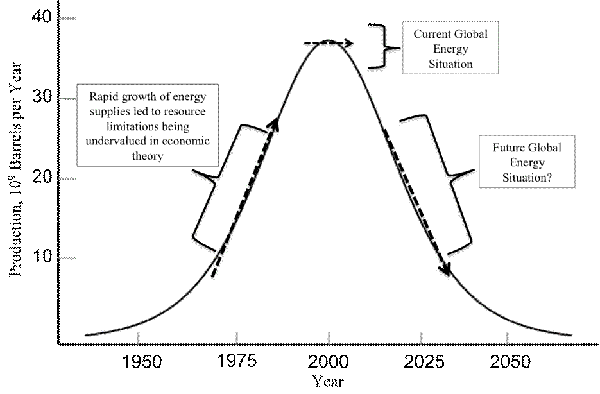
Until we understand this key point, we are going to continue to go through wrenching cycles like we experienced over the last year. Spiking energy and commodity prices lead to destruction of the economy, which then gathers itself at a lower overall level until prices spike again, and back around the wheel we go. As energy declines, the ceiling will get lower and lower, and it will take more and more money to buy the same things.
No amount of tinkering with monetary policy can change that. Unlike money, Btus can’t be printed out of thin air.
Unfortunately, neither the Fed nor Congress seems to have learned this lesson.
The Fed still thinks that tweaking interest rates, buying bonds, forcing banks to keep the fantasy money, hiding the stress test results and the like can somehow ease us into a manageable recovery.
A few bright bulbs in Congress suggested last week that we exchange 70 million barrels of light sweet crude oil from the Strategic Petroleum Reserve (SPR) for an equivalent amount of lesser quality heavy sour crude, in an effort to dampen oil prices. Aside from being a fundamentally bad idea, I continue to believe such a move would be utterly ineffectual. The maximum official rate at which the SPR can be drawn down is four million barrels per day, but I suspect the actual rate would be far lower. In any case, the price difference between the two grades of oil is fairly small, and the value of the swap would virtually disappear within a flow of 84 million barrels a day of globally priced oil.
The other bit of new legislation, a “Cash for Clunkers” bill that passed last week, also appears to be completely toothless. I supported the idea until I learned the anemic requirements of this bill, which would offer $3,500 vouchers for a mere 2 mpg gain in fuel economy for light trucks and SUVs, and $4,500 for a 5 mpg improvement. Cars would only need to gain 4 to 10 mpg to qualify.
Suffice to say that I still have very low expectations that our national leadership will offer any tangible, effective methods to significantly reduce our consumption of petroleum. I certainly do not see them coming to grips with the near-certainty that by 2012, the world’s oil supply will go into terminal and relentless decline.
Looking internationally, finance ministers for the Group of Eight (G8) expressed concern over the influx of capital into the commodity sector after their meeting last weekend. In a communiqué, the group stated, “Excess volatility of commodity prices poses risks to growth. We will consider ways to improve the functioning and transparency of global commodity markets, including considering IOSCO [the International Organisation of Securities Commissions] work on commodity derivative markets.” Ministers have asked the International Monetary Fund (IMF) and the International Energy Agency (IEA) to suggest new ways to monitor and regulate the oil markets, in an effort to limit speculation and dampen future volatility.
If done very carefully, such an effort could moderate the boom-bust cycles ahead, and give the world a crucial measure of slack in which we can sustain the long term investment horizon needed to transition to a renewable energy infrastructure. If done hastily or badly, it could starve the energy markets of capital, or cause unintended and probably worse effects.
I think that as it is now constituted, the market is inadequately equipped to face this inflection point of indeflation, and history is no longer a useful guide. We’re entering uncharted territory while the risk of peak oil is still priced at approximately zero.
So what does all this mean for investors?
First, it means long-term investing in a diversified portfolio of stocks is probably not going to be a good strategy for a long time to come (if ever); it’s time to play defense and look for low-risk yield. Second, it means that investing in oil and commodities will continue to be the name of the game for many years, but investors must watch the signs I have identified here carefully to know when it’s time to dive in and time to jump out as we churn through these cycles under a dropping ceiling. And third, it means that we all need to learn to live at a lower level, eliminate debt, build savings, and buckle up for a long and bumpy ride.
Categories: Links
Recent comments
8 weeks 5 days ago
10 weeks 6 days ago
11 weeks 3 days ago
20 weeks 5 days ago
20 weeks 6 days ago
22 weeks 2 days ago
22 weeks 5 days ago
24 weeks 5 days ago
29 weeks 14 hours ago
29 weeks 2 days ago