- Home
- What is Peak Oil?
- Info & Resources
- Events
- Forums
- Get Involved
- Recent Posts
- Contact Us
- Login
Links
Peak Oil, Sustainability and the Problem of Freedom
The following is a guest essay by Kurt Cobb exploring the concept of freedom via a resource depletion filter. Kurt speaks and writes frequently on energy and the environment and is featured on many sites including Energy Bulletin and EV World. His personal weblog is Resource Insights. Previously on TheOilDrum, Kurt wrote Peak Oil and Mass Communication.
In the film "A Beautiful Mind" the putative hero is John Nash, the Nobel prize-winning mathematician who struggles with paranoid schizophrenia and ultimately overcomes it. The same John Nash early in his career created a model of human behavior that lives on in our institutions and policies and which has significantly constricted our views of human freedom. So says a BBC documentary series entitled "The Trap: What Happened to Our Dream of Freedom."
(The three episodes of the documentary are available on YouTube: Episode One: F*ck You, Buddy, Episode Two: The Lonely Robot, Episode Three: We Will Force You To Be Free.)
The documentary's thesis is that Nash's view of humans as "self-seeking, almost robotic, creatures" has been incorporated into public policy and culture both in the United States and Great Britain in a way that undermines human freedom. The issues discussed in the broadcast and in a seminal essay by philosopher Isaiah Berlin entitled "Two Concepts of Liberty" which is referenced in the program have profound implications for those concerned about peak oil, resource depletion in general or any set of issues that falls under the rubric of sustainability. The ideas of negative and positive freedom outlined by Berlin in his famous essay and the Nashian model of human behavior pose difficult challenges to those who want to put human society on what they perceive as a more sustainable path.
First, let me briefly outline Berlin's definitions of negative and positive freedom though a complete reading of his essay is necessary to comprehend all the nuances. Negative freedom is essentially the freedom to be left alone. It is freedom from coercion, but within a well-defined realm that has differed from age to age. It would now commonly include one's home life, religious life, leisure pursuits and even voluntary economic transactions (that is, those involving something other than paying taxes). It is the realm of personal choice. But it is also the realm of privacy including the right to be free from arbitrary searches and the right to confidentiality in our financial and medical affairs.
Positive freedom is more difficult to explain. It involves the amount of autonomy we have, that is, the power we are able to exert over our own lives outside the realm reserved for personal choice and privacy. For example, at work your employer has a great deal to say about what you do, where you do it and how you are compensated. If you are member of a union, then you along with your fellow employees will have a bit more to say about these issues. If you are self-employed, you may have yet more autonomy, but your customers will limit what autonomy you have through the demands they put on you. If you are independently wealthy and do not have to work, you may have yet more autonomy though your autonomy will never be absolute.
If you live under a dictatorship, even if the dictator is very benevolent and gives you a great deal of negative freedom, you will still have very little autonomy in the political sphere. If you have a say in who governs you, then your positive freedom will increase. But it does not necessarily follow that your negative freedom will also increase. Berlin takes pains to point out that democracy does not always coincide with greater negative freedom. Democratically elected governments can decide to curtail severely the realm of personal choice and privacy. Witness the increasingly intrusive security measures enacted in the wake of the September 11th attacks on the United States.
Perhaps most important of all, each type of freedom is subject to being turned into an absolutist doctrine that perverts and undermines the very notion of freedom.
This is a mere sketch of Berlin's two kinds of freedom. But, it will serve my purpose of showing how contemporary notions of these two views of freedom affect efforts to reform society. The social reformer is always on the side of positive freedom. As it turns out, everyone who has a child is a social reformer. Parents believe they know what's best for children, and so they constantly correct their behavior. They try to set them on a course that will allow them to prosper emotionally, physically and mentally, a course that will prepare them for adult life.
Certainly, parents normally allow a realm of play and free expression for their children that can be seen as a type of negative freedom. But when it comes to brushing their teeth, eating their vegetables, and taking their vitamins, most parents take the view that an unhealthy child with rotting teeth and stunted growth will not be truly free to pursue his or her talents to the greatest degree possible.
This is where positive freedom comes in. Without the ability to act autonomously either due to poor health, imprisonment or impoverishment, all the negative freedom in the world is useless. A hungry person has little use for negative freedom and far more use for food. True, a hungry person with wide latitude to act in the marketplace to obtain the food he or she needs may have advantages. But lack of food may prohibit him or her from taking full advantage of that freedom in the first place.
In addition, parents also generally insist on education for their children. Again, without any skills or social training, all the negative freedom in the world is meaningless.
Governments often act like parents with respect to their citizens. They may insist on compulsory education for the young. They may insist on vaccinations as a public health measure. They may make laws to ensure the safety of food and automobiles. This is, of course, where controversy rages. The government as social reformer is behaving as if it knows what's best for each of us in the belief that by compelling us to get an education or to follow certain procedures to produce disease-free food, it will enhance our individual and collective lives. The belief is that following these requirements will actually make us more free by increasing our chances for success and helping us to maintain our health.
How far should the government go in trying to get us to do what is supposedly "best" for us? And, should it compel us to help other people obtain an education or basic nutrition or essential health care through taxation? In other words, is our freedom enhanced when the positive freedom of others who live around is also enhanced?
Berlin isn't opposed to positive freedom, but fears its unrestrained trajectory. The 20th century is replete with figures who were certain they knew what would allow humans to discover their true nature and become their highest and best selves. The trouble with this sort of absolutist thinking is that it can end up justifying imprisoning, torturing and/or killing all who stand in the way of perfecting humanity. The examples of the Stalinist purges of the 1930s and the so-called Cultural Revolution in China in the late 1960s and early 1970s are just two among many.
On the other hand, we celebrate figures such as Rachel Carson, who helped to spawn the modern environmental movement which has been in part focused on preventing the uncontrolled poisoning of the environment by human activities, especially the indiscriminate use of pesticides. This has been done primarily through government regulation. And, while in some circles controversy still swirls around the mandatory vaccination of children, Jonas Salk, inventor of the polio vaccine, is hailed by most as a hero for creating a vaccine which every child is now essentially forced to receive.
(Berlin might have been perplexed by the perversions of negative freedom as well. At least one of the justifications for the war in Iraq was to bring freedom and democracy to the Middle East. But the two words are not necessarily interchangeable as explained above. The result has been to bring the tradition of negative freedom as we know it to Iraq, particularly in the functioning of the economy where the previous socialist system of government control was dismantled almost overnight. Bringing our type of negative freedom to a country at the point of a gun hasn't worked out as well as planned.)
So, what is the state of interplay of these two notions of freedom today? The answer in the United States and Great Britain is that we are as cultures one-sidedly wedded to the idea of negative liberty. But even that idea has been further constricted by the widespread application of the Nashian model of human behavior in public policy. Nash's model was designed to describe a two-player game, namely The Cold War, in which the best posture was constant suspicion, and the most fruitful tactic betrayal. Nash's model is based on game theory and is related to the situation hypothesized in the now famous prisoner's dilemma problem. Each player plays to maximize his or her own gains without concern for the other. This has become what the documentary "The Trap" refers to as the maximizing information processor model of human beings with particular but not exclusive reference to their economic transactions.
If humans are atomized self-maximizers, scheming and calculating for their own advantage at all times, then any policy that treats them otherwise is foolishly misguided. Now, here is the crux of the problem for anybody who wants to reform society, that is, help others achieve more positive freedom. If this model of humans is correct, then leaders in every part of society including government are only out to enhance their own well-being and power to the exclusion of everyone else.
American economist James M. Buchanan (covered in the BBC documentary mentioned above) even posited that there is no such thing at "the public interest." There is only the competing self-interest of government officials and politicians trying to maximize their own gains, i.e. more pay, more power, more promotions, more election wins, etc. Therefore, the only way government could be made to serve the populace would be to provide incentives that make it in government employees' self-interest to serve the self-interest of members of the public. (There appears to be a bit of a contradiction here since citizens all working for their self-interest seems to be Buchanan's definition of what's best for society as a whole, i.e. the public interest. But let's leave this problem aside.)
Creating government services and protections for the public is problematic from the beginning, Buchanan and his fellow theorists explain. It is better to leave everything one can to the marketplace. That is where individuals can truly operate to satisfy their own interests most effectively and efficiently.
Buchanan was a consultant to the governments of both British Prime Minister Margaret Thatcher and her successor, John Major. It is Thatcher who once said: "Who is society? There is no such thing! There are individual men and women and there are families." If you read the entire passage, you'll see that she didn't quite embrace anarchy though her ideas reflect the libertarian notions evinced by Buchanan. But the effect of Buchanan's ideas can be seen even in the efforts of so-called left-of-center governments such as we find in a Clinton-era program referred to as "Reinventing Government." It is not the attempts to make government more effective at delivering services that should concern us here. It is the notion that there is no such thing as the public interest. If this is true, then there can be no meaningful program for improving society as a whole, only attempts by individuals to pursue their own improvement (or not) as they see fit.
In the context of resource depletion and sustainability such a view can only mean that the marketplace will determine all. No government intervention can take place save to enhance the interests of particular groups at the expense of others. That is the sole meaning of "government program." In Buchanan's view it cannot be construed otherwise.
The problem for those who seek widespread sustainability preparations is that this view has come to be widely accepted by the public and even by politicians. And, its corollary--that humans are all independent information processors that aim to maximize their personal gains at all times--has also achieved a broad purchase on the public mind.
What strategy, then, might one pursue to counteract this view which is now so prevalent? I no longer concern myself with the diehard cornucopians and techno-optimists who will never be convinced that anything truly catastrophic could ever happen to us or the natural systems that support us. The way to win any battle for the public mind is to focus on the so-called "persuadables." These are the people who haven't really made up their minds about an issue, and they tend to be the largest segment of any population. On this count my worry grows exponentially. As Robert Rapier has explained on this site previously in a piece entitled "We Won't Stop Global Warming," most people say they want to do something about global warming. But when one places a price on actually doing something, say, raising the cost of gasoline $1 a gallon through taxes, support for action drops precipitously. People see themselves as maximizing consumers first, and citizens with duties to a greater society second.
Therein lies the conundrum. Any public-spirited sacrifice--even for people who believe there is a problem--seems out of a question in societies whose entire politics and culture are dominated by the idea that personal wants are the equivalent of the public good. In the longer run the question of human freedom becomes even more nettlesome in my view because a sustainable industrial society implies two things: a steady-state economy and a stable population. And, that implies considerable regimentation of daily life, the likes of which people in Western-style democracies have never experienced.
It is conceivable to me that the privations of a post-peak oil world or, say, a food and water crisis brought on by the collapse of one or more key natural systems could alter the current paradigm of humans as selfish maximizers. But, by then it will be too late to prepare; we will only be coping.
I wonder whether anything can be done to change the way people think about freedom now, while there is still some time to do something that might be labeled as preparation. Certainly, the negative freedom we enjoy today in places such as Britain, the United States and Canada, allows individuals to make their own preparations. But that can only go so far. It seems to me that collective action in many areas will be required to avoid the worst consequences of resource depletion and to forestall ecosystem collapse. For that we need an entirely revised understanding of human freedom. But, if that's desirable, is it even possible?
Categories: Links
DrumBeat: June 7, 2009
Crisis to induce transparency in oil companies
The global financial crisis and the resulting difficulty in raising finances may force national oil companies to become more transparent in their operations.
Analysts at the World national oil companies congress' said oil firms, particularly those of consumer countries and emerging oil producers such as Petrobras of Brazil, raise finances through new business partnerships and issue of bonds.
Gulf majors such as Saudi Aramco, Adnoc and Kuwait National Petroleum Company (KNPC) will, however, remain immune to these changes, considering the low costs involved in extracting crude and strong financial positions. However, even they will be forced to diversify their sources of funding during the prevailing turbulent times, an analyst said.
Gas prices above $2.60 NEW YORK (CNNMoney.com) -- Gas prices continue to surge nationwide, and are now up more than 27% in the past seven and a half weeks.
9 Hostage Officers Killed at Peruvian Oil Facility
LIMA, Peru — Nine police officers were killed Saturday as security forces regained control of a petroleum facility from indigenous protesters in a remote jungle region, raising the death toll related to protests by indigenous activists since Friday above 30, Peruvian government officials here said.
Saudi Arabia's impetus to change grows as it dreams of new riches beyond oil
Oil is no longer enough for Saudi Arabia, Opec's largest producer of the black gold.
Since 1975 its population has more than tripled to 25 million people from 7.3 million - and 57 percent of all Saudis are under the age of 25. As the population grows, the kingdom's riches must be spread further. Last year, gross domestic product (GDP) per capita was less than $19 000 (R153 274), compared with $47 000 in the US and $103 000 in Qatar.
To create jobs for its citizenry, the government wants to build cities and diversify into new industries.
Gloomy outlook for coal
Lane said the United States' energy strategy for the last 50 years can be summarized as: "Borrow, buy, burn." The U.S. has 5 percent of the world's population but uses 25 percent of the world's energy. "We're energy pigs," he said. Studies show that 55 percent of the energy generated in the U.S. is lost as waste heat.
Americans who insist on driving around encased in 4,000 pounds of metal are going to start paying for it, he said. Europeans are already paying the equivalent of $9 a gallon for gasoline.
Towards a Great German Oil Empire
Dietrich Eichholtz does not mince words. From the first page of this powerfully argued book, his underlying argument is clear: "The imperialist interest in oil played a role in the occurrence, course, and outcome" of the Second World War.
Stephen Leeb - Energy: Zero Sum, We Lose
President Obama’s energy policy proposals have so far left a lot to be desired. While he’s intent on reducing emissions to combat global warming, Obama’s policy stance offers little incentive to develop much-needed alternative energy production.
Instead, his solutions are likely to result in conservation of resources here in the U.S. that others elsewhere will only use at prices that will be lower than they might be otherwise. Part of the problem may be the hand Obama has been dealt.
Could India Become a Solar Leader?
India may be gearing to turn itself into the global leader in solar power generation, a sign that major developing nations could become renewable energy hubs to rival Germany and the United States.
Ethanol Makers Still Trying to Catch a Break from Banks, Debt Holders
A combination of lower oil prices and challenging financial markets continues to spell disaster for U.S. ethanol companies, with another 10 providers of this first-generation biofuel going belly up in the first five months of 2009. Among the latest was Pacific Ethanol (PEIX), which saw its shares swoon 44 percent to 32 cents on May 19 when five of its six ethanol-producing units filed for Chapter 11 bankruptcy protection. The company had gone public in 2005 with shares debuting at $12.95.
Developing a Greener Third World
NEW YORK — If the United States and every wealthy country in the world were to reduce carbon dioxide emissions to zero tomorrow and there were no change in the developing world, “the crisis would still overtake us,” said Al Gore, the former vice president of the United States, at a forum in New York City last week.
Whether or not that is precisely true, the implication almost certainly is.
Japan auto-makers race ahead with green cars
While US carmakers like General Motors are on life support, struggling under the dead weight of their fuel-guzzling sports utility vehicles, the plant here is humming to the tune of next-generation car technology.
Japan's auto giants hope that, amid the global recession, brisk domestic sales and a worldwide trend towards tougher regulations on carbon dioxide emissions will keep them in international pole position.
Analysis Finds Elevated Risk From Soot Particles in the Air
A new appraisal of existing studies documenting the links between tiny soot particles and premature death from cardiovascular ailments shows that mortality rates among people exposed to the particles are twice as high as previously thought.
Heading to Texas, Hudson’s Toxic Mud Stirs Town
EUNICE, N.M. — There are not many towns in America that would welcome the 2.5 million cubic yards of toxic sludge being dredged from the bottom of the Hudson River in New York, but to hear Mayor Matt White tell it, Eunice is one of them.
Storing waste nobody else wants means more jobs, Mr. White said, and the oil workers here are used to living with hazards. After all, there are several oil wells in the town itself. One of them is a block from City Hall.
Greening the Herds: A New Diet to Cap Gas
Libby, age 6, and the 74 other dairy cows on Guy Choiniere’s farm here are at the heart of an experiment to determine whether a change in diet will help them belch less methane, a potent heat-trapping gas that has been linked to climate change.
Since January, cows at 15 farms across Vermont have had their grain feed adjusted to include more plants like alfalfa and flaxseed — substances that, unlike corn or soy, mimic the spring grasses that the animals evolved long ago to eat.
Higher oil price gives renewables a boost
AFTER a year of swings, the oil price is moving toward a stable middle ground that will benefit not just the oil industry but the struggling renewables sector as well, experts say.
Brent crude closed at $67.82 a barrel last week - nearly double the $35 it plumbed in February but still less than half the record $146 a barrel it touched last summer.
Barclays Capital predicts it is now heading toward the $75 to $85 “Goldilocks” range - not so high that governments aggressively seek alternatives but enough for oil-producing nations to make a comfortable return on more exotic endeavours such as deep-sea drilling and tar sands.
Chavez to expand Venezuela oil nationalizations
CARACAS (Reuters) - President Hugo Chavez has already nationalized most of Venezuela's energy industry and is preparing to bring chemicals under his wing, but he may still target firms running gas and oil services.
A former soldier inspired by Cuba's Fidel Castro, Chavez has made energy nationalization the linchpin in his drive to build his own brand of socialism. He has also taken over assets in telecommunications, power, steel and banking.
Tribes keep Peru police hostage after Amazon fights
TARAPOTO, Peru (Reuters) - Hundreds of indigenous protesters were holding 38 police hostage early on Saturday in Peru's Amazon jungle after fights between tribes and police killed up to 33 people in the worst violence of President Alan Garcia's government.
Demonstrators also were threatening to set fire to an oil pumping station of state-owned Petroperu unless the government told police to halt efforts to clear weeks of blockades of roads and rivers that have hurt food and fuel supplies.
'This is an oil war'
Lagos - Nigeria's main armed group on Sunday intensified its threat to attack the oil industry in the coming days, warning that it will stand firm on a 72-hour ultimatum issued earlier.
"The ultimatum (to local and foreign oil workers) expires about midnight (Monday) ... Our focus will be the oil industry as this is an oil war," the Movement for the Emancipation of the Niger Delta (MEND) said in an emailed statement.
Oil: Up to $200 or Down to $25?
It is worrying for oil producers when the Russian President Dimitri Medvedev talks of $150 oil because it is so reminiscent of the $250 a barrel forecast last summer. A little hubris often comes before a fall.
Oil got down to $33 a barrel last December. Could another fall be on the cards this autumn?
Lawsuits target overseas oil company operations
NEW YORK -- Royal Dutch Shell is preparing for a federal trial this summer where it would face allegations that it played a role in the executions of activist Ken Saro-Wiwa and other civilians by Nigeria's former military regime.
It is just the latest in a series of trials seeking to hold big oil companies liable for human rights abuses or environmental damage overseas. As in a similar case against Chevron last year, the plaintiffs found a way to strike at Shell through the courts using an 18th-century law meant to battle piracy.
Average price of Russian oil in 2010 to be about US $60 - Klepach
In a talk with journalists within the framework of the St. Petersburg International Economic Forum on Saturday, Klepach said, "The most probable price of oil (for 2010) is $60 dollars."
At the same time, he considers superoptimistic forecasts of a number of experts as unreal. "I don't think that it will rise to 100 dollars, there are no fundamental factors for this," Klepach said.
U.S. Interest in Caspian Sea Oil to Bring More Trouble for Russia
Oil and natural gas of the Caspian states seems to be of strategic significance for the West, Richard Morningstar, the US special envoy for Eurasian energy issues said. Why does the US administration show so much interest in the Caspian Sea region? Does it mean that US army bases will soon be deployed there?
Dismal day for Greens in Dublin
The Green Party has lost all its city and county council seats in Dublin, where most of its TDs are based.
Go on, tell it like it really is
Today, doubt is stirring in most corners of the world — mainly caused by the frightening spectre of climate change, peak oil, the global economic recession and rising poverty. To be harsh, but practical, these are probably the best things that have happened to humanity in a long time. They are causing us to wake up and rethink our frames of reference.
Deep ecologists say that modernism has led to a fundamental male-principle ethic of dominance and conquest played out in various hierarchical, militaristic, capitalist and industrialist forms. It disallows the feminine-principle values of caring and respect so necessary to the nurturing of life and the creation of balance in society.
Create a Metro Vancouver municipal party to cope with peak oil
Here’s an idea for a regional citizens’ group called Vancouver Peak Oil: form a political party and run a maximum of one candidate in every municipality across Metro Vancouver in the 2011 election.
The membership of Vancouver Peak Oil should choose the candidates, and each should run with the party label “Peak Oil” after their names.
Sacramento area drivers take the 'Car-Free Challenge'
Joan Edelstein of West Sacramento made a public vow last week. She will drive her car no more than 200 miles this month.
The go-green pledge puts her among a handful of Sacramentans who've announced similar intentions at the new "Car-Free Challenge" Web site – not for pocketbook reasons, they say, but because it's the right thing to do.
Just days in, however, Edelstein is learning an inconvenient truth about the movement to reduce driving.
Depending on where you live, it's not easy.
Clean energy is the best option for U.S.
Global warming and unsustainable energy dependence are the foremost environmental issues of our time; they are also the signature economic issues of our day, providing enormous risks to future economic growth and unparalleled opportunities to create jobs and launch a different model of economic development.
'Realists' challenge claim of consensus on warming
Several hundred scientists, politicians and activists participated in the third annual International Conference on Climate Change on Tuesday, marking another stage in the timeline of a scientific social movement.
The conference, sponsored by the nonprofit Heartland Institute, hosted panels of climatologists and meteorologists as well as members of Congress to address questions surrounding global warming and climate-change legislation.
Health, climate change vie for boost in Congress
WASHINGTON (Reuters) – Barack Obama may be pressuring Congress as no U.S. president has for decades as he aims to get two big domestic goals passed this year -- reforming health care and fighting global warming.
"It's not impossible to do both, but that would be more than a Congress has ever given a president, maybe since the first First 100 Days," said Brookings Institution senior fellow Stephen Hess, referring to the start of Franklin Roosevelt's "New Deal" presidency in 1933.
Categories: Links
Unintended Consequences: The Long Term Impacts of Crisis Blogging
The genesis for tonight's Campfire topic was an argument with a close friend a few weeks back, questioning the purpose/effectiveness of time spent blogging/speaking/educating about the various systemic errors embedded in conventional energy, economic and social thinking. Her question to me, before I left for a speech at U of Wisconsin, was unexpected:
"How can you be certain that all yours and others 'outreach' efforts will only result in slowing down our consumption paradigm just enough to allow for 20 or 30 more years of pulling in resources from the periphery, thereby unintentionally causing an ultimately greater ecological disaster than the one you are efforting to avoid?
I didn't have a quick answer to that one, though I have since puzzled out a rational response. Tonight's short essay then, is about unintended consequences, our human penchant to 'mess with things', and the benefits (or drawbacks) of wider education on our looming energy crisis.
# Based on a detailed bottom-up approach, CERA sees no evidence of a peak before 2030. CERA believes that we will see an undulating plateau of global production starting sometime after 2030, which is likely to last for a number of decades. Towards the end of the plateau period, we envisage that global production will decline more gently compared to the very rapid production decline predicted by the peak oil lobby.
# The peak oil theory causes confusion and can lead to inappropriate actions and turn attention away from the real issues. Corporations, governments, and other groups, including nongovernmental organizations, need to have a coherent description of how and when the undulating plateau will evolve so that rational policy and investment choices can be made. It is likely that the situation will unfold in slow motion and that there will be a number of decades to prepare for the start of the undulating plateau.
#Oil is too critical to the global economy to allow fear to replace careful analysis about the very real challenges of delivering liquid fuels to meet the needs of growing economies. This is a very important debate, and as such it deserves a rational and measured discourse. Source
The above comments were from a 2007 CERA report. To me it is clear what the risks are of such statements. In following this conventional line of thinking (resources vs reserves, gross vs net, in the ground vs. affordable flow rate etc.) we lose a most valuable asset - time. Resource depletion 'answers' revolve around reducing the amount of existing infrastructure dependent on resources that are about to get scarcer, and investing in infrastructure that can be supported for the long haul. If significant uncertainty exists about timing and decline rates, then the precautionary principle applies. Live to fight another day, etc. Simple.
With respect to blogging, speaking and educating, I have always felt that the facts are on my side (I suppose all of us, even CERA, believe so). A sample of these integrated (not to be rehashed here) facts are:
-we are wired to compete (between groups)
-there is a finite amount of land and net primary productivity available for human appropriation
-the OECD, and social democracies in general, are incredibly dependent on cheap, just-in-time liquid fuels, a fact that cannot be meaningfully mitigated in less than 10-15 years.
-depletion is in a race with technology, and is winning.
-debt/leverage/credit replaced cheap energy for a time, drawing marginal projects into production that are now below break-even. Higher oil and gas prices are needed for long term investments, but supply and demand won't justify such prices.
-we become habituated/addicted to higher novelty/stimulation via the ratchet effect.
-historical resource per capita drops have been met with wars (between groups).
-our steep discount rates, or penchant to overweight the here and now vs the future manifest in a market and political system with nearly ubiquitous short term focus, which ultimately makes marginal futures pricing bad signals of scarcity.
etc.
Blogs highlighting our problems in ecology, economics, finance, energy and human behavior abound, ostensibly to publicly synthesize issues not being adequately addressed by conventional media. I'm sure some of that traffic is driven by ego, or by the need to scratch a puzzle solving itch etc. Personally, it feels meaningful to share and accelerate awareness of these wide boundary issues to those who will listen, even to those I've never met. The more people that can articulate and synthesize these manifold related issues, the more likely a non-zero number of localities, communities, regions and possibly nations will have fast tracked changes in reducing consumption, investing in renewables, become more locally interdependent, etc. But my friends pointed query has nagged at me...what if the efforts at raising the bar on energy/sustainability discourse will have unintended consequences. And what kind of consequences?
From wikipedia:
Unintended consequences are outcomes that are not (or not limited to) the results originally intended in a particular situation. The unintended results may be foreseen or unforeseen, but they should be the logical or likely results of the action. For example, historians have speculated that if the Treaty of Versailles had not imposed such harsh conditions on Germany, World War II would not have occurred. From this perspective, one might consider the war an unintended consequence of the treaty.
Unintended consequences can be grouped into roughly three types:
* a positive unexpected benefit, usually referred to as serendipity or a windfall
* a negative or perverse effect, that may be contrary to what was originally intended
* a potential source of problems, such as described by Murphy's law
Our impacts on the future, if any, are unlikely to be binary. Firstly, they may impact different time periods in opposite ways (e.g. a positive impact on the next 20 years but a deleterious impact on 100 years hence or vice versa). Secondly, there are many subgroups (and species?) who reside in the future - it stands to reason that behaviours engendered today will have different impacts across future demographics. Finally, I think it difficult to answer questions about the future without defining how 'success' might be measured differently in future years/generations.
In sum, I do not spend as much time here as I used to. But my overall intent to lessen the social decline rate I expect will accompany a higher-than-socially-expected-oil-decline-rate seems worth some time and effort. Won't fewer people using fewer resources while we figure out more reasonable long term goals than importing Veblen goods and exporting desire for same, be a good thing? Won't growing consensus that more than 'minor changes' are necessary, eventually bear fruit?
It seems so to me, but I'm open to other lines of thinking...Perhaps even this
Campfire questions:
There will likely be unintended consequences from 'peak oil outreach'. Are they more likely to be positive or negative? What might some be?
Could my friend be right, (or at least in the ballpark)? That educating leaders to put the breaks on our consumptive trajectory might alter the natural human impact pulse just enough to pull in currently non-scarce resources from the periphery, making us worse off in the long run than if we attempt to mitigate?
Mitigating overconsumption, overpopulation, and resource depletion requires a longer term view. But perhaps focusing on making the next 10-30 years more sustainable discriminates against 30 years and beyond?
Tough questions. I don't have the answers. Perhaps some of you do....
Categories: Links
From a Failed Growth Economy to a Steady-State Economy
This past week was the United States Society for Ecological Economics bi-annual conference (at American University near Washington DC). Herman Daly was honored for his many and longstanding contributions. He also gave an amazing speech which he has graciously allowed us to reproduce as a guest post on theoildrum. In it he outlines 10 prescriptions for changing the course of our current socio-economic system, along the lines of the steady state themes he has been writing about for decades. I feel like keeping it on our main page for a week straight - it isn't perfect (nothing is), but these are the concepts that should be percolating among our nations/worlds decision-makers - please read it and pass it on. I sincerely hope ideas like these will soon be acknowledged not only as mainstream but as urgent - in the opinion of many it is past time for Herman to be awarded the Nobel Prize for Economics....
(Herman's previous essays on The Oil Drum are here (Steady-state) and here (credit crisis).
USSEE lecture, June 1, 2009
Herman E. Daly
School of Public Policy
University of Maryland
A steady-state economy is incompatible with continuous growth—either positive or negative growth. The goal of a steady state is to sustain a constant, sufficient stock of real wealth and people for a long time. A downward spiral of negative growth, a depression such as we are entering now, is a failed growth economy, not a steady-state economy. Halting an accelerating downward spiral is necessary, but is not the same thing as resuming continuous positive growth. The growth economy now fails in two ways: (1) positive growth becomes uneconomic in our full-world economy; (2) negative growth, resulting from the bursting of financial bubbles inflated beyond physical limits, though temporarily necessary, soon becomes self-destructive. That leaves a non-growing or steady-state economy as the only long run alternative. The level of physical wealth that the biosphere can sustain in a steady state may well be below the present level. The fact that recent efforts at growth have resulted mainly in bubbles suggests that this is so. Nevertheless, current policies all aim for the full re-establishment of the growth economy. No one denies that our problems would be easier to solve if we were richer. The question is, does growth any longer make us richer, or is it now making us poorer?
I will spend a few more minutes cursing the darkness of growth, but will then try to light ten little candles along the path to a steady state. Some advise me to forget the darkness and focus on the policy candles. But I find that without a dark background the light of my little candles is not visible in the false dawn projected by the economists, whose campaigning optimism never gives hope a chance to emerge from the shadows.
We have many problems (poverty, unemployment, environmental destruction, budget deficit, trade deficit, bailouts, bankruptcy, foreclosures, etc.), but apparently only one solution: economic growth, or as the pundits now like to say, “to grow the economy”-- as if it were a potted plant with healing leaves, like aloe vera or marijuana.
But let us stop right there and ask two questions that all students should put to their economics professors.
First, there is a deep theorem in mathematics that says when something grows it gets bigger! So, when the economy grows it too gets bigger. How big can the economy be, Professor? How big is it now? How big should it be? Have economists ever considered these questions? And most pointedly, what makes them think that growth (i.e., physical expansion of the economic subsystem into the finite containing biosphere), is not already increasing environmental and social costs faster than production benefits, thereby becoming uneconomic growth, making us poorer, not richer? After all, real GDP, the measure of “economic” growth so-called, does not separate costs from benefits, but conflates them as “economic” activity. How would we know when growth became uneconomic? Remedial and defensive activity becomes ever greater as we grow from an “empty-world” to a “full-world” economy, characterized by congestion, interference, displacement, depletion and pollution. The defensive expenditures induced by these negatives are all added to GDP, not subtracted. Be prepared, students, for some hand waving, throat clearing, and subject changing. But don’t be bluffed.
Second question; do you then, Professor, see growth as a continuing process, desirable in itself-- or as a temporary process required to reach a sufficient level of wealth which would thereafter be maintained more or less in a steady state? At least 99% of modern neoclassical economists hold the growth forever view. We have to go back to John Stuart Mill and the earlier Classical Economists to find serious treatment of the idea of a non-growing economy, the Stationary State. What makes modern economists so sure that the Classical Economists were wrong? Just dropping history of economic thought from the curriculum is not a refutation!
Here are some reasons to think that the Classical Economists are right.
A long run norm of continuous growth could make sense, only if one of the three following conditions were true:
(a) if the economy were not an open subsystem of a finite and non-growing biophysical system,
(b) if the economy were growing in a non physical dimension, or
(c) if the laws of thermodynamics did not hold.
Let us consider each of these three logical alternatives. (If you can think of a fourth one let me know.)
(a) Some economists in fact think of nature as the set of extractive subsectors of the economy (forests, fisheries, mines, wells, pastures, and even agriculture….). The economy, not the ecosystem or biosphere, is seen as the whole; nature is a collection of parts. If the economy is the whole then it is not a part of any larger thing or system that might restrain its expansion. If some extractive natural subsector gets scarce we will just substitute other sectors for it and growth of the whole economy will continue, not into any restraining biospheric envelope, but into sidereal space presumably full of resource-bearing asteroids and friendly highly-evolved aliens eager to teach us how to grow forever into their territory. Sources and sinks are considered infinite.
(b) Some economists say that what is growing in economic growth is value, and value is not reducible to physical units. The latter is true of course, but that does not mean that value is independent of physics! After all, value is price times quantity, and quantity is always basically physical. Even services are always the service of something or somebody for some time period, and people who render services have to eat. The value unit of GDP is not dollars, but dollar’s worth. A dollar’s worth of gasoline is a physical amount, currently about half a gallon. The aggregation of the dollar’s worth amounts of many different physical commodities (GDP) does not abolish the physicality of the measure even though the aggregate can no longer be expressed in physical units. True, $/q x q = $. But the fact that q cancels out mathematically does not mean that the aggregate measure, “dollars’ worth”, is just a pile of dollars. And it doesn’t help to speak instead of “value added” (by labor and capital) because we must ask, to what is the value added? And the answer is natural resources, low-entropy matter/energy—not fairy dust or frog’s hair! Development (squeezing more welfare from the same throughput of resources) is a good thing. Growth (pushing more resources through a physically larger economy) is the problem. Limiting quantitative growth is the way to force qualitative development.
(c) If resources could be created out of nothing, and wastes could be annihilated into nothing, then we could have an ever-growing resource throughput by which to fuel the continuous growth of the economy. But the first law of thermodynamics says NO. Or if we could just recycle the same matter and energy through the economy faster and faster we could keep growth going. The circular flow diagram of all economics principles texts unfortunately comes very close to affirming this. But the second law of thermodynamics says NO.
So—if we can’t grow our way out of all problems, then maybe we should reconsider the logic and virtues of non-growth, the steady-state economy. Why this refusal by neoclassical economists both to face common sense, and to reconsider the ideas of the early Classical Economists?
I think the answer is distressingly simple. Without growth the only way to cure poverty is by sharing. But redistribution is anathema. Without growth to push the hoped for demographic transition, the only way to cure overpopulation is by population control. A second anathema. Without growth the only way to increase funds to invest in environmental repair is by reducing current consumption. Anathema number three. Three anathemas and you are damned—go to hell!
And without growth how will we build up arsenals to protect democracy (and remaining petroleum reserves)? How will we go to Mars and Saturn and “conquer” space? Where can technical progress come from if not from unintended spin-offs from the military and from space research? Gnostic techno-fantasies of escaping earth to outer space, and of abolishing disease and death itself, feed on the perpetual growth myth of no limits. Digital-brained tekkies, who have never heard of the problem of evil, see heaven on earth (eternal growth) just around the corner. Without growth we must face the difficult religious task of finding a different god to worship. Too scary, we say, let’s try to grow some more instead! Let’s jump-start the GDP and the Dow-Jones! Let’s build another tower of Babel with obfuscating technical terms like sub-prime mortgage, derivative, securitized investment vehicle, collateralized debt obligation, credit default swap, “toxic” assets, and insider slang like the “dead cat bounce”. (If you drop it from a high enough tower of Babel even a dead cat will bounce enough to make some profit.)
Well, let us not do that. Let us ignore the anathemas and instead think about what policies would be required to move to a steady-state economy. They are a bit radical by present standards, but not as insanely unrealistic as any of the three alternatives for validating continuous growth, just discussed.
________________________________________________________________________________________________
Let us look briefly at ten specific policy proposals for moving to a steady-state economy, i.e., an economy that maintains a constant metabolic flow of resources from depletion to pollution—a throughput that is within the assimilative and regenerative capacities of the ecosystem.
1. Cap-auction-trade systems for basic resources. Caps limit biophysical scale by quotas on depletion or pollution, whichever is more limiting. Auctioning the quotas captures scarcity rents for equitable redistribution. Trade allows efficient allocation to highest uses. This policy has the advantage of transparency. There is a limit to the amount and rate of depletion and pollution that the economy can be allowed to impose on the ecosystem. Caps are quotas, limits to the throughput of basic resources, especially fossil fuels. The quota usually should be applied at the input end because depletion is more spatially concentrated than pollution and hence easier to monitor. Also the higher price of basic resources will induce their more economical use at each upstream stage of production. It may be that the effective limit in use of a resource comes from the pollution it causes rather than from depletion—no matter, we indirectly limit pollution by restricting depletion of the resource that ultimately is converted into wastes. Limiting barrels, tons, and cubic feet of carbon fuels extracted will limit tons of CO2 emitted. This scale limit serves the goal of biophysical sustainability. Ownership of the quotas is initially public—the government auctions them to the individuals and firms. The revenues go to the treasury and are used to replace regressive taxes, such as the payroll tax, and to reduce income tax on the lowest incomes. Once purchased at auction the quotas can be freely bought and sold by third parties, just as can the resources whose rate of depletion they limit. The trading allows efficient allocation; the auction serves just distribution, and the cap serves the goal of sustainable scale. The same logic can be applied to limiting the off-take from fisheries and forests.
2. Ecological tax reform—shift tax base from value added (labor and capital) and on to “that to which value is added”, namely the entropic throughput of resources extracted from nature (depletion), and returned to nature (pollution). This internalizes external costs as well as raises revenue more equitably. It prices the scarce but previously un-priced contribution of nature. Value added is something we want to encourage, so stop taxing it. Depletion and pollution are things we want to discourage, so tax them. Ecological tax reform can be an alternative or a supplement to cap-auction-trade systems.
3. Limit the range of inequality in income distribution—a minimum income and a maximum income. Without aggregate growth poverty reduction requires redistribution. Complete equality is unfair; unlimited inequality is unfair. Seek fair limits to the range of inequality. The civil service, the military, and the university manage with a range of inequality of a factor of 15 or 20. Corporate America has a range of 500 or more. Many industrial nations are below 25. Could we not limit the range to, say, 100, and see how it works? People who have reached the limit could either work for nothing at the margin if they enjoy their work, or devote their extra time to hobbies or public service. The demand left unmet by those at the top will be filled by those who are below the maximum. A sense of community necessary for democracy is hard to maintain across the vast income differences current in the US. Rich and poor separated by a factor of 500 become almost different species. The main justification for such differences has been that they stimulate growth, which will one day make everyone rich. This may have had superficial plausibility in an empty world, but in our full world it is a fairy tale.
4. Free up the length of the working day, week, and year—allow greater option for part-time or personal work. Full-time external employment for all is hard to provide without growth. Other industrial countries have much longer vacations and maternity leaves than the US. For the Classical Economists the length of the working day was a key variable by which the worker (self-employed yeoman or artisan) balanced the marginal disutility of labor with the marginal utility of income and of leisure so as to maximize enjoyment of life. Under industrialism the length of the working day became a parameter rather than a variable (and for Karl Marx was the key determinant of the rate of exploitation). We need to make it more of a variable subject to choice by the worker. And we should stop biasing the labor–leisure choice by advertising to stimulate more consumption and more labor to pay for it. Advertising should no longer be treated as a tax deductible ordinary expense of production.
5. Re-regulate international commerce—move away from free trade, free capital mobility and globalization, adopt compensating tariffs to protect, not inefficient firms, but efficient national policies of cost internalization from standards-lowering competition. We cannot integrate with the global economy and at the same time have higher wages, environmental standards, and social safety nets than the rest of the world. Trade and capital mobility must be balanced and fair, not deregulated or “free”. Tariffs are also a good source of revenue that could substitute for other taxes.
6.Downgrade the IMF-WB-WTO to something like Keynes’ original plan for a multilateral payments clearing union, charging penalty rates on surplus as well as deficit balances—seek balance on current account, and thereby avoid large foreign debts and capital account transfers. For example, under Keynes’ plan the US would pay a penalty charge to the clearing union for its large deficit with the rest of the world, and China would also pay a similar penalty for its surplus. Both sides of the imbalance would be pressured to balance their current accounts by financial penalties, and if need be by exchange rate adjustments relative to the clearing account unit, called the bancor by Keynes. The bancor would serve as world reserve currency, a privilege that should not be enjoyed by any national currency. The IMF preaches free trade based on comparative advantage, and has done so for a long time. More recently the IMF-WB-WTO have started preaching the gospel of globalization, which, in addition to free trade, means free capital mobility internationally. The classical comparative advantage argument, however, explicitly assumes international capital immobility! When confronted with this contradiction the IMF waves its hands, suggests that you might be a xenophobe, and changes the subject. The IMF-WB-WTO contradict themselves in service to the interests of transnational corporations. International capital mobility, coupled with free trade, allows corporations to escape from national regulation in the public interest, playing one nation off against another. Since there is no global government they are in effect uncontrolled. The nearest thing we have to a global government (IMF-WB-WTO) has shown no interest in regulating transnational capital for the common good.
7. Move away from fractional reserve banking toward a system of 100% reserve requirements. This would put control of the money supply and seigniorage in hands of the government rather than private banks, which would no longer be able to create money out of nothing and lend it at interest. All quasi-bank financial institutions should be brought under this rule, regulated as commercial banks subject to 100% reserve requirements. Banks would earn their profit by financial intermediation only, lending savers’ money for them (charging a loan rate higher than the rate paid to savings account depositors) and providing checking, safekeeping, and other services. With 100% reserves every dollar loaned would be a dollar previously saved, re-establishing the classical balance between abstinence and investment. The government can pay its expenses by issuing more non interest-bearing fiat money to make up for the eliminated bank-created, interest-bearing money. However, it can only do this up to a strict limit imposed by inflation. If the government issues more money than the public wants to hold, the public will trade it for goods, driving the price level up. As soon as the price index begins to rise the government must print less and tax more. Thus a policy of maintaining a constant price index would govern the internal value of the dollar. The external value of the dollar could be left to freely fluctuating exchange rates (or preferably to the rate against the bancor in Keynes’ clearing union).
8. Stop treating the scarce as if it were non-scarce, but also stop treating the non-scarce as if it were scarce. Enclose the remaining commons of rival natural capital (e.g. atmosphere, electromagnetic spectrum, public lands) in public trusts, and price it by a cap-auction–trade system, or by taxes, while freeing from private enclosure and prices the non-rival commonwealth of knowledge and information. Knowledge, unlike throughput, is not divided in the sharing, but multiplied. Once knowledge exists, the opportunity cost of sharing it is zero and its allocative price should be zero. International development aid should more and more take the form of freely and actively shared knowledge, along with small grants, and less and less the form of large interest-bearing loans. Sharing knowledge costs little, does not create un-repayable debts, and it increases the productivity of the truly rival and scarce factors of production. Existing knowledge is the most important input to the production of new knowledge, and keeping it artificially scarce and expensive is perverse. Patent monopolies (aka “intellectual property rights”) should be given for fewer “inventions”, and for fewer years. Costs of production of new knowledge should, more and more, be publicly financed and then the knowledge freely shared.
9. Stabilize population. Work toward a balance in which births plus in- migrants equals deaths plus out-migrants. This is controversial and difficult, but as a start contraception should be made available for voluntary use everywhere. And while each nation can debate whether it should accept many or few immigrants, such a debate is rendered moot if immigration laws are not enforced. Support voluntary family planning, and enforcement of reasonable immigration laws, democratically enacted in spite of the cheap labor lobby.
10. Reform national accounts—separate GDP into a cost account and a benefits account. Compare them at the margin, stop throughput growth when marginal costs equal marginal benefits. In addition to this objective approach, recognize the importance of the subjective studies that show that, beyond a threshold, further GDP growth does not increase self-evaluated happiness. Beyond a level already reached in many countries GDP growth delivers no more happiness, but continues to generate depletion and pollution. At a minimum we must not just assume that GDP growth is “economic growth”, but prove it. And start by trying to refute the mountain of contrary evidence.
While these policies will appear radical to many, it is worth remembering that they are amenable to gradual application. One hundred percent reserves can be approached gradually, the range of distribution can be restricted gradually, caps can be adjusted gradually, etc. Also these measures are based on the conservative institutions of private property and decentralized market allocation. They simply recognize that private property loses its legitimacy if too unequally distributed, and that markets lose their legitimacy if prices do not tell the whole truth about opportunity costs. In addition, the macro-economy becomes an absurdity if its scale is structurally required to grow beyond the biophysical limits of the Earth. And well before reaching that radical physical limit we are encountering the conservative economic limit in which extra costs of growth become greater than the extra benefits, ushering in the era of uneconomic growth, so far unrecognized.
Categories: Links
Five Easy Leases: Ghawar's Discovery Wells
A few months back, Saudi Aramco commissioned a story about the first wells in the Ghawar oil field in Saudi Arabia, the world's largest. With the title "Ghawar's Magnificent Five", it was published first on the Saudi Aramco website but has subsequently appeared elsewhere. Saudi Aramco later published the same article along with the companion piece "Still Going Strong" (subtitled "57-year-old super-giant Ghawar oil field productive as ever") in the Fall 2008 issue of SA Dimensions magazine, also available on their website1. "Magnificent Five" is the newly minted moniker2 for the group of discovery wells, one for each of the five major production areas of Ghawar: 'Ain Dar, Shedgum, Uthmaniyah, Hawiyah, and Haradh. These articles are remarkable in that Saudi Aramco rarely reveals production details for specific wells in Ghawar, but something in this myth-building exercise is amiss -- both in the consistency of the numbers provided and their use as indicators for the state of the wells and the overall field. In this article, I will examine the data provided for these wells and cross check with other available information including satellite imagery available within Google Earth. There is definitely more to the story, and this uncut version is actually more interesting than what Saudi Aramco has released to theaters.
1http://www.saudiaramco.com. Click Newsroom/Publications/Dimensions.
2The wells' new nickname invokes the grandeur of another movie: The Magnificent Seven. It is noteworthy, though, that most of the seven died prematurely.
First Things First The first, (or discovery) well is certainly critical to the success of an oil field in that, well, there has to be one. Its story can also be one of drama, as is the case for the first (successful) well in Saudi Arabia, Damman #7 (aptly named "Prosperity Well"), located a short walk from Saudi Aramco's headquarters in Dhahran. Here are some excerpts from an account of the drilling: By May, 1937, everybody around Dammam admitted that the well was in bad shape and was going to be slow. There was a spurt in July that took them down to 2,400 feet, then delays again. On October 6 they had reached 3,300 feet. Tests then, as well as on the 11th and 13th at slighly greater depths, produced the same report: "No oil, no water." At 3,600 feet, on October 16, they got their first showing of oil—about two gallons, in a flow of thin gas-cut mud. On the last day of 1937, with the hole drilled to 4,535 feet, the well blew out when the control equipment failed. After contact was reestablished, measurements showed the well making 30 million cubic feet of gas a day against 1,600 pounds back pressure. Because of the high pressure they let it blow for seven hours while mixing mud to kill it with, and then killed it without difficulty. There was no oil in the gas it blew. ... While he was selling them, Ohliger's crew was drilling past the "fish" that it had been unable to pick up, and on March 4, 1938, San Francisco got the word that blew it back again into the euphoria of the summer of 1936. Tested on that day, No.7 flowed at the rate of 1,585 barrels a day. Tested three days later, it flowed at the rate of 3,690 barrels. The drilling party stuck the tester in the hole and couldn't get it out, and the well, flowing as nearly open as possible through the stuck pipe, went on producing at a rate that made them cheer.Pretty gripping stuff, and probably worth the well being immortalized with a nickname and by mounting the original wellhead at Saudi Aramco headquarters. Anyway, back to the "Magnificant Five".
Given its size, Ghawar warrants five discovery wells (Fazran's well didn't make the team). Disappointingly, the tale related for each of these discoveries is not as gripping as that for Damman #7. Also, these are likely not the most productive wells in each of the areas, and lauding the achievement of any particular well in Ghawar seems somewhat akin to giving the straw credit for the margarita. So why tell their story? As shown in the excerpts below, it seems to be a case of wanting to cement the legacy while reassuring the world that the "Glory Days" are not gone.
Since the discovery of the Ghawar field in 1948, Saudi Aramco has implemented best-in-class reservoir management practices and leading technologies that have evolved over the years. As a result, the Magnificent Five have demonstrated extraordinary performance with extended lifecycles and outstanding oil recovery. and in conclusion: Altogether, the Magnificent Five have produced nearly 350 million barrels of oil. There’s no telling how much more they will produce — as the end of their story is not yet in sight. Unless you go looking for it. Sweeping InBefore we look more closely at the "Mag Five", let's address an important aspect of Ghawar not discussed in the articles. The Ghawar oil field has been subjected to peripheral water injection for nearly 40 years. The goal of the water injection is to maintain pressure at the oil/water contact (OWC) so as to enable the oil to flow uniformly towards the wells. As the OWC moves upwards as the oil is displaced, wells nearer to the periphery of the field will be expected to encounter water sooner than those in the middle. Ideally, the field would be developed in stages, with the first producers situated a modest distance from the (original) OWC and wells further updip either choked back (to concentrate flow on the first producers) or simply undrilled. This is shown below. Click the Start/Continue button to proceed through the various stages of field depletion.
Figure 1. Peripheral water injection.If the first wells are drilled near the middle of the field, a successful sweep would mean that they would remain successful producers for most of the field's life. As we will see, four of the "Magnificent Five" are indeed located in the middle of their respective areas of Ghawar. There was one slight miss, however.
The Ghawar field is 264 km (164 miles) long, but it is not the simple anticline pictured above. This is shown in the cross-sectional representations below. A single NW-trending anticline in the south becomes two in Uthmaniyah. This has implications for the uniformity of the water flood, as distance from the water injectors will tend to keep the "valley" between the anticlines dry longer than would be predicted from gravity-dominated drainage. Note the exaggerated vertical relief in most 3-D reservoir depictions.
Figure 2. left: location of discovery wells on 3-D rendering of Arab-D reservoir for Ghawar; right: cutaway rendering near 'Uthmaniyah discovery well Stacking the DeckThe "Mag Five" article provides some basic production data for each of the five wells, including production start, cumulative oil produced, and current flow. For these, one can calculate the average daily flow rate for each well. These data are summarized in the table below:
Two of the wells (Hawiyah-1 and Haradh-1) were presumed to be shutdown along with their respective fields during the price crash in the 1980s , so the years 1983-1990 were excluded from their calculated averages. And though the authors are loathe to type the words, the Uthmaniyah discovery well died a watery death some years ago.
Most of the production has come from the 'Ain Dar and Shedgum wells, due mostly to their high flow rates, but also because they have been flowing more or less continuously. They are both down from their lifetime average flow rates, however.
A couple of months after the "Mag Five" article came out, a story in Forbes appeared which used similar information in a story on Saudi oil: "We go really slow and soft," says Al-Naim, the engineering chief. "Ghawar we treat as you would a young woman." Every Aramco well is fitted with an adjustable steel choke that restricts a standard 3-inch-diameter well bore down to a quarter-inch or less. Slowing the well reduces the amount of water that is produced alongside the oil, and a gentler flow protects the reservoir from damage. Aramco's oldest operating well, Ain Dar 1, was drilled in 1948. This single well in the Ghawar complex has produced 152 million barrels from its original casing. The well's free-flow rate is now 8,000 barrels a day, but Aramco restricts it to 2,500. It insists that rumors of Ghawar's demise are premature. The field has given up some 45 billion of at least 100 billion barrels of original oil in place (only Aramco knows for sure, and it's not telling), yet still easily produces 5 million barrels a day; its overall water cut has declined in recent years to only 28%. Says Nasser, "If I needed more production I could go to Ghawar and boost it to 10 million barrels a day."The suggestion here is that 'Ain Dar-1 could be producing more than its lifetime average but is instead being throttled back to 2500 or lower. The more outlandish claim -- that Ghawar could produce 10 million barrels on demand -- does make one question any numbers provided. For one thing, there is no way to provide that much water to pump into Ghawar, and thus the field pressure would quickly collapse.
The "Still Going Strong" article presents similar numbers but also tantalizes us with a graphic showing the production history for the wells. Unfortunately, it was routed through Saudi Aramco's data obfuscation department; their first act was providing running sums instead of showing actual rates, and the second was stacking the data to yield a completely meaningless summation of the five disparate wells. This graphic is reproduced below.
Figure 3. Stacked presentation of cumulative production for five Ghawar discovery wellsIt is possible, though, to resurrect the more pertinent data from the above, more clearly delineating the production trend for each well:
Figure 4. Unstacked presentation of cumulative production for five Ghawar discovery wells. Note: The above graphic is interactive. Click on each of the five well names to highlight an individual production history. Each will be discussed in detail subsequently.One could take this a step further by differentiating each curve to yield the instantaneous rate over time, but the noise level becomes too distracting to be helpful. Average daily flow rates can be obtained from periods of relatively steady production, however, as will be shown later. One thing that is apparent from the above graphic is that production for each of the Uthmaniyah, Hawiyah, and Haradh wells was rather minimal for a 20 year period. Possible explanations for the above production trends for each well will be covered in the next section.
Location LocationThe "Mag Five" article shows approximate locations for each of the wells. More useful are old Saudi Aramco maps for Ghawar which show the well positions relative to other numbered wells, including Figure 3b from:
"Ghawar Oil Field, Saudi Arabia" Bulletin of the American Association of Petroleum Geologists Vol 43, No. 2 (February, 1959), pp 434-454
Figure 5. Left: Discovery wells for Ghawar shown on Google Earth map. Right: Overlay of 1959 map section for north Ghawar on Google Earth. Large black dots are discovery wells, small dots are other 1959 wells. Move cursor over image to show actual locations of existing wells which correspond to those on 1959 map.The well spacings on this map were overlayed on the actual spacings on the imagery in Google Earth. A combination of sufficient resolution on the map (in the vicinity of each discovery well) and the relatively sparse well placement in Ghawar permits an unequivocal identification of each of the five wells. A Google Earth KML file which includes the well locations and the Ghawar field boundaries can be found here.
For more information about (and examples of) using Google Earth to geo-reference maps, see the links below.
Note: Underlying satellite imagery in the figures for this work are copyright Google and DigitalGlobe.
In the next sections, I will look more closely at each of the discovery wells -- both literally and figuratively.
'Ain Dar-1The 'Ain Dar discovery well, the first well drilled in Ghawar, is located in north central 'Ain Dar. After pinpointing the exact location of the well a shown earlier, one thing to do is take a close look to see if anything is or has been happening around the wellhead. New features of Google Earth makes this a simple task, as archival images (if they exist) can be browsed to look for changes. For the area around 'Ain Dar #1, images are available from 2003 and 2006, as shown below.
Figure 6. Close up satellite image of 'Ain Dar discovery well from 2003. Mouseover reveals 2006 appearance.Note that there are pipelines running both north (to Gas Oil Separation Plant #1) and south (to GOSP #2). From the images, it appears that the south pipeline is the one currently in use. There are some small changes visible, including a plumbing replacement at the wellhead. It is not likely that any other substantial modification of this well has been done. By way of comparison, consider the image pair (shown below) for another 'Ain Dar well, located 4.5 km to the northeast of ANDR-1. This well was being re-drilled in 2006, and such efforts leave a pronounced footprint on the wellsite. Newer drilling procedures seem to require the staging of more equipment and facilities, thus requiring more physical area. Older wells which have not been redrilled retain the original footprint.
Figure 7. Close up satellite image of another 'Ain Dar well obtained in 2003. Mouseover reveals 2006 re-drilling.Although not much can be discerned from looking at the well itself, more is learned by looking at the surrounding wells. The north-central part of 'Ain Dar was apparently an area of interest for Saudi Aramco in 2003-2005, with several new wells added to provide additional dry production for delivery to the existing Gas-Oil Separation Plants (GOSPs). Three articles from Saudi Aramco give useful information (often unwittingly) on the placement of a Maximum Reservoir Contact (MRC) well in northern Ghawar: ANDR-524.
- Water Management in North 'Ain Dar, Saudi Arabia (SPE 93439
- Optimizing Maximum-Reservoir-Contact wells: Application to Saudi Arabian Reservoirs (IPTC 10395).
- Well Placement Optimization Using GIS (from 2005 ESRI International User Conference Proceedings
MRC wells typically have two or more laterals drilled horizontally from a single wellbore. Saudi Aramco had previously placed such wells in the low-permeability Shaybah field and more recently in the Haradh area of Ghawar (Haradh II increment). The ANDR-524 was the first MRC well targeting Ghawar's higher-quality rock in the north. The goal was to tap into multiple reservoirs layers simultaneously with the capability of shutting off individual laterals as they became watered out. According to the above articles, this was an area that (in 2005 or so) was seemingly on the front lines in 'Ain Dar for maximizing oil extraction from thinned oil layers before of the advancing water made it less accessible. The latter two articles included oil thickness plots which indicate the depletion state of the reservoir in the vicinity of the location of the new MRC well. In Water Under the Gas Cap in Ain Dar, I showed how Google Earth could be used to geo-locate ANDR-524 and these oil layer thickness diagrams. After pinpointing the exact location of ANDR-1, as luck would have it, I realized that it lies within area covered by the oil thickness plot from the ESRI article.
Shown below is an interactive view of a 25 sq. km area near ANDR-1 obtained using Google Earth. Mouseover the image to show exact wellhead locations, and then click on image to show the oil layer thickess contours. The date of the image is May 2006.
Figure 8. Section of Ghawar near 'Ain Dar discovery well. Mouseover show actual well locations visible in May 2006.Click on image to view oil thickness plot superimposed on the satellite imagery. Labeled contours correspond to the top of the Arab-D reservoir in feet below sea level, and red trace indicates boundary of gas cap located at the crest of 'Ain Dar. Click here to view the well area in Google Maps.The 2006 image above shows mostly weathered well sites along with two newer wells. By comparing with the archival 2003 image, small changes were observed for seven wells similar to those noted for ANDR-1 above. Wells drilled prior to 2003 were at 1 km spacing, and from looking at the well layout in the overlay (click on image), they would seem to be vertical wells. New wells, including ANDR-524, are drilled horizontally with possible multilaterals. Thus, the location of the wellhead is less determinant of what part of the field is being drained by it. The laterals of ANDR-524 are targeting unswept oil to the east. At the top of the overlay, there is an indication of a bi-lateral well with one arm going after oil near ANDR-1, although the location of the northern-most new wellhead is a few hundred meters distant. The other new well is probably targeting the thinning oil column to the east similar to ANDR-524.
There was no scale for the oil thickness map provided in the ESRI article, but it is similar in color scheme to oil-thickness diagrams published elsewhere by Saudi Aramco engineers. There are 7-8 distinct color bands in the full image. Assuming a 200 ft. full thickness, this would give ~30 feet per division. Based on this estimate, the Arab-D reservoir where penetrated by 'Ain Dar #1 is crudely estimated to have 50-80 feet of oil left. Unfortunately, it is not certain that this diagram accurately reflects the state of the reservoir just before ANDR-524 was drilled. However, the ESRI article describes the use of a software program with a specific purpose: assist in the placing of a new well by combining geophysical data and existing well placement data in a Geographic Informtion System. The program seems to rely on current data and does not have predictive capability (e.g. simulating the depletion state some years in the future).
The task of planning a new well in a field with a high density of wells, complex geological features, multiple formation targets and advancing flood front or expanding gas cap is extremely challenging....
The existing well locations, flood front/oil column maps and reservoir structure information can now be used as an effective guide to place new well locations.
Finally, the state of the reservoir near ANDR-524 as suggested by the diagram is consistent with this description from the first of the three referenced articles:
The well is placed at the top of the target reservoir in a partially flooded area of the field and is planned to produce dry oil while the surrounding vertical wells are producing at water cuts in the range of 32-62%....
Following the successful operation of this MRC well, additional complex wells are planned to be drilled to further develop the field and keep water-cut at the current level of 42%. ANDR-1 Production History
The collective Saudi Aramco articles provide the following data -- initial rate: 15,600 bpd; 2008 rate: 2100 bpd; cumulative: 152 million barrels; first water produced in 1999. Looking at the cumulative production profile below, the well was not produced at the reportedly high initial rate for long. Production did ramp up about the time that powered water injection was implemented in the field (gas was injected before this to maintain pressure, followed by gravity-fed water injection).
Figure 9. 'Ain Dar-1 cumulative production.
The production dropoff around 1980 is conceivably explained by the overall cut in North Ghawar production about that time, as seen by the combined 'Ain Dar/Shedgum production history (provided by Nansen Saleri, then of Saudi Aramco, in 2004) shown below. However, the nearly complete cessation of production in the early 1990s does not correlate with what was going on in the overall field. A more likely explanation than the one provided in the articles is that water hit the well in the early 1990s, and then it was shut down until more wells in drier areas could be put in so as to lessen the load on the GOSPs which, as revealed by Saudi Aramco, were processing all the water they could handle. The well was flowing again by 1999, although the rate has been decreasing somewhat since.
Figure 10. 'Ain Dar/Shedgum daily oil production history
In summary, this well has had a remarkable, if somewhat erratic, production history. It clearly has its best days behind it, though, as the water level will keep rising until nothing but water flows. If it is not capped and redrilled as a horizontal, it will either be shutdown or throttled way back as newer horizontal wells drain the oil from its vicinity.
Haradh-1The discovery well in Haradh was the second well to be drilled in Ghawar, and seemed to be quite productive initially (6,400 bbl/d). However, due to the distance to the existing production facilities at Abqaiq, HRDH-1 was not brought online until the early 1960s. A few dilineation wells had been drilled by then, as seven wells appear on the 1959 Haradh map. The well count increased to 12 by 1971, and then to at least 65 over the next twenty years. Haradh was completely shut off for most of the 1980s, and it wasn't until the first of three redevelopment increments (Haradh-I) was completed in 1996 that Haradh contributed much to Ghawar's total flow. This first increment was first completed with vertical wells and water injectors, but the water flood proved to be very erratic and many wells quickly watered out. Haradh is hightly fractured, and even though vertical wells rarely cut through them, these fractures, in combination with Super-k intervals, created conduits by which water could prematurely flow from injectors to wells, bypassing the oil. Super-k intervals are relatively thin sections of reservoir rock (as little as a few feet) which contribute disproportionally to the overall flow of the well. These are handy when flowing oil, but much less so when flowing water.
The vertical wells of Haradh-I were later supplemented with horizontal wells, and the plan for the Haradh-II increment called for all horizontal producers and injectors. 3-D seismic mapping of Haradh was performed to identify major fractures such that horizontal wells could be directed so as to avoid them. Problems still arose, however. During the drilling of several wells, lost circulation of drilling fluid was reported. Normally, drilling fluid (or mud) is pumped down to the drill head and returns to the surface carrying debris. If a fracture or Super-k interval is penetrated by the drilling, as much as 100% of the drilling fluid (or mud) does not get recirculated but instead gets pumped into the reservoir. This adds considerably to the time and expense of drilling the well, but also indicates a significant probability for early water breakthrough depending on where the loss is occuring and the distance from the water injectors. Somewhat after Haradh-II was brought online in 2003, a few MRC wells were added to the mix. The advantage of these was that individual laterals could be shut off if they started flowing water. This trend culminated in the decision to develop the final increment, Haradh-III, using only MRC producers.
The Haradh discovery well is located in the center of the "heel" and on the southern edge of what would become the Haradh-II increment, as shown in the figure below. The base image shows the locations of wells prior to the 1996 redevelopment. Mouseover reveals the locations of Haradh-II wells trajectories of the laterals. Mouseclick shows the locations of subsequent drilling in the area (caveat: the lower third of the image dates to 2004, whereas the upper two thirds dates to 2006). Note the added wells between HRDH-1 (discovery well) and the water injectors to the east. A closeup look at HRDH-1 isn't particularly informative.
Figure 11. Google Earth view for central Haradh showing locations of early wells. Mouseover shows Haradh-II development. Click to show additions visible in 2006.It is likely that HRDH-1 production was deemed inconsequential or perhaps counterproductive to the newer production plans, and this likely became more the case after Haradh-II was completed.
Any delineation between Haradh-II and Haradh-III oil is artificial, of course. The bottomhole pressure for HRDH-1 will be affected by downdip wells corresponding to both increments. Shown in the image below is a closer view of HRDH-1 relative to the newer wells. One of the Haradh-II wells, HRDH-489 the well closest to HRDH-1, experienced 100% circulation loss during drilling, but the later drilling of the MRC well HRDH-470 seemed to go more smoothly. As for Haradh_III, Saudi Aramco published some pressure measurements taken when the new injectors were completed (prior to production; see Figure 5 in this paper). The low pressure zone at the top of the figure corresponds to the area of the field encompassing wells HRDH-1, HRDH-13, and HRDH-28. A scale for the pressure gradations was not provided, unfortunately.
Figure 12. Closeup Google Earth view of wells near HRDH-1 (Haradh discovery well). HRDH-1 Production History As the plot below indicates, most of the cumulative production of HRDH-1 occured prior to the shutdown in the 1980s, despite the absence of water injection during those early years. Although the restarted production was boosted with acid stimulation up to 6700 bbl/d in 1990, this spurt only lasted a couple of years for reasons unreported. While it probably has the capability of flowing 2300 bbl/day as reported, this doesn't appear to have been the case over the last few years.Figure 12. Haradh-1 cumulative production.
'Uthmaniyah-1One close Google Earth look at the 'Uthmaniyah discovery well reveals the current status rather clearly; it became a non-performing asset sometime prior to 2006.
Figure 13. The ghost well that is UTMN-1As is the case with ANDR-1, there is some information as to the status of the reservoir in the vicinity of UTMN-1. Shown below is the area of the field near this well. Mouseover shows the oil layer thickness values reported in a figure from this paper but which can also be found here. This discovery well is clearly out to sea. The darker blue and green areas have 0-30 feet and > 120 feet of oil, respectively, remaining from over 200 feet initially. Click on the graphic to show the coutours for the top of the Arab-D reservoir. UTMN-1 is about half way up to the local crest for the east ridge, so it is not that surprising that is has watered out. It is amusing that the author avoids saying this outright, however.
Figure 14. Google Earth view showing wells near UTMN-1. Red and green placemarks denote older and newer wells respectively, green diamonds denote drilling rigs, and blue placemarks denote water injectors. Mouseover shows recent oil thickness as described in text. Click to show elevation contours for Arab-D reservoir. UTMN-1 Production HistoryIt is claimed that UTMN-1 produced at 11,300 bbl/day in its first year, and this is somewhat consistent with the reported cumulative production profile shown below. However, the well seemed to be offline in the early 1960s, and then was again rather useless by 1975 as the waterflood had overrun it. Dates were not given for the reported attempt to shut off the water-producing sections of the well or its unreported abandonment. Perhaps a good well, but in an unfortunate location.
Figure 15. 'Uthmaniyah-1 cumulative production.
Shedgum-1The Shedgum discovery well is located well updip of the water injectors on the east flank, but as Shedgum has been produced heavily for a long time, SDGM-1 is seeing higher water. Although the Saudi Aramco articles mention a recent project to drill a horizontal sidetrack of the well, the 2006 Google Earth/Maps view does not show recent evidence of this. There is a 2009 Digital Globe image of the area available, but GE hasn't incorporated the high resolution version; the low-res version shows no obvious changes around the well.
As was the case for ANDR-1, SDGM-1 is located in an area for which an oil thickness plot was published (IPTC 10395). As shown in the figure below (click on image), water clearly has reached the discovery well. It does seem to be in a better situation than ANDR-1, so it is interesting that it has been redrilled while the latter has not.
Figure 16. Section of Ghawar near the Shedgum discovery well. Mouseover shows nearby oil (red) and gas (yellow) well locations. Click on image to show ~2005 oil thickness overlay. Click here to view the well area in Google Maps. SDGM-1 Production HistoryThis well actually started its life with a higher production rate than ANDR-1, although it slowly declined (possibly along with the pressure in the field). The rejuvenation just prior to 1980 followed the acid treatment by a few years, and powered water injection was started before then as well. Other maintenance didn't seem to have much of an effect, though. Any connection to the overall Shedgum production is also not obvious.
If the most recent resurgence is due to the horizontal sidetrack, this would suggest this was done early in the current decade. 3700 barrels per day seems a bit high though.
Figure 17. Shedgum-1 cumulative production.
Hawiyah-1Of all of the Ghawar discovery wells, Hawiyah-1 seems best positioned for sustained production. It is located near the center of a section of Ghawar which should a lot of oil left. Very little data on the production history or current status of Hawiyah has been made available. However, the following was reported in 2005:
Pre-mature water injection breakthrough into the mid-field areas, through high permeability zones and fractures, caused some wells to die, leaving trapped oil behind and affecting reservoir sweep efficiency. The field is being developed by drilling highly deviated and true horizontal wells. Many of these wells died right after drilling or after a short period of production due to excessive water production from high flow intervals. Water isolation in such wells is both a challenge and expensive. The challenges include understanding the mechanism of water movement in the reservoir horizontally and vertically that might enable communication of the water from the lower zones to the upper zones through the reservoir after the water zone isolation in the well bore.Similar to the case for Haradh, the Google Earth coverage of Hawiyah is a patchwork of 2004 and 2006 imagery. HWYH-1 is located in the north-center of Hawiyah, somewhat closer to the west flank than the east, in an area photographed in 2004. As shown below, four new wells located about 1 mile east of HWYH-1 were drilled between 2004 and 2006. These newer wells are midway between the injector lines, and it is curious that new wells are being drilled there at this point in the production history for Hawiyah. Of course, horizontal trajectories could be pointing in any direction from the wellheads with extents of several kilometers.
Figure 18. Section of Ghawar near Hawiyah discovery well as photographed in 2004. Mouseover shows oil reveals 2006 imagery covering two-thirds of the view. Click here to view the well area in Google Maps. HWYH-1 Production HistoryIt was reported that HWYH-1 initially produced 4,800 bpd and then 7600 bpd after acid stimulation in 1977. However, the shown profile below is more consistent with these values reversed.
Figure 19. Hawiyah-1 cumulative production.
Also, the average rate over the last decade was higher (5700 bbl/d) than is reported for the current (4600 bbl/d). The improvements to the water injection for Hawiyah during the 1990s perhaps accounts for most of the increased flow from HWYH-1.
Hawiyah-1: A Natural Horizontal WellGiven the lower porosity and permeability values for southern Ghawar in comparison to the north, both the Hawiyah and Haradh discovery wells had better flow rates than one would predict. As for HWYH-1, it turns out that it is no ordinary well, but rather a Super-k well.
In 2000, a study by Meyer et. al. on Super-k wells in the Hawiyah area of Ghawar was published:
Stratigraphic and Petrophysical Characteristics of Cored Arab-D "Super-k Intervals, Hawiyah Area, Ghawar Field, Saudi Arabia" Franz O. Meyer, Rex C. Price, and Saleh M. Al Raimi GeoArabia, Vol. 5, No. #3, 2000, pp. 355-384.This paper is not widely available, but several figures from it and discussion thereof are available in the doctoral dissertation of Joe Voelker (starting on page 111). A Super-k well is defined as a well which intersects an interval (rock layer) having a productivity/injectivity of 500 barrels per day per foot. Based on flowmeter measurements, 88 wells (both producers and injectors) were identified as Super-k, and 8 of these wells were cored for further analysis. One of these, identified as HWYH-C in the paper, is unveiled here as Hawiyah-1. The Super-k behavior of this well is rather extreme:
Ninety-one percent of the oil produced (1,161.8 bf/d/ft) is from a section measuring 15 ft in HWYH-C. Super-k flow (820 bf/d/ft) is from the bottom six feet, and high flow (342 bf/d/ft) also occurs from the top nine feet.From these numbers, it would seem that we have some actual flow measurements that we can compare with those reported in the "Mag Five" articles. Unfortunately, the numbers from the Meyer paper don't quite add up. Consider:
1,161.8 bbl/day/ft times 15 ft gives 17,430 bbl/dayHowever, if we compute the flow from the six and nine foot sections separately (and then sum), we get:
820 bbl/day/ft times 6 ft plus 342 bbl/day/ft times 9 ft = 7998 bbl/dayEither the average rate of 1,161.8 bbl/day/ft from the 15 ft. section is correct, or the rates for the six and nine foot sections are -- but not both. Suspiciously, 820 plus 342 roughly equals 1161.8, so perhaps (astonishingly) the authors just added the two averages to get a new one. If is the case, then the total flow for the 15 ft section would really be 7998 b/d, or an average of 533 b/d/ft across the entire 15 ft. section. This is consistent with the reported production history of HWYH-1; dividing by .91 (the fraction of oil from the 15 ft. section) gives 8789 bbl/day for the entire well. In any case, this well is capable of higher production than is currently the case, and as of the 2000 publication date for the paper, was not producing significant water.
It is worth reflecting on this amazing phenomenon; a vertical well is drilled through ~200 feet of reservoir, but 56% of the oil flows out of a five foot slab and another 35% flows from an adjacent nine feet. But the permeabilities of the rock these intervals are not high enough to support these flows, so something else is going on.
Core plug analysis throughout the 15-foot thick flow zone indicates that good but not exceptionally high permeability (average 540 md) occurs in the predominantly grainstone interval. Furthermore, the average permeability is higher in the high-flow zone (612 md) than it is in the super-k flow interval (344 md). Fractures readily explain this discrepancy because they override the matrix permeability at the base of the super-k interval. Supporting evidence includes observed fractures in the recovered core, an underlying enterval of core rubble within the basal part of the super-k flow interval, and two feet of missing core immediately beneath it.What does this flow look like? In his dissertation, Joe Voelker found that a linear flow model is better supported by the data than a radial flow model. Thus, it is perhaps best to think of a Super-k well as a natural horizontal well, where the Super-k interval acts as the (perforated) horizontal well bore. This is very adventageous when this oil flows into this interval (or fracture) from the immediate surroundings, but it is rather disasterous when water flows in. If the latter occurs, isolating the interval (blocking the flow) can dramatically lower the water cut, but the result is a much reduced oil rate. In many such cases, Saudi Aramco has chosen to produce the Super-k flow and deal with the extra water as the lesser of two evils. The Hawiyah discovery well seems to have avoided this fate so far, as the Super-k interval is in the upper layers of the reservoir -- although a fracture could eventually produce water from lower layers as the flood front advances.
ConclusionA closer look at the continuing saga of the five Ghawar discovery wells provides an interesting glimpse at the history and current state of the field. Ghawar is truly an outlier, even amongst supergiant fields. Its full story, with warts and all, is much more interesting than what seems to squeeze out of the Saudi Aramco PR department. But even a field as unique as Ghawar has a finite supply of oil, and most of the original wells are reaching the limit of their usefulness. Perhaps not coincidentally, Ghawar might be getting a respite. Saudi oil minister Al-Naimi has indicated that Ghawar output will be cut back as Khurais is brought online in a few weeks.
Credits- http://www.saudiaramco.com. Click Newsroom/Publications/Dimensions
- "Ghawar Oil Field, Saudi Arabia", Bulletin of the American Association of Petroleum Geologists, Vol 43, No. 2 (February, 1959), pp 434-454
- Water Management in North 'Ain Dar, Saudi Arabia (SPE 93439)
- (Optimizing Maximum-Reservoir-Contact wells: Application to Saudi Arabian Reservoirs (IPTC 10395))
- Well Placement Optimization Using GIS (2005 ESRI International User Conference Proceedings)
- Fifty-Year Crude Oil Supply Scenarios: Saudi Aramco’s Perspective
- First Lateral-Flow-Controlled Maximum Reservoir Contact (MRC) Well in Saudi Arabia: Drilling & Completion: Challenges & Achievements: Case Study (SPE 87959)
- A Probability Approach to Development of a Large Carbonate Reservoir with Natural Fractures and Stratiform Super-Permeabilities (SPE 81433)
- Maximum Reservoir Contact Wells: A new Generation of Wells for Developing Tight Reservoir Facies (Salam P. Salamy, SPE Distinguished Lecturer Series Program 2004 -2005)
- Reservoir Monitoring with Permanent Borehole Seismic Sensors
- Inflatable Enables Successful Water Shutoff in High Angle Wellbores in Ghawar Field
- A Reservoir Characterization of Arab-D Super-K (Joe Voelker Thesis, 2004)
- Stratigraphic and Petrophysical Characteristics of Cored Arab-D "Super-k Intervals, Hawiyah Area, Ghawar Field, Saudi Arabia" Franz O. Meyer, Rex C. Price, and Saleh M. Al Raimi GeoArabia, Vol. 5, No. #3, 2000, pp. 355-384.
Categories: Links
DrumBeat: June 6, 2009
Energy execs worry oil rise just mood swing
HOUSTON (Reuters) - A broad consensus about the need for oil prices to rise over time is not reassuring energy experts, who worry that the recent rally is driven simply by an improving "mood," and therefore very fragile.
Energy executives at the Reuters Global Energy Summit this week sounded unnerved by a surge in the U.S. benchmark oil price near $70 per barrel which, while less than half its peak last July, is double its level of mid-February.
No relief in sight for asphalt pricing Crude oil prices may be holding near recent lows, but don’t expect that drop to translate into lower asphalt prices now or in the near future.
Eric Sigurdson, asphalt operations co-ordinator at Imperial Oil’s Nanticoke refinery, the only plant in Ontario making asphalt, says there’s not much in the way of long-term relief in anyone’s crystal ball.
Pricey oil bringing revolution in lifestyle, writer says
We'll no longer import flowers from Colombia, bananas from Ecuador or steel from China.
More food will be grown locally or regionally. Long commutes will be out. Cities will densify.
And millions of cars--Rubin says 50 million or so--will likely disappear from North America's roads, as annual vehicle sales are cut in half, and commuters opt for mass transit to get around.
The tiny fleet of electric cars now on the roads won't grow much, he says, since the power grid simply won't be able to meet demand.
T. Boone Pickens Highlights U.S. Oil Dependence for Sixth Consecutive Month
DALLAS--(BUSINESS WIRE)--Today energy expert T. Boone Pickens provided his sixth consecutive monthly update on the level of United States’ oil importation.
Pickens said that based on the latest figures from the U.S. Department of Energy’s Energy Information Administration (EIA), the U.S. imported 65 percent of its oil, or 366 million barrels, in May 2009, sending approximately $21.6 billion, or $484,087 per minute, overseas to foreign governments.
Future of 'green' cars begins with the hybrid
Toyota Motor Corp.'s newest Prius hybrid, with tens of thousands of orders in before it hit dealerships nationwide in May, seems a sure-fire winner in the race to dominate the eco-car market.
Also in the running is Honda Motor Co.'s gas-electric Insight, introduced earlier this year.
But with full-electric vehicles coming up fast in the development lane and minivehicle makers scrambling to improve fuel efficiency, will hybrids fulfill their promise in the global market for "green" cars?
9 muscle cars we'd miss
As Detroit downsizes with a mandate to make greener cars, Motown's hot rods may not be around much longer. A fond tribute to an endangered species.
Weaning consumers away from dirty gas-guzzling autos
AUTO pollution is a major contributor to global warming and the energy crisis, yet life without the comfort and mobility offered by cars is unthinkable to many people.
The authors of "Zoom," Iain Carson and Vijay V. Vaitheeswaran, attempt to find a compromise - using clean fuel cars not powered by petroleum.
They appear confident, clearly too confident, that a timely shift from gas-burning cars to those powered by other sources will greatly help solve environmental problems without ridding the world of cars.
Oil and gas industry's costs of doing business slide
The oil and gas industry’s costs of doing business are falling amid a pullback in activity and the global recession, according to a pair of indexes kept by IHS/Cambridge Energy Research Associates released Friday.
However, the decline in costs is much slower than crude’s swift fall from last year’s unprecedented three-digit highs. Also, expenses for more fixed costs — like personnel or contracts for limited deep-water vessels — remain largely unchanged.
Daniel Yergin, IHS CERA chairman, said signs of the downward shift in costs emerged in the third quarter last year, before the recession really took hold.
But IHS/CERA’s latest cost analyses “place into clearer view the impact of the financial crisis, spending cutbacks and the fall in crude prices,” Yergin said.
Ukraine pays for Russian gas consumed in May - Naftogaz
KIEV (Itar-Tass) -- Ukraine’s oil and gas company Naftogaz Ukrainy has paid in full for the Russian gas imported in May, the company’s press-secretary Valentin Zemlyansky said on Friday.
“The required sum has been entered to Gazprom accounts,” he said.
Big oil watches Iran vote, but investment distant
DUBAI (Reuters) - Iran's presidential election on June 12 may mark a small step toward the return of big oil's cash to the country's energy sector, but it could be years before investment flows freely.
Iran sits on the world's second-largest oil and gas reserves, a mouth-watering prospect for international firms starved of access to Middle East fields. But Tehran has not signed a major deal with a large western oil company for years as political pressure over its nuclear program kept them out.
Nationalization spree continues with seizure of gas-compression plants
State-run oil company Petróleos de Venezuela (Pdvsa) continued its expropriation spree by taking control of gas-compression companies, under the law which reserves goods and services related to hydrocarbons primary activities for the state.
A month after the entry into force of the legal instrument and after the seizure of 76 oil service companies, President Hugo Chávez announced the timetable that the government will follow to seize about 70 gas-compression units in 14 Venezuelan plants.
Pdvsa, Citgo face financial and labor troubles
Futpv -which comprises some 67,000 workers- denounced that Pdvsa has breached the collective bargaining agreement as it has failed to disburse the trade union allowance. Further the oil giant failed to provide proper medical care and to deliver materials and equipments to carry out industry activities. Futpv also deplored the situation facing more than 8,000 workers in northwestern Zulia state, following takeover by the government of oil services companies.
Nigerian militants warn of "imminent attack"
LAGOS (AFP) – Nigeria's main armed group Saturday warned oil workers in the southern Niger Delta to leave within 72 hours to avoid an "imminent attack", which the Nigerian military dismissed as an "empty boast".
"This is a final warning from the Movement for the Emancipation of the Niger Delta (MEND) to local and foreign workers in the oil services and exploration companies to vacate the region within the next 72 hours due to an imminent attack," MEND said in an email statement.
The militants dubbed the attack "Hurricane Piper Alpha" which they warned "will not discriminate on tribe, nationality, or race when it sweeps across the region."
Kuwaiti oil puts on 9.1 pct this week, at highest so far this year
KUWAIT (KUNA) -- This past week can only be viewed as extraordinary for Kuwait's crude oil, which was able to make up for some of its losses since July 2008, when its exceeded USD 135 per barrel (pb), only to begin its downward tumble.
British motorists turning their backs on volatile petrol car market, says car manufacturer
Figures show that an increasing number of UK motorists are opting out of the petrol car market and turning to Liquid Petroleum gas (LPG).
With petrol prices again on the rise and LPG costing around half that of petrol, LPG sales figures from Proton reflect consumers changing attitudes.
Energy firms expanding, but cautious over risks
SINGAPORE (Reuters) - Energy companies are planning expansions to capture a bigger slice of future growth, looking past gloomy months on hopes the worst of the economic crisis is past, industry executives said this week.
But the optimism is tempered by the view the industry still holds many risks -- Japan's Idemitsu sees lower export margins this year and leading Asian trader Hin Leong says end user demand for distillates in Asia and Europe remains bad.
Total lives with oil at $50, sees $80
PARIS (Reuters) - Total is living with an oil price assumption of $50 a barrel this year but that could rise to $60 next year and $80 in the next two years, a senior company executive said on Thursday.
Saudi - Calling OPEC a 'cartel' nothing but show of Western bias
Technically speaking, there does not appear to be anything sinister in using the term "cartel" for OPEC, yet, journalistically speaking, the word definitely carries a negative, rather derogatory connotation. One cannot deny this.
OPEC sensitivity is definitely not without a background. In the Western media, OPEC has often been portrayed as a cartel, the gang bent upon destroying global economic prosperity. By endeavoring for a fair price, some accuse OPEC of masterminding the derailment of attempts at global economic recovery.
Somali Pirates Release Nigerian Tug, Crew Held Since August
(Bloomberg) -- Somali pirates released a Nigerian oil field tugboat with its 11 crew, held captive since August, after friends and relatives of the hostages raised a $43,000 ransom, the Somali-American who led the talks said in an interview.
Uganda toughens as oil bullies close in
KAMPALA (Xinhua) -- As Uganda prepares to start the commercial drilling of its oil, pressure has started setting in causing concern that the mineral may turn out to be a curse rather than a blessing like in many oil producing African countries.
Gazprom eyes takeover of Slovenia's fuel retailer
LJUBLJANA (AFP) – Russian gas giant Gazprom may be interested in acquiring Slovenia's largest fuel retailer Petrol, Slovenian daily Delo reported Saturday, citing unnamed sources.
"It seems that Petrol has become an interesting takeover target for Gazprom amid the global crisis in the capital market and the drop in share prices," Delo reported on its frontpage.
Obama tax plans draw ire of energy companies
HOUSTON (Reuters) - The Obama administration's plan to do away with billions in tax breaks for U.S. oil and natural gas companies faces a tough and expensive fight from the industry, which says the proposals would threaten energy security and raise costs for everyone.
Oil's Ascent To Ground Airlines Again
Just when things started looking up for the carriers, higher fuel threatens to put a lid on gains.
Coal, Oil and the Human Difficulty of Grasping Long Duration Problems
In the mid 19th Century, William Stanley Jevons patiently tried to explain to his fellow countrymen that the rich energy content in coal was not a marginal but a pervasive influence on nearly every aspect of the British economy. He warned that coal production would inevitably migrate away from the easy, near-surface deposits to the deeper deposits that would take more capital, more labor–indeed more energy–to extract. His point was rather simple, but, it of course escaped the understanding of the general public. Jevons held the view that British coal would attain, and then surpass, an optimal point of price, production, and therefore utility to the British economy.
Does any of this sound familiar? Jevons was repeatedly misunderstood as saying that Britain was running out of coal. He took great pains to explain the scale of the problem, but Jevons was talking about a cycle whose duration would extend beyond people’s immediate concerns.
Why Your World is About to Get a Whole Lot Smaller (review)
This is a book about the implications of Peak Oil: the theory that the world’s oil production is past the highest level it will ever reach, or very close to it.
Merely by writing that sentence, I have ensured a healthy crop of angry correspondence for the FT. Believers in Peak Oil are quick and often intemperate in defence of their views.
Their zeal is understandable. If you had uncovered a truth that would mean the end of civilisation as we know it, but were being universally ignored, you too might seem a little wild-eyed. Yet that intensity often makes it hard for the Peak Oilists to get their message across.
It does not help that many of them are engineers and scientists, unskilled in the subtle arts of persuasion. Some, who stockpile shotgun shells and tins of beans with grim satisfaction, seem actively to relish the prospect of a harsher but simpler world after society has broken down.
The new economy of tomorrow
Rubin says the "new economy" will have a wide variety of goods produced regionally with less environmental impact.
"It will be a more diverse economy with more diverse job opportunities," he says. "All of those things that we now import from somewhere halfway around the world - well most of those things we're going to now have to learn to make for ourselves."
But not everything will come from close to home, he admits.
"We've always got our tea and coffee from China," Rubin says. "And it's going to take a whole lot more global warming before we can start growing coffee in Canada."
Toyota says hybrids will be the best 'green' car for some time
TOYOTA, Japan (AP) — A Toyota executive said Thursday a battery breakthrough is needed for electric vehicles to become mainstream, and hybrids will remain the best "green" car choice for some time.
His comments came just hours after the Japan Automobile Dealers Association said Toyota's Prius hybrid was the No. 1 selling vehicle in Japan for May, clinching the top spot for the first time — even though the latest model had been on sale for only half the month.
Save money - car share
The county council has launched a Moving Forward campaign and part of the scheme includes a car sharing initiative.
The free service means people can find car share partners by matching journeys together online.
Alternative Energy Power Cost Parity By 2011 Experts Say
By 2011, solar power should be at a point where it has never been in history, which is being cost competitive with traditional power generation without taking any subsidies into account.
Antibiotic problem haunts biofuels
The Food and Drug Administration recently found that samples of a feed byproduct from dozens of corn-ethanol plants were contaminated with antibiotics. With that news, producing vehicle fuel from grain is looking not only like a wasteful and inefficient process but also like a danger to human health.
New device can make ethanol at home
This is how it will work: Interested motorists will buy the microfueler and keep it at home, probably in the garage. A normal wall socket and water supply are all that's needed to churn the waste into ethanol. GreenHouse Energy will supply the liquid waste at no charge.
Motorists can then pull the car up and pump the ethanol at the going market price, currently about $2 a gallon. They will be billed a fixed rate for the fuel pumped, most likely monthly. The pump machine can make 40 gallons a day and will automatically notify the distributor when supplies are running low, company officials say.
Rainforest Conservation More Profitable Than Palm Oil Production
Writing in the peer-reviewed journal Conservation Letters on Friday, researchers noted that a system of selling credits to reduce carbon emissions in the Indonesian rainforest could provide a feasible method of conservation.
Authors of the new report stated that paying to reduce rainforest carbon emissions could actually amount to more income than initiatives to use the deforested land for palm oil production.
New clean energy 2009 investment seen sharply down
LONDON (Reuters) - New investment in clean energy will total $95 to $115 billion in 2009, representing a drop of 26-39 percent from last year's total of $155 billion, data published by research group New Energy Finance showed on Friday.
The clean energy sector including wind and solar power enjoyed more than fourthfold growth in investment since 2004 but has suffered a sharp fall as a result of the financial crisis.
Clean energy depends on wider economy growth
LONDON (Reuters) - Clean energy has strong guaranteed government backing in long-term subsidies but its future growth hinges on wider economic recovery and European targets are in doubt, senior energy executives told Reuters Energy Summit.
The big picture for renewables is a sector which may emerge from recession as fast or faster than the wider economy, because government support is often in the form of guaranteed long-term price support.
The race for clean-energy innovation
ON A RECENT congressional delegation to Hong Kong, I toured a factory that is developing a thin solar cell that can be put on windows to generate electricity from the sun with zero carbon emissions. I thought of 1366 Technologies, a company in Lexington that is also racing to get advanced solar technologies to market.
It may seem like your typical competition between two companies, but this race is about much more than the solar market. It is about the race for trillions of dollars in clean-energy investments. As President Obama says, "the nation that leads in 21st-century clean energy is the nation that will lead the 21st-century global economy."
The Next Climate Deal: How Big is the Battle for Cleantech IP?
Late last month, the U.S. Chamber of Commerce pulled together a small, motley crew of companies with a stake in upcoming climate policy to launch its Innovation, Development & Employment Alliance — a group trying to ensure that an international climate deal doesn’t weaken rules about who can profit from cleantech innovations. As we’ve noted before, the V-P of the Chamber of Commerce’s intellectual property center called the UN climate negotiations taking place in Copenhagen this December “the IP battle of the year.”
But for those waging battles to defend IP, the consequences of negotiators taking a “very collaborative” approach to reducing greenhouse gas emissions and sharing “all intellectual property as much as possible,” as U.S. Energy Secretary Steven Chu has urged, may not be such big a threat.
Money grows on trees
Kevin Conrad, interviewed last week, said it was too early to conclude what went wrong but said an “independent review” was under way. He added that “carbon speculators” were putting pressures on landowners in many countries to sell large tracts of forest ahead of a possible deal on avoided deforestation in Copenhagen later this year.
The broader issue with any kind of carbon credit, however, is ensuring that governments of poor countries behave impeccably. Indeed, if problems like this can happen in Mr Conrad’s own back yard, it suggests that the challenges ahead for REDD are tough ones.
"Buy American" provision in House climate bill
WASHINGTON (Reuters) – A new "Buy American" provision in a massive climate change bill working its way through Congress is a worrisome sign of increased U.S. protection, a business official said on Friday.
The provision offers financial aid to automakers building plug-in electric cars. But it stipulates those cars must be "developed and produced in the United States."
Dodging a CO2 hangover
Even as they defend national interests, negotiators need to bear in mind the latest evidence of the continuing buildup of heat-trapping carbon dioxide (CO2) and other greenhouse gases in the atmosphere despite the economic slump, and the projections for a further massive rise as growth resumes, particularly in Asia.
Deciding when to move plants and animals to save them from global warming
As the climate warms and alters the global ecosystem, many plants and animals will find themselves in habitats too warm or physically altered. For some, it may be a case of move or die. Some researchers have proposed using "managed relocation," or assisted migration, to help move vulnerable flora and fauna to habitats where they are more likely to thrive.
Anglican Head Urges Churches to Pray, Act Now for Environment
LONDON – The head of the worldwide Anglican Communion has issued an appeal to churches to pray and act for the environment ahead of key UN talks on climate change later this year.
Archbishop of Canterbury Dr. Rowan Williams is urging churches to use Environment Sunday on June 7 as an opportunity to pray for the planet and the campaign for climate change to ensure that the best deal is reached by government leaders at the United Nations Climate Change Conference in Copenhagen.
Mexico promises CO2 cuts, activists urge consistency
XCARET, Mexico (AFP) – President Felipe Calderon has promised to dramatically reduce Mexico's carbon dioxide (CO2) emissions as activists slammed the government for inconsistent energy policies.
Developed countries responsible for climate change: Chinese expert
Developed countries bear the historical responsibility for climate change and should provide compensation for that, an expert from Tsinhua University said on Thursday.
Study Finds Large Area of Africa Vulnerable to Climate Change
A new study on climate change warns that hotter weather and shifting rainfall patterns could ruin as many as one million square kilometers of marginal farmlands in sub-Saharan Africa by 2050. Scientists say poor subsistence farmers may have to depend much more on livestock to act as a source for food and income.
Climate insurance
Since those early days, when manmade climate change was a virtually unknown theory, other far-sighted reinsurers, chiefly giant Swiss Re, have joined Munich Re in aggressively warning of climate-change dangers. In doing so, the reinsurers have been doing their duty in maximizing shareholder profit.
Fear of climate change, in fact, has been the biggest boon in insurance industry history. Contrary to conventional wisdom, the insurance industry has no interest in minimizing future risks to the public, in climate change or in any other field. To the contrary, the more that risks exist and the more that the insurance industry can charge to insure against those risks, the larger the potential market for insurance industry products.
Categories: Links
DrumBeat: June 5, 2009
Mid-term oil production outlook down by 500,000 barrels a day
Over the next 11 years, Canada's oil industry is likely to produce 500,000 barrels a day less than was forecast a year ago, the Canadian Association of Petroleum Producers (CAPP) said Friday.
The forecast for the oilsands has dropped even further, the industry group said in an annual report on expected future production.
PDVSA set to hire workers Venezuela state-owned PDVSA will hire all 8000 workers from the more than 70 oil service contractors that the government nationalised last month, President Hugo Chavez said.
A Green-Powered Trip Through Ecotopia
This free-ranging conversation between Ernest Callenbach, author of the legendary Ecotopia (1974), and Harvey Wasserman, author of SOLARTOPIA! Our Green-Powered Earth, A.D. 2030 (2007), about our green-powered future was filmed by EON and can be viewed here.
Why This Crisis May Be Our Best Chance to Build a New Economy
Wall Street is bankrupt. Instead of trying to save it, we can build a new economy that puts money and business in the service of people and the planet—not the other way around.
The Failed Promise of Innovation in the U.S.
"We live in an era of rapid innovation." I'm sure you've heard that phrase, or some variant, over and over again. The evidence appears to be all around us: Google (GOOG), Facebook, Twitter, smartphones, flat-screen televisions, the Internet itself.
But what if the conventional wisdom is wrong? What if outside of a few high-profile areas, the past decade has seen far too few commercial innovations that can transform lives and move the economy forward? What if, rather than being an era of rapid innovation, this has been an era of innovation interrupted? And if that's true, is there any reason to expect the next decade to be any better?
Russia warns on output from high loan rates
Russia warned today oil could soar to $150 a barrel if the global economic crisis continued to curb investment in capacity by top producers.
Moscow's top energy policy official also warned output from Russia could be hit unless borrowing costs fell for its energy giants and called for a move away from trading oil only in US dollars.
Russia, which is currently producing more oil than Saudi Arabia, has refused to cut production with Opec and wants higher prices for the lifeblood of its $1.7 trillion economy.
Oil industry seeks to adjust to changing landscape
SINGAPORE (Reuters) - Oil's race towards $70 a barrel in the last few months has stirred a debate on whether prices have run ahead of fundamentals, or if the market has bottomed and the time is now for a comeback in investments.
Near-term overcapacity, relatively lower oil prices and caution in committing to new large-scale refining and upstream projects have also prompted concerns of under-investment that will lead to future oil price spikes.
"The key issue facing the industry is trying to understand future demand and trying to balance that against investments," Simon Littlewood, president of consultancy Asia Now, said.
High oil prices may mean more jobs
“The market will tell people, ‘See that big honkin’ SUV? Ditch it. See that bike? Buy it,’ ” he says in a boardroom near Toronto’s financial district. “No one will have to tell them. They’ll figure it out all by themselves, and I think that world is just around the corner.”
Rubin’s recently published book explains that as the supply of easily accessible oil depletes, the price of oil will continue to rise to the point where high transportation costs will make it too expensive to import manufactured goods from overseas – or even from another province – forcing cities to start producing goods locally. Related: Rubin's book is #1 on the nonfiction bestsellers list in Canada.
Panarchy: Insights Into Our Civilization
As valuable as Dr. Buzz Holling's notion of panarchy theory is in helping us understand the cyclical changes in forests -- the way they move through continuous phases of regeneration, growth, increasing connectivity, and then rigidity, crisis, collapse and regeneration again -- his thinking is much more valuable in helping us identify and correct the same trends occurring in our modern civilization. It, too, is a natural system that has been moving through a growth phase for the last several centuries and is now becoming increasingly interconnected and rigid, conditions that are prelude to a crisis.
Oil touches $70 after jobs report
LONDON (Reuters) -- Oil rose Friday, hovering around $70 a barrel, after a better-than-expected report on the U.S. labor market.
Government data showed the U.S. economy shed 345,000 jobs in May, below the 520,000 expected by economists and the revised 504,000 jobs lost in April. The jobless rate rose to 9.4%.
Bullish Goldman Sachs Predicts Price Hike in 2009, 2010 Forecast
Bullish analysts at Goldman Sachs have raised their oil price forecast for 2009 and 2010, on confidence that a new and sustained upturn is underway.
The global investment bank and securities firm said on Friday that it has raised its 2009 forecast to a $59 a barrel average, up from an earlier prediction $50. For 2010 the broker lifted its forecast to $80 a barrel, up from $70 a barrel as previously predicted.
'Tax breaks still on agenda'
Russia will return to the idea of granting new tax breaks to oil firms as soon as the acute phase of the financial crisis is over, Russia's President Dmitry Medvedev said today.
Ukraine President Pledges Loan to Avert New Russian Gas Crisis
(Bloomberg) -- Ukraine President Viktor Yushchenko, trying to avert a repeat of the dispute that froze gas shipments to Europe earlier this year, said the state energy company will receive the funds it needs today to pay for Russia imports.
Waiting for the Blow: GOM Rig Fleet Preps for Hurricane Season
Hurricane season 2009 officially begins this week and lasts through Nov. 30. Despite the fact that two respected hurricane forecasting groups have predicted an average season, the high winds and waves from one hurricane could wreak havoc on the offshore oil and gas industry operating in the Gulf of Mexico.
Shale Drillers Push Back Against Calls for More Oversight
The oil and gas industry's trade group says increased federal regulation of a method to crack underground shale rock to release natural gas could increase costs and chill production.
"Drilling operations today are being effectively regulated by the different states," said Richard Ranger, a senior policy adviser for the American Petroleum Institute.
Rio Tinto scraps Chinalco deal
MELBOURNE (Reuters) -- Miner Rio Tinto scrapped a planned $19.5 billion tie-up with China's Chinalco struck at the height of a global financial crisis, turning instead to an iron ore joint venture with rival BHP Billiton and a share sale to slash its debts.
The collapse of the Chinalco deal, put together in February in a bid to halve Rio's $38 billion of debt, leaves the world's biggest steel making nation vulnerable to just two suppliers -- a Rio/BHP combination and Brazil's Vale -- controlling 70% of global iron ore trade.
Africa: Biofuels And Neo-Colonialism
We are currently witnessing a new and massive land-grabbing scramble in Africa, unprecedented since the fall of colonialism. The 'justification' for this land-grabbing is supposedly that global climate change is threatening the entire world and that therefore huge tracts of land are required for the planting of biological crops which produce 'biofuels' which should replace 'fossil fuels' so as not to add net carbon dioxide to the atmosphere.
But this ignores the underlying fact that the vast majority of carbon dioxide is being produced by rich countries in the North who do not want to reduce their excessive fuel consumption and wastage levels. It is postulated by the proponents of 'biofuels' that enormous areas of unused (or under-used) land supposedly exist in Africa, which can be bought (cheaply) by commercial enterprises from the rich countries in the North. The logic is that rich countries can thus 'buy' their way out of a situation wherein they would otherwise have to drastically reduce their carbon dioxide production if indeed they really are serious about the threats posed by such emissions.
UAE to award nuclear project contract in H2'09-Total
The UAE will likely award a contract for the construction of two nuclear reactors in the second half of 2009, a senior executive at French oil major Total said on Thursday.
Oil Stored On Tankers Is Up 71% Since April
The volume of refined fuel stored on ships floating at sea has jumped nearly 71 percent since early April, industry sources said on Thursday.
About 41 million barrels of gas oil and jet fuel were being stored in tankers mostly off Europe's coast, up from around 24 million barrels in April, sources said.
Crude has rallied to a seventh-month high on optimism the economy would soon improve, despite the continued build in storage.
Crude Oil Floating Storage Falls As Crude Rallies
LONDON -(Dow Jones)- The number of supertankers used to store crude oil worldwide dropped last month after a rally in crude oil prices lured barrels onshore, shipping data suggested Thursday.
A total of 34 very large crude carriers were in use for storage purposes at the end of May, down from 53 a month earlier, according to preliminary data from shipbroker Simpson Spence & Young Ltd.
The number of very large crude carriers - which typically hold about 2 million barrels of crude each - employed in U.S. Gulf of Mexico crude oil storage dropped to 16 from 24 over that period, said analysts at SSY, the world's largest independent shipbroking group.
Oil Drops as U.S. Unemployment Expected to Rise to 25-Year High
(Bloomberg) -- Crude oil dropped before a report today forecast to show that unemployment rose to a 25-year high in the U.S., sowing doubts about the global recovery.
The International Energy Agency’s executive director, Nobuo Tanaka, said today that oil demand may not return quickly even after economic activity picks up. Yesterday, crude rose to a seven-month high as Goldman Sachs Group Inc. increased its year- end forecast to $85 a barrel from $65.
Crude Oil May Fall as U.S. Fuel Demand Declines, Survey Shows
(Bloomberg) -- Crude oil futures may fall from a seven-month high on speculation U.S. stockpiles will increase as consumption tumbles.
Twenty-three of 34 analysts surveyed by Bloomberg News, or 68 percent, said futures will fall through June 12. It’s the most bearish response since February 2008. Seven respondents, or 21 percent, forecast that oil prices will rise and four said the market will be little changed. Last week, 50 percent of analysts said prices would decline.
Shell's Van der Veer sees global oil demand now stabilized
St Petersburg, Russia (Platts) - Shell's outgoing CEO Jeroen van der Veer said Friday he believes that
global oil demand has now stabilized, but warned that industry costs must fall
further in order for Shell to revive its delayed oil sands projects in Canada.
"So far we saw a decline in demand in Europe and the US, especially in the fourth quarter of 2008," he said in an interview Friday.
BlackRock’s Rice Says Oil Shares May Double as Crude Climbs
(Bloomberg) -- Daniel Rice, whose BlackRock Energy & Resources Fund rose more than any U.S. equity mutual fund in the past decade, said oil-company stocks may double within three years as crude prices climb toward $90 a barrel.
The global recession didn’t fundamentally change the demand for energy or affect long-term supply constraints, Rice said in a June 2 interview at his Boston office. Coal stocks may triple, he said.
Byron King: Heavy Oil Starts Looking a Lot More Enticing
But now conventional oil resources are drying up. The reasons have to do with geology, politics, macroeconomics and the investment cycle. Boiled down, it’s the Peak Oil argument, which focuses on the worldwide decline in output of light, easy-to-get oil. And Peak Oil is a serious matter. As light oil gets scarce, however, a lot of new heavy oil plays are coming out of the industrial shadows.
Indeed, with the breakout of heavy oil into the marketplace, the world energy business is about to change dramatically.
Sell the Banks, Buy Oil Stocks
I’d also point out that natural gas in particular sure looks cheap. Over the weekend, I was reading over some recent research from Matt Simmons, the famed energy analyst. He points out how we are running out of the sweet, dry gas and how more and more supply comes from unconventional sources. These sources have huge decline rates. As he puts it: “Deep-water gas declines fast. Conventional declines fast. Tight rocks [or shale gas] decline super fast.”
People focus a lot on the sluggish demand, but the drop-off in supply is going to be a bigger issue. The industry has to run pretty hard to keep the gas flowing. He also produces a number of charts that show how drilling-intensive these basins are. These production declines occur even in the face of increased drilling of wells.
Russia says $75 per barrel reasonable price for oil
ST. PETERSBURG (RIA Novosti) - A reasonable price for oil is at least $75 per barrel, Russia's first deputy prime minister said on Friday adding that production could drop in Russia if the credit crisis persists.
Speaking on the sidelines of the International Economic Forum in St. Petersburg, Igor Sechin said: "We need at least $75 per barrel."
Russia launches second train of Sakhalin 2 LNG plant
St Petersburg (Platts) - The 9.6 million mt/year Sakhalin 2 project in Russia's Far East has begun
commissioning the second train at its LNG plant, an official with Gazprom told Platts Friday.
"Yes, we have launched the second train," Gazprom's head of foreign operations, Stanislav Tsygankov, said in St. Petersburg.
Gas Supplies to Bulgaria to be Cut on Sunday, Russian Ambassador Warns
Russia might cut the gas supplies for South-Eastern Europe, Bulgaria included, if Ukraine fails to pay its debts to Gazprom, the Russian ambassador to Bulgaria Yuri Isakov warned on Friday.
Isakov sent a notice to Bulgarian Energy Minister Petar Dimitrov, saying that Sunday, June 7th, is the deadline for Ukraine. This is the same day Bulgarians vote for members of the European Parliament.
Kremlin Woos Foreign Investors as Putin Slams Corporate ‘Greed’
(Bloomberg) -- The Kremlin touted the resilience of the economy at yesterday’s opening of the “Russian Davos” in St. Petersburg. BP Plc, Citigroup Inc. and Royal Dutch Shell executives and 2,000 guests heard little of nearby protests against what Premier Vladimir Putin called corporate greed.
Baker Hughes Announces May 2009 Rig Counts
HOUSTON /PRNewswire-FirstCall/ -- Baker Hughes Incorporated announced today that the international rig count for May 2009 was 993, up 7 from the 986 counted in April 2009, and down 82 from the 1,075 counted in May 2008. The international offshore rig count for May 2009 was 272, down 1 from the 273 counted in April 2009 and down 33 from the 305 counted in May 2008.
Nigeria: Fuel Scarcity Imminent
Nigeria may face another round of fuel scarcity if the marketers' subsidy claims are not paid on time, Independent Petroleum Marketers Association of Nigeria (IPMAN) has warned.
IPMAN said the Nigeria National Petroleum Corporation (NNPC) is yet to pay the Petroleum Equalisation Fund (PEF) their claims.
Current Market Strategy? Invest in Resource-Rich Countries
The US Treasury, Federal Reserve and Congress are attempting to re-inflate the US economy by working in concert to pump massive amounts of US dollar liquidity into the system. Although their policies have been successful in averting a complete financial meltdown, and stability has returned to US equity markets, the questions still remain: can US policymakers solve a commodity problem (oil) with financial policies? Can the US ever again attain financial solvency and economic security without first solving their addiction to foreign oil by adopting a strategic long-term comprehensive energy policy? If you’re an American investor and believe the answers to these questions are “No”, how should you position your investment portfolio to protect your assets and prosper in a future when America’s star is likely to dim?
Mitsubishi Motors to Preempt Rivals’ Electric Cars
(Bloomberg) -- Mitsubishi Motors Corp., the maker of the i MiEV electric car, will begin selling the model to corporate and government customers in Japan next month before Toyota Motor Corp. and Nissan Motor Co. introduce rival versions.
World oil supply has peaked: expert
Professor Aleklatt says all governments must act now to reduce the world's energy consumption.
"If we don't have the energy, society will crack, so there is not one solution," he said.
Walking Around the World: Innovation and inspiration for Designing, Engineering and Planning our Cities
The obesity epidemic, congestion, pollution, peak oil and climate change are just five of the imperatives that demand we walk more — and walk more often. Yet the barriers to walking have intensified in recent years. This presentation will show how streets around the world are being opened up again to people on foot, with spectacular benefits for our personal health, and the health of our cities, our communities and our children. Walk 21 is a global partnership of experts who raise international awareness of walking issues and support development of best practice.
Attend a free lecture on this subject by Dr. Rodney Tolley with Bronwen Thornton of Walk 21on Monday, June 8th at 7:00pm at UBC Robson Square, located at 800 Robson Street in Vancouver. Reservations are required, so please call 778.782.5100 or e-mail cstudies@sfu.ca.
On American sustainability: anatomy of societal collapse
“The extent to which we are overextended is appalling. Under the best case scenario, the US can support sustainably less than 20% of our existing population living at less than 20% of our current average living standard,” Clugston said.
High Population Density Triggers Cultural Explosions
ScienceDaily — Increasing population density, rather than boosts in human brain power, appears to have catalysed the emergence of modern human behaviour, according to a new study by UCL (University College London) scientists published in the journal Science.
High population density leads to greater exchange of ideas and skills and prevents the loss of new innovations. It is this skill maintenance, combined with a greater probability of useful innovations, that led to modern human behaviour appearing at different times in different parts of the world.
Gas companies threaten city water supply — NYH20
Water, water everywhere, but not a drop to drink.
That’s the doomsday scenario being presented by an environmental group that wants the city to ban a certain type of drilling process to acquire natural gas, buried near the city’s supply of drinking water.
China Rejects $21.5 Billion of Polluting Projects
(Bloomberg) -- China, the world’s second-biggest energy user, rejected 147 billion yuan ($21.5 billion) of project proposals in the past seven months because of concern they will worsen pollution.
As many as 29 steel, petrochemicals and power projects weren’t approved between November last year and May, Zhang Lijun, the deputy head of the Ministry of Environmental Protection, said in a televised press conference today in Beijing. The country’s emissions of sulfur dioxide fell by 4.9 percent in the first quarter from a year earlier, he said.
China considering environmental tax
The Chinese Government says it is considering taxing polluting businesses in a bid to improve the environment in the nation, one of the world's largest emitters of greenhouse gases.
"Collecting environmental taxes from [polluting] companies is one of the directions of China's tax system reform," Zhang Lijun, deputy head of the Environmental Protection Ministry, said.
Carbon capture no 'silver bullet'
The much-touted carbon capture and storage technology is not the answer to reducing greenhouse gas emissions from oil sands projects in northeastern Alberta, Environment Minister Jim Prentice says.
While Ottawa and Alberta are spending billions of dollars on CCS demonstration projects, the minister yesterday acknowledged what critics have said all along: The technology has limited application at the energy-intensive mines and in situ projects that extract the bitumen from the ground.
Nurturing Forests, Peatlands Will Attack Global Warming - UNEP
PARIS (AFP)--Fixing deforestation, preserving peatlands and ending reckless agricultural methods could be a major weapon in tackling climate change, the U.N. Environment Programme said Friday.
Biological systems, if responsibly managed, can absorb billions of tons of the dangerous carbon gases that fuel the greenhouse effect, the agency said in a report coinciding with World Environment Day.
Forest carbon market already shows cracks
LONDON/NUSA DUA, Indonesia (Reuters) - It could save the rainforests of Borneo, slow climate change and the international community backs it. But a plan to pay tropical countries not to chop down trees risks being discredited by
Maldives’ Disappearing Coast Prompts Appeal to UN Space Agency
(Bloomberg) -- The Maldives, one of the nations most threatened by global warming, is appealing to the United Nations space agency to help the island country plan its defenses against rising sea levels.
“Beach erosion is the No. 1 problem for our country right now,” Environment Minister Abdulla Shahid said today in an interview in Vienna. The Indian Ocean nation of 385,000 people has had to relocate the populations of two of its 200 islands because of eroding beaches, he said.
Captured on camera: 50 years of climate change in the Himalayas
When Fritz Müller and Erwin Schneider battled ice storms, altitude sickness and snow blindness in the 1950s to map, measure and photograph the Imja glacier in the Himalayas, they could never have foreseen that the gigantic tongue of millennia-old glacial ice would be reduced to a lake within 50 years.
But half a century later, American mountain geographer Alton Byers returned to the precise locations of the original pictures and replicated 40 panoramas taken by explorers Müller and Schneider. Placed together, the juxtaposed images are not only visually stunning but also of significant scientific value.
Study: Climate change altering lake levels
WEST MICHIGAN -- A new study blames a post-1998 plunge in upper Great Lakes water levels on changing climate patterns -- not a manmade "drain hole" sucking lake water out the St. Clair River.
So there's no need to plug the leak ... for now. But global warming might make a St. Clair fix necessary in the future.
Climate change work 'a game-changer': Pelosi
WASHINGTON (AFP) – US House Speaker Nancy Pelosi said Thursday that the initial progress Congress has made on a climate change bill was a "game-changer" in her recent talks in China ahead of a major UN conference.
"Frankly, it was a game-changer for us in our discussions in China, that the US was ready to do something very substantial, and that, therefore, it was important for China to do so, as well," Pelosi told reporters.
Global Airline Industry Group Starts Carbon-Offset Program
(Bloomberg) -- The International Air Transport Association began a carbon-offset program so airlines can help passengers compensate for carbon-dioxide emissions by making financial contributions to environmental projects in developing countries.
The Business Case for Climate Protection
Hunter Lovins, co-author of the acclaimed book Natural Capitalism: Creating the Next Industrial Revolution and president and founder of Natural Capitalism Solutions, makes the economic case for moving aggressively to solve such challenges as global warming, peak oil, the vulnerability of our energy infrastructure and others.
The presentation is here [PDF]. Hunter Lovins is Amory's ex-wife.
Categories: Links
Walkscore: Now With Added Features & Analysis
A couple of years ago, I wrote about Walkscore as a handy tool to estimate the walkability of a specific address anywhere in the US. There are a few limitations to the tool, but by and large it hits the mark in determining which areas have the potential to be great walkable communities where you don't need to own a car versus totally auto-dependent areas.
Now they have added a whole lot of new features, analysis and commentary to the site and it's worth a look.
You might want to start by running your address and a few prior addresses or addresses of friends and relatives to get a taste of what makes a community walkable. The basic idea from Walkscore is that you are within a mile or less of basic necessities like grocery store, schools, hospitals, employment, post office, etc. While it helps, population density is not necessarily the best predictor of walkability, but rather the mixing of uses (residential, commercial, retail, public spaces, etc). For instance a suburban single use residential area by actually have quite a few people per square mile if they are filled with 4-5 people per house, but they are still completely dependent on automobiles to get around because of the single use zoning. However, just because you live in a single detached house with a yard in a low density area doesn't mean that you can't live without a car if you have a retail street around the corner.
For more on what factors contribute to a walkable community, take a look at Walkscore's handy checklist.
Here's some of the new features:
1. Place Finder: Find all the walkable places around the country with the new Census Viewer. All the little dots are places that are walkable. Notice all the interesting patterns, especially how towns and villages seem evenly spaced out and form lines along rivers, old rail lines or roads. Note the ring around Yellowstone. Note the east to west lines in Nebraska & Kansas.
2. Community/Neighborhood rankings: Find the top walkable neighborhoods around the country. While standout cities like New York, San Fran and Boston have a lot of representation, I had no idea Kansas City's Old Westport would clock in at #10.
3. Walkscore Blog: They had a lot of good recent post including the video up at the beginning of this post and links to other cool features like heat maps of walk scores in different areas.
4. Real Estate Services: If you are looking for real estate or trying to sell real estate, Walkscore has different web features to add the Walkscore API to any listing automatically, which Zillow and other real estate websites now use.
Enjoy Walkscore - maybe you can use it to find a cool neighborhood to live, work or play.
Categories: Links
DrumBeat: June 4, 2009
The Peak Oil Crisis: Watching a Mega-Crisis
We, in America, are deep in the midst of a four-sided crisis. The first side is an economic slump; second, surprisingly, is our government's panicky efforts to stabilize the situation; third, the imminent peaking of fossil fuels and numerous other resources that seems to be in abeyance for the moment; and fourth, global warming which in the long run could overshadow the other three by a wide margin and is attracting considerable amounts of government and Congressional attention.
The important point is that the four aspects of what could easily turn out to be the mega-crisis of the century are all interrelated. Developments in any of the four will cause perturbations for better or worse in the others.
Petrobras well proves Tupi reserves Petrobras said that the drilling of an additional well in the Tupi area has further confirmed estimates of a potential of 5 to 8 billion barrels of recoverable light oil and natural gas in the pre-salt layers of that field.
Drilling is still underway seeking for other objectives at greater depths.
BP Head Tells Russia To Drop Investment Barriers
BP Plc Chief Executive Officer Tony Hayward urged Russia, the world’s largest energy supplier, to drop barriers to foreign investment and mitigate risks at a time when “capital is in short supply.”
“Erecting barriers to the inflow of foreign direct investment is questionable,” Hayward said Thursday at the St. Petersburg International Economic Forum. “Russia would benefit from higher investment.”
'World's cheapest car' coming to US
NEW YORK (Reuters) -- India's Tata Motors hopes to offer the Nano, dubbed the world's cheapest car, in the United States within two years, its chairman said.
Phosphorus Famine: The Threat to Our Food Supply
As complex as the chemistry of life may be, the conditions for the vigorous growth of plants often boil down to three numbers, say, 19-12-5. Those are the percentages of nitrogen, phosphorus and potassium, prominently displayed on every package of fertilizer. In the 20th century the three nutrients enabled agriculture to increase its productivity and the world’s population to grow more than sixfold. But what is their source? We obtain nitrogen from the air, but we must mine phosphorus and potassium. The world has enough potassium to last several centuries. But phosphorus is a different story. Readily available global supplies may start running out by the end of this century. By then our population may have reached a peak that some say is beyond what the planet can sustainably feed.
Moreover, trouble may surface much sooner. As last year’s oil price swings have shown, markets can tighten long before a given resource is anywhere near its end. And reserves of phosphorus are even less evenly distributed than oil’s, raising additional supply concerns. The U.S. is the world’s second-largest producer of phosphorus (after China), at 19 percent of the total, but 65 percent of that amount comes from a single source: pit mines near Tampa, Fla., which may not last more than a few decades. Meanwhile nearly 40 percent of global reserves are controlled by a single country, Morocco, sometimes referred to as the “Saudi Arabia of phosphorus.” Although Morocco is a stable, friendly nation, the imbalance makes phosphorus a geostrategic ticking time bomb.
Peru fertilizer plant would need gas line
HOUSTON -- A grassroots nitrogen fertilizer complex under consideration in Peru would require construction of about 100 miles of gas pipeline.
Malaysia calls for calm over border dispute with Indonesia
KUALA LUMPUR (AFP) – Malaysia's deputy prime minister Muhyiddin Yassin called for calm Thursday amid reports that Malaysian warships had entered oil-rich waters off northeastern Borneo also claimed by Indonesia.
Total sees Iraq oil deals awarded this summer
PARIS (Reuters) - French oil major Total expects Iraq to award stakes in oil fields open to bids this summer, a senior executive told the Reuters Energy Summit on Thursday.
'It is a matter of two or three months starting from now,' Jean-Jacques Mosconi, head of strategy and planning at Total, said when asked when Baghdad would award contracts.
Canadian oil giants closer to finalizing takeover
CALGARY, Alberta (AP) -- Petro-Canada shareholders have voted to approve the takeover of their integrated oil and gas company by Suncor Energy Inc., uniting two of Canada's biggest oil companies.
Towns in transition
At the Sullivan Renaissance conference in February, author and keynote speaker James Howard Kunstler predicted jarring social changes coming our way, changes coming not just because of peak oil, meaning the time when oil supplies are in decline as demand increases, but also because of global climate change and global economic turmoil.
Those changes are also a concern of Liberty resident Tim Shera and Livingston Manor resident Maria Grimaldi. And as a way of dealing with them, Shera and Grimaldi are hosting a Transition Towns-Sullivan County meeting on June 9, from 3:00 to 5:00 p.m. at the Cornell Cooperative Extension Sullivan on Ferndale Loomis Road in Liberty.
The new 'good' job: 12 bucks an hour
NEW YORK (CNNMoney.com) -- Massive investment in renewable energy could ultimately create 4 million manufacturing jobs. But for the workers in the bottom rung of this movement, the shift to green jobs could very well mean a pay cut of nearly 60%, a trend spreading across the entire manufacturing sector.
Many of the entry-level jobs making green energy components start at $12 an hour, much less than the now extinct $28 an hour job that had allowed high school-educated workers in the auto sector to achieve middle class status.
Goldman Sachs and the unrecognised energy crisis
There is a lot to look at in a new note from Goldman Sachs’ commodities team: a WTI price target of $85 for the end of 2009; a forecast that we are now in the beginning of a four-part bull rally.
More interestingly, the note talks about the ‘unrecognised energy crisis’ and concludes that underlying demand must fall in the OECD countries if the BRICs are to maintain their growth.
US Interior to Collect Billions from New O&G Fees in 2010
The U.S Interior Department has projected $14 billion in revenue collections for fiscal-year 2010, stemming from several new and increased fees.
A new fee on non-producing Gulf of Mexico offshore oil and gas leases would increase revenue by requiring lease holders to pay $4 per acre when leases are in non-producing status, Interior Secretary Ken Salazar said in prepared testimony before a subcommittee of the Senate Appropriations Committee on Wednesday.
Gas Exporters May Meet in Qatar This Month, Iran Official Says
(Bloomberg) -- The world’s biggest natural-gas exporters may meet in Doha, Qatar on June 30 as they pursue greater collaboration at a time of plummeting prices, an Iranian oil official said.
BP Norway Shaving Costs by Reworking Contracts
As oil producers battle falling revenues, BP Norway's chief said the company is having success in lowering its supply costs in the country by renegotiating contracts.
At the same time, BP has an ambitious target of nearly doubling its Norwegian output to 80,000 barrels of oil equivalents a day by 2012, or 2% of the company's projected global daily output of around 4 million barrels.
Reliance suspends exports to Iran
NEW DELHI (UPI) -- Reliance Industries Ltd., the largest private-sector oil conglomerate in India, stopped petroleum exports to Iran under pressure from U.S.-backed sanctions.
Shell Confirms Reports of Large Gas Field Off Norway
Anglo-Dutch oil and gas company Shell has confirmed a Norwegian newspaper report that it has discovered a large gas field in the Norwegian Sea, the Dutch paper, Financiele Dagblad, reported on Wednesday.
More Mexico oil reforms unlikely after midterm vote
MEXICO CITY (Reuters) - Mexican lawmakers are unlikely to attempt any further reforms of the country's oil sector after midterm Congressional elections in July, where the ruling conservative party is expected to lose some ground.
The country's battered economy, its fight with powerful drug cartels and the need for a major overhaul of the tax system are a higher priority for lawmakers than revisiting the sensitive topic of opening the tightly controlled oil industry to more participation by foreign companies.
After months of emotional debate last year, Mexico enacted a package of laws that opened the door to more private-sector involvement in the oil industry.
Resources short Cuba cuts power to wasteful companies
Hundreds of Cuban entities and state-run companies were sanctioned when a drastic government plan to save energy entered into force, according to reports in the official media.
S.African refineries need $4.95 bln for clean fuels
JOHANNESBURG (Reuters) - Refineries in South Africa will need to spend 40 billion rand ($4.95 billion) to upgrade facilities to conform with cleaner fuel specifications, a senior executive of petrochemicals group Sasol said on Thursday.
Sasol Executive Director Benny Mokaba said the upgrades necessary to comply with the new specifications, which South Africa has said it wants to introduce by 2012, exceeded the companies' balance sheets.
Pipeline Operator Says Wind, Solar Not the Answers to Energy Crisis
Reuters TV has an interesting interview of Rich Kinder, the CEO of Kinder Morgan, who says that wind and solar energies are not the answers to reducing America's greenhouse gas emissions or the country's dependence on oil.
Rather, he says that natural gas, nuclear, and even clean coil are much more logistically viable options. We've previously covered the pros and cons of nuclear energy, more recently Germany's attempt to utilize clean coal, and even energy think tanks that believe our energy policy should be governed by "facts, sound science, and good American common sense.” As we learn more about our energy capacities and potential, it seems like the debate over energy policy just seems to get more convoluted.
Nigeria: Electricity Crisis - Coal to the Rescue (1)
President Umaru Musa Yar'Adua in his inaugural speech on the 29th of May, 2007 offered Nigerians cause to celebrate by promising to tackle the energy crisis that had bedevilled the nation for some time. He further promised a complete overhaul of the energy sector to ensure that the populace enjoys steady electricity supply. He likewise said he wanted Nigeria to be one of the world's biggest 20 economies by 2020. This tall ambition would largely depend on steady electricity supply. The President went further to establish the National Energy Commission to investigate and offer solutions to the current energy crisis. He has announced that he wants the Power Holding Company of Nigeria (PHCN) to generate 6,000 mega watts of electricity before December, 2009.
The Philippines: ‘Keep in mind risks of nuke plant’s operation’
OPPONENTS of the plan to revive the mothballed Bataan Nuclear Power Plant (BNPP) on Thursday chided lawmakers for ignoring the risks involved in operating the plant.
Giovanni Tapang, spokesman for the No to BNPP Revival! said lawmakers seem to ignore the voluminous studies that document the danger of operating the plant.
Mike Ruppert reviews Carolyn Baker's "Sacred Demise"
In the rare instances where I come across a book that is a feast for the mind and soul I wrestle with it as with a lover. Pages get dog-eared, the pen comes out and notes appear all over. Great passages are underlined. There are coffee and wine stains. This marks my affair with a great book. “Sacred Demise” is the first such book I have read in many years. In spite of the profoundly disturbing topic: the collapse of industrial civilization and possible extinction of the human race; it is a book which has left me feeling joyful, hopeful, humorous and deeply comforted. It has made me love more completely and – in that process – has allowed me to be more alive in this present moment.
It’s all interconnected, Weizmann scientist says
Berkowitz, who hails from Edmonton, talked about Water, Energy, and the Environment: Science and Sustainability, making it clear that no single solution will materialize to solve what many consider to be the two most serious environmental challenges facing the world today.
“It is a zero-sum game,” he said. “If you win somewhere, you lose somewhere else.… There ain’t no such thing as a magic bullet.”
Will Emerging Markets Make Renewable Energy More Democratic?
Think of the renewable-energy market as an oligarchy, with a handful of countries making up by far a super majority. The top 10 wind countries, for example, represented a whopping 87.8 percent of the wind market last year, according to the Global Wind Energy Council (GWEC). And in solar, even just the top two markets -- Spain and Germany -- accounted for 72.9 percent of the total world market, with the top 10 making up 96.5 percent, according to the European Photovoltaic Industry Association.
Over the years, the industry has been expanding to new countries, dividing the market among a larger number of countries every year. But in an economic downturn, with price declines amid an oversupply of solar panels and wind turbines, that trend could be accelerating. And as more countries pass a variety of climate-change legislation, industry insiders predict that — in the coming years — the clean-energy oligarchy will become ever more democratic.
Climate change poses threat to Mideast security, report warns
BEIRUT: Climate change poses potential threats to security that could lead to conflict in the Middle East, a report presented Tuesday at the American University of Beirut (AUB) by Oli Brown of the International Institute for Sustainable Development (IISD) says. Brown co-wrote the report, which is entitled "Rising Temperatures, Rising Tensions: Climate Change and the Risk of Violent Conflict in the Middle East." Brown said the report's aim was to explore potential connections between climate change and conflict in the region and to generally raise awareness of the issue.
Allotment demand leads to 40-year waiting lists
Demand for allotments has reached such heights that in one London borough would-be gardeners will be waiting 40 years for a patch of land, it emerged today.
Goldman Raises Year-End Crude Forecast by 31% to $85
(Bloomberg) -- Goldman Sachs Group Inc. raised its forecast for U.S. benchmark oil by 31 percent to $85 a barrel for the end of 2009 and predicted further gains next year as demand recovers and supplies shrink.
“As the financial crisis eases, an energy shortage lies ahead,” Goldman analysts Jeffrey Currie in London and David Greely in New York said in a report e-mailed today. The bank set a 12-month price target of $90 a barrel for West Texas Intermediate crude, up from $70, and introduced a forecast of $95 for the end of 2010.
Oil to Reach $70-75 by Year End, OPEC’s El-Badri Says
(Bloomberg) -- Oil prices are likely to rise to between $70 and $75 a barrel by the end of this year because of expectations for an economic recovery and a weak dollar, OPEC Secretary General Abdalla el-Badri said.
The Organization of Petroleum Exporting Countries has seen a pick-up in demand from China though the global economy isn’t recovering as fast as the price of oil, he said today at an energy forum in London organized by Bloomberg LP, the parent company of Bloomberg News.
Don't Buy Into This Energy Bull
This is starting to look like the endgame, Fools. After a gnarly April, Patterson's May rig count decline decelerated significantly. In absolute terms (i.e. the number of rigs, rather than the percentage), this was easily the smallest sequential drawdown since the carnage began last fall. Of course, there just aren't many marginal rigs left running at this point.
It looks like Mr. Market wasn't being too crazy in bidding up these stocks back in March. As I pointed out in February, Patterson in particular was practically being given away. That said, I'm concerned that the rebound in oil services stocks, and energy stocks more broadly, is a bit overdone at this point.
Suncor Energy reports oil sands production numbers for May 2009
CALGARY /CNW/ - Suncor Energy Inc. reported today that production at its oil sands facility during May averaged approximately 296,000 barrels per day (bpd). Year-to-date oil sands production at the end of May averaged approximately 286,000 bpd. Suncor is targeting average oil sands production of 300,000 bpd (+5%/-10%) in 2009.
Trading Down Forever?
Does the recession spell permanent changes for how America lives? Probably not, say our experts, as people will always shop.
IATA: Airline 2009 losses to exceed $4.7 billion
KUALA LUMPUR, Malaysia (AP) -- The International Air Transport Association called for more liberalization to bolster the global airline industry, which is expected to lose more than $4.7 billion this year because of falling cargo and passenger traffic.
Our peak oil future? Electric vehicle startup unveils Chinese-made, $45K ‘economy’ car
The Coda sedan, which resembles a previous-generation Honda Civic, is a highway-ready, 80 mph five-seater that will travel 90 to 120 miles on a charge, according to the company.
And it is likely to be the first Chinese-made car to hit American roads. The car’s 333-volt lithium ion battery pack comes from the Tianjin Lishen Battery Joint-Stock Co., a huge state-owned corporation that supplies batteries to Apple and other consumer electronics companies. Coda has established a joint venture with Tianjin Lishen to design and sell batteries for transportation and utility storage. The sedan’s design, brand and intellectual property will be owned by Coda, but it will be manufactured and assembled in China by Hafei, a state-owned automobile and aircraft manufacturer.
Pickens left indelible mark on Obama
(AP:OKLAHOMA CITY) With a black Sharpie marker, T. Boone Pickens mapped out for Barack Obama the way to U.S. energy independence - right there on a white tablecloth.
It was a demonstration he wouldn't soon forget. After Pickens' wife encountered Obama at a function this week in Las Vegas, she relayed word that the president was still astounded by her husband's indelible markings.
High hurdle for ethanol
Undoubtedly, ethanol and the renewable fuels industry will go through many fits and starts as it continues to move toward becoming a reliable source of alternative energy. Edwin Drake could probably understand that all too well.
Only a Total fool would be convinced by giraffes and solar panels
The French oil company's investment in renewables sounds large, but it's a drop in the oil barrel.
Still Digging Up Exxon Valdez Oil, 20 Years Later
Today, the coast is clear and clean. But clean is not the same as pristine. Decades ago, some of the spill found its way to a beach on Knight Island in the Sound, a site that scientists studying the accident would designate KN-102 but which during the multiyear cleanup would earn another name: Death Marsh.
Here, on Death Marsh, Mandy Lindberg, a scientist with the National Oceanic and Atmospheric Administration (NOAA) in Alaska's Auke Bay, turns over a shovel of sand and broken rock to reveal a glistening pool of brackish oil. The crude can be chemically typed to the Exxon Valdez, and more oil can be found beneath the beach at Death Marsh and at a number of islands around the Sound. "I wouldn't have possibly believed the oil would last this long," says Lindberg. "Studying the spill has been a great learning experience, but if we had known in the years after the spill what we know now, we would have been looking for oil much earlier."
A China-U.S. Partnership on Global Warming
Meeting with officials in China last week, House Speaker Nancy Pelosi said little about human rights, a topic on which she has been notably vocal in the past, and instead focused on one of the big hurdles the United States faces in trying to tackle climate change: making sure China cooperates.
Alaska: Federal report says villages need better help in relocating
WASHINGTON -- The federal government could be doing more to help relocate Alaska Native communities whose vulnerability to erosion and flooding has only worsened with global warming, concludes a report from the Government Accountability Office.
The Human Cost of Climate Change
Quick: What does global warming look like? A forlorn polar bear stuck on a splintering glacier makes for a gripping visual, but a new report says there are millions of climate-change victims we don't see — and many look just like us. The Global Humanitarian Forum paints a grim portrait of the human toll inflicted by Earth's gradual rise in temperature: 26 million people displaced, $125 billion in annual economic losses and more than 300,000 yearly deaths, as climate change speeds desertification and magnifies scourges from malnutrition to flooding. "We can no longer hold back from speaking out on the silent suffering of millions worldwide," writes the group's leader, former U.N. Secretary-General Kofi Annan.
Calculating The True Cost Of Carbon
U.S. firms produce from $60 billion to $80 billion worth of carbon annually but don't pay for it. What the carbon market could mean to investors.
Is a Popular Carbon-Offset Method Just a Lot of Hot Air?
A convenient way of cutting industrial gases that warm the planet was supposed to be the United Nation’s clean development mechanism (CDM). As a provision of the Kyoto Protocol, the CDM enables industrial nations to reduce their greenhouse gas emissions in part by purchasing “carbon offsets” from poorer countries, where green projects are more affordable. The scheme, which issued its first credits in 2005, has already transferred the right to emit an extra 250 million tons of carbon dioxide (CO2), and that could swell to 2.9 billion tons by 2012. Offsets will “play a more significant role” as emissions targets become tighter, asserts Yvo de Boer of the U.N. Framework Convention on Climate Change.
But criticism of the CDM has been mounting. Despite strenuous efforts by regulators, a significant fraction of the offset credits is fictitious “hot air” manufactured by accounting tricks, critics say. As a result, greenhouse gases are being emitted without compensating reductions elsewhere.
It's the end of the world as we know it (annotated)
For your consideration: Two possible, if not probable, future scenarios for the human race should the business of fossil fuel combustion continue as usual for the next few decades. The first, an ABC-TV special that aired this Tuesday night, "Earth 2100." The second, a film by UK documentarian Frannie Armstrong, "The Age of Stupid." The former depicts a world that is increasing hostile to civilization as the century draws to a close, the latter an even less habitable planet, not just for humans, by 2055.
Are either visions realistic, or just more worse-case scenarios that grossly exaggerate what the science says?
Lester R. Brown: Melting Ice Could Lead to Massive Waves of Climate Refugees
As the earth warms, the melting of the earth’s two massive ice sheets--Antarctica and Greenland--could raise sea level enormously. If the Greenland ice sheet were to melt, it would raise sea level 7 meters (23 feet). Melting of the West Antarctic Ice Sheet would raise sea level 5 meters (16 feet). But even just partial melting of these ice sheets will have a dramatic effect on sea level rise. Senior scientists are noting that the Intergovernmental Panel on Climate Change (IPCC) projections of sea level rise during this century of 18 to 59 centimeters are already obsolete and that a rise of 2 meters during this time is within range.
Categories: Links
Natural Gas Revisited
It seems like the question I get asked more than any other one is "What are the prospects for natural gas?"
I wrote a post in September, 2008, saying that it looked like there was a reasonable chance natural gas production could be ramped up. I still think that is true. In fact, through March 2009, US natural gas production is up, although it is not rising as rapidly as in 2008. The dips in production in September 2005 and September 2008 are from drops in production due to hurricanes.
US marketed natural gas production, based on EIA data
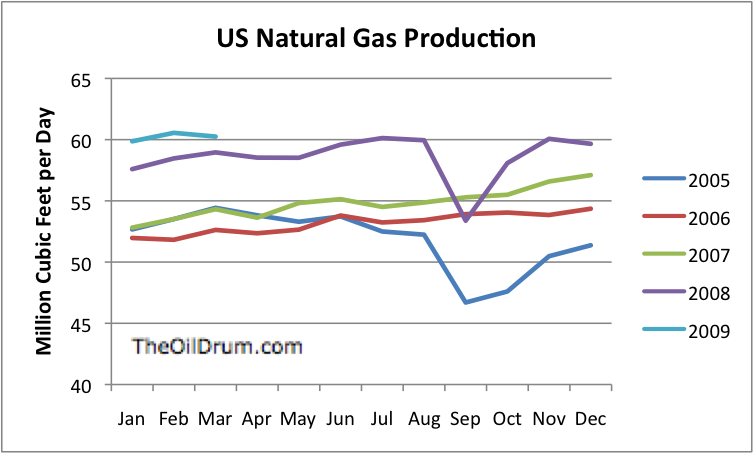
What has happened since September 2008 is a serious drop in prices, because demand did not rise to match the new higher production. Such a drop in prices makes the price too low for nearly all producers.
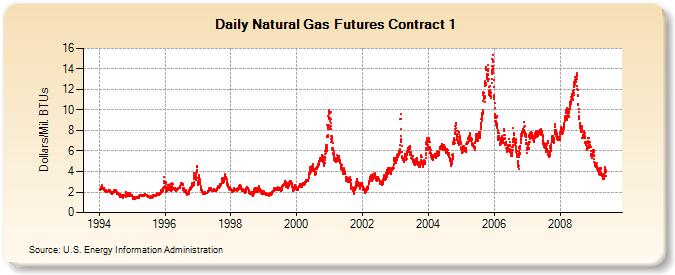
At this point, natural gas prices are back at 2002 levels. This is too low a level to be profitable, and natural gas producers have reduced the number of drilling rigs by more than half since September 2008. With fewer drilling rigs, natural gas production can be expected to decline in the not too distant future, perhaps late 2009 or sometime in 2010.
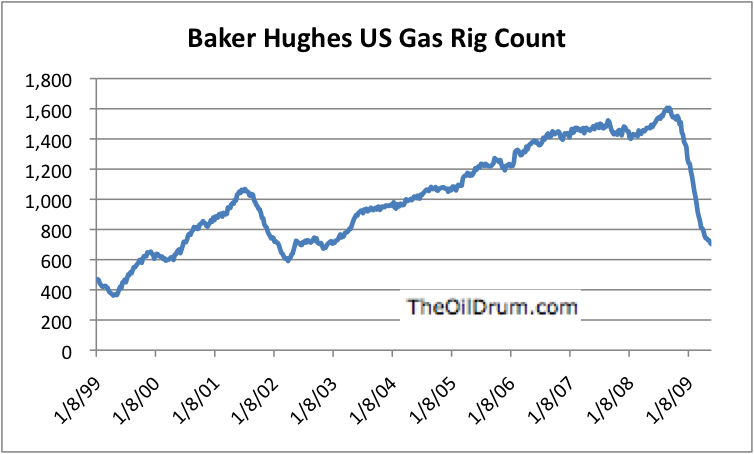
Natural gas acts fairly differently than oil. Oil prices have begun to turn back up again, while natural gas prices have not.
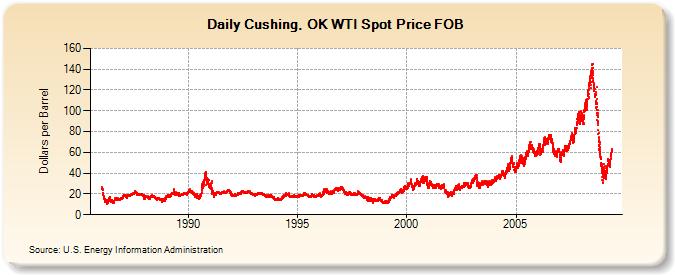
The problem is that with natural gas, the amount of storage is not very large. If production is too high, there is no place to store the excess. Demand doesn't change very quickly, because the infrastructure is pretty well fixed. Homeowners and businesses have whatever furnaces and hot waters they have, and don't change them, just because of a short-term change in natural gas price. Electricity can do some fuel switching between coal and natural gas, but long term contracts prevent this from happening very quickly.
In my post last September, I mentioned some of these issues as possibilities standing in the way of ramping up natural gas production. It is very difficult to get a balance between supply and demand, since there is so little margin for error, and since infrastructure doesn't change quickly.
With the new lower price, producers are leaving the business. Some drilling rigs will likely be permanently dismantled. After being "burned" this time, producers are not going to be so willing to come back in again.
It seems likely that if natural gas prices were in the $8 to $10 range, instead of the $3 to $4 range, natural gas production could continue to rise. This would be helpful in many ways. Natural gas could be used to power at least some vehicles, if oil is less available. Natural gas is needed as a chemical feedstock for plastics and other products. Natural gas is also used in electricity production. Without it, it would be very difficult to balance out electricity generated from wind.
It seems to me that if we want to have an increase in natural gas production (or at least, not a big decrease), the US government will need to get involved, and help bring prices to a more reasonable level, and stabilize them at that level. Constant prices, rather than big increases or decreases are what is needed. The government may also need to be involved in helping build more storage capacity, and in deciding exactly what should be done with the additional gas. Should more natural gas vehicles be built, or should more gas be used for electricity?
I think natural gas has a lot of possibilities, but somehow, we will need to encourage it, or it too will decline, with oil production.
September 2008 Post
Can US Natural Gas Production be Ramped Up?
Navigant Consulting Inc (NCI) recently prepared a report called North American Natural Gas Supply Assessment on behalf of a natural gas organization called the American Clean Skies Foundation. In this report, NCI estimates the amounts shale gas and tight gas production can be increased in the next decade. These estimates suggest that US natural gas production can be ramped up by nearly 50% by 2020. How reasonable are these estimates? What obstacles are there to such a big ramp up?
Figure 1. Approximate future US natural gas production, based on Navigant Consulting estimates of shale gas and tight gas production.
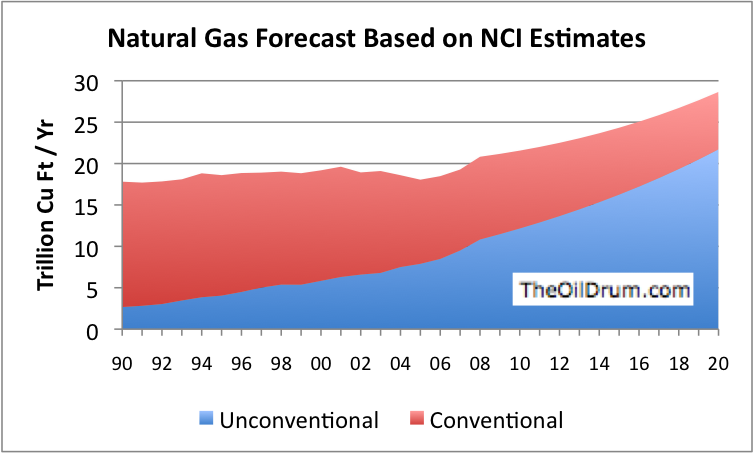
My analysis indicates that NCI is correct in some respects. There is indeed a great deal of unconventional natural gas resources in the United States, and recent improvements in technology point to the possibility of significantly greater production.
There are two major problems, however. One is that short-term demand is not very flexible. It is very easy to flood the market with more natural gas than the market can absorb. The other is that there are a number of obstacles ahead for companies selling natural gas. It is likely that these obstacles, rather than a lack of natural gas, will curtail the rise in natural gas production. As a result, the full ramp up in production is not very likely.
Recent EIA Data for Natural Gas
Let's start by looking at EIA natural gas data. EIA has recently reported a big increase in US natural gas production (8.8%, comparing the first five months of 2008 with the first five months of 2007). Some have suggested that the EIA numbers must be wrong. It seems to me that what we may be seeing is the effect of a recent technological breakthrough.
Until fairly recently, many of us had noticed a pattern of increased drilling being required to achieve the same quantity of natural gas production. Most of us interpreted this to reflect declining Energy Return on Energy Invested (EROEI).
In the last few months, there has been a sudden shift in the data. EIA data shows that recent production is rising at the same time that the drilling of new wells is leveling off. Average daily dry gas production during the first five months of 2008 is up 8.1% over the same period in 2007. (Because 2008 is a leap year, total dry gas production has increased 8.8% for the five month period.)
Figure 2. US dry gas production has been rising since about November 2007
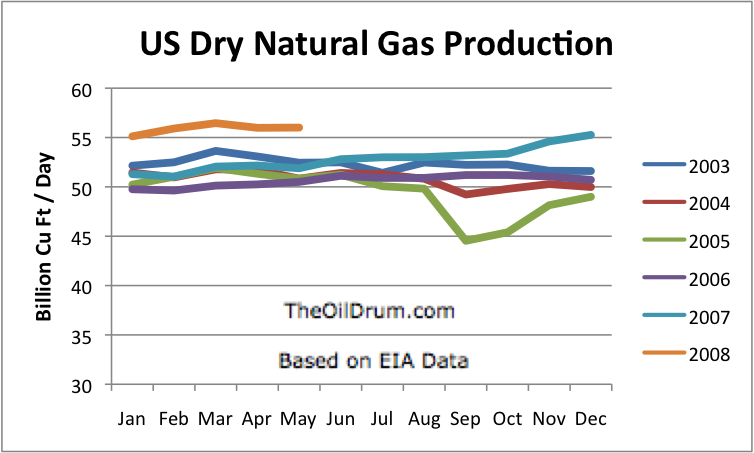
Figure 3. Number of natural gas wells drilled levels out, about the same time production begins to rise (November 2007)
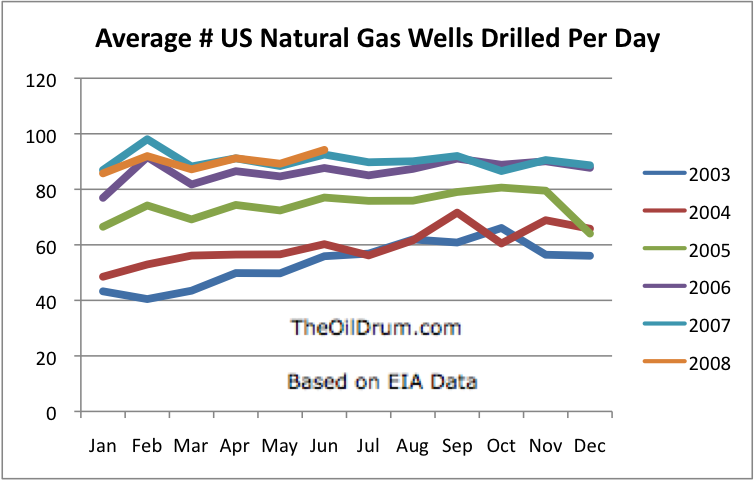
Figure 4. Number of natural gas drilling rigs levels out in late 2007
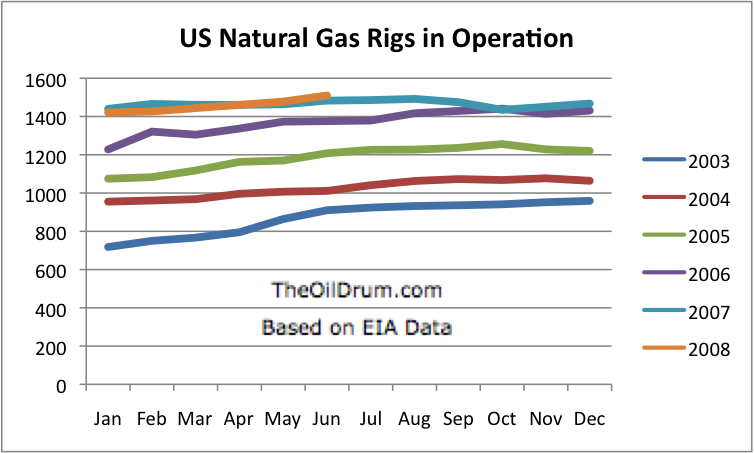
One can look at many other measures as well, and see a similar pattern. The number of well feet drilled per day levels off and even drops, in late 2007 and early 2008, at the same time natural gas production increases. My interpretation of what is happening is that there has been a technological breakthrough, probably in the area of shale gas production of natural gas. Because of this breakthrough, companies are able to produce more gas, with less drilling effort.
There are several reasons I believe that the data reflects a technological breakthrough, rather than, say, an error in EIA data. First, when I look at individual company reports, the ones that show drilling activity seem to show the same kind of pattern--more success with fewer wells drilled. Also, even where there is not information on the number of wells drilled, the company reports talk about increased productivity of wells, due to the increased use of horizontal drilling and better fracturing techniques. Finally, the increased natural gas in the system is having the expected impact on storage and prices, as I will discuss later in this post.
EIA does not break out recent production into unconventional vs. conventional. In fact, the most recent break out of unconventional is for 2006, given in the backup data to Figure 80 of the Annual Energy Outlook:
Figure 5. EIA History of Forecast of Natural Gas by Source
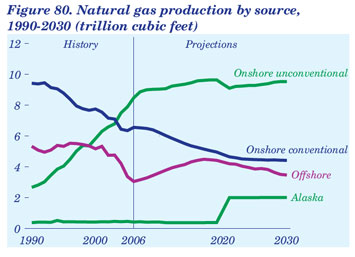
It is clear from looking at this figure that unconventional gas has been rising rapidly. EIA's forecast for the future looks unreasonably pessimistic alongside its production history. The other two major categories (onshore conventional and offshore conventional) are both declining rapidly (but miraculously are forecast to rise in the future).
The EIA graph in Figure 5 shows that there is the potential for an increase in gas production from Alaska, once a pipeline is built. The EIA forecasts that this will happen in 2020. The amount of the increase appears to be about 10% of current US natural gas production. If this in fact takes place, on my Figure 1, there will be a small bump up in production in 2020, bringing the 2020 production total from 29 trillion cubic feet to 31 trillion cubic feet.
If there is an increase in overall natural gas production, one might reasonably assume that the increase in unconventional natural gas is finally overpowering the decline in conventional production. EIA data by state and information from company financial reports both point to success with shale gas, particularly Barnett shale in Texas. If the recent increase in production in fact relates to shale gas, this would tend to tie what is happening now to what the Navicgant Consulting, Inc.(NCI) analysis is forecasting for the years ahead.
Navigant Estimates
NCI in its report does not make an estimate of total US natural gas production. Instead, it makes estimates of shale gas and tight gas production, in very general terms. In Figure 1, I put these estimates together with some rough estimates of the remaining pieces to get an estimate of expected future natural gas production. (I used a 3% annual decline rate for conventional natural gas.)
NCI's forecast of shale gas production is in terms of how much sustainable production might be expected from the various shale formations:
Figure 6. Navigant Consulting Inc (NCI) forecast of future shale gas production
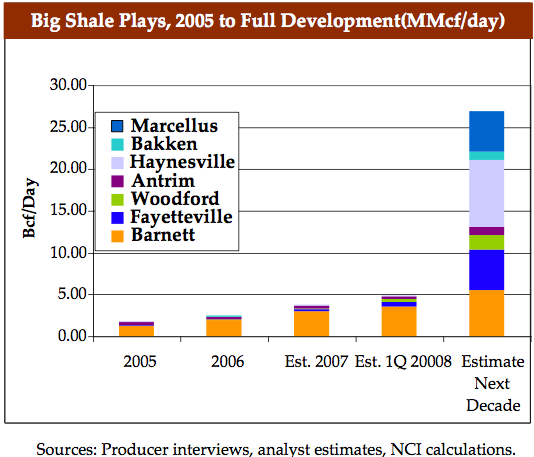
The timing is not given very precisely, just "next decade". In Figure 1, I assume that this higher level of production will not be reached until 2020. Because of the imprecision of the wording, a person could argue that production might reach this higher level as early as 2015.
With my interpretation of the NCI report, indications are that shale gas is now the big source of growth, and will continue to be in the future. Tight gas production will also continue to grow.
Figure 7. Breakdown of Figure 1 forecast of unconventional gas into tight gas, shale gas, and coal bed methane
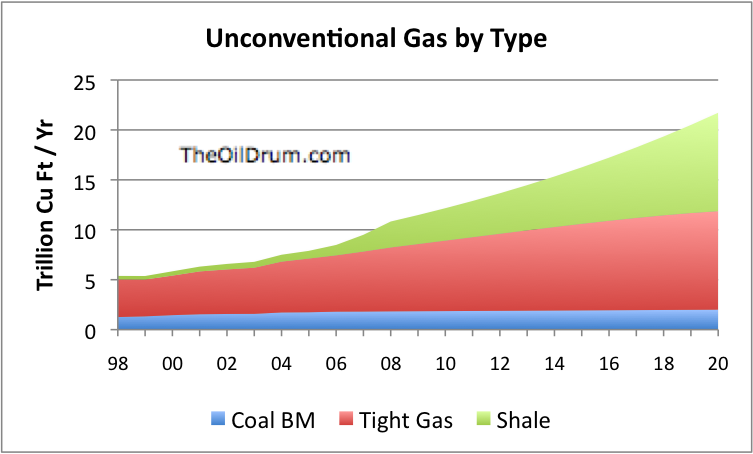
Previous unconventional gas posts
Many readers will remember that I have written previously about unconventional natural gas:
US Natural Gas: The Role of Unconventional Gas
US Natural Gas: Lessons from BP's Tight Gas Facility in Wamsutter WY
In these posts, I talk about how widespread shale gas and tight gas are. I also talk about the advances BP has been making in its Wamsutter, Wyoming tight gas facility. With this as a background, it is easy for me to believe that if all of the resources are there, there is a reasonable possibility that US unconventional production can be ramped up further. I think there are obstacles that may get in the way of this, however.
Short term problem: overwhelming the system with too much gas, and causing price to drop
What happens when one increases natural gas production by 8% per day? There are a few places this can go--a little to offset a decline in imports from Canada, a little to use as exports to Canada and Mexico, and a little to meet the growing demand of electric utilities. Liquefied natural gas (LNG) imports can be reduced to their contractual minimum. On the industrial side, some factories with spare capacity can use some additional natural gas. It is difficult for these uses to absorb the 8% growth in production, however.
How could you individually increase your own natural gas use? You could turn up the thermostat to heat your house more in the winter, or you could use more electric appliances if you have electricity from natural gas. There really isn't much else you could do, without purchasing something new (for example, a clothes dryer that runs on natural gas, or a car that runs on natural gas). It is not a whole lot different for business users of natural gas.
Once demand is satisfied, the remainder is added to natural gas underground storage. This past week, 102 billion cubic feet were added to storage; the week before 88 billion cubic feet were added to storage. The US is currently producing about 56 billion cubic feet of natural gas a day, so over the past two weeks we have put about 20% of production into storage.
Figure 8. Recent EIA Natural Gas Underground Storage Graphic
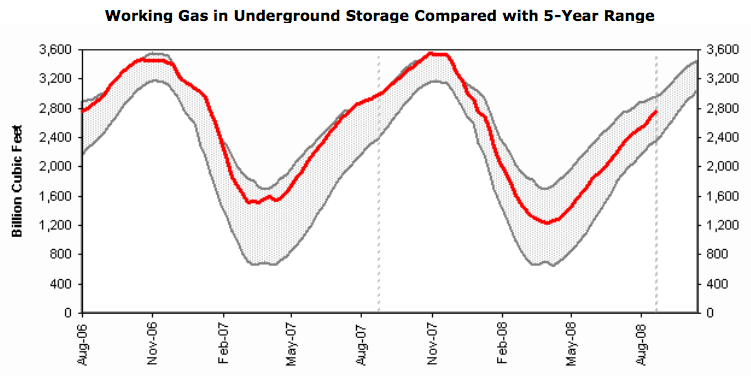
The problem is that natural gas underground storage is not terribly large, and it hasn't been increased recently in size to accommodate the new larger natural gas production. Historical data suggests that the practical limit of working storage is 3,600 billion cubic feet. This is a bit over two months' production. As of August 22, 2008, the amount of natural gas in working storage was 2,757 billion cubic feet, leaving only 843 (= 3,600 - 2,757) billion cubic feet of "space" available.
Once storage fills up, there is no other place for the natural gas to go. To make matters worse, it is very difficult for producers to shut production in, if there is no space available for storage, so producers will mostly continue to produce, whether or not there is space available.
Once traders realize that there is a significant chance that natural gas production will exceed storage space, prices start to drop. It seems to me that this is part of what has happened with natural gas prices recently. One consideration in deciding whether the supply will exceed the storage space is the long range weather forecast. The forecast is for a warm fall, meaning that little heat will be needed. We are also in the midst of an economic slowdown, and this is also likely to reduce natural gas use.
All of this makes for a bad situation for natural gas producers--lots of supply, but not enough demand, and prices dropping disproportionately to the prices of other fuels. In another post in the next few days, I will talk various approaches that have been proposed to increase demand, so as prevent this problem. I will also talk about the quantity of gas that might be available.
Other obstacles to growth
It seems to me that the main issue is not whether there is enough natural gas in the ground. It is whether we will be able to get it out and transport it to users. It seems likely to me that one or more of the following will reduce growth to significantly below what theoretical studies would suggest:
Not enough distribution pipeline and underground storage
Every company adding new production will realize that it needs pipeline to connect its gas to an appropriate processing center. It may not be as obvious that the distribution system as a whole is likely to need to be expanded, if significantly more natural gas is produced. For example, if natural gas is to be used to replace heating oil in the Northeast, it is likely that both more underground storage and more distribution pipeline will be needed. (See this post by Heading Out.) Expanding the distribution system is likely to be expensive and take several years.
Worn out pipelines
Matt Simmons has repeatedly stated that pipeline infrastructure is nearing the end of its useful life. If this is true for natural gas, this could be a problem.
Not enough of the right kind of drilling rigs
If everyone wants new horizontal drilling rigs, this will be a bottleneck to growth, until enough new rigs of the correct type can be built.
Not enough pipe
There have been articles in the press about steel for drilling pipe and casing being in short supply.
Not enough trained manpower
This is a problem in any industry that tries to ramp up quickly.
Reduced credit availability
Banks have cut back on their lending. Natural gas companies that have depended on a lot of leverage in the past will find this business model very difficult to maintain. I expect them to either slow down their rates of growth, or partner with an oil major who is in a better position financially.
Counter-party risk
Quite a few of the natural gas companies are major participants in the derivative markets. We know that many banks are in financial difficulty. If banks in financial difficulty are counter-parties on transactions, their defaults may cause financial problems for the natural gas companies.
Issues with water re-injection or disposal
Unconventional gas production requires re-fracturing of wells from time to time. The fluid used in re-fracturing must be disposed of properly. There was recently considerable opposition to shale gas drilling in New York because of water issues.
Declining profitability
This is closely tied to EROEI. If there continue to be advances in technology, I would not expect this to be a problem. Some of the sites may prove to be more difficult to extract than the NCI forecasts, and this could be a problem. There is also the possibility of external impacts, such as higher taxes.
Peak oil
Peak oil will reduce the availability of oil for every use. It is hard to think of an allocation scheme that would fully protect the unconventional natural gas industry. The workers all need cars to get to work; food needs to be transported to the location where there workers are working; and drilling rigs often diesel powered. Any oil disruption could interfere with natural gas drilling.
Categories: Links
EuroElections 2009 : Greens-EFA
This round through the European political landscape now leaves the parties more used to power and starts dealing with those found more often in the opposition. The Greens – European Free Alliance (Greens-EFA) is the fifth largest political block at Parliament, with little over 5% of the seats. Greens-EFA is a coalition largely composed by state-level Green Parties plus a small number of Regionalist deputies. After an all-time high close to 10% in 1999 the party had what can be called a disappointing result in 2004. Embarking on a worldwide effort to promote its ideologies by the midst of the current term, it is quite possible that the Greens-EFA may reach a relevant stake at Parliament this time.
The Green ideology is possibly the most complex political philosophy in Europe today, a sort of definition can be attempted at, but with the due reserves. The roots of the Green movement can be traced back to the late XIX century when Naturist Anarchism emerged in France, Spain and Portugal. Among other things it advocated for an ecological relation of Man with Nature, reducing or even annulling the impact of the former on the latter. It was a rather individualist philosophy, underpinned on self-sufficiency. Throughout the XX century these ideas evolved into modern Green Anarchism, that embraced community with the development of the eco-village concept (units of no more than a few hundred folk living from subsistence agriculture). It brought about the idea that modern realizations of primitive social structures would allow a way of life in harmony with Nature, repudiating larger power hierarchies. With the debate about limits to growth and the oil crisis unfolding in the 1970s the Green ideology made it into larger sections of the political landscape, with movements emerging aiming to push those ideas through the established Democratic process.
By 1979 the German Green Party developed the Four Pillars of the Green Party: Ecological wisdom, Social justice, Grassroots democracy and Nonviolence. These are still today the main guidelines followed by most Green parties around the world. In Europe, Green Parties started reaching parliamentary representation during the 1980s and from that time, the most important legacy they left was the halting of further developments to the European Nuclear Programme (facilitated by the tragic events at Chernobyl in 1986). Early on, Green Parties were composed by activists that could be identified both with the traditional right and the left and for some time this created internal tensions and some splits. To their aid came the establishment of Liberalism and the revival of pure Monetarism in Europe, especially from the second half of the 1980s onwards. Appealing to individualism, Liberalism wasn't that far from the Greens' roots and the merging of these two philosophies happened rather naturally. With the approach of Socialists and Conservatives to Liberalism, a fertile political landscape was set for the Greens to flourish, not by alternative social policies, but by presenting the differentiating element of Environmentalism. This allowed the German Green Party to reach a government backing coalition in 2002. In other states, albeit their increasing popularity, Green parties have remained in the opposition invariably with single digit electoral results.
As happens with Liberal parties, the Greens haven't so far been able to fully capitalize on the electorate closer to the traditional parties. Nonetheless, their activism have been having a crucial role in shaping politics in Europe, especially in the field of Energy.
The party's website, although simple and low budget, is quite straightforward and presents the visitor with plenty of information on its activities and ideas. In the Who we are section comes a synthesised political presentation:
Our project is to :
- build a society respectful of fundamental human rights and environmental justice: the rights to self‑determination, to shelter, to good health, to education, to culture, and to a high quality of life;
- increase freedom within the world of work, not only by tackling unemployment but also by widening people's choices, releasing human creative potential ;
- deepen democracy by decentralisation and direct participation of people in decision‑making that concerns them, and by enhancing openness of government in Council and Commission, and making the Commission fullv answerable to Parliament.
- build a European Union of free peoples based on the principle of subsidiarity who believe in solidarity with each other and all the peoples of the world.
- re‑orientate the European Union, which currently over‑emphasises its economic conception at the expense of social, cultural and ecological values
And then comes a section headed with “The Greens/European Free Alliance is working for:” that includes the incredible statement:
[...] economic and social reforms to make development sustainable for both human beings and the natural world;
Just to remind the inattentive reader that the Greens-EFA is a party like any other, with growth at the front of its concerns.
Like in the case of the liberals, Greens-EFA doesn't have any election specific content summarizing the party's policy proposals for the next term. Moving around the website a thorough Energy Policy stance is no where to be found. In the Documents subsection there is a long list of essays and news that can be organized thematically, being possible to access a list of those tagged with Energy; this is a long list of articles going back to 2001, that present a sort of recent history of the party's vision on this field. These articles are almost exclusively dedicated to dismiss Nuclear Energy, with the occasional promotion of Natural Gas.
But there's more to the website. Another section is called Campaigns where the party lists special policy programmes, each one with its own website. Two of these are worth a closer look: E-Polis and TEN-T. The first is dedicated to Urban Planing, the second to Transport.
E-Polis is not a real political programme or a formal policy, it is more of communication and experience-sharing platform:
E-Polis - European Sustainable Cities Network
E-Polis was founded by 4 Green Members of the European Parliament in 2006: Gisela Kallenbach, Monica Frassoni, David Hammerstein-Mintz and Michael Cramer - all driven by the need to involve citizens in local decision-making and to promote sustainability in urban development.
E-Polis supports and inspires local initiatives and NGOs whose purpose is to promote sustainable development and participation of civil society in urban development processes. E-Polis aims to create and establish a European-wide network of such local initiatives/NGOs in order to share experiences and find partners for joint activities.
E-Polis launched with selected local initiatives/NGOs from different European countries. The activities stimulated by E-Polis cover a broad range of issues, although there is particular focus on activities raising environmental awareness and empowering citizens in local decision-making processes.
The main networking tool is this e-polis website with a forum and a NGO data base, allowing to get in touch with persons and organisations that share the same idea: a better city is possible.
It is time to network!
It is always awkward to read the oxymoron “sustainable development” in a text supposedly inspired by Environmentalism. Nowhere in the website is it made clear what the Greens understand by “sustainability in urban development”, so the E-Polis campaign can be actually promoting practices that increase energy use. Notwithstanding, the Greens seem to be concerned with a matter that is unfortunately missing from the big parties' scope.
TEN-T is originally an European programme dedicated to develop an trans-European transport network, that the Greens-EFA regard as being a failure at the moment. The website the party dedicates to it is a reformulation of this plan, a serious attempt at a Transport Policy capable of changing Europe's direction on the matter. While energy is not at the root of this campaign, this is one of the areas were emissions reduction and Energy easily overlap:
Transport in Europe is unsustainable at the moment. Although there are huge investments in infrastructure like the TEN-T program, it is quite evident that especially for the environmental harmful modes of transport such as road and air borne transport are constantly increasing. We want to propose some solutions in order to make transport more sustainable and to allow for the climate effects of transport
This Policy is laid down in three stages: Ad-hoc measures, Medium-term measures and Long-term measures. Below is a synthetic list of the tactics proposed in each scope. For each one the website goes into great detail, with much information worthy of a closer look, especially for those working and/or researching in the field.
These measures comprise some ideas and practical advice that could be easily and immediately implemented without changing the legal basis at the European level. Due to reluctance from the member states these opportunities are not utilised on a broad scale.
- Additional inspections - controlling of compliance with social and employment standards for truck drivers and the compliance with general rules;
- Cross financing for rail - due to the new directive on the "Eurovignette" (Directive 2006/38/EC of the European Parliament and of the Council) each member state is allowed to levy tolls and user charges for vehicles over 3.5 t (from 2012 onwards) for the use of certain infrastructure.
These measures are intended to change transport policy in the medium term. In order to tackle the problems of climate change, as well as other environmental problems, changes in the legal and policy basis are nescesa
- Internalisation of external costs - will help to abolish distortion of competition between rail and road;
- Climate change - shift money from prestigious projects to upgrading on a large scale within the period 2007 - 2013 especially in the context of climate change;
- Intelligence for rail - improving cross-border rail transport through Europe-wide technological and regulatory harmonisation under the flagship ERTMS/ETCS;
- Funding preferences - shifting funds from huge infrastructure projects to efficient multimodal nodes - new funding programme (amendment to TEN-T);
- Alpine crossing exchange - recognizing transport opportunities as a limited good especially in areas with geographical constraints like the Alps, the trading of transit rights could bring a solution: "The Alpine Crossing Exchange";
- Transport Subsidies - cut transport subsidies for environmentally harmful modes in order to facilitate the shift towards rail;
- Kerosene tax - introduction of a European tax on kerosene in order to support the realisation of the TEN-T rail links;
These measures are intended to sustainably change the direction of European transport policy over the long-term. New strategic approaches, as well as reconsidering existing programmes, could help to make transport greener in the future.
- Strategy for intermodal logistics - development and implementation of a European strategy for intermodal logistics, enlarging combined traffic etc;
- Big projects - realisation of huge infrastructure projects that are proven to have a long-term economic viability and that are indispensable;
- Inland Waterways - the use of inland waterways could help to make freight transport more sustainable but only if strong environmental concerns are respected and resolved: fit the ships to the rivers and not the other way round!
Much could be discussion on each of these tactics, but the most important thing to note is that the programme is congruent with itself and throughout compliant with the vision of an infrastructure shift away from fossil fuels towards electricity. Where a shift to electricity isn't immediately a goal there are proposals for taxing fossil fuels or to use more efficient modes of transport. All that is left to say is how that shift will be accomplished in the short/medium term with the decommissioning of the Nuclear Park taking place simultaneously.
One thing is certain, Greens-EFA is so far in this round up the party dedicating more resources to Energy related issues and the one willing to go more deeply in its proposed polices. Unfortunately, that is not happening by the acknowledgment of impeding Fossil Fuel shortages, which leads to an incoherent message. Although not openly proposing one, the Energy Policy emerging for the party's websites' is the most ambiguous of those reviewed so far. Greens-EFA should try to bring about a thorough and integrated realization of such policy and seriously reflect on the consequences of deactivating the European Nuclear Programme at this stage, or at least provide a realistic and comprehensive road map to achieve such goal.
Previous entries of this series:
Categories: Links
DrumBeat: June 3, 2009
Jeff Rubin: Small new world
With global oil supply dwindling and demand rising, you can expect scarcity. And scarcity means high prices. You can expect triple-digit oil prices in the near future. Yes, the price at the pump is going to go up. Count on it. In the United States, that should translate into as much as $7 per gallon of gasoline, and about $2 per litre in Canada. Europe is of course already paying those prices, so they should get ready for the equivalent of double-digit gas prices. But it will also hurt in a lot of ways you may not be thinking about.
Life as we've known it is up for grabs in a world of expensive fossil fuels. Expensive oil means a severe curb on the free-spending lifestyle that cheap energy has afforded us for some time now. It means you can say a long and wistful goodbye to the inexpensive products manufactured on the other side of the world. You may not love them, but they have been stretching our dollars for a while now and holding down inflation at the same time. You'll miss them when it starts to become clear that your paycheque just doesn't go as far as it used to.
Jeff Rubin interview: ‘When you spend more on fuel than food, an economic contaction will follow’ The global economy is mostly about wage arbitrage… but the implicit assumption is that we can move goods and not just finished goods, [but also] the intermediary inputs around the world - that distance does not cost money.
We’ve already seen evidence that China was losing advantage in the North American steel market because it wasn’t economically feasible to ship it across.
What they said on hot energy topics: Wednesday
LONDON (Reuters) - The following are comments on a number of key topics from speakers at the Reuters Global Energy Summit on Wednesday:
Libya sees further oil price rise
Ghanem echoed the views of other OPEC members that prices needed to rise to secure future investment in oil production. But he cautioned oil markets were likely to tighten in coming years regardless.
"In 2-3 years, or maybe even next year, the talk of peak oil will be looming again. What is happening is temporary; demand will come back," Ghanem said.
Energy Chief Says Nuclear Disclosure 'of Great Concern'
WASHINGTON -- The accidental disclosure of a report that gives detailed information about the nation's civilian nuclear sites and programs is "of great concern," and U.S. officials intend to closely examine whether it has jeopardized national security, Energy Secretary Steven Chu said Wednesday.
Venezuela agrees to Russian group venture
Venezuela agreed to work with a group of five Russian oil companies including Rosneft and Lukoil to create an oil joint venture in areas of the country’s Orinoco Belt, according to an accord published today.
Putin Urges Europe to Help Ukraine Avoid New Gas Halt
(Bloomberg) -- Russian Prime Minister Vladimir Putin urged Europe to help Ukraine make payments for supplies of natural gas because transit from Russia may otherwise be halted in weeks for the second time this year.
Transit via Ukraine may stop as early as the end of June or the start of July, Putin told reporters in Helsinki today at a press conference with Finnish Prime Minister Matti Vanhanen.
Eni must sell some gas storage - watchdog
ROME (Reuters) - Italy's oil and gas giant Eni (ENI.MI) must sell some of its gas storage sites to other players, Italy's antitrust authority and energy watchdog AEEG said on Wednesday, as its management damages competition.
The authorities said Eni, which controls 97 percent of stocks through its Stogit unit, had so far made "absolutely marginal" improvements to guarantee more security to the system and to increase competition.
Energy Northwest considers nuclear power again
RICHLAND, Wash. — A quarter century after a grand plan to develop nuclear power in the Northwest collapsed, a regional power consortium is quietly shopping the idea of building another reactor.
In a letter obtained by The Associated Press, Energy Northwest asked each of its 25 member public utilities and municipalities to pitch in $25,000 for further research into building small nuclear reactors.
Ethanol to take over 75 pct Brazil car fuel market
SAO PAULO (Reuters) - Sugar cane-based ethanol fuel is expected to take over 75 percent of Brazil's light vehicle fuel market, shrinking gasoline's stake to 17 percent by 2020, the head of the state-run oil company said.
The flex-fuel engine technology, which is now included in about 90 percent of all new car sales, is the reason that Brazilians are buying more ethanol fuel, said Jose Sergio Gabrielli, chief executive of Petrobras(PETR4.SA) (PBR.N), Brazil's state-run oil company.
Oil Demand Falling Fast In Japan
Japan may be forced to shut more than a fifth of its refining capacity, at least 1 million barrels per day, in the next five years as oil demand falls faster than expected, the head of the country's top refiner said on Tuesday.
Nippon Oil Corp President Shinji Nishio also told the Reuters Energy Summit that the company, after its planned merger with Nippon Mining, might shut in 200,000 bpd more capacity than originally planned by 2015, underscoring the rapid demand erosion in the world's No. 3 consumer.
"I think we are likely to see an even faster decline than the government's projection," he said in Tokyo.
Putin threatens to choke Europe's gas
Russia's Prime Minister Vladimir Putin said today gas transit to Europe may stop at the end of June or in early July if Ukraine does not pay for pumping the gas into underground storage.
Shell Says Nigerian Oil Export Disruption May Extend Into June
(Bloomberg) -- Royal Dutch Shell Plc said exports of Nigeria’s Bonny Light and Forcados crude may continue to be disrupted in June after pipelines were damaged.
Shell has extended a so-called force majeure declaration on Bonny Light and Forcados crude exports into June, company spokesman Adam Newton said in a telephone interview today. Force majeure is a legal clause that allows producers to miss contracted deliveries citing circumstances beyond their control.
China warily permits a peek into its oil reserves
NINGBO, China (Reuters) - China let reporters into its secretive strategic oil reserve on Wednesday, revealing facilities adjacent to major commercial storage, with managers drafted in from state-owned firms on a tight rein from Beijing.
China has rushed to fill its four strategic oil bases since oil prices fell last year and will now build a second, bigger set of bases to expand its capacity, with the eventual aim of having enough to cover 90 days of imports, three times more than now.
Competitors behind palm oil slurs: industry boss
JAKARTA (Reuters) - Western countries are using climate change as an excuse to constrain palm oil production in Asia because it competes with Western business interests, Indonesia's palm oil industry chief said on Wednesday.
Venezuela Offering 3 Projects in Oil Licensing Round, PDVSA Says
(Bloomberg) -- Venezuela, South America’s biggest oil exporting country, is seeking bids for three projects to develop 4 billion barrels of crude reserves, Eulogio del Pino, head of exploration and production at state-owned Petroleos de Venezuela SA, said at a conference in Abu Dhabi today.
Rosneft Faces Challenges in Building Two Asian Oil Refineries
(Bloomberg) -- OAO Rosneft, Russia’s largest state- owned oil producer, will face challenges if it seeks to build simultaneously two refineries in Russia’s Far East and China, said Peter O’Brien, vice president for finance and investment.
Saudi Arabia Increases All Crude Oil Export Prices Worldwide
(Bloomberg) -- Saudi Aramco, the world’s largest state-owned oil company, increased its official selling prices for exports of all grades globally in July.
For U.S. customers, Saudi Arabia increased the price of its Extra Light crude the most, raising it by 60 cents a barrel to $1.35 below the cost of West Texas Intermediate crude, the state oil company said in a faxed statement today.
Even If Oil Hits $90, OPEC Won't Increase Production
Oil prices could reach $80-$90 a barrel by early next year, but OPEC will not increase its output until a huge amount of over-supply has been absorbed, the group's Secretary General said on Tuesday.
Calderon to Avert Debt Rating Cut, Goldman Says
(Bloomberg) -- Mexico probably will stave off a credit rating downgrade by raising taxes to reduce the government’s dependence on oil exports, according to Goldman Sachs Group Inc.
President Felipe Calderon may reach an accord with lawmakers after July mid-term elections, buoying revenue as a decline in oil output and the first recession in eight years swells the budget deficit, said Paulo Leme, Goldman Sachs’s chief Latin America economist. Standard and Poor’s cut the outlook on Mexico’s BBB+ rating to negative last month, saying the slump was heightening the country’s “fiscal vulnerabilities.”
Are Monopolies Holding Mexico Back?
the World Bank has published a book, “No Growth without Equity?,” that summarizes the theories explaining Mexico’s mediocre performance. The book argues that special interest groups, particularly in business and labor, have managed to block changes that would make the economy more efficient and productive in an attempt to preserve privileges built up over decades under Mexico’s closed economy and one-party state. Most important, those groups have frustrated attempts to introduce competition.
Surprisingly, Mexico’s transition from a one-party state to a fractious democracy has done little to change this. Powerful interests have been successful at controlling weak government institutions and co-opting political parties.
Among the book’s cases studies are two areas where Mexico is falling behind by just about any measure: its state-owned oil monopoly, Pemex; and telecommunications, where one player, Teléfonos de México, is so dominant that it exercises a de facto monopoly.
Reserves and production at the oil company, also known as Petróleos Mexicanos, are declining. But even though the evidence of Pemex’s problems is undeniable, efforts to change the company have stalled because several powerful groups benefit – in the short-term at least – from keeping things the way they are.
Kuwait Oil Co Says No Upstream Projects Canceled
State-owned Kuwait Oil Co. has not canceled or postponed any upstream projects, and will invest as much as $6 billion in 2009 on exploration and production activities, the company's chairman said Monday.
"I want to emphasize that we have not slowed down our strategic investments," said Sami Al Rushaid, who is also KOC's Managing Director, at an oil companies conference.
U.S. releases secret nuclear list accidentally
The federal government mistakenly made public a 266-page report, its pages marked “highly confidential,” that gives detailed information about hundreds of the nation’s civilian nuclear sites and programs, including maps showing the precise locations of stockpiles of fuel for nuclear weapons.
Urban gardens ease bills, brighten cityscape
DETROIT — Every little bit helps for Earlean White's family.
The neighborhood garden a block from her home was the source of fresh tomatoes, cucumbers and peppers for her family last summer.
So on a recent sunny Saturday, White, 48, enlisted two of her kids — Katherine White, 9, and David Smith, 13 — and her grandson Robert Puritan, 8, to start planting for this year's growing season.
White says the garden helps ease her grocery bill and "helps the community and makes it look better."
With the help of Urban Farming, a Detroit-based non-profit group, this 20-foot-by-20-foot lot and more than 600 others like it across the USA are being turned into gardens filled with fresh vegetables for hungry families.
Saudi to commission two new oil developments
Saudi Arabia will commission two new oil developments on schedule this summer to boost the country’s production capacity, even as it delays new refinery projects, a Saudi oil official said yesterday.
Chevron to expand oil project in Kingdom
ABU DHABI - US oil major Chevron could deploy a technique to boost oilfield output across the neutral zone between Kuwait and Saudi Arabia in 2017, a top Chevron executive said on Tuesday.
If successful, the technique could be rolled out worldwide and add billions of barrels to global reserves, said Guy Hollingsworth, Chevron’s president for exploration and production in Europe, Eurasia and the Middle East.
“We could go to full-field in 2017,” Hollingsworth told reporters on the sidelines of an energy conference in Abu Dhabi.
Chevron is testing the impact of steam flooding in the oilfields in the neutral zone to help boost output of heavy oil. Steam raises the temperature below ground and loosens up crude that is otherwise difficult to pump.
Bids asked for Saudi fuel hub upgrades
Saudi oil giant Aramco expects to receive bids for the upgrade of around 14 bulk plants by June 28, two sources familiar with the plan said on Monday.
A bulk plant is a wholesale receiving and distributing facility for petroleum products. It includes storage tanks, warehouses, truck loading racks and relared elements.
"Some bulk plants are very old, they are updating them to increase capacity," a source close to the project said.
Saudi to start production at Khurais end June
Although it was not immediately expected to add to the sum of Saudi output, the field represents the biggest ever single increment to global production.
"It's mechanically completed, and it's commissioning...and I expect by the end of this month we will have oil production from Khurais," Abdulaziz al-Judaimi, vice president for new business development at Aramco, told reporters on the sidelines of an industry conference.
Lukoil reports 71 pct drop in Q1 profit
Russia's largest privately owned oil company Lukoil said Wednesday that net profit in the first quarter dropped 71 percent compared to a year earlier, dragged down by low oil prices.
The company booked a profit of $900 million, down from $3.1 billion a year earlier. It said its cost-cutting program helped limit the decline and that the results were still an improvement compared to last year's fourth quarter, when it reported a $674 million loss.
China replaces Total in giant Iran gas scheme-IRNA
TEHRAN (Reuters) - Iran will sign a contract on Wednesday with China National Petroleum Corporation (CNPC) for the development of phase 11 of the giant South Pars gas field in the Gulf, replacing France's Total, the official IRNA news agency reported.
Total said it considered the report to be a market rumour.
Cap-and-trade is coming
A cap-and-trade system won't come to Ontario, the government says, before 2012. The delay is, perhaps, understandable. There are many details yet to be worked out, and it makes sense to time the implementation to coincide with an expected North America-wide system.
All the same, the sooner the Ontario government can give industry a clear idea of what the new economy will look like, the better it will be for the province's economy in the meantime. A recession is no time to let uncertainty linger.
Jeff Rubin's Shrinking World
After a quarter-century of increasing free trade and globalization, we have seen our prosperity suddenly stagger -- even in China, where mere six per cent growth is effectively a recession. While GM goes bankrupt, investors still dream of a return to "normal": the happy years before 2008.
Jeff Rubin, chief economist at CIBC World Markets for almost 20 years, makes it clear that those years were decidedly abnormal, a three-decade holiday from reality.
Stop the world, Jeff wants to get off
Mr. Rubin has since departed from CIBC. This, he claims, is significantly due to his new book: Why Your World Is About To Get a Whole Lot Smaller. It's easy to see why the bank wouldn't like it. But that's likely not because it's too boldly insightful, as Mr. Rubin might believe. It's because Mr. Rubin has gone from the dismal science to the Dark Side.
The former CIBC star is both a fine writer and an engaging speaker, but he has contracted a bad case of Peak Oil Theory, a condition that afflicts those inclined to anti-materialism, Big Oil paranoia and Pollyanna-ish belief in policy wisdom (But then Mr. Rubin is actually in favour of carbon tariffs, which would collapse world trade faster than you could say Smoot-Hawley).
Peak oil three years away
The global financial crisis might have put it back a little, but peak oil is just three years away, according to the chair of Australia's peak body for petroleum.
JPMorgan Hires Supertanker to Store Heating Oil, Brokers Say
(Bloomberg) -- JPMorgan Chase & Co., the second- largest U.S. bank by deposits, hired a newly built supertanker to store heating oil off Malta, shipbrokers reported, in the company’s first such booking in at least five years.
The bank hired the Front Queen for nine months, according to daily reports from Oslo-based SeaLeague A/S and Athens-based Optima Shipbrokers Ltd. David Wells, a spokesman for JPMorgan in London, declined to comment.
BP Missed Opportunity in Brazil’s Santos Basin, Citigroup Says
(Bloomberg) -- BP Plc, Europe’s second-largest oil company, views its absence from Brazil’s pre-salt offshore region as an “opportunity now missed,” according to analysts at Citigroup Inc.
A Call to Action on Peak Oil
We are being lulled to sleep by temporarily low oil prices caused by the global financial crisis. In fact, low prices may lead to an increased level of consumption and accelerated exhaustion of oil reserves.
OPEC Expert says Oil Prices Could Fall Again
ABU DHABI (Reuters) - Oil prices could fall again because fundamentals are still weak, OPEC's director of research said on Tuesday.
Total calls for openess in Nigeria reforms
The chief executive of French giant Total, Christophe de Margerie, has urged Nigeria to boost transparency and lay down clearer rules for foreign partners as it pushes through reforms in its mainstay oil and gas industry.
China opens national oil reserve bases for media visit
NINGBO, June 3 (Xinhua) -- China opened its national oil reserve bases to domestic and foreign media for the first time Wednesday since the bases were built.
China Won’t Buy Oil for Stockpiling Until More Storage Built
(Bloomberg) -- China, the world’s second-biggest energy consumer, won’t buy more oil for stockpiling until additional storage tanks are built, a government official said.
Until the second phase of the country’s emergency oil reserves is constructed, there will be no additional purchases for stockpiling, Zeng Yachuan, deputy director-general of the policies and laws department at the National Energy Administration, told reporters at the Zhenhai facility in the coastal province of Zhejiang today.
Uganda: Oil Reserves Rival Saudi Arabia's, Says U.S. Expert
Kampala — Uganda's oil reserves could be as much as that of the Gulf countries, a senior official at the US Department of Energy has said.
Based on the test flow results encountered at the wells so far drilled and other oil numbers, Ms. Sally Kornfeld, a senior analyst in the office of fossil energy went ahead to talk about Uganda's oil reservoirs in the same sentence as Saudi Arabia.
"You are blessed with amazing reservoirs. Your reservoirs are incredible. I am amazed by what I have seen, you might rival Saudi Arabia," Kornfeld told a visiting delegation from Uganda in Washington DC.
Russia's Gazprom places 15 bln rouble bonds - sources
MOSCOW (Reuters) - Russia's gas export monopoly Gazprom is placing two issues of rouble denominated bonds worth 15 billion roubles, banking sources told Reuters on Wednesday.
Wyo gets oil shale project
GREEN RIVER -- Scientists estimate there's up to 1.5 trillion barrels of oil within shale formations that could be recovered in northwest Colorado, southwest Wyoming and northeast Utah.
But it's going to require new, environmentally friendly technology to make it commercially viable to develop all that oil shale, they say.
Dana Petroleum ‘Not for Sale,’ Focuses on Boosting Production
(Bloomberg) -- Dana Petroleum Plc, a Scottish explorer focused on Europe and North Africa, says it “isn’t for sale” even as rivals target each other because the company expects to boost market value by finding more oil and gas.
Dana is forecasting output will rise 9 percent this year after jumping 29 percent in 2008, and plans to start production at two new fields in 2009 in addition to the 34 already pumping. Its exploration campaign over the next two years is targeting 1.2 billion barrels of oil equivalent resources.
My Thoughts on Oil
● Despite US oil inventories at near 20 year highs, simply the notion of global growth has oil prices up over 50% since March.
● US dollar weakness is helping to propel oil (and gold) higher.
● The US consumes around 20 million barrels of oil a day and imports roughly 65% of it. The amount of oil the US consumes is equal to the output of the world’s two largest oil producing nations (Saudi Arabia and Russia) combined.
Administration: Highway fund to go broke in August
WASHINGTON – The Obama administration is warning lawmakers that the trust fund that pays for highway construction will go broke in August unless Congress approves an infusion of as much as $7 billion.
2 percent Vt. gasoline tax takes effect
MONTPELIER — A new gasoline tax quietly kicked in this week, upping the price distributors pay by 3.3 cents a gallon.
The tax was part of a $540 million transportation bud´get that Gov. Jim Douglas signed without fanfare Fri´day. The bill called for the tax to take effect June 1.
The Ultimate Race: Peak Oil vs. Global Warming
Last year, in a fit of journo-satirical inspiration, we gamed out an enviro-athletic competition based on the pseudo-serious question: What will end the world first, Global Warming or Peak Oil? We called it The Ultimate Race. And after an offseason hiatus, the race is on, again. For how long? Well, that's kind of the point of the whole exercise, isn't it?
Toyota to start plug-in hybrid leasing
(AP:TOKYO) Toyota said Wednesday it will start leasing plug-in hybrid cars, that are even greener than its hit Prius, by the end of this year in the U.S., Japan and Europe.
Toyota Motor Corp., the world's top automaker, will start leasing 200 plug-ins in Japan, 150 in the U.S. and 150 in Europe, mostly for rental, such as through special government-backed programs, it said in a release.
Toyota will for the first time use lithium-ion batteries in the plug-ins. The batteries are already used in some cars but more common in laptops and other gadgets.
Zero Energy Houses Creating a New Design Vernacular
The traditional gabled roof that we are all familiar with was engineered to slough off snowfall. But in an uncertain post peak oil future of possible energy shortages and water shortages, more and more houses are showing up with roof-shapes engineered to harvest their own rainwater, and support solar power generation.
Germany’s $143 Billion Wind Farms Jeopardized by Tight Funding
(Bloomberg) -- As much as 100 billion euros ($143 billion) in planned investments in German offshore wind farms are at risk as developers struggle to get funding, jeopardizing the deepest emissions cuts in the European Union.
Spain Likely to Give Franco-Era Reactor New Life, Lozano Says
(Bloomberg) -- Spain is likely to extend the life of the last of its Franco-era nuclear plants, reversing a promise to close aging reactors as Europe seeks to cut fuel imports and curb generation costs, according to a former government adviser.
Climate Change Policies Won't Impact Global Warming: However, 10 Sensible Ideas Will Combat Global Warming Now and Boost the Economy
DALLAS /PRNewswire-USNewswire/ --The various policies currently being considered by the Obama Administration to combat global warming will ultimately do nothing to impact climate change, according to NCPA Senior Fellow H. Sterling Burnett.
In fact, there are several "no regrets" ideas that can impact climate change today, including the government reducing regulatory barriers to new nuclear power plants, according to a new NCPA study that examines 10 "cool" climate policies and will be released at a June 3 Capitol Hill briefing. For example, the study concludes that nuclear power generation worldwide can reduce emissions by almost 2 billion metric tons.
Pelosi upbeat on US-China climate cooperation
WASHINGTON (AFP) – US House Speaker Nancy Pelosi on Tuesday expressed high hopes of cooperation between the United State and China, the two biggest emitters of greenhouse gases, ahead of key climate change talks.
"We did see that the Chinese government knows that they have to do something," Pelosi told a news conference on the heels of a weeklong trip to China with other lawmakers devoted to energy and climate change.
Waxman Irks Allies by Bargaining With Companies on Climate Bill
(Bloomberg) -- Representative Henry Waxman has taken on everyone from drugmakers to the tobacco lobby in three decades in Congress. Now, leading the most comprehensive U.S. effort yet on global warming, he’s clashing with close allies.
Categories: Links
The Fifth Problem: Peak Capital
The five main elements of the world model developed in "The Limits to Growth" study according to Magne Myrtveit . The world' global positioning system (GPS) is in trouble. The US government accountability office (GAO) has published a worrysome report on the situation. The GPS satellites are wearing down and, if no new investments are made, the accuracy of the positioning system will be reduced. Eventually, the whole system may cease functioning.
What's happening here? The GPS system is a pinnacle of modern technology, a demonstration that the thing we call "progress" exists. If you have a car navigator, the idea of going back to clumsy printed maps just seems impossible. And that is just one of the many uses of the GPS system. How come that we left such an important system degrade? How can it be that someone forgot that satellites need to be replaced after a while?
The degradation of the GPS system may be attributed to mistakes, incompetence, bureaucracy or even conspiracies. But the problem may lie at a much deeper level. It may be a symptom of the degradation of the whole economy. But why is this happening? People mention evil banking practices, speculation, subprimes, terrorism, and what you have. But, with so many things going on at the same time, what is really the origin of the problems and what is just a consequence of other factors? To find an answer, you need to understand how the world's economic system works. One of the first attempts to do that in a comprehensive way was the 1972 report to the Club of Rome known as "The Limits to Growth" (LTG).
The LTG study was based on a rather complex model which, however, can be summarized in terms of five main elements, as you see in the figure at the beginning of this post. The five elements are 1) population, 2) mineral resources, 3) agricultural resources, 4) pollution and 5) capital investments. This is just one of the many ways to build such a model. Other choices are possible, but the LTG model, improved over the years, is a good way to capture the essential elements of the world's economy. Despite the persistent legend that the LTG study was "wrong"; the results of the study have been found to be remarkably accurate
None of the five elements of the model is a problem in itself. But each one can become a problem. In that case, we speak of 1) overpopulation, 2) mineral depletion, 3) famine, 4) ecosystem collapse and 5) economic decline. Often, these five problems are considered as if they were independent from each other. People tend to attribute all what is going on to a single problem: peak oil, climate change, overpopulation, and so on. In particular, economists tend to see the economy as independent from the availability of natural resources. Of course, this cannot be true and in a "dynamic" model, such as the LTG one, all the elements of the economic system interact with each other; either reinforcing each other (positive feedback) or weakening each other (negative feedback). To understand how the economy behaves as the natural resources are exploited (and overexploited) it is important to consider the role of the "capital" parameter. The behavior of the capital stock directly affects industrial production and other parameters which are counted as part of economic indicators such as the gross domestic product (GDP).
In the LTG world model, "capital" is created by investments generated by industrial activity. Capital is assumed to decay at a rate proportional to the amount of existing capital. This is called obsolescence or, sometimes, depreciation. To keep capital growing, or at least not disappearing, investments need to be larger than, or as large as, depreciation. Since investments depend on the availability of natural resources, the buildup (or the dissipation) of the capital stock depend on the progressive depletion of these resources. In the original LTG model of 1972, there were three kinds of capital stocks considered: industrial capital (factories, machines, etc.), service capital (schools, bridges, hospitals, etc.) and agricultural capital (farms, land, machinery, etc.). In the latest version (2004), industrial capital and mining capital are considered separately, as you see in the following figure ( from the synopsis of the 30 year update of LTG). Note how the "capital" parameter (in its various forms) affects the parameters which determine the GDP.
Here is a very clear description of how capital interacts with the other elements of the world model in a synopsis written in 1972 by the authors of the LTG report:
The industrial capital stock grows to a level that requires an enormous input of resources. In the very process of that growth it depletes a large fraction of the resource reserves available. As resource prices rise and mines are depleted, more and more capital must be used for obtaining resources, leaving less to be invested for future growth. Finally investment cannot keep up with depreciation, and the industrial base collapses, taking with it the service and agricultural systems, which have become dependent on industrial inputs.
Here are the results of these interactions, expressed in graphical form as what is called the "standard run" or "base case model" of the LTG study (from the 2004 edition)
In the graph, you don't see the "capital" parameter plotted. However, industrial capital follows the same curve of industrial production. The other forms of capital have a similar behavior. All reach a maximum level and then decline, carrying the whole economy down with them. Overall, it is "peak capital."
When do we expect peak capital to occur? According to the "standard run" of the LTG report, it may arrive during the first two decades of the century. It may very well be that much of what we are seeing now is a symptom of peak capital approaching: airports, roads, bridges, dikes, dams, and about everything that goes under the name of "infrastructure" are decaying everywhere in the world. The whole economic system is becoming unable to maintain the level of complexity that it had reached just a few decades ago.
So, the degradation of the world' GPS system is not something unexpected, nor it is unrelated to such problems as peak oil or the depletion of mineral resources. It is just another kind of peak: "peak capital." Maybe GAO has been too pessimistic; maybe we'll decide that the GPS system is so important that we can't let it decay. But, in any case, it is a sign of the times: the fifth problem.
_________________________
Two posts by Ugo Bardi on "The Limits to Growth"
Cassandra's curse: how the limits to growth was demonized
Peak oil and The Limits to Growth: two parallel stories
Categories: Links
DrumBeat: June 2, 2009
Power Surplus to Aid Homes
Weak demand for electricity and abundant stockpiles of fuel are creating conditions that could benefit consumers in two important ways this summer: more reliable delivery of power and, in some places, cheaper prices.
In most parts of the U.S., electricity reserves are getting fatter even though few power plants are being built. Overall U.S. electricity demand is expected to be 1.8% less this summer than last summer, according to the North American Electric Reliability Corp., or NERC, which is responsible for grid operations.
Power demand in industrialized nations usually rises steadily with population growth. However, the sharp drop in the economy, which has shuttered some big power users such as auto plants, has led to an unusually large falloff in demand.
Dow, Conoco Saudi projects delayed Dow Chemical Co.'s and ConocoPhillips' major joint ventures in Saudi Arabia face delays, a Saudi state oil company official said on Tuesday.
A giant petrochemical plant that Saudi Aramco planned to build with Dow Chemical Co. would start up in 2015. That was about two years behind the initial schedule.
Shell chief expects oil project costs to retreat
Royal Dutch Shell Plc expects oil-project costs to retreat further, Chief Executive Officer Jeroen van der Veer said.
Costs for projects doubled since 2004 before starting to fall last year, Van der Veer told reporters in Abu Dhabi today. Shell is putting “lots of pressure” on contractors to cut project costs, said Van der Veer, who steps down on July 1 and will be succeeded by former Chief Financial Officer Peter Voser.
Full Russian gas supplies restored to Poland - PGNiG
WARSAW (Reuters) - Natural gas supplies to Poland from Russia were fully restored on Monday after Polish gas delivery monopoly PGNiG PGNI.WA signed a previously announced deal with Gazprom's trading unit on Tuesday.
Poland had not been receiving all of its contracted gas supplies from Russia after Ukrainian intermediary RosUkrEnergo, a joint venture between Gazprom and two Ukrainian businessmen, halted deliveries due to a gas row between Moscow and Kiev in January.
General Motors tells Middle East customers, dealers, it is committed to oil-rich region
DUBAI, United Arab Emirates (AP) — General Motors' Middle East head said the oil-rich region's operations are a "vibrant" part of the automaker and remain open for business, despite its bankruptcy protection filing.
Biomass Power Generates Traction
While solar power is taking root in the sunny Southwest and wind power is growing in the blustery band from the Dakotas to Texas, other places are turning to trees and grass as their best bet for producing renewable energy, leading to a new building boom in "biomass" power plants.
Solar power should replace wind energy, says Jack Steinberger
Europe should scrap its support for wind energy as soon as possible to focus on far more efficient emerging forms of clean power generation including solar thermal energy, one of the world’s most distinguished scientists said yesterday.
Professor Jack Steinberger, a Nobel prize-winning director of the CERN particle physics laboratory in Geneva, said that wind represented an illusory technology — a cul-de-sac that would prove uneconomic and a waste of resources in the battle against climate change.
“Wind is not the future,” he told the symposium of Nobel laureates at the Royal Society. Instead, he said, technologies such as solar thermal power — for which parabolic mirrors reflect the Sun’s rays to generate heat and electricity — represent a more promising way of supplanting fossil fuels. “I am certain that the energy of the future is going to be thermal solar,” he told The Times. “There is nothing comparable. The sooner we focus on it the better.”
Electricity figures show energy efficiency isn't working
The conclusion of the analysis in this short note is that almost all of the reduction in energy demand comes from cuts in usage in big industrial and commercial users. This means that the most likely cause of the cut is the fall in economic activity. Household demand seems to have remained about constant.
Rubin reveals a world bound to crude
"Right now, the oil companies of the world have their hands deep between the cushions, and so far they been coming up with enough dimes and quarters to get us all to work. But there is only so much change to be found, and more people are heading out the door to work every day."
That might true, but what of the fact that less oil is used to generate the same amount of GDP as was 20 years ago. Shouldn't that mean we are not as dependent on oil as we were?And isn't that the argument that was being made as oil was leaping toward the $150 mark? Because we use less, said the economists, the world could weather higher oil prices.
That might be true--to a point. But then something called the efficiency paradox kicks and the result is that even though the developed world might use less oil, it's because we are more efficient that consumption actually goes up.
Kevin Drum: Chart of the Day
As I've mentioned before, one of the big problems with reaching peak oil isn't just that oil prices will go up, but that they're likely to spike up and down fairly violently. In 2006, for example, demand for oil pretty much bumped up against the total available supply, which meant that even a small amount of additional demand was enough to send oil prices spiraling up past $150 in little more than a year. The ensuing recession reduced demand by only a modest amount, but that was enough to cause oil prices to plummet to under $50 in the same timespan. And this isn't just a demand-side problem: a small glitch in supply could easily have caused the same kinds of violent price spikes.
As a general rule, the world can handle high oil prices. In fact, to the extent that high prices get us off our butts and looking for cleaner, more sustainable sources of energy, high oil prices are a good thing. But what the world economy can't handle is constant, huge gyrations in oil prices: nearly all of our recessions since 1973 have been jump started by a sudden spike in oil prices.
Shell warns oil prices could spike on low investment
ABU DHABI (Reuters) - Low energy investment could lead to a future spike in oil prices, the chief executive of Royal Dutch Shell Plc (RDSa.L) said on Tuesday.
"If the oil prices stay volatile I'm afraid there will be too much slowdown in investment," Jeroen van der Veer said at an energy conference in Abu Dhabi.
"I think too low capacity means the next price spike is to come."
Construction vessel market improving
HOUSTON, TEXAS: As oil prices begin a slow climb, worldwide offshore construction vessel activity appears to be rising slightly alongside it. Derrick pipelay and pipelay barges continue to account for the majority of large construction vessel activity around the world.
Demand for derrick barges dropped in April before moving back to 28 in May out of a total 42 vessels, according to data gathered by ODS- Petrodata. This is down from a peak of 36 working units in October 2008.
Are oil prices threatening the world economy already?
A report by Jeff Rubin, then the chief economist at CIBC Markets, would also suggest today’s prices are not a threat: “If triple-digit oil prices are what started the recession, then $60 oil is what will end it,” he postulated.
So we are not in the danger zone yet. But could we be headed there?
Oil firms worldwide plan investments worth $375 billion this year
World's largest national oil companies (NOCs) and international oil companies (IOCs) are planning investments worth more than $375 billion (Dh1,377bn) despite ongoing concerns about oil demand, consultant Ernst & Young (E&Y) said in a report.
The view comes close on the heels of an International Energy Agency (IEA) statement, which warned that upstream oil investments will fall more than 21 per cent this year due to projections of low demand. That would be a reduction of almost $100bn, the IEA said. While Opec has forecasted an year-on-year decline of 1.6 mb/d in 2009, IEA said oil demand will fall by 3.5 per cent this year.
Kurdish oil begins flowing to international market
IRBIL, Iraq - Iraq's self-ruled Kurdish region officially started pumping crude oil to the international market on Monday, a development that will boost Iraq's cash-strapped economy.
The move could also bolster the Kurds' political clout and ease tension with the central government that has threatened to erupt into new violence.
Yemen to inaugurate first LNG plant
SANAA (AFP) – Yemen will inaugurate its first liquefied natural gas plant next month and begin exporting in August with the first shipment destined for South Korea, the oil minister said on Sunday.
The plant at Balhaf on the south coast is ready "for its official inauguration on June 16, and the export of its first shipment of gas to South Korea will come eight weeks later," Oil Minister Amir Salem al-Aydarus said.
Economic Crisis Set to Dominate Forum
Organizers of the annual International Economic Forum in St. Petersburg last spring boasted that the event is becoming “a second Davos,” a supreme showcase of Russia’s vast and diversified business potential. This confidence was largely based on then-skyrocketing oil and gas prices. But with the Russian economy now facing a recession due to the fall of crude prices and markets after financial turmoil developed in the second half of 2008, the tone and hopes of the forum’s hosts have become more modest. This year’s forum, like dozens of such business events around the world, is all about anti-crisis measures.
Saudi Arabia Suffers Lack of Working Women as Oil Fluctuates
The success -- or failure -- of Saudi Arabia’s plans could affect the stability of the whole region, which supplies the world with much of its oil and has also been a breeding ground for terrorists. “It’s a very big, populous country in a risky neighborhood,” Handy says. “It’s the holder of a tremendous amount of oil resources that are of great importance to the global economy. So everybody has an interest in its political future and the development of its economy.”
Recognizing this strategic significance, U.S. President Barack Obama plans to visit King Abdullah in Riyadh tomorrow to discuss such issues as peace in the Middle East, terrorism and the price of oil. Obama has said he intends to tell the king that “huge spikes” in energy prices would hurt the interests of both the U.S. and Saudi Arabia.
Pemex sees offshore platform deaths suit
A Mexican congressman said he will file suit against state-owned Pemex before the Inter-American Commission on Human Rights, contending that violations of labor laws have led to 116 deaths on offshore platforms in the past four years.
China Aviation to widen Asian fuel trade
SINGAPORE (Reuters) - China Aviation Oil (Singapore) Corp Ltd (CAO) plans to add two traders to prepare for double-digit growth in jet fuel demand in 2010 after this year's contraction and to expand its trade across Asia, its CEO said on Tuesday.
Hurricane Season Less Likely to Wind Up O&G Industry
Already off to a quiet start, June 1 marks the beginning of the Atlantic Hurricane Season, which spans five months and ends, to the relief of operators braving the storms in the Gulf of Mexico, on Nov. 30.
Contrary to forecasts made in December 2008, the oil and gas industry can expect a reduction in the number of tropical storms and hurricanes this year. Both the Department of Atmospheric Science at Colorado State University (CSU) and the National Oceanic and Atmospheric Administration (NOAA) cite a chance of up to 12 to 14 named storms, respectively, compared to the 16 named storms in 2008 -- five of which developed into major hurricanes.
Oil Patch Digs in on Tax Issue
Obama administration proposals to reap more tax dollars from the foreign-earned profits of U.S. companies are not going over well in the Oil Patch.
Billed as a way to make multinational corporations pay their fair share to Uncle Sam, the measures could add millions to the tax bills of some of some of the largest oil and gas companies, on top of the billions the industry says it already pays each year in taxes.
Toyota Prius sales boom in Japan despite slowdown
TOKYO – Orders in Japan for Toyota's new Prius hybrid have topped a booming 110,000, a major dealership chain said Saturday, in what is turning out to be a rare bright spot in the gloomy auto market.
The third-generation Prius officially rolled out in Japan just two weeks ago. But dealers are already flooded with orders, including some placed weeks in advance, according to the dealership.
General Motors in tentative deal to sell Hummer
NEW YORK – General Motors Corp. said Tuesday that it has tentatively agreed to sell its Hummer brand, a day after the U.S. automaker filed for bankruptcy protection with hopes that it will transform its most profitable assets into a new company within just 30 days.
The Detroit-based company did not name the proposed buyer or the price, but said the sale will likely save more than 3,000 U.S. jobs in manufacturing, engineering and at various Hummer dealerships.
New York 'green police' nab dirty criminals
NEW YORK (AFP) – A big red dump truck cruises along the Triborough Bridge from the Bronx, spitting thick black smoke in the air. Seconds later, the "green police" turn on their sirens and are in hot pursuit.
The polluting driver is pulled over and his face betrays astonishment and disbelief as he sees a young man step out of a dark green SUV emblazoned with the letters "DEC," for Department of Environmental Conservation.
Kazakhstan's uranium 'stolen' by ex-official
ASTANA (AFP) – The recently imprisoned former head of Kazakhstan's state nuclear power agency stole the majority of the Central Asian nation's uranium deposits, security officials alleged on Monday.
Former Kazatomprom head Mukhtar Dzhakishev and other company officials illegally shifted ownership of uranium mines worth tens of billions of dollars through a network of offshore companies, the KNB security service said.
India's Electrifying Women
WASHINGTON (OneWorld.net) - In India, teams of "barefoot solar engineers" are bringing electricity to rural villages. The project -- part of a larger campaign to help Indian villagers be self-sufficient -- trains women to build and maintain solar energy units.
160 Syrian villages deserted 'due to climate change'
DAMASCUS (AFP) – Some 160 villages in northern Syria were deserted of their residents in 2007 and 2008 because of climate change, according to a study released on Tuesday.
The report drawn up by the International Institute for Sustainable Development warns of potential armed conflict for control of water resources in the Middle East.
"The 2007/8 drought caused significant hardship in rural areas of Syria. In the northeast of the country, a reported 160 villages have been entirely abandoned and the inhabitants have had to move to urban areas," it said.
U.S. on way to becoming climate leader: Yergin
NEW YORK (Reuters) - The United States may soon take the mantle as the global leader on climate change in part because of its strong research and development on energy, said oil historian and analyst Daniel Yergin.
"The United States is way ahead of everybody else," on research and development of alternative fuels and energy efficiency, Yergin, chairman of IHS Cambridge Energy Research Associates (CERA), told the Reuters Global Energy Summit in Washington.
Free carbon emissions permits could create added costs
Those free passes that the House climate bill gives to major greenhouse gas-emitting industries might not be so free for consumers.
'Mystery' climate case might become issue in Sotomayor confirmation
The global warming case goes to the heart of a question that opponents are expected to raise during Sotomayor's confirmation: whether she is willing to issue opinions that create new law.
Burger Kings deny global
warming
MEMPHIS, Tenn. - Several Burger King restaurants in and around Memphis, Tenn., were seen displaying the message "Global warming is baloney" on their signs, according to the Memphis Flyer .
U.S. institutes lead in environmental research expertise
U.S. laboratories lead the world in green energy and environmental research expertise, an analysis of science journals shows. But Germany and China are not far behind.
The study of 3,000 research institutions and universities will be released Wednesday by Elsevier, the largest publisher of research journals. Ranked by areas of expertise, NASA's Goddard Space Flight Center in Greenbelt, Md., tops the list in alternative energy, such as solar cells, and environmental science from 2003 to 2007.
Energy shock and oil myths: Will soaring prices crush globalization? Don’t bet on it.
But there is a problem with the premise to which Rubin has attached his career and his reputation: a growing number of economists, and even environmentalists, say this dark scenario is flat-out wrong. It obsesses with counting how many barrels of oil are left in the ground. It also oversimplifies the powerful force of globalization, all the while ignoring some dramatic changes now unfolding; changes that could significantly reduce the world’s reliance on oil. New technologies, new forms of energy, and a new focus on conservation and efficiency are shifting us onto a dramatically different energy path. Your world is not about to get smaller, they say, but it is about to get a whole lot leaner.
Two years ago, Peter Tertzakian, the chief energy economist for ARC Financial Corp., appeared as a guest on The Daily Show with Jon Stewart. Talking about a future energy crisis, Stewart posed one of his trademark, over-the-top questions: “How long do we have before masked madmen roam the cities with AK-47s, Mad Max style?” Tertzakian, who looks like a brainy version of Stewart with glasses and flecks of grey hair, cracked a lopsided smile. “It may not come to that,” he deadpanned. “The good news is that although these transition periods in energy are uncomfortable, usually we come out for the better.” Just as whale oil was replaced by kerosene, which was eventually replaced by today’s fossil fuels, another shift will come.
CERA sees potential oil rebound
HOUSTON (Reuters) - Current oil prices are not justified in the face of weak global demand and a glut of spare supply, but oil supplies could tighten in the next three to five years, energy analyst Daniel Yergin said on Monday.
U.S. gasoline above $2.50 first time since October
WASHINGTON (Reuters) - U.S. retail gasoline prices increased for the fourth week in a row, rising another 9 cents to $2.52 a gallon, the Energy Department said on Monday.
It is the first time gasoline surpassed $2.50 a gallon since last October.
OPEC compliance eroding; US drivers may rev up - IEA
DARWIN (Reuters) - The Organization of Petroleum Exporting Countries (OPEC) members' compliance with production curbs they reaffirmed last week is eroding as prices rise, the International Energy Agency (IEA) said on Monday.
Richard Jones, deputy executive director of the West's energy watchdog, also said that OPEC would not be justified in cutting output, despite still-swollen global oil stocks, and that the strength of U.S. demand this summer could surprise analysts.
Oil speculators threaten British recovery, AA's experts warn
The cost of petrol is threatening to pass the psychologically important £1-per-litre mark, with motoring groups warning that speculators pushing up oil prices are endangering Britain's economic recovery.
Russian gas output hits new lows in May
MOSCOW (Reuters) - Russia's natural gas production declined further in May as the country cut fuel extraction sharply in response to plunging demand in Europe and at home while oil output held steady.
Energy Ministry data showed on Tuesday natural gas production at Russia's Gazprom, the world's top gas producer, reached new lows in a decade of 0.98 billion cubic metres (bcm) per day, down 14 percent from April and 34 percent from May 2008.
European consumers have been delaying gas purchases since the start of the year, waiting for prices to finally catch up with lower oil prices and switching to alternative fuels or pumping gas from underground storage facilities.
Oil stocks look too expensive in short term
Peak oil has arrived and prices are rising once again. The only problem with this story is that demand has peaked -- not supplies. Normalization in oil prices is needed to encourage long-term production; however, the 47% rise in oil prices over the past five weeks is at odds with a well-supplied market for 2009.
OPEC’s Oil Output Rose 1.5% in May, Survey Indicates
(Bloomberg) -- The Organization of Petroleum Exporting Countries increased oil output by 1.5 percent in May, the biggest gain since 2007, a Bloomberg News survey showed.
Oil output averaged 28.15 million barrels a day last month, up 405,000 from April, according to the survey of oil companies, producers and analysts. The 11 OPEC members with quotas, all except Iraq, pumped 25.76 million barrels a day, 915,000 more than their target.
Kuwaiti Lawmaker Demands Publication Of Oil Reserves Size
KUWAIT CITY, Kuwait (AFP)--A Kuwaiti lawmaker Monday demanded the oil minister provides the exact size of the OPEC member's crude reserves following doubts over the official figure of 100 billion barrels.
In a question to Oil Minister Sheikh Ahmad Abdullah al-Sabah, liberal lawmaker Saleh al-Mulla demanded the volume of recoverable reserves in each Kuwaiti field, including offshore fields and those shared with Saudi Arabia.
Warren Buffett: Peak Oil Apostle?
BUFFETT: Well, ag commodities are a little tough. You know, if I had to on–where ag commodities would be three years from now, up or down, I wouldn’t know which way to bet. But they look like they’ve had quite a run. But if you take something like oil, I mean, we have been sticking straws in the ground now since, what, Titusville in 1850-something with Colonel Drake. And we have–we have–we have found a lot of the oil that’s to be found. And if we’re going to produce–or use 85 million barrels a day now and the rest of the world probably is going to increase its demand in the–in the–in the next five or 10 years, we’re going to have–we’re going to have a tough time maintaining production that satisfies those at this price, even. So I think something like oil, six and a half million humans–or six and a half billion humans are going to use a lot more oil than a lot fewer used 20 years ago or 30 years ago.
Forget Peak Oil, What About Peak Demand?
With so many investors and pundits obsessed with peak oil, they may be missing the real story for oil: that we have passed peak demand and it's only downhill from here.
Is there a calm after the economic storm?
Experts on the oil market say there could be a new "peak oil" price above $US150 per barrel in the next year or two as demand recovers. This is because oil supply is falling while major nations, especially the US, have so far done little to introduce alternative, renewable energy sources.
Peak Oil: What To Do When The Wells Run Dry
During the oil crisis of the 1970s to the rapid rise of oil prices during the early part of the twenty-first century, concerns surrounding the use and availability of this non-renewable resource greatly increased in the minds of many. One theory that always seems to creep up when oil prices rise is the idea of peak oil, which is a hypothetical date at which the world's crude oil production will peak. Every day after this would mean lower production levels and an ever decreasing supply.
Simply put, when the world's oil producers combined can no longer increase their oil output, we will have reached peak oil. Oil will be increasingly difficult to find and extract because there will be less of it and fewer deposits to find.
Culprits in last year's energy spike reappear
Oil prices pushed to new highs for the year today on a weak dollar and new data suggesting manufacturing in China has strengthened. Both of those factors helped send energy prices to record highs last summer.
Technology seen key to oil sands: Chu
WASHINGTON (Reuters) - U.S. Energy Secretary Steven Chu said on Monday he believes technology can solve environmental problems associated with Canada's oil sands and that the huge nearby resource contributes to U.S. energy security.
Take foot off the gas, analysts warn
COMPANIES behind Australia's projected $200 billion investment boom in liquefied natural gas export projects are refusing to concede the need to adjust their aggressive development timetables in response to the financial crisis and the glut in global LNG supplies.
Carbon Plan Puts Unfair Burden on LNG, Woodside Says
(Bloomberg) -- Woodside Petroleum Ltd., Australia’s second-largest gas producer, said the country’s proposed carbon pollution reduction system places an unfair burden on liquefied natural gas producers and may constrain exports of the fuel.
“We remain concerned with the planned cap and trade scheme in its current form,” Woodside Chief Executive Officer Don Voelte said at the Australian Petroleum Production & Exploration Association conference in Darwin today.
Brazil and China boost oil investment
Brazilian and Chinese state oil firms are boosting investment even as their western independent competitors cut expenditure in light of lower demand, according to an Ernst and Young study.
China, The Impeccable Affair and Renewed Rivalry in the South China Sea
Developments in the South China Sea during the first quarter of 2009 reinforced several trends that have been apparent over the past two years. First, the Spratly Islands dispute has once again come to dominate Sino-Philippine relations, despite attempts by Beijing and Manila to move beyond it. Second, China has adopted a more assertive posture toward its territorial and maritime boundary claims in the South China Sea than at any time since the late 1990s. Third, the 2002 breakthrough agreement between the 10 members of the Association of Southeast Asian Nations (ASEAN) and China to manage tensions in the South China Sea is in danger of becoming irrelevant. Fourth, the USNS Impeccable incident on March 8 highlighted the growing strategic importance of the South China Sea for the United States and China, and reawakened concerns in ASEAN capitals that the region may one day become the principal theater wherein Sino-U.S. maritime rivalry is played out.
Worker shortage threatens oil industry
A key player in Australia's oil and gas industry says companies must do more to train and retain staff.
The Deloitte Oil and Gas Group has published a report highlighting the top 10 issues facing the industry.
A shortage of talented workers has come in at number seven.
U.S., Europe Share of Economy to Fall to 49% in 2009, CEBR Says
(Bloomberg) -- The U.S., Canada and Europe will generate less than half of global economic output this year as the recession accelerates a shift in wealth toward China and other nations, a research group said.
The three economies will together account for 49.4 percent of the world economy in 2009, the London-based Centre for Economics and Business Research Ltd said today in its quarterly ‘Global Prospects’ publication. That’s down from a range of 60 percent to 64 percent between 1995 and 2004.
Bye Bye, Barclays
LONDON - Barclays' once helpful Middle Eastern investors have fallen out of love with the British bank. The investment vehicle of the Abu Dhabi royal family announced Tuesday that it was placing around 1.3 billion shares of Barclays, along with 1.5 billion pounds ($2.5 billion) of capital notes, so that it could spend its money instead on energy investments. It is walking away with at least a 1.5 billion pounds ($2.5 billion) in profit, according to one analyst's estimate.
Kunstler: Shattered and Shuttered
The dollar was up to its armpits in quicksand, and oil prices had crept stealthily into the death-to-airlines range, and if, in the old slogan, what's good for General Motors really is good for the USA, then destiny was dealing a harsh lesson to The Land of the Free -- while I made a drive on Thursday (in a Japanese rent-a-car) through the remotest ends of upstate New York State into the province of Ontario, Canada, to see what I could see. What I saw was pretty scary.
You get into these far reaches of upstate New York and your senses report that you have entered something like an HP Lovecraft story, where the sun comes up twenty minutes late, and the magnetic poles are not where they're supposed to be, and the few remaining denizens of the towns all have eleven fingers.... Even though I've seen plenty of desolation like it in other parts of the country -- the back roads of Ohio, the Mississippi River towns of the upper Midwest, the morbid stretch of blue highway between Memphis and Little Rock -- I've never encountered a landscape so shattered by the mere ravages of economic fate.
Part 1: Hyper-population growth--how far down the gopher hole?
“Beyond oil, population is the number one problem of the 21st century, for when oil is gone as we know and use it today—and it WILL be gone—population will still be here.”
China plans new energy development program
The National Development and Reform Commission says China will soon launch a plan for the development of new energy in the country. The commission says in the face of the global financial crisis, a new energy strategy is crucial to boosting the country's energy sector and helping sustain steady growth in the national economy.
G20 renewable energy aid not enough: IEA
LONDON (Reuters) - Renewable energy's sliver of the multi-trillion dollar economic stimulus announced by the world's biggest economies falls far short of the investment needed to meet carbon emissions targets, the head of the International Energy Agency said on Monday.
Obama seeks funding cuts for wave, tidal energy research
The Obama administration has proposed a 25 percent cut in the research and development budget for one of the most promising renewable energy sources in the Northwest - wave and tidal power.
At the same time the White House sought an 82 percent increase in solar power research funding, a 36 percent increase in wind power funding and a 14 percent increase in geothermal funding, it sought to cut wave and tidal research funding from $40 million to $30 million.
ANALYSIS: Canada's Fuel Cell Sector Hungry For Help
OTTAWA - Just as substantial sales growth seems on the horizon for their long-suffering industry, Canada's hydrogen and fuel cell developers fear missing the wave because of lack of government support.
Falling silicon prices pressure thin-film solar
LOS ANGELES/TOKYO (Reuters) - A collapse in silicon prices threatens to put the heat on solar panel makers that use little of the material, such as Japan's Sharp Corp and even low-cost industry darling First Solar Inc.
Spot prices on the solar industry's key raw material, polysilicon, have halved since January, giving a leg up to solar panels that rely heavily on the material.
Brazil to invest in ethanol workers, environment
SAO PAULO (Reuters) - The Brazilian government and the sugar cane-based ethanol industry are hoping to head off complaints about harmful environmental and labor practices by investing in socially responsible production methods, speakers at the 2nd Ethanol Summit 2009 said on Monday.
Old Wood Is New Coal as Polluters Embrace Carbon-Eating Trees
(Bloomberg) -- Wood is becoming a hot commodity in a new low-carbon world.
Power companies are burning trees because they’re renewable and can be cheaper than coal. Wood needs no permit to release carbon dioxide, a greenhouse gas blamed for global warming.
Study: Hurricane damage on Texas coast to worsen
The study projected that rising sea levels and more intense hurricanes, due to global warming, will increase structural damage to homes and buildings from a major hurricane in Corpus Christi by 60 percent to 100 percent in about 20 years and by more than 250 percent by the 2080s.
Such a catastrophic storm surge event would translate into projected damage increases of between $100 million to $250 million in around 20 years and of between $250 million and more than $1 billion by the 2080s.
But Irish said such potential damage could happen anywhere along the Texas Gulf Coast and even the rest of the U.S. Gulf Coast due to global warming, in which carbon dioxide and other gases added to the air by industrial and other activities have been blamed for rising global temperatures. This has increased worries about possible major changes in weather and climate.
Draft text at UN climate talks survives first outing
PARIS (AFP) – The draft of a negotiating text for a new pact on climate change survived its first hearing at UN talks on Monday, providing a boost on a road still strewn with many obstacles, delegates and officials said.
Despite criticism from the United States and others, the document was "basically welcomed as a good starting point for the negotiations," said Michael Zammit Cutajar, who framed the text.
Categories: Links
EuroElections 2009 : ALDE
This series on the Energy Policies put forward by the main parties running for the European Parliament moves on, leaving the heavyweights and bringing focus to smaller political groups. The Alliance of Liberals and Democrats for Europe (ALDE) is the main political group at the centre, pretty much in between EPP-ED and PES. It is the major Liberal reference in Europe, as in the member states where it is represented.
Writing about Liberalism in Europe is not a simple task. While it can be identified as the ideology with the largest support base in the continent, and the one that had the strongest grip on politics during the last 25 years, the parties that directly subscribe to it are yet to have major electoral results (exception here must be made for Scandinavia). The main reason for such paradox has been the morphing of traditional parties (the several Conservative and Socialist flavours) closer to Liberalism, especially after the second oil crisis, that allowed them to capitalize on the broader Liberal electorate.
Portugal is an interesting exception: the largest party in this state is the PSD, that although directly subscribing to Liberalism, was created under a Social-Democrat image, right after the 1974 revolution (hence the SD in the party's acronym). As the previous 48 years of Fascism rendered Conservatism unfashionable, PSD was able to capitalize on a broader electorate and eventually took the majority of seats at Parliament. Initially a member of ALDE, it forfeited and joined ranks with EPP-ED about a decade ago, openly searching further influence on euro-politics.
For foreign readers, ALDE can be broadly considered the European counter-part of the American Democrat party, although in a smaller scale and without much of the burdens of a party that is at the helm from time to time. Still, state-level members of ALDE are many times in power, taking part in coalitions needed to reach majority at local Parliaments to back up state Governments. All things considered, ALDE can be seen, together with the two heavyweights, as a third element shaping the EU to what it is today.
Visiting the party's website, it is immediately clear that the kind of budget the big parties can afford isn't there. Still, the website is quite pleasant and well organized, with a good deal of information on the party's activities and policy proposals. But there is no Election dedicated content, and the inquiring citizen needs some extra effort to get a synthesized idea of the party's programme for the coming term.
Inside a special space called “Key Documents”, at the left-side navigation bar, is a document for download entitled About ALDE leaflet [pdf!]. It starts with a message from the party's president, Graham Watson, of which the following can be highlighted:
The Alliance of Liberals and Democrats for Europe offers leadership and direction. It aims to build a broad consensus about what the European Union is for and how we can face together the supranational challenges of global population growth and migration, energy security and climate change, internationally organized crime and terrorism – all of which require a supranational solutions.
Further relevant contents in the leaflet:
We stand for individual liberty, a free and dynamic business culture, economic and social solidarity, sustainability in taking actions, protection of the environment and respect and tolerance for cultural, religious and linguistic diversity.
Our vision for the EU is of a Europe which:
- Reaches out to all European countries which wish to join and respect the principles of democracy, stability, human rights and a functioning market economy;
- Promotes sustainable economic growth leading to more and better quality jobs, more consumer choice and greater opportunity for business;
- Provides freedom, security and justice for its citizens, standing up for human rights and combating discrimination in all its forms;
- Furthers justice, peace and stability and alleviates poverty in the world.
Finding ALDE's stance on Energy Policy is easy. At the top content bar there's a menu with the title “Policy themes” that unrolls a series of sub-menus, among which is Energy. This document doesn't really attempt to build a thorough Energy Policy, Vision and Mission are absent, strategies are diffuse; it is more a collage of loose tactics with a heavy focus on market liberalisation. The opening paragraphs don't leave much shadow of doubt:
ALDE Position on Energy Policy
The promotion of competitive, clean and secure energy is a key objective of the ALDE Group. This means a commitment to free and fair competition in the energy market and an active engagement in the environmental aspects of energy policy. ALDE supports firm binding targets for renewable energy and energy efficiency.
The liberalisation of energy markets and the completion of the internal market for energy has always been one of the key objectives of ALDE. A truly European energy market means real and fair competition that benefits consumers. The Group has actively pushed for energy liberalisation, e.g. in the 2006 Parliament report on the Trans European Energy Networks (electricity and natural gas), with ALDE MEP Anne Laperrouze as the EP rapporteur. The report aimed to diversify and improve the security of the European Union's energy supply by forging stronger links with non-EU countries and integrating the networks of the new Member States.
The party clearly aims at projecting an image of being a major defender of free market and its fully application to Energy. Further strategic lines are drawn ahead, but on a very superficial approach:
The ALDE Group supports the EU action plan on energy and climate change. It is important to address the multiple and linked challenges ahead for energy supply, environmental sustainability, research competitiveness and a consistent foreign policy.
Research and innovation in the energy area play a considerable role: development of renewable and clean energy and of technologies for energy saving and efficiency will reduce our energy dependence, diversify the energy sources as well as decrease our greenhouse gas emissions.
Not much to add to the Energy Policy put forward by the Commission, but in fashion providing much less commitment. The document only goes into more detail with two strategies, Liberalisation and Emissions:
The third liberalisation package
In September 2007 the Commission gave its proposal on a third package on liberalisation of energy markets. Its central aim is the effective separation between the control over electricity and gas transmission networks from supply and generation activities. The Commission proposed "Ownership unbundling", meaning that companies owning gas and electricity networks would not be allowed to engage in energy generation or supply at the same time. As an alternative solution the Commission suggested the establishment of Independent System Operators (ISO). This option would allow energy companies to keep their network assets, but they would have to hand over the control over their management to the ISOs. In its first reading in June 2008, the EP supported full ownership unbundling.
In reality, this is not exactly a strategy, ALDE simply limits itself to subscribe the Liberalisation strategy put together by the Commission. There's no reference to future actions or further Legislation to propose and discuss at Parliament.
The integrated proposal for Climate Action
In January 2008 the European Commission put forward an "integrated proposal for Climate Action" in order to achieve the targets that were set in 2007. The proposal includes:
- An update of the EU emissions trading scheme (EU-ETS) for the period after 2013. It includes expanding the scope of the ETS and replacing national allocation plans with either auctioning or free allocation through single EU-wide rules;
- A decision on Effort Sharing for cutting emissions in sectors not covered by the EU-ETS (such as transport);
- A directive on renewable energy. The proposed directive sets national renewable energy targets that taken together should result in the overall binding target of 20% in 2020. It also establishes the binding 10% minimum target for biofuels in transport to be achieved by each Member State;
- A communication on carbon capture and storage (CCS).
Once again, complete subscription to the Commission's Policy, no new elements are brought about. The party tries to present itself as a major element in building the Commission's strategies, providing the consensus that allowed to bridge from the need for market competitiveness and the environment. It is far from clear that such is the case. Further down the page there's a list of articles and news that further detail loose positions of the party and its members, but from which a clear Energy Policy can't be easily distilled.
This Policy project doesn't have the same level of incongruence as those presented by the big parties, but that's in great measure a consequence of its superficial nature. The only good point that can be made from this blurry image is that ALDE doesn't seem to be band-wagoning on the bio-fuels hype, although the word actually appears once in the text, it doesn't have the same highlight other parties lend to it. On the negative side is the obsession with Liberalisation; it can have obvious benefits if it comes to foster the physical inter-state integration of the Energy Grid, but how can it deal with internal depletion? And the depletion in Europe's main energy suppliers? Believing in Liberalisation and Deregulation can be seen largely as a philosophical option, but it is an illusion to push it as the remedy for all evil, and believe it can solve the EU's most pressing energy problems.
It would be better if there was more to write about ALDE's Energy Policy, but there really isn't.
Previous entries of the series:
Categories: Links
Some Cautionary Thoughts about Wind
This story has been edited to make it clearer that the analysis relates to US wind rather than European wind and to clarify the problem with excess generation at night. I also added an Item 10.
I think we think we know more about wind-power than we do. These are a few things that I have recently discovered about wind that make me think that plunging headlong into electricity is not necessarily a good idea. At this point, we don't seem to have a plan that does much more than address wind turbines themselves.
I should make it clear that this discussion relates to US wind power, not European wind power. Many of the issues directly or indirectly relate to the fact the US is facing a multi-faceted problem--lack of wind turbines, needed grid upgrades, and lack of electrical storage. In a time of financial problems, the price of such a big change makes it difficult to tackle all these problems on the necessary scale at once. If we only add wind turbines, and make minimal upgrades in storage and transmission, the change is still likely to still be expensive and will likely leave us with the need for large subsidies. Without extensive grid upgrades and electrical storage changes, wind generated electricity will continue to play only a supporting role, acting mostly as a fuel substitute.
Europe has been dealing with this issue longer and has better addressed the wind transmission and storage issue, so it is in better shape in this regard. Jerome Guillet has prepared a write-up focusing more on the European perspective.
1. Without mandates or feed-in tariffs, the selling price for wind is generally lower than that for other wholesale electricity.
A Department of Energy publication shows this graphic:
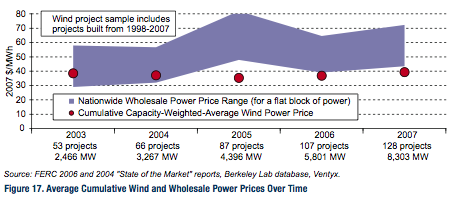
The red dots indicate that on average, the selling price for wind had been between $35 and $40 per MWk. (This is equivalent to $.035 to $.040 per kWh, while the band of wholesale prices of electricity has floated above it).
2. Sometimes the selling price of wind is even negative.
There are times when there is an oversupply of electricity. Often, this is as night, because usage is lower at that time, and base generation is not easily reduced. Adding wind can provide at night can provide more electricity than is needed.
When there is an over-supply, there is a question of what to do with it. According to this article, the usual procedure in the past in West Texas was for grid operator to ask the wind farms to reduce production, to balance supply with demand. The wind farms objected to this procedure, and requested an economic solution.
The solution was negative rates. Wind farms are now paying for the privilege of dumping the wind-generated electricity on the grid. This occurred for 23% of the hours in April.
3. Wind substitutes not for electricity, but for the fuels that power electrical generation (coal and natural gas).
Chris Namoviz, who is in charge of renewable energy forecasting at the EIA, recently told me the following:
Because of its relatively low “capacity value” (a result of usually not blowing very regularly during peak load hours), wind largely competes as a “fuel saver” resource, and can generally be compared against the fuel cost of what ever mix of fuel it is displacing (whether from existing capacity or from alternative investments in future capacity). In the U.S., this is typically some mix of relatively inexpensive coal and somewhat expensive natural gas, depending on the location of the wind plant, and the resulting seasonal/daily wind and load profiles (note that nuclear has relatively low operating costs, and typically does not act as a “marginal” or price-setting fuel). In gas-dominated regions like Texas, wind is relatively more competitive than in coal-dominated regions like the Mid-west, although recent growth patterns in the U.S. suggest a large role for state and Federal mandates and incentives as well.
The savings in fuel costs will vary. For 2008, the average cost of coal for electricity generation, including delivery costs, was $.022 per kWh, based on a calculation I made using EIA data. The average cost of delivered natural gas was $.082 per kWh in 2008, also based on EIA data. This year, natural gas prices are way down. One calculation by Oil Drum reader Steve Piper suggests that at current natural gas prices, the price of natural gas for electrical production may be under $.030 per kWh.
4. Currently, wind generated electricity, in the absence of subsidies, is much more expensive than the fossil fuels it is replacing.
According to this chart prepared by the Institute for Energy Reserach based on EIA forecasts, the expected levelized cost of wind in 2016 is expected to be about $.130 per kWh for onshore wind, and about $.220 per kWh for offshore wind. The amounts are in 2007 dollars, and without subsidies. I would expect costs of new production begun now would be not too different from this, because EIA is unlikely to be forecasting an increase in costs apart from inflation. (More likely, they are forecasting that costs will decrease, as we learn better to make wind turbines.)
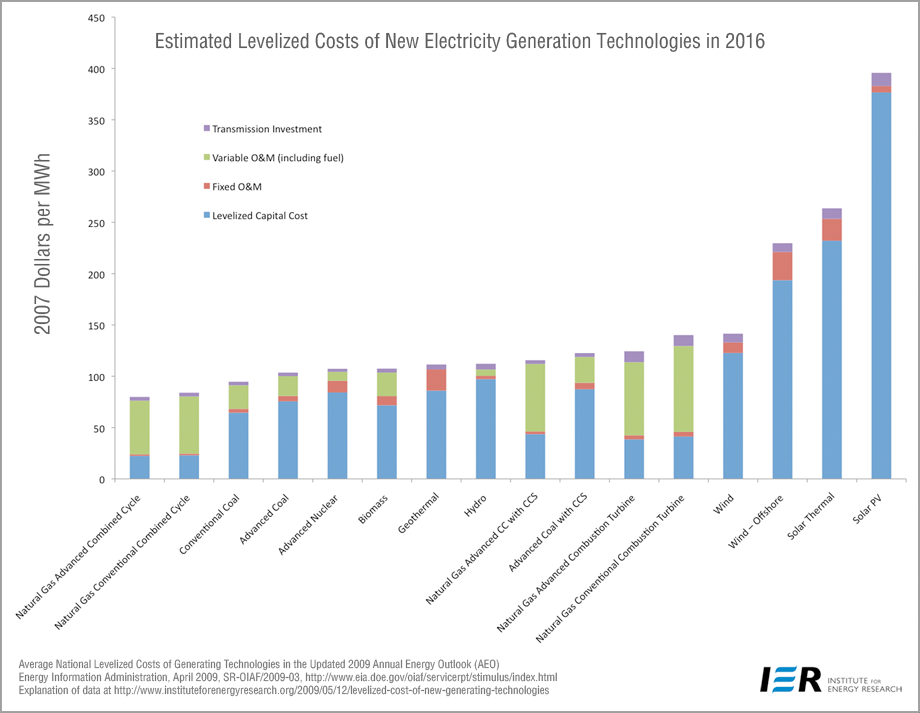
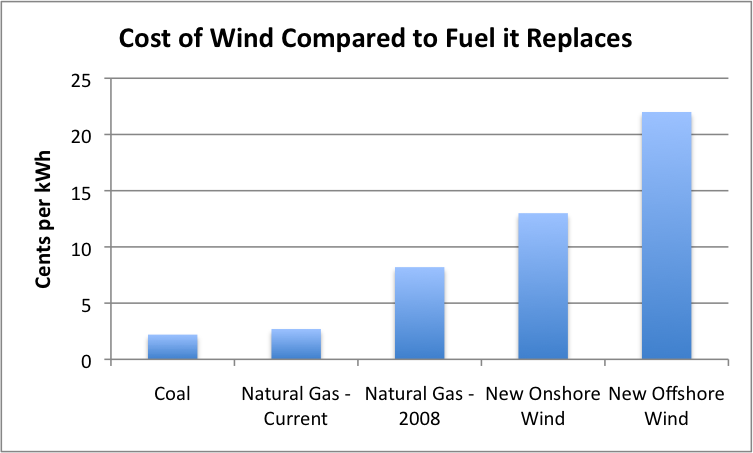
The problem is that the price of wind is vastly higher than the price of the fuel it is replacing. With delivered coal and natural gas in the $.020 to $.030 range, while the cost of new wind production is $.130 to $.220 per kWh, new wind production is four to ten times as expensive as the cost of the fuel it is replacing.
5. At this time, it is not entirely clear that we need any new electrical production capacity.
Since mid 2008, the use of electricity in the US has been decreasing, but electric utilities made plans for new capacity, as if demand would be increasing. A similar situation is being reported around the world.
It is easy to think that a decrease in oil use could be offset by an increase in electricity use, but a pretty good argument can be also made in the other direction: a reduction in oil use may have such a squeezing impact on the economy, that electricity use declines as well. If fewer factories are operating, they use less electricity. If people are moving in with relatives, they use less electricity in the combined quarters. If they also are replacing light bulbs with CFLs, this reduces electrical use further.
The lack of growth in the use of electricity is another reason that the cost of new wind production is really comparable, at least in the short term, to the cost of the fuels it replaces.
6. The combination of low selling prices for wind and high cost of generation means that wind is likely to need large subsidies for years in the future.
Wind will be expensive, not just now, but when the price of fuel is several times what it is today. It is even possible that the price of fuel can completely bring down the economy, before wind-generated electricity becomes competitive with the fuel it replaces.
7. The cost of wind turbines depends a great deal on the financing available. Because of the lack of cheap debt, the cost of wind may even be higher than what the EIA is forecasting.
Per hour of electricity generated, the up-front cost of wind is more expensive than the cost of nuclear energy. The following are approximate cost estimates per hour of annual electricity generated. These amounts are for 1 kW of generation throughout a year which equals 8,760 kWh:
Nuclear: Costs about 3,000 to 4,000 euros per kW of capacity; operates at 90% of capacity; cost for 1.1 kW capacity would be 3,300 - 4,400 euros
Onshore wind: Costs about 1,500 euros per kW of capacity; operates at 30% of capacity; cost for 3.3 kW capacity would be 5,000 euros
Offshore wind: Costs about 3,000 euros per kW of capacity; operates at 40% of capacity; cost for 2.5 kW capacity would be 7,500 euros
Financing these big amounts up front will be difficult, if debt financing is less available. Companies are not likely to want to part with equity for returns of 5% to 10%.
8. There are a lot of reasons that the EROI calculations may be misleadingly high.
Having looked at a few EROI calculations, I can see several issues:
a. When coal is transformed to electricity, there is a quality factor (of three to five) that the amount of energy is multiplied by to reflect the transformation to the higher quality fuel. In the wind EROI calculations, an "electricity in" -- "electricity out" calculation is used. I would argue that there should be a step-down factor, to correspond to the fact that the electricity from wind that is generated is of much lower quality than the electricity that went in. In fact, we are talking using wind-generated electricity as a substitute for coal.
b. There is a great deal of problem with the representations of manufacturers regarding how much wind turbines will generate, as a percentage of capacity, being vastly overstated. This is the abstract of a paper published this month in Energy Policy:
Capacity factor of wind power realized values vs. estimates
Nicolas Boccard, Departament d’Economia, Universitat de Girona, 17071 Girona, Spain
For two decades now, the capacity factor of wind power measuring the average energy delivered has been assumed in the 30–35% range of the name plate capacity. Yet, the mean realized value for Europe over the last five years is below 21%; accordingly private cost is two-third higher and the reduction of carbon emissions is 40% less than previously expected. We document this discrepancy and offer rationalizations that emphasize the long term variations of wind speeds, the behavior of the wind power industry, political interference and the mode of finance. We conclude with the consequences of the capacity factor miscalculation and some policy recommendations.
c. Wind turbines evaluated in EROI studies are not necessarily representative of what one might find in this country. For example, if a wind turbine is manufactured in Brazil using electricity generated by burning sugar cane bagasse and by hydroelectric power, the EROI will be very high, because the sources of electricity use little fossil fuel. This is not representative of wind turbines being manufactured in the United States or Europe, however.
There are other issues as well. How does one handle the excess generating capacity at night (and some other times), when there is no use for it? It seems to me that if all of these issues are sorted out, EROIs for US and European produced wind turbines are likely under 10, and quite possibly under 5.
9. Wind-generated electricity cannot be used on a stand-alone basis to substitute for fossil fuel-generated electricity, without a lot of electrical storage.
Wind on a stand-alone basis does have uses. It can be used to pump water and probably to make nitrogen fertilizer. It can also be used to operate desalination plants.
I think some people have the idea in the backs of their minds that if other electrical generation fails, wind can substitute. This might be the case if a lot of electrical storage is built, and a lot of transmission lines, but I don't see it to be the case otherwise. Wind-generated electricity is just too variable. I don't think that the electrical transformers could stand having the electricity supply constantly turned on and off for very long. I am not sure our electrical appliances in homes and businesses would work very well either. If we really want an idea like this to work, we would need to plan for it very specifically, not just let it fall out accidentally as a by-product.
10. If we want to follow the European model, and upgrade the grid and add more storage, wind-generated electricity will act more like other electricity, but it will be a very big undertaking.
In a time of financial difficulty, it will be difficult to do whole job that would be needed. In many ways, this would be the ideal, but with limited resources, it is not clear that all of these things can be done simultaneously.
If all of these changes were made, one might argue that EROI calculations would not need a step down. But it seems like some of the energy expenditures related to the additional infrastructure should be charged back to wind in the EROI calculation.
Categories: Links
DrumBeat: June 1, 2009
Jeff Rubin - The recession: First, there was expensive oil
Knowing the nature of a disease is usually a precondition for finding a cure. Similarly, identifying the cause of a recession goes a long way in defining what type of recovery is likely to follow.
Conventional wisdom ascribes the current downturn, which in many ways is already the postwar's deepest one, as a financial-market crisis with origins in the bursting of a U.S. real estate bubble. But how did the demise of the American subprime mortgage market create earlier and much deeper recessions overseas than in the U.S. economy itself?
Maybe there was something else going on, like triple-digit oil prices for example.
Global Storage Constraints Limit Oil Stockpiling (Bloomberg) -- Global storage constraints in the short term are limiting the ability of most countries to stockpile more oil, China’s energy chief said.
“Crude stockpile facilities at most countries have been fully filled in the first half, and it will be difficult for countries to greatly increase crude reserves in the second half as they did in the first,” Zhang Guobao, director of the National Energy Administration, said at a media briefing in Beijing today.
Driving Season in U.S. May Beat Forecasts, IEA Says
(Bloomberg) -- Fuel demand during the U.S. summer driving season may prove stronger than projected as consumers recover from the shock of the global financial crisis, an International Energy Agency official said.
“It wouldn’t surprise me if it was a better driving season than some people have forecast,” IEA Deputy Executive Director Richard Jones told reporters at the Australian Petroleum Production and Exploration Association conference today.
Oil Rises to Seven-Month High on China Manufacturing Expansion
(Bloomberg) -- Crude oil rose to the highest since November as China’s manufacturing expanded for a third month, signaling that fuel demand in the world’s second-biggest energy consumer will increase.
Oil climbed as much as 1.8 percent after the U.S. dollar fell to its lowest against the euro since December, heightening the need for commodities to hedge against inflation. China increased prices of gasoline and diesel by as much as 8 percent, a move that may prompt refiners to boost crude purchases.
OPEC unlikely to lower oil output
There is "no way" OPEC will cut production when the group meets again in September, Kuwait's oil minister said, after the supplier of about 40% of the world's oil left output quotas unchanged last week.
"We're not in favor to see the prices in the hundreds because this will fuel recession again," Sheik Ahmed al Abdullah al Sabah told reporters Sunday in Kuwait City. "We have to give the world economy more time" to recover from its worst recession since World War II.
The big American gas-guzzler: Down but not out
HOUSTON (Reuters) – Even though U.S. pump prices are nearly half the $4 per gallon ($1.06 per liter) levels of a year ago, the legions of American fans of gas-guzzling SUVs and trucks don't have much to celebrate.
President Barack Obama's White House has unveiled new fuel-efficiency rules that will push auto companies into making more small cars and General Motors and Chrysler -- both heavily associated with large vehicles -- have sunk into bankruptcy.
But don't expect many dents in the Sport Utility Vehicle fan club.
Total Says New Oil Finds Can Beat North Sea Decline
Bloomberg) -- Total SA, Europe’s third-largest oil company, calculates that investment in North Sea fields will make it the biggest oil and gas operator in the U.K. within three years, challenging top-ranked BP Plc on its home turf.
“Our strategy is more aggressive than other companies,” Roland Festor, managing director of Total E&P U.K. Ltd., said in a May 28 interview. “We don’t have a strategy to grow by acquisitions but by exploration in our hubs.”
US energy braced for hurricane pressure
Rising reinsurance rates and falling capacity have left some insurers and US energy producers with more to fear than in past years as the Gulf of Mexico hurricane season begins on Monday.
A severe storm season would put “big pressure” on the Gulf energy industry, according to brokers at Marsh, as producers have been left with little or no insurance cover.
A cutback in the state reinsurance fund has left insurers of buildings in Florida less able to afford reinsurance, according to research out on Monday.
GM files for bankruptcy
It's an end of an era for GM as the troubled automaker is forced into bankruptcy. GM is set to close nearly a dozen plants and cut more than 20,000 jobs.
Is Halliburton forgiven and forgotten?
The Houstonian Hotel is an elegant, secluded resort set on an 18-acre wooded oasis in the heart of downtown Houston. Two weeks ago, David Lesar, chief executive officer (CEO) of the once notorious energy services corporation Halliburton, spoke to some 100 shareholders and members of senior management gathered there at the company's annual meeting.
All was remarkably staid as they celebrated Halliburton's US$4 billion in operating profits in 2008, a striking 22% return at a time when many companies are announcing record losses. Analysts remain bullish on Halliburton's stock, reflecting a more general view that any company in the oil business is likely to have a profitable future in store.
Asia Crude-IOC seeks more August crude
SINGAPORE (Reuters) - India's largest state-owned refiner, Indian Oil Corp (IOC), has issued a second tender to buy August sweet crude, after having bought four million barrels last week, traders said on Monday.
China: Power consumption continues to drop, oil sales set new high
Statistics released by the State Electricity Regulatory Commission (SERC) reveals that starting from October 2008 China's power consumption has experienced negative growth for six consecutive months.
Kurt Cobb: Hypocritical modelers
Oil companies like to use models to estimate their reserves and the potential of unexplored fields. Exxon Mobil Corp., the world's largest oil company and a longtime supporter of the global warming denial lobby, tells us the following on page 8 of its 2007 annual report: "Using proprietary technologies and tools, including advanced reservoir prediction models and geological data visualization, we have significantly improved our ability to identify, model, and understand oil and gas reservoirs."
Exxon and its fossil fuel partners in the denial lobby seem to like models well enough when they use them for their own purposes; but through their hired mouthpieces they decry the use of models for climate change forecasting. (The Heritage Foundation to whose pages the previous link leads received consistent funding from Exxon throughout this decade.)
Saudi's Say Crude Oil $75 is Fair: Parasite Economics Explained
There is a rumor that demand for oil is a function of GDP, therefore when the world economy recovers, demand will go up, so divide that by supply and you get to price.There is only one small little thing wrong with that theory; historically it doesn't work very well.
Rather the other way around, sort of like a 300% increase in price might cause a 5% decrease in demand with a four or five year lag and a 60% decrease in price might give a 10% increase in demand with a four or five year lag.
Where Is Silver Heading Next?
The fundamentals that will propel wave 3 will be similar to wave 1 as the economy recovers, silver demand picks up industrially but again inflationary pressures begin to bear as commodity demand from China and elsewhere tightens. The inflationary effects of the worldwide credit crunch bailout will also finally filter through but we also expect Peak Oil to finally and decisively appear and oil to breach $200 and beyond. Wave 3 will occupy most of the next decade.
What’s wrong with a 30-hour work week?
With millions of jobs lost during the first part of 2009, who is calling for a shorter work week to spread the work around? Not the Republicans. Not even the Democrats. But why is there nary a peep from unions?
Red Cliffs and collapse
We are at the eve of a depletion crisis. Present day polities are so complex – and therefore costly – they cannot exist without a constant inflow of energy only fossil fuels can provide. With the advent of peak-oil, they will less and less able to pay for the cost of their existence and will disintegrate. The way they will do it, however, will matter quite a lot and if they cling to their unity too long and fail to decentralize, they will only exhaust resources their successor will need to firmly establish themselves. So instead of the warring but reasonably stable Three Kingdoms, we will end up with squabbling fiefdoms.
This is, I think, a vital task peak oil activists unfortunately tend to overlook : how to make sure that when current polities fail, they won't be replaced by a reincarnation of the petty kingdoms of England. That certainly does not mean encouraging every wild secessionist scheme – some are reasonable project, as in Scotland, Wales or Catalonya but most others are just recipes for disasters – but encouraging decentralization, growth of regional identities and empowerment of local authorities, so that, when the time will come, we won't need a Battle of the Red Cliffs to avoid fighting the one of Badon Hill.
Triple crisis for the motor car
THE modern world is so much built on the motor car. For many middle-income families, it is the most important asset they own after the house. And, many who don’t own a car have the fervent dream of doing so.
Just as car ownership is the most obvious status symbol for the individual, the making or assembly of automobiles is for many developing countries the centerpiece of their industrialisation process.
Today, the motor car, and what it represents, is caught in the midst of at least three crises – the environmental, economic and energy crises. Its future will not be the same.
Investing in creativity is way to achieve economic success
Global warming and peak oil may necessitate a complete rethink of our approach to investment in transport infrastructure. Rising unemployment means risking a repeat of the 1980s disapora and the brain drain that went with it.
Resources available now to begin the transition toward life we’re seeking
The Transition Town Movement – a grass-roots initiative spreading around the globe – is asking, “How are we going to drastically reduce carbon emissions (in response to climate change); significantly rebuild resilience (in response to peak oil); and greatly strengthen our local economy (in response to economic instability)?”
The movement, originated by Rob Hopkins, a UK ecological designer and permaculturist, provides a roadmap away from this triple threat and toward a sustainable future.
Seeds of Change
These are, to put it gently, unsettling times. A triple whammy confronts us: climate change, peak oil, and a global economy in a possible death spiral. With things spinning so badly out of control, it’s easy to feel daunted.
A century ago, the poet William Butler Yeats described chaos’s onset this way: “The center cannot hold.” While his words still resonate, they don’t quite capture the current crisis, whose cause lies precisely in this: The global economy has no center. It’s a system in which capital sloshes from money center to tax haven, and corporations, in the words of writer David Ehrenfeld, are “everywhere and nowhere.” The result: From the Hudson Valley to Hong Kong, people are plugged into an economic matrix that has no face and is indifferent to yours. Talk about your primal helplessness! Here we are, attached to the same global teat, the milk is slowing to a trickle, and Mama’s on crank and doesn’t care.
Is it end-game time? Yes, if we’re referring to the era of plentiful, cheap oil. But don’t assume a high-tech Dark Ages is upon us. Out of the rubble of the old, a new, postglobal economic arrangement is emerging.
Beyond Westminster's bankrupted practices, a new idealism is emerging
Progressive politics will take root from the rubble of a Labour defeat. The Transition movement is giving us a glimpse now.
Superfluous Luxuries: How science was put in the service of greed
Throughout our history our development has been geared into progressive invention, at no point have so many scientists co-operated in the name of preservation. Will peak oil result in a peak of technology, or at least those technologies which are such an ubiquitous aspect of our society?
I grew up with this notion that our race was infallible, that we would explore the stars, and even when I learned that, if we weren’t wiped out by a meteor the sun would burn out, the assumption was that we would inevitably prevail. I also naively believed that our evolution and the state of society was at a level and we would not experience even half the change our parents and grandparents witnessed. The last hundred years have seen the most drastic change to the lives of the ordinary in human history, but the next hundred will outdo that effort effortlessly, but we all know where you’re headed after a peak. The metaphorical conception of oil as the earth’s blood is only too accurate; we are bleeding it dry and the life-force we have invested far too much in will soon give up on us. Nature will have her revenge, she is already displaying her destructive potential, flexing her muscles, and we need look no further than our temperate little island to see the effects (in terms of unprecedented weather patterns and consistent meteorological anomalies).
'Clean-tech' start-ups are pushing the green button
Venture capitalists, big companies including Cisco Systems Inc. and General Electric Co. and private equity firms have been pumping money into a variety of green IT initiatives, said Ron Pernick, co-founder and principal of Clean Edge Inc., an environmental research and consulting firm. A major push includes an effort to make the nation's power grid "smarter" by using sensors and networking technology so companies can track their electricity use.
These initiatives look at the demand side -- figuring out how people are using energy -- rather than the supply side, such as solar power, to replace the type of energy being generated.
Corn farmers eye E15 waiver
For decades, much of the fuel sold in the U.S. has been blended with 10 percent ethanol. However, in recent years, the amount of ethanol produced in the U.S. has been on the rise. In 2008, the ethanol industry produced 9 billion gallons of the alternative fuel. And this year, ethanol production is expected to rise yet again, to more than 12 billion gallons.
But for the ethanol industry, the steadily rising production portends trouble. Should the federal government continue to limit the blend of ethanol in regular unleaded gasoline to 10 percent — a blend known as E10 — the ethanol industry will run into what is known in the industry as the "blend wall," or the maximum amount of ethanol that can be reliably absorbed by U.S. gasoline production.
Monbiot - Stern breaks the east-west deadlock on who's responsible for CO2
China says it's unfair that the west 'outsources' emissions. Now that Lord Stern has said responsibility should be split between producers and consumers, other countries may follow suit.
Japan to choose on climate: lose face or lose money
TOKYO (Reuters) - Japan's prime minister faces the country's toughest climate change challenge in more than a decade when he sets a greenhouse gas emissions goal for 2020 this month: he must either take a lead on the cuts or cave into pressure from business.
If his target is deemed too small, Taro Aso will earn global ire for not pulling his weight in the fight against climate change and disappoint some voters ahead of a looming election.
As the U.S. goes (green), so too goes Canada
“There is the strongest prospect ever” that the United States will embrace cap-and-trade, believes Elliot Diringer, vice-president for international strategies at the Pew Center on Global Climate Change.
That likelihood represents a profound surrender of sovereignty by Canada on environmental policy.
CO2 levels may cause underwater catastrophe
The world's scientific academies - including the UK's Royal Society - issued a warning that ocean acidification must be on the agenda when countries attempt to forge a new global deal on cutting emissions in Copenhagen in December.
And a separate paper warned that increasing acidity in the seas could damage fish, corals and shellfish - leaving fishing communities facing economic disaster.
Public asked to help monitor life on earth
OSLO (Reuters) - Scientists asked people around the world on Monday to help compile an Internet-based observatory of life on earth as a guide to everything from the impact of climate change on wildlife to pests that can damage crops.
"I would hope that ... we might even have millions of people providing data" in the long term, James Edwards, head of the Encyclopedia of Life (EOL) based at the Smithsonian Institution in Washington, told Reuters of the 10-year project.
The seldom-seen devastation of climate change
A NASA climatologist explains why global warming is more than starving polar bears, and skeptics are simplistic.
Apathy threatens humanity, ex-Clinton aide says
Thomas Homer-Dixon says we still don’t get it.
And unless we change our energy-consuming, air-polluting ways, we’re in for a rude awakening in just 26 years.
“It’s not going to look good,” said the author of “The Ingenuity Gap,” and editor of the recent best-seller, “Carbon Shift” and former White House advisor to the Clinton administration.
By 2035, Homer-Dixon warns there will be a cataclysmic shift in weather patterns that will leave us reeling.
Categories: Links
DrumBeat: May 31, 2009
Deffeyes Update: May 29th, 2009
My apologies for not posting a Current Events item earlier; I'm in the late stages of writing a third book on oil.
Bloomberg News reports that a high-level commission may be appointed to explore the roots of the present economic crisis. Bloomberg quotes Charles Geisst, a professor of finance at Manhattan College, who says that the commission would have to "dig way below the surface and get to the bottom of what caused all of the problems." It seems blatantly obvious that the crisis was caused by the end of growth in the world oil supply. Suggested people for the panel are Sandra Day O'Connor, Paul Volker, and Arthur Levitt. None of them could find peak oil using both hands and a flashlight. How about appointing a geologist like T. Boone Pickens to the commission? O'Connor, Volker, and Levitt will come out with recommendations for armor-plating the banking system, but the crisis could have had different effects from the same cause. Other countries could have stopped reinvesting our trade deficit back in the USA, or oil could have switched from pricing in dollars to pricing in Euros.
Ecuador Saves $252 Mln Swapping Oil for Products With Venezuela (Bloomberg) -- Ecuador has saved about $252 million by swapping crude oil for refined products with Venezuela, President Rafael Correa said.
“That alone justifies all the agreements with this country,” Correa said on his weekly radio-and-television address, according to a statement on his Web site.
Not Mixing With Rest of Economy, Oil Floats Higher
Edward Morse, chief economist of LCM Commodities, said: "The main determinant of oil prices over the past two months have been expectations. We are in an 'expeculation' frenzy."
He said that investors were looking to oil as a way to protect themselves from inflation and predicted that a sluggish economy, a weak driving season and contained inflation would bump oil prices back down again in the coming weeks.
Other analysts said there were signs that U.S. motorists and truck drivers, who consume more than one in every eight barrels of oil produced worldwide, were not reverting to earlier driving habits even though U.S. pump prices for regular gasoline average $2.45 a gallon, a full $1.50 lower than they were last year at this time, according to the auto club AAA.
Abundant Energy Supplies Ease Hurricane Season Concerns
Hurricane season isn't as threatening as it used to be, at least for energy markets mired in a recession.
The 2009 Atlantic Hurricane season, which officially starts on June 1 and lasts through Nov. 30, comes amid a global slump in oil and gas demand. Although well-aimed storms -- should they hit major refining center -- could still cause gasoline prices to spike, analysts say the threat to natural gas prices has softened, and crude oil prices are unlikely to move much on storm-related outages.
That's because the U.S. has come to rely less on the Gulf of Mexico's natural gas production, and crude output from the region is just a small piece of a relatively depressed global market -- representing less than 2% of worldwide demand.
Shell to Cut 350 - 450 Senior Managers
LONDON (Reuters) - Royal Dutch Shell plans to cut 350-450 senior management roles as it restructures to cut costs and improve operational performance, according to a website to which Shell employees post internal information.
The cuts represent almost 30 percent of Shell's "Senior Executive Group" layer of management, John Donovan, the operator of the Royaldutchshellplc.com website said. Earlier this week Shell announced a major restructuring but gave no targets for job or cost cuts.
Horizontal Drilling Raises Questions about Changes to State Regulations
The Oklahoma Corporation Commission has called a special meeting for June 30 to discuss whether regulatory changes are needed to accommodate increased horizontal drilling in the state.
Among the issues likely to be discussed is whether spacing and unitization regulations that govern the drilling of oil and natural gas wells need to be changed, Corporation Commissioner Dana Murphy said. "With all the technological advances on horizontal drilling and conventional and unconventional units, we just want to make sure our staff is keeping up with technology and see if there are rules and processes that we need to change, modify or improve," she said.
Western world is faced with the crude reality of rising oil prices
Cheaper crude has delivered the world's oil-importers – not least the major Western economies – an annualised windfall saving of $1,600bn (£1,000bn). That's more than all the heralded fiscal stimulus packages announced by the US, UK and eurozone for both this year and next.
The current situation is bad, but how bad would it be if Western firms and consumers faced rocketing energy prices?
Pipelineistan goes Iran-Pak
The earth has been shaking for a few days now all across Pipelineistan - with massive repercussions for all the big players in the New Great Game in Eurasia. United States President Barack Obama's AfPak strategists didn't even see it coming.
A silent, reptilian war had been going on for years between the US-favored Turkmenistan-Afghanistan-Pakistan-India (TAPI) pipeline and its rival, the Iran-Pakistan-India (IPI) pipeline, also known as the "peace pipeline". This past weekend, a winner emerged. And it's none of the above: instead, it's the 2,100-kilometer, US$7.5 billion IP (the Iran-Pakistan pipeline), with no India attached.
‘Gas imported from Iran to generate 5000MW’
ISLAMABAD—Pakistan will use gas imported from Iran to generate 5,000 mega watts of electricity, the Pakistani prime minister’s advisor on petroleum and natural resources said.
Asim Hussain said that natural gas imported from Iran will be exclusively used to generate 5,000 megawatts of electricity, ISNA wrote.
He said that Pakistan needs 8 to 10 billion cubic feet of gas while the supply is only four billion cubic feet. To a question, he said that Iranian gas is not expensive in comparison with natural gas, which is going to be even costlier than petrol due to high caloric value and environment-friendly nature.
Aramco renegotiates contracts on US$12bn refinery
State-owned hydrocarbons giant Saudi Aramco is looking to renegotiate a number of contracts for the construction of the Saudi Aramco Total Refining Co (Satorp) refinery in Jubail, Saudi Arabia.
News agency Reuters reported that six out of the 13 contracts for the 400,000 barrels per day (bpd) refinery, a joint venture with French oil company Total, are up for renegotiation as Aramco look to take advantage of the sharp drop in prices for raw materials that has occurred in the last few months.
Shell execs accused of 'collaboration' over hanging of Nigerian activist Ken Saro-Wiwa
"If you call off the campaign, maybe we can do something for your brother." A New York court will claims this week that Brian Anderson, Shell's former top official in Nigeria, used those words when asked to intercede with the country's military regime to save activist and writer Ken Saro-Wiwa from being executed.
No respite to power cut
HYDERABAD: With the monsoons round the corner and no end to power cuts, Transco officials said despite improved generation, there will be no respite to power cuts as the faulty distribution system is leading to frequent tripping all across the state.
Till Saturday, the Greater Hyderabad region was experiencing power cuts of about two to three hours per day which is even more in the rural areas. And farmers, for whom the kharif season begins as soon as the monsoon sets in, are a worried lot in view of the erratic free power supply.
Oil contracts still a hot topic
June lies at our doorstep, and the promise of summer helps diminish memories of ice storms, shoveling the steps and cranking up the thermostat.
But oil heat retailers say now is the time to start shopping around for a heating oil plan, and while some consumers who locked into fixed price contracts last summer felt betrayed by prices that dropped steeply during the heating season, some companies said they will continue to offer them as a hedge against rising prices.
Worried book industry gathers for convention
Except for e-books, sales are down throughout the publishing industry and the numbers have looked even steeper for audio. The Association of American Publishers has seen a 47 percent drop in audio revenue this year: Just 14 publishers reported, but they include Simon & Schuster, HarperCollins and virtually all the major New York companies.
...The shrinking economy has had a very direct impact. The fewer people who work, the fewer people who drive to work. And many audio customers listen in their cars, more than half, according to Chris Lynch, executive vice president and publisher of Simon & Schuster Audio, which just released "America's March to Socialism," an audio-only book by Glenn Beck.
"We got hit pretty badly last summer when gasoline prices were so high," Lynch says. "And then the stock market crashed in the fall and we got hit again."
How To Send Energy Across a Continent
Remember the Woodstock of physics? Probably not. Back in the spring of 1987, though, headlines were trumpeting it as the most exciting scientific meeting in history. Three thousand physicists crammed into a ballroom at the New York Hilton to talk about superconductivity—the transmission of electricity with literally zero resistance. The technology was suddenly within reach of being economical. So it appeared, anyway, and that could mean anything from superfast computers to tiny, powerful electric motors to power lines that could carry current with no loss of energy.
In the more than two decades since, superconductors haven't grabbed many headlines. That's partly because the new materials discovered in the late '80s proved to be a lot harder to work with than anyone expected, and partly because their energy-saving wizardry wasn't in high demand during most of the 1990s. But nowadays, using less energy is a key strategy in the fight against climate change—and a lot of the technical problems that have dogged superconductor technology have been solved. "Five years ago, I'd have been skeptical," says Robert Cava, a Princeton materials scientist who was in on the original Woodstock of Physics. "But after years and years and years of people beating their heads against the wall, they've finally got it."
UK won’t hit its target for renewables
BRITAIN is failing to green its economy, according to previously unpublished reports from the Department of Energy and Climate Change (DECC).
The internal forecasts show that by 2020 the UK will be sourcing only 5% of its energy from renewables, far short of the 15% target we signed up to with the European Commission.
Is the Nuclear Renaissance Fizzling?
Nuclear power may be making a comeback, but long-standing problems with the technology still could lead to canceled orders and renewed public opposition.
Tidal Power Keeps on Truckin’
Ocean power has suffered some setbacks recently, such as Pelamis’ bellyflop in Portugal and the UK’s WaveHub losing a developer, but the industry isn’t slowing down — in fact, it’s been a busy month for tidal technology. While there are only a small number of wave or tidal power projects in oceans and rivers right now, and large-scale projects remain a few years away, the race is on for companies hoping to get a first-mover’s advantage.
'Smart Turbine Blades' To Improve Wind Power
Researchers have developed a technique that uses sensors and computational software to constantly monitor forces exerted on wind turbine blades, a step toward improving efficiency by adjusting for rapidly changing wind conditions.
The research by engineers at Purdue University and Sandia National Laboratories is part of an effort to develop a smarter wind turbine structure
The Ethanol Lobby: Profits vs. Food
If you had two customers for the same product and one paid more than the other, which customer would you choose? That's the situation in which ethanol producers in the U.S. find themselves. They could grow corn and other crops for food and get one price, or produce the same crops for biofuel and get a higher price and tax credits. The problem is that by focusing on more profitable biofuels, farmers not only deplete the food supply, they are also producing an alternative fuel whose usefulness is still hotly debated.
Landfill methane gas now powering UNH
At the Waste Management facility, there are two power generating plants that take the landfill gas and convert it into 9 megawatts of power, used to power the whole facility with some left over that is sold to the New England power grid.
But according to Davis, "we still had extra gas" being harvested from some 300 wells over 200 acres of landfill. And 40 more acres are permitted and ready to go into use.
"We started looking for someone who might want to take it," Davis said. The excess gas would otherwise be burned, a "waste of a usable energy source," he said.
Meanwhile, UNH had built a co-generation plant in 2006, which produces both heat and electricity for the campus. Recognized nationwide for its sustainability work, the university was intrigued when Davis approached officials with his idea of using landfill gas to power its buildings.
Electric Motorcycles Gain Traction
Get ready for an American motorcycle revolution. That deep Harley rumble and the siren call of the Suzuki whine will soon be sharing the road with silent bikes. A slew of sleek, lightweight machines, either fully electric or hybrid, is making its debut and signaling a paradigm shift in both motorcycle culture and green transportation.
'Earth 2100': the Final Century of Civilization? - Planet at Risk: Experts Warn Population Growth, Resource Depletion, Climate Change Could Bring Catastrophe in Next Century
It's an idea that most of us would rather not face -- that within the next century, life as we know it could come to an end. Our civilization could crumble, leaving only traces of modern human existence behind.
It seems outlandish, extreme -- even impossible. But according to cutting edge scientific research, it is a very real possibility. And unless we make drastic changes now, it could very well happen.
Experts have a stark warning: that unless we change course, the "perfect storm" of population growth, dwindling resources and climate change has the potential to converge in the next century with catastrophic results.
The Context of 'Low Product': How designers can help articulate a new social language
Will "no product" become the new brand? John Hockenberry provocatively suggests that given the global economic crisis, "no product" is now plausible. But how plausible given our society organized around economic growth? I'm talking here about consumerism as both the primary purpose of growth, and its principal driver—the high product context.
How Obama Made Energy Platform 'Pop': President Has Gained Support by Framing Issues in Terms of Jobs, Security
Now, four months into his presidency, Obama has elevated energy and climate issues to near the top of his agenda; he has made them pop by packaging them as ways to create "green" jobs and reduce U.S. dependence on imports of foreign oil. Favoring pragmatism over moral suasion, the president is attempting to make a sharp shift in national policy on an issue that many voters have yet to embrace as a priority, advisers and lawmakers say.
His efforts, combined with those of congressional Democrats, have already pushed forward groundbreaking initiatives. February's stimulus act lavished money on projects for renewable energy, energy efficiency and energy research. This month, the White House announced that it had negotiated corporate, state and environmentalist support for higher fuel-efficiency and tailpipe-emissions standards that would clamp the first nationwide limits on greenhouse gases.
Climate change bill still in doubt
WASHINGTON -- Environmentalists celebrated earlier this month when a key House committee approved a contentious proposal to combat climate change after months of often-bitter public deliberations and intense closed-door negotiations.
But for congressional supporters of the bill, the really hard part is just beginning.
Ten reasons why population control can’t stop climate change
In Australia, a discussion has surfaced about whether population control measures should be a key plank in the climate action movement’s campaign arsenal. Here are 10 reasons why such a decision would hinder, rather than help, the necessary task of building a movement that can win.
Climate Change Now 'Biggest Global Health Threat'
WASHINGTON (OneWorld.net) - Climate change is currently the biggest global health threat, a leading medical journal has said, noting that water scarcity, shifting food resources, and extreme weather will drastically affect the world's poor unless development efforts are stepped up.
New Solar Cycle Prediction
Right now, the solar cycle is in a valley - the deepest of the past century. In 2008 and 2009, the sun set Space Age records for low sunspot counts, weak solar wind, and low solar irradiance. The sun has gone more than two years without a significant solar flare.
"In our professional careers, we've never seen anything quite like it," says Pesnell. "Solar minimum has lasted far beyond the date we predicted in 2007."
In recent months, however, the sun has begun to show timorous signs of life. Small sunspots and "proto-sunspots" are popping up with increasing frequency. Enormous currents of plasma on the sun’s surface ("zonal flows") are gaining strength and slowly drifting toward the sun’s equator. Radio astronomers have detected a tiny but significant uptick in solar radio emissions. All these things are precursors of an awakening Solar Cycle 24 and form the basis for the panel's new, almost unanimous forecast.
Categories: Links
The Oil Drum BookCollage -# 3 of 3 - General Recommendations For the Library
Earlier this week we had two threads for listing book recommendations, Thread 1 on energy, ecology, systems, etc. and Thread 2 on practical knowledge. This 3rd thread is for general book recommendations from Oil Drum readers. We don't always have to learn something from what we do or what we read - sometimes it can be just for fun or enjoyment.
I try to live my life using a barbell strategy. One one end I try to do things of meaning, importance and value. On the other end, I live with 'wide boundary hedonism', which basically means I laugh, love, sleep, eat, hike, read, play, consort with animals, spend time in nature, think, wonder, etc. (I try to cut most of the stuff between these two extremes -like typical social conformities, television, monotony etc. but I occasionally get pulled in like we all do.) In any case, reading has been a lifelong passion of mine. Whenever I was in a blue spot, perhaps from breaking up with a girlfriend, etc. I could lose myself in a good book for a few days and it would equilibrate my sense of self. In recent years (probably due to reading much on this site), I haven't had as much time to read 'for enjoyment'. But I intend to do that more in the future.
Here are a few selections that I enjoyed and have read more than once. I am a science fiction/fantasy nut so two of the three are from that genre.
Freddy and Fredericka Mark Halperin.
A well written book like many others by Helperin. I particularly liked the plot: a Prince on England was only able to become King if he could conquer America, with no money or no help - just being parachuted naked into New Jersey. As such it was inspirational that skills, integrity and leadership could rise to the top on their own merits rather than by birth, status or wealth. Cool idea.
The Foundation Trilogy Isaac Asimov
Oft mentioned in TOD threads was Asimovs theory of "pychohistory" which combined math, sociology and psychology and statistics to make predictions about large social groups. I have reread these books twice but it has been about 10+ years so I think I am due for a reread..;-)
Farseer Trilogy Robin Hobb
There are actually 9 books in this fantasy series. Hobb is my favorite fiction author - her character developments are so real that you are pulled into the story and forget about reality, which I imagine is good reason for reading fiction. This series is set in a kingdom where some people have the ability to mentally telepath/bond with animals, which I found to be a cool concept. Hobbs books also seem to not be candycoated. Many of main characters die, etc.
(Note: I have always wanted to write a sci/fi book. Perhaps a future earth traveler who visits many different areas of planet, which all pursued different peak oil social strategies - the traveler might engage with these future humans and via conversation provide insight/speculation as to the many complexities that the one big human tribe now faces..)
=========================================================================================
Please add up to 3 choices for general reading enjoyment to the list. Who knows - books might be a great store of unexpected reward someday....
Categories: Links
Blogger Conference Call with Robert Ryan, VP of Global Exploration, Chevron
This post is a summary of a conference call for bloggers hosted by the American Petroleum Institute (API) on Friday, May 15th, 2009, from 12 to 1 pm. The conference call was set up as a Q & A session where questions from numerous bloggers were fielded by Robert Ryan, the Vice President of Global Exploration at Chevron. Other participants that fielded some questions were Justin Higgs, News Media Advisor (Chevron), Mark Kibbe, Federal Relations Director (API), and John Felmy, Chief Economist (API). The following is an abridged version of the transcript, focusing on some of the more interesting questions and answers. A complete transcript of the conference call and recording of the call can be found here.
Bloggers who participated in the conference call are as follows: Alan Stewart Carl, Donklephant; Bob McCarty, Bob McCarty Writes; Brian Westenhaus, New Energy and Fuel; Bruce McQuain, The QandO Blog; Buster Cagney, The Oil Drum; Chris Nelder, GetRealList; David Murphy, The Oil Drum; Devil’s Advocate, Right Wing News; Geoff Styles, Energy Outlook; Jim Hoft, Gateway Pundit; Joy McCann, Little Miss Attila; Krystle, Bearing Drift and Crystal Clear Conservative; Tony Eriksen, The Oil Drum; Tim Hurst, Green Options; Stephen Rhodes, The Republican Temple
I have organized this summary by subject matter, which included the issues of: peak oil, oil prices, exploration costs, new leases for off-shore exploration, climate change policy, and Chevron's new(er) projects. The first section, however, begins with excerpts from Mr. Ryan's opening statements.
(note: all block quotes are responses from Mr. Ryan, unless otherwise noted)
We [Chevron] explore, we produce, we refine, we market. And that’s kind of the basic picture. Some companies do all, some do just pieces of it. My piece of that value chain is way up front. And it’s the exploration component. And it’s probably one of the least understood pieces of that. The public doesn’t usually see it; it’s not the corner service station. They don’t drive by a refinery; they don’t see a field, necessarily, producing off in the distance…
When it comes to the exploration world, people focus on first discovery to first production. And that’s typically a lot of industry benchmarks, measures, the stock market looks at us and how quick we are, et cetera. But I go back way before that. And to give you an example in Tahiti, we first started looking at the Tahiti play and transit around 1994.
In ’96, they had improved the concepts enough where we started to bid and we started to bid aggressively. And by 2002, had a discovery and of course, first production a week ago. So you might say my measure – my teammates’ measures – it’s not first discovery – or say discovery to first oil. It’s first hunch to first oil. When is that geologic concept first being developed?
When I was first working in the Gulf of Mexico out of our New Orleans office, deep water was 600 feet. We now have – Chevron has a well we drilled a few years ago in just over 10,000 feet of water – unheard of. Early in my career, when we hit salt, we stopped drilling; we were done. That’s all Mother Nature provided in the sense of rocks to look for. Now, we drill through 10- to 15,000 feet of salt just to get to the prospect, which is an example, for instance, at Tahiti.
So things have changed fundamentally. Does it make a difference? You bet it does.
PEAK OIL
The Devil’s Advocate: “I was wondering if you could comment or respond to any of the people that claim that we are eventually going to reach peak oil.”
Well, sometimes I view that as an academic exercise, it’s difficult to get your arms around it, and let me give you an example. Years ago I did a Google search in the Gulf of Mexico, and you type in Dead Sea and you type in Gulf of Mexico and you’d find all kinds of stories about the Gulf of Mexico had reached its peak and it’s over. And, lo and behold, we got new geologic concepts; we’ve got the capability to drill deeper, we’ve got 3-D seismic, we’ve got the ability to look below salt, et cetera, et cetera, et cetera.
And the point is we’ve got plays there that we never dreamed of, for instance, the Wilcox – which, by the way, Chevron’s one of the top leaseholders there in that play. No one would have ever dreamed of an oil province like that in that water depth in the Gulf of Mexico. If you can apply some of that same thinking to some of the other hydrocarbon basins around the world – what have we not found yet? Where does it end?
To quote my colleague Paul Siegle we might start talking about peak oil when we’ve addressed peak technology or peak geologic concepts. It is a non-renewable resource? You bet. Is there a peak one day? You bet. But, at the moment, things just keep moving forward, and I don’t think we’ve tested everything we know.
Emailed question: “despite technological improvements, global oil discoveries have been declining. What do you make of that?”
Yeah, that’s a fair statement. I looked at – I plotted the discoveries for about the past decade from Wood Mackenzie, just to give you my source. And we looked at it, and you could – if your eyeball just went across the bar graph, you could see, well, the number of discoveries was – (audio break) – the size of discoveries – the number of discoveries greater than 500 million barrels, if I recall – I don’t have the chart in front of me – was dipping. You could say, well, is that a trend, that the big ones are getting fewer, or not? And yes, I mean, you do see that trend.
Now, in the case of Chevron, to just get kind of on a micro scale, we’ve averaged an add of over a billion (barrels) a year since we put in a new exploration strategy back in 2002 with the Chevron and Texaco merger. That’s more than we expected to find. It’s now over eight-and-a- half billion. We continue to have a very strong queue of exploration opportunities for what we called impact wells – we define that as greater than 100 million barrels, the prospect size. We continue to have a strong queue. Every time we think it’s going to dip and say okay, the queue is running out, we’re running fewer impact wells, impact prospects, it seems to continue to hold up.
And so that’s just a small, micro view in the sense of Chevron, we’re just one piece of this giant puzzle. I can’t speak for my colleagues but, you know, so far, so good. But I’d be naïve to not say that, over time, yes, I mean, things would probably get smaller. And you could look at different data sets and say some of them are getting smaller.
OIL PRICES
Mr. Nelder: "Given the incredibly high expense of doing these deep-water projects, I wonder what Chevron’s current target is for the price of oil for the next five years or so in making it’s business decisions to proceed."
Well, I wouldn’t be able to share with you what our forecast of oil and gas prices would be, but I can tell you that we look at a myriad of price ranges and we also test all of our projects at a low end as well as a high end to look at their economic viability.
From an exploration sense, certainly I’d be naïve to say price isn’t important. So that’s kind of the wrong way to say it. But our piece is so long term that we try to just make sure that the projects are viable from both a technical and risk point of view as well as an economic test.
And we keep moving forward. For instance, when we bid on the Tahiti play in general in 1996 who would have ever dreamed of the prices we’ve seen on and off just even in the past year. So any assumptions we made on price would have been incorrect. But the project was viable at the price we tested it at then and we were willing to take that risk to drill the first well.
Emailed question: “the Chevron share price tracked crude oil prices pretty closely from 2002 through January of 2007. As the oil prices moved above the $100 per barrel range, Chevron’s share price stalled. Other major oil companies saw a similar situation. Do you think that the market was saying that Chevron would either be nationalized or suffer major windfall taxes if oil prices rallied above $100 a barrel on a sustained basis?”
Answered by Mr. Felmy: Remember, these companies are not just upstream producers. They also have refining operations. And for a substantial component of last year, when you saw these ramped-up prices of crude, refined products did not follow. And so that is – any kind of analyst will look at the combination of the operations in assessing what’s going on. So it’s probably more likely, just fundamentals.
EXPLORATION COSTS
Mr. Murphy: “I was wondering if you could give me a sense of how the expenditures in the exploration and development and production have changed through the lifespan of these projects in the last 30 years. For instance, has the amount of expenditures for exploration increased while production has remained relatively flat, or whatever the case may be?”
Yeah, we definitely – of course costs have gone up. And some of that is a fundamental of just cost increases as the economy heated up over the past few years. But on the other side of the coin, you look at it if we were drilling in the wells in the past in 100, 200, 300 feet of water, now we are drilling in the six- , seven-, 8,000 feet of water. You, of course, you can understand just fundamentally it’s going to be more costly because of the capabilities of the rig, et cetera.
Within the past, say, eight years that I’ve been involved with Chevron’s exploration from a senior leadership role, both in my international position prior to this one and the global one, we’ve gone from about a billion dollars a year to approximately 2 billion (dollars) a year. So you could say we doubled it.
Now, did we double the number of wells, exploratory wells, we drilled in that? No. The good news is a lot of that funding increase was due to appraisal wells. We have had a lot of success, the success in wildcats, triggers, appraisal well -- appraisal wells typically don’t add new resources but what they are doing is reducing the uncertainty with the discoveries. But that comes out of an exploration budget. And it’s good news.
Pre-development costs, where you start to get your ideas and concepts around what the field could be, that’s in an exploration budget. So with our success, those went up. So you might say a good piece of that increase is due to success. Another piece of that increase was of course due to costs going up for both wells and both seismic.
Our exploration budget this year in ’09 is about flat with ’08. And we’ve been hovering at say, just under 2 billion (dollars) for a couple of years now.
NEW LEASES FOR OFF SHORE DRILLING (i.e. East GOM and East Coast USA)
A good portion of the conversation was on the topic of new leases for offshore drilling and Mr. Ryan had some very insightful points on the subject. Here are some excerpts.
Will there be exploration allowed in the east Gulf of Mexico, the East Coast of the U.S. and the West Coast? That’s difficult to predict. But it would have potential, just like these other unexplored areas would.
And you’ve probably all about the MMS Outer Continental Shelf assessments of the potential there. Right now, those are just numbers done by studies with very old data. And until we get a better sense with more modern seismic we’ll never know, and in fact, until one day we ever put a well there, we’ll never know.
Mr Westenhaus: “There’s a lot of Gulf of Mexico besides just the western shore of the Gulf that’s explored now. I’m curious as to how much more the major independent oil companies are going to get access to. Things are changing in Mexico so I’m curious as to what your feel is as what might become an opportunity there.”
Well, I’d hate to speculate on the plans of the Mexican government and Mexican people. As you know, there’s no access to that for international companies as we speak. Do geologic trends stop at international boundaries? No, they don’t. And so when you look down at some of our discoveries and prospects down in the southernmost Gulf of Mexico – southern meaning closest to the U.S.-Mexican border – some of those trends do continue across. It’s a setting that, as you can imagine, it takes a significant technical capability to be able to drill in those water depths. And you might say that drilling is the easy part. If you make a discovery, you then have the challenge of developing it. And that’s a huge challenge, as evidenced by just you seeing our projects now: Tahiti and Blind Faith and others while the water gets even deeper as you head there.
Ms. McCann: “Just wondering what would be required to get modern, state-of- the-art seismics for some of the areas, particularly off of the U.S. coast? What would it take? And some of these other more promising arenas around the world, what would it take to do that?”
Well, we shoot seismic, of course, all over the world every day. And we don’t do it ourselves; we hire seismic vendors, different companies that actually do the work. But we typically would design the survey if it was one shot for us and work with that vendor to get it done.
If you were to go onto the East Coast, you’d have to get a permit to get this done, and the seismic companies would pursue that. And of course, the struggle would be, if you never had any chance at all of exploring, why would they go shoot it, and why would we buy it, or why would we work with them to acquire it?
Follow-up by Ms. McCann: “Does this imply a level of catch-22? I mean, if you can’t really get terrifically accurate surveys of what’s out there, then how do you convince people that it’s worth consenting to have this done?”
You’re right, it is sort of a catch-22 because people can – they see the big numbers, but you remember, those are big numbers from basically old data sets.
So I think a phased approach, where the country would really get to understand its resource base – and that’s what this all boils down to, you know, if you make the claim that it’s better for the economy, which I believe it is, and the experts, I believe, agree. If you believe it’s better for national security, then we should have a better handle on our resources. It’s an inventory; it’s no different than going back to understanding the inventory in a warehouse, and what you have, and what’s back there supporting your business.
This is the same thing; supporting your economy, supporting your national security, supporting jobs. Hey, let’s get an understanding of those numbers; let’s get an understanding of what the country’s resource base is. First step: Shoot the seismic, understand if the numbers are holding up. And then if they are move forward, and if they aren’t, we have an answer and we move on to the next thing.
Follow-up question by Mr. Styles: “I’ve heard people articulate the view that major oil companies would actually prefer to go into this totally blind and be able to capture the entire upside from resolving precisely those uncertainties, as opposed to having a national inventory done to actually assess what might be there so that by the time you bid, there’s a lot less uncertainty and presumably, the price is a lot higher. Could you comment on that?”
Well, yes, I think my words might have come across like I was looking for a national inventory, but when you think about it, it’s not. Back to the Gulf – seismic shot by – speculative seismic is shot by seismic companies all the time. And let’s go back 15 and 20 years ago, or even longer, when deep water was 1000 feet and things like that. Well, companies were shooting seismic in the deep water, then – 2-, 3-, 4000 feet. You might say they were taking an inventory. You might say they were going to understand what is there before we even want to bid.
Is that a national inventory? Well, you might say it is, because those are federal leases and the government does get the seismic. So in a sense, it is. But at the same time, it’s just a data set to allow companies to make good business decisions. And so maybe there are some companies that would just like to bid, you know, on a big swath of acreage without knowing anything about it, but prudent business decisions, we usually would prefer to know what we’re bidding on.
CLIMATE CHANGE POLICY
Mr. Hoft: “Congress next week is likely to vote on the cap-and-trade plan in the committee and Henry Waxman had announced that this week. I’m wondering if Chevron has any idea how this will affect their exploration or their industry as a whole?
Answered by Mr. Kibbe: Primarily what is being looked at in the Waxman-Markey climate bill are provisions that primarily will affect the downstream, the refining sector of the industry.
The two main issues are, what they’re looking at, the allocations: basically the allowances or permission to release greenhouse gases going forward and how those are allocated among industries. And our message has, again, just been, look, we’re going to rely on all of these energy resources going into the future so let’s treat everybody on an equitable basis.
Some of our concerns there is the Waxman-Markey bill starts with a 2005 baseline. And, as we look into the future, more and more of the fuel that refineries are going to have to use will come from heavier crudes, Canadian oil sands, for instance, and things along those lines, which will be more difficult to refine and could very well have a larger carbon content.
So if you’re starting from the 2005 baseline and go down from there, it’s going to be very difficult to satisfy energy needs with respect to transportation and still meet your carbon- reduction commitments.
CHEVRON’S NEW(ER) PROJECTS
Mr. Eriksen: “Could you please just give a bit of background of how the feed process in Jack and St. Malo was going and so if any more appraisal wells are going to be drilled on those structures?”
I mean, we’re in that feed phase as we move it into the first quarter of ’09. It’s looking like it’s something we could work to produce both fields or both discoveries together through one common facility.
We’re excited about it. I mentioned the Wilcox earlier. If you don’t mind, I’ll just touch on that. I mean, it’s a 300-mile-long play, plus. It’s got, you know, you’ve seen ranges of, say, three- to 15 billion barrels of potential and, of course, when you see a wide range like that, that tells you that it’s early in its exploratory phase as an industry, not just Chevron’s.
So far the industry and Chevron have had good success rates. They are quite good success rates. The oil that’s been – we found a good bit of oil so far and numerous discoveries both Chevron and our competitors. The key is, you know, getting that oil out of the ground. In fact, you may recall that press release we had a few years ago on the flow tech with Jack. That was very, very good news because, at those depths, with those reservoir conditions, to get that flow rate we did, I think some 6,000 barrels a day, we were quite excited about that.
Mr. McQuain: “Speaking of all those capital projects, how many does Chevron have ongoing right now, or under development right now around the world?”
Yeah, that’s something, as a shareholder, I’m quite proud of, to tell you the truth. We’ve got forty, plus or minus, over a billion dollars our share. So that’s quite a queue, and I guess what puts a smile on my face is the fact that those things come from – well, not all of them, of course, from recent exploration – but in general, where does a new field come from? It comes from exploration. So it’s really nice to look at that list and check off how many have come from success that we’ve had in exploration in the past eight years, since we revamped our approach to exploration. And so that forty is – keeps us busy.
Categories: Links
Recent comments
1 day 17 hours ago
8 weeks 3 days ago
10 weeks 4 days ago
11 weeks 1 day ago
20 weeks 3 days ago
20 weeks 4 days ago
21 weeks 6 days ago
22 weeks 2 days ago
24 weeks 2 days ago
28 weeks 5 days ago