- Home
- What is Peak Oil?
- Info & Resources
- Events
- Forums
- Get Involved
- Recent Posts
- Contact Us
- Login
Links
Update on US GOM from MMS, EIA and Scout Data
This is a guest post by Jean Laherrère on the current knowledge of the deepwater Oil and Gas reserve at the Gulf of Mexico. In this first installment of the series Jean looks at data recently made public by the MMS and compares it to previously published information from the EIA and scout companies.
In a coming installment Jean will discuss the recent Methane Hydrates findings announced in the region.
For those not familiar with it, MMS stands for Minerals Management Service, the Federal agency that manages the United States' natural gas, oil and other mineral resources on its outer continental shelf.
Ace did an update on the Gulf of Mexico (GOM) on the 9th of February, 2009 (TOD 5081), but MMS has released in May of 2009 several reports:
- Gulf of Mexico oil and gas forecasts: 2009-2018 MMS 2009-012;
- Deepwater Gulf of Mexico 2009 MMS 2009-016 (updating Deepwater Gulf of Mexico 2008: America’s offshore energy future MMS 2008-013);
- Estimated oil and gas reserves, Gulf of Mexico OCS, December 31, 2005 MMS 2009-022;
This article uses this data from the MMS and compares it with the EIA's and scout data.
What is deepwater?
Definitions of its limit in water depth vary from 656 to 1500 ft (200 to 457 m). Royalties vary with water depth: 0-200m, 201-400 m, 401-800m, over 1000m. Deepwater is defined as >200m in the Outer Continental Shelf Deep Water Royalty Relief Act of 1995, and the MMS, being a federal agency, is obliged since 1993 to use the Système International units. The Energy Policy Act of 2005 has introduced new royalty suspension categories: 1600-2000 m (5249 to 6562 ft) and > 2000 m (6562 ft).
But in MMS's technical reports, to please the industry, deepwater is defined as >1000 ft (305 m) and ultra-deepwater as > 5000 ft. For the EIA deepwater is > 200 m. For the IHS the frontier data for the GOM is over 400 m.
Past production
In 2007 oil and gas from the GOM represented respectively 25% and 14% of the US internal production.
What was the past production in the GOM?
Natural gas (1 boe = 5.62 kcf) production displays a bumpy plateau from 1980 to 2000, while oil peaked in 2003.
The state (Louisiana & Texas) oil production is negligible in front of federal production; deepwater production reached 76% of the total in 2007.
GOM natural gas production is declining (in 2005 Katrina worsened it). Deepwater represented 40 % of this production in 2006.
MMS forecasts production using industry committed projects for the short term and undiscovered estimates (full potential) for the middle term.
A new peak is forecast for oil around 2012.
MMS forecasts a natural gas decline for the next 10 years from industry committed projects.
A possible increase can take place if a large undiscovered volume comes about, but the creaming curve (see below) does not look too good, with only one dominant discovery cycle trend (except for a recent deep gas cycle).
Reserves
In MMS2008-013, MMS reports the annual discovery in Mboe from 1965 to 2006 with a breakdown by water depths (<1000 ft in yellow) in Fig. 41, but also in Fig. 45, which includes industry data. For 2006 there are only deepwater discoveries, with 1.5 Gboe reported in Fig. 41 and over 2 Gboe in Fig. 45; for 2007 discovery looks quite poor (wait for next year's reporting!).
Fig. 44 of the same report shows that deepwater discoveries peaked in 2001 in number, but in 2006 in volume.
But in MMS2009-012, Fig. 22 is different for the last 10 years, in particular 2003.
The complete file of field reserves at the end of 2005 in MMS 2009-022 shows a complete historical plot. The deepwater (>1000ft) plot shows also a peak in 1989 and 1999, but the number for 2001 is 13 against 29 fields from the previous graph, and for 1989 6 fields against 12 ! MMS2009-022 seems restricted to fields and not discoveries.
For the whole GOM and from MMS2009-022, the peak in number of discoveries is in 1984 (73) and the volume in 1956 (2,8 Gboe).
Deepwater discoveries
Geographically, deepwater (>1000 ft) discoveries are reported in MMS2009-12 mainly around the Mississippi delta.
Frontier scout data reports only discoveries for water depths beyond 400 m; they are compared to MMS at end of 2005:
It is obvious that MMS2009-022 reports only fields and not discoveries and is incomplete for recent years. It is a pity because MMS GOM field data is the most complete database in the world, together with the UK's and Norway's files, and should be the base of studies to apply to the rest of the world.
However, the synthesis from this data leads to the following forecasts.
US GOM oil and gas reserves at end 2005 (MMS 2009-022)
Cumulative production increases in line with cumulative discovery both for oil and gas.
Ultimates can be estimated looking at the fractal distribution or at the creaming curve.
Fractal display
The fractal display (cumulative discovery versus size rank in a log-log scale) is obviously parabolic when corrected and a parabola can be taken as a model of what is in the ground. MMS field data ranks as largest field MC 807, but in fact it gathers two fields: Mars (1989) and Ursa (1990), operated by the same operator; despite that, in other reports they report them separately. The corrected display with a plot every 10 years shows that contrary to most fractal displays, if the largest fields (the largest Mars was found in 1989 , the second Thunder Horse was found in 1999) are found first, there are still large fields to be found.
Using the parabolic model an ultimate of 33 Gb can be estimated.
The comparison of the fractal display for water depths over 400 m between MMS at end of 2005 and the scout data at end 2007 shows a similar plot. The parabola used for MMS full GOM is a fair model for the scout data for a depth > 400m, because the largest fields are in deepwater.
MMS gas field reserves at the end of 2005 are plotted as a fractal display and the display is more like the usual ones with large fields found first (before 1985) with recently found fields mainly small ones.
Creaming curve
The creaming curve is a graph that plots the cumulative discovery versus the cumulative number of New Field Wildcats (or of fields when NFW are not available). It is the best tool to estimate ultimates, but the field reserves must be the mean values (or 2P) and not the proven values (1P) used by MMS to follow the obsolete SEC rules (in 2010 SEC will allow reporting of 2P, meaning that the past reporting was wrong, leading to artificial reserve growth).
The creaming curve for 1947-2005 is easily modelled for natural gas with one cycle for an ultimate of 36 Gboe or 200 Tcf. I do not know enough about deep gas geology to foresee a new cycle for deep gas!
For oil, three cycles are needed, leading to a possible fourth cycle (subsalt?). Minimum oil ultimate is estimated at 23 Gb.
The creaming curve plotted at end of 1998 was extrapolated for an ultimate of 190 Tcf for gas and only 17 Gb for oil (the large deepest water fields were not yet drilled).
But a comparison of the MMS1998-032, MMS2000-069 and MM 2009-022 shows that obviously the past data were incomplete, when plotting the cumulative number of fields (in blue). The growth in Gboe was mainly due to incomplete data (as found when comparing with scout data), but also due to reserve growth because of the practice to report proven estimates instead of 2P figures.
Conclusions
The GOM field database is one of the best ones to study the evolution of discoveries and to estimate ultimates, but unfortunately the data is incomplete (missing fields and discoveries) and reserves estimates are only proven (because of the obsolete SEC rules) and not the reliable proved + probable values used in the rest of the world outside the US. But in the future with the new SEC rules allowing the reporting of 2P, it will be interesting to see the evolution of reported GOM reserves in 2011 or 2012!
Categories: Links
DrumBeat: June 19, 2009
More drivers hit the road in April: Lower gas prices encourage drivers, with the number of miles driven increasing for the first time in 18 months. But rising prices will likely lead to fewer drivers this summer.
NEW YORK (CNNMoney.com) -- Drivers took advantage of lower gas prices in April, with the number of miles driven increasing for the first time in 18 months, according to a report released Friday.
The Department of Transportation said that travel on all roads and streets rose by 0.6% in April to nearly 250 billion miles, up from 246 billion a year ago. That marked the first increase since October 2007, when the number of miles driven edged up 0.1%.
After 52 days, gas price rise nears end NEW YORK (AP) — Gasoline markets exhibited the first signs that an extended rally in pump prices is nearing an end after 52 straight days on the rise.
Gasoline futures started falling midweek after a government report showed a huge surplus. Already, wholesale gasoline prices in key markets like the Gulf Coast and Chicago had begun to fade. Should prices continue to fall on the New York Mercantile Exchange, cheaper gas may be on the way for motorists.
"Supply won't be an issue," said Andrew Lebow, senior vice president and broker at MF Global. "That's why gasoline futures are dropping. It's down so sharply that it's really going to be hard for crude or any of the energy commodities to show gains today."
US natgas rig count rises for first time since Nov
NEW YORK (Reuters) - The number of rigs drilling for natural gas in the United States unexpectedly rose by seven to 692 this week, the first gain in the rig count in seven months, according to a report on Friday by oil services firm Baker Hughes in Houston.
U.S. natural gas drilling rigs have been in a mostly steady decline since peaking above 1,600 in September.
Schlumberger axes jobs once again
Oilfield services giant Schlumberger has swung the axe once again, lopping heads off across the Houston area in another round of job layoffs resulting in the elimination of around 100 positions.
Eni Shuts Nigerian Crude Oil Pipeline Following Armed Attack
(Bloomberg) -- Eni SpA, Italy’s largest oil company, closed an oil pipeline supplying the Brass export terminal in Nigeria after it came under armed attack last night.
The lost output totals 33,000 barrels a day, of which 16,000 belongs to Eni, the company said in an e-mailed statement today. An Eni official couldn’t immediately say whether the attack would cause a suspension of contractual delivery obligations.
Feds charge Exxon Mobil in Kansas over dead birds
The Justice Department charged the company Thursday with violating a law protecting migratory birds. The misdemeanor charge filed in federal court in Wichita alleges the company unlawfully killed migratory birds, including three owls.
The government alleges the birds died after coming into contact with hydrocarbons at tanks in Kearney, Stevens and Morton counties in Kansas.
Urban Survivalists
"Normally the kind of people that do this and there is a group of them would be known as extremists. People are thinking that -- is about to happen and the end is here."
"But experts say there's been a recent shift in the typical survivalist they're not just extremist anymore living somewhere in a remote wilderness. They're more mainstream more urban and more prevalent than ever."
"The thing that's led to the change were everyday Joes are now hoarding supplies in the coming survivalists there's this notion that the economy is in trouble. It is not going to repair itself. And the government is not helping so people are thinking that they may suddenly have a day where there's no food had to. Have been the question of the economy is perfect people and they are concerned and you know we'd like survivalist. I want more than a lot of people who would like. You don't -- watched -- preparing of sort of sort of laughter you know. How are now like actually safe haven here or can go get a budget survival supplies and if people felt like across the spectrum not just the -- people on the extreme left or extreme right."
Living on Canada's Oil: Must we really choose between energy security and a climate disaster?
No matter how useful the oil sands might be to our energy supplies, tapping into them remains the most controversial petroleum project on Earth. The local environmental fallout—in terms of deforestation, water demand, and toxic waste—varies among the dozens of ongoing extraction projects but is often immense. And taken as a whole, the oil-sands industry emits so much greenhouse gas that Greenpeace has called it "the biggest global warming crime ever seen."
In other words, U.S. policymakers are now faced with an awkward problem: How do you balance improvements in energy security with worsening climate change, especially when dealing with a resource that isn't yours? It's a live issue for the administration and Congress. President Obama was forced to address the matter when he visited with his Canadian counterpart in February. Energy Secretary Steven Chu brought it up in a meeting with Alberta premier Ed Stelmach this week. Meanwhile, lawmakers must decide what to do with several laws that could end up restricting oil-sands consumption in the United States. This is an issue that isn't going away soon.
Review and Analysis of the Peak Oil Debate (PDF)
This paper reviews arguments from both sides, focusing the discussion on three topics. First, we review the Hubbert theory, examine its assumptions, and note the criticism levied by optimists. We present the results of our own modifications to Hubbert’s theory, which attempt to account for some of the critiques of optimists. In particular, we account for the impact of economic conditions on oil production in a simple, endogenous manner. Second, we review peakist arguments that are based on declining discovery rates. Finally, we include a section that reviews peakis concerns about Saudi Arabia’s oil production in particular as described in a book by Matthew Simmons.
We conclude from these reviews that the most alarmist of the peakoil claims are likely false. Still, we see some convincing reasons to think that global production could peak within 20 years, with demand outstripping production indefinitely.
Russia-Ukraine Tension Could Cause Another Gas Crisis
BRUSSELS -- A lingering natural-gas dispute between Russia and Ukraine could cause a major crisis in the European Union "in weeks, not months," the second such crisis in just over six months, European Commission President Jose Manuel Barroso said Friday.
Norway approves $890 mln Troll field project
OSLO (Reuters) - Norway approved on Friday StatoilHydro's 5.7 billion crown ($891.6 million) plan to boost recovery rates and extend the life of Troll, the biggest oil and gas field in the North Sea.
"The Troll projects will contribute to getting more resources out of the field and will increase the field's lifetime," Oil and Energy Minister Terje Riis-Johansen said in a statement.
China Oil Demand Jumps for Second Consecutive Month
China consumed 33.23 million metric tons of oil in May, up a strong 6% from the same month in 2008, a Platts analysis of official data showed June 18.
The data means Chinese demand has shown a year-on-year increase for a second consecutive month, evidence that demand for fuel in the world's second largest oil-consuming nation is in recovery. In April, Chinese oil demand rose for the first time in six months.
China's own crude oil production slipped by more than 1% in May.
Machiavelli's Insight
"The human tragedy," wrote Niccolo Machiavelli (1469-1527), "is that circumstances change, but man does not."
...Time and circumstances do not seem to have altered our human character despite the unprecedented changes that are happening around us these days. Indeed, if Machiavelli could sense this steadfast attribute of humanity five hundred years ago, then he would be awestruck by juxtaposing our collective character with the incredible changes presently underway. Even though he was alive in a time of considerable energy and excitement, that change is dwarfed by the speed and scope of the change enveloping us now. By almost every conceivable measure, we live in a world of cataclysmic upheavals. And yet our human character still seems fixed on being itself, plodding steadily into the rapidly emerging future with a dull innocence that is strangely incongruous and alarming.
Return to Babel
There has been some talk in the peak oil community about leaving some kind of legacy to post-peak societies – Lovelock's "scientific equivalent of the Bible" comes to mind, as well as John Michael Greer's essays.
This is a subject worth discussing. It becomes increasingly obvious industrial society will undergo some kind of collapse. It is probably too late to prevent or even significantly delay it, but saving some of our civilization's achievements so that our successors – whoever they might be – are left with something else than ruins in the jungle is certainly something worth fighting for. The problem is that bequeathing them a hoard of textbooks written on acid-free paper won't be of much use if they don't understand them... as it is very likely to be the case.
China's Oil Supply Dependence
China is aggressively looking worldwide for oil. The major Chinese state oil companies: China National Petroleum Corporation (CNPC), and the China Petrochemical Corporation (Sinopec) are the leaders behind such initiatives. The other state sector firm in China is the China National Offshore Oil Corporation (CNOOC), supported by its “forward scout” PetroChina. CNOOC accounts for more than 10% of China’s domestic crude oil production. The State Energy Administration (SEA) is responsible for regulatory oversight of the industry.
CNPC, Sinopec, and CNOOC/PetroChina are vigorously pursuing oil supply contracts with foreign firms. To this end, the Chinese oil majors have acquired a variety of holdings in Angola, Azerbaijan, Canada, Chad, Indonesia, Iraq, Iran, Kazakhstan, Myanmar (Burma), Nigeria, Peru, Russia, Singapore (pending), Saudi Arabia, Sudan, Turkmenistan, Uzbekistan, and Venezuela.
The Arab World Turns East
For the first time, China has surpassed the U.S. in exports to the Arab world. The Media Line heads to the largest Chinese products fair in the Middle East and investigates.
Gas focus shifts to eastern Mediterranean and Arabian Gulf
Most countries in the Middle East have experienced some fresh offshore activity over the past 12 months. But the main event of note was Noble Energy’s subsalt gas discoveries in the previously unexplored deepwater Levantine basin.
Oilman still tilting at windmills
T. Boone Pickens, billionaire oilman who doubles as one of North America's most prominent advocates for natural gas and renewable energy, is looking to invest in wind power in Alberta.
The province is hoping his quest to invest in wind power will provide a major boost for the sector, which has had a hard time attracting financing so far.
The Clean Energy Revolution Must Be Collaborative
Yet at the same time that companies are collecting patents for clean energy innovations in record numbers, governments are developing new schemes for making advanced technologies available at relatively low cost (one option is compulsory licensing, a legal requirement for companies to license their technology for a nominal fee if they are not providing it in a certain market). And the U.S. government will likely acquire some of the IP developed by companies funded under programs such as the Energy Dept.'s Advanced Research Projects Agency-Energy. Meanwhile, open-source projects—platforms for sharing IP with all comers for free—are also starting to emerge. For example, IBM, Nokia, Pitney Bowes, and Sony created the Eco Patent Commons in partnership with the World Business Council for Sustainable Development, a project that has accumulated pledges for nearly 100 patents to enter the public domain from just nine member companies since its launch last year.
Feds pulled plug on MAPLE reactor too soon, MPs told
OTTAWA — The engineering team that built the MAPLE nuclear reactors at Chalk River, Ont., was four months away from fixing a technical problem that had kept them from getting a licence when the project was cancelled, MPs were told Tuesday.
Multinationals eye up lithium reserves beneath Bolivia's salt flats
Four wells have been dug in Salar de Uyuni and a state-run pilot plant is being built near the village of Rio Grande on the fringe of the desert.
But there is a problem. Bolivia's socialist government has a habit of clashing with foreign multinationals in other sectors and has not clinched a deal – and, according to some, may never seal one – with the investors needed to extract significant quantities of lithium.
Analysis: Many LED patents set to expire in 2010
In 2010, many patents in the light-emitting diode industry will expire. Chinese enterprises are expected to break through the shackles of the intellectual property rights from European, American and Japanese giants. They should make good use of huge market bases and abundant labor resources in order to occupy a place in the global light-emitting diode market.
Bacteria could help solve the energy crisis
They've developed a process that uses organic materials like switch-grass. But if that sounds like just another version of ethanol or bio-diesel, it's not.
"In our case, we made the molecule that can be converted into gasoline," said Voigt
The secret is an obscure bacteria first discovered at a waste-dump in France. The bacteria, which can be recreated in the lab, devours different types of agricultural waste, leaving behind a specific molecule that interacts with yeast.
Urban Farming, a Bit Closer to the Sun
THIS summer, Tony Tomelden hopes to be making bloody marys at the Pug in Washington, D.C., with tomatoes and chilies grown above the bar, thanks to the city’s incentives for green roofs.
Mr. Tomelden, the Pug’s principal owner, says he’s planting a garden to take advantage of tax subsidies the city offers in his neighborhood if he covers his roof with plants.
Philly's fresh-food triumph: Nationally admired program opens supermarkets for underserved
The program was aimed at addressing two related developments: the disappearance of supermarkets from struggling communities and the inner city, and studies showing a host of health problems among the poor related to too much soda, chips, and fast food and not enough fresh anything within shopping distance.
Facts and figures don't support the end of oil - yet
World oil reserves fell last year for the first time in a decade, according to the latest statistical review from BP, an oil company that has changed the meaning of its moniker from British Petroleum to Beyond Petroleum.
Does it herald the coming of the global apocalypse that peak oil catastrophists have prayed for? Will it bring about the end of globalization, as former CIBC economist Jeff Rubin predicts in his book, Why Your World Is About To Get A Whole Lot Smaller?
Maybe. But oil markets are not static like theories are. Supply and demand fluctuate in defiance of our attempts to determine their direction.
Peak Oil pundits need to review their calculations after BP report
“The challenges the world faces in growing supplies to meet future demand are not below ground, they are above ground. They are human, not geological,” argued Tony Hayward, BP’s group chief in an introduction to the “Statistical Review of World Energy.” Here he sounded very much like an OPEC man, as this is what the producers have been stressing for years now.
Worldwide proven oil reserves, excluding the controversial Canadian tar sands, stand at 1.26 trillion barrels, enough for another 42 years of production at last year’s rates. There is thus enough gas for another 60 years and enough coal for another 122 years, the BP report underlined.
Gas price rally may try for 52nd day
NEW YORK - Oil prices rose to near $72 a barrel on Friday amid concerns that massive U.S. fiscal spending will spark inflation down the road, making oil and other commodities attractive investment alternatives.
Credit Suisse Lifts Oil Forecast, Rosneft, KazMunaiGas Targets
(Bloomberg) -- Credit Suisse Group AG raised its forecast for Brent crude oil and upgraded its target for stock prices on companies including Rosneft Oil Co. and KazMunaiGas Exploration Production.
Brent crude is estimated at $54.73 a barrel in 2009, 14 percent higher than previously forecast, analysts including Mark Henderson in London said in a research note dated today.
Oil industry cranks up lobbying effort
Oil and gas companies have accelerated their spending on lobbying faster than any other industry, training their gusher of profits on Washington to fight new taxes on drilling and slow efforts to move the nation off fossil fuels.
The industry spent $44.5 million lobbying Congress and federal agencies in the first three months of this year, on pace to shatter last year's record. Only the drug industry spent more.
Last year's total of $129 million was up 73 percent from two years earlier. That's a faster clip than any other major industry, according to data from the Center for Responsive Politics.
Workers Fired at Total’s U.K. Refinery as Labor Dispute Spreads
(Bloomberg) -- Total SA, Europe’s largest refiner, said striking contract workers were fired at its Lindsey plant in northern England as a dispute over job losses spread to plants across the U.K..
About 600 workers employed by Jacobs Engineering Group Inc., the main contractor, and Shaw Group Inc., a sub- contractor, were dismissed, Emily Cooper, a U.K.-based Total spokeswoman, said in a telephone interview today. About 150 workers are protesting outside the refinery, she said.
Brazil pumps up output by 0.7%
Brazil's state-run oil company Petrobras said domestic oil production rose 0.7% in May to 1.99 million barrels per day from 1.98 million bpd in April.
The slight increase puts the company's domestic oil output near previous record levels as it begins pumping crude from reserves buried beneath a layer of salt miles below the surface of the ocean off the Brazilian coast.
Nigeria militants 'attack Agip oil pipeline'
Nigeria's main militant group said today it had attacked an oil pipeline operated by Italian energy firm Agip, widening a campaign which has so far targeted Chevron and Royal Dutch Shell.
"A major pipeline which delivers crude oil to the Brass export terminal was blown up at the Nembe creek in Bayelsa state this morning," the Movement for the Emancipation of the Niger Delta (MEND) said in a statement emailed to media.
Angola to launch sovereign wealth fund in 2009
LUANDA (Reuters) - Angola plans to launch a sovereign fund in 2009 to invest the oil-producing nation's wealth abroad, Finance Minister Severim de Morais said on Friday.
Plans to create the fund, known as the Fundo Soberano Angolano, were announced in November by President Jose Eduardo dos Santos, but the project has since been delayed due to the global economic downturn.
China: Oil price may hike again in late June
China's top economic planner could raise the prices of refined oil products as early as late June as the international crude price hits over $70 a barrel while the domestic oil price is only equivalent to $50 a barrel, experts have said.
According to a new oil pricing mechanism introduced by the National Development and Reform Commission (NDRC) in May, China will adjust domestic fuel prices when global crude prices see a daily fluctuation band of more than 4 percent for 22 working days in a row. There have been two such price hikes this year.
Oil's Tail is Supply
The simple fundamental reality of resources such as oil and natural gas is that they have decline rates. That is, the amount of oil that can be extracted from any field over time will naturally decrease over time, so for production in a region, or the world, to grow, the amount of new oil supply brought online must offset the natural decline rates that exist. The last five years show us that we have barely been able to budge the global decline rate. As a point of fact, global oil rig count hit a 20+ year high in 2008. This means that more wells were drilled and completed in 2008 than since any year in the past 20 years. Rig count has been on a steady up tick from the 1990s, and accelerated over the past five years. Once again, massive investment in production, but a very tepid increase in supply.
Beaufort Sea 'new frontier' for BP and Imperial Oil
Despite the glacial pace of progress of the proposed Mackenzie Valley gas pipeline, a new bright spot is emerging for energy development in Canada's North -- some of the world's largest companies are mounting in the Beaufort Sea the first deep-water exploration program in an Arctic environment.
Rosneft cuts debt, flags cost-cutting plan
MOSCOW (Reuters) - Russian top oil firm Rosneft's managers told a shareholders meeting on Friday they were upbeat on performance as heavy debt was being refinanced with a huge Chinese loan and cost were being cut.
"In 2008 some $16 billion in debts have been refinanced and partly repaid, in the first half of this year it was $7 billion. The company feels confident," Rosneft's Chairman and Russia's top energy official, Deputy Prime Minister Igor Sechin, told a gathering of some 740 shareholders at the annual meeting.
A coming natural gas bonanza?
Charismatic Texas oilman T. Boone Pickens talked up natural gas in a visit to Calgary this week, saying any new energy policy from the United States would inevitably be a boon to investors in Canada's vast gas deposits.
"It's going to be good for America, it's going to be good for Canada, it's going to be good for the producers, it's going to be good for everybody," he told about 770 executives on Wednesday. "I can only see that the only loser in this deal is foreign oil. And I don't call you foreign."
Is there a green fossil fuel?
From coal mining to obtaining minerals for lithium-ion batteries to casting solar panels to storing nuclear waste, we’ve no energy source that does not exact some environmental toll. We need a new calculus that takes into account the full costs of any future technology, even that of burning natural gas.
Shell Gas Find in Norway May Be Biggest in 12 Years
(Bloomberg) -- Royal Dutch Shell Plc, Europe’s largest oil company, made a natural gas discovery at a record depth in the northern Norwegian Sea that may equal the size of Norway’s annual production of the fuel.
The find was made in the Gro prospect 360 kilometers (224 miles) offshore Broennoeysund in Nordland and is estimated to hold 10 to 100 billion standard cubic meters of recoverable gas, the Norwegian Petroleum Directorate said today. The country had net gas output of 99 billion cubic meters last year.
Anger fuels suits over underfilled propane tanks
KANSAS CITY, Mo. - The heat is being turned up on big propane companies who last summer quietly reduced the amount of fuel in canisters that are attached to backyard grills without telling their customers, according to a pair of federal lawsuits.
The propane companies named in the suits said they cut the amount of fuel in each tank to avoid raising prices last summer when energy prices soared. Propane prices have since plunged, however, yet the practice of putting 15 pounds of gas in a 20-pound tank continues.
GM preparing for high oil prices: chief executive
DETROIT, Michigan (AFP) – General Motors is preparing for oil prices as high as 130 dollars a barrel once the world economy recovers and will develop more electric cars and biofuels, GM's top executive said Wednesday.
"We're planning for oil in the 100 dollars per barrel to 130 dollars per barrel range," the bankrupt automaker's chief executive Fritz Henderson said at an energy conference in Detroit sponsored by the Detroit Economic Club.
"This is a structural change," he added, noting increased global demand.
Toyota gets 180,000 orders for new Prius hybrid
TOKYO — Toyota Motor Corp. got 180,000 orders for the new Prius hybrid in Japan in just a month, far surpassing its target of 10,000 vehicles in monthly sales, the automaker said Friday.
The third-generation Prius, which rolled out a month ago, has been a big hit here, partly because of tax-breaks and other new government incentives that are meant to perk growth during the nation's downturn.
Senate passes cash-for-clunkers bill for new car buyers
DETROIT — The Senate passed a pared-down version of the so-called cash-for-clunkers program Thursday that will give rebates to new car buyers who turn in older, less fuel-efficient models and that supporters are hopeful will kick-start the anemic car market.
The program, offering $3,500 or $4,500 cash vouchers, was inserted into a war-spending measure. As passed, program spending is limited to $1 billion and expires Oct. 1.
Future-proof your business
Local business people have a terrific opportunity to hear an acclaimed US author & economist talk about the ways business can grow in response to the global economic crisis and other crises like climate change and peak oil.
From Crisis Comes Hope
Those individuals and organizations who have fought off the madness and ruin of neo-liberal policies for more than 20 years are now presented with the best possible time to present a vision of what is possible. Globalization is effectively dead: what characterized the world for the past 30 years, the suicidal policies of what was called the Washington Consensus, will never return, at least not in its old form. The climate crisis, the damage done to the real economies of the global North, the arrival of peak oil, the inevitable return of protectionism and state intervention mean that we have left that era behind.
Australia: Councils meet to 'chew over' food plan
ON THE same day the US Administration warned climate change 'is happening now and in your back yard', seven Northern Rivers councils met to nut out a plan to protect the region's food supplies.
Known as the Northern Rivers Food Link Project, its aim is to protect urban communities from the social and environmental impacts of climate change.
Will fertiliser scarcity harm farm economy?
Wills won't fertilise his fields this year. At $392 a tonne for superphosphate, it's unaffordable. To put that in perspective, in April last year it was $261 a tonne. For Wills, it's uneconomic to fertilise until superphosphate drops below $300.
He freely acknowledges he's running a risk. If Wills skips fertilisation for longer than one or two years, he risks significant damage to his fields, the engine room of his farm. Most other farmers around the country, according to agricultural analysts, are making similarly hard decisions.
Driving the price rises is resource scarcity, global demand for food (particularly among the rising Asian middle class) and growing thirst for alternative energy sources. Increased production demands greater fertiliser use.
Intel Shows Off Power-Saving IT
Information technology uses about 2 percent of the electricity generated in the United States. Intel says it wants to bring its share of that power use down.
Oil companies shop for discounted ethanol plants
FULTON, N.Y. — When Sunoco closed this week on the acquisition of a bankrupt ethanol plant for pennies on the dollar, it became just the latest oil refiner to step into the alternative fuels market.
Traditional refiners under pressure to reduce emissions are finding new avenues to meet evolving environmental standards, and finding big bargains along the way.
Ethanol-free gas rare but popular
Gasoline without ethanol has become a hot commodity for the only two vendors who sell it in Brevard County.
"We just recently started bringing it in because there's been such a hue and cry for it from the marinas," Ken Marshall, vice president of Glover Oil in Melbourne, said Thursday.
The Ethanol Industry's Persecution Complex
It's no secret that the ethanol industry is having problems, mostly, in my mind, due to a classic commodity squeeze: the industry has no pricing power either for its inputs (corn and natural gas,) or its products (ethanol, with a price which closely tracks gasoline.) This is why, and Mr. Bryan said, the industry could not get plants financed a year before the financial crisis.
Report: Nuclear plant a pricey plan
WASHINGTON -- A new study suggests that nuclear power plants such as the one being considered for Piketon end up costing far more than originally projected and are not a cost-effective way to combat global warming.
The report, released yesterday by the University of Vermont, concluded that electricity generated at a new generation of nuclear power plants would cost 12 to 20 cents per kilowatt hour compared with renewable-energy costs of 6 cents per kilowatt hour.
The report predicted that building 100 new nuclear power plants could cost as much as $4 trillion more over the life of those plants than simply using more renewable energy and adopting energy conservation measures.
Suncor answers critics with green targets
Faced with a growing chorus of criticism aimed at the "dirty oil" that environmental groups say it produces, Suncor Energy Inc. released a series of environmental targets yesterday that promised better performance but admitted to a widening carbon footprint. By 2015, the company pledged to double its reclaimed land area, cut 10 per cent from its total water intake and air emissions, and boost its energy efficiency by 10 per cent.
Carbon counter ticks up: A greenhouse sign of the times
Forget the National Debt Clock - the new number to watch is the Carbon Counter, which tracks the amount of greenhouse gases in the atmosphere.
A 70-foot-high billboard was erected yesterday on the northwest corner of 33rd St. and Seventh Ave. - near Penn Station, across the street from the debt clock.
As of yesterday, the sign clocked more than 3.6 trillion metric tons.
Greening the apocalypse
Climate change should be countered by working with nature rather than relying on untried technology.
Was Global Warming The Culprit Of Sudden Collapse In Ancient Biodiversity?
Scientists have unearthed striking evidence for a sudden ancient collapse in plant biodiversity. A trove of 200 million-year-old fossil leaves collected in East Greenland tells the story, carrying its message across time to us today.
Results of the research appear in this week's issue of the journal Science.
The researchers were surprised to find that a likely candidate responsible for the loss of plant life was a small rise in the greenhouse gas carbon dioxide, which caused Earth's temperature to rise.
Reps. Waxman, Peterson Inch Closer to Consensus on Climate Bill
House Democrats are within sight of agreement on a comprehensive energy and global warming bill, but it is still unclear if they have satisfied enough rural and fiscal conservative lawmakers to guarantee the votes for floor passage by next week.
Study: US technology key to China and climate
WASHINGTON – Finding an economical way to capture carbon dioxide from existing coal burning power plants is key to getting China to reduce its greenhouse gas emissions as well as for U.S. efforts to combat global warming, says a study being released Friday.
Europe to offer China, India help in burying CO2 emissions
BRUSSELS (Reuters) – Europe will next week start moves to help China and India develop technology to trap and bury carbon dioxide underground in the fight against global warming, according to a draft European Commission document.
Asia needs bold action on climate change: S.Korea
SEOUL (AFP) – Asian countries are particularly vulnerable to the effects of global climate change and must take bold action to reverse it, South Korean Prime Minister Han Seung-Soo has said.
In a keynote speech at the World Economic Forum on East Asia, Han said many major cities on the continent are situated along coastlines.
"Two thirds of the world's poorest live in our region, and they are the most severely and disproportionately affected by climate change," he said on Friday.
China Attacks Kyoto Carbon Trading With Greenpeace Approval
(Bloomberg) -- The market for trading rights to spew carbon dioxide, created by the 1997 Kyoto Protocol to reduce global warming, is under attack by developing countries and environmentalists as negotiators hammer out a sequel treaty.
2.1 million-year high measured for CO2 in atmosphere
Carbon dioxide in the earth’s atmosphere has risen to its highest level in at least 2.1 million years, according to a new investigation of the greenhouse gas’s role in ice ages over the millennia.
Checking the facts
Reserves are a flexible concept, since they increase not only as more discoveries are made but also as prices increase so as to make the more difficult-to-reach reserves economic to exploit. Thus, in the case of oil, the reserves-to-production ratio has risen with time (even as consumption has increased) and remained above 40 years for the last decade. Some economists therefore see fossil fuel resources as effectively infinite: as the price rises, so do exploitable reserves. Of course, once the price rises too far and remains there, the incentive to use other forms of energy increases greatly. So consumption of oil, gas or coal would be expected to fall steadily as it becomes more difficult to extract it at the same rate.
But there is another school of thought, which believes in the concept of Peak Oil. As a global concept, it is an extension of the (correct) prediction made by geophysicist King Hubbert in 1956 that US oil production would peak around 1970, even with the most optimistic view of likely reserves. Others have previously questioned the likelihood of IPCC assumptions on fossil fuel use being right, but Prof David Rutledge of Caltech has analysed the situation in some detail. (Readers can access Prof Rutledge's lecture and slides at http://rutledge.caltech.edu/ and form their own opinion.)
Categories: Links
Understanding peak oil - Why we need the national academy of sciences to study peak oil (petition)
This is a guest post by Phyllis Sladek. This post previously appeared in Energy Bulletin. The petition can also be found at Phyllis' blog.
Peak Oil: Our Need for Immediate Scientific Investigation – and ActionA growing number of international geologists and analysts warn of a looming catastrophe with the onset of the decline in the global supply of oil [1]. Likewise, reports by several federal agencies, including the US Army Corps of Engineers, point to the need for immediate action, because the foreseeable impacts on our infrastructure and economy are without precedent [2].
Please sign our petition, calling on President Obama and Congress to direct an immediate scientific investigation by the National Academy of Sciences (NAS).
Peak Oil will present our Nation with multiple and continuing crises that will require hard decisions. With a near-term peak, for example, we face the likelihood of shortages of gasoline and diesel fuel, along with the problem of how to allocate limited supplies. Beyond the direct effect on the movement of people and goods, we might well have difficulty maintaining components of our vital infrastructure such as roads, pipelines and the electrical grid. [3].
The National Academy of Sciences is the only source that can provide unbiased and authoritative answers to the questions of how to manage in the era of the “remorseless decline” in available oil and natural gas. The Academies occupy a special place, due to their unique history and mission as the scientific advisors to the Nation [4].
The Academies will have the opportunity to lay out the pieces of the peak oil crises in a clear overview that can provide a factual basis for the emotionally difficult reality we face. We can make our political process work for us to make changes in oil use and energy policy – and influence other nations to do the same…before it is too late.
This complete picture of “peak oil”, along with the Academies recommendations for policy guidelines, can galvanize our top political leaders to dramatically change the course of world history.
Our petition specifically asks for these specific and positive directions, so we will know what constructive actions might be taken at the national, state and local levels on short notice, such as community-based emergency plans and bolstering local food production.
Please sign our petition asking President Obama and Congress to act now.
Full Text of "Petition for the NAS to Study the Decline of Worldwide Oil Production"A Call to President Barack Obama and to the Congress of the United States of America to Commission a Comprehensive Study of Oil Production Decline (termed "Peak Oil"): Facts, Impacts and Mitigation and Preparedness Options to be undertaken by the National Academy of Sciences (NAS), the National Academy of Engineering (NAE), the Institute of Medicine (IOM) and the National Research Council (NRC).
Whereas, noted governmental, industrial and scientific authorities indicate the Nation and the World face unprecedented challenge and hardships due to the decline of worldwide oil production[1];
Whereas, many of these authorities indicate that time is of the utmost importance [2];
Whereas, many studies also conclude that leaving the problem unaddressed will result in major economic dislocations and the possibility of global economic collapse [3];
Therefore, we, the undersigned, petition the Congress and the President to commission the NAS, NAE, IOM and NRC to undertake a comprehensive, nonpartisan analysis of the facts, impacts and implications of "Peak Oil" in order to advise the Nation on appropriate responses [4].
Further, we request that this comprehensive study be undertaken with speed and with a formal mechanism whereby independent analyses regarding causes, impacts, and mitigation, risk management, and contingency options be considered by members of the study committees.
Notes:
1 US Army Corps of Engineers, Energy Trends and Their Implications for the US. Army Installations. Construction Engineering. Sep 05. ERDC/CERL TR-05-21. analysis of "primary issues affecting energy options" and the Executive Summary, p IV, states "Domestic production of both oil and natural gas are past their peak and world petroleum production is nearing its peak." http://stinet.dtic.mil/cgi-bin/GetTRDoc?AD=A440265
International Energy Agency (IEA) World Energy Outlook 2008. English Executive Summary, p. 3 "Current global trends in energy supply are patently unsustainable", and on page 7 "Some 64 mb/d of additional gross capacity - the equivalent of almost six times that of Saudi Arabia today - needs to be brought on stream between 2007 and 2030." http://www.worldenergyoutlook.org/docs/weo2008/WEO2008_es_english.pdf
2 US Department of Energy: Peaking of World Oil Production: Feb 5, 07. DOE/NETL-2007/1263. p6 "The mitigation of the post peaking oil shortage will require extremely large-scale action, starting roughly 20 years before the onset of peaking" http://www.netl.doe.gov/energy-analyses/pubs/Peaking%20of%20World%20Oil%...
3 DOE NETL. Peaking of World Oil Production: Impacts, Mitigation, & Risk Management. February 2005 Hirsch, R.L., Bezdek, R., Wendling, R "... the failure to act on a timely basis could have debilitating impacts on the world economy." p.60 http://www.netl.doe.gov/publications/others/pdf/Oil_Peaking_NETL.pdf ; also see (1) above.
4 US Government Accountability Office, Report to Congressional Requesters. Crude Oil. Uncertainty about Future Oil Supplies Makes It Important to Develop a Strategy Addressing a Peak and Decline in Oil Production. February 7, 2007. GAO-07-283. In the Highlights section , "no coordinated federal strategy for reducing uncertainty about the peak's timing or mitigating its consequences." http://www.gao.gov/new.items/d07283.pdf
More about the petitionWe are dedicated to promoting the understanding of “peak oil” and the interlocking problems that relate to the impending decline in our global energy supply.
We urge a comprehensive, objective and integrated “peak oil” study by the US National Academy of Sciences and the affiliated Academies, to include a study of impacts and policy advice.
We support creative and practical strategies for sustainability, based on the values of civil liberties and fundamental human rights for all people.
Author of blog – Phyllis Sladek. Please note: The best way to reach us is to submit your comments on the blog. You can also send an email to understandingpeak (at) gmail.com.
What can you do?- Our elected representatives need to hear from us about “peak oil”! We want the National Academy of Sciences to investigate the likelihood of “near-term” peak and its impacts. Please tell your friends and neighbors!
- Want to do a one minute action? Go here to sign the petition.
- Would you like to take another effective action? To reach your Congressperson, copy and paste the petition into this site.
- Please take a minute to follow-up with a phone call to your Senators and members of Congress. The toll-free number is (866-220-0044.) Let them know you want a “peak oil impacts” study by our National Academy of Sciences – now!
- You can also paste the petition into President Obama’s contact page here.
- And, you can call and leave your message for the President at (202) 456-1111.
Categories: Links
Could $30/bbl Oil Happen Before New Year’s Eve?
In this post last month, I described how the recent storage build might serve as a good proxy for describing a well supplied oil market. I also presented data suggesting that actual physical oil consumption may have been running 2 - 3 Mb/d beneath supplies.
In this post, I will present further evidence that oil markets have for some time been well supplied. Furthermore, it appears to me that both the run up last summer and the more recent run up in oil prices bear the hallmarks of an oil market now being heavily influenced by speculative forces.
The chart above shows how IEA (The International Energy Agency) have estimated total supply (blue line) and total demand (red line) in their monthly OMR’s (Oil Market Reports). The diagram also shows the development of the oil price (black line).
As a result of these forces, I believe that there is a substantial chance that oil prices may again experience a rapid drop to perhaps as low as $30 barrel before Christmas. One reason I believe this is likely is based on my research with respect to US Oil Fund USO. In February USO held 100 000 WTI contracts (1 contract = 1 000 bbls), but this had dropped to 50 000 WTI contracts recently, as ETF purchasers increasingly switched to Natural Gas. Strange as it may seem, the sale of these USO contracts may be part of what is holding WTI prices up, and natural gas prices down. As the number of WTI contracts reaches a minimum, this influence may turn around the other way.
[break]
DISCLAIMER: The author holds no positions in the oil/energy market that may be affected by the content of this post.
For those of the readers who are interested in learning more about how USO seems to operate, the articles linked below may provide some historical and fresh insights.
From alphaville, quoting Olivier Jakob at Petromatrix, dated May 12th 2009, linked above:
Early in the year, the super contango was for a big part the result of the extravagance of the United States Oil Fund ETF (USO) but their positions have been trimmed closer to the Nymex accountability level and they are now less a factor in the crude oil spread.
The managers of the USO are also running the United States Natural Gas Fund (UNG) and the recent position increases in that ETF are as troubling as what they did on WTI in the first two months of the year. Positions in the UNG have grown 4.5 times since the end of March and the positions held in the UNG could represent as much as 80% of the June Nymex NatGas Open Interest. The four day roll of the ETF starts tomorrow and to avoid the risk of being hanged by the UNG we would already move any NatGas length from June to July. The positions in the UNG are more than 7 times what would be the Nymex accountability limit, the problem is however that they holding the majority of the position in “swaps” rather than Futures.
We do not know the exact nature of those “swaps” and whether they are a swap on the Futures or a monthly pricing swap. The latter would have less of rolling impact than the former but we will assume the former for risk assessment, especially since we sincerely doubt that whoever sold those swaps to the UNG is a charitable organization.
Alphaville, in the post The problem with commodity ETFs, explains the apparently strange price relationship that I mentioned in the introduction, where a sale of ETFs seems to result in a rise in prices of a commodity, and the purchase seems result in a fall in prices. This seems to be related to the fact that ETFs, because their market positions are so large, cannot hold their entire positions in commodity contracts. Instead, they hold a majority of their position on over-the-counter swaps. Changes in these positions behave differently than one would expect.
Let us continue with global oil supplies.
Figure 01: The diagram illustrates the world’s supplies of all liquid energy (stacked columns against the right y-axis, which is not zero scaled) as presented by EIA IPM (EIA International Petroleum Monthly) for June 2009. A 12 MMA (12 Month Moving Average; black dots connected by black line) has been added to smooth the swings. Further the price development for oil (monthly averages for Brent spot) yellow dots connected by black line plotted against the left y-axis.
World total oil supplies have been running flat since 2004, and the recent OPEC quota cutbacks have not come into full effect as of March 2009. As will be illustrated with diagrams later in his post, the reduction in oil supplies has been less than the reduction in demand/consumption from OECD alone.
Figure 02: The diagram shows total petroleum consumption within OECD from January 2000 till February 2009 with blue lines and a 12 MMA is added (black line) to smooth the data plotted against the left y-axis, which is not zero scaled. The oil price developments are added as a red line plotted against the right y-axis.
First of all, it seems like oil consumption within the OECD area will become affected, that is consumption will stop growing and show signs of decline, as oil prices reach US$60 - 70/Bbl and higher. This gives an indication of the OECD economies’ resilience to oil price growth. Increased oil prices will at some point lead to a decline in consumption. The data suggests that OECD economies are able to absorb some price increases when these are growing.
From February 2008 to February 2009, oil consumption within OECD declined by approximately 2 Mb/d, which is close to the reduction in global supplies, and the decline is expected to continue, as illustrated by the diagram below.
Figure 03: The diagram shows the development of US total petroleum consumption from January 2000 till early June 2009 using a blue line, and a 12 MMA is added (red line) to smooth the data plotted against the left y-axis, which is not zero scaled. The oil price developments are added as a black line plotted against the right y-axis.
The diagram also illustrates that US total petroleum consumption continues to decline.
Figure 04: The diagram shows the development of US gasoline consumption US from January 2000 till early June 2009 using a blue line, and a 12 MMA is added (red line) to smooth the data plotted against the left y-axis, which is not zero scaled. The gasoline price developments are added as a black line plotted against the right y-axis.
The diagram above also illustrates that changes in consumer behavior earlier started as gasoline prices rose above US$2,60 - 2,70/Gal. In other words, petroleum products need to be affordable for consumers. Too wild price increases will affect demand and consumers are in general in worse shape than a while ago.
Figure 05: The chart above shows how IEA (The International Energy Agency) have estimated total supply (blue line) and total demand (red line) in their monthly OMR’s (Oil Market Reports). The diagram also shows the development of the oil price (black line).
Based upon IEA’s estimates it seems like the oil price growth through 2007 was mainly demand driven (demand was larger than supply). Note also the unusual steep climb in oil prices in recent weeks.
IEA’s estimates also show that during all of 2008, global oil supplies were running higher than demand. If the laws of demand and supply still worked, these should not have been the cause of a growth in the oil price. Instead, it seemed like the laws of demand and supply had been suspended, and oil prices continued to defy gravity until early July 2008, when gravity again caught up with prices.
Presently it looks like some of the speculative demand (money) is shifting from oil to another related commodity ….natural gas.
The above and the continued decline in consumption, higher than “normal” storage levels (within OECD), weak economies suggests an oil market that will remain “loose” for some time
What are the signs that oil prices might continue to weaken?- Unemployment is still rising
- House prices are still declining
- Credit lines are or have been reduced
- The Dow Jones is presently down close to 4 000 points relative to this time 2008
- The dollar has lost some strength (which may explain some of the price growth)
- Many big economies are still contracting
Households’ purchasing power and equities are now, in general, considerably weakened compared to last year at this time. This does not sound like an economic environment that is ready to absorb huge price rises in oil and energy.
Figure 06: The chart above shows how the present contango continues to flatten.
Furthermore, some analysts using Elliot wave theory suggest that Oil will fall more than 30 %. In addition, even the IEA thinks speculators were part of the oil spike.
Because of the various issues described in this post and in previous posts, I believe that the Christmas present from the oil market may to households arrive early this year.
Categories: Links
DrumBeat: June 18, 2009
US oil, gas reserve dropoff less than stated - study
HOUSTON, June 18 (Reuters) - U.S. oil and gas reserve additions were hit hard by low prices at the end of 2008, but accounting rules forced companies to overstate the real decline, Ernst & Young LLP executives said Thursday.
Charles Swanson, managing partner of the accounting firm's Houston office, said reserve growth could recover quickly when the economy rebounds, boosting prices and improving the economics of discoveries that had to be taken off the books.
"The physical hydrocarbons are there," Marcela Donadio, Americas director of oil and gas, said at a briefing on the firm's 2009 "benchmark study" of 40 companies' exploration and production performance.
The Peak Oil Crisis: The Year of the Dollar Our peak oil crisis is morphing into a dollar crisis. Despite record inventories, and millions of barrels sitting in anchored tankers, oil prices continue to rise. Earlier this week the average price of gasoline rose to $3 in California and many are predicting that the rest of us will be seeing $3 gasoline later this year.
While analysts are moaning that $70 oil is not justified by supply and demand, it seems that oil has become a favored store of value as massive US deficits eat away at the value of the dollar. The dollar goes down; oil goes up. For now there is so much excess capacity that geopolitical developments, stockpile reports and run-of-the-mill oil news has only a minor effect on oil prices.
As Wall St ails, oil traders weigh return to roots
SINGAPORE (Reuters) - For a growing number of oil traders, there's a new math at work in the traditional career calculus: why take the stress, long hours and uncertainty of a Wall Street job when the easy money is in physical trading?
While investment banks and hedge funds nurse the painful wounds of constricted credit markets, lessened liquidity and more restrictive remuneration schemes, oil majors like BP and independent traders like Vitol are raking in record profits by filling up storage tanks or exploiting global arbitrage.
Big effort to ensure security of supply
Many Bulgarians only realised that Russia was the country’s exclusive supplier of natural gas last January when temperatures in their homes fell sharply and hot water taps ran cold. The dispute between Russia and Ukraine shut down the pipeline bringing gas across the Danube from Romania and forced heating plants in Bulgarian cities to operate at minimum capacity during the coldest winter in a decade.
Bulgaria’s big chemicals and fertiliser plants were also hard hit. Industrial output fell by almost 20 per cent in the first two months.
“It was a sobering moment,” says Ilian Vassilev, head of the Sofia office of Deloitte, the international consultancy. “For the first time, the government had to think about how to diversify gas supplies.”
The pitfalls of natural gas as the default climate change option
Cheap, plentiful natural gas is a mixed bag. With a glut of natural gas and depressed demand in the US, the industry outlook may have been glum. Plenty of big LNG projects are still going ahead. So news today that US natural gas reserves may be much bigger than thought may not be welcome news for many.
Investors hoping to take advantage of the recent unusually wide gap between gas and oil prices might be disappointed (although this depends very much on your views of what is driving natural gas markets).
EU discussing fresh anti-gas crisis tactics
EUOBSERVER / BRUSSELS - European gas companies may end up buying excess volumes of Russian gas to help prevent a new EU supply crisis, in plans to be discussed at the EU summit on Thursday (18 June).
Russian supplier Gazprom is facing financial and technical difficulties after having contracted to buy set volumes of gas from Central Asian producers while facing a sharp drop in demand in the EU and Ukraine.
Natural gas companies spend $178-million on B.C. exploration rights
Natural gas NG-FT explorers displayed a surprising burst of confidence Thursday morning when the British Columbia government revealed that $178-million had been spent by energy companies to snap up new rights to explore for the commodity.
Despite the bonus for the provincial treasury, where the deficit is worsening, it is difficult to say the spending is a trend – or if it's a budding sign of recovery in the energy business. It is, however, a reversal from the severe weakness of the last five auctions.
UK oil refinery strike goes on, plants unaffected
LONDON (Reuters) - Contractors at a Total oil refinery in eastern England continued their week-old unofficial strike on Thursday over planned redundancies, a spokesman for the French energy company said.
Contract workers have also stopped work at several power stations in Britain in sympathy this week, after 1,200 contract workers walked off a construction project at Total's Lindsey refinery in Lincolnshire last Thursday.
Socialism on the never-never
GLOBAL capitalism may be in crisis, but thanks to “21st-century socialism” Venezuela’s economy is “armour-plated” and the country’s poor have nothing to fear. That has been the message from Hugo Chávez, Venezuela’s president, and his ministers in recent months. If anyone is to suffer from the lower price of oil, the country’s mainstay, they insist it will be only “the oligarchy”. And serve them right: according to Mr Chávez, the rich are merely “animals in human form”.
The oil price has doubled from its December trough (although it is still only half its peak of a year ago), so one might expect Mr Chávez’s fighting talk to be reflected in resilient living standards. But inflation is close to 30%, real wages are falling and welfare schemes have suffered big cuts in their budget. The mood on the streets of poorer suburbs of Caracas, the capital, is glum.
Colorado Springs Utilities plans to buy wind power
Colorado Springs Utilities plans to purchase 50 megawatts of wind energy from Clipper Windpower in a deal that will provide 3 percent of the city's electricity in 2011.
The deal, which has yet to be signed, calls for the utility to pay up to $273 million over 20 years. Wind turbines for the project will be constructed in eastern El Paso County.
Obama's forgotten climate agenda
Congress is set to consider an $846 billion climate bill. Supporters say it could save money and the environment, opponents say it's too expensive.
Most Oil Projects May Not Be Profitable
The majority of new oil projects in Russia will not be profitable even with oil prices at $150 per barrel, according to an Energy Ministry proposal on how to reduce taxes at undeveloped fields.
Based on data from oil companies, the ministry determined that under the current tax regime most new oil projects would not be financially viable. Of the nearly 10 major deposits, just three would make sense to develop, and even then only with a Urals crude price of no less than $60 to $90 per barrel.
Without additional tax incentives for new fields, Russian oil companies will be producing 40 million tons less crude in 2013 than they did last year, the ministry said.
Asia imports of W.Africa oil surge on China demand
LONDON (Reuters) - Asian imports of West African crude oil have surged by around 11 percent this month on strong demand from refineries in China and India and due to low freight rates, trade and industry sources said on Thursday.
A Reuters survey of oil companies and importers showed 50 cargoes of crude oil from Nigeria, Angola and other African exporters such as Equatorial Guinea, are moving to Asia in June, equivalent to around 1.58 million barrels per day (bpd).
Oil at $50 will help economy, hinder investment: UAE
DUBAI: An oil price of $50 a barrel may help the global economy recover faster, the UAE oil minister said, but could deter investment in capacity among non-OPEC producers according to International Energy Agency estimates.
Russia Jan-May gas exports via Ukraine down 45.5pct
KIEV (Reuters) - Russian gas export to Europe via the territory of Ukraine fell by 45.5 percent in January-May 2009, year-on-year, Ukraine's energy ministry said on Thursday.
The figure was a slight improvement from a decline of 50 percent seen in the first four months of 2009.
Belarus looks to Turkmens as ties with Russia sour
ASHGABAT, Turkmenistan - Belarus's president is in gas-rich Turkmenistan to find new markets for his country's exports after diplomatic ties with Russia soured.
Dow, Gazprom to work on reducing greenhouse gases
NEW YORK (Reuters) - Dow Chemical Co and Russia's Gazprom Marketing and Trading Ltd said on Thursday they will work together to develop and implement greenhouse gas reduction projects around the world.
The companies signed a memorandum of understanding to identify projects that could reduce millions of tons of carbon dioxide emissions through Dow technologies and other cooperative efforts, they said in a joint news release.
Exelon to lay off 500 workers, take $40M charge
Exelon Corp. said Thursday it will lay off 500 employees and incur a $40 million severance charge in the second quarter, both part of a massive restructuring plan designed to cut costs.
The company -- which runs the utilities ComEd in Chicago, as well as Peco Energy in Philadelphia -- also plans to cut operations and maintenance spending by 3.5 percent in 2009, a move expected to save about $350 million.
John Michael Greer: Survival isn't cost-effective
The classic example has to be the plethora of projects for “lifeboat communities” floated in recent years. The basic idea seems plausible enough at first glance: to preserve lives and knowledge through the decline and fall of the industrial age, establish a network of self-sufficient communities in isolated rural areas, equipped with the tools and technology they will need to maintain a tolerable standard of living in difficult times. The trouble comes, as it usually does, when it’s time to tot up the bill. The average lifeboat community project I’ve seen would cost well over $10 million to establish – many would cost a great deal more – and I have yet to see such a project that provides any means for its inhabitants to cover those costs and pay their bills in the years before industrial civilization goes away.
The unstated assumption seems to be that as soon as the intrepid residents of such a community move into their solar-heated cohousing units, start up the wind turbines and the methane generators, and get to work harvesting tree crops from the permacultured landscaping all around, industrial civilization will disappear in a puff of smoke and take its taxes, debts, and miscellaneous expenses with it. Pleasant though the prospect might seem, I am sorry to say that this isn’t going to happen. The residents of any lifeboat community founded today will not only have to come up somehow with the very substantial sums needed to buy the land, build the cohousing units, wind turbines and so on, and plant all that permaculture landscaping; they will also have to earn a living during the long transitional process that leads from the world we inhabit today to the conditions that will pertain at the bottom of the curve of decline. Some awareness of these difficulties may go a long way to explain why, of the great number of lifeboat communities that have been proposed over the last decade or two, the number that have actually been built can be counted on the fingers of one foot.
A very bullish oil presentation from Goldman
Jeffrey Currie, head of energy research at Goldman Sachs, made a very bullish case to investors in a presentation on Wednesday. He sees oil at $95 per barrel by December 2010.
Petrobras Approves First Offshore Heavy Oil Development
Brazil state-controlled oil company Petrobras (PBR) has approved the development project for its Siri field in the Campos Basin, the Estado news agency reported Wednesday.
The field will be the first in the world to produce extra heavy oil from an offshore site, the report said.
Oman eyes solar, wind power plants
Oman is looking into building solar and wind power plants to meet rising demand as the sultanate faces a gas shortage, a government energy official said.
How Can America Cope With the Oil and Energy Crisis? - New Informative Book Challenges Americans to Adapt to Having Less Despite of Being Used to More
BANGOR, Mich. (GLOBE NEWSWIRE) -- "The bad news is that rising prices of oil may bankrupt our economy unless we learn how to reduce our energy use," states author Maynard Kaufman in his stirring new book. "The good news is that earth-centered values are being affirmed by increasing numbers of people." Released through Xlibris, Adapting to the End of Oil: Toward an Earth-Centered Spirituality, shows how earth-centered spirituality can help us live more modestly on the earth and preserve the climate.
Maintaining Our Prosperity
This submission aims to better inform its readers about the monumental changes that we now face as we pass worldwide Peak Oil and enter into the era of the decline of oil and the overall energy available to our society. This renders our growth dependent economic system (Capitalism) no longer viable, which will have profound effects on the functioning of our society.
Australia’s new Energy White Paper will be crucial in dealing prudently and effectively with the immense challenges facing Australia as the era of cheap energy and the economic system based upon it comes to an end. We are now in the early stages of an unprecedented economic failure - the terminal decline and probable collapse of global Capitalism. We are completely unprepared for this failure of our economic system and tsunamic societal change that will soon be imposed upon us. We face the prospect of protracted economic dysfunction and mass unemployment leading to social and political unrest. If we fail to respond prudently to this emergency we face the prospect of the failure of our essential services and even the collapse of our society itself.
Garden power sparks aid for region's needy
DTE Energy is putting to good use the land ringing its power substations by planting vegetable gardens.
The Detroit utility giant has teamed up with Gleaners Community Food Bank to grow tomatoes, lettuce, herbs and other greens at six more substations in southeastern Michigan, expanding a community gardening program begun last year.
Fertility of lands in Rangpur region falling following shortage of green manure, sulphur, zinc
Land fertility in Rangpur region comprising Kurigram, Gaibandha, Nilphamari and Lalmonirhat districts is falling alarmingly due to shortage of green manure, sulphur and zinc in the soil.
Unrestricted use of chemical fertilizers and pesticides were also contributed in reducing fertility of lands, agricultural experts here said.
Activists Risk Arrest to Stop Mountaintop Removal
COAL RIVER VALLEY, WV - Moments ago, four concerned citizens entered onto Massey Energy’s mountaintop removal mine site near Twilight WV and have begun to scale a150-foot dragline machine to drop a banner that says, ‘stop mountaintop removal mining.’ The climbers plan to stay on the enormous dragline, a massive piece of equipment that removes house-sized chunks of blasted rock and earth to expose coal, until police arrest them. Equipped with satellites phones and a web camera, the climbers will be available for interviews.
Warmists are Eco-vandals
We must assess the environmental damage caused by global warming alarmists.
Estimate Places Natural Gas Reserves 35% Higher
Thanks to new drilling technologies that are unlocking substantial amounts of natural gas from shale rocks, the nation’s estimated gas reserves have surged by 35 percent, according to a study due for release on Thursday.
The report by the Potential Gas Committee, the authority on gas supplies, shows the United States holds far larger reserves than previously thought. The jump is the largest increase in the 44-year history of reports from the committee.
The finding raises the possibility that natural gas could emerge as a critical transition fuel that could help to battle global warming. For a given amount of heat energy, burning gas produces about half as much carbon dioxide, the main cause of global warming, as burning coal. (WSJ's take: US Has Almost 100-Year Supply of Natural Gas)
Survivalists act as energy fears grow
Convinced the planet's oil supply is dwindling and the world's economies are heading for a crash, some people around the country are moving onto homesteads, learning to live off their land, conserving fuel and, in some cases, stocking up on guns they expect to use to defend themselves and their supplies from desperate crowds of people who didn't prepare.
The exact number of people taking such steps is impossible to determine, but anecdotal evidence suggests the movement has been gaining momentum in the last few years.
These energy survivalists are not leading some sort of green revolution meant to save the planet. Many believe it is too late for that, seeing signs in soaring fuel and food prices and a faltering U.S. economy, and are largely focused on saving themselves.
Has Oil Peaked?
I have written many times how we have forgotten about “peak oil”, and the future is being written now. Low prices are causing exploration budgets to shrink. Following are two charts that graphically show the reduced income for the majors, and reduction in capital expenditures. Lower investments will slow the discovery of productive oil fields, resulting in lower production in the future, when we need it.
Santa Cruz Group Gears Up for Life After Cheap Oil
In late May, a small grassroots organization called Transition Santa Cruz convened for an evening meeting at the police station on Center Street. The subject of the hour was how the community could bolster Santa Cruz’s public transportation system and steer residents away from sprawl and dependency on cars for every outing and errand. Led in part by Micah Posner, director of the cycling advocacy group People Power, the discussion quickly veered into a debate over whether or not high-density housing would facilitate a public rail system or do the opposite and lead to more cars on the streets.
Pressure over land rights to increase, conference told
As metals and resources become more precious, First Nations people will come under increasing pressure to relinquish their lands to mining operations, participants at a Queen's University conference were told yesterday.
Oil prices may create more local tourism
A Royal Roads University professor says local tourism will survive a tough recession but that peak oil and localization of travel will affect the industry in coming years.
Taxing to Better Mileage?
The bill, as it stands, is less likely to be affecting normal car owners — so this is for our SUV/truck-driving neighbor. Because even if you bought a 1990 Chevy Cavalier or Ford Taurus, you’re still probably getting well above 18 mpg.
So obviously, this bill is almost strictly for those non-Peak Oil-thinking, overzealous SUV or truck buyers. These folks have roughly the same restraint and foresight as those who purchased houses that they couldn’t afford.
Leaving war behind
Economic collapse is the unavoidable result of unsustainable and ultimately unjust lifestyles fostered in the industrialized nations and spreading like cancer throughout the developing second- and third-tier nations.
Oil Little Changed After Nigerian Militants Attack Pipeline
(Bloomberg) -- Crude oil traded little changed in New York after militants attacked a pipeline in Nigeria, Africa’s largest producer.
A “major” delivery line to Royal Dutch Shell Plc’s Forcados terminal was breached using high explosives yesterday, the Movement for the Emancipation of the Niger Delta said in a statement. U.S. crude stockpiles fell a more than-estimated 3.87 million barrels last week to 357.7 million, the Energy Department said yesterday.
Nigerian Rebels Claim to Destroy Shell Crude Pipeline
Bloomberg) -- Nigerian rebels said they destroyed a “major” crude oil pipeline in Bayelsa state-owned by Royal Dutch Shell Plc, Europe’s biggest oil company, according to an e-mailed statement.
OPEC not likely to increase output
The Organization of the Petroleum Exporting Countries is unlikely to agree to raise crude production any time soon, despite a steep rally in oil prices since winter, Qatar's top energy official said yesterday.
"No, I don't think so," Abdullah al-Attiyah told Reuters when asked if the group would consider an output hike at its next meeting in September to cool a price spike some economists worry could hinder the economic recovery.
Iraqi oil minister accused of mother of all sell-outs
Furious protests threaten to undermine the Iraqi government's controversial plan to give international oil companies a stake in its giant oilfields in a desperate effort to raise declining oil production and revenues.
Iran’s unrest won’t lead to higher oil prices
Of perhaps greater concern to the average American is whether there’s an oil story behind a vote that seemingly few people take seriously. Specifically, could problems in Iran lead to another oil spike that would show up in higher gasoline prices?
Although the answer is likely no (the price of a barrel of oil has fallen 4 percent since the elections), there are a few scenarios that might on their face impact oil supply.
Oil consumer hedging recovery? Still early days
SINGAPORE (Reuters) - While Pakistan's move to consider hedging some of its oil imports may suggest that energy consumers are thinking differently about the outlook for prices, most remain gun-shy after a punishing year.
Falling options costs -- the first hint of price stability after two months of gains and OPEC's aggressive targeting of a $70-$80 oil price -- make it cheaper for consumers ranging from import-dependent governments to global airlines to buy protection against a further rally.
For the moment, however, those signs are tentative, with the majority of analysts calling for a bigger short-term price correction, while hedgers from the Sri Lankan government to Singapore Airlines nurse hundreds of millions of dollars in losses after prices crashed from $147 a year ago to under $33.
Venezuela Buys Stake in Dominican Oil Refinery, EFE Reports
(Bloomberg) -- Venezuela will pay $130 million in cash for a 49 percent stake in the Refidomsa refinery in the Dominican Republic, EFE reported, citing the island nation’s housing minister, Vicente Bengoa.
Petroleos de Venezuela SA will also give the 34,000 barrel- a-day refinery 30,000 barrels a day of oil for free for three months, rather than charging 60 percent of market price, the Spanish-language news service reported.
Aramco, Total award Jubail refinery contracts
Saudi Aramco and France's Total S.A. said Thursday they had finalized contracts for their 400,000 barrel per day joint venture Jubail export refinery, pushing ahead with a project that had seen investment delays as the two companies sought to cut costs.
The refinery -- a key part of the oil-rich kingdom's plan to boost overall capacity -- is expected to be fully operational by the second half of 2013.
Welch pushes for cheaper fuel
MONTPELIER, Vt. (AP) - U.S. Rep. Peter Welch wants the country to switch to cheaper crude oil for its emergency oil supply.
The Vermont Democrat introduced a bill Wednesday that would require the Strategic Petroleum Reserve to sell and replace 70 million barrels of light sweet crude oil with the less expensive heavy crude oil, according to the Barre-Montpelier Times Argus.
US auto lobby's clout flagging
WASHINGTON – Arrayed like props behind the Rose Garden lectern, Detroit automotive executives applauded last month as President Barack Obama announced new federal standards for gasoline mileage and greenhouse gas emissions.
Many in the auto industry said the moment was a triumph that clinched their long-sought goal of national rules for fuel efficiency and tailpipe pollution, heading off a confusing, state-by state web of requirements. Others say it symbolized just the opposite — a humbled industry forced to swallow tough new mandates_ and highlighted the diminished clout of one of Washington's most potent lobbies.
Energy-saving bulbs light up recycling puzzle
More states are moving to establish safe recycling programs and address the mercury content of the popular curly, compact fluorescent light bulbs.
EU And U.S. Set Energy Standards For Office Equipment
BRUSSELS - The European Commission and the U.S. Environmental Protection Agency (EPA) have set new standards for office appliances which could save the equivalent of one year electricity consumption in Ireland.
ADB says it will double clean energy investment by 2013
MANILA (AFP) — The Asian Development Bank (ADB) will boost its investments in "clean energy" to two billion dollars a year by 2013, doubling its current contribution, the bank's president said Wednesday.
Graham Ford, CEO of Heliodynamics, maker of Combined Heat and Power for urban and industrial environments
I mean one of the projects that we’re looking at in Middle East is exactly that where new towns are being created and they have a number of problems; they’ve got to cool them in the intense heat of the desert and they’ve got to provide water, and they’re looking to plan for the future beyond peak oil which is rapidly approaching if it hasn’t got here already, and so they’re interested in solar.
And there are communities in Australia of course that have a very similar combination of problems. I mean, with this technology you could establish whole towns and cities say along the southern coast of Australia where it’s just desert and very little rain. That wouldn’t be a problem. You could build these cities and provide them with water, so it’s a very interesting technology for a desert continent like Australia.
Continental says biofuel did well in flight test
NEW YORK (Reuters) - Continental Airlines said a blend of biologically derived fuel and jet fuel performed slightly better than jet fuel alone during a test flight by the world's fifth-largest airline.
During some parts of a 90-minute test flight in January, the blended fuel displayed a 1.1 percent increase in fuel efficiency over traditional jet fuel alone, the Houston, Texas-based airline said in a statement on Wednesday.
Mixed future for sugar ethanol
SUGARCANE has been recognised as the cheapest renewable crop from which to produce ethanol but waiting for technology to catch up in order to make it viable could be the hardest thing for growers.
Announcement of atomic plant set
CINCINNATI – The site of a former uranium enrichment plant tucked away in the hills of southern Ohio has the necessary infrastructure for a nuclear power plant — abundant water, a power grid and bipartisan political backing.
It's where the former Portsmouth Gaseous Diffusion Plant enriched uranium during the Cold War. Cleanup of the site is still going on, along with construction of a new-technology centrifuge process to enrich uranium for use in nuclear power plants.
Money to shut nuclear plants falls short
VERNON, Vt. - The companies that own almost half the nation's nuclear reactors are not setting aside enough money to dismantle them, and many may sit idle for decades and pose safety and security risks as a result, an Associated Press investigation has found.
The shortfalls are caused not by fluctuating appetites for nuclear power but by the stock market and other investments, which have suffered huge losses over the past year and devastated the plants' savings, and by the soaring costs of decommissioning.
Beetles called threat to water, power supplies
WASHINGTON - Hoping to get some attention and more federal money, experts on beetle-ravaged forests in the Rocky Mountains argued that wildfires there would threaten water and power supplies to millions of people across the West.
Climate Bill That Isn’t ‘Perfect’ Is Worth Passing, Chu Says
(Bloomberg) -- Congress should approve legislation to reduce greenhouse gas emissions this year, even if the targets aren’t “perfect” and need to be tightened in the future, U.S. Energy Secretary Steven Chu said.
Climate change hits China's 'poor hardest'
BEIJING (AFP) – Climate change hits China's poor the hardest and also forces some of those lifted out of hardship back into it, activist groups Greenpeace and Oxfam said Wednesday.
The two urged the Chinese government to review its existing poverty alleviation policy to take climate change into account, in a report compiled with experts from the nation's Academy of Agricultural Sciences.
800,000 homes face flood risk, warns climate change report
Twice as many British homes will be at risk of flooding than previously thought because of the impact of climate change on sea levels, according to a report by government-appointed experts.
Warming may outstrip Africa's ability to feed itself: study
PARIS (AFP) – By mid-century, climate change may have outrun the ability of Africa's farmers to adapt to rising temperatures, threatening the continent's precarious food security, warns a new study.
Growing seasons throughout nearly all of Africa in 2050 will likely be "hotter than any year in historical experience," reports the study, published in the current issue of the British-based journal Global Environmental Change.
Six nations -- Senegal, Chad, Mali, Burkina Faso, Niger and Sierra Leone -- are especially at risk because they will face conditions that are today unknown anywhere in Africa.
'Game-changer': Report on climate change urges action
WASHINGTON — Droughts, floods and wildfires have worsened due to global warming, an Obama administration report found Tuesday in the most complete federal look yet at the effects of a changing climate.
"Global Climate Change Impacts in the United States," released by White House science adviser John Holdren and National Oceanic and Atmospheric Administration head Jane Lubchenco, echoes past climate assessments, but comes amid a push in Congress and by the Obama administration to limit the emission of heat-trapping "greenhouse" gases.
Global Warming Bill Is A Job-Killer
Environment: Democrats failed to create jobs with their unnecessary, pork-laden stimulus bill. Now they want to kill even more of them with an equally unnecessary global warming bill.
The party that cares so much about jobs for "working families" sure has a funny way of saving them.
Amid pre-summer frosts and hailstorms, the White House this week released a sky-is-falling report on global warming that outdoes even Al Gore in predicting doomsday scenarios.
U.S. Study Projects How 'Unequivocal Warming' Will Change Americans' Lives
Climate change is already reshaping the United States, according to a new federal report that predicts global warming could have serious consequences for how Americans live and work.
Climate change threatens water supplies
SAN DIEGO (UPI) -- Speakers at a water utilities convention in San Diego, Calif., say it's getting more difficult to manage water supplies amid global warming.
Climate catastrophe getting closer, warn scientists
PARIS (AFP) – The world faces a growing risk of "abrupt and irreversible climatic shifts" as fallout from global warming hits faster than expected, according to research by international scientists released Thursday.
Global surface and ocean temperatures, sea levels, extreme climate events, and the retreat of Arctic sea ice have all significantly picked up pace than experts predicted only a couple of years ago, they said.
Categories: Links
Campfire and Human Capital - What Do You Want to Learn?
It has been about six months since we started the Campfire series on The Oil Drum. The intent was to host an outlet for those who were reasonably convinced that peak oil and energy descent begin now. The schedule is on Wednesdays to have 'practical' guest posts from 'experts' on various aspects of human capital (skills and knowledge) that might be useful for the community to learn and discuss. The Saturday slot was for some of the larger and more difficult questions we face as a society in an overshoot situation.
The 'guest post' larder since the start of Campfire has been on the bare side (with some stellar exceptions). Tonights post is a blank slate for you to articulate what 'practical' topics you would like covered in future posts. Since peak oil likely means more localization and a move towards self-reliance, essays and expertise on food/water/energy will clearly be of interest. But information on health, psychology, leisure, etc. in a post-peak world will be equally interesting.
This slot is to create social capital via sharing human capital within this community (so in some ways is a microcosm of post-peak culture itself)....
What would you like to learn?
Categories: Links
Energy Journal Roundup: June 2009
Feature Article
Aguilera, R.F., 2009, Oil Supply in Central and South America, Energy Policy, Vol. 37, is. 8, pp. 2916
The Energy Journal Roundup is a monthly post reviewing the peer-reviewed literature published in various energy journals from around the world.
Aguilera, R.F., 2009, Oil Supply in Central and South America, Energy Policy, Vol. 37, is. 8, pp. 2916-2925
This paper estimates a cumulative supply curve for conventional oil in the Central and South American (CSA) region. The curve includes volumes from provinces not previously assessed by other organizations, as well as reserve growth. Volumes for the previously unassessed provinces are estimated using a variable shape distribution (VSD) model. Then the volumes are allocated to CSA countries based on each country's share of proved reserves. Figures provided by the cumulative supply curve are stock variables for all time, unlike the traditional supply curve where they are flow variables that can continue from one period to the next. In this study, the fixed stock approach is used since it provides practical information with respect to the concerns that some have expressed about oil scarcity in the near future. Results indicate that Central and South American oil is more abundant than often assumed, and can be produced at costs below current market oil prices, and substantially below mid-2008 prices.
Fischer, C., Hernnstadt, E., Morgenstern, R., 2009, Understanding errors in EIA projections of energy demand, Resource and Energy Economics, Vol. 31, no. 3, pp. 198 - 209
This paper investigates the potential for systematic errors in the Energy Information Administration's (EIA) widely used Annual Energy Outlook, focusing on the near- to mid-term projections of energy demand. Based on analysis of the EIA's 22-year projection record, we find a fairly modest but persistent tendency to underestimate total energy demand by an average of 2 percent per year after controlling for projection errors in gross domestic product, oil prices, and heating/cooling degree days. For 14 individual fuels/consuming sectors routinely reported by the EIA, we observe a great deal of directional consistency in the errors over time, ranging up to 7 percent per year. Electric utility renewables, electric utility natural gas, transportation distillate, and residential electricity show significant biases on average. Projections for certain other sectors have significant unexplained errors for selected time horizons. Such independent evaluation can be useful for validating analytic efforts and for prioritizing future model revisions.
Campbell, J.E., Lobell, D.B., Field, C.B., May 2009, Greater Transportation Energy and GHG Offsets from Bioelectricity Than Ethanol, Science, Vol. 324, no. 5930, pp. 1055 – 1057.
The quantity of land available to grow biofuel crops without affecting food prices or greenhouse gas (GHG) emissions from land conversion is limited. Therefore, bioenergy should maximize land-use efficiency when addressing transportation and climate change goals. Biomass could power either internal combustion or electric vehicles, but the relative land-use efficiency of these two energy pathways is not well quantified. Here, we show that bioelectricity outperforms ethanol across a range of feedstocks, conversion technologies, and vehicle classes. Bioelectricity produces an average of 81% more transportation kilometers and 108% more emissions offsets per unit area of cropland than does cellulosic ethanol. These results suggest that alternative bioenergy pathways have large differences in how efficiently they use the available land to achieve transportation and climate goals.
Baxter, J. et al., 2009, Nanoscale design to enable the revolution in renewable energy, Energy and Environmental Science, Vol. 2, pp. 559 – 588.
The creation of a sustainable energy generation, storage, and distribution infrastructure represents a global grand challenge that requires massive transnational investments in the research and development of energy technologies that will provide the amount of energy needed on a sufficient scale and timeframe with minimal impact on the environment and have limited economic and societal disruption during implementation. In this opinion paper, we focus on an important set of solar, thermal, and electrochemical energy conversion, storage, and conservation technologies specifically related to recent and prospective advances in nanoscale science and technology that offer high potential in addressing the energy challenge. We approach this task from a two-fold perspective: analyzing the fundamental physicochemical principles and engineering aspects of these energy technologies and identifying unique opportunities enabled by nanoscale design of materials, processes, and systems in order to improve performance and reduce costs. Our principal goal is to establish a roadmap for research and development activities in nanoscale science and technology that would significantly advance and accelerate the implementation of renewable energy technologies. In all cases we make specific recommendations for research needs in the near-term (2–5 years), mid-term (5–10 years) and long-term (>10 years), as well as projecting a timeline for maturation of each technological solution. We also identify a number of priority themes in basic energy science that cut across the entire spectrum of energy conversion, storage, and conservation technologies. We anticipate that the conclusions and recommendations herein will be of use not only to the technical community, but also to policy makers and the broader public, occasionally with an admitted emphasis on the US perspective.
Ridolfi, R., Scubba, E., Tiezzi, E., 2009, A multi-criteria assessment of six energy conversion processes for H2 production, International Journal of Hydrogen Energy, Vol. 34, no. 12, pp. 5080 – 5090.
The study of Very Large Complex systems (“VLCS”), of which modern energy conversion systems are an important subset, requires a holistic approach to analyze the system itself and all of its “external” and “internal” interactions. The view taken in this paper is that the VLCS should be considered as an “extended” (in a sense specified below) thermodynamic system. The evaluation of the flows of matter and energy sustaining a VLCS and the knowledge of the transformations therein can be used to describe the rate of exploitation of the available natural resources, to assess the efficiency of the conversion process, and to provide a quantitative estimate of the impact of the system on the environment. This kind of information is an important part of the essential database of any Decision Support System for both the internal and global policy planning and for resources management. Several assessment methods are in use at present, and each one of them provides a different insight in the “performance” of the conversion chain under examination.
This paper presents the results of a multi-criteria comparative analysis of both conventional and innovative hydrogen production processes in which H2 is generated from different feedstocks: methane, residual oil and biomass (wood chips).
A multi-criteria comparison of different H2 production processes based on exergy, emergy and economic analysis represents a viable approach to the assessment of a VLCS. The exergy analysis provides important information (and insight) on the efficiency of the process, the emergy assessment focuses its attention on the type of resources used (notice that plant costs do not affect much the EmA results). This suggests that EmA may be the proper tool to assess the degree of sustainability of possible future productive processes. The economic analysis, in a more conventional way, measures how feasible these processes really are.
Newsham, G.R., Mancini, S., Birt, B.J., 2009, Do LEED-certified buildings save energy? Yes, but…, Energy and Buildings, Vol. 41, no. 8, pp. 897-905.
We conducted a re-analysis of data supplied by the New Buildings Institute and the US Green Buildings Council on measured energy use data from 100 LEED-certified commercial and institutional buildings. These data were compared to the energy use of the general US commercial building stock. We also examined energy use by LEED certification level, and by energy-related credits achieved in the certification process. On average, LEED buildings used 18–39% less energy per floor area than their conventional counterparts. However, 28–35% of LEED buildings used more energy than their conventional counterparts. Further, the measured energy performance of LEED buildings had little correlation with certification level of the building, or the number of energy credits achieved by the building at design time. Therefore, at a societal level, green buildings can contribute substantial energy savings, but further work needs to be done to define green building rating schemes to ensure more consistent success at the individual building level. Note, these findings should be considered as preliminary, and the analyses should be repeated when longer data histories from a larger sample of green buildings are available.
Service, R. F., June 2009, Hydrogen Cars: Fad or the Future?, Science, Vol. 324, no. 5932, pp. 1257-1259
Last month, Energy Secretary Steven Chu announced that the Department of Energy (DOE) was putting the brakes on research into automotive hydrogen fuel cells because it would take decades to convert to a hydrogen-car economy. But many scientists and energy experts believe Chu made the wrong call. No alternative-vehicle technology will make a major impact on carbon emissions, petroleum use, or anything else within the next 20 years, they say, because it takes longer than that for a new technology to displace what is already on the road. In the long run, they say only two technologies—hydrogen fuel cells and electric vehicles—are capable of getting the job done, and only one variation, plug-in hybrids, will be on the market anytime soon. But the uncertainties with both technologies make it shortsighted to abandon one.
Czech, B., 2009, The neoclassical production function as a relic of anti-George politics: Implications for ecological economics, Ecological Economics, Vol. 68, is. 8-9, pp. 2193-2197
Widespread support for Henry George's land tax proposal prompted a backlash from wealthy landowners, who focused their political efforts on tax policy. The backlash corresponded chronologically with the development of neoclassical economics, and land barons became active in the establishment of academic economics institutions in the United States. Whereas the classical economists frequently referred to the factors of production as land, labor, and capital, neoclassical textbooks appearing in the 20th century increasingly ignored land and provided a production function, “Y = f(K,L),” in which capital and labor were the only factors explicitly identified. Neoclassical authors had several possible reasons for using a two-factor production function, but the political influence on neoclassical economics during its formative stages was conducive to avoiding reference to land when discussing factors of production. An emphasis on land would have invited scrutiny of land rents for tax purposes. Ecological economics has evolved as a response to the shortcomings of neoclassical economics in dealing with the environmental perils of economic growth. One of those shortcomings is the capital/labor production function which hides the importance of land and natural resources. Ecological economists have developed production functions that are more ecologically oriented, and one of them is explained herein.
Michael Sivak, and Omer Tsimhoni, 2009, Fuel efficiency of vehicles on US roads: 1923–2006, Energy Policy, Vol. 37, is. 8, pp. 3168-3170
This article documents and analyzes the changes in fuel efficiency of vehicles on US roads between 1923 and 2006. Information about distances driven and fuel consumed was used to calculate the on-the-road fuel efficiency of the overall fleet and of different classes of vehicles. The overall fleet fuel efficiency decreased from 14 mpg in 1923 to 11.9 mpg in 1973. Starting in 1974, efficiency increased rapidly to 16.9 mpg in 1991. Thereafter, improvements have been small, with efficiency reaching 17.2 mpg in 2006. The information for 2006 was used to calculate the fuel-efficiency improvements in different classes of vehicles that would be needed to achieve a given percentage reduction in the total amount of fuel consumed by all vehicles.
Farid Guliyev, and Nozima Akhrarkhodjaeva, 2009, The Trans-Caspian energy route: Cronyism, competition and cooperation in Kazakh oil export, Energy Policy, Vol. 37, is. 8, pp. 3171-3182
The article delineates the major national, regional and international level stakeholders in the westward Trans-Caspian transportation of Kazakh oil, supplemented with a discussion of the prospect of expansion of the Trans-Caspian/South Caucasus corridor in light of the presumably harmful effect of the war between Russia and Georgia in August 2008. It demonstrates that while foreign companies have been backed by their respective governments, national firms have also enjoyed considerable state support, partly due to their close links to the interests of state elites in Kazakhstan and Azerbaijan. It appears that most companies along the shipping line either belong to the governments of Kazakhstan or Azerbaijan, directly or indirectly (through subsidiaries), or enjoy favoritism and a near monopoly in their markets (crony capitalism). Some of these firms are privately owned but registered in offshore tax havens, while some others have rather obscure ownership structures and corporate profiles. It suggests that cronyism and state capture comprise that politico-economic environment within which the future of Caspian transport systems will have to be decided.
Xiaodong Du, and Dermot J. Hayes, 2009, The impact of ethanol production on US and regional gasoline markets, Energy Policy, Vol. 37, is. 8, pp. 3227-3234
This study quantifies the impact of increasing ethanol production on wholesale/retail gasoline prices employing pooled regional time-series data from January 1995 to March 2008. We find that the growth in ethanol production kept wholesale gasoline prices $0.14/gallon lower than would otherwise have been the case. The negative impact of ethanol on retail gasoline prices is found to vary considerably across regions. The Midwest region has the biggest impact at $0.28/gallon, while the Rocky Mountain region had the smallest impact at $0.07/gallon. The results also indicate that the ethanol-induced reduction in gasoline prices comes at the expense of refiners’ profits. We find a net welfare loss of $0.5 billion from the ethanol support policies in multiple markets.
Robert K. Kaufmann, and Ben Ullman, 2009, Oil prices, speculation, and fundamentals: Interpreting causal relations among spot and futures prices, Energy Economics, Vol. 31, is. 4, pp. 550-558
A consensus that the world oil market is unified begs the question, where do innovations in oil prices enter the market? Here we investigate where changes in the price of crude oil originate and how they spread by examining causal relationships among prices for crude oils from North America, Europe, Africa, and the Middle East on both spot and futures markets. Results indicate that innovations first appear in spot prices for Dubai–Fateh and spread to other spot and futures prices while other innovations first appear in the far month contract for West Texas Intermediate and spread to other exchanges and contracts. Links between spot and futures markets are relatively weak and this may have allowed the long-run relationship between spot and future prices to change after September 2004. Together, these results suggest that market fundamentals initiated a long-term increase in oil prices that was exacerbated by speculators, who recognized an increase in the probability that oil prices would rise over time.
Nicholas Apergis, and Stephen M. Miller, 2009, Do structural oil-market shocks affect stock prices?, Energy Economics, Vol. 31, is. 4, pp. 569-575
This paper investigates how explicit structural shocks that characterize the endogenous character of oil price changes affect stock-market returns in a sample of eight countries — Australia, Canada, France, Germany, Italy, Japan, the United Kingdom, and the United States. For each country, the analysis proceeds in two steps. First, modifying the procedure of Kilian [Kilian, L., (forthcoming). Not All Oil Price Shocks are Alike: Disentangling Demand and Supply Shocks in the Crude Oil Market. American Economic Review.], we employ a vector error–correction or vector autoregressive model to decompose oil-price changes into three components: oil-supply shocks, global aggregate-demand shocks, and global oil-demand shocks. The last component relates to specific idiosyncratic features of the oil market, such as changes in the precautionary demand concerning the uncertainty about the availability of future oil supplies. Second, recovering the oil-supply shocks, global aggregate-demand shocks, and global oil-demand shocks from the first analysis, we then employ a vector autoregressive model to determine the effects of these structural shocks on the stock market returns in our sample of eight countries. We find that international stock market returns do not respond in a large way to oil market shocks. That is, the significant effects that exist prove small in magnitude.
Józef Paska, Piotr Biczel, and Mariusz Kłos, 2009, Hybrid power systems – An effective way of utilising primary energy sources, Renewable Energy, Vol. 34, is. 11, pp. 2414-2421
Nowadays in many countries the increase of generating capacity takes place in small units within the framework of so-called distributed power industry (distributed generation – DG, embedded generation), and among them in hybrid power systems (HPS).
In this paper we present our experience of the design, build and exploitation of HPS in the Institute of Electrical Power Engineering, Warsaw University of Technology. The following major subjects are considered:
■ the experience of exploitation of a hybrid solar – wind power plant,
■ a solar power plant with a fuel cell,
■ the concept of a wind power plant with a battery energy storage,
■ the utilisation of a DC micro-grid for the integration of different electrical energy sources.
Tomas Persson, Axel Garcia y Garcia, Joel O. Paz, James W. Jones and Gerrit Hoogenboom, 2009, Net energy value of maize ethanol as a response to different climate and soil conditions in the southeastern USA, Biomass and Bioenergy, Vol. 33, is. 8, pp. 1055-1064
A recent increase in the demand for bio-ethanol has sparked maize production in the USA and other countries across the world. The net energy value (NEV), i.e. the energy output in ethanol and co-products after accounting for energy input requirements in the production chain of ethanol, is a measure of its sustainability. Grain yield of maize, which varies substantially across different climate and soil conditions, greatly impacts the ethanol NEV. The objectives of this study were to determine i) the NEV of ethanol produced from maize grown in four production regions in the southeastern USA and, ii) the specific impact of local soil variability under the same climate conditions within the four regions on the NEV of maize-ethanol. Maize yield was simulated with the Cropping System Model (CSM)-CERES-Maize model for soil and weather conditions, and management practices representing Bulloch, Floyd, Laurens and Mitchell counties, Georgia, USA. The calculation of ethanol NEV took into account the energy inputs and outputs of the entire ethanol production chain, and was based on the crop simulations. There were statistically significant differences in ethanol NEV among the counties, and within counties due to local soil variability. Differences in ethanol NEV among counties were partially due to different transportation distances. Based on the results of this study, it was concluded that maize-ethanol NEV can be increased by accounting for the soil and climate factors in the feedstock production and by locating ethanol-processing facilities in regions with soil and climate conditions that are favorable for ethanol-maize production.
Categories: Links
The 2012 Oil Crunch vs. Cash for Clunkers
World oil production is beset by declining fields and stagnant investment, and Saudi Arabia is predicting a new price spike even higher than the one in 2008. In the midst of this looming crisis, HR2751 is set to saddle the USA with a brand-new crop of gas-guzzling vehicles.
Via the UAE comes a warning from Saudi Arabia: crude oil prices are likely to spike above last year's record high. "If others do not begin to invest similarly in new capacity expansion projects, we could see within two to three years another price spike similar to, or worse than, what we witnessed in 2008."
This is no surprise to anyone who's been following the peak oil news, and it seems very unlikely that anything can be done on the supply side. If oil production is to keep pace with the historically rising consumption curve, we'll need 20-30 million barrels per day of new production by 2030 just to keep pace with depletion elsewhere. That's several new Saudi Arabias.
Where would this capacity come from? Not Mexico; its fields are sliding fast (Cantarell at 30%/year) and Pemex has neither the capability to develop difficult new resources nor the legal ability to partner with private oil companies. Not Venezuela; Chavez steals anything that comes into his country. Not Canada; the tar sands are terribly expensive to develop and are unlikely to hit 3 million bbl/day. Not Russia, which is past peak and following the same route as the USA's lower 48. Not Brazil; even if the 8 billion barrels in Tupi can be pumped at an initial 10%/year, that is only about 2 million bbl/day. And certainly not ANWR or the Bakken shale, which are good for perhaps 2 mmbbl/day total.
Non-solutions = we're screwedThere is NO solution to this problem on the supply side. The supply needed to continue BAU does not exist; oil prices high enough to expand supply will instead collapse the economy before that supply can be brought to market. The only way this challenge will be met is on the demand side, by shifting to other energy sources where it is feasible and aggressive economizing where it is not.
What's depressing is the utter inadequacy of our government response. Let's take this "Cash for Clunkers" bill (HR2751). It would give a $3500 rebate for the purchase of a vehicle achieving as little as two miles per gallon more than the one traded in. A five MPG increase nets $4500.
This will help clear dealer lots, but it won't do squat for our real problems:
- It will not significantly reduce our fuel consumption; we will still be burning far too much to accomplish too little.
- It will not fix the bad production mix of the auto companies; it adds demand for guzzlers only slightly less thirsty than the ones they'd replace. But worst of all,
- It will leave us with a brand-new fleet of guzzlers which will not be paid off for years at the exact time when we are facing radical increases in the cost of oil.
Let's try an example here. Suppose that Joe Sixpack has a 10-year-old pickup that's EPA rated at 17 MPG combined, which he drives 20 miles one-way to work 250 days a year plus 50 miles each weekend. His fuel consumption is 741 gallons per year. He has a choice of trading it for a Model X achieving 19 MPG plus $3500, a Model Y achieving 22 MPG plus $4500, or a Prius netting 50 MPG plus $4500.
At historical gasoline prices of perhaps $1.50/gallon, his fuel expenses were around $1100/year or under $100/month; this is quite bearable. But at today's local price of about $2.80/gallon, this jumps to $2075/year or $173/month; the extra $80/month has to come from somewhere, which is either his non-existent savings or the consumer economy. This is a substantial hit; if Joe makes $40,000/year, the increase is roughly 2% of his income. Things aren't much better with the trade-ins. The Model X's thirst costs $1857 ($155/month) to slake today, and the Model Y costs $1604/year ($134/month). Only the Prius gets costs down into the realm of reason, at a mere $59/month. Joe could pay off some debt and take his lady out for a night on the town now and then.
It will get worse. Much, much worse.But we're not done yet. If crude prices head toward $200/bbl in 2012, gasoline will be above $5/gallon. At $5/gallon, feeding the 17 MPG monster costs $3706/year ($309/mo), which is over 9% of Joe's gross income. The Model X takes $3316/$276 (over 8%) and the Model Y $2864/$239 (over 7%). Only the cost of the Prius remains in sane territory, at $1260/year or $105/month—roughly 3% of Joe's income, or about what the old pickup cost at $1.50/gallon. The Prius, or something like it, is the only vehicle that Joe can afford to keep driving at that point.
You may have noticed that I ignored the rebates in the cost calculations. They barely matter. If Joe banks $3500 on the Model X and gas goes to $5, his fuel costs will eat those savings in about 16 months; if he buys the Model Y, the $4500 in the bank will pay his increased fuel bills for about two and a half years. Joe will be out of savings while he's still upside-down on his new car loan. Again, only a Prius-class car can save his budget.
Of course, this is in addition to the credit crunch. The USA needs to be paying its debts off, not adding to them. Are we going to be able to finance a whole new fleet of guzzlers, and then the crude to run them? Or will we face a surge of business failures, credit-card defaults and mortgage foreclosures which make the last two years look like a corner lemonade stand on a rainy weekend? My money (what's left of it) is on the latter, and building another fleet 3 years from now when this year's becomes unaffordable to run is out of the question.
The yawning gap between the crisis and the responseIf our government was attuned to the looming problem, we would be seeing some real action on these problems. Nothing like HR2751 would receive a committee hearing, let alone House passage. We would be closing truck production lines and converting them to non-automotive products, while pushing to get Fiat's and other manufacturers' high-economy products into the remaining plants as rapidly as possible. US auto suppliers would be paid to re-tool for the new models, and Toyota's US Prius production line would be opened ahead of schedule. We'd be settting a high and steadily increasing floor on fuel prices, to keep that money inside the country instead of flowing out to oil producers.
Congress won't even think about anything like that.
Can we stop the Guzzler Subsidy Bill of 2009? Perhaps not. But if I was going to try, I'd call my congresscritters and Senators and tell them something like this:
- By 2012 at the latest, we will be facing fuel prices even higher than 2008.
- Paying people to buy inefficient vehicles is insane, no matter what they drive now.
- If we are going to survive the next oil-price surge, we need a fleet which gets closer to 50 MPG than 20. Anything less puts the economy at great risk.
- Achieving that fleet means Detroit has to build it, and the public has to buy it... and that means Congress cannot waste our money promoting anything less.
At this point it's up to you. Can you stop this runaway train before it runs off the collapsed bridge? I'm not sanguine, but I can hope.
Categories: Links
DrumBeat: June 17, 2009
Rising gas prices hit drivers nationwide
NEW YORK (CNNMoney.com) -- Gas prices have risen for 50 days in a row and the pain at the pump is taking a toll on household budgets across the nation.
Nationwide, gas prices now average $2.679, motorist group AAA said Wednesday. Prices have risen every day since April 29, when the national average stood at $2.05 a gallon.
Drivers in every U.S. state, with the exception of South Carolina, now pay an average of at least $2.50 a gallon. In the Palmetto State, gas averages $2.49 a gallon.
The runup in gas prices comes at a time when drivers are already struggling with record high unemployment and an abysmal housing market.
Oil back above $71 NEW YORK (CNNMoney.com) -- Oil settled above $71 Wednesday, tracking a turnaround in equities and erasing earlier losses after a weekly inventory report showed soaring gasoline supplies.
API, 15 Labor Unions to Lobby for U.S. Job Creation
(Bloomberg) -- The American Petroleum Institute, an industry group, and 15 construction-trades labor unions agreed to coordinate lobbying in Washington to promote job creation and oppose tax proposals that might discourage growth.
The newly formed Oil and Natural Gas Industry Labor- Management Committee includes Exxon Mobil Corp., the largest U.S. oil company, and unions such as the International Brotherhood of Teamsters that help build oilfields, refineries and pipelines, the institute and unions said today in a joint statement.
New Zealand: Downturn cuts power use
Electricity consumption dropped in the March quarter because of the economic downturn, Energy Minister Gerry Brownlee said yesterday when he released new statistics.
He said the New Zealand energy quarterly report showed a 5 per cent decrease in electricity generation compared with the same quarter last year.
African farms becoming too hot to handle
African farmers will soon face growing seasons hotter than any in their experience. To cope with this rapid climate change, they – and the plant breeders who supply their crops – will need to make big changes, and soon.
Renewable Power Rules, Drilling Backed by U.S. Senate Panel
(Bloomberg) -- A Senate energy panel approved legislation that would require utilities to get as much as 15 percent of their power from renewable sources and open more of the eastern Gulf of Mexico to oil and gas drilling.
The Senate Energy and Natural Resources Committee voted 15- 8 today for the measure, which would also expand oversight of oil, natural gas and power markets.
The legislation will help push the nation to develop “the next generation of renewable energy sources,” Alaska Senator Lisa Murkowski, the senior Republican on the committee, told reporters on June 15 in Washington. The measure also recognizes “we will continue to use” fossil fuels such as oil, natural gas and coal, she said.
Government to Guarantee Loans for Nuclear Power Plants
The Energy Department is planning to award $18.5 billion in loan guarantees for the construction of new nuclear power plants to four utilities, government sources said today. The companies include UniStar Nuclear Energy, NRG Energy Inc., Scana Corp. and Southern Co.
Nuclear power advocates hope that the loan guarantees will help launch a new wave of nuclear power plants that use a new generation of technology; moreover, they note, nuclear plants do not emit greenhouse gases. But foes of nuclear power argue that the plants remain too expensive to build without federal assistance and that energy efficiency and renewable energy resources offer better alternatives. New plants could cost anywhere from $6 billion to $12 billion, industry executives say.
Russia asks Belarus to pay $230 mln gas debt
MOSCOW (Reuters) - Russia's gas export monopoly Gazprom has demanded Belarus to pay $230 million in gas arrears, Interfax news agency reported on Wednesday, citing the Russian embassy in Minsk.
The move marks another escalation in a trade war between the two states after Russia banned some Belarussian milk imports and Minsk retaliated by ordering to impose strict customs controls on main roads to Russia.
Abraxas curtails gas production in South Texas
Abraxas Petroleum Corp. has decided to scale back production of the company’s Nordheim #2H horizontal well in response to low natural gas prices.
Re-Engineering the Earth
If we were transported forward in time, to an Earth ravaged by catastrophic climate change, we might see long, delicate strands of fire hose stretching into the sky, like spaghetti, attached to zeppelins hovering 65,000 feet in the air. Factories on the ground would pump 10 kilos of sulfur dioxide up through those hoses every second. And at the top, the hoses would cough a sulfurous pall into the sky. At sunset on some parts of the planet, these puffs of aerosolized pollutant would glow a dramatic red, like the skies in Blade Runner. During the day, they would shield the planet from the sun’s full force, keeping temperatures cool—as long as the puffing never ceased.
Technology that could redden the skies and chill the planet is available right now. Within a few years we could cool the Earth to temperatures not regularly seen since James Watt’s steam engine belched its first smoky plume in the late 18th century. And we could do it cheaply: $100 billion could reverse anthropogenic climate change entirely, and some experts suspect that a hundredth of that sum could suffice. To stop global warming the old-fashioned way, by cutting carbon emissions, would cost on the order of $1 trillion yearly. If this idea sounds unlikely, consider that President Obama’s science adviser, John Holdren, said in April that he thought the administration would consider it, “if we get desperate enough.” And if it sounds dystopian or futuristic, consider that Blade Runner was set in 2019, not long after Obama would complete a second term.
Mexico racing against time at Cantarell oil field
MEXICO CITY (Reuters) - Mexico's state energy company Pemex is scrambling to extract what oil it can from its key Cantarell deposit as growing water and natural gas levels in the giant field depress yields of crude.
Cantarell produced more than 2 million barrels per day as recently as 2004, but yield has plunged as the aging field enters its natural decline phase, sending Mexican oil production tumbling to its lowest level since the mid-1990s.
The giant offshore Akal field and several nearby deposits that Pemex groups as Cantarell produced only 713,000 bpd in April, below Pemex's forecast of 756,000 bpd for 2009. Yields from the area have fallen at annualized rates of more than 35 percent in recent months.
Pemex engineers said at a conference last week that the oil layer of the Akal field is shrinking by at least 4 meters (13 feet) a month as gas moves downward and water moves upward in the rock formation.
Obama vs. the oil bubble
NEW YORK (Fortune) -- Can reinvigorated financial watchdogs take a bite out of surging oil prices?
President Obama is scheduled to outline a regulatory reform program Wednesday that will, among other things, call for strong federal oversight of derivatives -- side bets on changes in asset values or interest rates.
The reform push is being driven by the past year's financial-system tremors, which were intensified by derivatives such as credit default swaps, or wagers on a bond issuer's health. The administration aims to defang that demon by moving derivatives trading out of the shadows to reduce uncertainty.
But this year's surge in the price of oil is turning Washington's attention back to another derivatives debate: whether speculation in the futures markets is responsible for wild swings in the prices for crude oil and other commodities.
Analysis: Inside the Persian Gulf Jackup Market
With waters averaging 160 feet deep and not exceeding 300 feet deep, jackups have always dominated the Persian Gulf. Currently, there are 73 jackups under contract that are located in the Persian Gulf. Sixty-eight of the rigs are presently performing drilling or workover operations. Two jackups are waiting on location, two are undergoing modifications, and one is serving as an accommodation unit.
The number of jackups working in the Persian Gulf has been growing consistently over the last decade. Since June of 2000, the number of jackups working in the Persian Gulf has more than doubled. While the Gulf of Mexico and North Sea previously dominated the jackup market, the Middle East is now the largest employer of jackup rigs in the world.
More Doubts Than Answers As Brazil Prepares New Oil Law
Work on a critical new oil law for Brazil is near completion but doubts remain about how the new framework might work and when it will be implemented.
Macarthur Coal sees signs of rising demand
MACARTHUR COAL is the latest coal producer to raise hopes of a revival in demand for fuel from Chinese steelmakers.
The miner said there were "early indications" Australian exports of coal to China had risen more than eight-fold last month, from less than 500,000 tonnes in April to 4.1 million tonnes.
Dealers facing tight supply of SUVs, trucks
Even with the auto industry mired in depression – sales are down nationally 36.5 percent – big vehicles such as the Ford Expedition and Chevy Tahoe are in tight supply because of drastic production cuts that automakers imposed last year as sales began to plummet.
Now, a year after $4-a-gallon gas nearly killed SUVs, some dealers in this market are selling them for window-sticker prices. Moreover, most late-model used pickups and SUVs have regained all of the thousands of dollars in trade-in value they lost last summer, dealers say.
Oil Industry Senses Better Days Ahead
Hundreds of local workers on and off the oil patch may have surging crude prices to thank for their jobs.
An executive at Nabors Well Services Co. said Monday that, despite a warning filed in March, the company will not need to lay off as many as 780 employees. Instead, Nabors' dismissals probably will not exceed about 100, including the 43 oil rig workers it let go last week.
"The anxiety level has come down a bit," said Nabors' local director of business development, Alan Pounds.
Oil Services Cos Wait Patiently for Rebound
Oilfield services shares will need more than a return to boom-era oil prices to fully recover from the sector's worst downturn in a decade.
Sinopec drills 7th Saudi gas well after others disappoint
BEIJING (Reuters) - China's Sinopec Group is sinking a seventh exploration well in Saudi Arabia to hunt for natural gas, after the previous six found no flows of commercial value, partly due to low gas prices, a company executive told Reuters.
How the energy industry is moving out of the dark ages to prevent you from getting caught in rolling blackouts
AUGUSTA, GA - Maybe you took advantage of desperate retailers this year to pick up some big new electronics, like a flat-screen TV or an iPod. But have you noticed that key items that keep your wired home running comfortably, such as your electricity meter and your thermostat, are unintelligible antiques compared to your cell phone and your netbook?
That’s about to change, as digital technology finally revolutionizes our energy delivery system.
The energy revolution doesn’t hinge on technological discovery. Indeed, the vast majority of technology it will draw on has existed for years, if not decades. The energy revolution is about something much more difficult to change: our own human behavior.
PowerSat: Space Solar Flies Closer to Earth
Solar from space: It may sound like a bad sci-fi movie, but a growing number of companies think it could solve the world’s energy crisis. Among them is Everett, Wash.-based PowerSat Corp., which said today it’s filed a provisional patent for two technologies it claims could help make the transmission of solar power from space more cost-effective. CEO William Maness also told us that the 8-year-old company has received commitments for $3-$5 million in angel funding, which it’s using to develop wireless power demonstrations on Earth, and is currently in negotiations for a first venture round in the single-digit millions.
Development At The Cost Of Destruction
Pakistan has initiated a mega power project in its administrative part of Kashmir without fulfilling mandatory environmental obligations required for development projects. Contemporary international environmental laws and standards bound all governments and their publics to conduct Environmental Impact Assessment (EIA) and ecological surveys (both phase1&2) in every developmental project to achieve goals of sustainable development, nonetheless, Pakistan’s official Water And Power Development Authority (WAPDA), has started the construction of US $2.16 billion- Neelum-Jhelum Hydro Project in a remote and scenic Neelum Valley -100 km to the north-west of Islamabad, through a consortium of Chinese firms in order to generate 969 Megawatt electricity, without fulfilling the set global criteria.
The project will divert Neelum River, which originates from Indian part of Kashmir and also called as Kishangana, through a 47-km long tunnel system to another river Jehlum near Muzaffarabad, capital of the Pakistan-controlled Kashmir. After 8 years of its completion period, it will be the first underground hydropower project of its kind in Pakistan which the government claims is under the terms of the Indus Waters Treaty of 1960 reached between India and Pakistan, and the country would get “priority rights” to the use of its waters trough this significant project.
Clean-energy windmills a 'dirty business' for farmers in Mexico
"This is one of the finest wind areas in the world, and they are being very ambitious about developing it," said Martin Pasqualetti, an expert on renewable energy at Arizona State University who has studied the region. "They're trying to do in five years what California took 35 years to do."
But the energy gold rush has also brought discord, as building crews slice through irrigation canals, divide pastures and cover crops with dust. Some farmers complain they were tricked into renting their land for as little as $46 an acre annually.
Opponents of Mexican President Felipe Calderón fear the generators are the first step toward privatizing Mexico's energy sector. And some residents are angry that the electricity being generated is not going to homes here in Oaxaca, one of the poorest states in Mexico, but to power Walmart stores, Cemex cement plants and a few other industrial customers in Mexico.
"It has divided neighbors against each other," said Alejo Giron, a communal farmer in La Venta. "If this place has so much possibility, where are the benefits for us?"
ConocoPhillips chief warns of impending oil crisis
DETROIT, Michigan: Government efforts to curb climate change could soon spur an oil crisis more severe than those already experienced, the head of oil and gas giant ConocoPhillips said on Tuesday.
"We're very concerned that if we don't keep the supply up we're going to see another crisis," said chief executive officer Jim Mulva.
Canada pushes past North Pole in Arctic survey
Canada's mapping of the Arctic is pushing into territory claimed by Russia in the high-stakes drive by countries to establish clear title to the polar region and its seabed riches.
Survey flights Ottawa conducted in late winter and early spring went beyond the North Pole and into an area where Russia has staked claims, a Department of Natural Resources official said Sunday.
StatoilHydro to Import LNG Into U.S. From Qatar, Reuters Says
(Bloomberg) -- StatoilHydro ASA, Norway’s biggest oil and gas producer, agreed to import liquefied natural gas cargoes from Qatar to supply a terminal in the U.S., Reuters said, citing spokeswoman Rannveig Stangeland.
Coal bed methane set to plug gap in UK
Aim-traded Island Gas (with Canadian partner Nexen) has made the UK's first commercial sale into the national grid of electricity generated from coal bed methane (CBM). It is selling electricity generated from CBM at its pilot Doe Green site in Cheshire under a three-month fixed contract; gas production is expected to increase over the coming months to a volume capable of powering some 1,200 homes.
Exxon Set to Tap ‘Enormous’ Slochteren Field for 50 More Years
(Bloomberg) -- The Dutch Slochteren natural-gas field, the largest on mainland Europe, may be productive for at least 50 more years because it contains “enormous” resources, according to project operator Exxon Mobil Corp.
“Our expectations are that we are going to achieve a very high recovery level in that field,” Chief Executive Officer Rex Tillerson told reporters at a conference yesterday in Groningen province, where the deposit is located. “There is still an enormous amount of gas yet to be recovered.”
Norges Bank Cuts Key Rate to 1.25% to Fight Recession
(Bloomberg) -- Norway’s central bank cut the benchmark interest rate for the seventh time in eight months as the world’s fifth-largest oil exporter battles a trade-related recession and rising joblessness.
Russia actually granted loan to Ukraine - Putin
NOVO-OGAREVO (Itar-Tass) -- Gazprom will not impose a fine on Ukraine for importing a smaller amount of gas, but it hopes that the contracts, now in effect, will be fulfilled, Alexei Miller, head of Gazprom, said at a meeting with Prime Minister Vladimir Putin here on Wednesday. “We regard with understanding the economic situation in Ukraine, we realise it is living through a crisis. In the future we shall not impose fines on our Ukrainian partners,” he said.
Putin expressed hope that “both parties will continue to observe discipline within the framework of the contracts signed.”
Lukoil keeps faith with Baghdad
Russian producer Lukoil said today it was confident after meeting Iraqi officials that the country's auction for service contracts in its prized oilfields will be held as planned at the end of June.
Lukoil chief executive Vagit Alekperov also reconfirmed his company's wish to take part in the bidding, in which development contracts for Iraq's six largest oil producing fields and two undeveloped gas fields are on offer.
Nigeria oil militant 'to disarm'
One of Nigeria's militant leaders says he is ready to lay down his weapons, following the government's offer of an amnesty in the Niger Delta oil region.
Ateke Tom said his group would disarm as long as the government was sincere.
New 'Urban Car' claims to slash CO2 emissions by two thirds
LONDON, England (CNN) -- A former motor-racing engineer has unveiled a prototype of a new hydrogen-powered city car which claims to emit less than one third of the carbon emissions produced by its nearest rival.
Australia's carbon farmers in quiet revolution
WINONA, Australia (Reuters) - On the rolling hills of Winona, a fine merino sheep stud, a quiet revolution is taking place which Australian farmers hope will eventually see them selling soil carbon credits in the fight against climate change. Winona's Colin Seis is one of the country's leading "carbon farmers" and has for the past 10 years been encouraging the extraction of greenhouse gas CO2 from the atmosphere and increasing the carbon content of his soil to improve pastures.
GOP Goes off the Deep End, Proposes 100 New Nuclear Reactors in the U.S.
But they fail to address who will pay for and insure them, where will the fuel come from and the waste go and who will protect them from terrorists.
Fusion falters under soaring costs
An international plan to build a nuclear fusion reactor is being threatened by rising costs, delays and technical challenges.
Emails leaked to the BBC indicate that construction costs for the experimental fusion project called Iter have more than doubled.
Some scientists also believe that the technical hurdles to fusion have become more difficult to overcome and that the development of fusion as a commercial power source is still at least 100 years away.
Russia 'should join Opec, dictate price'
Russia should join Opec so that the exporters' group can control more than half of world oil output and dictate its price, a top executive of the country's biggest private sector oil company said.
Lukoil vice president Leonid Fedun made the remarks in an interview in the Kommersant newspaper on Wednesday, months after Russia's flirtation with Opec ended.
'If Russia joined Opec, which did not happen, we could define the price precisely. We could decide that tomorrow the oil price would be $100 per barrel. Unfortunately Russia's political leaders did not go this route,' Fedun said.
Shell Says Nigerian Exports Will Be Disrupted for a Fifth Month
(Bloomberg) -- Royal Dutch Shell Plc told customers that Nigerian shipments will be disrupted for a fifth month in July as violence escalates in Africa’s largest oil producer.
Shell suspended export obligations on crude exports from the Forcados terminal in Nigeria to cover the remaining loading program for June and July, company spokesman Precious Okolobo said by phone from Lagos today.
Reject Russia’s Energy ‘Blackmail’, Vaclav Havel Urges Europe
(Bloomberg) -- Vaclav Havel, the dissident playwright who led his countrymen in revolt against their Soviet-backed regime, said Central Europe should reject Russian energy supplies rather than be “blackmailed” by the government in Moscow.
Sinopec plans wildcat in disputed waters
China's Sinopec aims to drill its first deep-water well next year in the South China Sea, ending a moratorium on exploration in waters near areas disputed by Vietnam, two company officials said.
The move marks the first foray into deep-water offshore drilling for Sinopec, which is mainly a refiner with limited experience in oil drilling. It also underlines a renewed industry interest in the search for oil in the waters off China.
Angola’s August Oil Exports to Drop, Ex-Palanca, Gimboa Grades
(Bloomberg) -- Angola’s crude oil exports will fall 1.6 percent in August, excluding the Palanca and Gimboa grades, as OPEC members pledge to comply with production targets.
Oil drilling to expand off Canada's Atlantic coast
OTTAWA (AFP) – Canada's island province of Newfoundland on Tuesday announced a tentative deal with oil firms to significantly boost Atlantic offshore drilling in the Hibernia oil fields.
The original field, located in the Jeanne d'Arc Basin about 315 kilometers southeast of St. John's, Newfoundland, has produced 670 million barrels to date, after nearly 12 years of production.
Ocean current experts warn of risks if eastern Gulf is opened to drilling
While Congress considers opening the eastern Gulf of Mexico to oil-and-gas drilling, experts on ocean currents warn of a potential environmental nightmare that could reach the coast of South Florida.
If a rig in the eastern Gulf springs a leak, the spill could turn into an oil slick that gets caught in a fast-moving current that runs south to the Florida Keys. The current turns into the Gulf Stream, which could drag the polluted mess through the Florida Straits and carry it north to the beaches of southeast Florida.
This scenario is all too realistic, oceanographers say.
Sympathy refinery strikes staged
An unofficial strike at a North Lincolnshire oil refinery is continuing for a fifth day, and has spread to other sites in Britain.
Rising Energy Demands Necessitate Capacity Additions in Oil and Gas Refineries, Finds Frost & Sullivan
MUMBAI, India /PRNewswire/ -- The sustained economic growth in the country over the last five years has led to a concurrent growth in energy demand across industrial, transportation, commercial, and residential sectors. Oil and gas account for 41 percent of India's energy consumption and there is unlikely to be any significant scaling down of dependence on these fuels in the next five to ten years.
Get real: 'Green' energy alone can't keep the country humming -- PPL chief
Jim Miller calls for a clean coal push, plus getting on board with nuclear power.
Pickens expects energy legislation by end of year
The progenitor of the Pickens Plan is expecting Congress to complete action on an energy plan by the end of the year.
The prediction comes as oil again is rocketing upwards, having nearly doubled in price since earlier this year.
Report says peak oil could cause food shortages in S.F.
In May, an obscure city advisory group released the results of a 15-month study of San Francisco's vulnerabilities to peak oil, a scenario that assumes the global supply of oil will run thin in the near future and that the world could go the way of Mad Max. Produced by the now-disbanded Peak Oil Preparedness Task Force, seven volunteers appointed in part by Supervisor Ross Mirkarimi in late 2007, the 120-page report warns that San Francisco is looking at a grim future if public policymakers and city residents don't start preparing for the post-oil apocalypse right away.
Why Businesses And Individuals Aren't Racing To Go Green (And What To Do About It)
Let's face it. The human race is on an ever-accelerating march towards the Earth's point of no return (the point at which we could seal our own extinction). By some estimates, approximately 300,000 preventable deaths per year can be attributed to climate change. Somewhere down the line, someone is going to burn the last watt. It won't be you. But it could be one of your descendants.
Most people are aware of the problem. Unfortunately, most people aren't responding as though their very existence is at issue. Most of us wash our hands of the problem after we feel as though we've done our part. We turn out a few more lights. Recycle some additional things that we'd normally toss out. Now now, doesn't that feel better?
The problem is, it's not enough.
Obama not yet owner
Compounding the problem is the national economy badly needs a strong dose of spending. The world doesn't. The world is starting to flirt with the "peak resources" phenomenon. We hear mostly about "peak oil," the idea that we've used up more than half the oil that exists. Finding new sources of oil will be more expensive in the future, the oil we find will be harder and more expensive to retrieve and the getting the oil that's still in the ground is going to be more environmentally damaging in more than one way.
But that's just the beginning. We've been extracting raw resources from the ground for going on 5,000 years, although it's only in the past 100 or so years that people have really begun to do serious-style rape and pillage of the environment. What's worse is that all the "uh-oh's" in our energy future are going to start turning in on each other: Trying to fix Problem A is going to have the probable result of making Problem B worse, and in the meantime Problem C just turned up and it looks worse than the other two put together. These are going to be the kind of juggler's balls we're going to be dealing with in coming years.
Japan May Offer Loans to Fund Clean-Coal Power Plants
(Bloomberg) -- Japan plans to offer loans to power producers in the U.S. and Australia that buy so-called clean coal generators from Japanese manufacturers, according to a government document obtained by Bloomberg News.
Milne: The climate nightmare is upon us
So what is stopping us from achieving what we are capable of, of reaching ‘the most ambitious agreement ever negotiated’?
ABARE, the Bureau of Agricultural and Resource Economics, last year unwittingly provided me with the answer! They had sought a meeting on their latest modelling of the economic costs of climate action. I asked them what atmospheric carbon concentrations they were assuming in their models and was astonished to hear that they had modelled nothing lower than 575 parts per million — a level that every projection tells us would trigger catastrophic climate change.
When I suggested that it might be appropriate to run their models using scenarios that have some hope of constraining global warming to merely dangerous levels, even down as low as 350 ppm to deliver a safe climate, my astonishment was matched by theirs.
“But, Senator,” came the reply, “that would be a different world!”
Exactly!
New Climate Change Report: From Bad to Worse
Even as Congress belatedly tackles legislation that would cut U.S. carbon emissions and international negotiators have bickered over a global climate deal in Bonn, a new report by several federal agencies underscores the truths that too often risk getting lost in politics: global warming is real, it's happening now and if we don't act soon, the consequences are likely to be catastrophic.
Categories: Links
Oilwatch Monthly June 2009
The June 2009 edition of Oilwatch Monthly can be downloaded at this weblink (PDF, 2.0 MB, 28 pp).
Figure 1 - Iraq crude oil & Liquids fuel production from January 2005 to May 2009.
The Oilwatch Monthly is a newsletter that is available free of charge with the latest data on oil supply, demand, oil stocks, spare capacity and exports. Readers who want to receive the Oilwatch Monthly in their e-mail box each month can subscribe at this weblink, by filling in their first name, last name, email adress and selecting Oilwatch Monthly in the mailing list box. To finalize your subscription push the 'inschrijven' button below the form.
A summary and latest graphics below the fold.
Latest Developments:
1) Conventional crude production - Latest available figures from the Energy Information Administration (EIA) show that crude oil production including lease condensates decreased by 34,000 b/d from February to March 2009, resulting in a total production of crude oil including lease condensates of 72.00 million barrels per day. The all time high production record of crude oil stands at 74.80 million b/d reached in July 2008.
2) Total liquids production - In May 2009 world production of total liquids decreased by 220,000 barrels per day from April according to the latest figures of the International Energy Agency (IEA), resulting in total world liquids production of 83.67 million b/d.
Average global production in 2009 up to May was 84.13 million b/d. In 2008 and 2007 an average of respectively 86.59 and 85.41 million b/d was produced. The US Energy Information Administration (EIA) in their International Petroleum Monthly puts average global 2008 production at 85.46 million b/d and average 2007 production at 84.43 million b/d.
3) OPEC Production - Total crude oil production excluding lease condensates of the OPEC cartel increased by 170,000 b/d to a level of 28.39 million b/d, from April to May 2009, according to the latest available estimate of the IEA. OPEC natural gas liquids production remained stable from April to May at a level of 4.99 million b/d. Average total liquids production in OPEC countries in 2009 up to May was 33.25 million b/d, versus 36.09 million b/d in 2008, and 35.02 million b/d in 2007.
4) Non-OPEC Production - Total crude oil production including lease condensates of non-OPEC increased by 26,000 b/d from February to March 2009 to a level of 41.95 million b/d, according to the latest available estimate of the EIA. Average crude oil production of non-OPEC in 2008 was 41.31 million b/d, versus 41.80 million b/d in 2007 and 41.87 million b/d in 2006. Total non-OPEC liquids production decreased by 390,000 b/d to a level of 50.29 million b/d from April to May 2009, according to the latest figures of the IEA. Average total liquids production of non-OPEC up to May 2009 was 50.87 million b/d, versus 50.5 million b/d in 2008, and 50.41 million b/d in 2007.
5) OECD liquids demand - No update from previous month
6) Chinese & Indian liquids demand - No update from previous month
8) OPEC spare capacity - Total OPEC spare production capacity increased to 4.34 million b/d in May 2009 from a level of 4.32 million b/d in April according to the Energy Information Administration. Of total spare capacity 2.65 million b/d is estimated to come from Saudi Arabia, 0.24 million b/d from Qatar, 0.33 million b/d from Angola, 0.30 million b/d from Kuwait, 0.30 million b/d from the United Arabic Emirates, 0.10 million b/d from Iran, and 0.42 million b/d from other countries.
According to the International Energy Agency total effective spare capacity (excluding Iraq, Venezuela and Nigeria) decreased to 4.96 million b/d in May 2009 from a level of 5.13 million b/d in April. The IEA estimates Saudi Arabia to be capable of producing an additional 2.95 million b/d within 90 days, the United Arab Emirates 0.60 million b/d, Angola 0.36 million b/d, Iran 0.28 million b/d, Libya 0.23 million b/d, Qatar 0.14 million b/d, and the other remaining countries 0.40 million b/d.
9) OECD oil stocks - Industrial inventories of crude oil in the OECD in April 2009 decreased to a level of 1024 million barrels from 1029 million barrels in March 2009 according to latest IEA statistics. Total industrial product stocks in the OECD were 1434 million barrels in April 2009, an increase of 13 million barrels from March. Total product stocks are slightly higher than the five year average of 1390 million barrels.
Figure 2 - OECD crude oil stocks from January 2002 to April 2009.
Figure 3 - World crude oil production from January 2004 to March 2009
Figure 4 - Non-OPEC crude oil production from January 2004 to March 2009
Figure 5 - OPEC crude oil production from January 2004 to March 2009
Figure 6 - OPEC liquids fuel production from January 2004 to May 2009
Figure 7 - Non-OPEC liquids fuel production from January 2004 to May 2009
Figure 8 - Saudi Arabia crude oil and liquids production from January 2004 to May 2009
Figure 9 - Angola crude oil and liquids production from January 2002 to May 2009
Figure 10 - Azerbaijan crude oil and liquids production from January 2004 to March 2009
Figure 11 - Kazakhstan crude oil and liquids production from January 2004 to March 2009
Figure 12 - Brazil crude oil and liquids production from January 2004 to May 2009
Categories: Links
The Trouble With Energy - Part 3.
This is part 3 of a series of posts co-authored by phoenix, who is an Engineer heavily involved in the energy sector. It will be based on a submission we made recently to the Australian Government.
Part 1 is here.
Part 2 is here.
Introduction
In part 2 we introduced a model for looking at energy use over the next few decades and applied it to the Australian situation. This model:
- Estimates how much time will be needed to achieve a transition to alternate and renewable energy sources.
- Estimates how much energy will be needed to achieve this.
- Estimates the cost of this transition.
- Calculates (based on industry figures) how much energy we have left in our remaining energy reserves and how long this will last.
The model shows that:
- If Business As Usual is the assumed paradigm, the energy required may exceed the energy available.
- If Business As Usual is the assumed paradigm, the cost of the transition is likely to place an untenable strain on GDP.
The market can be counted on to deal with this problem, but over the last few months we have seen that the market can be brutal. BAU is not an option. Our choice is to manage the problem, or let the market manage it for us.
There is a gap between our current expectations and the reality we will experience over the next few decades. In developing this model we are quantifying that gap. This allows decisions to be made based on hard numbers.
In this post we apply the model to the larger picture.
World Situation
Following on from the analysis of Australia’s energy security the following broad analysis has been performed to ascertain the relationship between remaining fossil fuel energy and the capacity to put in place an equivalent economy based of renewable energy.
The basis for this analysis is the presumption of a Business As Usual (BAU) transition from an economy based on fossil fuels to an economy based on renewable energy. Although we assume BAU for the purposes of vthis post, the authors are not advocating BAU. This analysis clearly demonstrates that a BAU future is simple not possible. Although we demonstrate that BAU is not possible, this does not indicate that we believe that an alternate infrastructure cannot be achieved. It merely shows that the requirements associated with a building an alternate energy structure are not compatible with the profligate lifestyle associated with BAU.
How Much Time Do We Have?
As discussed in the previous post, most production vs. resource figures are established by assuming a continuation of the current demand or extraction rate. While this may be a reasonable methodology for determination of the life of a mine or the value of the resource it is patently false for determination of our overall resource security. Demand rates for all of our energy resources are climbing year by year.
The paradigm of continually increasing growth driven by an increasing population and an expectation of improving standards of living demands a continuing increase in production of our natural resources. The following table shows the World’s major non renewable energy resources together with their expected life calculated on this basis.
Coal Oil(inc all liquids) Gas Uranium Unit Billion Tonnes Billion Barrels Trillion M3 ThousandTonnes Base Year 2007 2007 2007 2007 Resource 847 1,238 177 5,469 Consumption 6.4 27 2.3 65 Growth Rate 2.95% 1.39% 2.1% 1.2% Life Expected 63 years 32 years 41 years 59 years Resource Exhausted 2070 2039 2048 2066Sources: BP World Energy
Note 1: All of the above numbers including growth rates have been established from the industry-recognised source listed above. Long term growth rates have been used based on growth from 1998 to 2007.
Note 2: This is a simplistic analysis, assuming an exponential increase up to a precipitous fall. Of course this will not occur. Each of the fuels will undergo their own peaking curve. In order to generate the most conservative possible result, we have not taken this into account, nor have we considered the resulting cost increases that will occur when the supply and demand curves separate for these basics energy commodities.
Of course there will be continual additions to the current proven reserves that will have the potential to extend the above calculated life expectancies. On the other hand there are a number of factors that will tend to decrease available life expectancies:
- The exponential effects of EROEI will dramatically increase energy demand as we approach exhaustion of the energy resources.
- Higher energy demands will also result from higher extraction (or recycling) costs associated with the whole range of other economy related resources.
- The figures quoted above do not take into account any restriction in fuel availability as a result of greenhouse gas limitations.
- As depletion occurs in some of the above resources it is likely that alternative fossil fuels will be transmuted to fill the required shortfall eg. coal to oil, gas to oil, etc. These transfers of energy almost always result in lower overall energy efficiencies.
On balance then the above figures represent a reasonable view of the expected life of our non-renewable energy resources in a business as usual scenario. The above life expectancies can then be averaged based on energy values.
We have until around 2052 to put in place renewable technologies to provide for our energy needs.The size of the task
In order to establish the time required to put in place renewable sources for energy supply, it is necessary to make assumptions with regard to the infrastructure that needs to be constructed. This is a very difficult task given that much of the technology is in a developmental phase. Picking winners is not easy and frequently not wise. However by taking an average developmental cost for a range of possible technologies,we can be fairly confident about the expected implementation effort and time required.
The following table represents one possible scenario in respect of the conversion of demand from fossil based energy to renewables. The table indicates both a growth in demand up to the year 2050 and the effects in energy efficiency terms of conversion from one form of energy base to an alternate renewable source.
Energy Source Conversion
Energy uses Current Renewable Conversion Source Usage EJ/y Growth Rate Usage 2050 Source Efficiency Gain Usage 2050 (Non- electricity based) Agriculture Oil 7 1.2% 11 Biofuels -33% 15 Industry/Commerce Oil 18 2.5% 50 Electricity 10% 45 Gas 34 2.5% 94 Electricity 10% 85 Road Transport Personal Oil 58 0.0% 58 Electricity 70% 17 Freight (Road/Rail/Sea) Oil 39 2.5% 107 Biofuels -33% 71 Electricity 60% 21 Public Transport Oil 7 7.0% 110 Electricity 70% 33 Air Transport Oil 15 0.0% 15 Biofuels -33% 20 Products Oil 24 2.5% 65 Biofuels -33% 86 Heating Oil 14 1.2% 22 Electricity 60% 9 Gas 26 1.2% 43 Electricity 60% 17 Metal smelting Coal 19 2.5% 53 Electricity 20% 43 Electrical demand 72 2.5% 198 Electricity 0% 198 Sub-total Electricity 270 Sub-total Biofuels 192 Total 333 827 661Notes
1/ The basis of GDP growth has been assumed be a 2.5% p.a.. This value is in line with the relatively modest world GDP growth posted in 2008 - lower than 2007, but higher than the projected figure for 2009. The authors believe that even this low level of growth will be difficult to achieve, given the energy constraints that will be place on the world economies.
2/ In line with other analysis described in this paper the energy demand forecast has been kept in direct proportion to the projected GDP figures for all industry and commercial based energy uses.
3/ Population related energy uses have been kept in line with the world’s current 1.2% p.a. population increase rate.
4/ The classification of energy use into sectors has been a very difficult exercise and represents an amalgam of numerous published data sets. If readers have any better definitive data that provides energy use by source and sector the authors would appreciate any input.
4/ In anticipation of a dramatic
increases in energy pricing, the growth figures for personal transport have been forecast at 0%. As a complimentary allowance the growth in public transport has been increased to 7%. The balance between these growth numbers represents a reasonable transference of energy use between these two categories.
5/ Again in anticipation of the effects of high energy costs the level of air transport growth has been limited to 0%.
6/ The efficiency gain nominated for all conversions from oil based fuel to biofuels is a loss of 33%. This represents a nominal loss due to EROEI effects. It assumes an EROEI for future biofuels of around 3. Given the current analysis from the USA on ethanol based biofuels this is very optimistic assumption.
7/ The conversion efficiency for most oil to electricity conversions has been assumed to be 70%. This figure represents a combination of a number of factors including:
- Change in mechanical efficiency between electric and internal combustion engine drives
- Losses due to transmission and storage of electricity
- Reduction in vehicle weights due to energy cost drivers
8/ No currently viable technology exists for large scale smelting of iron ore using renewable energy sources. The figures for energy efficiency therefore represent a nominal allowance that this technology when developed will be based on electrically derived heat.
Therefore under this scenario to completely replace the world's energy sources with renewables will require the construction of the appropriate infrastructure to produce:- 270 EJ or 75,092 TWHr of electricity and
- 192 EJ or approximately 5,800 gigalitres of biodiesel
The cost of the task
With respect to the electrical demand, our future energy requirements will undoubtedly come from a range of renewable sources. These will include hydro, wind, biomass, solar thermal and solar PV and geothermal. The table below indicates a possible mix of sources and their respective capital construction costs.
Renewable Electricity Generation
Source Proportion Generation Utilisation Capacity CapitalCost TWhr/y GW USD$/kW US$Billion Hydro 15%
10,716 70%
1,748 2500
4,369 Wind 30%
21,433 25%
9,787 1600
15,658 Biomass 15%
10,716 70%
1,748 2000
3,495 Solar Thermal 20%
14,288 20%
8,155 2400
19,573 Solar PV 10%
7,144 20%
4,078 5000
20,389 Geothermal 10%
7,144 70%
1,165 2500
2,913 Plus already built
3,650 Total 100%
75,092
26,680
66,397
Notes
1/ Utilisation factors indicated above reflect the relationship between the average working generation capacity and that needed to provide a consistent reliable grid supply.
2/ Utilisation factors for Solar Thermal and Solar PV are indicative of current technologies in these respective fields with an overlay of system reliability. A number of proposals exist for extending the daily range of solar thermal. While these heat storage technologies may enhance the application of solar thermal they will not significantly alter the capital cost per MW delivered.
3/ The utilisation factor attributed to Wind is probably low by current wind farm development standards, which aim for an availability of between 30% and 35%. This number has been reduced to reflect actual return figures for installed wind generation and to reflect the fact that, in order to achieve the overall output required, wind-farms will need to be developed at locations not currently considered viable.
4/ Utilisation of Hydro, Biomass and Geothermal have been kept low to recognise that these technologies will probably fulfil the role of peaking power plant.
The infrastructure required for provision of biofuels will be a significant challenge, hence the limitation of this fuel source for all uses except where it is irreplaceable because of energy density. The production of biofuels on the scale required is unprecedented. Production of sugar or grain based ethanol for this volume could not be contemplated. It appears that the only viable biofuel at this level of production will be production of algal based biodiesel. Research has indicated that this form of biodiesel production will involve plant capital costs in the region of US$6.5 Million per megalitre of production capacity. The capital cost of the infrastructure to produce 5,800 GL per year will therefore be approximately US$37,900 Billion.
The total direct cost of revamping the world’s energy production infrastructure will be in the order of US$104 Trillion.
Some points to note in respect to this number.
- Although the cost has been based on a range of assumptions concerning energy technologies, it is unlikely that a different mix of conversions or replacement technologies would greatly affect the bottom line price.
- The figure quoted only represents the major energy production plant required. In parallel with this will be a similar cost associated with the changes made by energy users (i.e. electric vehicles, mining and manufacturing equipment, rail lines, power transmission, metal smelters etc. etc....)
- The cost assumes a single transition from the current energy production infrastructure to the final renewable infrastructure. This won’t happen. As successive governments are driven by the need to maintain the power on and the fuel tanks full there will be a staged series of interim technologies implemented. Depending on the quality of vision of political and industry leaders these interim technologies could consume as much or more than the cost indicated for the final conversion.
What can we afford to spend?
Total world GDP is currently around US$ 70 Trillion per year. This GDP is growing in real terms at a long term average rate of around 3.5%. A growth rate of 1.2% is required to maintain a stable GDP per capita.
Looking at the US$150 Trillion required expenditure this represents an expenditure of US$3.5 Trillion per year over the period up to 2052. This figure is in turn represents 5% of world GDP for the period. Now, there are a few savings along the way:
- The expenditure that would normally be required for the replacement and building of new conventional power plant under a BAU future. Based on current capacity per capita this works out to be about US$250 Billion per year.
- There would be a progressive saving on fossil fuel extraction and supply costs. This would average out at approximately $US700 Billion per year.
The economic drag imposed by the required investment would therefore amount to about US$ 2.5 Trillion per year on the world economy. This continuous drag will occur over a period where we also experience the peaking of not only the fossil fuels being replaced but also the common construction materials such as copper, nickel etc. It is difficult to see how the world economy could cope with such a demand.
Is the world capacity associated with this investment possible ? The only way we can get a perspective on this is by looking at the construction requirements. The different power plant types listed in the table above will have a differing construction components ranging from hydro plant involving perhaps 90% construction to solar PV where the construction component may drop as low as 20%.. On average we will assume a construction component of 40% of the investment cost. This then amounts to US$1.4 Trillion per year. Over recent years the world has undertaken approximately US$5.5 Trillion in construction work per year. Of this less than 25% or US$ 1.4 Trillion is attributed to industrial construction of the type used on power plant or petrochemical plant. So in order to make the transition the entire world capacity for industrial construction would need to be dedicated to the task. This means no construction of new mines or manufacturing plants or materials processing lants. This does not seem at all feasible.
Conclusion
It appears that a conventional BAU transition to a completely renewable energy economy is just not possible or at the very least there are serious concerns over the capacity of the world economy to facilitate this transition over the remaining life of our fossil fuel reserves.
In order to make the transition possible we face a range of possible compromises to BAU:
- Reduction in energy demand through conservation
- reduction in energy demand growth through population limitation/reduction
- continuing the limited access to energy to large portions of the world population
- breakthroughs in energy conversion efficiency
- large new resource identification
- the roll out of renewable energy generation raised to a war footing for all industrialised countries
In part 4 we look at some possible solutions.
Categories: Links
DrumBeat: June 16, 2009
Conoco Chief Says Replacing Oil May Take a Century
(Bloomberg) -- ConocoPhillips, the third-largest U.S. oil company, said it may take a century for the nation to replace fossil fuels with alternative energy sources.
The country will need to develop its own oil and natural- gas deposits and continue importing petroleum while developing alternative supplies in the decades ahead, ConocoPhillips Chief Executive Officer Jim Mulva said today at the National Summit economic conference in Detroit. At the same time, he said, the nation will need to address climate change.
The U.S. needs policy that encourages investments in all types of energy and avoids hurting the economy by making the nation less competitive than countries with cheaper energy, Mulva said. Proposed climate legislation in Congress threatens to drive U.S. refiners out of business by imposing higher carbon costs on domestic fuel than on imports, he said.
Statoil says may pull ex-pats' families from Iran OSLO (Reuters) - Norwegian oil and gas group StatoilHydro said on Tuesday it is considering pulling the families of its foreign workers out of Iran due to security concerns after Friday's presidential elections. StatoilHydro, which is part of the South Pars gas project, has 120 workers in Iran. About half are foreigners.
"We are very likely to ask the families of ex-pats to leave Iran ... The object is safety and nothing else," StatoilHydro spokesman Kai Nielsen told Reuters.
BA asks staff to work for nothing
British Airways is asking thousands of staff to work for nothing, for up to one month, to help the airline survive.
The appeal, sent by e-mail to more than 30,000 workers in the UK, asks them to volunteer for between one week and one month's unpaid leave, or unpaid work.
Price of jet fuel jumps 22 percent
For the second straight summer, airlines are staring down the barrel of rising fuel prices. Travelers can expect fewer flights, higher fares, elimination of markets and a drop in less-revenue- producing regional jet service.
"It will get very rough out there," said aviation analyst Mike Boyd, whose Boyd Group is based in Evergreen.
World's megacities ripe for 'megadisaster': UN
GENEVA (AFP) – Some of the world's biggest cities are at growing risk of "megadisasters", the UN's humanitarian chief said Tuesday, warning that climate change was behind a rising number of natural catastrophes.
"We are going to see more disasters and more intense disasters as a result of climate change," said UN Under Secretary General for Humanitarian Affairs John Holmes.
Why oil is on the rise again: Prices have doubled since February, but that's probably not the end of it. Asia's recovery is igniting demand.
NEW YORK (Fortune) -- Ask a group of oil analysts about the recent surge in crude costs and here's the consensus answer you'll get: Prices have run up too far, too fast and they aren't supported by the fundamentals.
Ask them about where prices will be two years from now, however, and the majority will offer this prediction: A lot higher.
"We're concerned about oil prices rising so rapidly in the near-term," says Hussein Allidina, head of commodities research at Morgan Stanley. "But the bet in the long-term is one way, and that's just up."
Kunstler: Too Stupid To Survive
The proposed solution to this is the most expensive public works program in the history of the world, at a time when both the state of California and the US federal government are effectively bankrupt. By the way, I wouldn't argue that California shouldn't have high-speed rail. It might have been nice if, say, in the late 20th century, some far-seeing governor had noticed what was going on in France, Germany, and Spain but, alas.... It would have been nice, too, if the doltish George W. Bush, when addressing extreme airport congestion in 2003, had considered serious upgrades in normal train service between the many US cities 500 miles or so apart. The idea never entered his walnut brain.
The sad truth is it's too late now. But the additional sad truth, at this point, is that Californians (and US public in general) would benefit tremendously from normal rail service on a par with the standards of 1927, when speeds of 100 miles-per-hour were common and the trains ran absolutely on time (and frequently, too) without computers (imagine that !). The tracks are still there, waiting to be fixed. In our current condition of psychotic techno-grandiosity, this is all too hopelessly quaint, not cutting edge enough, pathetically un-"hot." The fact that it is not even considered by the editors of The New York Times, not to mention the governor of California, the President of the United States, and all the agency heads and departmental chiefs and think tank gurus and university engineering professors, is something that will have historians of the future rolling their eyes. But for the moment all it shows is that we are collectively too stupid to survive as an advanced society.
China demand for oil, other resources soars as Beijing stockpiles reserves for future growth
ZHOUSHAN, China (AP) — One reason behind the rebound in world oil prices lies here on China's eastern seaboard, where tidy rows of immense, squat oil tanks tucked away on an island south of Shanghai, have been filled to guard China's energy security.
Patrolled by military personnel, these tanks in Zhoushan are one of four locations where China keeps its national strategic reserves.
Since crude oil and other commodity prices plunged last year — oil tumbled from $147 last July to nearly $33 in December — China has been rushing to build up stockpiles at bargain prices, economists say. That motive, more than a revival in actual industrial demand, has driven its recent import boom of oil, copper and other metals.
Iran oil flows '100% secure'
Iran's oil output and exports were unaffected by the wave of protests that have swept the country since Friday's presidential poll, the country's Opec governor said today.
"The oil industry is 100% secure," Mohammad Ali Khatibi told Reuters. "There is no affect on production, exports or refining."
Iraq says it won't delay 1st oil bidding
The Iraqi government says it remains committed to holding its first postwar oil bidding round at the end of this month despite parliamentary calls for a delay.
Mexico set to recover its international leadership in the Petroleum Industry: President Calderón
President Felipe Calderón declared that the national petroleum industry has the potential to continue being the trigger for development that will enable Mexico to become the modern, developed, competitive country we want.
“Our aim is very clear: We will recover the position of leadership Mexico is entitled to in the world as a petroleum power. That way we will be able to trigger our country's growth and development in the coming decades," he stressed.
New environmental challenges to test European refiners’ flexibility, resources
European refiners have enjoyed a short period of extremely good profitability caused by a tightening of refining capacity in the Atlantic Basin. The current recession, however, with the consequent loss of demand, has taken pressure off capacity and margins have reduced but not collapsed.
European refiners face new challenges driven by environmental concerns of a different order of magnitude from earlier ones. These challenges will test the flexibility and resourcefulness of participants. They will make more important than ever before the necessity to work with regulators to ensure realistic solutions that meet reasonable environmental objectives with due consideration to consumer and industry needs.
BP Says Valhall North Sea Oil Field Resumed Output
(Bloomberg) -- BP Plc, Europe’s second-largest oil company, said its North Sea Valhall oilfield resumed production yesterday after repeated oil and natural-gas leaks prompted a shutdown of the facility.
“Valhall had a cautious production start yesterday and was producing at 13,000 barrels a day,” Jan Erik Geirmo, a BP spokesman, said after a company presentation in Oslo. “It will take a few days before it can reach normal production.”
Airline defers salaries
MUMBAI: Air India, the country's national carrier, will defer salary payments for its 31 000 employees for two weeks because of a cash shortage born of tepid demand and overcapacity, the company says.
A Preassembled Nuclear Reactor
A new modular design could make building nuclear reactors faster and cheaper.
Fertilizer industry finds its alternative energy: corncobs
WASHINGTON — American agriculture has become increasingly dependent on foreign sources of natural gas, a key ingredient in the nitrogen fertilizer that farmers use to get high yields of crops such as corn and wheat.
Now, a California start-up company is preparing to open a plant that will make fertilizer in the U.S. and reduce fossil fuel emissions from agriculture.
Nothing exotic needed, said the company, SynGest of San Francisco. The raw ingredient for the same ammonia-based fertilizer farmers have used for decades is something many already have and don't really need: corncobs.
Biofuels may lead to a 'drink or drive' issue
Rice University scientists warned that the United States must be careful that the new emphasis on developing biofuels as an alternative to imported oil takes into account potential damage to the nation's water resources.
"The ongoing, rapid growth in biofuels production could have far-reaching environmental and economic repercussions, and it will likely highlight the interdependence and growing tension between energy and water security," said a report titled "The Water Footprint of Biofuels: A Drink or Drive Issue?"
Water risks ripple through the beverage industry
NEW YORK(Reuters) - At New York's Del Posto, diners can share a $130 entree of wild branzino fish with roasted fennel and peperonata concentrato and a $3,600 bottle of Dom Perignon. They cannot share a bottle of Perrier or San Pellegrino water.
The Italian restaurant backed by celebrities Mario Batali and Joseph Bastianich is one of several shunning bottled water, along with the city of San Francisco and New York state.
Can We Survive the “Anthropocene” Period?
Unless there is a global catastrophe – a meteorite impact, a world war, or a pandemic – mankind will remain a major environmental force for many millennia. As a result, scientists and engineers face a daunting task during the Anthropocene era: to guide us towards environmentally sustainable management. This will require appropriate human behavior at all levels, and may well involve internationally accepted, large-scale geo-engineering projects to “optimize” climate. At this stage, however, we are still largely treading on terra incognita.
Only faith can solve the energy crisis
Rational self-interest isn't enough to save the world. We will need faith as well.
Gazprom may delay key field due to low gas demand
MOSCOW (Reuters) - Gazprom (GAZP.MM), the world's biggest gas producer, may delay the launch of a major field because it expects gas demand in Russia and Europe to be depressed through 2012, an executive said on Tuesday.
Deputy Chief Executive Alexander Ananenkov told a news conference Gazprom may postpone the giant Bovanenkovo field by one year to the third quarter of 2012.
"We see that there will be no demand for that gas. So why invest money in what is not in demand?" said Ananenkov.
Gazprom Loses European Market Share After January Supply Halt
(Bloomberg) -- Europe increased imports of natural gas from Norway and liquefied natural gas from Trinidad and Tobago in the first quarter after gas supplies from Russia were halted in January.
European imports from the former Soviet Union fell 35 percent to 26.9 billion cubic meters from a year earlier, the International Energy Agency said in a report posted on its Web site late yesterday.
EnCana cuts natural gas output
The continent's largest natural gas producer is turning off the taps on a hefty chunk of its daily natural gas production, saying low prices make it too expensive for EnCana Corp. ECA-T to bring some of its gas to the surface.
With gas prices hovering around $4 (U.S.) for 1,000 cubic feet, EnCana has dropped its production by "a couple hundred million cubic feet per day in Canada, and a couple hundred million cubic feet in the U.S.," chief executive officer Randy Eresman said yesterday, adding that the company is also cutting spending by 10 per cent.
Q&A: "The Global Crisis Is Really About a 140-dollar Barrel of Oil"
VANCOUVER (IPS) - Sitting in the restaurant of Vancouver’s posh Fairmount Waterfront Hotel, the former chief economist for one of Canada’s largest banks doesn’t seem like the typical apocalyptic peak oil theorist.
But in his new book, "Why Your World is About to Get a Whole Lot Smaller", Jeff Rubin argues that globalisation, fuelled by cheap oil, is finished. In the book, Rubin contends the current global recession is a result of expensive oil, rather than subprime mortgages in the U.S.
BP retreats to a paler shade of green
Remember the 'Beyond Petroelum' slogan? BP is now quietly returning to its carbon roots
Crude Responsible for High Gasoline Prices, API Says
(Bloomberg) -- The rising cost of crude oil is vaulting gasoline prices higher as world supply and demand for oil have reached an equilibrium, said the American Petroleum Institute, which represents the oil and natural-gas industry.
“The cost of gasoline has gone up because the cost of crude oil has gone up,” said John Felmy, chief economist with the Washington-based API, in a conference call today with reporters.
Worldwide supply and demand are “probably at equilibrium,” in part from effective OPEC cuts, he said.
Russian executives to try to revive Iraqi oil deal
BAGHDAD - Officials say executives from Russia's biggest independent oil producer Lukoil will visit Baghdad this week to try to revive a Saddam Hussein-era deal.
Construction of Sino-Myanmar oil-and-gas pipelines to begin
BEIJING - The construction of pipelines that will transport oil and gas to China via Myanmar will begin in full swing in September, an insider from PetroChina said Tuesday.
The project will open the fourth route for China's oil and nature gas imports, after ocean shipping, the Sino-Kazakhstan crude oil and natural gas pipelines, and the Sino-Russian oil pipeline, according to the insider, who declined to be named.
Petrobras cash plans on track
Petrobras boss Jose Sergio Gabrielli has insisted that the company is on course to financing its ambitious $174.4 billion capital expenditure plan after raising more than $30 billlion at the height of the global credit crunch.
Petrobras financial managers were taken aback last week when credit rating agency Standard & Poors downgraded the company due to signs of financial overstretching in the five-year investment plan.
“We were very surprised that Standard and Poors downgraded us because it comes as the price of oil is rising and not falling, at a moment when we have practically raised all the finance we need over the full five years, at current prices,” Gabrielli said.
Saudi cuts reverse repo rate to 0.25 pct
RIYADH, Saudi Arabia -- Saudi Arabia's central bank has cut its reverse repurchase rate by 25 basis points as the oil-rich kingdom looks to boost bank landing amid tight credit markets worldwide.
Tesla Motors CEO: Gas Should Be $10/Gallon
(CNET) "I'm anti-tax, but I'm pro-carbon tax," Tesla Motors founder Elon Musk said onstage at the Wired Business Conference here Monday--a remark that prompted interviewer and Wired editor-in-chief Chris Anderson to quip that he was a "true Silicon Valley libertarian."
Gasoline "should probably be $10" per gallon, said onetime PayPal co-founder Musk, who is also attempting to make sending satellites into space cheaper with a start-up called SpaceX. "I'm not paying for the true cost of gasoline at the pump...since nobody's explicitly paying for the CO2 capacity of the oceans and atmospheres, it's getting consumed. We will pay for it down the road, but we are sort of ignoring it for now."
Officials vow support for renewable energy in West
PARK CITY, Utah – Cabinet leaders in the Obama administration promised Monday to help Western states develop a robust system for delivering renewable energy.
Interior Secretary Ken Salazar said the West has vast untapped potential for harnessing wind, the sun and geothermal energy to create electricity. But "it doesn't do any good to generate energy if you can't get it to market," Salazar said during the annual meeting of the Western Governors' Association.
German firms eye huge African solar project: report
BERLIN (AFP) – German firms plan to club together next month to turn into reality a dream to generate electricity for Europe in the deserts of north Africa using solar power, a newspaper report said Tuesday.
The 20 or so firms will form on July 13 a consortium that aims to attract an enormous 400 billion euros (560 billion dollars) in investment in the project, known as Desertec, the Suedeutsche Zeitung daily reported.
Bangla 'green revolution' starts with solar power
NAYEB ALI BAZAR, Bangladesh (AFP) – Like all rural Bangladeshis, Saidul Islam knows the hardships of summer, when his tin-roofed house turns into a furnace with not enough electricity to power even a fan.
For the 100 million Bangladeshis -- most of them farmers -- who live in the countryside, the notion of electricity supply is little more than an empty promise bandied about by politicians at election time.
Only villages close to highways or large farms with irrigation pumps have access to the national grid, and even then for an average of just one hour in four.
Fed up with promises of a connection that never came, Islam took matters into his own hands, and four years ago scraped together 335 dollars to buy a solar panel for the roof of his modest mudbrick-and-tin home.
Irish company buys Ill. wind farms
CHICAGO – An Irish company hoping to benefit from the Obama administration's emphasis on renewable energy purchased three Illinois wind farms near Chicago.
AEP signs first solar energy agreement
COLUMBUS, Ohio—American Electric Power Co. said Monday that its AEP Ohio unit has signed a long-term power purchase agreement for a 10 megawatt solar energy plant to be built in Ohio.
Oil, Utility, Train Executives Want Comprehensive US Energy Policy
DETROIT (AFP)--From oil executives to utility and train operators, the message to Washington was clear: come up with a plan to deal with climate change and lay out a comprehensive energy policy.
Otherwise, the U.S. will lose its competitive edge and have its national security threatened, they warned Monday at a summit aimed at developing a new strategy for dealing with the nation's economic woes.
Coastal castles 'to be moved inland'
Castles on the coast could be moved brick by brick and rebuilt inland as part of plans to save Britain's coastal heritage from climate change.
Asia set to become biggest climate change driver
MANILA, Philippines – Asia's share of global greenhouse gas emissions could rise to more than 40 percent by 2030, making it the world's main driver of climate change, experts warned Tuesday.
The most populous continent with the fastest-growing economies in China and India already accounts for a third of world emissions of gases blamed for warming weather, including carbon dioxide, Asian Development Bank President Haruhiko Kuroda told a conference in Manila.
Its share of discharges from energy use has tripled over the past 30 years, he said.
Asia also stands out as the most vulnerable region to climate change.
Government Study Warns of Climate Change Effects
WASHINGTON — The impact of a changing climate is already being felt across the United States, like shifting migration patterns of butterflies in the West and heavier downpours in the Midwest and East, according to a government study to be released on Tuesday.
Even if the nation takes significant steps to slow emissions of heat-trapping gases, the impact of global warming is expected to become more severe in coming years, the report says, affecting farms and forests, coastlines and floodplains, water and energy supplies, transportation and human health.
Categories: Links
DrumBeat: June 15, 2009
U.S. Energy Secretary wants to cut carbon in the Americas
LIMA (Reuters) - U.S. Energy Secretary Steven Chu urged officials from the Americas on Monday to throw their weight behind a new initiative to reduce carbon emissions and make cities in the Western Hemisphere more energy efficient.
Chu launched the "Low Carbon Communities of the Americas" program at an event on energy and climate change that was put together after presidents at the Fifth Summit of the Americas in April agreed to collaborate more on green energy issues.
The Obama administration is pushing renewable energy and energy-saving technologies, and Chu encouraged other countries to participate in the new program.
This Woman Is Redefining Public Transportation Ask a friend to name a shared transportation option and he’ll probably mention that bus that rumbles past on the avenue or the commuter train that all the office jockeys pile into each weekday morning. But Robin Chase thinks the phrase is about to undergo a radical evolution. Almost ten years ago she founded car-sharing service Zip Car, which has proven a smashing success in urban areas across the country and is rumored to be going public next year. Now she’s put her visionary zeal behind GoLoco, a social networking site that encourage people to catch rides with each other (they take a 10 percent a fee if you choose to let them manage the financial arrangements.)
Thinking of your friends’ and neighbors’ cars as a personal transportation resource is the next wave in American mobility, Chase argues — an elegant response to rising costs, congestion and our existing road-heavy infrastructure.
Australia Warns Oil And Gas Cos to Develop Interests
Australian Energy Minister Martin Ferguson has warned foreign energy companies to develop their oil and gas interests in the nation soon, or risk having them stripped away, the Age newspaper reported on its Web site Sunday.
Court orders $507.5 mln damages in Exxon Valdez spill
LOS ANGELES (Reuters) - A federal appeals court on Monday ordered Exxon Mobil Corp (XOM.N) to pay $507.5 million in punitive damages stemming from the 1989 Exxon Valdez oil spill off Alaska, plus 5.9 percent interest running from the 1996 trial judgment, the opinion said.
The amount is a fraction of the $5 billion in punitive damages originally awarded to fishermen, Alaska natives, business owners and other litigants by a jury in 1996, and equals the compensatory damages agreed to in a subsequent settlement, the opinion said.
Marcellus Shale: A Million Acres of Paydirt?
The next big thing in U.S. energy exploration will be the Marcellus Shale, a vast, underground layer of rock stretching from upstate New York down through Pennsylvania and into Ohio and West Virginia. By some estimates, this formation contains 50 trillion cubic feet of recoverable natural gas, enough to meet two years of gas consumption for the entire U.S. That kind of volume could go a long way to helping the country cut its dependence on foreign oil.
Survey: Gas prices up 17 cents in two weeks
"It's a direct result of continued increases in the price of crude, with crude oil itself responding to a flight from the weaker dollar on the expectation of rising inflation from federal monetary policy," Lundberg said.
"Demand is not increasing. It is shrinking."
Lundberg said there is no reason to expect gas prices will reach the $4-plus levels of last summer but "it might certainly feel that high to many consumers, especially those who are unemployed."
CME Group Ethanol Outlook Report - June 15, 2009
"Peak Oil" but for a different reason -- Proponents of "peak oil," a concept originally developed by M. King Hubbert in 1956, have argued for years that global oil production will soon peak due to depleted reserves, thus leading to soaring oil prices. The theory is based on part on the experience of the U.S., which has seen its domestic oil production fall since 1970 due to the depletion of U.S. oil wells. However, ethanol has helped change the calculus for peak oil. In fact, BP's CEO Tony Hayward said last week that U.S. gasoline demand has "probably peaked" due to increased ethanol blending requirements, higher fuel efficiency standards, and gasoline-electric hybrids (see p. 3). He added that BP in the 1st-half of 2008 "probably sold as much gasoline into the U.S. as we'll ever sell." "Peak oil" may occur, but not because of supply constraints, but because demand for oil may peak long before supplies run dry, which suggests a bearish long-term case for oil prices.
Oil should not rise too fast: OPEC Sec-Gen
LONDON (Reuters) - Oil prices should not rise too quickly and hurt the world economy, but a price of $80 a barrel would stimulate investment without putting a brake on growth, OPEC's secretary general said on Monday.
The price of oil hit a 2009 high near $73 a barrel last week, up from below $33 in mid-December, and politicians in consumer countries have started to express concern that the rally could threaten their economies.
"Of course we do not want to see oil prices rising too rapidly and certainly not to harm growth in the global economy," OPEC's Abdullah al-Badri said in an email response to questions. "We need a stable oil price."
"Yes, I am concerned that high oil prices will affect the economy but even at $80 a barrel, I am confident that this will not be the case."
Town sets off on healthy path practicing 4 keys to longevity
The project's strategies are simple: eat more fruits and vegetables, walk instead of drive, stay productive and social well into old age, and seek inner fulfillment — things we all know will improve our quality of life, but we don't always do, he says.
"Optimizing where you spend most of your day, minimizing the opportunity to eat unhealthy food, and helping people find meaning and purpose is tied to healthier, longer living," he says.
Regulator slams Cantarell flaring
The head of Mexico’s new hydrocarbons agency has shown his organisation has teeth by slamming Pemex’s failure to exploit gas from the giant Cantarell field.
National Hydrocarbons Commission (CNH) boss, Juan Carlos Zepeda, claimed Pemex has been flaring up to 70% of the gas from Cantarell, a field which still accounts for almost a third of Mexico’s crude output.
Valero Delays Planned Shutdown of Aruba Oil Refinery
(Bloomberg) -- Valero Energy Corp., the largest U.S. refiner, will delay until July the planned two- to three- month shutdown of its Aruba plant, originally scheduled for June, Bill Day, a company spokesman, said in an interview.
Valero, based in San Antonio, said last week that the shutdown was for “economic reasons” and to make repairs. The length of the closing still will be two to three months, Day said in a telephone interview today.
Shell raises its fuel storage capacity at sea
DUBAI (Reuters) - Royal Dutch Shell Plc has increased its floating storage capacity for fuel by about 1.3 million barrels, shipbrokers and traders said on Monday.
The oil major has booked the 90,000 deadweight tonne (dwt) clean petroleum tanker the River Pride for $2.1 million from June 20, and a second tanker, the Survetta of similar size from June 30, shipbrokers said.
Ship Tax by Alaska City Voided by U.S. Supreme Court
(Bloomberg) -- The U.S. Supreme Court, siding with a ConocoPhillips unit, struck down a tax imposed by Valdez, Alaska, on oil tankers and a handful of other ships that use the city’s ports.
The justices, voting 7-2, said the personal property tax violated the Constitution’s tonnage clause, which bars states acting without congressional approval from imposing taxes based on a ship’s carrying capacity. The city argued that the tonnage clause doesn’t cover value-based property taxes.
Thinning ice already allowing more commercial shipping in Northwest Passage
The thinning Arctic ice pack is already producing the much-anticipated surge in commercial shipping through the Northwest Passage.
And as the pace of ice loss accelerates, experts say the federal government is not keeping up to ensure Canadians control it.
Lousy bumpers smack owners of small cars with huge repair bills in low-speed crashes, study finds
Because of their smaller stance, many minis lack bumpers high enough to engage with the bumpers on other vehicles in collisions, forcing crash energy to be absorbed by body parts. Another problematic trend among the smaller cars is that the bars underneath the bumper covers aren’t long enough to protect the corners of the body. Five out of seven cars in the full-front test and six in the front-corner test required headlight replacement.
“Bumpers are doing their job if the only damage is to the bumper cover. Bumpers aren’t doing their job when headlights get knocked out or sheet metal crumples after a low-speed impact,” Nolan said.
One reason the Smart ForTwo fared so well in the study was not because of the effectiveness of its bumper in crashes, but because of the affordability of its repairs. The Smart’s plastic body parts can be easily replaced. The front and rear bumper come in three sections and are prepainted.
Manure to fill gas grid
LONDON (Reuters) - Manchester's toilets will soon be contributing to the local gas network under a green energy project planned by United Utilities Group Plc and National Grid Plc.
In a UK first, the two companies plan to turn a by-product of the wastewater treatment plant at Davyhulme in Manchester, northwest England into gas for the local network and fuel for a fleet of sludge tankers.
'Terrorists' threaten property of power station boss
CANBERRA - The threat by environmental extremists against the head of an International Power coal-fired power station in Victoria must be taken seriously, the state's Energy Minister says.
Police would investigate the letter delivered to the home of Hazelwood power station chief executive Graeme York by the Earth Liberation Front, Peter Batchelor said in Melbourne yesterday.
Saudi Arabia warns of crude price spike above 2008 record high
Saudi Arabia has warned that oil prices could again surge above the record high level in 2008 within three years unless other producers join the Kingdom and pump sufficient investment into capacity expansions.
The government-owned Saudi Aramco, the world's largest oil exporter, said the collapse of crude prices in the second half of 2008 was only a temporary phenomenon and demand would pick up again in the near future.
"We must recognise that depressed oil prices are not only detrimental to the economies of petroleum producing nations but also to the interests of consuming countries. That may seem counterintuitive, but consider that sustained and timely investments in petroleum projects and infrastructure are essential for maintaining future supplies at adequate levels," said Mohammed Madi, Chief Representative in Beijing of Aramco's Saudi Petroleum.
Saudi Aramco inaugurates world’s largest redevelopment in the desert west of supergiant Ghawar
Khurais oil field has been in the news off and on since its discovery in 1957. The size of the huge field has never been in question but performance has left much to be desired. The field was placed on production in 1963 with the crude oil transported by truck to Riyadh and used as fuel for electric power generation. The field stayed on continuous production until early 1982 at which time cumulative production was 140 million barrels from 33 wells. To arrest declining production, a gas lift system was installed in 1983. Early wells tested the entire stratigraphic column and additional pay zones were found in the Hanifa, some 300 feet below the main formation (Arab Zone). Another pay zone was found in the Fadhili formation. Over time it was realized that the Hanifa and the Arab Zone were connected by vertical faults near the crest of the structure. But the Fadhili, deeper in the column was isolated and during this era, not placed on production. About 100 miles to the north the relatively small Fadhili oil field, discovered in 1949 produced good quality oil at high rates and this gave a clue as to the potential of the formation at Khurais.
Global economy to get 'shock of its life' when oil hits triple digits
Jeff Rubin says global economy will get the "shock of its life" within 12 months of the end of the recession when oil prices hit triple digits and the age of globalization starts to come to an end.
The former maverick chief economist for CIBC's World Markets for about 20 years and author of the new book Why Your World Is About To Get A Whole Lot Smaller: Oil and the End of Globalization, says demand for oil will outstrip supply, food prices will soar, and countries will be shocked into growing their own food, manufacturing their own products, and paying a lot money more for everything.
For power on a clean, big scale, it's nuclear
Closing the Rancho Seco nuclear reactor near Sacramento was a big mistake. Upgrading the reactor would have been less expensive than spending three times more on new power lines extended to wind and solar farms in remote areas that would damage ecosystems. It was as foolish as removing electric streetcars in the 1930s and 1940s in Los Angeles, only to replace them with gasoline-powered buses.
Snatching the car battery biz from Asia
Ener1 aims to fuel the car of the future and bring jobs to the Midwest. But the jury is still out on whether or not it can compete against its larger, more established rivals.
Fresh air to power South Africa?
If Hermann Oelsner had his way, statuesque wind turbines would dominate the landscape of the Western Cape, breathing fresh air into South Africa's beleaguered power industry.
What if the techno-optimists and cornucopians are half right?
Some days I wake up and wish for the world's techno-optimists and cornucopians (TOCs) to be right. The future would be so much easier for all of us. But perhaps more immediately, the present would become a less worrisome time zone. Those who anguish about peak oil, climate change, water depletion, and the panoply of resource and ecosystem disasters that are already arriving or are in the making would get a pleasant reprieve. And, the vast majority of citizens on the planet who almost never give such things a thought would simply go on as they have been.
Denver grads create 'bike library' for people in need of a free ride
They're known around the University of Denver campus as "the sustainability duo."
Mary Jean O'Malley and Zoee Turrill, 22-year-old recent graduates of the university, are the masterminds behind a bike-sharing program on DU's campus that will debut this fall.
The "bike library" is a pilot for a citywide bike-sharing program that will launch next spring. Six hundred bikes will be placed in 40 kiosks around the city of Denver, so locals can borrow and return them.
Lifestyle melts away with Uganda peak snow cap
When Yasamu Maate was a younger man, he could stand in his garden on a clear, cloudless morning and stare at the ice caps on the range.
But on a recent Friday the 87-year-old lamented the loss of those ice caps, which have all but disappeared, as the world around him has gotten warmer.
"We used to use the snow and ice as our guide," he said, sitting on a roadside chair in Bundibugyo, a village in western Uganda at the base of the Rwenzoris, which run roughly 100 kilometres (60 miles) along the border with the Democratic Republic of Congo.
"We would say if there was a lot of snow on the mountains the rain was coming, but these days we are not seeing it. The coldness has disappeared."
Forest covers only 5.3 percent of Pakistani land
ISLAMABAD: Forest area, a basic ingredient of clean environment, stood at a mere 5.3 percent of Pakistan’s total land area, a report citing the economic survey said yesterday. According to the Forest Wing of the environment ministry, Pakistan has about 3.8 million hectare of rangeland, and the only surviving forests in the country are the alpine grasslands of NWFP, the Northern Areas and the AJK.
“Apart from these relatively intact forests, around 85-90 percent of the country’s arid and semi-arid rangeland has been degraded as a result of the five-fold increase in live stock numbers since 1947,” the economic survey said.
Due to energy crisis forests are faced with the stress for fuel wood production, the survey also observed that, “it is extremely disquieting to note that the Juniper forests, located in Balochistan, are continuously being cut beyond their regeneration capacity.”
Oil Age still has some time to run
IF you think the running battle over climate change has been a long one, it's a pup compared with the peak oil debate.
Essentially, the question with oil is whether it's going to run out before our need to use it does.
The peak oil brigade say all the big and easy oilfields around the world have been discovered and global oil discovery has therefore peaked, while at the same time oil demand is showing no serious sign of dropping.
They started their campaign, albeit quietly, in the late 1970s, with the debate over the Hubbert curve -- the claim that oil discovery and production had moved in a curve rather than a straight line. Following on from that they posited that what went up must come down, in the form of a normal distribution curve.
BP's new annual tome on the state of the oil industry, the "BP Statistical Review of World Energy for 2009", sits on the fence on that one. It quotes chief executive Tony Hayward saying "the world has enough proved reserves of oil, natural gas and coal to meet the world's needs for decades to come".
Pump pain: It’s back … but we’re not surprised, are we?
EIA has revised its earlier numbers for global crude production looking far ahead to 2030, Klare observes. The EIA prognosticators have backed off earlier predictions that global crude production in 2030 would be 107 million barrels per day. They now say it’s likely to be only about 93 million, with the slack taken up by nonconventional sources. The headline here, Klare argues, is that the EIA is finally joining with those who have predicted for years that we have passed the curve of peak oil production and that cheap, plentiful crude is history.
Rising oil prices will buy off democracy
The swing of effective demand to the emerging countries is not in dispute, but there are different views about an even greater shift in the oil market, so-called “peak oil”. That is the point in time when flows of new production are fully cancelled out by declines in existing production. That does not mean that oil is running out; but it does mean that demand will outstrip new supply, as has happened in the North Sea and North America. This time it will be a universal shortfall.
Oil Falls a Second Day as Stronger Dollar Dulls Hedge Appeal
(Bloomberg) -- Oil fell as the dollar rose the most in a week against the euro, limiting investors’ need to use commodities as an inflation hedge.
Crude declined for a second day before a report forecast to show that manufacturing in New York state contracted for a 14th month and as European and Asian equities retreated, compounding speculation that the economic recovery has yet to take hold.
Inflation alarm after oil surge
LONDON (Reuters) - Inflation will be back at center-stage for financial markets next week with oil's surge past $70 a barrel and rising bond yields rekindling worries about long-term borrowing costs and the fragile housing sector.
Mexico May ‘Go Naked’ on Oil Hedges as Crude Surges
(Bloomberg) -- Mexico, Latin America’s biggest oil producer, may refrain from hedging against fluctuations in prices for the commodity next year for the first time since 2003 as crude rebounds.
Russia May Increase Oil Export Duty by 39% on July 1
(Bloomberg) -- Russia’s government may raise the export duty on crude oil by 39 percent on July 1, the Finance Ministry said today.
The duty will probably increase to $212.60 a metric ton, $29 a barrel, from $152.80, Alexander Sakovich, deputy head of the ministry’s customs payment department, said in an interview.
“It sounds scary,” Unicredit SpA oil analyst Artem Konchin said by telephone from Moscow. ”It is really in line with what oil has done. Oil had gotten ahead.”
North Sea Troll Crude Daily Shipments to Increase 16% in July
(Bloomberg) -- Daily shipments of North Sea Troll crude are scheduled to increase 16 percent next month to the highest in five months
Eni declines comment on North Sea sale report
MILAN (Reuters) - Italy oil company Eni SpA declined to comment on Monday on a report that it planned to sell most of its North Sea oil fields for more than $1 billion.
Eni has hired Rothschild to sell the fields, according to an online version of Britain's Sunday Times newspaper. They produce about 20,000 barrels of oil a day and contain 120 million barrels of reserves.
Sinopec swoops on oil explorer — or does it?
China’s resources drive continues apace, despite the resounding failure of Chinalco’s bid to acquire a big stake in Rio Tinto. According to weekend reports - initially in the Sunday Times - Chinese state-owned oil group Sinopec is stepping up its race to secure access to global oil reserves with an “audacious” £4.8bn bid for Addax Petroleum, a London-listed group with fields in Iraqi Kurdistan and Nigeria.
EnCana's post-hedging future
EnCana Corp. has weathered detrimental natural gas prices smoothly, posting healthy cash flow results, thanks to its hedging program. Roughly two-thirds of its production is locked in at US$9.13 per mcf until October. But then what?
Ahmadinejad Boosted as Iran Sees ‘Return to the Past’
(Bloomberg) -- Iranian President Mahmoud Ahmadinejad vowed defiance against external “threats” as he defended his disputed re-election. He may have vanquished for now the internal challenges to his authority.
Nigerian rebels attack oil facility, eyes offshore
ABUJA (Reuters) – Nigeria's main militant group on Monday threatened to extend its attacks to offshore oil facilities after sabotaging a Chevron-operated oil pumping station in the Niger Delta.
The Movement for the Emancipation of the Niger Delta (MEND) said it attacked the Abiteye flow station early on Monday, the fifth militant attack claimed against the U.S. energy company in Delta state in less than a month.
China's car sales boom, reshaping a way of life
QUFU, China — This city is a symbol of China's past — the birthplace 2,500 years ago of the revered philosopher Confucius, a town where ancient temples still stand and the gas station sells time-honored Chinese delicacies such as chicken feet and tea eggs.
Even here, though, cars are suddenly everywhere — honking constantly, speeding through the city's medieval gates, crowding pastthe horse-drawn carts and rickshaw cycles that have had Qufu's roads mostly to themselves.
"We never used to have traffic jams," sighs Song Wenjun, 63, who founded the local brewery. Song says just a year ago, his chauffeur-driven Buick moved easily through the city of 60,000, hindered only by its four stoplights. Now, he says, there are more than 20 lights and the roads are packed.
On the Streets of China, Electric Bikes Are Swarming
Of all the things that have changed in China over the past 30 years, transportation has undergone one of the most obvious of transformations. Where city streets once swarmed with bicycles, they are now full of automobiles. Cars clog intersection and expressways. Their exhaust clouds the sky and the air is full of the sound of horns. But zipping through the congestion is the vanguard of another transportation revolution: vehicles that use no gas, emit no exhaust and are so quiet they can surprise the unwary pedestrian.
South Africa: In the driving seat
But Johannesburg and Cape Town decided to move ahead, and there is no doubt that BRT was mapped out with the best intentions. In essence, it is about introducing an improved system not only for existing users, but for the broader public, one that will alleviate traffic congestion and prepare for the crisis that peak oil will eventually present.
Yet what the project has since done is highlight some major faults in the broader system. Not least is the fact that the taxi industry has been relegated to the second economy, yet it has been servicing the largest number of commuters on a daily basis, most of whom reside in the farthest reaches of the still socially segregated country.
Honda’s Hybrid Insight May Miss U.S. Sales Forecast
(Bloomberg) -- Honda Motor Co.’s Insight hybrid may fall 33 percent short of its U.S. sales goal as cheap fuel, the economic slump and competition from Toyota Motor Corp.’s Prius undermine demand for the model.
Drilling disaster: Senate push to reduce state's oil-drilling buffer can hurt tourism
Drill, baby, drill may work as a political bumper sticker but it's not the answer to the nation's energy independence. Drilling could prove to be a Florida disaster -- if offshore oil and gas rigs are allowed to move so close to the eastern Gulf of Mexico that beachgoers in the Panhandle could see them.
All it takes is one spill from a tanker to wreck a coastline for years.
Before Adding, Try Reducing
The U.S. government is committing billions of dollars to support renewable energy such as wind- and solar-power plants. Some say it should use more of that financial clout to encourage less energy consumption in the first place.
Advocates of conservation, including businesses that help homeowners and companies save energy, think there should be more subsidies and tax incentives for basics like insulation and window shading, and for newer, more costly products like light-emitting-diode lamps and building-automation systems. LEDs cost more but use less energy than incandescent bulbs. The new automation systems help buildings waste less energy on cooling, heating and lighting.
Taiwan passes major green energy bill
TAIPEI (AFP) – Taiwan has passed a bill on renewable energy in a move which is expected to attract 30 billion Taiwan dollar (937 million US) worth of investment, the government and reports said Saturday.
Gulf’s Push for Nuclear Experts May Delay U.K. Plans
(Bloomberg) -- U.K. utilities risk falling behind with plans to build nuclear power plants because Middle East nations may use higher salaries to lure skilled workers, reactor builder Westinghouse Electric Co. said.
Northwest utilities turn to nuclear, 25 years after industry collapsed
WASHINGTON — A consortium of utilities in the Pacific Northwest once known as "Whoops," synonymous with the collapse of the nuclear power industry, wants back in the game.
Though many blame the demise of the industry on the 1979 accident at Pennsylvania's Three Mile Island , the financial meltdown of the Washington Public Power Supply System — WPPSS — became the poster child for all that went wrong.
At first the power was going to be too cheap to meter, but cost overruns, schedule delays, nagging licensing problems and safety issues in the late 1970s and 1980s brought construction of commercial nuclear power plants to a halt. Nationwide, nearly 120 nuclear power plants were canceled.
EPA to rebuild uranium-contaminated Navajo homes
FLAGSTAFF, Ariz. – The federal government plans to spend up to $3 million a year to demolish and rebuild uranium-contaminated structures across the Navajo Nation, where Cold War-era mining of the radioactive substance left a legacy of disease and death.
Obama gives US first national ocean policy
WASHINGTON (AFP) – President Barack Obama on Friday set up a task force to craft the first US national policy for sustainably managing the country's oceans, drawing praise from environmentalists who said the move was long overdue.
Amazon deforestation: short-lived boost, big damage
WASHINGTON (AFP) – Clearing the Amazon rainforest for soy or cattle does not bring long-term social or economic benefit to local communities and threatens the environment, according to a study published Friday.
Huge swaths of the Brazilian rainforest are cut down, burnt or cleared each year, at an average rate of 1.8 million hectares (4.4 million acres) -- about the size of Kuwait -- because the land is worth more when deforested.
Can We Be Honest About Energy That Will Last?
The decline of American oil production is a reminder that even the world’s blood has its limits. But there has always been another assumption – that there is enough supply to last for a long time. Just as conveniently as the supply-demand relationship suggests that demand for energy will never rise above supply, it has always been supposed that there is enough oil to last. How much? Who knows – but it’s enough to last through the immediate future, which is all anyone really cares about.
Economist shows the whole world how to go green
Rich Sandor is a guy who lives in the future. He always has. In fact, he created some of the world's most advanced futures markets, and he's still at it. He says we're now on the verge of an environmental breakthrough.
Costing the Earth
Helen Harvey talks to some people who say we can't keep leaving the environment out of our economic calculations.
Reversing globalization
If Jeff Rubin had a sprawling house in the suburbs, he'd sell it and move downtown.
The author of Why Your World is About to Get a Whole Lot Smaller thinks the day is not far off when soaring oil prices will mean subdivisions in suburbia will be plowed under for farm fields and the average Canadian won't be able to afford to drive a car.
Building the future politics on our toxic present
In public service, kindness, care and generosity are out of keeping with the dominant market culture. The chronic housing shortage is a national scandal. Unemployment is growing and areas of our country which were devastated in the 1980s are again sinking in the recession. The social welfare contract that once gave some protection in times of adversity is in tatters.
The future is full of threats and challenges. A revolution in human longevity is transforming society and leading to an explosion in the burden of care. The value of pension funds has been destroyed by the market. There is food and water insecurity, while oil production will peak at some point within the next 10 years. Looming over all these is the threat posed by global warming. For the great majority of people, there are no individual market solutions to the problems we face.
This should be the moment of the left, but it, too, is trapped in the same interregnum. It lacks a coherent identity, is organisationally and numerically weak, and unclear about its values. It has no story that defines what it stands for. It is telling that, during the past three decades of resurgent capitalism, social democracy in Britain has failed to produce a significant theoretical work to replace Anthony Crosland’s The Future of Socialism. Crosland’s revisionist answer to Marxism, however flawed, at one time provided an intellectual cornerstone for the centre-left. Crosland was always out there on the horizon, keeping alive the language of class, capitalism and equality. This is no longer the case. The self-inflicted crisis of capitalism is serving only to highlight the weakness of the social democratic and liberal left.
Emerald Isle plots green revolution
Ireland seems ready to lead the way as Europe gears up for the low-carbon future.
How the Global Warming Bill Will Affect Your Wallet
In the coming weeks, Congress will likely consider a massive global-warming bill to create a new cap-and-trade program to regulate greenhouse gas emissions. President Obama praised the bill, dubbed "Waxman-Markey" for its co-sponsors, as a vital step to "create millions of new jobs all across America."
But Obama and supporters of the bill are now facing a litany of charges that the bill is not a good deal for American consumers. Critics on both sides of the political aisle complain that the bill does both too little and too much.
Paul McCartney Calls for Meat-Free Mondays to Curb Animal Gas
(Bloomberg) -- Paul McCartney, the former Beatle and vegetarian pop star, asked fans to go meatless on Mondays to help slow global warming by reducing the amount of gaseous emissions from farm animals.
Argentine glacier advances despite global warming
BUENOS AIRES, Argentina – Argentina's Perito Moreno glacier is one of only a few ice fields worldwide that have withstood rising global temperatures.
Nourished by Andean snowmelt, the glacier constantly grows even as it spawns icebergs the size of apartment buildings into a frigid lake, maintaining a nearly perfect equilibrium since measurements began more than a century ago.
Silk Road threatened by melting glaciers
The Chinese gateway to the ancient Silk Road is being flooded – and the culprit, researchers say, is climate change. Melting glaciers sitting above the Hexi corridor in Gansu province, once an important trading and military route into Central Asia, are fuelling dramatic regional floods.
The finding illustrates a major problem for the coming century: around the world, arid regions that sit next to glaciers will suffer a spate of floods, then dry up completely when the glaciers melt away.
US expects China to cut emissions after a 'peak year'
WASHINGTON (AFP) – The United States wants China to accept slow increases in its greenhouse gas emissions until it hits a "peak year," beyond which a real decrease must occur, US negotiator Todd Stern said Friday.
Pachauri: Stern stance on China climate talks 'pragmatic'
(CNN) -- The head of the Intergovernmental Panel on Climate Change has rejected suggestions that the U.S. has adopted too soft a stance on climate change negotiations with China.
Climate Change Costs: Stern Review Update
The costs of climate change are going up, warns Alex Bowen, the senior economist on the team that produced the seminal Stern Review on the Economics of Climate Change. But a global green recovery could cut those costs.
Categories: Links
Solar Satellite Power with Laser Propulsion and Reusable Launch Vehicle
This is a guest post by Keith Henson.
Could Satellite Solar Power (SSP) solve worldwide energy problems and even sequester serious amounts of carbon dioxide? In this post, I look at SSP built with laser propulsion and a new Reusable Launch Vehicle (RLV) combination, since this approach seems to be lower cost than other approaches and still could produce a huge amount of electric power. If there is enough electric power, some of it might even be used to sequester carbon dioxide by converting it to synthetic oil.
In this post, I prepare a financial model (available as a spreadsheet in PDF form) of what this approach to SSP might cost. Based on my calculations, the total investment required would be $58 billion, spread over a little over eight years. The system would produce a huge amount of electricity, so that long-term, the cost per kWh would only be $ .02.
While this proposed approach may not come about, or could take 20 years, it does offer a way out, if it can be made to work. There have been two recent posts on SSP that may be of interest to readers - one by Darel Preble and another by Big Gav.
With substantial input from Jordin Kare, Spike Jones, Howard Davidson, Ron Clark and others, I have been working for the past year on a new approach to SSP’s primary problem - reducing launch cost to orbit. If power from space were abundant and low enough in cost, we could even put carbon dioxide back into empty oil fields as synthetic oil.1 The goal is to reduce the cost of transport to Geosynchronous Earth Orbit (GEO) by a factor of ~200 over current expendable rockets.
This work has been on "pop up and push," i.e., rocket boost to a few hundred km and a long ablation laser push for the rest of the delta V, (change in orbital velocity) to GEO. This takes advantage of the large thrust available from chemical rockets and the high exhaust velocity of lasers. The method allows much larger payloads than laser propulsion alone. It offers a substantial improvement over rockets. With chemical rockets, only one part in sixty of the lift off mass gets to GEO. It's 14 km/sec to GEO, (Figure 1), and 14/4.5 is about 3. As you can see from Figure 2, fuel is 20 times the rocket and payload together.
Figure 1
Figure 2
The combination of a mass ratio 3 rocket first stage (4 km/sec) and mass ratio 2 laser second stage (10 km/sec) could (according to the rocket equation) deliver one part in twelve of the lift-off mass to GEO, a significant 5 to one improvement.
The problem with that scheme is that many very expensive lasers must be in place before the first launch. I have not run a pro forma financial analysis because the rough numbers (well over $100 billion) are so daunting.
Recently another option came to my attention, the Skylon Spaceplane designed by Reaction Engines Ltd, in the UK.2 Performance, development and production cost of Skylon and SABRE (Synergic Air BReathing Engine) was obtained from Reaction Engines. By using air in place of oxygen to 26 km and Mach 5.5, then shifting SABRE to rocket mode, a Skylon is projected to place a modest (12 t) payload into LEO (Low Earth Orbit).
The April 2009 contract between PG&E and Solaren for 200 MW of space solar power generated many news stories and demonstrated the strong market for clean SSP energy - even though it has never been fully demonstrated (due to SSP’s intrinsically large scale).
A pro forma financial model was created using cost information provided by Reaction Engines, prior knowledge of laser propulsion, informal cost estimates for high kg/kW SSP and propulsion lasers and the 2016 delivery time for the PG&E/Solaren contract.
Pro Forma Model Assumptions (PDF spreadsheet here)The model uses Reaction Engine's published development numbers. We doubled this to $21.7 B and compressed the development time in half to five years starting in 2010. First vehicle flies in 2015. Production Skylons in the pro forma model decline from $450 M to $292 M after 10,000 flights and vehicle life increases from 200 flights to 500.
Laser and GEO focusing mirror development is assumed to require $2 billion.
The proposed power satellite design is a very conservative 5 kg/kW or 5,000 tonnes per GW. (The project would still make money at 10,000 t per GW.) Development cost of $4 B seems reasonable by taking a low-tech approach and not being too concerned with mass. Four billion dollars should be enough money to rough design three (one PV and two solar dynamic cycles). A substantial fraction of this money will be for design of construction facilities at GEO. Other than being able to be broken down into loads that fit the transportation system, mass is even less of a factor for the "dockyard."
Working capital is also not included in the model because the time between purchasing parts for a power satellite and selling the new power satellite is under 90 days. The construction facility at GEO to build 1 GW power satellites is assumed in the model to be equal to the first power satellite mass (5000 tonnes). One GW is not optimal for power sats. As the increasing flow of materials makes larger-size power satellites practical, the model enlarges the construction facilities by 5000 tonnes per GW.
There is no provision in the financial model for robot assembly or teleoperators. The model assumes up to 1000 workers at GEO. Food and oxygen supply for the workers is not included because it is no more than 1 part in 240 (ten tons per day out of 2400). Wages for the workers in space is not included either because wages (at $500,000 per worker per year) would be one part in 365. (A GW turned out every two days and the net profit after transport cost and parts is a billion dollars per GW.)
Flights to orbit (sub-orbital as more lasers come on line) increase by three additional flights per day per quarter. I assumed the lasers to take over providing delta V in a linear way. As the lasers grow from a few MW to eight GW, payload per flight grows from six tonnes to twenty-five.3
Skylon's ability to go to LEO means that a single 6 MW laser built for $60 million (after development) can raise six tonnes of power sat parts from LEO to GEO in a day. This is a huge improvement over building $40 B of lasers.
Figure 4. This graph shows the trajectory resulting from a 290 tonne Skylon booster vehicle, carrying a 40 tonne laser stage sub-orbital. The stage is then boosted to GEO by 4 GW of ground based lasers. Payload to GEO is 14.5 tonnes. Laser stage mass rises to 50 t and payload to GEO to 25 t with 8 GW of laser. The vertical axis is nautical miles altitude; horizontal axis is downrange. The constant laser acceleration applied is 1.1 g , much less than the rocket burnout of 3.5 g.
We still build the lasers, but in this model, we buy the lasers over a long time with power-satellite sales. Each laser requires a focusing mirror in GEO. Only one mirror has to go to GEO the hard way (with rockets). We bootstrap the rest up at 50 mirrors a quarter with laser power from the first.
The model has been adjusted so that by the end of 2016, there is ~10,000 tonnes at GEO, enough for the construction facility and parts for the first 1 GW power sat. A linear ramp from zero over 18 months would put the first flight in mid-2015. The flight rate over the next year ramps up to 12 per day. The fleet size assumes flying 1.5 times a day.
Production of Skylons (counting the prototype) by the end of 2016 is 14 with a peak rate of five per quarter. Skylons are similar in size to 747s. Boeing built 747s at higher rates.
The focusing mirrors for the lasers reduce net cargo to GEO by 250 tonnes per quarter. We assume the lasers and focusing mirrors will cost $10/watt. Depending on how much laser power will fit into a standard shipping module, the project installs 50-250 laser modules per quarter.
This involves purchase or construction of 200-1000 "on the ground" laser modules per year. Scaling the factory size from locomotives, the plant making the lasers might be a square mile. The cost of this factory has not been included. In this model, we ramp up and install lasers at a GW per year for 8 years. The factory should reach excellent economy of scale with a production run this long. Financing for the factory could be based on a firm order of this size.
The model accounts for power satellites not sold but diverted internally to make Skylon propellants and to power the lasers. (The cost of the propellant plant and the laser infrastructure such as a refrigeration plant to cool the lasers has not been included.) By the beginning of 2018, the lasers and propellant plants in the model are using ten GW of the 84 GW produced by that date (split almost evenly between lasers and propellant).
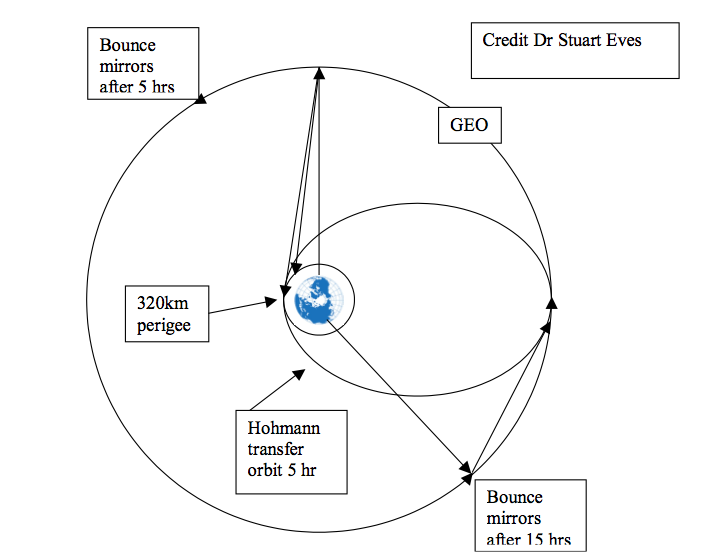
Figure 5. A mature laser boost system as envisioned by Dr. Stuart Eves, Surrey Satellite Technology. The laser stage makes 1 1/2 orbits so the mirrors will be in the correct place to circularize the orbit at GEO.
The initial design capacity of the system builds up over 8 years. At that point of maturity, it is launching 50-ton laser stages and using 8 GW of lasers (1600 modules). There are 4 sub-orbital Skylon flights an hour, less than 100 flights per day. They lift about 800 million kg per year on sub-orbital flights. Not taking the Skylons into LEO might extend their life (though it may complicate recovery). The price per kg lifted to GEO falls from an initial $750/kg (based on twice the depreciation of the Skylons and mass ratio 2 laser stages) to $50/kg. This reduction is due to the cost per flight (lower cost, higher life) and the payload at GEO rising from six t per flight to 25 t per flight due to more lasers.
For a simple financial model, we have conservatively figured net profit for power satellites (not counting transportation otherwise covered) at $1 per watt. If power satellite parts cost $600/kw, then a 1 GW power satellite would sell for $1.6 B. This is 2 cents per kWh based on a ten-year recovery of capital. (It does not include the customer’s associated rectenna.) The market for power in the 1-2 cents per kWh range is close to unlimited because of the demand for low cost synthetic oil.
The model is full of feedback loops because of the bootstrapping. When it first starts, one laser/mirror lifts the cargo of one Skylon flown once a day. That is 12 tons per to LEO and six tons per day to GEO. Two lasers/mirrors allow the Skylon to fly twice a day for 12 tons per day to GEO. More Skylon and lasers rapidly build up the cargo capacity (the effects multiply). (Missing, the cost to boost the first mirror to GEO. IOSTAR's tug may be how we maneuver it into place.)
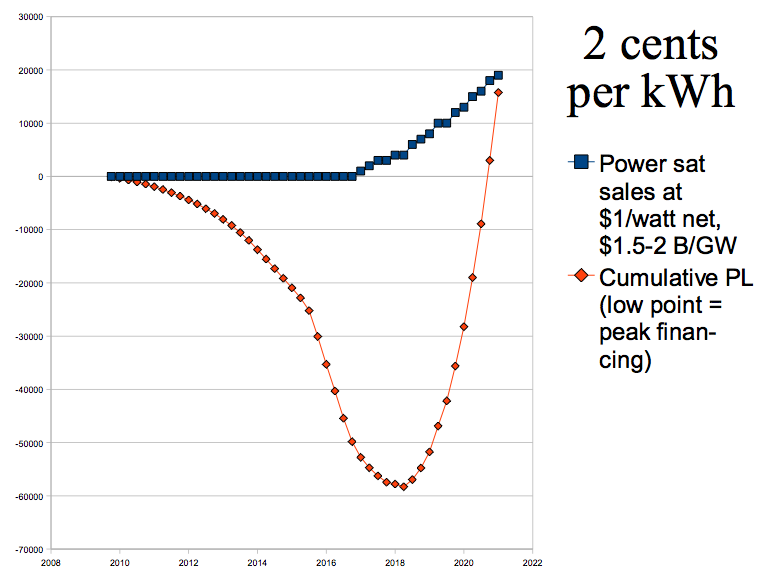
Figure 6. In this draft model the red line tracks cumulative profit / loss (in millions of dollars) each year and the black line shows annual sales - $1.5 - $2 Billion/Gigawatt. The debt bottoms out in 8.25 years at just over $58 billion dollars. That is about twice what the Chinese spent on Three Gorges Dam. For that they obtained 22 GW at a human cost of displacing 1.24 million people. Mature, this project would provide 22 GW of new generating capacity every 44 days.
At the peak investment, power satellite sales in the model are over $4B/year. Refining the model will cause this peak investment and timing to grow or shrink due to conceptual improvements, the minor items mentioned above, those cost items not yet considered and a more realistic (higher) initial sales price for power satellites.4
The current model shows repayment of the entire investment from selling power satellites only nine quarters after reaching the bottom at 8.25 years. (Interest on the capital investment has been included.) The delivery of power satellite parts and power satellite sales grows rapidly after that point.
Current world energy demand is around 15 TW. The "Manhattan Project" crash program outlined here has ~30 TW on line by 2043. World usage of fossil fuels beyond 2040 should be negligible. (Lower cost carbon neutral synthetic fuels would displace liquid fossil fuels.)
The model shows producing over four TW/year of new power satellites by 2040. Four years of power satellite production at this rate would be over 15 TW, enough to put 100 ppm of CO2 back in the ground as synthetic oil in two decades following 2040.
The proposed power satellite financial model makes considerable profit in addition to solving carbon dioxide and energy problems. How to finance it and who might finance this approach to solving the carbon dioxide and energy problems as well as potential military uses of the propulsion lasers are outside the scope of this analysis.
Notes1 The area of the earth is ~5.1 x 10¹⁴ square meters; air pressure is ~100,000 N/m2. The force would be ~5.1 x 10¹⁹ and the mass (force/acceleration of 9.8 m/sec2) is ~5.2 x 10¹⁸kg or 5.2 x 10¹⁵ t. One ppm would be 5.2 x 10⁹ t and 100 ppm would be ~520 billion tonnes.
It takes ~100kWh to remove a ton of CO2 from the atmosphere.
http://www.eurekalert.org/pub_releases/2008-09/uoc-cd092908.php
Removing 100 ppm of CO2 from the air would take 52000 billion kWh or 52,000 TWh, or since a year is about 8700 hours, about six TW years. A TW is about twice the installed power in the US.
It would take a 1000 1GW nuclear reactors 6 years to bring the CO2 level back to the level of 1960 if no new CO2 was being added.
The problem is what to do with the CO2? Liquid CO2 has a density of 1.1. As liquid, this much CO2 would occupy ~470 cubic km. It would cause a real problem downwind if it blew out of storage. We know that oil stayed in the ground for millions of years.
It takes ~50 times as much energy to convert CO2 to synthetic oil as it does to capture it. So to convert 100 ppm of CO2 to synthetic oil would take ~300 TW-years. If we are already feeding 15 TW into making synthetic oil, we could dedicate another 15 TW into making more and pumping it back into empty oil fields. It would take two decades at this rate to bring the current CO2 level back to that of 1960. We might be able to take the CO2 level down far enough to get the earth to go into an ice age (for those who like to ski).
For the details on the energy cost of making synthetic oil see www.htyp.org/dtc
2 http://en.wikipedia.org/wiki/Reaction_Engines_Skylon
3It is our economic judgment that lasers become useful when there is enough power to raise a 12-ton stage with mass ratio of two to GEO in a day. LEO to GEO is 4.1 km/sec. For a mass ratio of two, the exhaust velocity is 4,1/.69 which is ~six km/sec (ISP of only 600!). We assume multi impulse Hohmann transfer rather than spiral. Twenty-four hours is 86,000 sec.
V=at, a=v/t a 4100/86000 =~0.05 m/sec2. One m/sec2 is ~0.1 g so this is half a percent of a g.
How much mass must be blown off in one second to get 0.05 m/sec2
MV = mv where M is the current laser stage mass, V is 0.05 m/sec and m is the mass blown off in one second at velocity v, 6000 m/sec.
m/sec = 0.05M/v = 0.05m/sec2 x 12,000kg/6000m/sec
m/sec is 0.1k/sec
Ke (of exhaust) =1/2mv2
Ke = 1/2 (0.1) (6000)2 =1.8 x MJ
Laser efficiency of 30% increases this to six MJ.
Since this is over a second, the laser power to provide six MJ/sec is six MW.
The payload multiplier as a function of laser power is from this number and other work indicating delivery of 25 t of payload from a 50 t laser stage placed in a 300 km sub orbital flight.
4There may be resistance to paying a great deal more than the projected cost in a few years.
Categories: Links
DrumBeat: June 14, 2009
David Stahan: We need a stable oil price – but we're at the mercy of Opec
BP famously "doesn't do" oil- price forecasts. After 18 months in which crude has ricocheted from just under $100 per barrel to an all-time high of $147, then down to less than $40, and now up to $73 again, you can see their point.
But at the launch of its annual Statistical Review of World Energy last week, its chief executive, Tony Hayward, came close when he ventured "there is a rational argument to say that somewhere between $60 to $90 a barrel is the right sort of level". At the same time, BP continued to claim that there is no geological shortage of oil, and sought to blame the recent volatility on Opec's refusal to open up to Western investment. These arguments are wrong, partial or beside the point.
Pemex May Drill 22 Wells at Sihil Through 2012, Triple Output (Bloomberg) -- Petroleos Mexicanos, the state-owned oil company, may drill 22 wells at Sihil through 2012, tripling output at the field that is part of the Cantarell complex.
From recovery to oil price surges
Dubai: Last week Goldman Sachs' "Energy Watch" led with the headline: "As the financial crisis eases, an energy shortage lies ahead". For Goldman, the energy shortage will include a four-stage oil price rally over the period 2009 to 2010. More of that later.
For the thinking-man, experienced investor, Goldman's piece is further evidence of the sentiment now doing the rounds: global recovery will stimulate asset prices. The sub-message is: asset prices must have been at their bottom or remain at a "near-to-bottom" level. And, given the nature of the absolute historic bottoms, it leads to the question: where is the opportunity?
Aramco to speed up natural gas projects
Saudi Arabian Oil Co may speed up natural gas projects in light of growing domestic demand especially from the industrial sector, Saudi-based Al Riyadh daily reported yesterday.
Too Poor to Make the News
The deprivations of the formerly affluent Nouveau Poor are real enough, but the situation of the already poor suggests that they do not necessarily presage a greener, more harmonious future with a flatter distribution of wealth. There are no data yet on the effects of the recession on measures of inequality, but historically the effect of downturns is to increase, not decrease, class polarization.
Jesse Jackson: U.S. needs better industrial policy
We need an industrial plan that helps forge new industry and new markets. Public investment in mass transit -- buses, subways, fast rail -- and subsidies for fuel-efficient cars help generate the market. Significant investment in research and development for the next generation of products helps capture the future. Resources to retool factories and retrain workers are needed to build the new generation of fuel-efficient cars or renewable energy sources.
Making Case for Climate as Driver of Migration
NEW YORK — A new report on human migration and climate change, released as delegates from 182 countries gathered in Bonn over the past two weeks to continue hammering out some preliminary language for a new global climate treaty, made its case plainly:
“The impacts of climate change are already causing migration and displacement,” the document began, adding that by midcentury, “the prospects for the scope and scale could vastly exceed anything that has occurred before.”
Humans Intrude on Indonesian Park, Threatening Forests and Wildlife
Forest rangers have been powerless in checking development inside the park as the local authorities have urged people to settle and open businesses there.
City Known for Its Water Turns to Tap to Cut Trash
Italians are the leading consumers of bottled water in the world, drinking more than 40 gallons per person annually. But as their environmental consciousness deepens, officials here are avidly promoting what was previously unthinkable: that Italians should drink tap water.
Peak Coal, Global Warming Policy and Exponential Math
Three reports say coal is not nearly so abundant, or cheap, as we think it is.
Departments to Toughen Standards for Mining
WASHINGTON — The Obama administration said Thursday that it would toughen standards for mountaintop-removal coal mining but would not end the practice as some environmental groups had hoped.
Jon Wellinghoff, Obama’s energy futurist
When giving his slide presentation on America’s new energy direction, Jon Wellinghoff sometimes sneaks in a picture of himself seated in a midnight blue, all-electric Tesla sports car.
It often wins a laugh, but makes a key point: The United States is accelerating in a new energy direction under President Obama’s newly appointed chairman of the Federal Energy Regulatory Commission (FERC). At the same time, FERC’s key role in the nation’s energy future is becoming more apparent.
Green 'supergrid' could plug Europe into renewable power by 2030, say scientists
Europe could build an electricity supply based entirely on renewable energy by 2030, according to scientists making a presentation at the House of Commons this week.
MPs will hear that an electricity "supergrid" across Europe and North Africa could solve the problem of the intermittency of wind turbines and solar power and dispense with the need for nuclear and "clean coal" power stations altogether.
Harnessing underground energy
An underground revolution in alternative energy is heating up the industry — and it comes a 30 percent tax credit.
Caltrans goes green
A Marysville Caltrans maintenance yard will soon be greening up.
Caltrans announced plans Thursday to install $20 million in new solar energy systems at 70 of its facilities throughout the state. The installation is estimated to save taxpayers $52.5 million in avoided energy costs in the next 25 years.
Rush for ‘easiest oil in the world’
This month an Iraqi politician will appear on television to open envelopes and reveal the winners of a long and hard-fought contest. In the balance hangs the wellbeing of 28m people, tens of billions of dollars of contracts and how much you and I pay for everything from yoghurt pots to petrol.
It should make good viewing. For the hopeful contestants, it has been a long wait — since 1972 to be exact. That was when the Iraqi oil industry was nationalised and foreign operators were booted out.
Kurds lay claim to oil riches in Iraq as old hatreds flare
Sitting on vast untapped oilfields, the northern Iraqi city of Kirkuk has the natural resources to become one of the wealthiest places in the Middle East. But a standoff has developed between local Kurdish leaders and Baghdad over rights of ownership. And in Kirkuk itself, ethnic tensions are rising.
Oil prices will be driven upwards by the needs of developing nations
The "demand destruction" argument was always overdone. Across the Western world, oil demand is relatively "income inelastic", seeing as people want to get around, heat their homes in winter and keep cool in summer whether the economy is slowing or not. So Western oil use hasn't fallen that much.
But the main reason "demand destruction" is nonsense is that the populous emerging markets have, for the most part, continued to grow despite the credit-crunch. And, as more and more of their people get richer – buying cars, air-conditioners and white goods for the first time – per capita oil use in these nations is growing faster still.
Oil must reach $90 to stabilise market - Algeria
ALGIERS (Reuters) - The global oil market could stabilise if crude prices rise to around $90 a barrel and that is likely to happen in the second half of 2010, Algerian Energy and Mines Minister Chakib Khelil said on Saturday.
"A price which ensures the stability of the oil market must evolve around $90 a barrel. It should be reached between the middle and the end of 2010," Algerian official news agency APS quoted him as saying.
How Much Oil Is In The Arctic?
One way to know that the end of the Age of Oil will soon be upon us is the current excitement and chatter about going—literally—to the ends of the earth to find more oil.
The Arctic Circle, which circumscribes about 6% of the earth’s total surface, is one of the last regions of any significant size to be explored for oil, and for good reason: It’s locked in ice for much of the year, far from support and distribution lines, and is one of the most extreme environments on earth. Whatever oil and gas is extracted from the top cap of our planet will be the most expensive and difficult oil ever produced.
Interview with Nick Griffin
Why do you want to give me £50k to leave?
Because this country is the most overcrowded in Europe. To some extent I would agree with the greens that its proper carrying capacity is about 30m. Particularly with the peak oil problem – which is the real problem that politicians should be addressing and not climate change which is either nothing to do with us or nothing we can do anything about or which won't strike for another 100 years anyway – the real problem is peak oil and the implications of running out of oil for a civilisation which is built on easily available oil and the benefits it brings that this country should not have the population it has and what's more we need the most stable, homogenous population possible because anything less than that once you subject a society to the stresses of the economic impact of the crisis which is very rapidly approaching people instead of pulling together tend to fall apart.
Forget the BNP. What about the planet?
There have been two big media stories of the 2009 elections: the demise of Labour and the rise of the BNP. Both were trailed heavily throughout the six weeks of the campaign. Both have received a good deal of attention since. But behind the headlines there's another story, a story that I would suggest offers Britain rather more hope than the other two: the rise of the Green Party.
Nigerian militants say destroy Chevron oil wells
LAGOS (AFP) – Nigeria's main militant group said it had destroyed three oil wells belonging to the US firm Chevron as it continues its campaign against foreign oil companies.
The Movement for the Emancipation of the Niger Delta (MEND) said in a statement its fighters had destroyed two of Chevron's oil wells at Makaraba and the Otunana oil well in Nigeria's southern Delta state.
Secret papers 'show how Shell targeted Nigeria oil protests'
Serious questions over Shell Oil's alleged involvement in human rights abuses in Nigeria emerged last night after confidential internal documents and court statements revealed how the energy giant enlisted the help of the country's brutal former military government to deal with protesters.
Iran Calm After Vote Fraud Claims Trigger Clashes
Tehran was mostly calm Sunday after election fraud claims triggered violent street clashes, but the government maintained fairly tight control of information flow and new details emerged of arrests of high-profile reformists.
The efforts seemed aimed at avoiding a repeat of the chaos that lasted past midnight Saturday. Opponents of President Mahmoud Ahmadinejad set buses and cars ablaze in the capital and threw rocks at police to protest what they viewed as his illegitimate victory.
Attack Demonstrates Pirates Expanding Reach
DUBAI -- Pirates commandeered a cargo ship in the territorial waters of Oman, dramatically extending their area of operation and threatening for the first time shipping in and out of the oil-rich Persian Gulf.
The hijacking, reported over the weekend, took place Friday. It follows another failed attack nearby earlier last week.
Chavez's expropriation of oil service firms could spark labor unrest
CIUDAD OJEDA, Venezuela -- Despite the recent sharp rise in oil prices, Venezuelan President Hugo Chavez last month expropriated 70 oil service companies in western Venezuela, putting some 10,000 Venezuelans out of work, turning local unions against him and forcing production cuts at important oilfields.
The action has drawn little international attention because Chavez stopped short of nationalizing big U.S.-based multinationals such as Halliburton or Schlumberger that carry out technical and highly skilled work in producing oil. Nor have the owners of the 70 Venezuelan firms - in addition to four foreign-owned firms - protested publicly, fearing that doing so might jeopardize settlement negotiations with the government.
OPEC Unlikely to Raise Oil Output in September, Qatar Says
(Bloomberg) - OPEC, the supplier of 40 percent of the world’s oil, is unlikely to increase output when the group meets in Vienna in September, Qatar’s oil minister said.
“I don’t think so,” Abdullah bin-Hamad Al-Attiyah said today in an interview in Amsterdam when asked if the Organization of Petroleum Exporting Countries would need to raise production. “I would like to see where the real growth is, when the economic crisis reaches bottom and will take off again” before making a decision on oil output, he said.
Skills shortage may hit oil projects - expert
A stabilising of oil prices above $70 is likely to expose a skills shortage at Gulf national oil companies (NOCs) which could lead to “bottlenecks” in completing projects designed to ramp up capacity, according to a leading energy consultant.
Pertamina suffers Rp 15b in losses in gas depot fire
State-owned oil and gas firm PT Pertamina said Sunday it had suffered losses of Rp 15 billion (US$ 1.5 million) in the gas depot fire that happened in Makassar on Saturday.
Rosina Nurdin, a spokeswoman at Pertamina’s Makassar unit said the fire had destroyed four Liquefied Petroleum Gas (LGP) tankers and other equipment belonging to Pertamina's business partner.
Oman oil revenues drop 50% in 4 months
(MENAFN) Non-OPEC producer Oman said that it posted a 50.5 percent drop in net oil revenues in the first four months of 2009 as oil prices weakened, but raised spending by 7.2 percent, Reuters reported.
Qatar, Shell Talk on Joint Projects Outside Country
(Bloomberg) -- Qatar, the world’s biggest exporter of liquefied natural gas, is in talks with Royal Dutch Shell Plc to jointly invest in oil and gas projects outside the country, Qatar’s oil minister said.
Bartlett's 'eccentricity' is an acquired taste
Bartlett, says the Sun, is "regarded as eccentric" by his fellow Republicans. Let that statement sink in for a moment. In a party currently defined by the level-headed likes of Newt Gingrich and Rush Limbaugh, if you're considered eccentric, you must be on one of Jupiter's moons.
But Bartlett begs to differ. The reason he was passed over has nothing to do with his peak-oil rants before an empty House chamber, or statements made through the years, including the assertion that not enough science fair winners have "normal names."
No, the reason is he does not raise gobs of cash for GOP fundraising efforts. In a statement, he wrote: "Not for the first time, big-state and big-money politics trumped experience, independent judgment and dedication to the legislative work of a committee."
Study: Harnessing of oil shale could aid energy solutions
BOULDER, Colo. — The University of Colorado's Center of the American West released an online report Friday that examines the extensive history of oil shale and aims to "bring an impartial perspective to the debate" over its future.
World Bank withdraws loan to Brazilian cattle giant
Sao Paulo, Brazil — The International Finance Corporation (IFC), the private lending arm of the World Bank, has withdrawn a USD 90 million loan to Brazil's cattle giant Bertin. The loan was used for the company to further expand into the Amazon region, which was causing destruction of the rainforest and fuelling global climate change.
US, Canada to update Great Lakes water agreement
NIAGARA FALLS, Ontario – The United States and Canada say they will update a key agreement to protect the Great Lakes from invasive species, climate change and other established and emerging threats to the world's biggest surface freshwater system.
Secretary of State Hillary Rodham Clinton said Saturday that the Great Lakes Water Quality Agreement, which was last amended in 1987, is no longer sufficient.
Australia demands bushfire exemption in carbon treaty
Peat bogs in Germany, New Zealand firs and North American forests will likely allow industrialized countries to lower carbon emissions while still burning coal and oil, according to a draft United Nations document.
Australia is demanding that emissions from natural disasters, such as bush fires, not be counted in its tally.
Met Office predict likelihood of climate change on your doorstep
The most detailed set of climate change projections ever produced will show the risks of sea level rise, droughts and floods in Britain over the next 80 years to within 16 miles of your front door.
Korea moving toward a subtropical climate
Global warming has increased temperature and precipitation and widened regional and seasonal weather differences on the Korea Peninsula, changing it closer to a subtropical climate, the state meteorological agency said yesterday.
The Korea Meteorological Administration yesterday released its analysis on climate change that occurred for the past 10 years.
White Rooftops May Help Slow Warming
Chu has brought increased attention to an idea that -- depending on your perspective -- is either fairly new, or as old as Mediterranean villages, desert robes and Colonel Sanders's summer suit. Climate scientists say that the reflective properties of the color white, if applied on enough of the world's rooftops, might actually be a brake on global warming.
But if anybody is seriously considering a global whitewash, "simple" and "immediate" are probably not words that come to mind.
"I don't think that it could ever be done at a sufficient scale," said Ken Caldeira, a climate scientist at the Carnegie Institution in Stanford, Calif. He added: "It's hard enough, in many of the cities of the world, to keep the streets swept, much less to keep the city reflective."
Categories: Links
The Dubious Lawsuit against Chevron in Ecuador - Part 1
[Editor's note by Super G] The Oil Drum staff consists of a diverse set of voices. The story that follows is one staff member's perspective. Other perspectives on this case may be posted in the future.
Recently, a fraudulent lawsuit against Dole was dismissed. According to the WSJ,
Court cases get dismissed all the time, but rarely are dismissals as significant as the two lawsuits against Dole Food and other companies that were tossed recently by a California judge. Among other good things, the ruling is a setback for tort lawyers who troll abroad seeking dubious claims to bring in U.S. courts.
The allegations against Dole, the world's largest fruit and vegetable producer, involved banana plantation workers in Nicaragua who alleged that exposure to the pesticide DBPC in the 1970s left them sterile. The only problem is that most of the plaintiffs had not worked at plantations and weren't sterile. In fact, there's no evidence that farm workers at Dole facilities were exposed to harmful levels of the chemical -- which was legal and widely used at the time -- or that the level of exposure they did experience even causes sterility.
I recently visited Ecuador, as a guest of Chevron. Based on what I learned during that visit, it seems to me that the suit against Chevron has a fair number of similarities to the Dole suit. In this post, I will explain why I think the Chevron case is as dubious as the Dole case.
The Chevron case has gotten widespread publicity in the US, as a result of publicity by the Amazon Defense Front, or, as it is known in the US, the Amazon Defense Coalition. If the plaintiffs win the case, the Amazon Defense Coalition (ADC) will be the recipients of any monies awarded. This is a photo of members of the ADC, assisting the allegedly "independent expert" in gathering soil samples for testing for the court. The independent expert is not in the photo shown below, although he is present in others in the series.
Figure 1. Click here for PDF with 18 similar photos

It seems to me that the Amazon lawsuit is filled with myths, misunderstandings, and out-and-out lies. Here are a few I have run across.
Myth 1. Pablo Fajardo, winner of the CNN hero award in 2007 and Goldman Environmental Prize is lead lawyer for the plaintiffs in the suit against Chevron.
It is certainly true that Pablo Fajardo is a lawyer for the case. Pablo Fajardo became a lawyer in 2004 after completing a correspondence law degree, and this is his first case ever. The question is whether he is really has been "spearheading the legal team for the plaintiffs for several years" as the article describing the Goldman award says, or is just a puppet, with other more experienced lawyers really in charge.
Who would these other lawyers be? The original lawyer when a similar case was brought in the US in 1993 was Cristóbal Bonifaz, a native Ecuadorian whose grandfather was president of the country in the 1930s. He is no longer on the case, but he was one of the leading lawyers when the case was first filed against Chevron in Ecuador in May 2003.
Another lawyer for the plaintiffs is Steven Donziger of New York. In a recent letter to the Econmist Magazine, he bills himself as "Lawyer representing Amazonian communities in legal action against Chevron". He has also been involved with the current suit in Ecuador since it was filed in 2003.
According to this article, Donsiger enlisted the help of the Philadelphia law firm of Kohn, Swift & Graf, which specializes in class-action suits. We also read on Kron, Swift, & Graf's web page:
Figure 2. Image from Kohn, Swift, and Graf website
So, in 2007, which is about the time when Fajardo was getting these awards, Kohn, Swift & Graf considered themselves "one of the lead plaintiffs' council" in the Amazon litigation.
We find others involved in the case as well. According to a July 2008 Newsweek article:
Just recently, Donziger and other trial lawyers in the case retained their own high-profile D.C. superlobbyist, Ben Barnes, a major Democratic fund-raiser. And they have tapped a capital connection that may pay off even more. Roughly two years ago, when Donziger first got wind that Chevron might take its case to Washington, he went to see Obama. The two were basketball buddies at Harvard Law School. In several meetings in Obama's office, Donziger showed his old friend graphic photos of toxic oil pits and runoffs. He also argued strongly that Chevron was trying to subvert the "rule of law" by doing an end run on an Ecuadoran legal case. Obama was "offended by that," said Donziger.
So there seem to be all kinds of high-profile folks involved in the case. We know that Ben Barnes is being paid by Kohn, Swift, & Graf, because his lobbying registration indicates that that is his employer.
Was Fajardo, on his first case after completing correspondence school for a law degree in 2004, really in charge? Maybe, maybe not.
Myth 2. The death of Pablo Fajardo's brother in 2004 was in some way connected to Texaco or Chevron.
These are a couple of typical quotes:
"In my case, in 2004 when we were starting the case, one of my brothers was killed. I cannot say Texaco is to be blamed for this, and neither can I say the opposite. This was never investigated. There have been a lot of things, a lot of pressure and persecution.” -- Pablo Fajardo, Ecuador TV, April 22, 2008
Fajardo affirmed that “in these 15 years we have received a lot of pressure, starting with threatening phone calls, and campaigns to damage the professional reputation of experts defending the FEDAM’S cause. Undoubtedly the most dramatic experience of these clashes is the death of Pablo Fajardo’s brother eight days prior to the beginning of the oral proceedings in this case. “I cannot prove Texaco was behind this, but the truth is my brother was killed,” said Fajardo. – Europa Press (Zaragoza), September 3, 2008
The death of Pablo's brother Wilson Fajardo most certainly has been investigated. There is no evidence whatsoever that Texaco was involved. Instead, it seems to an "execution" by FARC, related to drugs and the theft of "white gasoline" from pipelines for use in cocaine preparation. His brother was tortured and shot in the head at close range.
This is the complaint filed by Pablo Fajardo with the police at the time of his brother's death. At no point in the complaint does he mention Texaco. Instead, he asks that the friends who his brother had been drinking with that night be taken into protective custody.
This is an editorial from El Commercio talking about the 20 FARC deaths by hired assassins in the past year, which mentions Wilson Fajardo. He was a journalist working for Radio Ecuador, and seems to have offended FARC by talking about the link between drug trafficking and the theft of white gasoline.
There are numerous other documents available with respect to this case. These are a few (1, 2, 3, 4, 5, and 6 ). There are additional documents that are too large to be loaded on this server, including the forensics report, the police report, and the prosecutors' report. E-mail me at Gail Tverberg at comcast dot net if you would like these.
Myth 3. Chevron or Texaco has been harassing or intimidating Pablo Fajardo through threatening phone calls and break-ins to their office.
If the story of the death of Pablo's brother could be worked into an endless anti-Texaco publicity stunt, why not carry the whole process one step further? Accuse Texaco of threatening phone calls and break-ins. No one would ever be able to check these out. Letters to high level human rights organizations would be particularly impressive. According to an email I received from a contract at Chevron:
It is the same with their other public accusations [besides Wilson Fajardo death], which include attempted kidnapping and robbery, throughout this trial. In fact, in many of those purported cases they have not bothered to file police complaints, so there is actually no investigation. Instead, they have gone to the media or to international human rights groups with the sole intention of making false accusations to create the appearance of persecution without actually enduring any persecution whatsoever.
In each case that has been investigated you will find enormous holes. The robbery of computers, which they initialy blamed on Chevron personnel, were carried out by members of the FDA against their own technical team because their expert refused to submit a false report during the Judicial Inspections. The alleged "kidnapping" attempt against one of their family members was in fact a botched buglary attempt completely unrelated to the case, according to police who later investigated the incident. In this case, there actually was an investigation and we have the police report we can show you. Again, no mention of Chevron or anyone associated with Chevron.
While I don't have direct evidence to show that all of these allegations are false, I think one should categorize the statements regarding harassment as myths, unless Fajardo or the ADC can produce evidence to back them up.
Why would Pablo Fajardo and the ADC be so eager for favorable publicity? I think at least part of the reason is because they want the public to donate to their cause. They are collecting donations on their US web site. They are even offering tax receipts, suggesting that their activity is sanctioned by US tax officials. I wonder where their money is really going (pay US lawyers, pay US lobbyists, pay to "educate" journalists on their story, pay the "unbiased expert" in Ecuador), and who is auditing it. The ADC is a Non-Government Organization based in Ecuador.
Myth 4. When Texaco came to Ecuador, it had a huge negative impact on the lives of the people of Ecuador.
Texaco was granted a concession to look for and develop oil in Ecuador in 1964. Its first discovery of oil was in 1967, and oil began flowing about 1970.
Figure 3. Ecuador oil production, based on EIA data. Includes all companies producing oil in Ecuador, so in later years includes more than TexPet and Petroecuador.
Figure 3 gives show the history of oil production in Ecuador. Texaco (or really Texaco's subsidiary Texaco Petroleum, abbreviated "TexPet") started oil production about 1970, and by 1973 had ramped production up to the production plateau of about 200,000 bpd for the particular fields it developed. By 1976, the government of Ecuador through its company Petroecuador had taken over 62.5% owner of the consortium, and TexPet became minority owner with 37.5% ownership. After 1990, TexPet had 0% ownership of the consortium. Thus, TexPet's influence was greatest in the "blue" period, declining in the "red" period, and out by the "green" period.
So how did the people of Ecuador fare when TexPet began production?
Figure 4 Site Pozo Sacha 53 in 1975, after TexPet completed its physical infrastructure

Figure 4 shows an areal photograph of one of the well sites, taken in 1975, after production was ramped up by TexPet. As one can see, the footprint is very small. The surrounding land is still virgin forest. It is hard to see why the infrastructure by itself would have had huge impact on Indians living nearby.
Figure 5 Site Pozo Sacha 53 in 2001, after the government completed its resettlement to develop agriculture in the area

Figure 5 shows the same area, after the government of Ecuador completed its community resettlement plan. Families were given 50 hectacre (124 acre) plots to farm, with the requirement that they clear the trees on at least half of the land. The families moving to this land were farmers, not workers in petroleum fields. This activity was much more disruptive to native peoples than the oil drilling.
Life expectancies have risen dramatically over the years, and are now very close to US life expectancies. According to IndexMundi, the 2008 life expectancy at birth is estimated to be 76.81 years. The corresponding US life expectancy is 78.14 years.
If one looks back, there has been a huge improvement in life expectancy. According to Globalis, the life expectancy for men in Ecuador was 50.1 years in 1960; 55.4 in 1970; 59.7 in 1980 and 64.7 in 1990. If oil production was having a terribly detrimental impact on life expectancy, it is hard to see it from the data.
Myth 5. The pits shown on television and featured in magazine articles are Chevron's responsibility to remediate.
ADC has been taking reporters on tours and giving them the impression that the pits they are showing them are Chevron's responsibility to clean up. In every instance I am aware of, the pits that have been shown are those that are Petroecuador's responsibility to clean up, rather than the responsibility of Chevron.
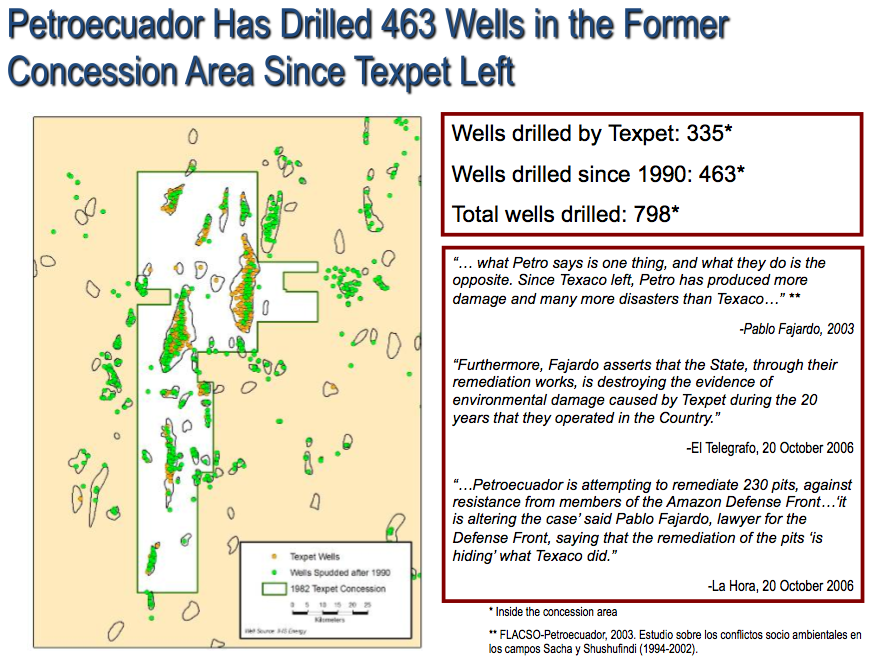
On the map above, the wells drilled prior to 1990 are shown in brown; the wells drilled subsequent to 1990 are shown in green. Since Chevron and TexPet had nothing whatsoever to do with the wells drilled since 1990--the green dots--there is no way the pits associated with these wells are Chevron's responsibility.
With respect to the pits associated with the brown dots, a Remediation Action Plan was developed in 1995, overseen by Petroecuador and the Republic of Ecuador. TexPet was assigned its share of the pits (about 37.5%, based on its participation in the consortium). TexPet remediated the pits it was assigned. The remediation of these pits took three years (1995 to 1998) and cost $40 million. Each of the pits was signed off individually. When the overall group was completed, TexPet was given a document releasing it from further liability. This is an English-language version of the document--the Spanish version was what was actually signed.
Petroecuador was still using many of the pits it was assigned, so elected not to clean them up at that time. It has since started the clean-up. Petorecuador posted this advertisement in a newspaper 2006, indicating it was looking for workers to work on its assigned brown dot sites.
Figure 7 Petroecuador Advertisement for Workers to Clean Up Assigned Sites - (Click for larger image)

When I was visiting in Ecuador, I had the opportunity to see a number of pits--some cleaned up by TexPet and some assigned to Petroecuador. The sites that TexPet had cleaned up were pretty much invisible.
Figure 8 Cattle grazing on one site cleaned up by TexPet in 1995- 1998

Figure 8 shows one site which had been cleaned up, and now had cattle grazing on it. We saw others as well--one pit was remediated to a palm oil plantation and another had been remediated back to rain forest. The type of remediation for each pit was determined by the needs of land owners. Without geographical coordinates to tell where the pits had been there, it would have been impossible to detect where the former pits had been.
Figure 9 - Unremediated sitefrom pre-1990 (Petroecuador's responsibililty to clean up)

We also had the opportunity to see an unremediated pit that dated from 1990. It was a site that had been assigned to Petroecuador to clean up. Petroecuador had chosen not to continue using the site, but had also failed to clean it up. In the 19 years since 1990, any volatile hydrocarbons had long since vaporized. What was left looked very much like asphalt. We threw a large stone so it hit the surface. It simply landed on top of the asphalt-like substance. We did not try to walk on it because we did not have boots, and did not know if there would be a spot that would not hold our weight and would have water underneath. We heard that others had walked on top.
Clearly neither of these types of sites would be helpful to the cause of the ADC for showing journalists. So what did the ADC do? It found pits that Petroecudor had been using more recently, and had not cleaned up. The journalists didn't know any better, and fell for their story. That is why one sees all of the photos of yukky looking Petroecuador pits in all of the journal articles and television articles about the lawsuit against Chevron. I expect the photos Ben Barnes showed Obama were also of recently used Petroecuador pits, that he represented as Chevron's responsibility to clean up.
Figure 10 Site where Petroecuador workers were cleaning up assigned pit
We also stopped and talked to Petroecuador workers at a site they were cleaning up. We asked them questions about how far out from the pit it was necessary to dig to get all the hydrocarbons, and about their general technique. Everything we were told indicated that they were using exactly the same clean-up technique that TexPet had used in 1995 to 1998, that ADC is now criticizing.
- - - - - - - - - - - - - - - - - - - - - --
I will have to finish the rest of the story later. There is at least this much more to tell, but the post is getting too long, and web page would never open if I kept adding graphics to this page.
Categories: Links
Right Sizing the Economy: Can Herman Daly's Prescription for a Steady State Economy Accomplish this Task?
This is a guest post from RogerK, a hardware engineer from San Jose California who thinks and writes about the finite world paradigms which will be needed to replace the 'no limits' paradigm which exists as the cultural norm of modern industrial society. Tonights post expands on a comment he made in last weeks guest essay from Herman Daly on a Steady State Economy. Roger previously has written a related essay on TOD here, and a follow up here.
Right Sizing the Economy: Can Herman Daly's Prescription for a Steady State Economy Accomplish this Task?TOD recently published the text of a speech delivered by economist Herman Daly at the United States Society for Ecological Economics bi-annual conference (at American University near Washington DC). About half of this speech was dedicated to making the case for limits to economic growth, a subject on which Daly has written eloquently for years, most notably in his book Steady State Economics[1]. The second half of the speech was dedicated to presenting proposals for economic reforms which would keep in check the destructive tendencies of an economic system which is always trying to maximize short term income.
I am glad to see an economist with Herman Daly's credentials banging the drum for limits to growth. I read Steady State Economics several years ago, and I very much enjoyed Daly's debunking of the "growth men" as he refers to the conventional economists who insist that neither supplies of natural resources or of ecosystem services will put any limits on human economic expansion in the foreseeable future. I particularly like his description of "the myth of the angelized GDP"[2] in which it is claimed that the flow of dollars will increase exponentially forever, purchasing a continually increasing quality of life without requiring any increase in the throughput of materials and energy.
However, I found his proposed fixes to the growth problem to be less than convincing. It is clear that Daly has not stood still in the years since the original publication of Steady State Economics, and the reform proposals presented in his recent speech are more sophisticated and more well thought out than those presented in the earlier book. Nevertheless I am still unconvinced that the proposed reforms would be effective even if the political will to carry them out came into existence.
Daly presents a vision of a regulated, controlled, rationalized version of private finance capitalism. In my view this prescription for a steady state economy is addressed to the symptom of our problem rather than to the underlying fundamental cause. The symptom is that we strongly desire to use resources in a way that will maximize our current exchange income in dollars. The underlying cause is the structural emphasis of our economic system on the atomized accumulation of private financial wealth as the primary route to security and status for individuals and nuclear families.
Daily's vision of a steady state economy leaves in place the primary structures of our current economic system (e.g. capital markets, interest based banking, private savings, etc) and then proposes to control their destructive and depletionary tendencies by a series of rules and regulations. I am extremely skeptical about the potential for success of such a strategy. Yes, a cap and trade system and ecological taxes will work against the destructive tendencies of private finance capitalism, but the political pressure to let us go hammer and tongs after whatever resources will maximize our dollar income in the short term will be enormous and unrelenting. Conservative banking will prevent financial bubbles, but it will not alleviate the desire to squeeze as much short term growth out of the system as current resource flows allow.
I think that much more radical changes than those envisioned by Daily are required in order to create an ecologically sane economic system. I think that we should create an economic system in which we are attempting to minimize our current exchange income in dollars, consistent with the constraint of producing adequate levels of total income including psychic components. The psychic component of our income needs to be largely decoupled from the formal economy as measured by transactions in large scale exchange media like dollars.
The question of how to accomplish such a goal is a complex one. Maybe the often repeated claim that it is not culturally/genetically possible to create such a society is correct. However, I think that some structural features required to make such a society work are clear whether or not one believes that they can be implemented in practice.
First of all community finance is required. Clearly we need to go on investing in infrastructure. But if we wish to avoid a growth orientation, then the purpose of building such infrastructure should be to preserve the long term productivity of society and not to increase the stash of private financial investors. The return on such investment should be the goods and services produced and not excess purchasing power for people who already have excess purchasing power.
Secondly, mutual support has to be clearly and explicitly recognized as the normal path to long term material security. Of course mutual support is already an objective fact. Aside from some bags of flower or rice in your basement, private savings are largely a delusion. Land is sometimes referred as the most substantial and secure of all stores of value. But in point of fact land, in and of itself, is not a store of value. Suppose that you were a feudal land owner with vast estates, warehouses full of grain, fields full of sheep and cattle, dense woodlands, etc. One day you wake up and every human being besides yourself has vanished from the face of the earth. You are rich no longer. Within a comparatively short time your grain stores will be depleted by rodents and rot, and even in the meantime you will have to chop your own wood, haul your own water, grow and harvest your own vegetables, clean and repair your own dwelling etc. So called private stores of value are merely claims against the output of the economic community.
The only real store of value is the built up infrastructure of society, including, crucially, the skill and knowledge of the men and women who are the brains and hands of that society, and in the sustainable resource base which supports that infrastructure. In your prime working years you are supporting the aged and the sick, and when sickness or age reduces your productivity you will be supported in your turn by those who are still in the prime of their productivity (again I am speaking of objective physical fact, not of religious or political ideology). We need to create a society in which people who put their shoulder to the wheel, in however humble a capacity, and help to maintain the productivity of the community can have confidence that they will supported in their hour of need independent of the size of their private financial stash. If such mutual trust cannot be achieved outside of groups of a hundred or so people, then it is hard to see how large scale civilization can attain to long term stability in finite world.
Obviously I am not presenting a practical political program for achieving such objectives, but here are some questions to be considered by anyone hoping that new economic paradigms can ultimately be established.
1. What mechanism(s) should be used for community finance?
One possible answer, of course, is the Politburo and the five year plan. The often made claim that no other possible mechanisms exist strikes me a displaying an incredible poverty of imagination. The Chilean state copper company CODELCO has existed as a highly profitable enterprise for three decades, and I see no reason for comparing its operation to that of a Stalinist tractor factory.
2. What levels of organization of community finance should exist (e.g. village, bioregion, province, nation-state, international, global)?
In giving the example of the Chilean state copper company I did not mean to imply that I think that economic organization should all be concentrated at the level of the nation state. However, if we are not going to return all the way to neolithic technology some amount of specialized large scale manufacturing will be required and the financing decisions concerning such infrastructure should be made by the larger communities that are being served by these forms of manufacturing.
3. What specific mechanisms should be used to make it clear to everyone that a stable, right sized economic community is the real source of our long term security rather than private financial stashes? I have discussed this issue in more detail here.
4. If atomized wealth accumulation by individuals and families is abandoned as the driving force behind economic activity how can efficiency and productivity to be encouraged and rewarded?.
This discussion of this question would lead into a long and complex essay by itself, but I would like to point out one aspect of a possible answer. In a world in which continuous wealth accumulation has been abandoned as a goal one reward of greater efficiency/productivity is greater freedom. In your personal life the less time you spend cleaning, painting, repairing your personal property the more time you have to engage in more fulfilling activities. In our collective economic life the more efficiently we provide ourselves with essential products and services, the more toys we have to manufacture in order to make sure that everyone has a job. Long before I had any particular worries about peak oil this feature of private finance capitalism struck me as colossally stupid.
The task we are faced with is intelligently right sizing the economy. Today this task is virtually impossible because the perception of individual economic actors is: The more my business/ salary/ bank account/ investment portfolio grows, the better off I am. This simple perception is the driving engine behind the growth machine. We need to replace this perception with a new one: If I do my part to create and support a right sized economy (in however humble a role) I know that I will receive the wherewithal for a decent quality of life, and I can have confidence that in an hour of need the right sized economy that I helped to create and support will support me.
This task may appear impossibly difficult, but it is really the only game in town. If we cannot accomplish it then we are stuck with the doomer/cornucopian dichotomy.
[1] Daly, Herman. Steady State Economics. Washington D.C.: Island Press 1991.
[2] A Catechism of Growth Fallacies (Chapter 5 of Steady State Economics) can be found on line at: http://www.dieoff.org/page88.htm
Categories: Links
Floating Offshore Wind Power Update
I did a post last year on the potential for floating offshore wind power, which looked at a number of different prototypes at various stages of development.
StatoilHydro and Siemens have made some progress on their pilot project, installing the world's first large-scale floating offshore wind turbine off the coast of Karmøy, Norway. The 2.3 MW Hywind (see the link for a set of videos on the turbine being deployed) was built at a depth of 722 feet and will be tested over the next two years.
StatoilHydro is investing around NOK 400 million (US$62 million) in the pilot and related research and development. Enova SF, a company whose aim is to promote the transition to environmentally friendly energy use and energy production in Norway, has contributed NOK 59 million (US$9 million) in support for the project.
[break]
The New York Times has a brief report on this - Wind Farming in Deep Waters.
Most existing offshore wind turbines are mounted firmly to the seabed. Now StatoilHydro of Norway and Siemens of Germany are installing what they say is the world’s first large-scale floating turbine to exploit the potential of the technology in deep waters.
Building foundations to attach turbines to the seabed becomes expensive at water depths of more than about 50 meters (164 feet), according to the companies. That has limited large-scale exploitation of offshore wind power, particularly in countries with little or no shallow water near the coast line, they said.
Expansion near coastlines can also be difficult because of restrictions on construction in fishing grounds and bird migration zones. And an advantage of building on the high seas is that winds are stronger and more consistent than near the coast. ...
The new turbine is designed to be suitable for installation in water depths between 120 and 700 meters (394-2,297 feet), allowing them to be “placed much more freely than before,” said Henrik Stiesdal of the wind power unit at Siemens. ...
Siemens is supplying the turbine, which will start delivering electricity in mid-July. StatoilHydro is providing the floating structure with a center of gravity deep below the water surface to reduce bobbing. That structure would then be fastened to the seabed by three anchor wires. Even so, the companies have developed an “advanced control system” to take “advantage of the turbine’s ability to dampen out part of the wave-induced motions of the floating system.”
Categories: Links
DrumBeat: June 13, 2009
US Gas Hydrates Find Has Worldwide Implications
In a 21-day expedition led by Chevron, DOE's National Energy Technology Lab (NETL), the US Geological Survey, the Minerals Management Service, in addition to a host of other industry experts, the most prospective gas hydrates reservoirs yet found have been located and drilled.
"Gas hydrates for a long time have been the most elusive and confounding of hydrocarbon deposits to find," said Dan McConnell, vice president of AOA Geophysics, one of the companies selected for the site selection committee. "This is the very first time that thick hydrates accumulations have been drilled by design, that those hydrates were where they were predicted to be."
Mexico State Oil Co Optimistic on Two Largest Fields Mexico's state oil company has a sunnier outlook for its two largest fields, thanks to remediation programs to squeeze as much oil as possible from the crude-laden waters of the Campeche Sound, Petroleos Mexicanos executives said at an oil conference Thursday.
Pemex Expects Budget Increase Request to Be Approved
(Bloomberg) -- Petroleos Mexicanos, Mexico’s state oil company, expects the country’s government to approve a request for 20 billion pesos ($1.5 billion) in extra financing to help it pay for oilfield investments after the peso plunged.
The financing will allow Pemex, as the Mexico City-based company is known, to help fund $19.5 billion in capital expenditures this year as it seeks to offset the fastest drop in output since 1942, Carlos Morales, director of exploration and production, said today at a conference in Veracruz.
Calderon: Pemex Must Be Freed From “Ideological” Prejudice
MEXICO CITY – Mexican President Felipe Calderon said state oil company Petroleos Mexicanos must be freed from political and ideological “prejudice” and from interests that have prevented it from remaining in the vanguard in terms of technology and investment.
Petroleos Mexicanos will struggle with oil rate even with new water removal facilities
The fundamental problem with Cantarell is that it has a bottom water drive on one side of the field. On the other side the bottom is impermeable. Bottom water moving up structure drowned the pay zone causing the loss of reserves. Discovered in 1976 and placed on production in 1979, crude oil production peaked in 1981 at 1.156 million bbl/day from 40 flowing wells. Production was then stabilized at 1 million bbl/day by drilling more wells. In 1995 production/well had fallen to 7,000 bbl/day and 150 wells were required. Pemex then installed gas lift which allowed production to rise to 1.4 million bbl/day in 1999. But reservoir pressure continued to decline.
Emirate must decide whether oil partners are worth keeping
The production of oil in Abu Dhabi has always been a group effort.
International oil companies such as Shell and ExxonMobil deploy engineers in the emirate’s oil fields and help build the pipes and wells that generate the country’s wealth, in return for minority ownership stakes in subsidiaries of the Abu Dhabi National Oil Company (ADNOC).
But the Government faces a momentous decision as the expiry of concessions that form the basis of those partnerships nears: should it stick with modified agreements or abandon the international partners altogether?
Oil Explorers in Nigeria Raise Alarm over Safety of Facilities
Oil explorers under the aegis of the Society of Petroleum Engineers (SPE) in Nigeria have expressed concern over the vandalism of oil facilities in the Niger Delta region, the News Agency of Nigeria reported on Thursday.
Bayo Ojulari, the SPE's chairman, was quoted as saying the destruction of the oil facilities by militants would adversely affect development in the region.
IPAA still leading the charge against policies harmful to oil and gas interests
With the arrival of the Obama administration, a solid and somewhat hostile Democratic majority in Congress, and low commodity prices, US oil and gas producers have entered a challenging period.
Chesapeake CEO defends $75-million bonus
The chief executive of Chesapeake Energy CHK-N, under fire for taking a $75-million (U.S.) bonus while the company was losing billions, defended his leadership at one of the nation's largest natural gas producers.
Jeff Rubin: Warming up to carbon tax
Efforts in the developed world to restrict and replace coal-fired capacity seem downright quixotic when juxtaposed against China's (and other developing countries') coal-expansion plans. Whatever reduction in greenhouse gas emissions is achieved in the world's developed economies from switching away from coal will simply be overwhelmed by the increase in emissions from new coal-fired plants in China and the rest of the developing world.
Saving the world is a noble motive for going green. But there is another compelling reason to want a carbon-abatement regime in place as soon as possible. It is called good old-fashioned naked economic self-interest. If we can't agree to save the world for someone else's benefit, we might as well do it for our own.
Maker Of 'Fuel' Documentary Promotes Algae Energy
For documentary film maker Josh Tickell, it's all about algae.
The micro organism's potential to deliver America from its dependence on foreign oil receives a big chunk of screen time in Tickell's movie "Fuel," which goes into national distribution this fall after winning awards at the Sundance Film Festival and others.
"Algae is the next step," said Tickell, who visited New York to receive the honor of Goodwill Ambassador from the United Nations. "We have to get away from propagating a system that's undermining the U.S. economy."
Please Take Your Seats Ladies and Gentlement, the Online Screening of ‘In Transition’ Starts Now…
The film ‘In Transition’ is now available for viewing, for the next 72 hours. The version being screened is not the final version, it still has a sequence to add and some tidying up to do, but is almost there. We very much hope you enjoy it (you will need Quicktime on your computer)….
Indigenous 'genocide' in battle for oilfields
Across the globe, as mining and oil firms race for dwindling resources, indigenous peoples are battling to defend their lands - often paying the ultimate price.
"Peru Oil Standoff" - Richard Heinberg interviewed on CBC The Current
Richard Heinberg was interviewed on CBC radio in "Peru Oil Standoff", a segment of the CBC daily show The Current.
Chevron confirms damage to Nigerian oil pipelines
ABUJA (Reuters) - U.S. oil major Chevron confirmed one of its Nigerian oil pipelines was damaged on Friday in the Niger Delta, but output was unaffected as the infrastructure had been shut down before the incident.
The Movement for the Emancipation of the Niger Delta (MEND) on Friday said it attacked the Chevron pipelines and threatened to sabotage another facility operated by the U.S. oil company.
Total says 1,200 workers walk out at UK refinery
LONDON (Reuters) - France's Total said on Friday that 1,200 contractors have walked out on unofficial strike over planned redundancies at its British Lindsey refinery.
Total said in a statement that 600 workers were protesting outside the refinery, but production was not affected.
Surreal goings on in the commodities show
When markets look like a surreal comedy, turn to Monty Python. Try to explain current goings on in the commodity market and two sketches might help.
Contours of Crisis III: Systemic Fear and Forward-Looking Finance
By the middle of 2002, the crisis finally ended. Earnings staged a massive, V shaped recovery and, over the next five years, rose by nearly 350%. And yet, despite the surge, capitalists still found the future hard to envisage. The earnings boom certainly was real enough—but so were its limits. In the United States, the national income share of corporate profits was hitting record highs, so the prospect for further redistribution in favor of capitalists seemed increasingly dim. And those who pinned their hopes on “real” growth were running into doomsday scenarios of “peak oil” and “climate tipping.”
With the future looking disheartening at best, capitalists preferred to keep their eyes on the past. Share prices started to rise only in October 2002, a full six months after the earnings upswing began, and they continued to increase in tandem with profits (albeit at a lower rate) for the next five years.
And then all hell broke loose.
Your life is awash with oil
Oil is filthy old stuff that causes nothing but pollution all the way through our use of it, but why, oh why do we keep going back for more. Pretty simply, we’re addicted. Whether it is good for us or not, and in the long term it undoubtedly is not, we are so totally addicted to the stuff that your life would not last more than a few days without a continuous stream of it being fed into your lifestyle.
The five horsemen of our apocalypse
We're trained in school and business in linear-rational engineering thinking. Focus on one problem at a time. Find a solution to it. Don't look at externalized costs or the connectedness between things, because that's hard to put numbers on and doesn't help who is paying for the answer.
That isn't how things really work. Every real problem has multiple, intertwined causes, and needs multiple, intertwined solutions. Every real solution also solves multiple problems. Real economics has no bottom line. That's linear thinking, and puts out of our sight all the secondary costs and problems and linkages that always occur.
There are at least five major players in the transition we're in. They all interact - wildly - and all need to be tracked at the same time.
The best time to read chilling fiction and non-fiction is during the long, hot summer
Some books represent their worlds as so dark and bleak that the best (or perhaps the only good) time to read them is in the middle of summer, when their chilling presentation can easily be countered by a pleasant walk outside in the blazing heat.
The Hundred-Octane Vision of Freedom - Hey, Bob Lutz and GM, can you make my nine-year-old love a thundering V-8 more than the environment?
But frankly — and I love him like I love nobody and nothing else in the world — the lectures get obnoxious. He sees no contradiction in mooning over a million-buck road rocket and worrying about global warming and peak oil. When it comes to our cars — an Accord and an Element — what matters to him are miles per gallon, reliability, safety, and resale value. All he's ever known are Consumer Report-beloved imports.
Shell’s Cellulosic ‘First’ Is More of a Second
Much fanfare attended the arrival in Ottawa earlier this week of Luis Scoffone, Royal Dutch Shell’s vice president of biofuels. Mr. Scuffone flew in from England and descended, along with John Baird, Canada’s transport minister, on a large Shell station at Merivale Road — an undistinguished avenue of strip malls and big box stores.
It was here, at a single pump, Shell said in a news release, where customers could become “the first in the world to fill their tanks with gasoline containing advanced biofuel made from wheat straw.”
That was news to MacEwen Petroleum, however — a small regional service station chain based in Maxville, Ontario.
We must stop overfishing now to save our empty oceans
The hammour of the Arabian Gulf and the North Sea cod have an unenviable thing in common. They are both down to around three per cent of their former abundance and rank among the third of the world’s fish stocks that scientists consider to have collapsed. If the Arabian Gulf or the North Sea fell within United States jurisdiction, they would be declared fisheries disaster areas and spawning areas, and vital habitat would be closed by law to commercial fishing.
But neither the North Sea nor the Arabian Gulf is managed in the cutting-edge way that the United States now manages some of its domestic fisheries – which has come about as a result of a healthy enthusiasm among environmental bodies for using the law to sue the authorities. (The other side of the coin is that 70 per cent of fish the US now consumes is from fisheries around the world, many of them unsustainable. Ditto the EU.) We in Europe and the Middle East go on hoping that something will turn up, that nature will somehow solve the problem, while doing rather less than is needed to bring about recovery.
GOP slams Democrats' climate bill as an energy tax
WASHINGTON – Republicans on Saturday slammed a Democratic bill before the House that seeks to address climate change, arguing that it amounts to an energy tax on consumers.
In the GOP's weekly radio and Internet address, Rep. Mike Pence said Congress should instead open the way for more domestic oil and natural gas production and ease regulatory barriers for building new nuclear power plants.
Oil, Gasoline, Fall on Record European Industrial Output Drop
(Bloomberg) -- Crude oil and gasoline fell for the first time in four days as a record plunge in European industrial production prompted speculation that bets on an economic recovery are premature.
Rally in oil prices may be running on empty, but oh, what a ride!
Meanwhile, despite all the apocalyptic talk about the implications of "peak oil," significant new oil supplies are coming onstream, notes King.
"The latest forecast (by the U. S. Department of Energy) shows a steadily increasing trend in effective spare capacity, driven primarily by capacity adds taking place in Saudi Arabia," he says.
Ahmadinejad Wins Iran Re-Election as Rivals See ‘Violations’
(Bloomberg) -- Iranian President Mahmoud Ahmadinejad won a second term after an election that his main challenger, former Prime Minister Mir Hossein Mousavi, said was blighted by “obvious violations.”
Ahmadinejad, 52, took 62.6 percent of the vote in final results of the presidential election, compared with 33.7 percent for Mousavi, Interior Minister Sadegh Mahsouli said on state television. Mousavi, 67, who said he was the winner shortly after the polls closed last night, said today he “won’t surrender” in the face of irregularities.
Canadian economist predicts a smaller future
The short answer to the question implied by the title of this new book by former CIBC economist Jeff Rubin is that oil scarcity inevitably leads to higher transportation costs, curtailing global trade and travel. As we all learn to live local, the world is going to seem smaller.
The argument is based largely on the so-called "peak oil" theory, which in its most basic form just says that since oil is a non-renewable resource, sooner or later we are going to start running out. This drives the price of oil up -- though it can still drop, temporarily, in a recession -- and since the global economy runs on oil we are all going to feel the pinch.
Of course, some of us are going to feel it more than others.
Don't be in any hurry to write off suburbia
A somewhat overblowing Kunstler decried suburbia as "the greatest miscalculation of resources in the history of the world." He went on to say, "We squandered our national treasure by constructing an infrastructure for daily life that has no future."
He cited a convergence of factors that will lead to the demise of not only suburbia but a homebuilding industry. He included reasons such as the current global economic crisis, the collapse of the housing market and the end of cheap energy.
Foreign land hot commodity as nations seek to grow food
Much has been said in recent years about the implications of the world reaching Peak Oil -- when demand outstrips supply. However, the growing discussion these days is about Peak Soil.
Countries such as Saudi Arabia, China, Kuwait and Egypt, which import a lot of food, have apparently lost confidence in the international trading system since the ethanol boom in 2007-2008 and the flood of investment money that poured into the commodity markets, sending staple food prices through the roof.
It wasn't the spike in commodity prices that scared them; it was the decision by several exporting nations to stop selling at any price. So instead of buying commodities, they're buying or leasing farms, producing their own grain and shipping it home.
Even as Industry Slumps, Prius Inspires Waiting List
TOYOTA CITY, Japan — Throughout Toyota’s global operations, managers are scrambling to cut costs in the wake of record losses.
But at Toyota’s Tsutsumi plant, managers have the opposite problem: meeting demand for the third generation of the Prius, which has become an instant hit in Japan and is rolling into American showrooms now.
Exelon to Add 1,300 Megawatts of Nuclear Generation
(Bloomberg) -- Exelon Corp., the largest U.S. operator of nuclear power plants, plans reactor upgrades that will add 1,300 to 1,500 megawatts of generating capacity by 2017, equivalent to building a new unit.
As Wind Power Grows, a Push to Tear Down Dams
The amount of wind power on the Bonneville transmission system quadrupled in the last three years and is expected to double again in another two. The turbines are making an electricity system with low carbon emissions even greener — already, in Seattle, more than 90 percent of the power comes from renewable sources.
Yet the shift of emphasis at the dam agencies is proving far from simple. It could end up pitting one environmental goal against another, a tension that is emerging in renewable-power projects across the country.
Seeking Growth Market, Chip Maker Eyes Solar Cells
HSINCHU, Taiwan — Taiwan Semiconductor Manufacturing, or TSMC, has seen the light and now wants to make some.
The world’s largest for-hire chip maker could soon start manufacturing solar cells and LED lights. The company’s entry into these nascent industries will catch the attention of existing makers, which could find themselves battling one of the most formidable manufacturers on the planet. Taiwan Semiconductor could drive down prices, as it did for computer chips. But the lower prices could also stimulate demand for what are now expensive technologies.
Life May Extend Planet's 'Life': Billion-year Life Extension For Earth Also Doubles Odds Of Finding Life On Other Planets
As the sun has matured over the past 4.5 billion years, it has become both brighter and hotter, increasing the amount of solar radiation received by Earth, along with surface temperatures. Earth has coped by reducing the amount of carbon dioxide in the atmosphere, thus reducing the warming effect. (Despite current concerns about rising carbon dioxide levels triggering detrimental climate change, the pressure of carbon dioxide in the atmosphere has dropped some 2,000-fold over the past 3.5 billion years; modern, man-made increases in atmospheric carbon dioxide offset a fraction of this overall decrease.)
The problem, says Joseph L. Kirschvink, the Nico and Marilyn Van Wingen Professor of Geobiology at Caltech and a coauthor of the PNAS paper, is that "we're nearing the point where there's not enough carbon dioxide left to regulate temperatures following the same procedures."
Climate Change Treaty, to Go Beyond the Kyoto Protocol, Is Expected by the Year’s End
The world is on track to produce a new global climate treaty by December, the top United Nations climate official said Friday as delegates from more than 100 nations concluded 12 days of talks in Bonn, Germany.
The delegates issued a 200-page document that they said would serve as the starting point for treaty negotiations that open in Copenhagen in December.
Categories: Links
Does Federal Regulation of Hydraulic Fracturing Make Sense?
A few days ago, Federal Legislation was introduced to regulate Hydraulic Fracturing. Dow Jones Newswire reported:
Industry Warns Bill May Halt Natural Gas Development
U.S. lawmakers Tuesday unveiled a bill that industry warns could prevent development of trillions of cubic feet of natural gas by putting regulation of a key production technique under federal oversight.
It is unclear how much support the proposal could get in Congress or from the White House, but the oil and natural-gas industry has already geared up for a fight to oppose the provision given its potential impact on the sector.
The legislation would repeal an exemption for the process of "hydraulic fracturing" in the Safe Drinking Water Act that requires disclosure of the chemicals used the production process.
By forcing hydraulic water, sand and a small percentage of lubricating chemicals into unconventional types of reservoirs called tight sand and shale gas, companies are able to fracture underground rocks and release the trapped gas not traditionally accessible. States' offices, such as Pennsylvania's Department of Environmental Protection, currently regulate the 60-year-old practice.
Arguments Against Federal RegulationThe industry arguments against stopping the current practice include:
1. The practice is already regulated by the states. Federal legislation would be duplicative, cause delays, and be expensive.
2. The practice has been used for more than 50 years, and seems to be safe.
3. The chemicals that are injected are injected thousands of feet below the water table. There is generally rock that acts as a barrier to keep the chemicals where they are re-injected. It would be very difficult for them to get back up to the water table again.
Arguments for Federal RegulationThe sponsors of the new legislation are concerned because drilling is being proposed near major urban areas, such as New York City. A small problem could be catastrophic. According to Senator Bob Casey (D-PA), who is one of the sponsors of the legislation:
Drilling for natural gas in the Marcellus Shale across much of Pennsylvania is part of our future. I believe that we have an obligation to develop that natural gas responsibly to safeguard the drinking water wells used by 3 million Pennsylvanians. We already have private wells contaminated by gas and fluids used in hydraulic fracturing. We need to make sure that this doesn’t become a state-wide problem over the next few decades as we extract natural gas.
According to the website of another sponsor of the legislation, Diana DeGette (D-CO),
Hydraulic fracturing – also known as “fracking”, which is used in almost all oil and gas wells, is a process whereby fluids are injected at high pressure into underground rock formations to blast them open and increase the flow of fossil fuels. This injection of unknown and potentially toxic chemicals often occurs near drinking water wells. Troubling incidents have occurred around the country where people became ill after fracking operations began in their communities. Some chemicals that are known to have been used in fracking include diesel fuel, benzene, industrial solvents, and other carcinogens and endocrine disrupters.
One issue I have not seen discussed too much is the quantity of water used in fracking--probably because the legislation is not aimed at addressing water use. Perhaps readers can add more on the issue of water use. At the recent hearing House Hearing on Hydrofracturing, testimony by Albert F. Appleton who is a consultant on Infrastructure and the Environment and a former Director of the New York City Water and Sewer System, does touch on the water withdrawal issue. According to a post by Heading Out, his testimony can be summarized as follows:
He has been, as one concerned with the NY water supply, a critical evaluator of what goes on in the watershed that feeds water to the city and the state. He spoke to the fact that we are supposed to be moving away from fossil fuels toward renewable ones, that there are concerns with the fluids that are used in hydrofracing, and the industry that says it can’t afford more regulation is the one that makes these huge profits. His main concern was that the fluids used are toxic and do not biodegrade, so that even though they are stored in deep wells, they are still there as a threat. But there are also concerns that there are not enough regulators to ensure compliance with the regulations, and that water withdrawal may have severe and negative impact on communities. And he returned to the point that the Government is now pouring billions into green energy but this will compete with natural gas, so that if we subsidize the gas by easing the regulations we are undercutting the green energy program. And we have to be concerned about global warming.
Results of Analysis for the American Petroleum InstituteAccording to a report (which can be downloaded here) prepared by IHS Global Insight commissioned by the American Petroleum Institute, elimination of hydraulic fracturing would have a huge impact on the industry. By 2104, the United States elimination of hydraulic fracturing could be expected to experience a 17% in oil production and a 45% reduction in natural gas production, relative to the reference case.
Of course, no one is really talking about eliminating hydraulic fracturing, just enacting federal regulation. The calculation of what happens if hydraulic fracturing is eliminated is really an intermediate result, in trying to figure out what would happen if regulation is enacted.
The report offers two regulation scenarios. If the new regulation results in only additional reporting, the report estimates that there will be a 20.5% reduction in the number of natural gas wells drilled over a five year period, and a 10% reduction in natural gas volumes. No estimate is given with respect to impact on oil production, but presumably it would be significantly less.
The report prepared for API also looks at a scenario where the types of fluids that can be used for hydrofracturing would be restricted. In this scenario, gas production would decrease by 22% and oil production by 8%, relative to baseline.
All of the analyses in the report prepared for API depend very much on the price of oil and of natural gas. If the price of natural gas remains low, there could be a big drop in production, with or without the proposed regulation.
Chemicals Used in Hydraulic FracturingHeading Out posted this general list of fracking fluids, introduced by Mr. Mike John of Chesapeake Energy at the House Hearings:
Other ThoughtsIn many ways, the current legislation seems to reflect emotional concerns over what might happen, and what might be done to prevent what seems to be a fairly low chance of contamination. The problem is that if contamination did occur, the consequences could affect a huge number of people, and be difficult to resolve.
The issue of too much water use is not really addressed by current legislation. If the EPA regulates fracturing fluids, it may increase the cost of drilling wells, and thereby cause some wells which might have been economic without regulation to fall into the non-economic category. As a consequence, fewer wells will be drilled. This will reduce water use for hydraulic fracturing in proportion to the fewer wells drilled, but not otherwise.
The proposed legislation does not appear to have a good chance of passing. Supporters asked to get the legislation attached to energy packages, but were not successful in doing so. It seems to me that state legislation, in states like New York and Pennsylvania, will have a greater chance of passing.
Categories: Links
Recent comments
8 weeks 6 hours ago
10 weeks 1 day ago
10 weeks 5 days ago
20 weeks 13 hours ago
20 weeks 22 hours ago
21 weeks 3 days ago
21 weeks 6 days ago
23 weeks 6 days ago
28 weeks 2 days ago
28 weeks 4 days ago