Peak Oil outreach and educational material
What follows is a the resources that Portland Peak Oil has used to both get the word out about peak oil and how to begin to prepare for the effects of peak oil.
peak oil movies
PPO has shown the following movies about peak oil many times and they always draw fairly large crowds (30-150).
Sustainability 101: Arithmetic, Population, and Energy
<!--Optional Full-size image ends--> <!--ITEM DETAILS--> <!--shared3/catalogs/common/item_details.inc begins--> Sustainability 101: Arithmetic, Population, and Energy
Dr. Albert A. Bartlett, Professor Emeritus
Department of Physics
University of Colorado, Boulder
"THE GREATEST SHORTCOMING OF THE HUMAN RACE IS OUR INABILITY TO UNDERSTAND THE EXPONENTIAL FUNCTION."
With these words, Professor Al Bartlett opens part one of a presentation in which he shows that the forgotten fundamental of the energy crisis is the elementary arithmetic of growth.
Our world's technological societies operate on an assumption of continued steady growth of populations, resource consumption and the gross national product. CAN THESE GROWTHS CONTINUE? This question is answered by explaining the arithmetic of steady growth.
Professor Bartlett explains "doubling time," which is the time it takes for a growing quantity to double in size. He uses doubling time to show how one can predict the consequences of steady growth in examples such as inflation and the population growth of our communities, our nation, and the world.
In part two the program turns to the problem of steady growth in a finite environment: the situation we face as we deplete our fossil fuel resources. When steady growth occurs in a finite environment, the end of these resources comes frighteningly fast.
These facts are compared to the wildly optimistic estimates and public pronouncements that appear in many highly regarded sources. This discrepancy between fact and opinion creates confusion about the energy situation.
The presentation concludes with recommendations of a course of action that we must adopt in order to make a smooth, rather than a painful, transition to a future of reduced population and reduced energy usage.
Professor Bartlett has given this talk over fourteen hundred times in all parts of the United States and a number of times in Canada to audiences ranging from junior high school and college students to corporate executives and scientists, to congressional staffs. The talk is based on the paper, "Forgotten Fundamentals of the Energy Crisis," American Journal of Physics, Vol. 46, pp. 876-888, Sept. 1978, and revised in the Journal of Geological Education, Vol. 28 #1, pp.4-35, Jan. 1980. Copies of the paper may be obtained by writing directly to Professor Bartlett at the University of Colorado, Department of Physics, 390 UCB, Boulder, Colorado 80309, or email him at Albert.Bartlett@colorado.edu.
Professor Bartlett has a BA degree from Colgate University and MA and PhD degrees in Nuclear Physics from Harvard University. He has been a member of the faculty of the University of Colorado since 1950. In 1978, he was President of the American Association of Physics Teachers, and in 1981 he received the Association's Robert A. Millikan Award.
PAL, VHS, NTSC formats available upon request. Please call 800-255-9168 to order PAL or VHS copies. Some production delay and additional cost may apply. Normal shipping rates apply. The DVD featured here is formatted to play on North American DVD players. This item is non-returnable. Exchanges for defectives only.
THE END OF SUBURBIA: Oil Depletion and the Collapse of The American Dream
"We're literally stuck up a cul-de-sac in a cement SUV without a fill-up" - James Howard Kunstler
Since World War II North Americans have invested much of their newfound wealth in suburbia. It has promised a sense of space, affordability, family life and upward mobility. As the population of suburban sprawl has exploded in the past 50 years, so too has the suburban way of life become embedded in the American consciousness.
Suburbia, and all it promises, has become the American Dream.
But as we enter the 21st century, serious questions are beginning to emerge about the sustainability of this way of life. With brutal honesty and a touch of irony, The End of Suburbia explores the American Way of Life and its prospects as the planet approaches a critical era, as global demand for fossil fuels begins to outstrip supply. World Oil Peak and the inevitable decline of fossil fuels are upon us now, some scientists and policy makers argue in this documentary.
The consequences of inaction in the face of this global crisis are enormous. What does Oil Peak mean for North America? As energy prices skyrocket in the coming years, how will the populations of suburbia react to the collapse of their dream? Are today's suburbs destined to become the slums of tomorrow? And what can be done NOW, individually and collectively, to avoid The End of Suburbia ?




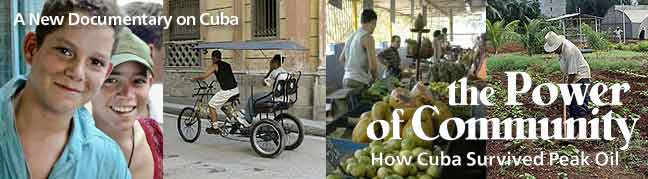
The Power of Community: How Cuba survived peak oil.
http://www.communitysolution.org/cuba.html

|
The documentary, "The Power of Community – How Cuba Survived Peak Oil," was inspired when Faith Morgan and Pat Murphy took a trip to Cuba through Global Exchange in August, 2003. That year Pat had begun studying and speaking about worldwide peak oil production. In May Pat and Faith attended the second meeting of The Association for the Study of Peak Oil and Gas, a European group of oil geologists and scientists, which predicted that mankind was perilously close to having used up half of the world's oil resources. When they learned that Cuba underwent the loss of over half of its oil imports and survived, after the fall of the Soviet Union in 1990, the couple wanted to see for themselves how Cuba had done this. During their first trip to Cuba, in |